All information provided in this deck is subject to change without notice.
Contact your Intel representative to obtain the latest Intel product specifications and roadmaps.
One Intel Software & Architecture group
Intel Architecture, Graphics & Software
November 2020
Cross-Architecture Programming for Accelerated Compute, Freedom of Choice for Hardware
oneAPI:
Industry Initiative & Intel Products
2
Growth in specialized workloads
Variety of data-centric hardware required
Separate programming models and toolchains for each
architecture are required today
Software development complexity limits freedom of
architectural choice
Programming Challenges
for Multiple Architectures
Scalar Vector Spatial Matrix
Middleware & Frameworks
XPUs
Application Workloads Need Diverse Hardware
CPU
programming
model
GPU
programming
model
FPGA
programming
model
Other accel.
programming
models
CPU GPU FPGA Other accel.
3
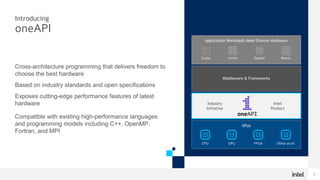
Cross-architecture programming that delivers freedom to
choose the best hardware
Based on industry standards and open specifications
Exposes cutting-edge performance features of latest
hardware
Compatible with existing high-performance languages
and programming models including C++, OpenMP,
Fortran, and MPI
Introducing
oneAPI
Industry
Initiative
Intel
Product
Scalar Vector Spatial Matrix
Middleware & Frameworks
XPUs
Application Workloads Need Diverse Hardware
CPU GPU FPGA Other accel.
4
Middleware & Frameworks
Application Workloads Need Diverse Hardware
oneAPI Industry Initiative
Break the Chains of Proprietary Lock-in
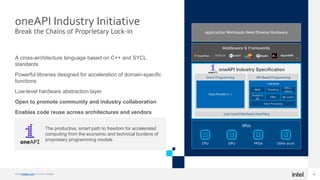
A cross-architecture language based on C++ and SYCL
standards
Powerful libraries designed for acceleration of domain-specific
functions
Low-level hardware abstraction layer
Open to promote community and industry collaboration
Enables code reuse across architectures and vendors
API-Based ProgrammingDirect Programming
Low-Level Hardware Interface
Math Threading
DPC++
Library
Analytics/
ML
DNN ML Comm
Video Processing
Libraries
Data Parallel C++
XPUs
oneAPI Industry Specification
The productive, smart path to freedom for accelerated
computing from the economic and technical burdens of
proprietary programming models
Visit oneapi.com for more details
CPU GPU FPGA Other accel.
..
.
5
Parallelism, productivity and performance for CPUs and
Accelerators
 Delivers accelerated computing by exposing hardware features
 Allows code reuse across hardware targets, while permitting custom tuning for
specific accelerators
 Provides an open, cross-industry solution to single architecture proprietary lock-in
Based on C++ and SYCL
 Delivers C++ productivity benefits, using common, familiar C and C++ constructs
 Incorporates SYCL from the Khronos Group to support data parallelism and
heterogeneous programming
Community Project to drive language enhancements
 Provides extensions to simplify data parallel programming
 Continues evolution through open and cooperative development
Data Parallel C++
Standards-based, Cross-architecture Language
DPC++ = ISO C++ and Khronos SYCL
Direct Programming:
Data Parallel C++
Community Extensions
Khronos SYCL
ISO C++
The open source and Intel DPC++/C++ compiler supports Intel CPUs, GPUs, and FPGAs.
Codeplay announced a DPC++ compiler that targets Nvidia GPUs.
Apply your skills to the next innovation, not rewriting
software for the next hardware platform
6
Powerful oneAPI Libraries
 Designed for acceleration of key domain-specific
functions
 Pre-optimized for each target platform for
maximum performance
oneAPI Deep Neural Network
Library
oneDNN
oneAPI Math Kernel Library
oneMKL
oneAPI Data Analytics Library
oneDAL
oneAPI Video Processing
Library
oneVPL
oneAPI Collective
Communications Library
oneCCL
oneAPI Threading Building
Blocks
oneTBB
oneAPI DPC++ Library
oneDPL
7
Q1 Q2 Q3 Q4
2020
7
oneAPI
Industry
Initiative
Industry
Initiative
Announced
oneAPI
1.0 Spec.
CodePlay oneAPI
Nvidia GPU Support
2019 2021
Univ. Heidelberg to
deliver oneAPI
AMD GPU support
Future
oneAPI
Industry
Adoption
oneAPI
0.6 Spec.
oneAPI
0.7 Spec.
oneAPI
0.8 Spec.
oneAPI
0.9 Spec.
oneAPI Industry Initiative Progress
8
oneAPI Ecosystem Support
These organizations support the oneAPI initiative ‘concept’ for a single, unified programming model for cross-architecture development. It does not indicate any
agreement to purchase or use of Intel’s products.
*Other names and brands may be claimed as the property of others.
Indian Institute of
Technology Delhi
UNIVERSITY OF
CAMBRIDGE
Medison
9
oneAPI Ecosystem Support
These organizations support the oneAPI initiative ‘concept’ for a single, unified programming model for cross-architecture development. It does not indicate any
agreement to purchase or use of Intel’s products.
*Other names and brands may be claimed as the property of others.
With the growth of AI, machine learning, and data-centric applications, the industry needs
a programming model that allows developers to take advantage of rapid innovation in
processor architectures. TensorFlow supports the oneAPI industry initiative and its
standards-based open specification.
oneAPI complements TensorFlow’s modular design and provides increased choice of
hardware vendor and processor architecture, and faster support of next-generation
accelerators. TensorFlow uses oneAPI today on Xeon processors and we look forward to
using oneAPI to run on future Intel architectures.
“…The goal of oneAPI is to provide increased choice of hardware vendors, processor
architectures, and faster support of next-generation accelerators.
Microsoft has been using oneAPI elements across Intel hardware offerings as part of its
initiatives and supports the open standards-based specification.
We are excited to support our customers with choice and accelerate the growth of AI
and machine learning.”
10
XPUs
Low-Level Hardware Interface
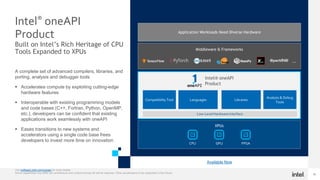
A complete set of advanced compilers, libraries, and
porting, analysis and debugger tools
 Accelerates compute by exploiting cutting-edge
hardware features
 Interoperable with existing programming models
and code bases (C++, Fortran, Python, OpenMP,
etc.), developers can be confident that existing
applications work seamlessly with oneAPI
 Eases transitions to new systems and
accelerators using a single code base frees
developers to invest more time on innovation
Intel® oneAPI
Product
Built on Intel’s Rich Heritage of CPU
Tools Expanded to XPUs
LibrariesLanguagesCompatibility Tool
Analysis & Debug
Tools
Intel® oneAPI
Product
CPU GPU FPGA
Visit software.intel.com/oneapi for more details
Some capabilities may differ per architecture and custom-tuning will still be required. Other accelerators to be supported in the future.
Middleware & Frameworks
Application Workloads Need Diverse Hardware
...
Available Now
11
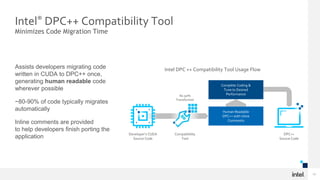
Intel® DPC++ Compatibility Tool
Minimizes Code Migration Time
Assists developers migrating code
written in CUDA to DPC++ once,
generating human readable code
wherever possible
~80-90% of code typically migrates
automatically
Inline comments are provided
to help developers finish porting the
application
11
Intel DPC ++ Compatibility Tool Usage Flow
80-90%
Transformed
Complete Coding &
Tune to Desired
Performance
Developer’s CUDA
Source Code
Compatibility
Tool
DPC++
Source Code
Human Readable
DPC++ with inline
Comments
12
Design Debug Tune
 Efficiently offload code to GPUs
 Optimize your CPU/GPU code for
memory and compute
 Enable more vector parallelism and
improve efficiency
 Add effective threading to unthreaded
applications
 Multiple accelerator support with
CPU, GPU, FPGA emulation
 Enables deep, system-wide debug of
Data Parallel C++ (DPC++), C, C++,
and Fortran code
 Analyze DPC++
 Tune for GPU, CPU, and FPGA
 Optimize offload performance
 Supports DPC++, C, C++, Fortran,
Python, Go, Java or a mix of
languages
Intel® Advisor Intel® Distribution for GDB Intel® VTune™ Profiler
Use advanced tools to efficiently debug & profile code
across all levels of abstraction.
Analysis & Debug Tools
Get More from Diverse Hardware
13
Toolkit
Intel® oneAPI Toolkits
A complete set of proven developer tools expanded from CPU to XPU
A core set of high-performance tools
for building C++, Data Parallel C++
applications & oneAPI library-based
applications
Intel® oneAPI
Rendering
Toolkit
Create performant,
high-fidelity visualization
applications
Intel® oneAPI
Tools for HPC
Deliver fast Fortran,
OpenMP & MPI
applications that
scale
Intel® oneAPI
Tools for IoT
Build efficient, reliable
solutions that run at
network’s edge
Intel® AI Analytics
Toolkit
Accelerate machine learning & data
science pipelines with optimized DL
frameworks & high-performing Python
libraries
Intel® Distribution of
OpenVINO™ Toolkit
Deploy high performance
inference & applications from
edge to cloud
Native Code Developers
Data Scientists &AI Developers
Specialized Workloads
14
Run the tools locally Run the tools in the Cloud
Intel® oneAPI Toolkits
Free Availability
Get Started Quickly
Code Samples, Quick-start Guides,Webinars,Training
software.intel.com/oneapi
Downloads
Repositories
Containers
DevCloud
15
+ +
Intel®
Parallel
Studio
XE
Intel®
System
Studio
+
Commercial oneAPI Toolkits Available
Next Generation of Commercial
Intel® Software Development
Products
 Worldwide support from Intel technical
consulting engineers
 Prior commercial tool suites,
Intel® Parallel Studio XE and Intel®
System Studio, transition to oneAPI
products
16
10
Visualization of EasyWave tsunami simulation application
Courtesy Zuse Institute Berlin (ZIB)
ZIB ported EasyWave application from CUDA to
DPC++ delivering performance across multi-
architectures
 Ported EasyWave written in CUDA to Data Parallel C++
efficiently using the Intel® DPC++ Compatibility Tool
 Achieved strong performance across Intel CPU, GPU
and FPGA architectures, and within 5% of CUDA
performance on Nvidia P100
oneAPI
oneAPI Development Example
Intel does not control or audit third-party data. You should consult other sources to evaluate accuracy.
17
oneAPI Available on
Intel® DevCloud
A development sandbox to develop, test
and run workloads across a range of
Intel CPUs, GPUs, and FPGAs using
Intel’s oneAPI software.
Get Up & Running In Seconds!
software.intel.com/devcloud/oneapi
1 Minute to Code
No Hardware Acquisition
No Download, Install or Configuration
Easy Access to Samples & Tutorials
Support for Jupyter Notebooks, Visual Studio Code
DevCloud
18
Ecosystem Adoption & Support
Training Academia Community
Intel® DevCloud
Training by leading technical training
companies worldwide
Summits & Workshops
Live & on-demand virtual workshops,
community-led sessions
State-of-the-art software and hardware
Intel® oneAPI Toolkits + latest Intel® Xeon®processors,
GPUs (integrated & discrete), FPGAs
Online webinars & courses,
developer guides, sample code
oneAPI Centers of Excellence: research,
enabling code, curriculum, teaching
oneAPI open specification, DevMesh
innovators, community support forums
Industry Experts
19
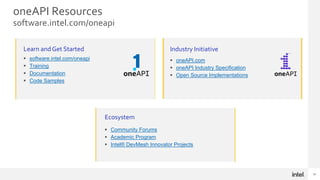
oneAPI Resources
software.intel.com/oneapi
Learn and Get Started
 software.intel.com/oneapi
 Training
 Documentation
 Code Samples
Industry Initiative
 oneAPI.com
 oneAPI Industry Specification
 Open Source Implementations
Ecosystem
 Community Forums
 Academic Program
 Intel® DevMesh Innovator Projects
2020
 Diverse workloads are driving the need for
heterogeneous compute architectures, but each
architecture has required separate programming
models.
 oneAPI cross-architecure programming model
provides freedom of choice. Apply your skills to the
next innovation, not to rewriting software for the next
hardware platform.
 Intel® oneAPI products take full advantage of
accelerated compute by maximizing performance
across Intel CPUs, GPUs, and FPGAs.
 Make development fast and efficient with a complete
set of cross-architecture libraries and advanced tools
that interoperate with existing performance
programming models.
Summary
21
Notices & Disclaimers
This document contains information on products, services and/or processes in development. All information provided here is subject to change without notice. Contact your Intel representative to
obtain the latest forecast, schedule, specifications and roadmaps.
The products and services described may contain defects or errors known as errata which may cause deviations from published specifications. Current characterized errata are available on request.
No product or component can be absolutely secure. Intel technologies’ features and benefits depend on system configuration and may require enabled hardware, software or service activation.
Learn more at intel.com, or from the OEM or retailer.
Software and workloads used in performance tests may have been optimized for performance only on Intel microprocessors. Performance tests, such as SYSmark and MobileMark, are measured
using specific computer systems, components, software, operations and functions. Any change to any of those factors may cause the results to vary. You should consult other information and
performance tests to assist you in fully evaluating your contemplated purchases, including the performance of that product when combined with other products. For more complete information visit
www.intel.com/benchmarks.
INFORMATION IN THIS DOCUMENT IS PROVIDED “AS IS”. NO LICENSE, EXPRESS OR IMPLIED, BY ESTOPPEL OR OTHERWISE, TO ANY INTELLECTUAL PROPERTY RIGHTS IS
GRANTED BY THIS DOCUMENT. INTEL ASSUMES NO LIABILITY WHATSOEVER AND INTEL DISCLAIMS ANY EXPRESS OR IMPLIED WARRANTY, RELATING TO THIS INFORMATION
INCLUDING LIABILITY OR WARRANTIES RELATING TO FITNESS FOR A PARTICULAR PURPOSE, MERCHANTABILITY, OR INFRINGEMENT OF ANY PATENT, COPYRIGHT OR OTHER
INTELLECTUAL PROPERTY RIGHT.
Copyright ©, Intel Corporation. All rights reserved. Intel, the Intel logo, Xeon, Core, VTune, and OpenVINO are trademarks of Intel Corporation or its subsidiaries in the U.S. and other countries.
Optimization Notices
Intel’s compilers may or may not optimize to the same degree for non-Intel microprocessors for optimizations that are not unique to Intel microprocessors. These optimizations include SSE2, SSE3,
and SSSE3 instruction sets and other optimizations. Intel does not guarantee the availability, functionality, or effectiveness of any optimization on microprocessors not manufactured by Intel.
Microprocessor-dependent optimizations in this product are intended for use with Intel microprocessors. Certain optimizations not specific to Intel microarchitecture are reserved for Intel
microprocessors. Please refer to the applicable product User and Reference Guides for more information regarding the specific instruction sets covered by this notice.
Notice revision #20110804
Refer to software.intel.com/articles/optimization-notice for more information regarding performance & optimization choices in Intel software products.
Copyright ©, Intel Corporation. All rights reserved.
*Other names and brands may be claimed as the property of others.
Back to Domain-specific Toolkits for Specialized Workloads
22

oneAPI: Industry Initiative & Intel Product

  • 1.
    All information providedin this deck is subject to change without notice. Contact your Intel representative to obtain the latest Intel product specifications and roadmaps. One Intel Software & Architecture group Intel Architecture, Graphics & Software November 2020 Cross-Architecture Programming for Accelerated Compute, Freedom of Choice for Hardware oneAPI: Industry Initiative & Intel Products
  • 2.
    2 Growth in specializedworkloads Variety of data-centric hardware required Separate programming models and toolchains for each architecture are required today Software development complexity limits freedom of architectural choice Programming Challenges for Multiple Architectures Scalar Vector Spatial Matrix Middleware & Frameworks XPUs Application Workloads Need Diverse Hardware CPU programming model GPU programming model FPGA programming model Other accel. programming models CPU GPU FPGA Other accel.
  • 3.
    3 Cross-architecture programming thatdelivers freedom to choose the best hardware Based on industry standards and open specifications Exposes cutting-edge performance features of latest hardware Compatible with existing high-performance languages and programming models including C++, OpenMP, Fortran, and MPI Introducing oneAPI Industry Initiative Intel Product Scalar Vector Spatial Matrix Middleware & Frameworks XPUs Application Workloads Need Diverse Hardware CPU GPU FPGA Other accel.
  • 4.
    4 Middleware & Frameworks ApplicationWorkloads Need Diverse Hardware oneAPI Industry Initiative Break the Chains of Proprietary Lock-in A cross-architecture language based on C++ and SYCL standards Powerful libraries designed for acceleration of domain-specific functions Low-level hardware abstraction layer Open to promote community and industry collaboration Enables code reuse across architectures and vendors API-Based ProgrammingDirect Programming Low-Level Hardware Interface Math Threading DPC++ Library Analytics/ ML DNN ML Comm Video Processing Libraries Data Parallel C++ XPUs oneAPI Industry Specification The productive, smart path to freedom for accelerated computing from the economic and technical burdens of proprietary programming models Visit oneapi.com for more details CPU GPU FPGA Other accel. .. .
  • 5.
    5 Parallelism, productivity andperformance for CPUs and Accelerators  Delivers accelerated computing by exposing hardware features  Allows code reuse across hardware targets, while permitting custom tuning for specific accelerators  Provides an open, cross-industry solution to single architecture proprietary lock-in Based on C++ and SYCL  Delivers C++ productivity benefits, using common, familiar C and C++ constructs  Incorporates SYCL from the Khronos Group to support data parallelism and heterogeneous programming Community Project to drive language enhancements  Provides extensions to simplify data parallel programming  Continues evolution through open and cooperative development Data Parallel C++ Standards-based, Cross-architecture Language DPC++ = ISO C++ and Khronos SYCL Direct Programming: Data Parallel C++ Community Extensions Khronos SYCL ISO C++ The open source and Intel DPC++/C++ compiler supports Intel CPUs, GPUs, and FPGAs. Codeplay announced a DPC++ compiler that targets Nvidia GPUs. Apply your skills to the next innovation, not rewriting software for the next hardware platform
  • 6.
    6 Powerful oneAPI Libraries Designed for acceleration of key domain-specific functions  Pre-optimized for each target platform for maximum performance oneAPI Deep Neural Network Library oneDNN oneAPI Math Kernel Library oneMKL oneAPI Data Analytics Library oneDAL oneAPI Video Processing Library oneVPL oneAPI Collective Communications Library oneCCL oneAPI Threading Building Blocks oneTBB oneAPI DPC++ Library oneDPL
  • 7.
    7 Q1 Q2 Q3Q4 2020 7 oneAPI Industry Initiative Industry Initiative Announced oneAPI 1.0 Spec. CodePlay oneAPI Nvidia GPU Support 2019 2021 Univ. Heidelberg to deliver oneAPI AMD GPU support Future oneAPI Industry Adoption oneAPI 0.6 Spec. oneAPI 0.7 Spec. oneAPI 0.8 Spec. oneAPI 0.9 Spec. oneAPI Industry Initiative Progress
  • 8.
    8 oneAPI Ecosystem Support Theseorganizations support the oneAPI initiative ‘concept’ for a single, unified programming model for cross-architecture development. It does not indicate any agreement to purchase or use of Intel’s products. *Other names and brands may be claimed as the property of others. Indian Institute of Technology Delhi UNIVERSITY OF CAMBRIDGE Medison
  • 9.
    9 oneAPI Ecosystem Support Theseorganizations support the oneAPI initiative ‘concept’ for a single, unified programming model for cross-architecture development. It does not indicate any agreement to purchase or use of Intel’s products. *Other names and brands may be claimed as the property of others. With the growth of AI, machine learning, and data-centric applications, the industry needs a programming model that allows developers to take advantage of rapid innovation in processor architectures. TensorFlow supports the oneAPI industry initiative and its standards-based open specification. oneAPI complements TensorFlow’s modular design and provides increased choice of hardware vendor and processor architecture, and faster support of next-generation accelerators. TensorFlow uses oneAPI today on Xeon processors and we look forward to using oneAPI to run on future Intel architectures. “…The goal of oneAPI is to provide increased choice of hardware vendors, processor architectures, and faster support of next-generation accelerators. Microsoft has been using oneAPI elements across Intel hardware offerings as part of its initiatives and supports the open standards-based specification. We are excited to support our customers with choice and accelerate the growth of AI and machine learning.”
  • 10.
    10 XPUs Low-Level Hardware Interface Acomplete set of advanced compilers, libraries, and porting, analysis and debugger tools  Accelerates compute by exploiting cutting-edge hardware features  Interoperable with existing programming models and code bases (C++, Fortran, Python, OpenMP, etc.), developers can be confident that existing applications work seamlessly with oneAPI  Eases transitions to new systems and accelerators using a single code base frees developers to invest more time on innovation Intel® oneAPI Product Built on Intel’s Rich Heritage of CPU Tools Expanded to XPUs LibrariesLanguagesCompatibility Tool Analysis & Debug Tools Intel® oneAPI Product CPU GPU FPGA Visit software.intel.com/oneapi for more details Some capabilities may differ per architecture and custom-tuning will still be required. Other accelerators to be supported in the future. Middleware & Frameworks Application Workloads Need Diverse Hardware ... Available Now
  • 11.
    11 Intel® DPC++ CompatibilityTool Minimizes Code Migration Time Assists developers migrating code written in CUDA to DPC++ once, generating human readable code wherever possible ~80-90% of code typically migrates automatically Inline comments are provided to help developers finish porting the application 11 Intel DPC ++ Compatibility Tool Usage Flow 80-90% Transformed Complete Coding & Tune to Desired Performance Developer’s CUDA Source Code Compatibility Tool DPC++ Source Code Human Readable DPC++ with inline Comments
  • 12.
    12 Design Debug Tune Efficiently offload code to GPUs  Optimize your CPU/GPU code for memory and compute  Enable more vector parallelism and improve efficiency  Add effective threading to unthreaded applications  Multiple accelerator support with CPU, GPU, FPGA emulation  Enables deep, system-wide debug of Data Parallel C++ (DPC++), C, C++, and Fortran code  Analyze DPC++  Tune for GPU, CPU, and FPGA  Optimize offload performance  Supports DPC++, C, C++, Fortran, Python, Go, Java or a mix of languages Intel® Advisor Intel® Distribution for GDB Intel® VTune™ Profiler Use advanced tools to efficiently debug & profile code across all levels of abstraction. Analysis & Debug Tools Get More from Diverse Hardware
  • 13.
    13 Toolkit Intel® oneAPI Toolkits Acomplete set of proven developer tools expanded from CPU to XPU A core set of high-performance tools for building C++, Data Parallel C++ applications & oneAPI library-based applications Intel® oneAPI Rendering Toolkit Create performant, high-fidelity visualization applications Intel® oneAPI Tools for HPC Deliver fast Fortran, OpenMP & MPI applications that scale Intel® oneAPI Tools for IoT Build efficient, reliable solutions that run at network’s edge Intel® AI Analytics Toolkit Accelerate machine learning & data science pipelines with optimized DL frameworks & high-performing Python libraries Intel® Distribution of OpenVINO™ Toolkit Deploy high performance inference & applications from edge to cloud Native Code Developers Data Scientists &AI Developers Specialized Workloads
  • 14.
    14 Run the toolslocally Run the tools in the Cloud Intel® oneAPI Toolkits Free Availability Get Started Quickly Code Samples, Quick-start Guides,Webinars,Training software.intel.com/oneapi Downloads Repositories Containers DevCloud
  • 15.
    15 + + Intel® Parallel Studio XE Intel® System Studio + Commercial oneAPIToolkits Available Next Generation of Commercial Intel® Software Development Products  Worldwide support from Intel technical consulting engineers  Prior commercial tool suites, Intel® Parallel Studio XE and Intel® System Studio, transition to oneAPI products
  • 16.
    16 10 Visualization of EasyWavetsunami simulation application Courtesy Zuse Institute Berlin (ZIB) ZIB ported EasyWave application from CUDA to DPC++ delivering performance across multi- architectures  Ported EasyWave written in CUDA to Data Parallel C++ efficiently using the Intel® DPC++ Compatibility Tool  Achieved strong performance across Intel CPU, GPU and FPGA architectures, and within 5% of CUDA performance on Nvidia P100 oneAPI oneAPI Development Example Intel does not control or audit third-party data. You should consult other sources to evaluate accuracy.
  • 17.
    17 oneAPI Available on Intel®DevCloud A development sandbox to develop, test and run workloads across a range of Intel CPUs, GPUs, and FPGAs using Intel’s oneAPI software. Get Up & Running In Seconds! software.intel.com/devcloud/oneapi 1 Minute to Code No Hardware Acquisition No Download, Install or Configuration Easy Access to Samples & Tutorials Support for Jupyter Notebooks, Visual Studio Code DevCloud
  • 18.
    18 Ecosystem Adoption &Support Training Academia Community Intel® DevCloud Training by leading technical training companies worldwide Summits & Workshops Live & on-demand virtual workshops, community-led sessions State-of-the-art software and hardware Intel® oneAPI Toolkits + latest Intel® Xeon®processors, GPUs (integrated & discrete), FPGAs Online webinars & courses, developer guides, sample code oneAPI Centers of Excellence: research, enabling code, curriculum, teaching oneAPI open specification, DevMesh innovators, community support forums Industry Experts
  • 19.
    19 oneAPI Resources software.intel.com/oneapi Learn andGet Started  software.intel.com/oneapi  Training  Documentation  Code Samples Industry Initiative  oneAPI.com  oneAPI Industry Specification  Open Source Implementations Ecosystem  Community Forums  Academic Program  Intel® DevMesh Innovator Projects
  • 20.
    2020  Diverse workloadsare driving the need for heterogeneous compute architectures, but each architecture has required separate programming models.  oneAPI cross-architecure programming model provides freedom of choice. Apply your skills to the next innovation, not to rewriting software for the next hardware platform.  Intel® oneAPI products take full advantage of accelerated compute by maximizing performance across Intel CPUs, GPUs, and FPGAs.  Make development fast and efficient with a complete set of cross-architecture libraries and advanced tools that interoperate with existing performance programming models. Summary
  • 21.
    21 Notices & Disclaimers Thisdocument contains information on products, services and/or processes in development. All information provided here is subject to change without notice. Contact your Intel representative to obtain the latest forecast, schedule, specifications and roadmaps. The products and services described may contain defects or errors known as errata which may cause deviations from published specifications. Current characterized errata are available on request. No product or component can be absolutely secure. Intel technologies’ features and benefits depend on system configuration and may require enabled hardware, software or service activation. Learn more at intel.com, or from the OEM or retailer. Software and workloads used in performance tests may have been optimized for performance only on Intel microprocessors. Performance tests, such as SYSmark and MobileMark, are measured using specific computer systems, components, software, operations and functions. Any change to any of those factors may cause the results to vary. You should consult other information and performance tests to assist you in fully evaluating your contemplated purchases, including the performance of that product when combined with other products. For more complete information visit www.intel.com/benchmarks. INFORMATION IN THIS DOCUMENT IS PROVIDED “AS IS”. NO LICENSE, EXPRESS OR IMPLIED, BY ESTOPPEL OR OTHERWISE, TO ANY INTELLECTUAL PROPERTY RIGHTS IS GRANTED BY THIS DOCUMENT. INTEL ASSUMES NO LIABILITY WHATSOEVER AND INTEL DISCLAIMS ANY EXPRESS OR IMPLIED WARRANTY, RELATING TO THIS INFORMATION INCLUDING LIABILITY OR WARRANTIES RELATING TO FITNESS FOR A PARTICULAR PURPOSE, MERCHANTABILITY, OR INFRINGEMENT OF ANY PATENT, COPYRIGHT OR OTHER INTELLECTUAL PROPERTY RIGHT. Copyright ©, Intel Corporation. All rights reserved. Intel, the Intel logo, Xeon, Core, VTune, and OpenVINO are trademarks of Intel Corporation or its subsidiaries in the U.S. and other countries. Optimization Notices Intel’s compilers may or may not optimize to the same degree for non-Intel microprocessors for optimizations that are not unique to Intel microprocessors. These optimizations include SSE2, SSE3, and SSSE3 instruction sets and other optimizations. Intel does not guarantee the availability, functionality, or effectiveness of any optimization on microprocessors not manufactured by Intel. Microprocessor-dependent optimizations in this product are intended for use with Intel microprocessors. Certain optimizations not specific to Intel microarchitecture are reserved for Intel microprocessors. Please refer to the applicable product User and Reference Guides for more information regarding the specific instruction sets covered by this notice. Notice revision #20110804 Refer to software.intel.com/articles/optimization-notice for more information regarding performance & optimization choices in Intel software products. Copyright ©, Intel Corporation. All rights reserved. *Other names and brands may be claimed as the property of others. Back to Domain-specific Toolkits for Specialized Workloads
  • 22.