BENZODIAZEPINES
 The term benzodiazepine is the chemical
name for the heterocyclic ring system, which is
a fusion between the
benzene and diazepine ring
systems. Under Hantzsch–Widman
nomenclature, a diazepine is a heterocycle with
two nitrogen atoms, five carbon atom and the
maximum possible number of
cumulative double bonds. The "benzo" prefix
indicates the benzene ring fused onto the
diazepine ring.
1
Left: The 1,4-benzodiazepine ring system. Right: 5-phenyl-1H-
benzo[e][1,4]diazepin-2(3H)-one forms the skeleton of many of the most
common benzodiazepine pharmaceuticals, such as diazepam (7-chloro-1-
methyl substituted)
CONTD….
2
HISTORY….
 The first benzodiazepine, chlordiazepoxide
(Librium), was synthesized in 1955 by Leo
Sternbach.
 Following chlordiazepoxide, diazepam was
synthesized in 1959 and marketed by Hoffmann–La
Roche under the brand name Valium in 1963, and
for a while the two were the most commercially
successful drugs.
 The introduction of benzodiazepines led to a
decrease in the prescription of barbiturates, and by
the 1970s they had largely replaced the older drugs
for sedative and hypnotic uses.
3
CONTD……
 In 2010, formerly classified documents from a Medical
Research Council (UK) meeting of experts emerged and
revealed that benzodiazepines could cause brain
damage in some people similar to that which occurs from
alcohol abuse and failed to follow-up with larger clinical
trials.
The molecular structure of chlordiazepoxide,
the first benzodiazepine. It was marketed
by Hoffmann–La Roche from 1960 branded
as Librium.
4
ADVANTAGES OF BENZODIAZEPINES OVER
BARBITURATES…..
 BZDs have high therapeutic index. Ingestion of
even 20 hypnotic doses does not usually endanger
life.
 Hypnotic does not affect respiration or
cardiovascular functions. Higher doses produce
mild respiration & hypotension which is problematic
only in patients with respiratory insufficiency &
cardiac abnormality.
 BZDs have practically no action on other body
system 5
CONTD……
BZDs cause little distortion of sleep
architecture.
BZDs do not alter disposition of other drug by
microsomal enzyme induction.
They have lower abuse liability: tolerance is
mild, psychological & physical dependence &
withdrawal syndrome are less marked.
A specific BZDs antagonist flumazenil is
available which can be used in case of
poisoning.
6
MOA OF BENZODIAZEPINES
 Benzodiazepines work by increasing the efficiency of a
natural brain chemical, GABA, to decrease the excitability
of neurons. This reduces the communication between
neurons and, therefore, has a calming effect on many of the
functions of the brain.
 GABA controls the excitability of neurons by binding to
the GABAA receptor. The GABAA receptor is a protein
complex located in the synapses of neurons. All
GABAA receptors contain an ion channel that
conducts chloride ions across neuronal cell
membranes and two binding sites for
the neurotransmitter gamma-aminobutyric acid (GABA),
while a subset of GABAA receptor complexes also contain a
single binding site for benzodiazepines.
7
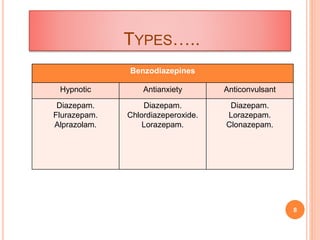
TYPES…..
Benzodiazepines
Hypnotic Antianxiety Anticonvulsant
Diazepam.
Flurazepam.
Alprazolam.
Diazepam.
Chlordiazeperoxide.
Lorazepam.
Diazepam.
Lorazepam.
Clonazepam.
8
 Clonazepam is a benzodiazepine derivative
having anticonvulsant, muscle relaxant, and very
potent anxiolytic properties.
 Clonazepam is classified as a high potency
benzodiazepine and is sometimes used as a
second line treatment of epilepsy. Clonazepam,
like other benzodiazepines, while being first line
treatments for acute seizures, are not first line for
the long-term treatment of seizures due to the
development of tolerance to the anticonvulsant
effects.
9
FEW WORDS ABOUT
CLONAZIPAM…
 Clonazepam is a chlorinated derivative of nitrazepam and
therefore a chloro-nitrobenzodiazepine.
10
CONTD……
5-(2-chlorophenyl)-7-nitro-2,3-dihydro-
1,4-benzodiazepin-2-one
Pharmacokinetic data
Bioavailability 90%
Protein binding ~85%
Metabolism Hepatic CYP3A4
Half-life 18-50 hours
Excretion Renal
PARENT STRUCTURE…..
N
R7
C N
C
C
R2
R3
R2'
A B
C
1 2
3
4
5
6
7
8
9
2'
3'
4'
5'
6'
R1
11
 Seven membered imino ring B was essential
for its affinity towards the BZ-binding site.
SAR STUDY….
N
R7
C N
C
C
R2
R3
R2'
A B
C
1 2
3
4
5
6
7
8
9
2'
3'
4'
5'
6'
R1
12
 Additionally, the carbonyl group at position 2,
and the 4,5 double bond within the ligand have
also been shown to substantially contribute to
the binding affinity of the compound.
N
R7
C N
C
C
R2
R3
R2'
A B
C
1 2
3
4
5
6
7
8
9
2'
3'
4'
5'
6'
R1
Required for activity
CONTD……
13
 Shift of double bond to the 3,4 position
decreases activity.
CONTD……
N
R7
C N
C
C
R2
R3
R2'
A B
C
1 2
3
4
5
6
7
8
9
2'
3'
4'
5'
6'
R1
14
 An electronegative Substituent at position 7 is
required for is required for activity, more the
electronegativety higher will be the activity.
N
R7
C N
C
C
R2
R3
R2'
A B
C
1 2
3
4
5
6
7
8
9
2'
3'
4'
5'
6'
R1
CONTD……
15
CONTD….
 Positions at 6,7 & 9 should not be substituted.
N
R7
C N
C
C
R2
R3
R2'
A B
C
1 2
3
4
5
6
7
8
9
2'
3'
4'
5'
6'
R1
16
 A phenyl at position 5 promotes activity. If this
phenyl group is ortho or diortho (2’ , 6’)
substituted with electron attracting substituents,
activity increase.
CONTD….
N
R7
C N
C
C
R2
R3
R2'
A B
C
1 2
3
4
5
6
7
8
9
2'
3'
4'
5'
6'
R1
17
 But para substitution decreases activity greatly.
 Alkyl substitution at position 3 decreases activity
except hydroxy group.
CONTD….
N
R7
C N
C
C
R2
R3
R2'
A B
C
1 2
3
4
5
6
7
8
9
2'
3'
4'
5'
6'
R1
18
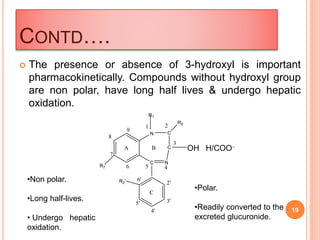
 The presence or absence of 3-hydroxyl is important
pharmacokinetically. Compounds without hydroxyl group
are non polar, have long half lives & undergo hepatic
oxidation.
CONTD….
N
R7
C N
C
C
R2
R2'
A B
C
1 2
3
4
5
6
7
8
9
2'
3'
4'
5'
6'
R1
OH H/COO–
•Polar.
•Readily converted to the
excreted glucuronide.
•Non polar.
•Long half-lives.
• Undergo hepatic
oxidation.
19
 The 2-carbonyl function is optimal for activity.
CONTD….
N
R7
C N
C
C R3
R2'
A B
C
1 2
3
4
5
6
7
8
9
2'
3'
4'
5'
6'
O
R1
20
 R1 substitution should be small.
CONTD….
N
R7
C N
C
C
R2
R3
R2'
A B
C
1 2
3
4
5
6
7
8
9
2'
3'
4'
5'
6'
R1
21
Chemical synthesis of Librium
Chemical synthesis of diazepam
Benzodiazepine
a. diazepam b.flutoprazepam c. nitrazepam
d. clonazepam
R1 R2 R3 R4
a CH3 H H Cl
b CH3 H F Cl
c H H H NO2
d H H Cl NO2
MODIFICATION: (TRIAZOLE OR IMIDAZOLE) ESTAZOLAM,
ALPRAZOLAM, TRIZOLAM AND MIDAZOLAM
N
N
(Z)
Cl
R2
N
N
R1
N
N
(E)
Cl
F
N
H3C
R1 R2
estazolam H H
alprazolam CH3 H
trizolam CH3 Cl
Midazolam CH3 F

BZD.pptx

  • 1.
    BENZODIAZEPINES  The termbenzodiazepine is the chemical name for the heterocyclic ring system, which is a fusion between the benzene and diazepine ring systems. Under Hantzsch–Widman nomenclature, a diazepine is a heterocycle with two nitrogen atoms, five carbon atom and the maximum possible number of cumulative double bonds. The "benzo" prefix indicates the benzene ring fused onto the diazepine ring. 1
  • 2.
    Left: The 1,4-benzodiazepinering system. Right: 5-phenyl-1H- benzo[e][1,4]diazepin-2(3H)-one forms the skeleton of many of the most common benzodiazepine pharmaceuticals, such as diazepam (7-chloro-1- methyl substituted) CONTD…. 2
  • 3.
    HISTORY….  The firstbenzodiazepine, chlordiazepoxide (Librium), was synthesized in 1955 by Leo Sternbach.  Following chlordiazepoxide, diazepam was synthesized in 1959 and marketed by Hoffmann–La Roche under the brand name Valium in 1963, and for a while the two were the most commercially successful drugs.  The introduction of benzodiazepines led to a decrease in the prescription of barbiturates, and by the 1970s they had largely replaced the older drugs for sedative and hypnotic uses. 3
  • 4.
    CONTD……  In 2010,formerly classified documents from a Medical Research Council (UK) meeting of experts emerged and revealed that benzodiazepines could cause brain damage in some people similar to that which occurs from alcohol abuse and failed to follow-up with larger clinical trials. The molecular structure of chlordiazepoxide, the first benzodiazepine. It was marketed by Hoffmann–La Roche from 1960 branded as Librium. 4
  • 5.
    ADVANTAGES OF BENZODIAZEPINESOVER BARBITURATES…..  BZDs have high therapeutic index. Ingestion of even 20 hypnotic doses does not usually endanger life.  Hypnotic does not affect respiration or cardiovascular functions. Higher doses produce mild respiration & hypotension which is problematic only in patients with respiratory insufficiency & cardiac abnormality.  BZDs have practically no action on other body system 5
  • 6.
    CONTD…… BZDs cause littledistortion of sleep architecture. BZDs do not alter disposition of other drug by microsomal enzyme induction. They have lower abuse liability: tolerance is mild, psychological & physical dependence & withdrawal syndrome are less marked. A specific BZDs antagonist flumazenil is available which can be used in case of poisoning. 6
  • 7.
    MOA OF BENZODIAZEPINES Benzodiazepines work by increasing the efficiency of a natural brain chemical, GABA, to decrease the excitability of neurons. This reduces the communication between neurons and, therefore, has a calming effect on many of the functions of the brain.  GABA controls the excitability of neurons by binding to the GABAA receptor. The GABAA receptor is a protein complex located in the synapses of neurons. All GABAA receptors contain an ion channel that conducts chloride ions across neuronal cell membranes and two binding sites for the neurotransmitter gamma-aminobutyric acid (GABA), while a subset of GABAA receptor complexes also contain a single binding site for benzodiazepines. 7
  • 8.
  • 9.
     Clonazepam isa benzodiazepine derivative having anticonvulsant, muscle relaxant, and very potent anxiolytic properties.  Clonazepam is classified as a high potency benzodiazepine and is sometimes used as a second line treatment of epilepsy. Clonazepam, like other benzodiazepines, while being first line treatments for acute seizures, are not first line for the long-term treatment of seizures due to the development of tolerance to the anticonvulsant effects. 9 FEW WORDS ABOUT CLONAZIPAM…
  • 10.
     Clonazepam isa chlorinated derivative of nitrazepam and therefore a chloro-nitrobenzodiazepine. 10 CONTD…… 5-(2-chlorophenyl)-7-nitro-2,3-dihydro- 1,4-benzodiazepin-2-one Pharmacokinetic data Bioavailability 90% Protein binding ~85% Metabolism Hepatic CYP3A4 Half-life 18-50 hours Excretion Renal
  • 11.
    PARENT STRUCTURE….. N R7 C N C C R2 R3 R2' AB C 1 2 3 4 5 6 7 8 9 2' 3' 4' 5' 6' R1 11
  • 12.
     Seven memberedimino ring B was essential for its affinity towards the BZ-binding site. SAR STUDY…. N R7 C N C C R2 R3 R2' A B C 1 2 3 4 5 6 7 8 9 2' 3' 4' 5' 6' R1 12
  • 13.
     Additionally, thecarbonyl group at position 2, and the 4,5 double bond within the ligand have also been shown to substantially contribute to the binding affinity of the compound. N R7 C N C C R2 R3 R2' A B C 1 2 3 4 5 6 7 8 9 2' 3' 4' 5' 6' R1 Required for activity CONTD…… 13
  • 14.
     Shift ofdouble bond to the 3,4 position decreases activity. CONTD…… N R7 C N C C R2 R3 R2' A B C 1 2 3 4 5 6 7 8 9 2' 3' 4' 5' 6' R1 14
  • 15.
     An electronegativeSubstituent at position 7 is required for is required for activity, more the electronegativety higher will be the activity. N R7 C N C C R2 R3 R2' A B C 1 2 3 4 5 6 7 8 9 2' 3' 4' 5' 6' R1 CONTD…… 15
  • 16.
    CONTD….  Positions at6,7 & 9 should not be substituted. N R7 C N C C R2 R3 R2' A B C 1 2 3 4 5 6 7 8 9 2' 3' 4' 5' 6' R1 16
  • 17.
     A phenylat position 5 promotes activity. If this phenyl group is ortho or diortho (2’ , 6’) substituted with electron attracting substituents, activity increase. CONTD…. N R7 C N C C R2 R3 R2' A B C 1 2 3 4 5 6 7 8 9 2' 3' 4' 5' 6' R1 17
  • 18.
     But parasubstitution decreases activity greatly.  Alkyl substitution at position 3 decreases activity except hydroxy group. CONTD…. N R7 C N C C R2 R3 R2' A B C 1 2 3 4 5 6 7 8 9 2' 3' 4' 5' 6' R1 18
  • 19.
     The presenceor absence of 3-hydroxyl is important pharmacokinetically. Compounds without hydroxyl group are non polar, have long half lives & undergo hepatic oxidation. CONTD…. N R7 C N C C R2 R2' A B C 1 2 3 4 5 6 7 8 9 2' 3' 4' 5' 6' R1 OH H/COO– •Polar. •Readily converted to the excreted glucuronide. •Non polar. •Long half-lives. • Undergo hepatic oxidation. 19
  • 20.
     The 2-carbonylfunction is optimal for activity. CONTD…. N R7 C N C C R3 R2' A B C 1 2 3 4 5 6 7 8 9 2' 3' 4' 5' 6' O R1 20
  • 21.
     R1 substitutionshould be small. CONTD…. N R7 C N C C R2 R3 R2' A B C 1 2 3 4 5 6 7 8 9 2' 3' 4' 5' 6' R1 21
  • 22.
  • 23.
  • 24.
    Benzodiazepine a. diazepam b.flutoprazepamc. nitrazepam d. clonazepam R1 R2 R3 R4 a CH3 H H Cl b CH3 H F Cl c H H H NO2 d H H Cl NO2
  • 25.
    MODIFICATION: (TRIAZOLE ORIMIDAZOLE) ESTAZOLAM, ALPRAZOLAM, TRIZOLAM AND MIDAZOLAM N N (Z) Cl R2 N N R1 N N (E) Cl F N H3C R1 R2 estazolam H H alprazolam CH3 H trizolam CH3 Cl Midazolam CH3 F