USING DEGRADABLE
PLASTICS IN INDONESIA
A Product Stewardship Guide and
         Commitment

                  Joseph G. Gho, Chief Executive Officer
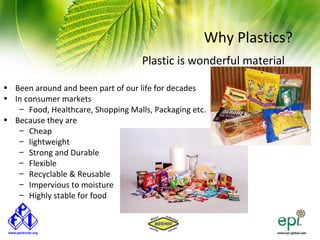
Why Plastics?
                                    Plastic is wonderful material

• Been around and been part of our life for decades
• In consumer markets
   – Food, Healthcare, Shopping Malls, Packaging etc.
• Because they are
   – Cheap
   – lightweight
   – Strong and Durable
   – Flexible
   – Recyclable & Reusable
   – Impervious to moisture
   – Highly stable for food
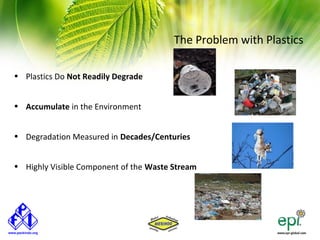
The Problem with Plastics

• Plastics Do Not Readily Degrade


• Accumulate in the Environment


• Degradation Measured in Decades/Centuries


• Highly Visible Component of the Waste Stream
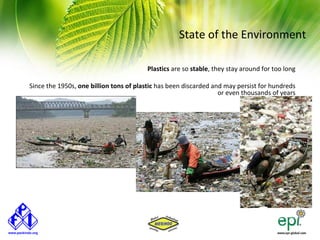
State of the Environment

                                        Plastics are so stable, they stay around for too long

Since the 1950s, one billion tons of plastic has been discarded and may persist for hundreds
                                                                  or even thousands of years
What drives the Sustainability Trend?

 Global warming awareness

 Finite resource base: rising prices and cost of waste
disposal

 Guilt over wastefulness: Germany (1990) 30%
incinerated, 65% landfilled, only 5%
recovered/recycled

 Law proposal every where to reduce waste based on
the producer’s responsibility principle
Sustainability Packaging is News!

 Move away from the throw-away society.

 Whole industry sector responsible for the entire life
cycle of its products.

 Disposal and recycling costs have been integrated in
the product price.

 ‘Polluter pays’ principle means that consumers
share the cost burden with industry.

 Triple bottom line: economic, social and
environmental success.
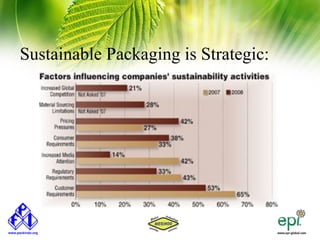
Sustainable Packaging is Strategic:
Why make the producer responsible?

 Only the product designer can choose material and
form/function of the product

 Puts the feedback loop back on the producer to design for dis
assembly, reduce, reuse, using renewable material and safer
recycling

 Hazardous materials increase the producer’s liability and
costs
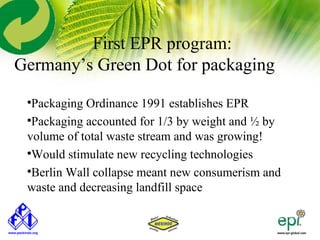
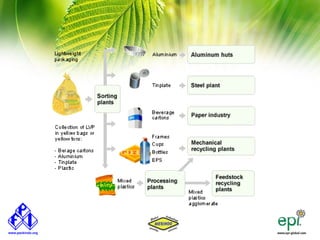
First EPR program:
Germany’s Green Dot for packaging
 
  Packaging Ordinance 1991 establishes EPR
 
  Packaging accounted for 1/3 by weight and ½ by
 volume of total waste stream and was growing!
 
  Would stimulate new recycling technologies
 
  Berlin Wall collapse meant new consumerism and
 waste and decreasing landfill space
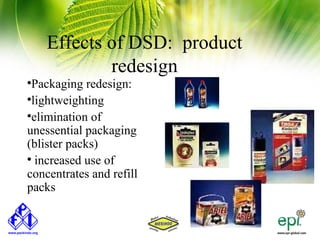
Effects of DSD: product
            redesign

 Packaging redesign:

 lightweighting

 elimination of
unessential packaging
(blister packs)

  increased use of
concentrates and refill
packs
Wal-Mart Packaging Scorecard

    2006: Packaging announced
        - Goal: 5% reduction in “packaging waste” by
          2013 or US$ 3billion savings
        - Feb 2008 implementation

    Internet-based database
        - Brand owners enter data
        - Calculates the “net environmental impact”
        - Metrics developed with Wal-Mart’s “Sustainable
          Value network” of over 200 organizations
          (government, academia, packaging suppliers & brand owners)
Wal-Mart Success Stories
Sustainable Materials: PLA replacing PET for deli trays



Lighter weight packages, source reduction: Cost savings



Renewable energy and forest use



Increase recycled content and recyclability

What about plastics?
Petro-plastic are threatened, defensive



    - Recycled materials, energy efficiency
    - Promoting performance benefits
    - Innovation
Growth in bio-based plastics




 Flexible packaging industry promotes “less waste in the first
place”
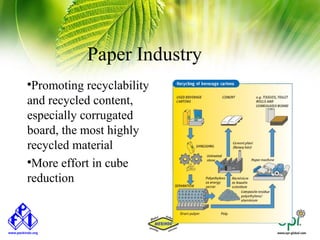
Paper Industry

 Promoting recyclability
and recycled content,
especially corrugated
board, the most highly
recycled material

 More effort in cube
reduction
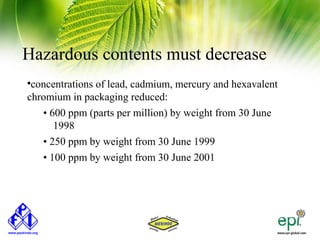
Hazardous contents must decrease

 concentrations of lead, cadmium, mercury and hexavalent
chromium in packaging reduced:
   • 600 ppm (parts per million) by weight from 30 June
      1998
   • 250 ppm by weight from 30 June 1999
   • 100 ppm by weight from 30 June 2001
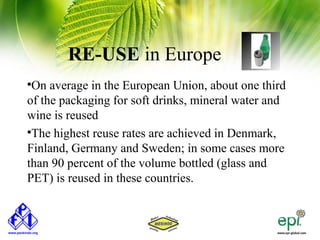
RE-USE in Europe

 On average in the European Union, about one third
of the packaging for soft drinks, mineral water and
wine is reused

 The highest reuse rates are achieved in Denmark,
Finland, Germany and Sweden; in some cases more
than 90 percent of the volume bottled (glass and
PET) is reused in these countries.
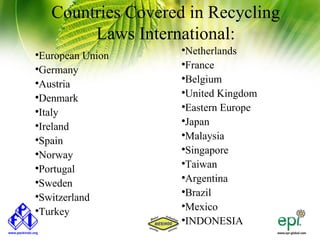
Countries Covered in Recycling
         Laws International:

 European Union
                     
                      Netherlands

 Germany
                     
                      France

 Austria
                     
                      Belgium

 Denmark
                     
                      United Kingdom

 Italy
                     
                      Eastern Europe

 Ireland
                     
                      Japan

 Spain
                     
                      Malaysia

 Norway
                     
                      Singapore

 Portugal
                     
                      Taiwan

 Sweden
                     
                      Argentina

 Switzerland
                     
                      Brazil

 Turkey
                     
                      Mexico
                     
                      INDONESIA
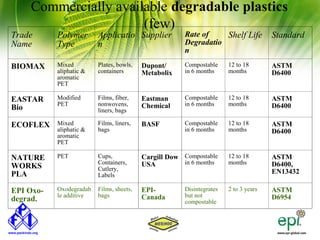
Commercially available degradable plastics
                      (few)
Trade      Polymer       Applicatio Supplier           Rate of    Shelf Life          Standard
Name       Type          n                             Degradatio
                                                       n

BIOMAX     Mixed         Plates, bowls,   Dupont/      Compostable     12 to 18       ASTM
           aliphatic &   containers       Metabolix    in 6 months     months         D6400
           aromatic
           PET

EASTAR     Modified      Films, fiber,    Eastman      Compostable     12 to 18       ASTM
           PET           nonwovens,       Chemical     in 6 months     months         D6400
Bio                      liners, bags

ECOFLEX    Mixed         Films, liners,   BASF         Compostable     12 to 18       ASTM
           aliphatic &   bags                          in 6 months     months         D6400
           aromatic
           PET

NATURE     PET           Cups,            Cargill Dow Compostable      12 to 18       ASTM
                         Containers,      USA         in 6 months      months         D6400,
WORKS                    Cutlery,
PLA                      Labels
                                                                                      EN13432

EPI Oxo-   Oxodegradab   Films, sheets,   EPI-         Disintegrates   2 to 3 years   ASTM
           le additive   bags             Canada       but not                        D6954
degrad.                                                compostable
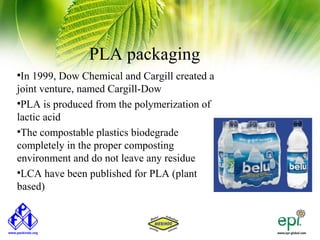
PLA packaging

 In 1999, Dow Chemical and Cargill created a
joint venture, named Cargill-Dow

 PLA is produced from the polymerization of
lactic acid

 The compostable plastics biodegrade
completely in the proper composting
environment and do not leave any residue

 LCA have been published for PLA (plant
based)
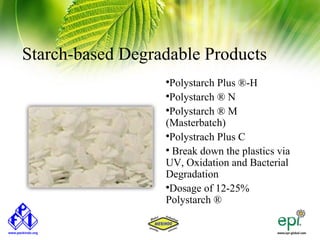
Starch-based Degradable Products
                  
                   Polystarch Plus ®-H
                  
                   Polystarch ® N
                  
                   Polystarch ® M
                  (Masterbatch)
                  
                   Polystrach Plus C
                  
                    Break down the plastics via
                  UV, Oxidation and Bacterial
                  Degradation
                  
                   Dosage of 12-25%
                  Polystarch ®
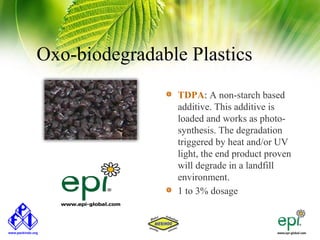
Oxo-biodegradable Plastics
                 TDPA: A non-starch based
                 additive. This additive is
                 loaded and works as photo-
                 synthesis. The degradation
                 triggered by heat and/or UV
                 light, the end product proven
                 will degrade in a landfill
                 environment.
                 1 to 3% dosage
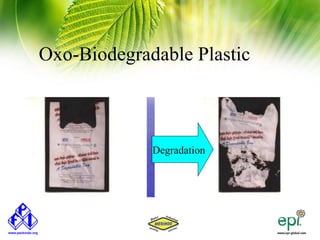
Oxo-Biodegradable Plastic


             Degradation
Standard guide for Oxo Biodegradable Plastics
              Technology


                      EPI Technology
          employs the standard guide and methods to test
                     Oxo Biodegradable Plastics
                         ASTM 6954-04
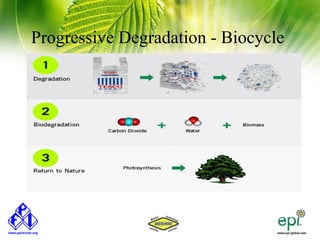
Progressive Degradation - Biocycle
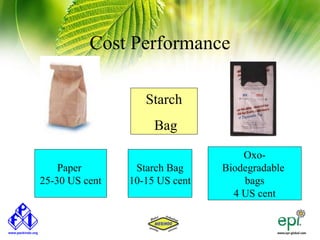
Cost Performance

                   Starch
                     Bag

                                    Oxo-
    Paper        Starch Bag     Biodegradable
25-30 US cent   10-15 US cent       bags
                                  4 US cent
Non Toxic
No adverse Impact
        to
   Environment
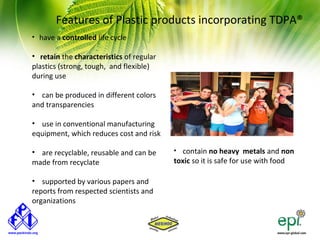
Features of Plastic products incorporating TDPA®
• have a controlled life cycle

• retain the characteristics of regular
plastics (strong, tough, and flexible)
during use

• can be produced in different colors
and transparencies

• use in conventional manufacturing
equipment, which reduces cost and risk

• are recyclable, reusable and can be     • contain no heavy metals and non
made from recyclate                       toxic so it is safe for use with food

• supported by various papers and
reports from respected scientists and
organizations
Strong Approval and Credibility
• International Scientific Advisory Board members from numerous Universities
  and Institutions, with publications on research and case studies.

• Employs standard guide - ASTM 6954-04

• Recognized by international governing bodies (FDA-USA, EFSA-Europe, and
  CFIA-Canada) - completely safe for direct food contact applications.

• Contains NO heavy metals in compliance to UK Food Standard Agency, US-
  CONEG and European Union, EC-Directive

• DO NOT contain carcinogens as per requirements of European Union, IARC
  and California State Water and Toxic Enforcement Acts 1986
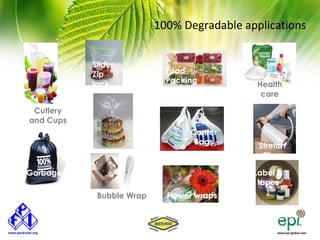
100% Degradable applications


           Slider
           Zip              Food
           lock             Packing
                                                 Health
           Bags             Trays
                                                  care

 Cutlery
and Cups    Bread
            Bags                 Carrier
                                  Bags               Stretch
                                                      Films

Garbage                                          Label &
                                                  tapes
            Bubble Wrap     Flower wraps
 bags
                                      Stretch Wrap
Corporate Benefits


• Environmental Impact Statement
• Positive Environmental Image Distinguishes from Competitors
• Customers Feel Good About Dealing with Environmentally Responsible
  Companies
• Increases Trust and Perceived Value
• Develops or Builds Brand Loyalty
• Reduces Customer “Switching”
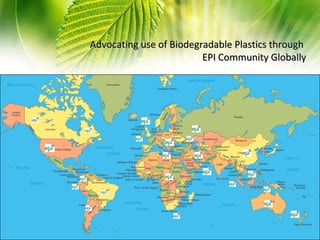
Advocating use of Biodegradable Plastics through
                         EPI Community Globally
Thank you


Email: henkywibawa@yahoo.com
      Phone: +62-816-922440

Using Degradable Plastics In Indonesia New

  • 1.
    USING DEGRADABLE PLASTICS ININDONESIA A Product Stewardship Guide and Commitment Joseph G. Gho, Chief Executive Officer
  • 2.
    Why Plastics? Plastic is wonderful material • Been around and been part of our life for decades • In consumer markets – Food, Healthcare, Shopping Malls, Packaging etc. • Because they are – Cheap – lightweight – Strong and Durable – Flexible – Recyclable & Reusable – Impervious to moisture – Highly stable for food
  • 3.
    The Problem withPlastics • Plastics Do Not Readily Degrade • Accumulate in the Environment • Degradation Measured in Decades/Centuries • Highly Visible Component of the Waste Stream
  • 4.
    State of theEnvironment Plastics are so stable, they stay around for too long Since the 1950s, one billion tons of plastic has been discarded and may persist for hundreds or even thousands of years
  • 5.
    What drives theSustainability Trend?  Global warming awareness  Finite resource base: rising prices and cost of waste disposal  Guilt over wastefulness: Germany (1990) 30% incinerated, 65% landfilled, only 5% recovered/recycled  Law proposal every where to reduce waste based on the producer’s responsibility principle
  • 6.
    Sustainability Packaging isNews!  Move away from the throw-away society.  Whole industry sector responsible for the entire life cycle of its products.  Disposal and recycling costs have been integrated in the product price.  ‘Polluter pays’ principle means that consumers share the cost burden with industry.  Triple bottom line: economic, social and environmental success.
  • 7.
  • 8.
    Why make theproducer responsible?  Only the product designer can choose material and form/function of the product  Puts the feedback loop back on the producer to design for dis assembly, reduce, reuse, using renewable material and safer recycling  Hazardous materials increase the producer’s liability and costs
  • 9.
    First EPR program: Germany’sGreen Dot for packaging  Packaging Ordinance 1991 establishes EPR  Packaging accounted for 1/3 by weight and ½ by volume of total waste stream and was growing!  Would stimulate new recycling technologies  Berlin Wall collapse meant new consumerism and waste and decreasing landfill space
  • 12.
    Effects of DSD:product redesign  Packaging redesign:  lightweighting  elimination of unessential packaging (blister packs)  increased use of concentrates and refill packs
  • 13.
    Wal-Mart Packaging Scorecard  2006: Packaging announced - Goal: 5% reduction in “packaging waste” by 2013 or US$ 3billion savings - Feb 2008 implementation  Internet-based database - Brand owners enter data - Calculates the “net environmental impact” - Metrics developed with Wal-Mart’s “Sustainable Value network” of over 200 organizations (government, academia, packaging suppliers & brand owners)
  • 14.
    Wal-Mart Success Stories SustainableMaterials: PLA replacing PET for deli trays  Lighter weight packages, source reduction: Cost savings  Renewable energy and forest use  Increase recycled content and recyclability 
  • 15.
    What about plastics? Petro-plasticare threatened, defensive  - Recycled materials, energy efficiency - Promoting performance benefits - Innovation Growth in bio-based plastics   Flexible packaging industry promotes “less waste in the first place”
  • 16.
    Paper Industry  Promotingrecyclability and recycled content, especially corrugated board, the most highly recycled material  More effort in cube reduction
  • 17.
    Hazardous contents mustdecrease  concentrations of lead, cadmium, mercury and hexavalent chromium in packaging reduced: • 600 ppm (parts per million) by weight from 30 June 1998 • 250 ppm by weight from 30 June 1999 • 100 ppm by weight from 30 June 2001
  • 18.
    RE-USE in Europe  On average in the European Union, about one third of the packaging for soft drinks, mineral water and wine is reused  The highest reuse rates are achieved in Denmark, Finland, Germany and Sweden; in some cases more than 90 percent of the volume bottled (glass and PET) is reused in these countries.
  • 19.
    Countries Covered inRecycling Laws International:  European Union  Netherlands  Germany  France  Austria  Belgium  Denmark  United Kingdom  Italy  Eastern Europe  Ireland  Japan  Spain  Malaysia  Norway  Singapore  Portugal  Taiwan  Sweden  Argentina  Switzerland  Brazil  Turkey  Mexico  INDONESIA
  • 20.
    Commercially available degradableplastics (few) Trade Polymer Applicatio Supplier Rate of Shelf Life Standard Name Type n Degradatio n BIOMAX Mixed Plates, bowls, Dupont/ Compostable 12 to 18 ASTM aliphatic & containers Metabolix in 6 months months D6400 aromatic PET EASTAR Modified Films, fiber, Eastman Compostable 12 to 18 ASTM PET nonwovens, Chemical in 6 months months D6400 Bio liners, bags ECOFLEX Mixed Films, liners, BASF Compostable 12 to 18 ASTM aliphatic & bags in 6 months months D6400 aromatic PET NATURE PET Cups, Cargill Dow Compostable 12 to 18 ASTM Containers, USA in 6 months months D6400, WORKS Cutlery, PLA Labels EN13432 EPI Oxo- Oxodegradab Films, sheets, EPI- Disintegrates 2 to 3 years ASTM le additive bags Canada but not D6954 degrad. compostable
  • 21.
    PLA packaging  In1999, Dow Chemical and Cargill created a joint venture, named Cargill-Dow  PLA is produced from the polymerization of lactic acid  The compostable plastics biodegrade completely in the proper composting environment and do not leave any residue  LCA have been published for PLA (plant based)
  • 22.
    Starch-based Degradable Products  Polystarch Plus ®-H  Polystarch ® N  Polystarch ® M (Masterbatch)  Polystrach Plus C  Break down the plastics via UV, Oxidation and Bacterial Degradation  Dosage of 12-25% Polystarch ®
  • 23.
    Oxo-biodegradable Plastics TDPA: A non-starch based additive. This additive is loaded and works as photo- synthesis. The degradation triggered by heat and/or UV light, the end product proven will degrade in a landfill environment. 1 to 3% dosage
  • 24.
  • 25.
    Standard guide forOxo Biodegradable Plastics Technology EPI Technology employs the standard guide and methods to test Oxo Biodegradable Plastics ASTM 6954-04
  • 26.
  • 27.
    Cost Performance Starch Bag Oxo- Paper Starch Bag Biodegradable 25-30 US cent 10-15 US cent bags 4 US cent
  • 28.
    Non Toxic No adverseImpact to Environment
  • 29.
    Features of Plasticproducts incorporating TDPA® • have a controlled life cycle • retain the characteristics of regular plastics (strong, tough, and flexible) during use • can be produced in different colors and transparencies • use in conventional manufacturing equipment, which reduces cost and risk • are recyclable, reusable and can be • contain no heavy metals and non made from recyclate toxic so it is safe for use with food • supported by various papers and reports from respected scientists and organizations
  • 30.
    Strong Approval andCredibility • International Scientific Advisory Board members from numerous Universities and Institutions, with publications on research and case studies. • Employs standard guide - ASTM 6954-04 • Recognized by international governing bodies (FDA-USA, EFSA-Europe, and CFIA-Canada) - completely safe for direct food contact applications. • Contains NO heavy metals in compliance to UK Food Standard Agency, US- CONEG and European Union, EC-Directive • DO NOT contain carcinogens as per requirements of European Union, IARC and California State Water and Toxic Enforcement Acts 1986
  • 31.
    100% Degradable applications Slider Zip Food lock Packing Health Bags Trays care Cutlery and Cups Bread Bags Carrier Bags Stretch Films Garbage Label & tapes Bubble Wrap Flower wraps bags Stretch Wrap
  • 32.
    Corporate Benefits • EnvironmentalImpact Statement • Positive Environmental Image Distinguishes from Competitors • Customers Feel Good About Dealing with Environmentally Responsible Companies • Increases Trust and Perceived Value • Develops or Builds Brand Loyalty • Reduces Customer “Switching”
  • 33.
    Advocating use ofBiodegradable Plastics through EPI Community Globally
  • 34.