BUSINESS
ENVIRONMENT
 The term Business Environment is composed of
two words ‘Business’ and ‘Environment’.
 In simple terms, the state in which a person
remains busy is known as Business.
 The word Business in its economic sense means
human activities like production, extraction or
purchase or sales of goods that are performed for
earning profits.
BUSINESS ENVIRONMENT
 Business environment is the climate or set of
conditions (economic, social, political or
institutional) in which business operations
are conducted.”
-Arthur M. Weimer
 “Business environment is the total of all things
external to business firms and industries which
affect their organization and operations.”
-Bayard O.Wheeler
BUSINESS ENVIRONMENT
 Business Environment means all of
the internal and external factors that
affect how the company functions
including
employees,
customers,
management,
supply & demand and
business regulations.
BUSINESS ENVIRONMENT
There is a close and continuous interaction between the
business and its environment.
This interaction helps in strengthening the business firm
and using its resources more effectively.
To be more specific, proper understanding of the social,
political, legal and economic environment helps the
business in the following ways:
Importance of Business Environment
 Identifying Firm’s Strength and Weakness:
Business environment helps to identify the individual
strengths and weaknesses in view of the technological and
global developments.
 Determining Opportunities and Threats:
The interaction between the business and its environment
would identify opportunities for and threats to the business
. It helps the business enterprises for meeting the
challenges successfully.
Importance of Business Environment
Giving Direction for Growth:
The interaction with the environment
leads to opening up new frontiers of
growth for the business firms. It
enables the business to identify
the areas for growth and expansion of
their activities.
Continuous Learning:
Environmental analysis makes the task
of managers easier in dealing with
business challenges. The managers are
motivated to continuously update their
knowledge, understanding and skills to
meet the predicted changes in realm of
business.
Image Building: Environmental understanding helps
the business organisations in improving their image by
showing their sensitivity to the environment within which
they are working.
Meeting Competition: It helps the firms to
analyse the competitors’ strategies and formulate their own
strategies accordingly.
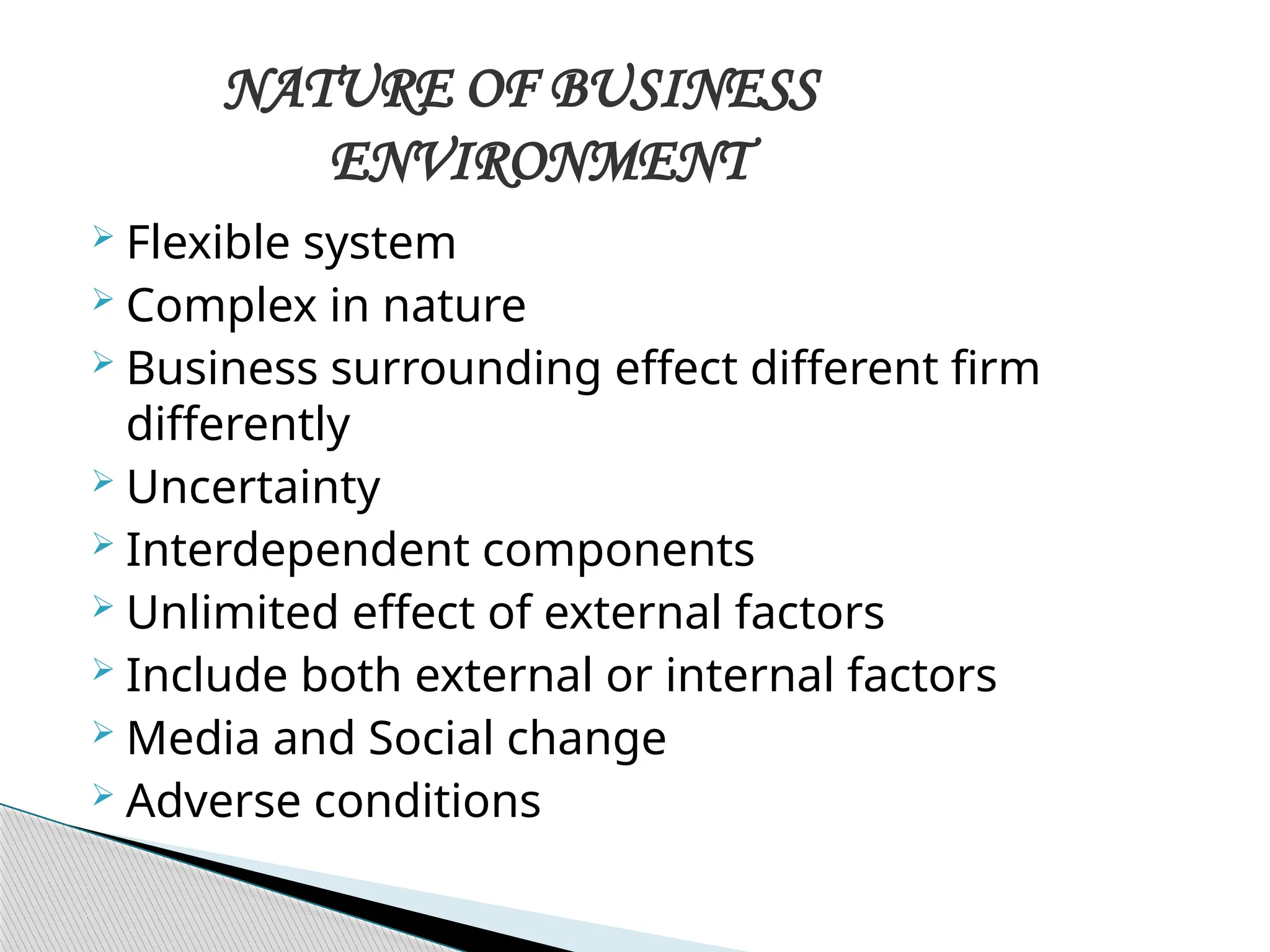
 Flexible system
 Complex in nature
 Business surrounding effect different firm
differently
 Uncertainty
 Interdependent components
 Unlimited effect of external factors
 Include both external or internal factors
 Media and Social change
 Adverse conditions
NATURE OF BUSINESS
ENVIRONMENT
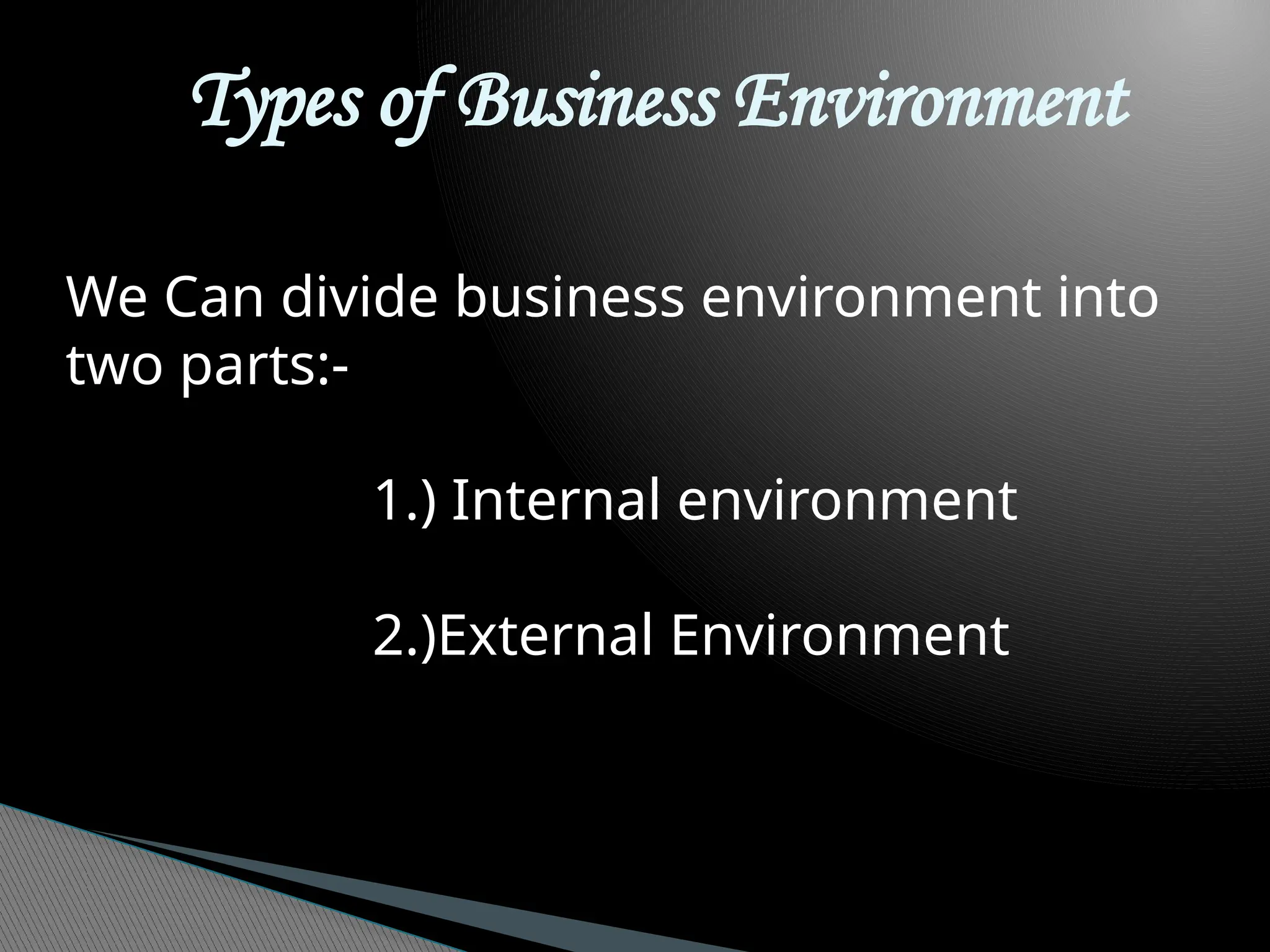
Types of Business Environment
We Can divide business environment into
two parts:-
1.) Internal environment
2.)External Environment
Internal
Environment
Business
Environment
External
Environment
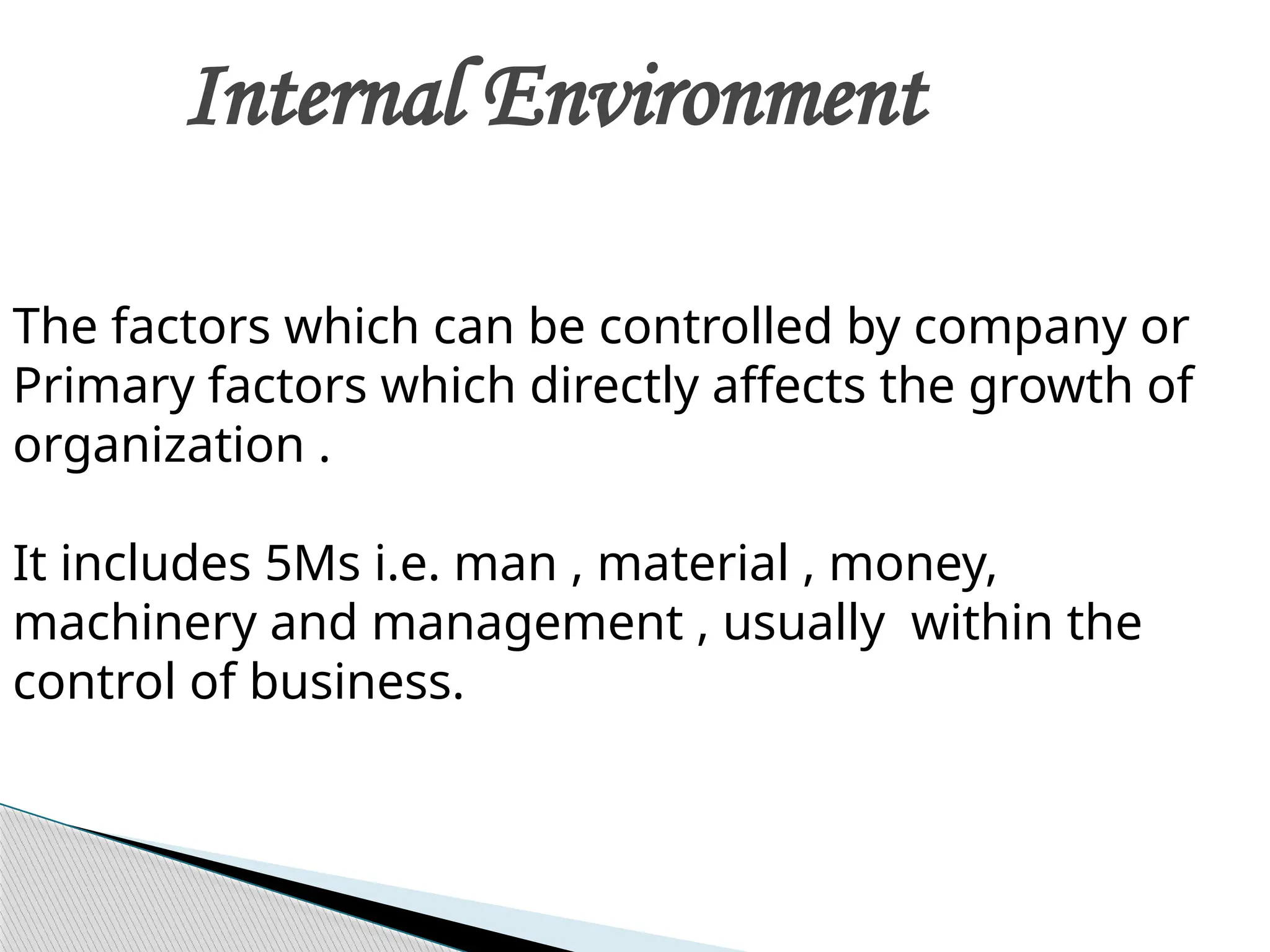
Internal Environment
The factors which can be controlled by company or
Primary factors which directly affects the growth of
organization .
It includes 5Ms i.e. man , material , money,
machinery and management , usually within the
control of business.
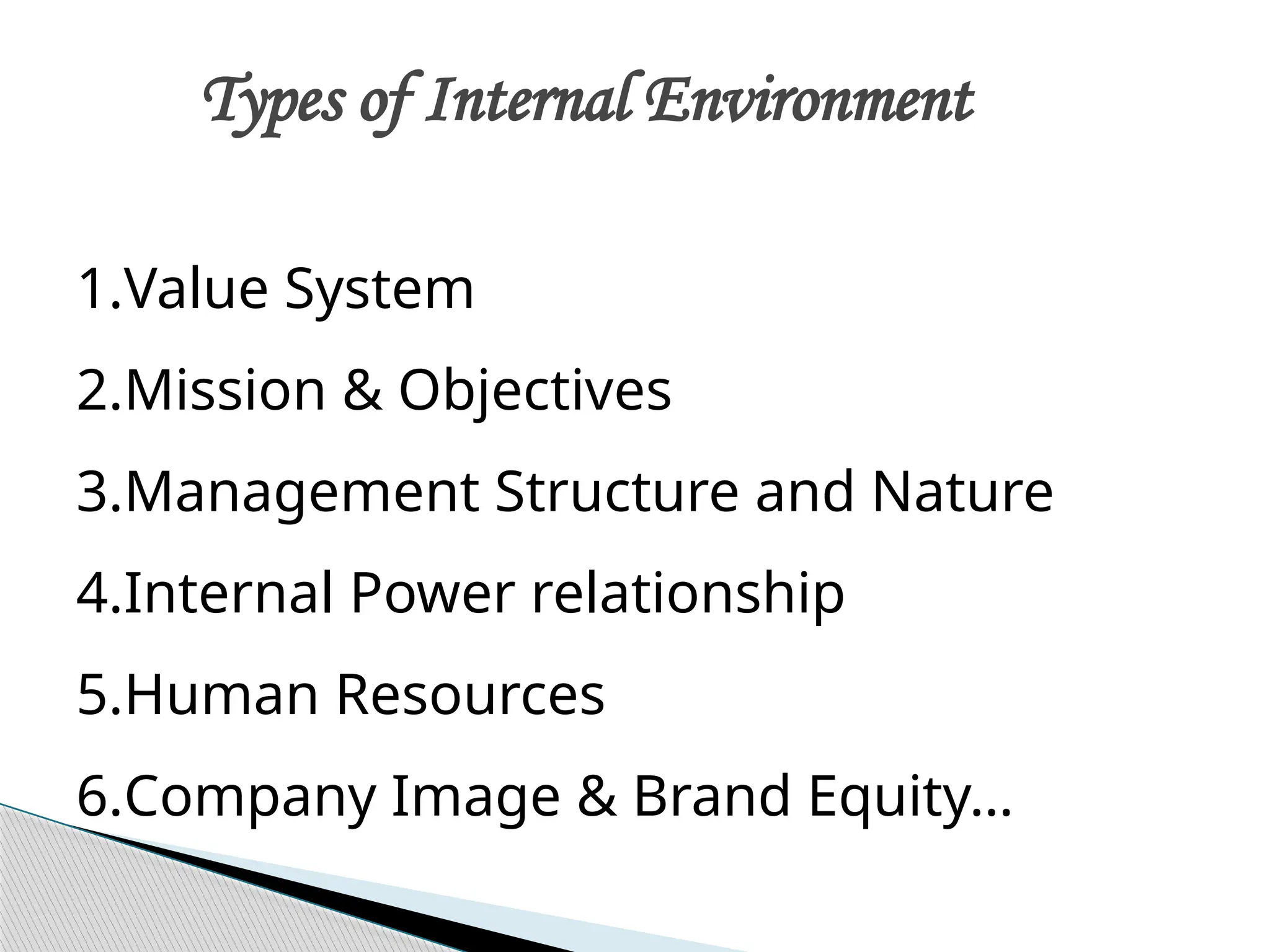
Types of Internal Environment
1.Value System
2.Mission & Objectives
3.Management Structure and Nature
4.Internal Power relationship
5.Human Resources
6.Company Image & Brand Equity…
External Environment
Those factors which are beyond the control of business
enterprise are included in external environment . It is of two
types;
1.) Micro Environment
2.) Macro Environment
Micro Environment
The Environment which is close to business and
effects its capacity to work is known as Micro
Environment .
1.)Supplier
 Consistency
 Multiple Supplier
2.) Customer
Types of Customers
-Industrial Customers
-Institutional Customers
-Foreign Customers
-Retail Customers
Multiple Customer
Globalization
Customer Segmentation
3. Market Intermediates
Types of Market Intermediates
-Middleman
-Marketing Agencies
-Financial Institutions
-Physical Intermediates
4. Public
-Media Public
-Local Public
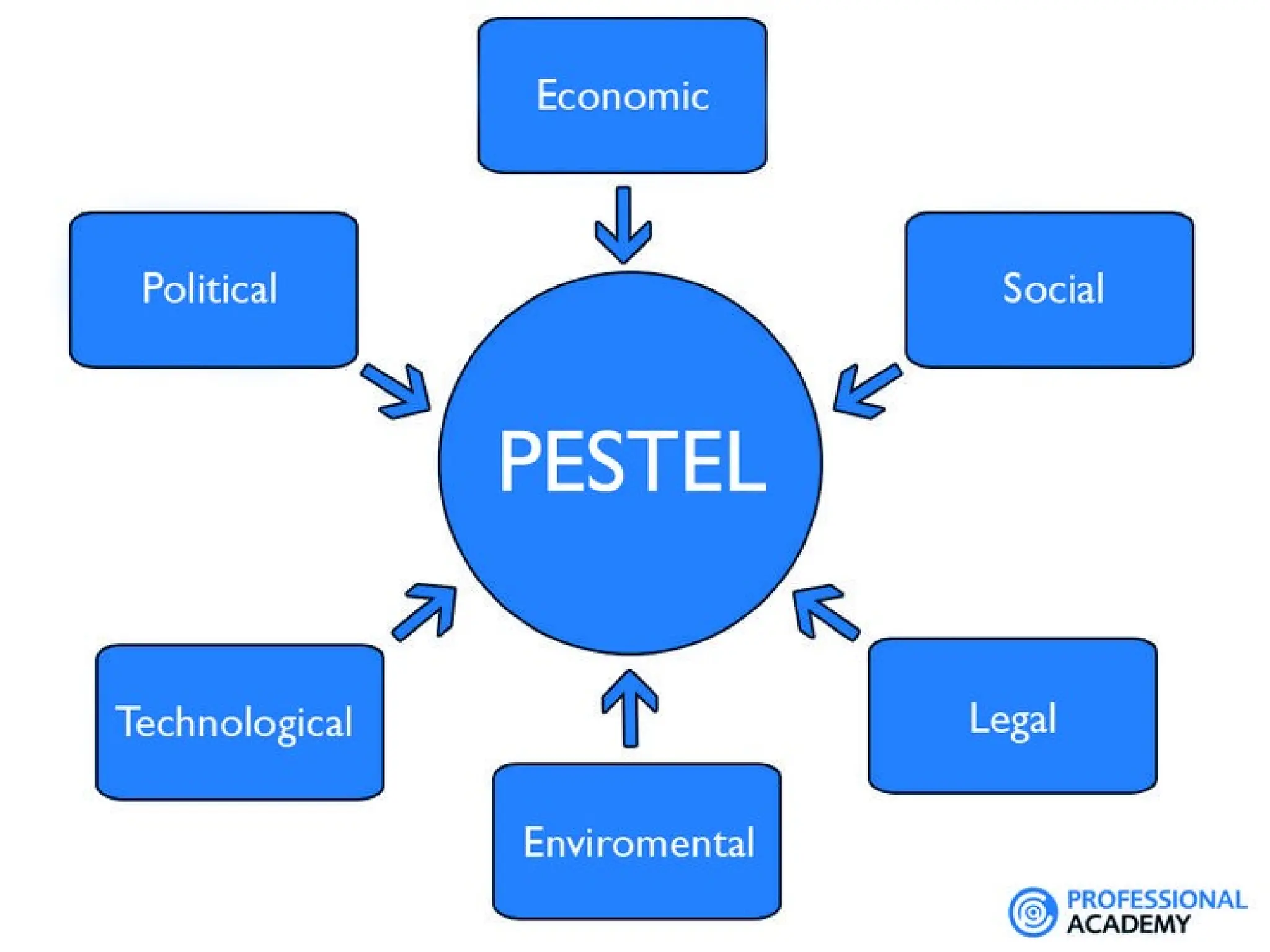
Macro Environment
It includes factors that create opportunities and
threats to business units.
1.Economic Environment
 Economic Conditions
-Boom
-Depression
 Economic System
-Capitalist
-Socialist
-Mixed Economy
 Economic Policies
- Monetary Policy
- Fiscal Policy
- Foreign Trade Policy
-Foreign Investment
-Industrial Policy
2. Political Environment
Political Ideology of Govt.
Political stability in the Economy.
Foreign Policy of Govt.
Defense & Military Policy.
Centre state relationship.
3. Socio-Cultural Environment
Influence exercised by social and cultural
factors, not within the control of business, is
known as Socio-Cultural Environment. These
factors include: attitude of people to work,
family system, caste system, religion,
education, marriage etc.
3. Socio-Cultural Environment
Religion
Tastes & Preferences
Customs & Tradition in Society
Health & Quality of Life
Language
4. Technological Environment
A systematic application of scientific
knowledge to practical task is known as
technology. Every day there has been vast
changes in products, services, lifestyles
and living conditions, these changes must be
analysed by every business unit and should
adapt these changes.
4. Technological Environment
Innovation
Research & Development
Inflow of Foreign Technology etc.
5. Natural Environment
It includes natural resources, weather,
climaticconditions, port facilities,
topographical factorssuch as soil, sea, rivers,
rainfall etc. Every business unit must look for
these factors beforechoosing the location for
their business.
5. Natural Environment
Climatic & Weather Condition.
Ease of use of Natural resources
Pollution Control
Physical features of place.
6. International Environment
It includes natural resources, weather,
climatic conditions, port facilities,
topographical factors such as soil, sea, rivers,
rainfall etc. Every business unit must look for
these factors before choosing the location for
their business.
6. International Environment
Globalization
Oil price Hike
International Terrorism
Cultural Exchange
7.Demographic Environment
It is a study of perspective of population i.e.
its size, standard of living, growth rate, age-sex
composition, family size, income level (upper
level, middle level and lower level), education
level etc. Every business unit must see these
features of population and recognize their
various needs and produce accordingly.
7.Demographic Environment
Age Composition
Gender Composition
Education Size & structure
Urban-rural population
CONCLUSION
•The environmental factors have an important
impact on the business.
•These factors affects a business a lot.
•The environment factors are never stable and can
change quickly.
•These factors also help in analyzing the changes and
implementing them in the business.
BUSINESS_ENVIRONMENT detail presentation

  • 1.
  • 2.
     The termBusiness Environment is composed of two words ‘Business’ and ‘Environment’.  In simple terms, the state in which a person remains busy is known as Business.  The word Business in its economic sense means human activities like production, extraction or purchase or sales of goods that are performed for earning profits. BUSINESS ENVIRONMENT
  • 3.
     Business environmentis the climate or set of conditions (economic, social, political or institutional) in which business operations are conducted.” -Arthur M. Weimer  “Business environment is the total of all things external to business firms and industries which affect their organization and operations.” -Bayard O.Wheeler BUSINESS ENVIRONMENT
  • 4.
     Business Environmentmeans all of the internal and external factors that affect how the company functions including employees, customers, management, supply & demand and business regulations. BUSINESS ENVIRONMENT
  • 5.
    There is aclose and continuous interaction between the business and its environment. This interaction helps in strengthening the business firm and using its resources more effectively. To be more specific, proper understanding of the social, political, legal and economic environment helps the business in the following ways: Importance of Business Environment
  • 6.
     Identifying Firm’sStrength and Weakness: Business environment helps to identify the individual strengths and weaknesses in view of the technological and global developments.  Determining Opportunities and Threats: The interaction between the business and its environment would identify opportunities for and threats to the business . It helps the business enterprises for meeting the challenges successfully. Importance of Business Environment
  • 7.
    Giving Direction forGrowth: The interaction with the environment leads to opening up new frontiers of growth for the business firms. It enables the business to identify the areas for growth and expansion of their activities.
  • 8.
    Continuous Learning: Environmental analysismakes the task of managers easier in dealing with business challenges. The managers are motivated to continuously update their knowledge, understanding and skills to meet the predicted changes in realm of business.
  • 9.
    Image Building: Environmentalunderstanding helps the business organisations in improving their image by showing their sensitivity to the environment within which they are working. Meeting Competition: It helps the firms to analyse the competitors’ strategies and formulate their own strategies accordingly.
  • 10.
     Flexible system Complex in nature  Business surrounding effect different firm differently  Uncertainty  Interdependent components  Unlimited effect of external factors  Include both external or internal factors  Media and Social change  Adverse conditions NATURE OF BUSINESS ENVIRONMENT
  • 11.
    Types of BusinessEnvironment We Can divide business environment into two parts:- 1.) Internal environment 2.)External Environment
  • 12.
  • 13.
    Internal Environment The factorswhich can be controlled by company or Primary factors which directly affects the growth of organization . It includes 5Ms i.e. man , material , money, machinery and management , usually within the control of business.
  • 14.
    Types of InternalEnvironment 1.Value System 2.Mission & Objectives 3.Management Structure and Nature 4.Internal Power relationship 5.Human Resources 6.Company Image & Brand Equity…
  • 15.
    External Environment Those factorswhich are beyond the control of business enterprise are included in external environment . It is of two types; 1.) Micro Environment 2.) Macro Environment
  • 16.
    Micro Environment The Environmentwhich is close to business and effects its capacity to work is known as Micro Environment .
  • 17.
  • 18.
    2.) Customer Types ofCustomers -Industrial Customers -Institutional Customers -Foreign Customers -Retail Customers Multiple Customer Globalization Customer Segmentation
  • 19.
    3. Market Intermediates Typesof Market Intermediates -Middleman -Marketing Agencies -Financial Institutions -Physical Intermediates
  • 20.
  • 21.
    Macro Environment It includesfactors that create opportunities and threats to business units.
  • 23.
    1.Economic Environment  EconomicConditions -Boom -Depression  Economic System -Capitalist -Socialist -Mixed Economy  Economic Policies - Monetary Policy - Fiscal Policy - Foreign Trade Policy -Foreign Investment -Industrial Policy
  • 24.
    2. Political Environment PoliticalIdeology of Govt. Political stability in the Economy. Foreign Policy of Govt. Defense & Military Policy. Centre state relationship.
  • 25.
    3. Socio-Cultural Environment Influenceexercised by social and cultural factors, not within the control of business, is known as Socio-Cultural Environment. These factors include: attitude of people to work, family system, caste system, religion, education, marriage etc.
  • 26.
    3. Socio-Cultural Environment Religion Tastes& Preferences Customs & Tradition in Society Health & Quality of Life Language
  • 27.
    4. Technological Environment Asystematic application of scientific knowledge to practical task is known as technology. Every day there has been vast changes in products, services, lifestyles and living conditions, these changes must be analysed by every business unit and should adapt these changes.
  • 28.
    4. Technological Environment Innovation Research& Development Inflow of Foreign Technology etc.
  • 29.
    5. Natural Environment Itincludes natural resources, weather, climaticconditions, port facilities, topographical factorssuch as soil, sea, rivers, rainfall etc. Every business unit must look for these factors beforechoosing the location for their business.
  • 30.
    5. Natural Environment Climatic& Weather Condition. Ease of use of Natural resources Pollution Control Physical features of place.
  • 31.
    6. International Environment Itincludes natural resources, weather, climatic conditions, port facilities, topographical factors such as soil, sea, rivers, rainfall etc. Every business unit must look for these factors before choosing the location for their business.
  • 32.
    6. International Environment Globalization Oilprice Hike International Terrorism Cultural Exchange
  • 33.
    7.Demographic Environment It isa study of perspective of population i.e. its size, standard of living, growth rate, age-sex composition, family size, income level (upper level, middle level and lower level), education level etc. Every business unit must see these features of population and recognize their various needs and produce accordingly.
  • 34.
    7.Demographic Environment Age Composition GenderComposition Education Size & structure Urban-rural population
  • 35.
    CONCLUSION •The environmental factorshave an important impact on the business. •These factors affects a business a lot. •The environment factors are never stable and can change quickly. •These factors also help in analyzing the changes and implementing them in the business.