Introduction of
Business Environment
Prepared by:
Dr. Rachna Balyan
Assistant Professor
Faculty of Commerce
Govt. Girls Degree College
Kharkhauda, Meerut
What Is Business
Environment?
.
Meaning: - The term Business Environment is
composed of two words ‘Business’ and
‘Environment’. In simple terms, the state in
which a person remains busy is known as
Business. The word Business in its economic
sense means human activities like
production, extraction or purchase or sales
of goods that are performed for earning
profits
On the other hand, the word ‘Environment’
refers to the aspects of surroundings.
Therefore, Business Environment may be
defined as a set of conditions – Social,
Legal, Economical, Political or Institutional
that are uncontrollable in nature and affects
the functioning of organization. Business
Environment has two components:
1. Internal Environment
2. External Environment
Internal Environment: It includes 5 Ms i.e. man,
material, money, machinery and management,
usually within the control of business. Business can
make changes in these factors according to the
change in the functioning of enterprise.
External Environment: Those factors which are
beyond the control of business enterprise are
included in external environment. These factors
Government and Legal factors, Geo-Physical
Factors, Political Factors, Socio-Cultural Factors,
Demo-Graphical factors etc. It is of two Types:
1. Micro/Operating Environment
2. Macro/General Environment
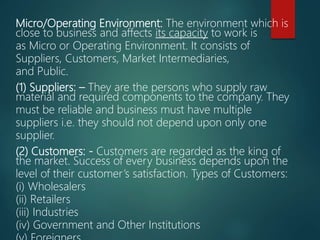
Micro/Operating Environment: The environment which is
close to business and affects its capacity to work is
as Micro or Operating Environment. It consists of
Suppliers, Customers, Market Intermediaries,
and Public.
(1) Suppliers: – They are the persons who supply raw
material and required components to the company. They
must be reliable and business must have multiple
suppliers i.e. they should not depend upon only one
supplier.
(2) Customers: - Customers are regarded as the king of
the market. Success of every business depends upon the
level of their customer’s satisfaction. Types of Customers:
(i) Wholesalers
(ii) Retailers
(iii) Industries
(iv) Government and Other Institutions
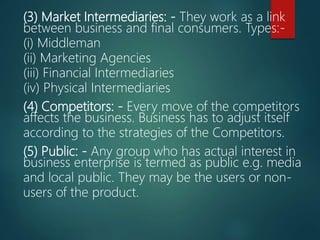
(3) Market Intermediaries: - They work as a link
between business and final consumers. Types:-
(i) Middleman
(ii) Marketing Agencies
(iii) Financial Intermediaries
(iv) Physical Intermediaries
(4) Competitors: - Every move of the competitors
affects the business. Business has to adjust itself
according to the strategies of the Competitors.
(5) Public: - Any group who has actual interest in
business enterprise is termed as public e.g. media
and local public. They may be the users or non-
users of the product.
Macro/General Environment: – It includes factors that create
opportunities and threats to business units. Following are the elements
of Macro Environment:
(1) Economic Environment: - It is very complex and dynamic in nature
that keeps on changing with the change in policies or political
It has three elements:
(i) Economic Conditions of Public
(ii) Economic Policies of the country
(iii)Economic System
(iv) Other Economic Factors: – Infrastructural Facilities, Banking,
companies, money markets, capital markets etc.
(2) Non-Economic Environment: - Following are included in non-
economic environment:-
(i) Political Environment: - It affects different business units extensively.
Components:
(a) Political Belief of Government
(b) Political Strength of the Country
(c) Relation with other countries
(d) Defense and Military Policies
(e) Centre State Relationship in the Country
(f) Thinking Opposition Parties towards Business Unit
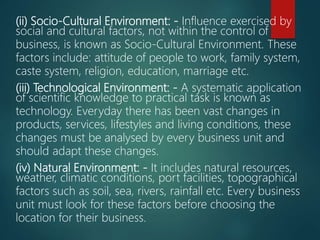
(ii) Socio-Cultural Environment: - Influence exercised by
social and cultural factors, not within the control of
business, is known as Socio-Cultural Environment. These
factors include: attitude of people to work, family system,
caste system, religion, education, marriage etc.
(iii) Technological Environment: - A systematic application
of scientific knowledge to practical task is known as
technology. Everyday there has been vast changes in
products, services, lifestyles and living conditions, these
changes must be analysed by every business unit and
should adapt these changes.
(iv) Natural Environment: - It includes natural resources,
weather, climatic conditions, port facilities, topographical
factors such as soil, sea, rivers, rainfall etc. Every business
unit must look for these factors before choosing the
location for their business.
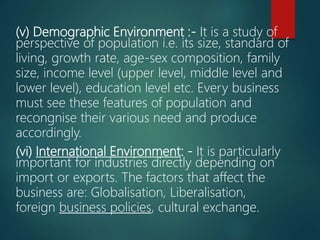
(v) Demographic Environment :- It is a study of
perspective of population i.e. its size, standard of
living, growth rate, age-sex composition, family
size, income level (upper level, middle level and
lower level), education level etc. Every business
must see these features of population and
recongnise their various need and produce
accordingly.
(vi) International Environment: - It is particularly
important for industries directly depending on
import or exports. The factors that affect the
business are: Globalisation, Liberalisation,
foreign business policies, cultural exchange.
Characteristics:-
1. Business environment is compound in nature.
2. Business environment is constantly changing
process.
3. Business environment is different for different
business units.
4. It has both long term and short term impact.
5. Unlimited influence of external environment
factors.
6. It is very uncertain.
7. Inter-related components.
8. It includes both internal and external
Thanks

business environment

  • 1.
    Introduction of Business Environment Preparedby: Dr. Rachna Balyan Assistant Professor Faculty of Commerce Govt. Girls Degree College Kharkhauda, Meerut
  • 2.
    What Is Business Environment? . Meaning:- The term Business Environment is composed of two words ‘Business’ and ‘Environment’. In simple terms, the state in which a person remains busy is known as Business. The word Business in its economic sense means human activities like production, extraction or purchase or sales of goods that are performed for earning profits
  • 3.
    On the otherhand, the word ‘Environment’ refers to the aspects of surroundings. Therefore, Business Environment may be defined as a set of conditions – Social, Legal, Economical, Political or Institutional that are uncontrollable in nature and affects the functioning of organization. Business Environment has two components: 1. Internal Environment 2. External Environment
  • 4.
    Internal Environment: Itincludes 5 Ms i.e. man, material, money, machinery and management, usually within the control of business. Business can make changes in these factors according to the change in the functioning of enterprise. External Environment: Those factors which are beyond the control of business enterprise are included in external environment. These factors Government and Legal factors, Geo-Physical Factors, Political Factors, Socio-Cultural Factors, Demo-Graphical factors etc. It is of two Types: 1. Micro/Operating Environment 2. Macro/General Environment
  • 5.
    Micro/Operating Environment: Theenvironment which is close to business and affects its capacity to work is as Micro or Operating Environment. It consists of Suppliers, Customers, Market Intermediaries, and Public. (1) Suppliers: – They are the persons who supply raw material and required components to the company. They must be reliable and business must have multiple suppliers i.e. they should not depend upon only one supplier. (2) Customers: - Customers are regarded as the king of the market. Success of every business depends upon the level of their customer’s satisfaction. Types of Customers: (i) Wholesalers (ii) Retailers (iii) Industries (iv) Government and Other Institutions
  • 6.
    (3) Market Intermediaries:- They work as a link between business and final consumers. Types:- (i) Middleman (ii) Marketing Agencies (iii) Financial Intermediaries (iv) Physical Intermediaries (4) Competitors: - Every move of the competitors affects the business. Business has to adjust itself according to the strategies of the Competitors. (5) Public: - Any group who has actual interest in business enterprise is termed as public e.g. media and local public. They may be the users or non- users of the product.
  • 7.
    Macro/General Environment: –It includes factors that create opportunities and threats to business units. Following are the elements of Macro Environment: (1) Economic Environment: - It is very complex and dynamic in nature that keeps on changing with the change in policies or political It has three elements: (i) Economic Conditions of Public (ii) Economic Policies of the country (iii)Economic System (iv) Other Economic Factors: – Infrastructural Facilities, Banking, companies, money markets, capital markets etc. (2) Non-Economic Environment: - Following are included in non- economic environment:- (i) Political Environment: - It affects different business units extensively. Components: (a) Political Belief of Government (b) Political Strength of the Country (c) Relation with other countries (d) Defense and Military Policies (e) Centre State Relationship in the Country (f) Thinking Opposition Parties towards Business Unit
  • 8.
    (ii) Socio-Cultural Environment:- Influence exercised by social and cultural factors, not within the control of business, is known as Socio-Cultural Environment. These factors include: attitude of people to work, family system, caste system, religion, education, marriage etc. (iii) Technological Environment: - A systematic application of scientific knowledge to practical task is known as technology. Everyday there has been vast changes in products, services, lifestyles and living conditions, these changes must be analysed by every business unit and should adapt these changes. (iv) Natural Environment: - It includes natural resources, weather, climatic conditions, port facilities, topographical factors such as soil, sea, rivers, rainfall etc. Every business unit must look for these factors before choosing the location for their business.
  • 9.
    (v) Demographic Environment:- It is a study of perspective of population i.e. its size, standard of living, growth rate, age-sex composition, family size, income level (upper level, middle level and lower level), education level etc. Every business must see these features of population and recongnise their various need and produce accordingly. (vi) International Environment: - It is particularly important for industries directly depending on import or exports. The factors that affect the business are: Globalisation, Liberalisation, foreign business policies, cultural exchange.
  • 10.
    Characteristics:- 1. Business environmentis compound in nature. 2. Business environment is constantly changing process. 3. Business environment is different for different business units. 4. It has both long term and short term impact. 5. Unlimited influence of external environment factors. 6. It is very uncertain. 7. Inter-related components. 8. It includes both internal and external
  • 11.

Editor's Notes

  • #3 By Shalini Rajput