PRESENTATION ON :
WRITTEN AND ORAL
 COMMUNICATION
Submitted to: Mukti Miss
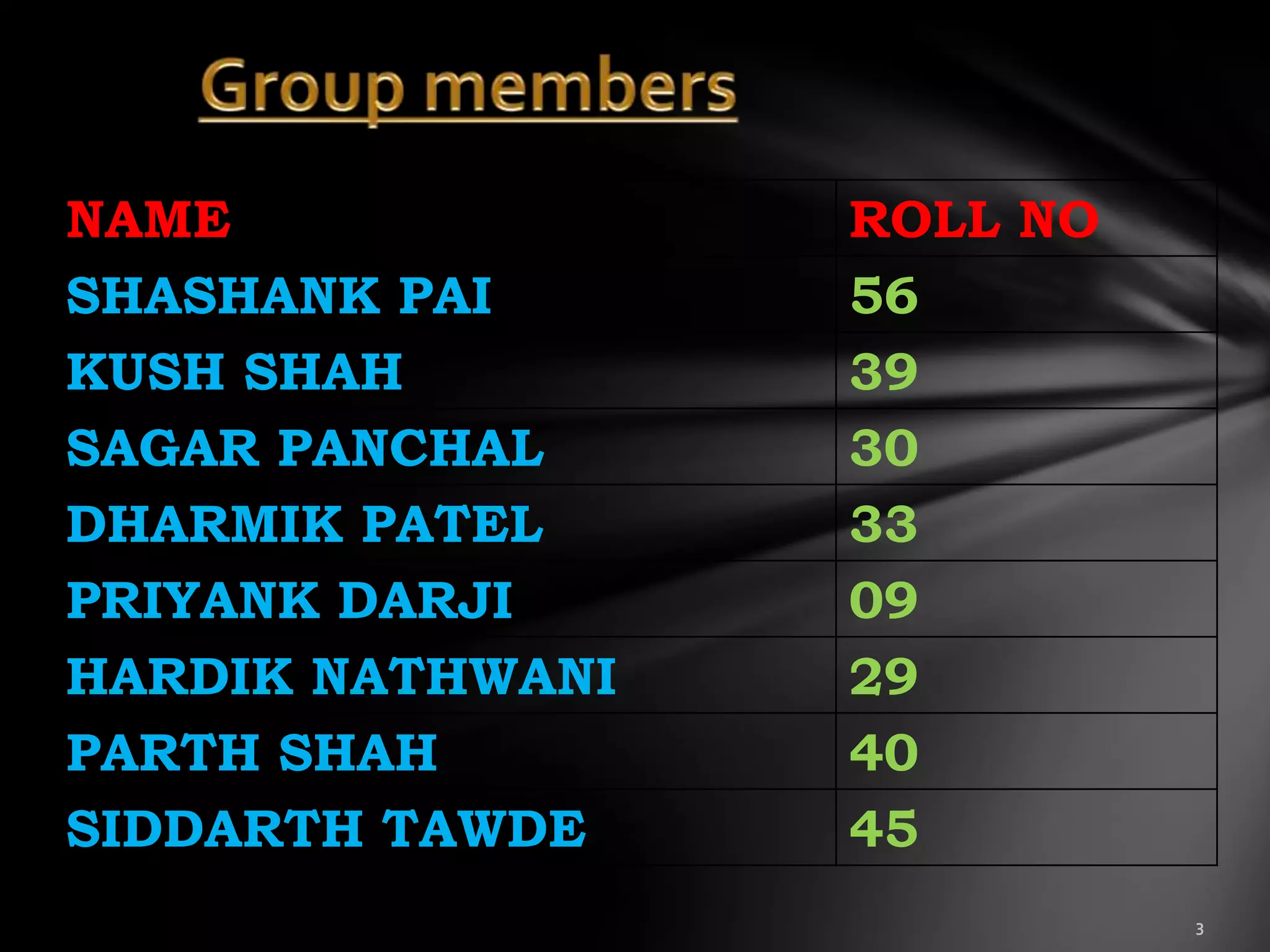
NAME              ROLL NO
SHASHANK PAI      56
KUSH SHAH         39
SAGAR PANCHAL     30
DHARMIK PATEL     33
PRIYANK DARJI     09
HARDIK NATHWANI   29
PARTH SHAH        40
SIDDARTH TAWDE    45
The term 'Communication' has been derived from the Latin word
'communis' that means 'common'. Thus 'to communicate' means 'to
make common' or 'to make known'. This act of making common and
known is carried out through exchange of thoughts, ideas or the like.
The exchange of thoughts and ideas can be had by gestures, signs,
signals, speech or writing. People are said to be in communication
when they discuss some matter, or when they talk on telephone, or
when they exchange information through letters.

It is the transfer of information from a sender to a receiver with the
information being understood by the receiver.
A proper understanding of information is one very important aspect
of communication
PURPOSE OF COMMUNICATION
Establish goals.
Develop plans for achievement of goals.
To effect change, internal functioning & influence actions
Organize human and other resources in the most effective
and efficient ways.
Select, develop and appraise members of the
organization.
Lead, direct, motivate and create a climate in which
people want to contribute.
Control performance.
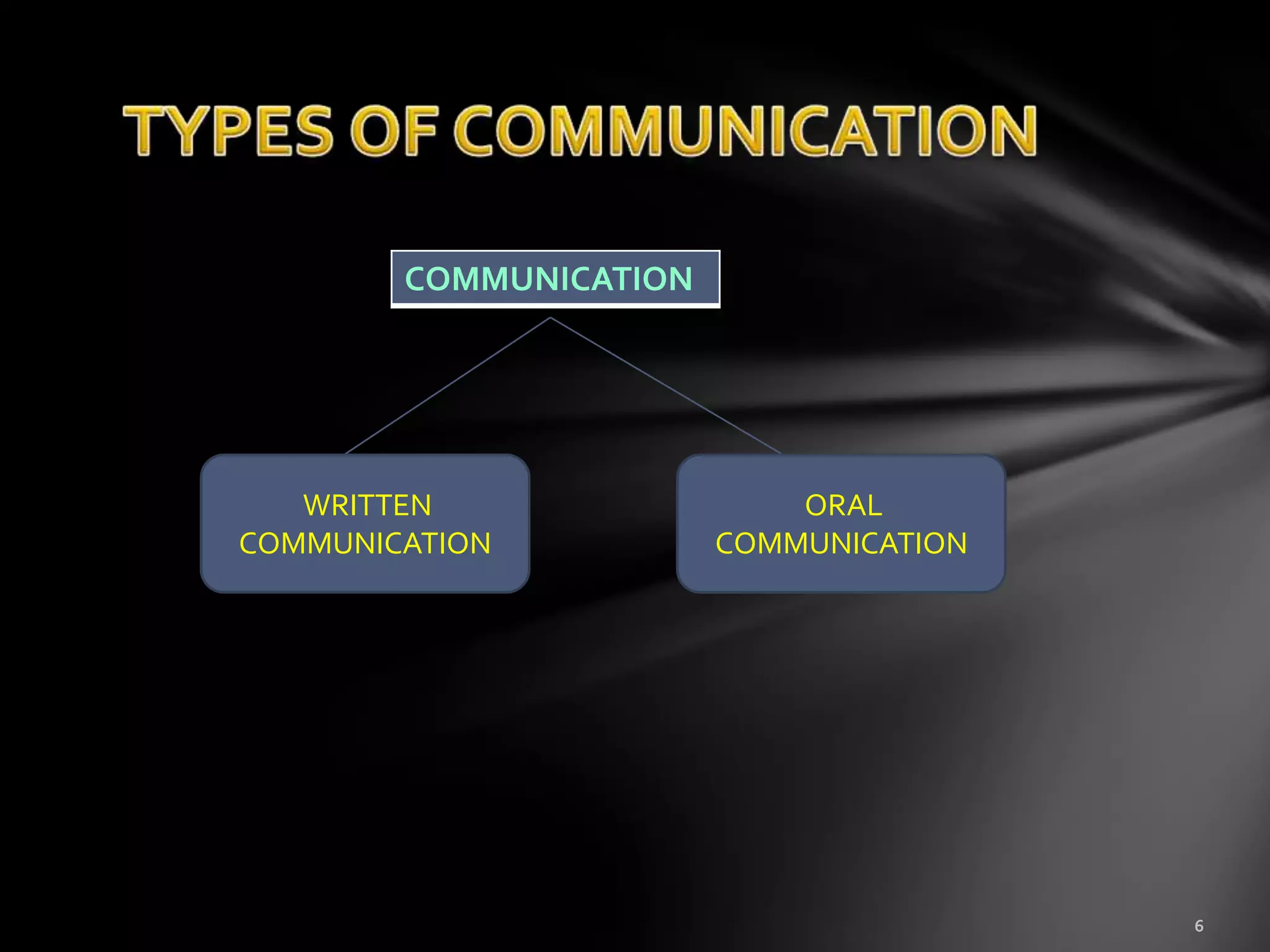
COMMUNICATION


   WRITTEN                  ORAL
COMMUNICATION           COMMUNICATION
History of Written Communication
Historians generally agree that causality is central to historical
writing. The fact that many school history students have difficulty
handling and expressing causal relations is therefore of concern. That
is, whereas historians tend to favor impersonal, abstract structures
as providing suitable explanations for historical events and states of
affairs, students often focus on human “wants and desires.”
The author argues that linguistic analysis can offer powerful insights
into how successful students use grammar and vocabulary to build
different types of causal explanations as they move through
secondary schooling.
 In particular, the author shows how functionally oriented linguistic
analysis makes it possible to discriminate between “narrative” and
“analytical” explanations, to distinguish between “enabling” and
“determining” types of causality, and to reveal the value of assessing
degrees of causal impact.
Meaning Of Written Communication
Communication is a part and parcel of everyday life. We
cannot not communicate. It is one of the most essential
and integral part of our existence, and the absence
of communication can lead to many problems and
misunderstandings.
In order to have an effective dialog, it is necessary
that effective communication skills be developed.
Communication can be divided into verbal and non verbal.
Verbal communication means any communication that
involves spoken words or sounds. Non verbal
communication includes any communication that does
not use oratory media for communication.
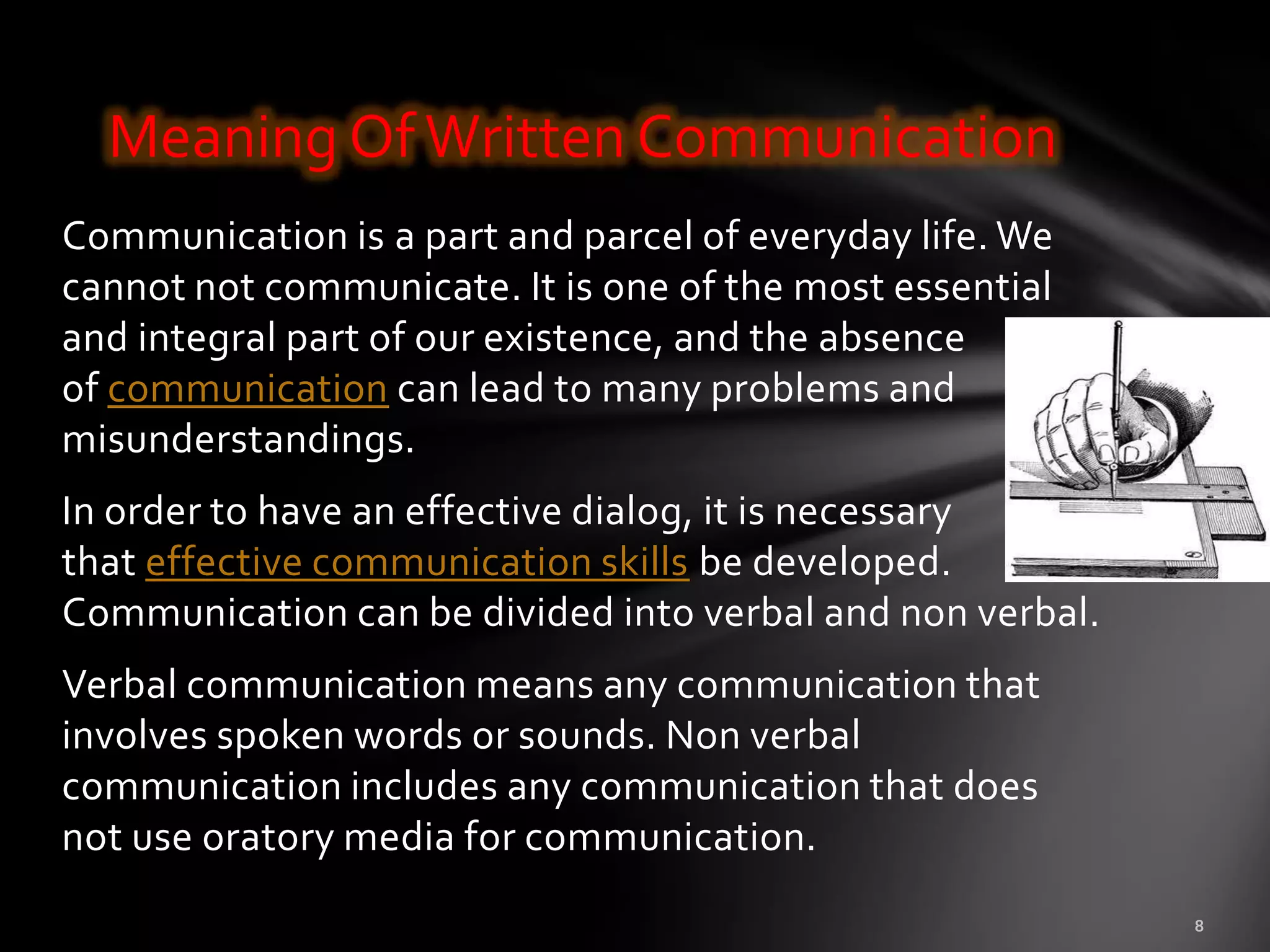
Written communication involves the use of written words to send a
message from one point to another. Written communication is important for
any business entity to carry out the daily business activities.
It helps in maintaining records of business transactions.
Written communication like brochures and catalogs help companies to
showcase their products effectively.
Print advertisements help to market products.
Written documents can serve as evidence in a court of law if and when
required.
Written words are believed more than spoken words. It's just human
psychology to believe something that we see in writing than something
someone says
Personal written communication like letters, emails, post cards, greeting
cards, etc., have their own charm and special meaning to the ones sending
and receiving them.
How to Improve Written Communication Skills:
The importance of effective written communication skills cannot be
stressed enough. Written communication plays a major role, especially in
the corporate world. Hence, it is doubly important to have good written
communication skills in the workplace. Business writing or any other form
of written communication can be very simple for those who follow the
guidelines that are given below.
Audience: The audience is mainly what determines the content to be
written. Once you have an idea about who is the intended audience, you
can judge for yourself what other necessary steps need to be taken to
ensure the completion of the communication cycle, which is, after all, the
intention of any piece of communication.
Information: The basics of communication should be covered in your piece
of written communication. This is basically almost the entire information
that you wish to give the reader. However you present the data, these
points need to covered, only then is it an effective way of communication.
Tone: Deciding the tone of your communication depends on
the audience to a large extent Tones can vary from casual,
semi formal to formal, depending on who you're
communicating with and what you intend to communicate.


Length: Knowing when to stop applies to written
communication skills as well. You can't just keep rambling on
and on, when not required. The beauty of effective written
communication can be seen in its presentation. How well and
how concisely you manage to accommodate all the
information that you need to give is what shows how
proficient your written communication skills are. The key is to
be 'clear, concise and correct'. But this does not necessarily
mean that you cut short on something that requires to be
explained in detail.
Written Communication
     Advantages               Disadvantages
Provide a tangible and        Time consuming
verifiable record             Lack of feedback
Record can be stored for an   No guarantee how
indefinite period of time     reader will interpret it
Permanent in nature           Costly process
Accurate and assigning of     Lack of clarification
responsibilities
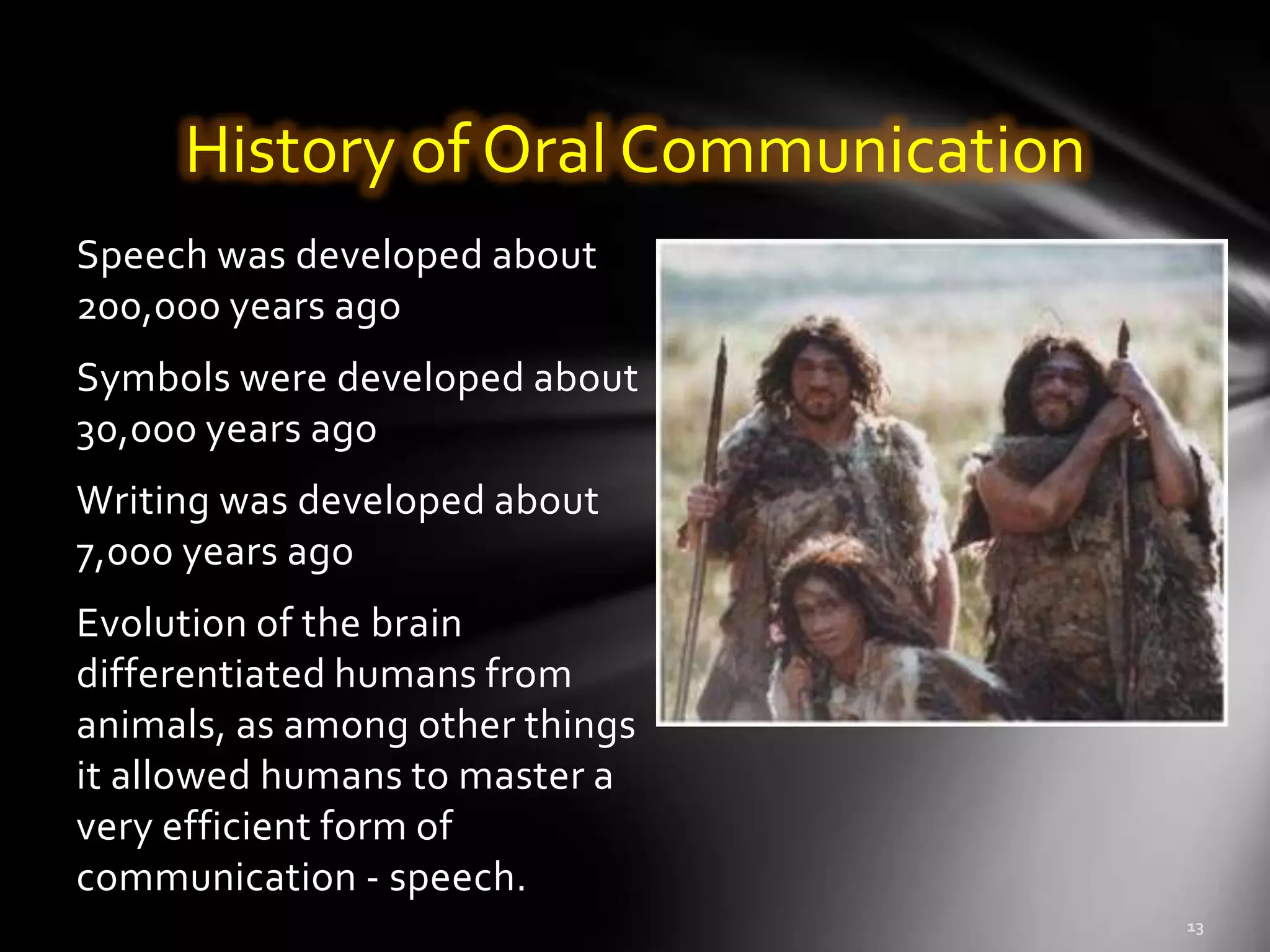
History of Oral Communication
Speech was developed about
200,000 years ago
Symbols were developed about
30,000 years ago
Writing was developed about
7,000 years ago
Evolution of the brain
differentiated humans from
animals, as among other things
it allowed humans to master a
very efficient form of
communication - speech.
Meaning Of Oral Communication
Developing the oral communication skills, holds great importance in
interacting properly with people. The communication process which is
carried out by means of spoken words is referred to as oral communication.
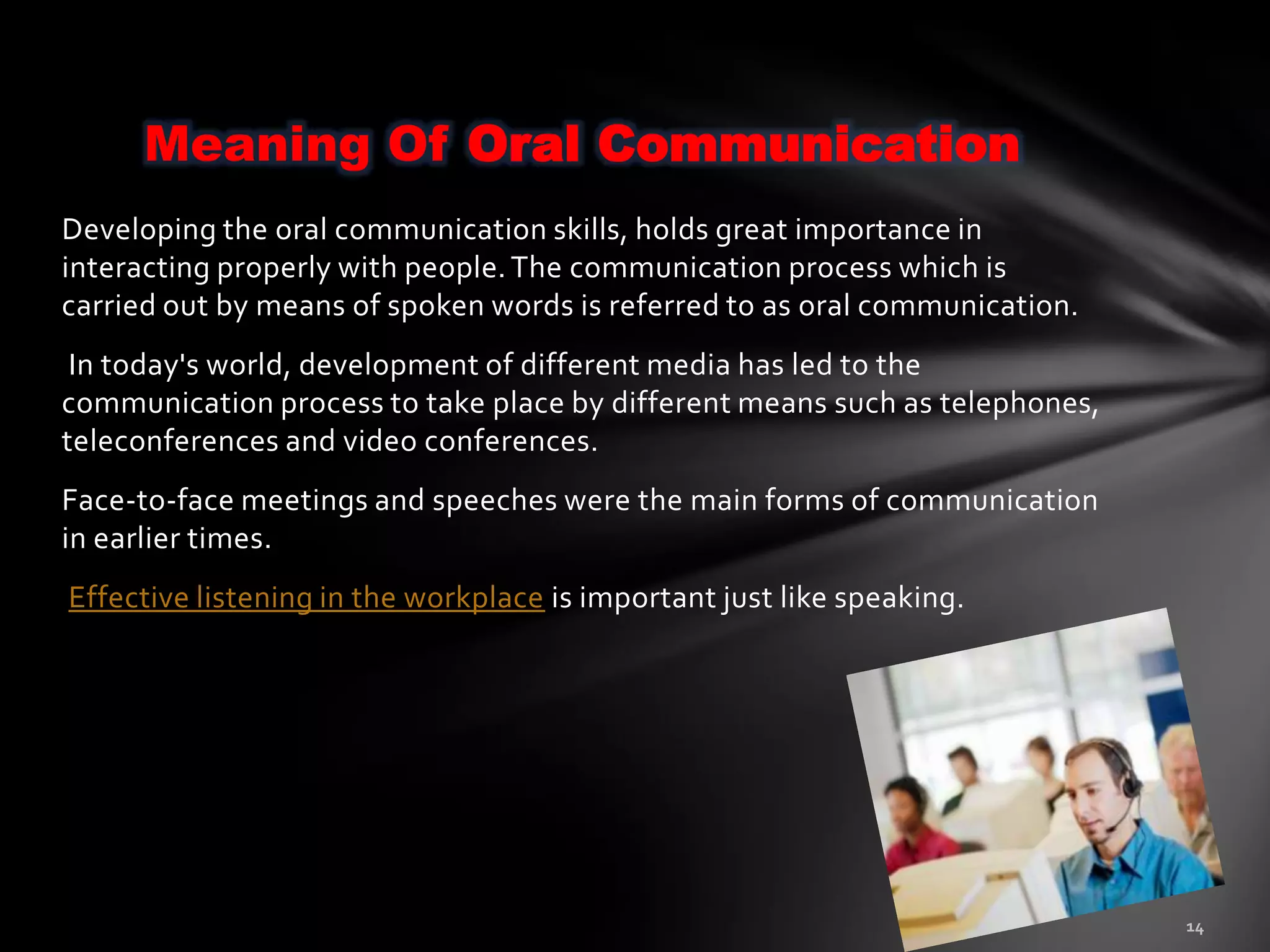
 In today's world, development of different media has led to the
communication process to take place by different means such as telephones,
teleconferences and video conferences.
Face-to-face meetings and speeches were the main forms of communication
in earlier times.
Effective listening in the workplace is important just like speaking.
Skills Required for Oral Presentation
For a good oral presentation, the quality of text being
prepared and the way it is presented are equally
important. An organized text presentation allows the
orator to proceed smoothly from point-to-point.
Presenting relevant data through the presentation is
first and foremost point to be kept in the mind. The
speech/presentation should be interactive.

It is necessary to develop oral communication skills to
survive in today's world. Individual and business
relations can be developed and maintained with the
help of these skills.
Oral Communication
     Advantages            Disadvantages

•   Time - saving device   Lack of time
•   Interaction
                           Lack of legal validity
•   Ample scope
                           Misunderstanding
•   Economic in nature
•   Feedback               Effectiveness
                           Retained in record books
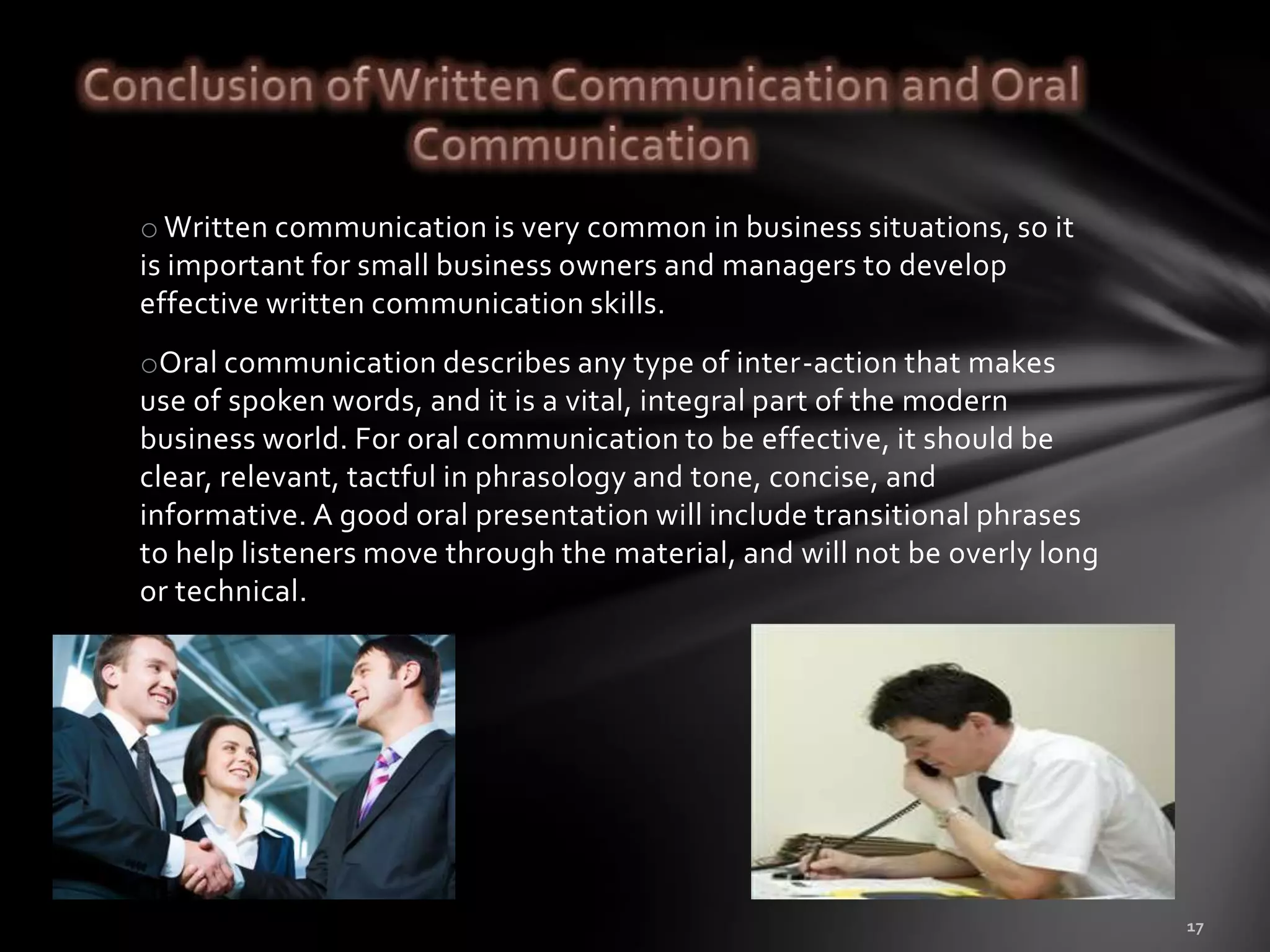
o Written communication is very common in business situations, so it
is important for small business owners and managers to develop
effective written communication skills.
oOral communication describes any type of inter-action that makes
use of spoken words, and it is a vital, integral part of the modern
business world. For oral communication to be effective, it should be
clear, relevant, tactful in phrasology and tone, concise, and
informative. A good oral presentation will include transitional phrases
to help listeners move through the material, and will not be overly long
or technical.
Communication skills   ppt

Communication skills ppt

  • 2.
    PRESENTATION ON : WRITTENAND ORAL COMMUNICATION Submitted to: Mukti Miss
  • 3.
    NAME ROLL NO SHASHANK PAI 56 KUSH SHAH 39 SAGAR PANCHAL 30 DHARMIK PATEL 33 PRIYANK DARJI 09 HARDIK NATHWANI 29 PARTH SHAH 40 SIDDARTH TAWDE 45
  • 4.
    The term 'Communication'has been derived from the Latin word 'communis' that means 'common'. Thus 'to communicate' means 'to make common' or 'to make known'. This act of making common and known is carried out through exchange of thoughts, ideas or the like. The exchange of thoughts and ideas can be had by gestures, signs, signals, speech or writing. People are said to be in communication when they discuss some matter, or when they talk on telephone, or when they exchange information through letters. It is the transfer of information from a sender to a receiver with the information being understood by the receiver. A proper understanding of information is one very important aspect of communication
  • 5.
    PURPOSE OF COMMUNICATION Establishgoals. Develop plans for achievement of goals. To effect change, internal functioning & influence actions Organize human and other resources in the most effective and efficient ways. Select, develop and appraise members of the organization. Lead, direct, motivate and create a climate in which people want to contribute. Control performance.
  • 6.
    COMMUNICATION WRITTEN ORAL COMMUNICATION COMMUNICATION
  • 7.
    History of WrittenCommunication Historians generally agree that causality is central to historical writing. The fact that many school history students have difficulty handling and expressing causal relations is therefore of concern. That is, whereas historians tend to favor impersonal, abstract structures as providing suitable explanations for historical events and states of affairs, students often focus on human “wants and desires.” The author argues that linguistic analysis can offer powerful insights into how successful students use grammar and vocabulary to build different types of causal explanations as they move through secondary schooling. In particular, the author shows how functionally oriented linguistic analysis makes it possible to discriminate between “narrative” and “analytical” explanations, to distinguish between “enabling” and “determining” types of causality, and to reveal the value of assessing degrees of causal impact.
  • 8.
    Meaning Of WrittenCommunication Communication is a part and parcel of everyday life. We cannot not communicate. It is one of the most essential and integral part of our existence, and the absence of communication can lead to many problems and misunderstandings. In order to have an effective dialog, it is necessary that effective communication skills be developed. Communication can be divided into verbal and non verbal. Verbal communication means any communication that involves spoken words or sounds. Non verbal communication includes any communication that does not use oratory media for communication.
  • 9.
    Written communication involvesthe use of written words to send a message from one point to another. Written communication is important for any business entity to carry out the daily business activities. It helps in maintaining records of business transactions. Written communication like brochures and catalogs help companies to showcase their products effectively. Print advertisements help to market products. Written documents can serve as evidence in a court of law if and when required. Written words are believed more than spoken words. It's just human psychology to believe something that we see in writing than something someone says Personal written communication like letters, emails, post cards, greeting cards, etc., have their own charm and special meaning to the ones sending and receiving them.
  • 10.
    How to ImproveWritten Communication Skills: The importance of effective written communication skills cannot be stressed enough. Written communication plays a major role, especially in the corporate world. Hence, it is doubly important to have good written communication skills in the workplace. Business writing or any other form of written communication can be very simple for those who follow the guidelines that are given below. Audience: The audience is mainly what determines the content to be written. Once you have an idea about who is the intended audience, you can judge for yourself what other necessary steps need to be taken to ensure the completion of the communication cycle, which is, after all, the intention of any piece of communication. Information: The basics of communication should be covered in your piece of written communication. This is basically almost the entire information that you wish to give the reader. However you present the data, these points need to covered, only then is it an effective way of communication.
  • 11.
    Tone: Deciding thetone of your communication depends on the audience to a large extent Tones can vary from casual, semi formal to formal, depending on who you're communicating with and what you intend to communicate. Length: Knowing when to stop applies to written communication skills as well. You can't just keep rambling on and on, when not required. The beauty of effective written communication can be seen in its presentation. How well and how concisely you manage to accommodate all the information that you need to give is what shows how proficient your written communication skills are. The key is to be 'clear, concise and correct'. But this does not necessarily mean that you cut short on something that requires to be explained in detail.
  • 12.
    Written Communication Advantages Disadvantages Provide a tangible and Time consuming verifiable record Lack of feedback Record can be stored for an No guarantee how indefinite period of time reader will interpret it Permanent in nature Costly process Accurate and assigning of Lack of clarification responsibilities
  • 13.
    History of OralCommunication Speech was developed about 200,000 years ago Symbols were developed about 30,000 years ago Writing was developed about 7,000 years ago Evolution of the brain differentiated humans from animals, as among other things it allowed humans to master a very efficient form of communication - speech.
  • 14.
    Meaning Of OralCommunication Developing the oral communication skills, holds great importance in interacting properly with people. The communication process which is carried out by means of spoken words is referred to as oral communication. In today's world, development of different media has led to the communication process to take place by different means such as telephones, teleconferences and video conferences. Face-to-face meetings and speeches were the main forms of communication in earlier times. Effective listening in the workplace is important just like speaking.
  • 15.
    Skills Required forOral Presentation For a good oral presentation, the quality of text being prepared and the way it is presented are equally important. An organized text presentation allows the orator to proceed smoothly from point-to-point. Presenting relevant data through the presentation is first and foremost point to be kept in the mind. The speech/presentation should be interactive. It is necessary to develop oral communication skills to survive in today's world. Individual and business relations can be developed and maintained with the help of these skills.
  • 16.
    Oral Communication Advantages Disadvantages • Time - saving device Lack of time • Interaction Lack of legal validity • Ample scope Misunderstanding • Economic in nature • Feedback Effectiveness Retained in record books
  • 17.
    o Written communicationis very common in business situations, so it is important for small business owners and managers to develop effective written communication skills. oOral communication describes any type of inter-action that makes use of spoken words, and it is a vital, integral part of the modern business world. For oral communication to be effective, it should be clear, relevant, tactful in phrasology and tone, concise, and informative. A good oral presentation will include transitional phrases to help listeners move through the material, and will not be overly long or technical.