A Leader’s
Guide to
Talent
Development
A Handbook for Managers
Stephanie Itle-Clark MS Ed., CHES
A Leader’s Guide to Talent Development

About this Handbook
You are probably already familiar with the fast pace of change and the
growing skill set needed by employees and even volunteers in businesses, both in
the for-profit and non-profit sector. Organizations have leaders in all levels, and
each level plays an important part in maintenance and long-term success of
strategic goals. Encouragement of leadership through personnel development
among staff and volunteers can increase morale and productivity–after all, when
people are engaged and rewarded they tend to be happier and more productive.
This handbook will help current and future leaders learn how to move beyond the
traditional hierarchy of those who lead only from coveted top levels to a leadership
style that develops talent in a way that promotes leadership renewal. By renewing
the leaders in all levels of your organization you are building a community of loyal
personnel and individuals who work in the position that is best for both them and
the organization.
Handbook Outcomes
This handbook will help leaders to:
Categorize and describe leadership theories and styles
Identify personnel (staff and volunteers) who have the skills and talent
needed in organization and evaluate personnel goals and career path
Appraise personnel and determine those who may need development before
they can assume greater responsibility
Ascertain future leaders and effectively foster development

1
A Leader’s Guide to Talent Development

Section One—Leadership and Talent
What is talent and how do we find it? According to the Merriam-Webster
Dictionary, talent is:
the natural endowments of a person; a special often athletic, creative, or
artistic aptitude; general intelligence or mental power (Merriam-Webster,
N.D.)
Talented staff and volunteers may be found or groomed, but a general rule is
that talented personnel have a high intelligence quotient (IQ), a high emotional
quotient (EQ), motivation, skills and knowledge related to the field, and can be a
good leader when they are asked to step up to the task (Conger & Fulmer, 2003).
So if it is true that talented individuals have certain traits and skills, how does
current leadership play into changes and the talent development of others in the
organization?
Leadership Impact on the Organization and Professional Development
The preparation and execution of successful management and change
creation in an organization is not a specific formula, which sadly means that many
individuals placed into positions of leadership are left to figure out the basics of
what works and what does not using the trial and error method. Effective leaders
utilize a combination of best business practice, knowledge of management,

2
A Leader’s Guide to Talent Development

leadership skill, and individual behaviors or demeanors that resonate with others
(Maciariello, 2006, p. 4).
Recognizing and developing future leadership in others begins with the
current leadership in an organization. The successful leader can not only inspire,
but be one who can see potential in personnel, work toward the mission and vision
of the organization, and recognize when personnel need repurposed or trained for
either their current or future roles.
A leader is expected to know the trends of his or her field, complete and
delegate tasks, be an effective executive, and lead in a way that inspires excellence
from others. Spirit of performance, or the commitment to “do the right thing” and
“get the right things done”, are key in an organization where management and
executives are a force of inspiration and act as leaders of change. The internal and
external actions of a group also act as a force of inspiration and indicate the
mission and values of an organization – personnel decisions reward the behaviors
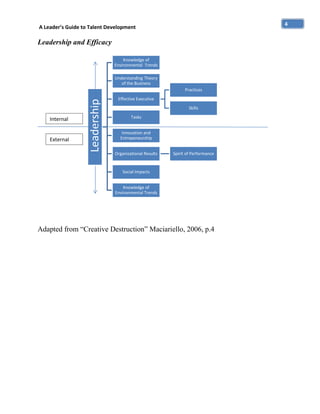
that are wanted and indicate those which are not desired (Maciariello, 2006, p. 57). As indicated by the Leadership and Efficacy graphic below, both internal and
external influences will impact a company and staff or volunteers.

3
4

A Leader’s Guide to Talent Development

Leadership and Efficacy
Knowledge of
Environmental Trends
Understanding Theory
of the Business

Internal

External

Leadership

Practices
Effective Executive
Skills
Tasks
Innovation and
Entrepeneurship
Organizational Results

Spirit of Performance

Social Impacts
Knowledge of
Environmental Trends

Adapted from “Creative Destruction” Maciariello, 2006, p.4
A Leader’s Guide to Talent Development

Successful Talent Management
Part of leading and managing change is the ability to assess, hire, promote, and
develop a team of motivated and successful people. Two key points should be kept
in mind as you and your organization build a valuable workforce:
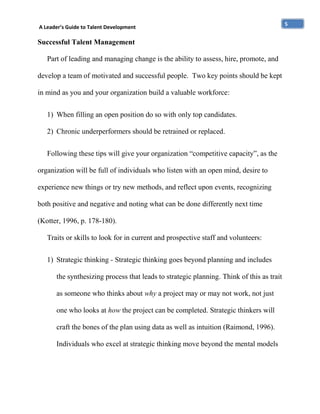
1) When filling an open position do so with only top candidates.
2) Chronic underperformers should be retrained or replaced.
Following these tips will give your organization “competitive capacity”, as the
organization will be full of individuals who listen with an open mind, desire to
experience new things or try new methods, and reflect upon events, recognizing
both positive and negative and noting what can be done differently next time
(Kotter, 1996, p. 178-180).
Traits or skills to look for in current and prospective staff and volunteers:
1) Strategic thinking - Strategic thinking goes beyond planning and includes
the synthesizing process that leads to strategic planning. Think of this as trait
as someone who thinks about why a project may or may not work, not just
one who looks at how the project can be completed. Strategic thinkers will
craft the bones of the plan using data as well as intuition (Raimond, 1996).
Individuals who excel at strategic thinking move beyond the mental models

5
A Leader’s Guide to Talent Development

with which they are most comfortable or those that are accepted as the norm.
Creative strategies push organizations to new levels (Senge, 1990).
2) Ability to listen and be coached (and in the future coach others) - Active
listening, open-ended questions, positive body language, and eliminated
distractions are tools used by effective communicators. Directing and telling
have a time and a place in the work place, but a person who may show
potential for a leadership role will be open to listening to and learning from
others. A coaching manager will work with direct reports to create a
personal development plan.
3) Willingness to gain cross-functional knowledge and perspective – Personnel
who expand their knowledge base to include not only their department or
specific tasks are often better prepared to take on new roles and be open to
professional development. This knowledge integration of department work is
‘‘an ongoing collective process of constructing, articulating, and redefining
shared beliefs through the social interaction of organizational members’’
(Huang, 2000, p. 15). Personnel who show creativity and innovation, and
those who generate consensus through collective input will be beneficial as
organizations work toward long-term goals (Bishop, 1999). Competitiveness
in the marketplace depends on the diversity and strategic value of

6
A Leader’s Guide to Talent Development

specialized knowledge, as well as an organization’s capacity to integrate the
knowledge in an effective fashion (Huang & Newell, 2003).
4) Knowledge of the industry – Similar to item three, willingness to gain crossfunctional knowledge, staff and volunteers who have an understanding of the
industry and competitors will be prepared to utilize environmental and social
events to benefit the organization (Drucker, 2001).
5) Ability to collaborate – The ability to work with others to achieve an
organization goal. A true collaborator will communicate with coworkers,
visualize ideas and create vision for strategic thinking, and acknowledge
partners in collaborative work.

7
A Leader’s Guide to Talent Development

Section Two—Follow the Leader
Leadership Theories
There are many types of leaders and theories about who will make a great
leader. Some leadership theories focus on what innate qualities distinguish between
leaders and followers, while other theories review other variables such as
situational factors and individual skill levels. You may find in your organization
that the best staff and volunteers are those who display components of various
theories.

8
9

A Leader’s Guide to Talent Development

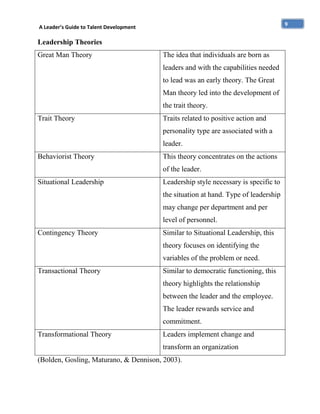
Leadership Theories
Great Man Theory

The idea that individuals are born as
leaders and with the capabilities needed
to lead was an early theory. The Great
Man theory led into the development of
the trait theory.

Trait Theory

Traits related to positive action and
personality type are associated with a
leader.

Behaviorist Theory

This theory concentrates on the actions
of the leader.

Situational Leadership

Leadership style necessary is specific to
the situation at hand. Type of leadership
may change per department and per
level of personnel.

Contingency Theory

Similar to Situational Leadership, this
theory focuses on identifying the
variables of the problem or need.

Transactional Theory

Similar to democratic functioning, this
theory highlights the relationship
between the leader and the employee.
The leader rewards service and
commitment.

Transformational Theory

Leaders implement change and
transform an organization

(Bolden, Gosling, Maturano, & Dennison, 2003).
A Leader’s Guide to Talent Development

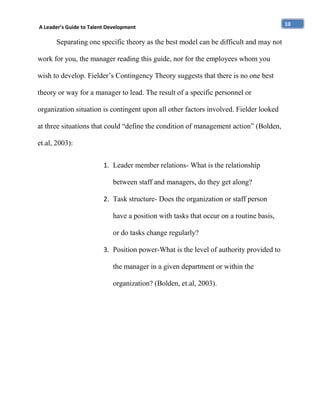
Separating one specific theory as the best model can be difficult and may not
work for you, the manager reading this guide, nor for the employees whom you
wish to develop. Fielder’s Contingency Theory suggests that there is no one best
theory or way for a manager to lead. The result of a specific personnel or
organization situation is contingent upon all other factors involved. Fielder looked
at three situations that could “define the condition of management action” (Bolden,
et.al, 2003):
1. Leader member relations- What is the relationship
between staff and managers, do they get along?
2. Task structure- Does the organization or staff person
have a position with tasks that occur on a routine basis,
or do tasks change regularly?
3. Position power-What is the level of authority provided to
the manager in a given department or within the
organization? (Bolden, et.al, 2003).

10
A Leader’s Guide to Talent Development

Leadership Styles
Fielder’s Contingency Model employs the idea that there are various styles
of leadership. Along with the theories of leadership, leadership styles influence
both the current managers, and also those who will be recognized as future leaders,
or the organization talent to be developed. Leadership styles range from
democratic or participative, allowing for a leader within the organization to
subscribe to team leadership or autocratic and authoritarian leadership in which the
leader maintains a high level of control (Sarin & McDermitt, 2003; Rotemberg
&Saloner, 1993).
Three main styles of leadership are authoritarian, participative, and
delegative (Lewin, Lippit, & White, 1939).
Authoritarian leadership (leader-based) provides a clear divide between the
leader and followers and the leader dictates what will occur, when it will occur. In
authoritarian models of leadership, the leader controls the decisions and the
followers have very little involvement regarding the change or projects. Leaderbased governance is most effective in creating fundamental change.
Participative leadership (or relationship-based), also known as democratic
leadership, allows leaders to offer direction to followers and allow the group to
participate in the outcomes and decision making. The leader maintains the final
decision while the followers feel connected to the organization. Relationship-based

11
A Leader’s Guide to Talent Development

authority is most effective when an organization plans to create growing change
and when relationships build between the leader and followers.
The final leadership style, the delegative leadership (follower-based) style,
is one in which the leader offers little direction to followers, allowing the group to
make the majority of the decisions. “This style can be effective in situations where
group members are highly qualified in an area of expertise; it often leads to poorly
defined roles and a lack of motivation” (Cherry, N.D.). Follower-based authority
requires highly skilled followers and the leader giving up a large amount of
control.

12
13

A Leader’s Guide to Talent Development

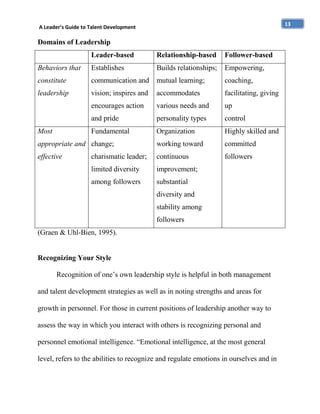
Domains of Leadership
Leader-based

Relationship-based

Follower-based

Behaviors that

Establishes

Builds relationships;

Empowering,

constitute

communication and

mutual learning;

coaching,

leadership

vision; inspires and

accommodates

facilitating, giving

encourages action

various needs and

up

and pride

personality types

control

Fundamental

Organization

Highly skilled and

appropriate and change;

working toward

committed

effective

charismatic leader;

continuous

followers

limited diversity

improvement;

among followers

substantial

Most

diversity and
stability among
followers
(Graen & Uhl-Bien, 1995).

Recognizing Your Style
Recognition of one’s own leadership style is helpful in both management
and talent development strategies as well as in noting strengths and areas for
growth in personnel. For those in current positions of leadership another way to
assess the way in which you interact with others is recognizing personal and
personnel emotional intelligence. “Emotional intelligence, at the most general
level, refers to the abilities to recognize and regulate emotions in ourselves and in
A Leader’s Guide to Talent Development

others” (Goleman, 2001). Emotional intelligence allows us to identify, understand,
and choose our thoughts and behaviors. “It shapes our interactions with others and
our understanding of ourselves. It defines how and what we learn; it allows us to
set priorities; it determines the majority of our daily actions. Because emotional
intelligence is so closely tied to the ways we relate to ourselves and others,
research suggests it is responsible for as much as 80% of the “success” in our
lives” (Jensen, Rideout, Freedman, 1998. )
Personnel with high emotional intelligence monitor and analyze their
emotions and the emotions of others. This allows them to consider how to best deal
with colleagues in the work environment to produce a positive working
relationship and product or service outcome (Spry, N.D.).
Included in this manual are three self-assessments. The first item (Appendix
A) is a brief assessment of leadership style. The second (Appendix B) is a
management skill assessment that not only allows for self-assessment of leadership
competencies, but also allows for input from a supervisor or colleague. The third
(Appendix C) can help you to see your personal level of emotional intelligence.
Each of these tools may be shared with others in your organization.

14
A Leader’s Guide to Talent Development

Section Three—The Strongest Organizational Tool: Recognizing Personnel
Strengths
As a leader or manager in your organization, the strongest tool in your
arsenal is the pool of your staff and volunteers. Knowing and recognizing
personnel can assist managers in identifying areas of strength and areas of need.
The capacity to recognize the talents in personnel can help an organization to grow
and maintain strong leaders through specific grooming and renewal processes. As
referenced earlier, ideally each organization will fill staff and volunteer positions
with those who are committed to the organization, show skill, and are willing to
reflect upon what needs done and how to accomplish it. But even the best leaders
and staff can get better! This is where professional development comes in.
Facilitating advancement can only happen when a person is able to grow from his
or her previous position and show the capacity to take on more challenges.
Regardless of profession or level, employees are constantly looking to take the
next step. The talent an employee or volunteer needs to get to the next level in their
career may be present, but they might not have yet needed it; the talent can be
developed. The recognition of personnel strengths allows talent to be developed
accordingly as either a specialist or generalist.
To develop specialists, staff is trained using a “skill-based plan” with
increasing responsibility. Generalists on the other hand are exposed to an

15
A Leader’s Guide to Talent Development

assortment of experiences allowing them to gain an understanding of the
organization as a whole. The development of each type of staff member
necessitates planning, support, and supervisor feedback.
Coaching the Team
Coaching, a popular approach to employee development is not a new
concept, dating back to “c.1830 Oxford University slang for a tutor” (coach, N.D.).
Coaching is founded upon the relationship between the coach and the individual
being coached. A coach may assist an individual in a variety of ways, including but
not limited to understanding and learning new skills, becoming comfortable in
particular situations, working on a personal goal, or preparing for a career change.
A coach does not tell a client what to do; instead the coach will provide patience
and assist personnel in creating his or her own solutions and answers (The
Executive Coaching Forum, 2004).
There are five steps to the coaching process:
1. Analyze the main patterns and trends in behavior
2. Understand the patterns and review the data for each of the trends in behavior.
3. Conclude by drawing together the findings from the previous two steps.
4. Plan development by prioritizing areas for action. Create outcomes.
5. Commit. Ensure plan is followed through in the timings you have specified. (ATen Talent, N.D.)

16
17

A Leader’s Guide to Talent Development

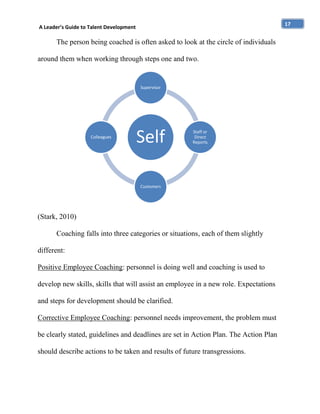
The person being coached is often asked to look at the circle of individuals
around them when working through steps one and two.

Supervisor

Colleagues

Self

Staff or
Direct
Reports

Customers

(Stark, 2010)
Coaching falls into three categories or situations, each of them slightly
different:
Positive Employee Coaching: personnel is doing well and coaching is used to
develop new skills, skills that will assist an employee in a new role. Expectations
and steps for development should be clarified.
Corrective Employee Coaching: personnel needs improvement, the problem must
be clearly stated, guidelines and deadlines are set in Action Plan. The Action Plan
should describe actions to be taken and results of future transgressions.
A Leader’s Guide to Talent Development

Coaching to Solve Problems: The coach is a resource and sounding board for
personnel as problems are described and solutions planned. The coach listens to
suggestions for resolution. This approach takes longer than the first two models.
(Spry, N.D.).
In all models of coaching, personnel should be encouraged to utilize and
strengthen individual skills (Spry, N.D.).The coach may provide a variety of
services to help the individual improve his or her performance. In most models of
coaching an Action Plan or Learning Plan is developed and followed. These plans
should assist each person in navigating the change that is required.
Supporting staff and volunteers through changes and promotions requires that
personnel not be placed into situations where they cannot be successful (Lazear,
2000). For example, an individual who is an excellent kennel cleaner may not
succeed if placed into a position of management over all other kennel cleaners.
Instead, this staff person may be able to assist with in-house training to help other
staff and volunteers learn how to replicate the same kind of success in cleaning
kennels.
Assessing and Guiding Professional Development
Not all professional development will be the same. As reviewed above, some
professional training may be part of an Action Plan or Learning Plan designed to
help an employee work toward competence, others may be part of a personnel

18
A Leader’s Guide to Talent Development

development plan if a manager wishes to groom a future organization leader.
Depending on the goals and type of position held by the individual receiving the
training, formal university education may be necessary and in other instances a
webinar or book may provide the needed education. Regardless of the type of
implementation, the plan will assist not only the employee, but also the
organization, work toward change and new goals (Kotter, 2006, pg. 21).
Change in an organization or expectations for departments or individuals can
be difficult for both a manager and employees. Part of managing the
implementation plan and change depends on the leadership of the manager and the
“spirit of performance” that will be expected by each member of the team (Dreker,
1974). A manager who involves employees in the process of change by asking for
input, initiating frequent communication, and maintaining positivity and flexibility
while also maintaining high expectations can be a facilitator for both increased
productivity and acceptance of the change needed by the organization (Stark,
2010).

19
A Leader’s Guide to Talent Development

References
A-Ten Talent. (N.D.). Development workbook. Accessed from
http://www.atentalent.co.uk/upload/Development%20Workbook.pdf.
Bishop S. (1999). Cross-functional project teams in functionally aligned
organizations. Project Management Journal. 30(3): pp.6–12.
Bolden, R. Gosling, J., Maturano, A., & Dennison, P. (2003). A review of
leadership theory and competency frameworks. Center for leadership
studies. University of Exeter.
Coach. (n.d.). Online etymology dictionary. Retrieved August 12, 2012, from
Dictionary.com website: http://dictionary.reference.com/browse/coach.
Cherry, K. (N.D.). Lewin’s leadership styles. Psychology. Accessed from
http://psychology.about.com/od/leadership/a/leadstyles.htm.
Conger, J. A. & Fulmer, R. M. (2003). Developing your leadership pipeline.
Harvard Business Review. Volume 12.
http://www.mbaforum.ir/download/developing_your_leadership_pipeline.pd
f.
Dreker, P. (1974). Management: Tasks, responsibilities, practices. Harper Row:
New York, NY.
Goleman, D. (2001). The emotionally intelligent workplace. (eds.Cherniss, C. &
Goleman, D.) Jossey Bass: San Francisco, CA. pp. 13-26.
Huang J. (2000). Knowledge integration processes and dynamics: an empirical
study of two cross-functional programme teams. Unpublished PhD thesis,
Warwick Business School, University of Warwick.
Jensen, A. L., Rideout, M.C.,Freedman, J. M. (1993). Handle with care. 6
Seconds. Watsonville, CA.
Kotter, J. P. (1996). Leading change. Harvard Business School Press: Boston, MA.
Lazear, E. P. (2000). The peter principle: Promotions and declining productivity.
Hoover Institution and Graduate School of Business, Stanford University.
Accessed from http://www-siepr.stanford.edu/Papers/pdf/00-04.pdf.
Lewin, K., Lippit, R. & White, R.K. (1939). Patterns of aggressive behavior in
experimentally created social climates. Journal of Social Psychology, 10, pp.
271-301.

20
A Leader’s Guide to Talent Development

Maciariello, J. A. (2006). The leader of the future 2: Visions, strategies, and
practices for the new era. Hesselbein, F. & Goldsmith, M. (Eds.) JosseyBass: San Francisco, CA.
Merriam-Webster. (N.D.). Talent. Accessed from http://www.merriamwebster.com/dictionary/talent.
Raimond, P. (1996). Two styles of foresight. Long Range Planning, April, pp 208214.
Rotemburg, J. J. & Saloner, G. (1993). Leadership style and incentives.
Management Science. 39(11): pp. 1299-1318.
Sarin, S. & McDermitt, C. (2003). The effect of team leader characteristics on
learning, knowledge application, and performance of cross-functional new
product development teams. Decision Sciences, 34(4): pp.707-739.
Senge, P. (1990). The fifth discipline: The art and practice of the learning
organization. New York: Doubleday/Currency.
Spry, D. (N.D.). What is cognitive behavioral coaching? Evan Carmichael.
http://www.evancarmichael.com/Business-Coach/6561/What-is-CognitiveBehavioural-Coaching.html.
Spry, D. (N.D.). Maintaining high emotional intelligence for employees. Evan
Carmichael. http://www.evancarmichael.com/BusinessCoach/6561/Maintaining-High-Emotional-Intelligence-for-Employees.html.
Stark, P.B. (2010). Guiding employees through change. 8 tips to help managers
and employees deal with organizational change. Peter Barron Stark
Companies. Accessed from http://www.peterstark.com/2010/managersemployees-organizational-change/.
Stark, P.B. (2010). 360 degree leadership development. Multi-level feedback. Peter
Barron Stark Companies. Accessed from
http://www.peterstark.com/services/surveys/leadership-developmentassessment/.
The Executive Coaching Forum. (2004). The executive coaching handbook:
Principles and guidelines for a successful coaching partnership. The
Executive Coaching Forum.
http://www.sitemason.com/files/lCd2Zq/The%20Executive%20Coaching%2
0Handbook.pdf.

21
22

A Leader’s Guide to Talent Development

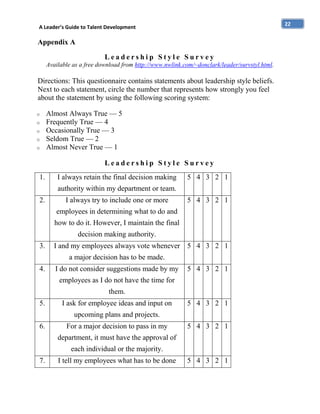
Appendix A
Leadership Style Survey
Available as a free download from http://www.nwlink.com/~donclark/leader/survstyl.html.

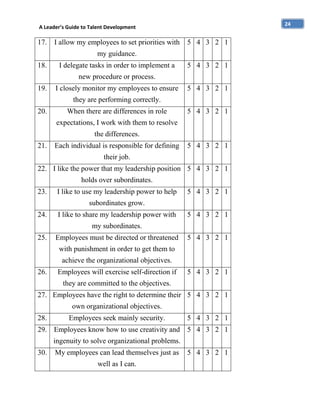
Directions: This questionnaire contains statements about leadership style beliefs.
Next to each statement, circle the number that represents how strongly you feel
about the statement by using the following scoring system:
o
o
o
o
o

Almost Always True — 5
Frequently True — 4
Occasionally True — 3
Seldom True — 2
Almost Never True — 1
Leadership Style Survey

1.

I always retain the final decision making

5 4 3 2 1

authority within my department or team.
2.

I always try to include one or more

5 4 3 2 1

employees in determining what to do and
how to do it. However, I maintain the final
decision making authority.
3.

I and my employees always vote whenever 5 4 3 2 1
a major decision has to be made.

4.

I do not consider suggestions made by my

5 4 3 2 1

employees as I do not have the time for
them.
5.

I ask for employee ideas and input on

5 4 3 2 1

upcoming plans and projects.
6.

For a major decision to pass in my

5 4 3 2 1

department, it must have the approval of
each individual or the majority.
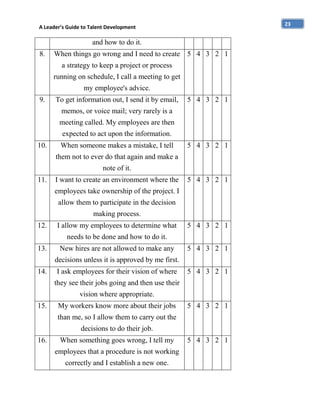
7.

I tell my employees what has to be done

5 4 3 2 1
23

A Leader’s Guide to Talent Development

and how to do it.
8.

When things go wrong and I need to create 5 4 3 2 1
a strategy to keep a project or process
running on schedule, I call a meeting to get
my employee's advice.

9.

To get information out, I send it by email,

5 4 3 2 1

memos, or voice mail; very rarely is a
meeting called. My employees are then
expected to act upon the information.
10.

When someone makes a mistake, I tell

5 4 3 2 1

them not to ever do that again and make a
note of it.
11.

I want to create an environment where the

5 4 3 2 1

employees take ownership of the project. I
allow them to participate in the decision
making process.
12.

I allow my employees to determine what

5 4 3 2 1

needs to be done and how to do it.
13.

New hires are not allowed to make any

5 4 3 2 1

decisions unless it is approved by me first.
14.

I ask employees for their vision of where

5 4 3 2 1

they see their jobs going and then use their
vision where appropriate.
15.

My workers know more about their jobs

5 4 3 2 1

than me, so I allow them to carry out the
decisions to do their job.
16.

When something goes wrong, I tell my
employees that a procedure is not working
correctly and I establish a new one.

5 4 3 2 1
24

A Leader’s Guide to Talent Development

17.

I allow my employees to set priorities with

5 4 3 2 1

my guidance.
18.

I delegate tasks in order to implement a

5 4 3 2 1

new procedure or process.
19.

I closely monitor my employees to ensure

5 4 3 2 1

they are performing correctly.
20.

When there are differences in role

5 4 3 2 1

expectations, I work with them to resolve
the differences.
21.

Each individual is responsible for defining

5 4 3 2 1

their job.
22. I like the power that my leadership position 5 4 3 2 1
holds over subordinates.
23.

I like to use my leadership power to help

5 4 3 2 1

subordinates grow.
24.

I like to share my leadership power with

5 4 3 2 1

my subordinates.
25.

Employees must be directed or threatened

5 4 3 2 1

with punishment in order to get them to
achieve the organizational objectives.
26.

Employees will exercise self-direction if

5 4 3 2 1

they are committed to the objectives.
27. Employees have the right to determine their 5 4 3 2 1
own organizational objectives.
28.

Employees seek mainly security.

5 4 3 2 1

29. Employees know how to use creativity and 5 4 3 2 1
ingenuity to solve organizational problems.
30.

My employees can lead themselves just as
well as I can.

5 4 3 2 1
25

A Leader’s Guide to Talent Development

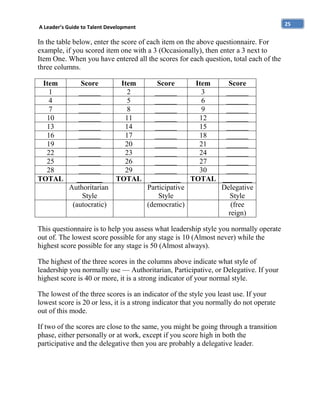
In the table below, enter the score of each item on the above questionnaire. For
example, if you scored item one with a 3 (Occasionally), then enter a 3 next to
Item One. When you have entered all the scores for each question, total each of the
three columns.
Item
1
4
7
10
13
16
19
22
25
28
TOTAL

Score
______
______
______
______
______
______
______
______
______
______
_______
Authoritarian
Style
(autocratic)

Item
2
5
8
11
14
17
20
23
26
29
TOTAL

Score
Item
Score
______
3
______
______
6
______
______
9
______
______
12
______
______
15
______
______
18
______
______
21
______
______
24
______
______
27
______
______
30
______
________ TOTAL ________
Participative
Delegative
Style
Style
(democratic)
(free
reign)

This questionnaire is to help you assess what leadership style you normally operate
out of. The lowest score possible for any stage is 10 (Almost never) while the
highest score possible for any stage is 50 (Almost always).
The highest of the three scores in the columns above indicate what style of
leadership you normally use — Authoritarian, Participative, or Delegative. If your
highest score is 40 or more, it is a strong indicator of your normal style.
The lowest of the three scores is an indicator of the style you least use. If your
lowest score is 20 or less, it is a strong indicator that you normally do not operate
out of this mode.
If two of the scores are close to the same, you might be going through a transition
phase, either personally or at work, except if you score high in both the
participative and the delegative then you are probably a delegative leader.
A Leader’s Guide to Talent Development

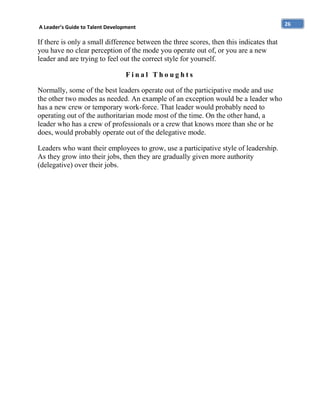
If there is only a small difference between the three scores, then this indicates that
you have no clear perception of the mode you operate out of, or you are a new
leader and are trying to feel out the correct style for yourself.
Final Thoughts
Normally, some of the best leaders operate out of the participative mode and use
the other two modes as needed. An example of an exception would be a leader who
has a new crew or temporary work-force. That leader would probably need to
operating out of the authoritarian mode most of the time. On the other hand, a
leader who has a crew of professionals or a crew that knows more than she or he
does, would probably operate out of the delegative mode.
Leaders who want their employees to grow, use a participative style of leadership.
As they grow into their jobs, then they are gradually given more authority
(delegative) over their jobs.

26
27

A Leader’s Guide to Talent Development

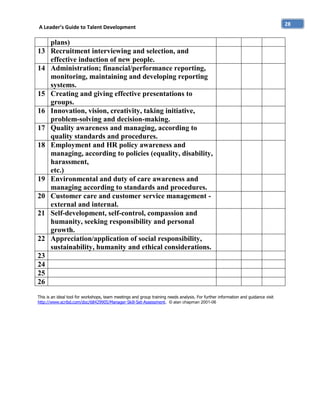
Appendix B-Management Skill Assessment
Created by Alan Chapman and available as a free download at
http://www.scribd.com/doc/68429905/Manager-Skill-Set-Assessment.
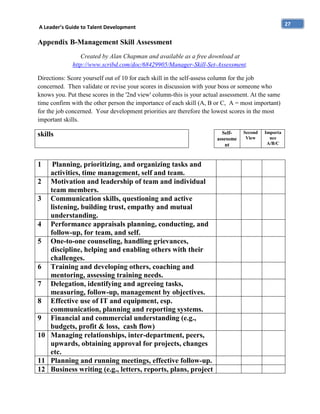
Directions: Score yourself out of 10 for each skill in the self-assess column for the job
concerned. Then validate or revise your scores in discussion with your boss or someone who
knows you. Put these scores in the '2nd view' column-this is your actual assessment. At the same
time confirm with the other person the importance of each skill (A, B or C, A = most important)
for the job concerned. Your development priorities are therefore the lowest scores in the most
important skills.

skills

1

Planning, prioritizing, and organizing tasks and
activities, time management, self and team.
2 Motivation and leadership of team and individual
team members.
3 Communication skills, questioning and active
listening, building trust, empathy and mutual
understanding.
4 Performance appraisals planning, conducting, and
follow-up, for team, and self.
5 One-to-one counseling, handling grievances,
discipline, helping and enabling others with their
challenges.
6 Training and developing others, coaching and
mentoring, assessing training needs.
7 Delegation, identifying and agreeing tasks,
measuring, follow-up, management by objectives.
8 Effective use of IT and equipment, esp.
communication, planning and reporting systems.
9 Financial and commercial understanding (e.g.,
budgets, profit & loss, cash flow)
10 Managing relationships, inter-department, peers,
upwards, obtaining approval for projects, changes
etc.
11 Planning and running meetings, effective follow-up.
12 Business writing (e.g., letters, reports, plans, project

Selfassessme
nt

Second
View

Importa
nce
A/B/C
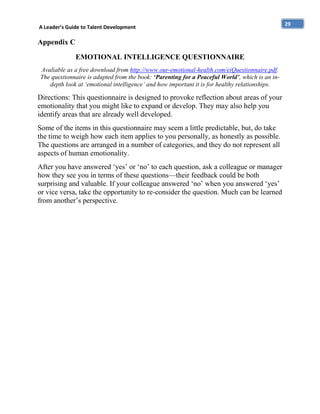
A Leader’s Guide to Talent Development

13
14

15
16
17
18

19
20
21

22

plans)
Recruitment interviewing and selection, and
effective induction of new people.
Administration; financial/performance reporting,
monitoring, maintaining and developing reporting
systems.
Creating and giving effective presentations to
groups.
Innovation, vision, creativity, taking initiative,
problem-solving and decision-making.
Quality awareness and managing, according to
quality standards and procedures.
Employment and HR policy awareness and
managing, according to policies (equality, disability,
harassment,
etc.)
Environmental and duty of care awareness and
managing according to standards and procedures.
Customer care and customer service management external and internal.
Self-development, self-control, compassion and
humanity, seeking responsibility and personal
growth.
Appreciation/application of social responsibility,
sustainability, humanity and ethical considerations.

23
24
25
26
This is an ideal tool for workshops, team meetings and group training needs analysis. For further information and guidance visit
http://www.scribd.com/doc/68429905/Manager-Skill-Set-Assessment. © alan chapman 2001-06

28
A Leader’s Guide to Talent Development

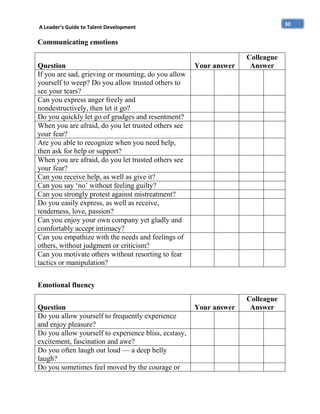
Appendix C
EMOTIONAL INTELLIGENCE QUESTIONNAIRE
Avaliable as a free download from http://www.our-emotional-health.com/eiQuestionnaire.pdf.
The questionnaire is adapted from the book: ‘Parenting for a Peaceful World’, which is an indepth look at ‘emotional intelligence’ and how important it is for healthy relationships.

Directions: This questionnaire is designed to provoke reflection about areas of your
emotionality that you might like to expand or develop. They may also help you
identify areas that are already well developed.
Some of the items in this questionnaire may seem a little predictable, but, do take
the time to weigh how each item applies to you personally, as honestly as possible.
The questions are arranged in a number of categories, and they do not represent all
aspects of human emotionality.
After you have answered ‘yes’ or ‘no’ to each question, ask a colleague or manager
how they see you in terms of these questions—their feedback could be both
surprising and valuable. If your colleague answered ‘no’ when you answered ‘yes’
or vice versa, take the opportunity to re-consider the question. Much can be learned
from another’s perspective.

29
30

A Leader’s Guide to Talent Development

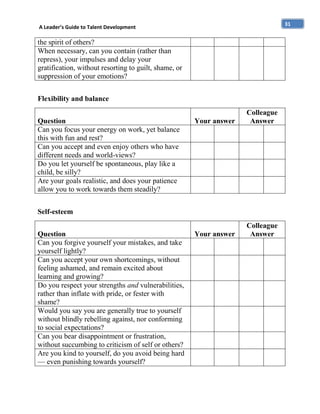
Communicating emotions
Question
If you are sad, grieving or mourning, do you allow
yourself to weep? Do you allow trusted others to
see your tears?
Can you express anger freely and
nondestructively, then let it go?
Do you quickly let go of grudges and resentment?
When you are afraid, do you let trusted others see
your fear?
Are you able to recognize when you need help,
then ask for help or support?
When you are afraid, do you let trusted others see
your fear?
Can you receive help, as well as give it?
Can you say ‘no’ without feeling guilty?
Can you strongly protest against mistreatment?
Do you easily express, as well as receive,
tenderness, love, passion?
Can you enjoy your own company yet gladly and
comfortably accept intimacy?
Can you empathize with the needs and feelings of
others, without judgment or criticism?
Can you motivate others without resorting to fear
tactics or manipulation?

Your answer

Colleague
Answer

Your answer

Colleague
Answer

Emotional fluency
Question
Do you allow yourself to frequently experience
and enjoy pleasure?
Do you allow yourself to experience bliss, ecstasy,
excitement, fascination and awe?
Do you often laugh out loud — a deep belly
laugh?
Do you sometimes feel moved by the courage or
31

A Leader’s Guide to Talent Development

the spirit of others?
When necessary, can you contain (rather than
repress), your impulses and delay your
gratification, without resorting to guilt, shame, or
suppression of your emotions?
Flexibility and balance
Question
Can you focus your energy on work, yet balance
this with fun and rest?
Can you accept and even enjoy others who have
different needs and world-views?
Do you let yourself be spontaneous, play like a
child, be silly?
Are your goals realistic, and does your patience
allow you to work towards them steadily?

Your answer

Colleague
Answer

Your answer

Colleague
Answer

Self-esteem
Question
Can you forgive yourself your mistakes, and take
yourself lightly?
Can you accept your own shortcomings, without
feeling ashamed, and remain excited about
learning and growing?
Do you respect your strengths and vulnerabilities,
rather than inflate with pride, or fester with
shame?
Would you say you are generally true to yourself
without blindly rebelling against, nor conforming
to social expectations?
Can you bear disappointment or frustration,
without succumbing to criticism of self or others?
Are you kind to yourself, do you avoid being hard
— even punishing towards yourself?
A Leader’s Guide to Talent Development

Have a look at the questions where you answered ‘no’. Your areas for potential
growth are signaled by those questions. Areas of difficulty may well represent
emotional wounds — possibly sustained early in life — that call for healing and
growth. Your answers may also point towards areas of personal vulnerability
where you might find your greatest challenges. For example, those who have
difficulty expressing anger may have the most trouble allowing their staff or
volunteers to be angry.
If any of the sections above feel particularly problematic, you may wish to seek
professional advice.

32

A leaders guide itle-clark1

  • 1.
    A Leader’s Guide to Talent Development AHandbook for Managers Stephanie Itle-Clark MS Ed., CHES
  • 2.
    A Leader’s Guideto Talent Development About this Handbook You are probably already familiar with the fast pace of change and the growing skill set needed by employees and even volunteers in businesses, both in the for-profit and non-profit sector. Organizations have leaders in all levels, and each level plays an important part in maintenance and long-term success of strategic goals. Encouragement of leadership through personnel development among staff and volunteers can increase morale and productivity–after all, when people are engaged and rewarded they tend to be happier and more productive. This handbook will help current and future leaders learn how to move beyond the traditional hierarchy of those who lead only from coveted top levels to a leadership style that develops talent in a way that promotes leadership renewal. By renewing the leaders in all levels of your organization you are building a community of loyal personnel and individuals who work in the position that is best for both them and the organization. Handbook Outcomes This handbook will help leaders to: Categorize and describe leadership theories and styles Identify personnel (staff and volunteers) who have the skills and talent needed in organization and evaluate personnel goals and career path Appraise personnel and determine those who may need development before they can assume greater responsibility Ascertain future leaders and effectively foster development 1
  • 3.
    A Leader’s Guideto Talent Development Section One—Leadership and Talent What is talent and how do we find it? According to the Merriam-Webster Dictionary, talent is: the natural endowments of a person; a special often athletic, creative, or artistic aptitude; general intelligence or mental power (Merriam-Webster, N.D.) Talented staff and volunteers may be found or groomed, but a general rule is that talented personnel have a high intelligence quotient (IQ), a high emotional quotient (EQ), motivation, skills and knowledge related to the field, and can be a good leader when they are asked to step up to the task (Conger & Fulmer, 2003). So if it is true that talented individuals have certain traits and skills, how does current leadership play into changes and the talent development of others in the organization? Leadership Impact on the Organization and Professional Development The preparation and execution of successful management and change creation in an organization is not a specific formula, which sadly means that many individuals placed into positions of leadership are left to figure out the basics of what works and what does not using the trial and error method. Effective leaders utilize a combination of best business practice, knowledge of management, 2
  • 4.
    A Leader’s Guideto Talent Development leadership skill, and individual behaviors or demeanors that resonate with others (Maciariello, 2006, p. 4). Recognizing and developing future leadership in others begins with the current leadership in an organization. The successful leader can not only inspire, but be one who can see potential in personnel, work toward the mission and vision of the organization, and recognize when personnel need repurposed or trained for either their current or future roles. A leader is expected to know the trends of his or her field, complete and delegate tasks, be an effective executive, and lead in a way that inspires excellence from others. Spirit of performance, or the commitment to “do the right thing” and “get the right things done”, are key in an organization where management and executives are a force of inspiration and act as leaders of change. The internal and external actions of a group also act as a force of inspiration and indicate the mission and values of an organization – personnel decisions reward the behaviors that are wanted and indicate those which are not desired (Maciariello, 2006, p. 57). As indicated by the Leadership and Efficacy graphic below, both internal and external influences will impact a company and staff or volunteers. 3
  • 5.
    4 A Leader’s Guideto Talent Development Leadership and Efficacy Knowledge of Environmental Trends Understanding Theory of the Business Internal External Leadership Practices Effective Executive Skills Tasks Innovation and Entrepeneurship Organizational Results Spirit of Performance Social Impacts Knowledge of Environmental Trends Adapted from “Creative Destruction” Maciariello, 2006, p.4
  • 6.
    A Leader’s Guideto Talent Development Successful Talent Management Part of leading and managing change is the ability to assess, hire, promote, and develop a team of motivated and successful people. Two key points should be kept in mind as you and your organization build a valuable workforce: 1) When filling an open position do so with only top candidates. 2) Chronic underperformers should be retrained or replaced. Following these tips will give your organization “competitive capacity”, as the organization will be full of individuals who listen with an open mind, desire to experience new things or try new methods, and reflect upon events, recognizing both positive and negative and noting what can be done differently next time (Kotter, 1996, p. 178-180). Traits or skills to look for in current and prospective staff and volunteers: 1) Strategic thinking - Strategic thinking goes beyond planning and includes the synthesizing process that leads to strategic planning. Think of this as trait as someone who thinks about why a project may or may not work, not just one who looks at how the project can be completed. Strategic thinkers will craft the bones of the plan using data as well as intuition (Raimond, 1996). Individuals who excel at strategic thinking move beyond the mental models 5
  • 7.
    A Leader’s Guideto Talent Development with which they are most comfortable or those that are accepted as the norm. Creative strategies push organizations to new levels (Senge, 1990). 2) Ability to listen and be coached (and in the future coach others) - Active listening, open-ended questions, positive body language, and eliminated distractions are tools used by effective communicators. Directing and telling have a time and a place in the work place, but a person who may show potential for a leadership role will be open to listening to and learning from others. A coaching manager will work with direct reports to create a personal development plan. 3) Willingness to gain cross-functional knowledge and perspective – Personnel who expand their knowledge base to include not only their department or specific tasks are often better prepared to take on new roles and be open to professional development. This knowledge integration of department work is ‘‘an ongoing collective process of constructing, articulating, and redefining shared beliefs through the social interaction of organizational members’’ (Huang, 2000, p. 15). Personnel who show creativity and innovation, and those who generate consensus through collective input will be beneficial as organizations work toward long-term goals (Bishop, 1999). Competitiveness in the marketplace depends on the diversity and strategic value of 6
  • 8.
    A Leader’s Guideto Talent Development specialized knowledge, as well as an organization’s capacity to integrate the knowledge in an effective fashion (Huang & Newell, 2003). 4) Knowledge of the industry – Similar to item three, willingness to gain crossfunctional knowledge, staff and volunteers who have an understanding of the industry and competitors will be prepared to utilize environmental and social events to benefit the organization (Drucker, 2001). 5) Ability to collaborate – The ability to work with others to achieve an organization goal. A true collaborator will communicate with coworkers, visualize ideas and create vision for strategic thinking, and acknowledge partners in collaborative work. 7
  • 9.
    A Leader’s Guideto Talent Development Section Two—Follow the Leader Leadership Theories There are many types of leaders and theories about who will make a great leader. Some leadership theories focus on what innate qualities distinguish between leaders and followers, while other theories review other variables such as situational factors and individual skill levels. You may find in your organization that the best staff and volunteers are those who display components of various theories. 8
  • 10.
    9 A Leader’s Guideto Talent Development Leadership Theories Great Man Theory The idea that individuals are born as leaders and with the capabilities needed to lead was an early theory. The Great Man theory led into the development of the trait theory. Trait Theory Traits related to positive action and personality type are associated with a leader. Behaviorist Theory This theory concentrates on the actions of the leader. Situational Leadership Leadership style necessary is specific to the situation at hand. Type of leadership may change per department and per level of personnel. Contingency Theory Similar to Situational Leadership, this theory focuses on identifying the variables of the problem or need. Transactional Theory Similar to democratic functioning, this theory highlights the relationship between the leader and the employee. The leader rewards service and commitment. Transformational Theory Leaders implement change and transform an organization (Bolden, Gosling, Maturano, & Dennison, 2003).
  • 11.
    A Leader’s Guideto Talent Development Separating one specific theory as the best model can be difficult and may not work for you, the manager reading this guide, nor for the employees whom you wish to develop. Fielder’s Contingency Theory suggests that there is no one best theory or way for a manager to lead. The result of a specific personnel or organization situation is contingent upon all other factors involved. Fielder looked at three situations that could “define the condition of management action” (Bolden, et.al, 2003): 1. Leader member relations- What is the relationship between staff and managers, do they get along? 2. Task structure- Does the organization or staff person have a position with tasks that occur on a routine basis, or do tasks change regularly? 3. Position power-What is the level of authority provided to the manager in a given department or within the organization? (Bolden, et.al, 2003). 10
  • 12.
    A Leader’s Guideto Talent Development Leadership Styles Fielder’s Contingency Model employs the idea that there are various styles of leadership. Along with the theories of leadership, leadership styles influence both the current managers, and also those who will be recognized as future leaders, or the organization talent to be developed. Leadership styles range from democratic or participative, allowing for a leader within the organization to subscribe to team leadership or autocratic and authoritarian leadership in which the leader maintains a high level of control (Sarin & McDermitt, 2003; Rotemberg &Saloner, 1993). Three main styles of leadership are authoritarian, participative, and delegative (Lewin, Lippit, & White, 1939). Authoritarian leadership (leader-based) provides a clear divide between the leader and followers and the leader dictates what will occur, when it will occur. In authoritarian models of leadership, the leader controls the decisions and the followers have very little involvement regarding the change or projects. Leaderbased governance is most effective in creating fundamental change. Participative leadership (or relationship-based), also known as democratic leadership, allows leaders to offer direction to followers and allow the group to participate in the outcomes and decision making. The leader maintains the final decision while the followers feel connected to the organization. Relationship-based 11
  • 13.
    A Leader’s Guideto Talent Development authority is most effective when an organization plans to create growing change and when relationships build between the leader and followers. The final leadership style, the delegative leadership (follower-based) style, is one in which the leader offers little direction to followers, allowing the group to make the majority of the decisions. “This style can be effective in situations where group members are highly qualified in an area of expertise; it often leads to poorly defined roles and a lack of motivation” (Cherry, N.D.). Follower-based authority requires highly skilled followers and the leader giving up a large amount of control. 12
  • 14.
    13 A Leader’s Guideto Talent Development Domains of Leadership Leader-based Relationship-based Follower-based Behaviors that Establishes Builds relationships; Empowering, constitute communication and mutual learning; coaching, leadership vision; inspires and accommodates facilitating, giving encourages action various needs and up and pride personality types control Fundamental Organization Highly skilled and appropriate and change; working toward committed effective charismatic leader; continuous followers limited diversity improvement; among followers substantial Most diversity and stability among followers (Graen & Uhl-Bien, 1995). Recognizing Your Style Recognition of one’s own leadership style is helpful in both management and talent development strategies as well as in noting strengths and areas for growth in personnel. For those in current positions of leadership another way to assess the way in which you interact with others is recognizing personal and personnel emotional intelligence. “Emotional intelligence, at the most general level, refers to the abilities to recognize and regulate emotions in ourselves and in
  • 15.
    A Leader’s Guideto Talent Development others” (Goleman, 2001). Emotional intelligence allows us to identify, understand, and choose our thoughts and behaviors. “It shapes our interactions with others and our understanding of ourselves. It defines how and what we learn; it allows us to set priorities; it determines the majority of our daily actions. Because emotional intelligence is so closely tied to the ways we relate to ourselves and others, research suggests it is responsible for as much as 80% of the “success” in our lives” (Jensen, Rideout, Freedman, 1998. ) Personnel with high emotional intelligence monitor and analyze their emotions and the emotions of others. This allows them to consider how to best deal with colleagues in the work environment to produce a positive working relationship and product or service outcome (Spry, N.D.). Included in this manual are three self-assessments. The first item (Appendix A) is a brief assessment of leadership style. The second (Appendix B) is a management skill assessment that not only allows for self-assessment of leadership competencies, but also allows for input from a supervisor or colleague. The third (Appendix C) can help you to see your personal level of emotional intelligence. Each of these tools may be shared with others in your organization. 14
  • 16.
    A Leader’s Guideto Talent Development Section Three—The Strongest Organizational Tool: Recognizing Personnel Strengths As a leader or manager in your organization, the strongest tool in your arsenal is the pool of your staff and volunteers. Knowing and recognizing personnel can assist managers in identifying areas of strength and areas of need. The capacity to recognize the talents in personnel can help an organization to grow and maintain strong leaders through specific grooming and renewal processes. As referenced earlier, ideally each organization will fill staff and volunteer positions with those who are committed to the organization, show skill, and are willing to reflect upon what needs done and how to accomplish it. But even the best leaders and staff can get better! This is where professional development comes in. Facilitating advancement can only happen when a person is able to grow from his or her previous position and show the capacity to take on more challenges. Regardless of profession or level, employees are constantly looking to take the next step. The talent an employee or volunteer needs to get to the next level in their career may be present, but they might not have yet needed it; the talent can be developed. The recognition of personnel strengths allows talent to be developed accordingly as either a specialist or generalist. To develop specialists, staff is trained using a “skill-based plan” with increasing responsibility. Generalists on the other hand are exposed to an 15
  • 17.
    A Leader’s Guideto Talent Development assortment of experiences allowing them to gain an understanding of the organization as a whole. The development of each type of staff member necessitates planning, support, and supervisor feedback. Coaching the Team Coaching, a popular approach to employee development is not a new concept, dating back to “c.1830 Oxford University slang for a tutor” (coach, N.D.). Coaching is founded upon the relationship between the coach and the individual being coached. A coach may assist an individual in a variety of ways, including but not limited to understanding and learning new skills, becoming comfortable in particular situations, working on a personal goal, or preparing for a career change. A coach does not tell a client what to do; instead the coach will provide patience and assist personnel in creating his or her own solutions and answers (The Executive Coaching Forum, 2004). There are five steps to the coaching process: 1. Analyze the main patterns and trends in behavior 2. Understand the patterns and review the data for each of the trends in behavior. 3. Conclude by drawing together the findings from the previous two steps. 4. Plan development by prioritizing areas for action. Create outcomes. 5. Commit. Ensure plan is followed through in the timings you have specified. (ATen Talent, N.D.) 16
  • 18.
    17 A Leader’s Guideto Talent Development The person being coached is often asked to look at the circle of individuals around them when working through steps one and two. Supervisor Colleagues Self Staff or Direct Reports Customers (Stark, 2010) Coaching falls into three categories or situations, each of them slightly different: Positive Employee Coaching: personnel is doing well and coaching is used to develop new skills, skills that will assist an employee in a new role. Expectations and steps for development should be clarified. Corrective Employee Coaching: personnel needs improvement, the problem must be clearly stated, guidelines and deadlines are set in Action Plan. The Action Plan should describe actions to be taken and results of future transgressions.
  • 19.
    A Leader’s Guideto Talent Development Coaching to Solve Problems: The coach is a resource and sounding board for personnel as problems are described and solutions planned. The coach listens to suggestions for resolution. This approach takes longer than the first two models. (Spry, N.D.). In all models of coaching, personnel should be encouraged to utilize and strengthen individual skills (Spry, N.D.).The coach may provide a variety of services to help the individual improve his or her performance. In most models of coaching an Action Plan or Learning Plan is developed and followed. These plans should assist each person in navigating the change that is required. Supporting staff and volunteers through changes and promotions requires that personnel not be placed into situations where they cannot be successful (Lazear, 2000). For example, an individual who is an excellent kennel cleaner may not succeed if placed into a position of management over all other kennel cleaners. Instead, this staff person may be able to assist with in-house training to help other staff and volunteers learn how to replicate the same kind of success in cleaning kennels. Assessing and Guiding Professional Development Not all professional development will be the same. As reviewed above, some professional training may be part of an Action Plan or Learning Plan designed to help an employee work toward competence, others may be part of a personnel 18
  • 20.
    A Leader’s Guideto Talent Development development plan if a manager wishes to groom a future organization leader. Depending on the goals and type of position held by the individual receiving the training, formal university education may be necessary and in other instances a webinar or book may provide the needed education. Regardless of the type of implementation, the plan will assist not only the employee, but also the organization, work toward change and new goals (Kotter, 2006, pg. 21). Change in an organization or expectations for departments or individuals can be difficult for both a manager and employees. Part of managing the implementation plan and change depends on the leadership of the manager and the “spirit of performance” that will be expected by each member of the team (Dreker, 1974). A manager who involves employees in the process of change by asking for input, initiating frequent communication, and maintaining positivity and flexibility while also maintaining high expectations can be a facilitator for both increased productivity and acceptance of the change needed by the organization (Stark, 2010). 19
  • 21.
    A Leader’s Guideto Talent Development References A-Ten Talent. (N.D.). Development workbook. Accessed from http://www.atentalent.co.uk/upload/Development%20Workbook.pdf. Bishop S. (1999). Cross-functional project teams in functionally aligned organizations. Project Management Journal. 30(3): pp.6–12. Bolden, R. Gosling, J., Maturano, A., & Dennison, P. (2003). A review of leadership theory and competency frameworks. Center for leadership studies. University of Exeter. Coach. (n.d.). Online etymology dictionary. Retrieved August 12, 2012, from Dictionary.com website: http://dictionary.reference.com/browse/coach. Cherry, K. (N.D.). Lewin’s leadership styles. Psychology. Accessed from http://psychology.about.com/od/leadership/a/leadstyles.htm. Conger, J. A. & Fulmer, R. M. (2003). Developing your leadership pipeline. Harvard Business Review. Volume 12. http://www.mbaforum.ir/download/developing_your_leadership_pipeline.pd f. Dreker, P. (1974). Management: Tasks, responsibilities, practices. Harper Row: New York, NY. Goleman, D. (2001). The emotionally intelligent workplace. (eds.Cherniss, C. & Goleman, D.) Jossey Bass: San Francisco, CA. pp. 13-26. Huang J. (2000). Knowledge integration processes and dynamics: an empirical study of two cross-functional programme teams. Unpublished PhD thesis, Warwick Business School, University of Warwick. Jensen, A. L., Rideout, M.C.,Freedman, J. M. (1993). Handle with care. 6 Seconds. Watsonville, CA. Kotter, J. P. (1996). Leading change. Harvard Business School Press: Boston, MA. Lazear, E. P. (2000). The peter principle: Promotions and declining productivity. Hoover Institution and Graduate School of Business, Stanford University. Accessed from http://www-siepr.stanford.edu/Papers/pdf/00-04.pdf. Lewin, K., Lippit, R. & White, R.K. (1939). Patterns of aggressive behavior in experimentally created social climates. Journal of Social Psychology, 10, pp. 271-301. 20
  • 22.
    A Leader’s Guideto Talent Development Maciariello, J. A. (2006). The leader of the future 2: Visions, strategies, and practices for the new era. Hesselbein, F. & Goldsmith, M. (Eds.) JosseyBass: San Francisco, CA. Merriam-Webster. (N.D.). Talent. Accessed from http://www.merriamwebster.com/dictionary/talent. Raimond, P. (1996). Two styles of foresight. Long Range Planning, April, pp 208214. Rotemburg, J. J. & Saloner, G. (1993). Leadership style and incentives. Management Science. 39(11): pp. 1299-1318. Sarin, S. & McDermitt, C. (2003). The effect of team leader characteristics on learning, knowledge application, and performance of cross-functional new product development teams. Decision Sciences, 34(4): pp.707-739. Senge, P. (1990). The fifth discipline: The art and practice of the learning organization. New York: Doubleday/Currency. Spry, D. (N.D.). What is cognitive behavioral coaching? Evan Carmichael. http://www.evancarmichael.com/Business-Coach/6561/What-is-CognitiveBehavioural-Coaching.html. Spry, D. (N.D.). Maintaining high emotional intelligence for employees. Evan Carmichael. http://www.evancarmichael.com/BusinessCoach/6561/Maintaining-High-Emotional-Intelligence-for-Employees.html. Stark, P.B. (2010). Guiding employees through change. 8 tips to help managers and employees deal with organizational change. Peter Barron Stark Companies. Accessed from http://www.peterstark.com/2010/managersemployees-organizational-change/. Stark, P.B. (2010). 360 degree leadership development. Multi-level feedback. Peter Barron Stark Companies. Accessed from http://www.peterstark.com/services/surveys/leadership-developmentassessment/. The Executive Coaching Forum. (2004). The executive coaching handbook: Principles and guidelines for a successful coaching partnership. The Executive Coaching Forum. http://www.sitemason.com/files/lCd2Zq/The%20Executive%20Coaching%2 0Handbook.pdf. 21
  • 23.
    22 A Leader’s Guideto Talent Development Appendix A Leadership Style Survey Available as a free download from http://www.nwlink.com/~donclark/leader/survstyl.html. Directions: This questionnaire contains statements about leadership style beliefs. Next to each statement, circle the number that represents how strongly you feel about the statement by using the following scoring system: o o o o o Almost Always True — 5 Frequently True — 4 Occasionally True — 3 Seldom True — 2 Almost Never True — 1 Leadership Style Survey 1. I always retain the final decision making 5 4 3 2 1 authority within my department or team. 2. I always try to include one or more 5 4 3 2 1 employees in determining what to do and how to do it. However, I maintain the final decision making authority. 3. I and my employees always vote whenever 5 4 3 2 1 a major decision has to be made. 4. I do not consider suggestions made by my 5 4 3 2 1 employees as I do not have the time for them. 5. I ask for employee ideas and input on 5 4 3 2 1 upcoming plans and projects. 6. For a major decision to pass in my 5 4 3 2 1 department, it must have the approval of each individual or the majority. 7. I tell my employees what has to be done 5 4 3 2 1
  • 24.
    23 A Leader’s Guideto Talent Development and how to do it. 8. When things go wrong and I need to create 5 4 3 2 1 a strategy to keep a project or process running on schedule, I call a meeting to get my employee's advice. 9. To get information out, I send it by email, 5 4 3 2 1 memos, or voice mail; very rarely is a meeting called. My employees are then expected to act upon the information. 10. When someone makes a mistake, I tell 5 4 3 2 1 them not to ever do that again and make a note of it. 11. I want to create an environment where the 5 4 3 2 1 employees take ownership of the project. I allow them to participate in the decision making process. 12. I allow my employees to determine what 5 4 3 2 1 needs to be done and how to do it. 13. New hires are not allowed to make any 5 4 3 2 1 decisions unless it is approved by me first. 14. I ask employees for their vision of where 5 4 3 2 1 they see their jobs going and then use their vision where appropriate. 15. My workers know more about their jobs 5 4 3 2 1 than me, so I allow them to carry out the decisions to do their job. 16. When something goes wrong, I tell my employees that a procedure is not working correctly and I establish a new one. 5 4 3 2 1
  • 25.
    24 A Leader’s Guideto Talent Development 17. I allow my employees to set priorities with 5 4 3 2 1 my guidance. 18. I delegate tasks in order to implement a 5 4 3 2 1 new procedure or process. 19. I closely monitor my employees to ensure 5 4 3 2 1 they are performing correctly. 20. When there are differences in role 5 4 3 2 1 expectations, I work with them to resolve the differences. 21. Each individual is responsible for defining 5 4 3 2 1 their job. 22. I like the power that my leadership position 5 4 3 2 1 holds over subordinates. 23. I like to use my leadership power to help 5 4 3 2 1 subordinates grow. 24. I like to share my leadership power with 5 4 3 2 1 my subordinates. 25. Employees must be directed or threatened 5 4 3 2 1 with punishment in order to get them to achieve the organizational objectives. 26. Employees will exercise self-direction if 5 4 3 2 1 they are committed to the objectives. 27. Employees have the right to determine their 5 4 3 2 1 own organizational objectives. 28. Employees seek mainly security. 5 4 3 2 1 29. Employees know how to use creativity and 5 4 3 2 1 ingenuity to solve organizational problems. 30. My employees can lead themselves just as well as I can. 5 4 3 2 1
  • 26.
    25 A Leader’s Guideto Talent Development In the table below, enter the score of each item on the above questionnaire. For example, if you scored item one with a 3 (Occasionally), then enter a 3 next to Item One. When you have entered all the scores for each question, total each of the three columns. Item 1 4 7 10 13 16 19 22 25 28 TOTAL Score ______ ______ ______ ______ ______ ______ ______ ______ ______ ______ _______ Authoritarian Style (autocratic) Item 2 5 8 11 14 17 20 23 26 29 TOTAL Score Item Score ______ 3 ______ ______ 6 ______ ______ 9 ______ ______ 12 ______ ______ 15 ______ ______ 18 ______ ______ 21 ______ ______ 24 ______ ______ 27 ______ ______ 30 ______ ________ TOTAL ________ Participative Delegative Style Style (democratic) (free reign) This questionnaire is to help you assess what leadership style you normally operate out of. The lowest score possible for any stage is 10 (Almost never) while the highest score possible for any stage is 50 (Almost always). The highest of the three scores in the columns above indicate what style of leadership you normally use — Authoritarian, Participative, or Delegative. If your highest score is 40 or more, it is a strong indicator of your normal style. The lowest of the three scores is an indicator of the style you least use. If your lowest score is 20 or less, it is a strong indicator that you normally do not operate out of this mode. If two of the scores are close to the same, you might be going through a transition phase, either personally or at work, except if you score high in both the participative and the delegative then you are probably a delegative leader.
  • 27.
    A Leader’s Guideto Talent Development If there is only a small difference between the three scores, then this indicates that you have no clear perception of the mode you operate out of, or you are a new leader and are trying to feel out the correct style for yourself. Final Thoughts Normally, some of the best leaders operate out of the participative mode and use the other two modes as needed. An example of an exception would be a leader who has a new crew or temporary work-force. That leader would probably need to operating out of the authoritarian mode most of the time. On the other hand, a leader who has a crew of professionals or a crew that knows more than she or he does, would probably operate out of the delegative mode. Leaders who want their employees to grow, use a participative style of leadership. As they grow into their jobs, then they are gradually given more authority (delegative) over their jobs. 26
  • 28.
    27 A Leader’s Guideto Talent Development Appendix B-Management Skill Assessment Created by Alan Chapman and available as a free download at http://www.scribd.com/doc/68429905/Manager-Skill-Set-Assessment. Directions: Score yourself out of 10 for each skill in the self-assess column for the job concerned. Then validate or revise your scores in discussion with your boss or someone who knows you. Put these scores in the '2nd view' column-this is your actual assessment. At the same time confirm with the other person the importance of each skill (A, B or C, A = most important) for the job concerned. Your development priorities are therefore the lowest scores in the most important skills. skills 1 Planning, prioritizing, and organizing tasks and activities, time management, self and team. 2 Motivation and leadership of team and individual team members. 3 Communication skills, questioning and active listening, building trust, empathy and mutual understanding. 4 Performance appraisals planning, conducting, and follow-up, for team, and self. 5 One-to-one counseling, handling grievances, discipline, helping and enabling others with their challenges. 6 Training and developing others, coaching and mentoring, assessing training needs. 7 Delegation, identifying and agreeing tasks, measuring, follow-up, management by objectives. 8 Effective use of IT and equipment, esp. communication, planning and reporting systems. 9 Financial and commercial understanding (e.g., budgets, profit & loss, cash flow) 10 Managing relationships, inter-department, peers, upwards, obtaining approval for projects, changes etc. 11 Planning and running meetings, effective follow-up. 12 Business writing (e.g., letters, reports, plans, project Selfassessme nt Second View Importa nce A/B/C
  • 29.
    A Leader’s Guideto Talent Development 13 14 15 16 17 18 19 20 21 22 plans) Recruitment interviewing and selection, and effective induction of new people. Administration; financial/performance reporting, monitoring, maintaining and developing reporting systems. Creating and giving effective presentations to groups. Innovation, vision, creativity, taking initiative, problem-solving and decision-making. Quality awareness and managing, according to quality standards and procedures. Employment and HR policy awareness and managing, according to policies (equality, disability, harassment, etc.) Environmental and duty of care awareness and managing according to standards and procedures. Customer care and customer service management external and internal. Self-development, self-control, compassion and humanity, seeking responsibility and personal growth. Appreciation/application of social responsibility, sustainability, humanity and ethical considerations. 23 24 25 26 This is an ideal tool for workshops, team meetings and group training needs analysis. For further information and guidance visit http://www.scribd.com/doc/68429905/Manager-Skill-Set-Assessment. © alan chapman 2001-06 28
  • 30.
    A Leader’s Guideto Talent Development Appendix C EMOTIONAL INTELLIGENCE QUESTIONNAIRE Avaliable as a free download from http://www.our-emotional-health.com/eiQuestionnaire.pdf. The questionnaire is adapted from the book: ‘Parenting for a Peaceful World’, which is an indepth look at ‘emotional intelligence’ and how important it is for healthy relationships. Directions: This questionnaire is designed to provoke reflection about areas of your emotionality that you might like to expand or develop. They may also help you identify areas that are already well developed. Some of the items in this questionnaire may seem a little predictable, but, do take the time to weigh how each item applies to you personally, as honestly as possible. The questions are arranged in a number of categories, and they do not represent all aspects of human emotionality. After you have answered ‘yes’ or ‘no’ to each question, ask a colleague or manager how they see you in terms of these questions—their feedback could be both surprising and valuable. If your colleague answered ‘no’ when you answered ‘yes’ or vice versa, take the opportunity to re-consider the question. Much can be learned from another’s perspective. 29
  • 31.
    30 A Leader’s Guideto Talent Development Communicating emotions Question If you are sad, grieving or mourning, do you allow yourself to weep? Do you allow trusted others to see your tears? Can you express anger freely and nondestructively, then let it go? Do you quickly let go of grudges and resentment? When you are afraid, do you let trusted others see your fear? Are you able to recognize when you need help, then ask for help or support? When you are afraid, do you let trusted others see your fear? Can you receive help, as well as give it? Can you say ‘no’ without feeling guilty? Can you strongly protest against mistreatment? Do you easily express, as well as receive, tenderness, love, passion? Can you enjoy your own company yet gladly and comfortably accept intimacy? Can you empathize with the needs and feelings of others, without judgment or criticism? Can you motivate others without resorting to fear tactics or manipulation? Your answer Colleague Answer Your answer Colleague Answer Emotional fluency Question Do you allow yourself to frequently experience and enjoy pleasure? Do you allow yourself to experience bliss, ecstasy, excitement, fascination and awe? Do you often laugh out loud — a deep belly laugh? Do you sometimes feel moved by the courage or
  • 32.
    31 A Leader’s Guideto Talent Development the spirit of others? When necessary, can you contain (rather than repress), your impulses and delay your gratification, without resorting to guilt, shame, or suppression of your emotions? Flexibility and balance Question Can you focus your energy on work, yet balance this with fun and rest? Can you accept and even enjoy others who have different needs and world-views? Do you let yourself be spontaneous, play like a child, be silly? Are your goals realistic, and does your patience allow you to work towards them steadily? Your answer Colleague Answer Your answer Colleague Answer Self-esteem Question Can you forgive yourself your mistakes, and take yourself lightly? Can you accept your own shortcomings, without feeling ashamed, and remain excited about learning and growing? Do you respect your strengths and vulnerabilities, rather than inflate with pride, or fester with shame? Would you say you are generally true to yourself without blindly rebelling against, nor conforming to social expectations? Can you bear disappointment or frustration, without succumbing to criticism of self or others? Are you kind to yourself, do you avoid being hard — even punishing towards yourself?
  • 33.
    A Leader’s Guideto Talent Development Have a look at the questions where you answered ‘no’. Your areas for potential growth are signaled by those questions. Areas of difficulty may well represent emotional wounds — possibly sustained early in life — that call for healing and growth. Your answers may also point towards areas of personal vulnerability where you might find your greatest challenges. For example, those who have difficulty expressing anger may have the most trouble allowing their staff or volunteers to be angry. If any of the sections above feel particularly problematic, you may wish to seek professional advice. 32