BURNSBURNS
 Dr BINU K JOHN
 JR1
1
BURNSBURNS
Destruction of skin by heat severe
local and systemic physiological alterations
2
BURNSBURNS
Results in 10-20 thousand deaths
annually
Survival best at ages 15-45
Children, elderly, and diabetics
Survival best burns cover less than 20%
of TBA
3
TYPES OF BURNSTYPES OF BURNS
Thermal
exposure to flame or a hot object
Chemical
exposure to acid, alkali or organic substances
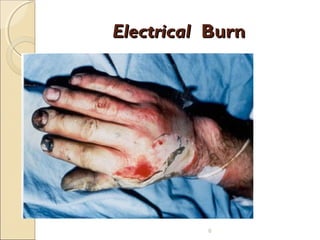
Electrical
result from the conversion of electrical energy into heat.
Extent of injury depends on the type of current, the pathway of
flow, local tissue resistance, and duration of contact
Radiation
result from radiant energy being transferred to the body
resulting in production of cellular toxins
4
Chemical BurnChemical Burn
5
ElectricalElectrical BurnBurn
6
BURN WOUNDBURN WOUND
ASSESSMENTASSESSMENT
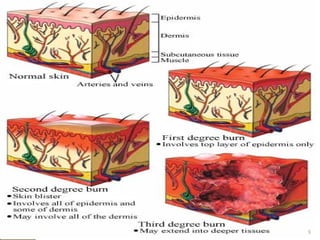
Classified according to depth of injury and
extent of body surface area involved
Burn wounds differentiated depending on the
level of dermis and subcutaneous tissue
involved
1. superficial (first-degree)
2. deep (second-degree)
3. full thickness (third and fourth degree)
7
Depth of burnsDepth of burns
First degree : limited to epidermis
Second degree : (Partial thickness)
 superficial partial thickness- epidermis and
superficicial dermis(superficial to papillary
dermis)
 deep partial thickness- through epidermis and
into deep dermis(deep dermal)
Third degree : Full thickness
Fourth degree: fascia,muscle or bone is involved
8
9
SUPERFICIAL BURNSSUPERFICIAL BURNS
(FIRST DEGREE)(FIRST DEGREE)
Epidermal tissue only affected
Erythema, blanching on pressure, mild
swelling
no vesicles or blister
Not serious unless large areas involved
Eg; sunburn
10
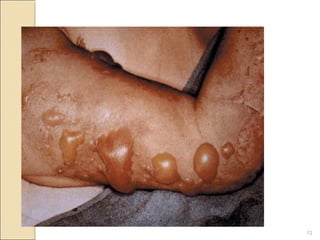
SECOND DEGREESECOND DEGREE
*Involves the epidermis and deep layer of
the dermis
Fluid-filled vesicles –red, shiny, wet, severe
pain
Hospitalization required if over 20% of
body surface involved
i.e. tar burn, flame
11
12
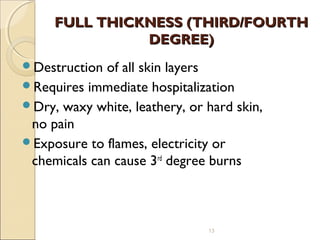
FULL THICKNESS (THIRD/FOURTHFULL THICKNESS (THIRD/FOURTH
DEGREE)DEGREE)
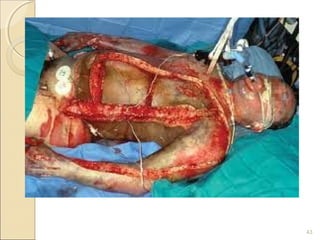
Destruction of all skin layers
Requires immediate hospitalization
Dry, waxy white, leathery, or hard skin,
no pain
Exposure to flames, electricity or
chemicals can cause 3rd
degree burns
13
4/1/2011 14
4/1/2011 15
07/16/16 16
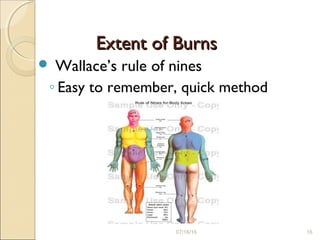
Extent of BurnsExtent of Burns
 Wallace’s rule of nines
◦ Easy to remember, quick method
17
18
07/16/16 19
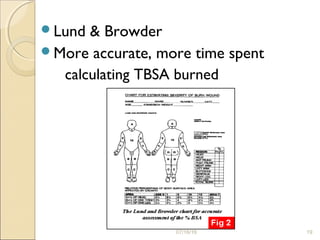
Lund & Browder
More accurate, more time spent
calculating TBSA burned
Lund Browder Chart used forLund Browder Chart used for
determining BSAdetermining BSA
4/1/2011 20Evans, 18.1,
Pathophysiology of burnsPathophysiology of burns
Burn coagulative necrosis of
epidermis and underlying tissues
Depth depends on temperature,duration of
exposure and specific heat of the
causative agent
21
Zones of injuryZones of injury
Zone of coagulation – irreversibly
damaged tissue
Zone of stasis – moderately damaged
with decreased tissue perfusion
Zone of hyperaemia – area of
vasodilatation from which healing process
begins
22
23
Local burn injuryLocal burn injury
Cytological damage due to protein
denaturation by rising temperature
Temp in excess of 45 degree C
blockage of thermolabile enzymes
 When enzymatic activity to 50% of
normal, cell death occurs
24
Local injury (cont’d)Local injury (cont’d)
Factors which determine the extent of
injury other than thermal insult are
Blood supply
Additional trauma
Oedema
Microbial invasion
25
Local inflammatory responseLocal inflammatory response
Both immediate & delayed vascular & cellular
immune response
Mediators – histamine, bradykinin, vasoactive
amines, prostaglandins, leukotrienes, activated
compliment & catecholamines etc.
Thermal injury vasoconstriction of arterioles
& venules and dilatation of capillaries
Capillaries & venules become permeable
leakage of fluid, electrolytes and proteins
Most rapid fluid loss occurs in the first 12 hours
26
Systemic responseSystemic response
Drop in cardiac ouput of upto 50%
Increased interstitial pressure and injured
basement membrane massive oedema
Direct toxic effect
Nearly total body capillary permeability occurs
in pts. With >30% burn
Fluid enters a functional third space
Burn shock
27
Cardiovascular responseCardiovascular response
(cont’d)(cont’d)
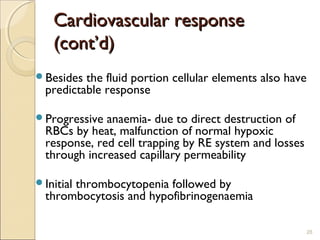
Besides the fluid portion cellular elements also have
predictable response
Progressive anaemia- due to direct destruction of
RBCs by heat, malfunction of normal hypoxic
response, red cell trapping by RE system and losses
through increased capillary permeability
Initial thrombocytopenia followed by
thrombocytosis and hypofibrinogenaemia
28
Renal responseRenal response
High levels of ADH maximal water
reabsorption
Maximum Na reabsorption due to aldosterone
release from adrenals
Increased amounts of myoglobin ,haemoglobin
and toxic products acute tubular necrosis
unless adequate GFR is maintained.
This results in acute renal failure
Myoglobin is the most injurious agent
29
Pulmonary responsePulmonary response
Heat can cause damage to upper airway
 oedema and obstruction
Hypoxia can lead to release of injurios free oxygen
radicals and arachidonic acid metabolites
When cardiac output falls, vascular space contracts
ventilation-perfusion imbalance
During resuscitation large volumes of salt containing
fluids can make chest wall heavy and difficult to
move or even pulmonary oedema
30
31
Gastrointestinal responseGastrointestinal response
Splanchnic vasoconstriction
Acute gastric dilatation, vomiting, gastric
mucosal ulceration curling’s ulcer
Translocation of gut bacteria
Liver function is altered in major burns
Early enteral feeding serves to protect
the GIT
32
Neuroendocrine responseNeuroendocrine response
Adrenaline and noradrenaline as a protective
mechanism
But catecholamine mediated hypermetabolism,
tachycardia and hyperdynamic cardiac activity
may lead to postburn cardiac dysfunction and
death
Glucocorticoids and mineralocorticoids are also
elevated
33
Metabolic-nutritional responseMetabolic-nutritional response
Metabolic rate of burn victim is greatly accelerated
Oxygen consumption
Nitrogen losses
Proteolysis Lipolysis Gluconeogenesis
Evaporative water losses increase at tremendous
energy expense body cooling and shivering
which adds to energy demands
34
Immune responseImmune response
In burns both cellular & humoral immunity is
depressed
Overall lymphopenia, decrease in IL-2, delayed
rejection of allograft skin suggest impaired
cellular immunity
35
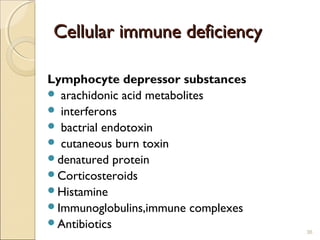
Cellular immune deficiencyCellular immune deficiency
Lymphocyte depressor substances
 arachidonic acid metabolites
 interferons
 bactrial endotoxin
 cutaneous burn toxin
denatured protein
Corticosteroids
Histamine
Immunoglobulins,immune complexes
Antibiotics 36
TreatmentTreatment
Prehospital
Remove from the source of injury
Ensure rescuer safety
Cool the burn wound, avoid hypothermia
All rings, jewelry,watches and belts
should be removed
37
Evaluation of burn victimEvaluation of burn victim
Airway
Breathing and ventilation
Circulation
Disability
Fluid resuscitation
38
AirwayAirway
Burned airway creates symptoms by
swelling
Early intubation in suspected airway burn
is safest
Clues of airway burn- blisters on hard
palate, burned nasal mucosa, loss of hair
in the nose and deep burns around the
mouth and in neck
39
40
BreathingBreathing
Inhalational injury-due to smoke inhalation
Suspect in those trapped in fire, presence of
soot in nose
C/F-increasing respiratory effort and rate, rising
pulse, anxiety and confusion and decreasing O2
saturation
Symptoms develop as late as 24 hrs to 5 days
41
Treatment of inhalational injuryTreatment of inhalational injury
Physiotherapy
Nebulisers
Warm humidified O2
Blood gas measurements
PPV if condition deteriorates
COHb of > 10% high inspired O2
Mechanical block to breathing from FTB
escharotomy
42
43
Major determinants of outcome ofMajor determinants of outcome of
burnburn
Percentage of surface area involved
Depth of burns
Presence of an inhalational injury
44
Fluid resuscitationFluid resuscitation
Sufficient volume to be infused to maintain perfusion
not only to vital organs but also to damaged skin
I/V resucitation is indicated in burns of > 10%in
children and > 15% in adult
Types of fluid used – Ringer lactate(Hartman’s
solution),Human albumin or FFP, and hypertonic
saline
45
Contd..Contd..
 The principle is to maintain IV vol. at a state
sufficient to perfuse all vital organs.
 Fluid loss depends on BSA involved.
 Replacement should be started if 10-15% BSA is
involved.
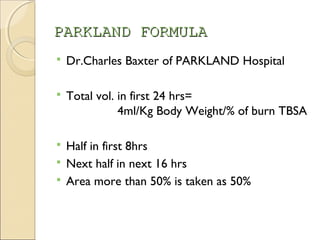
PARKLAND FORMULAPARKLAND FORMULA
 Dr.Charles Baxter of PARKLAND Hospital
 Total vol. in first 24 hrs=
4ml/Kg Body Weight/% of burn TBSA
 Half in first 8hrs
 Next half in next 16 hrs
 Area more than 50% is taken as 50%
TIME DEPENDENT VARIABLES SHOULD BETIME DEPENDENT VARIABLES SHOULD BE
CALCULATED FROM TIME OF BURNSCALCULATED FROM TIME OF BURNS
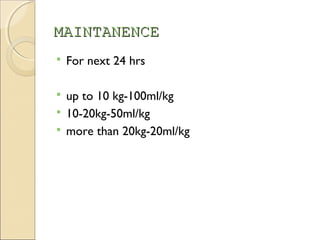
MAINTANENCEMAINTANENCE
 For next 24 hrs
 up to 10 kg-100ml/kg
 10-20kg-50ml/kg
 more than 20kg-20ml/kg
MonitoringMonitoring
 B.P, Pulse
 URINE OUTPUT
 b/w 0.5-1 ml/Kg/Hr
if below this-increase by 50%
below this+signs of hypoperfusion -10ml/Kg
Bolus
WHY RINGER LACTATE?WHY RINGER LACTATE?
 Composition
 Isotonic
 Low sodium
 High pH-6.5
 Buffering effect of lactate
Role of COLLOIDSRole of COLLOIDS
 Usually in 2nd 24 hr
 After capillary leak has subsided
 Mostly in
burns >40%
heart diseases
inhalational injuries
geriatric age group
COLLOIDSCOLLOIDS
 ALBUMIN-5%
Muir and BarclayMuir and Barclay FormulaFormula
 estimates the amount of fluid that needs to be infused during
the first 36 hours after a major burn.
 It divides up the total time into six periods of varying duration.
Each period requires the same volume of fluid.
 The volume for each period is calculated from the following
formula: (weight in kilograms multiplied by the percentage total
body surface area of the burn) divided by two.
Each infusion volume is given as follows:
first 12 hours - 3 infusions at 4 hour intervals
second 12 hours - 2 infusions at 6 hour intervals
third 12 hours - 1 infusion
The Muir and Barclay Formula was described for
albumin as the resuscitation fluid. It tends to give
less fluid per unit time than the Parkland Formula
favoured by the British Burns Association.
55
BROOKE FORMULABROOKE FORMULA
FIRST 24 HOURS
RL 1.5ml/kg/%burn
COLLOID – 0.5ml/kg/%
GLUCOSE IN WATER – 2000ml
SECOND 24 HOURS
RL - .5ml/kg/%burns
Colloids 0.25ml/kg/%burns
Glucose in water same as first 24hour
EVANS FORMULAEVANS FORMULA
 FIRST 24 HOURS
 N.S. – 1ml/kg/%burns
 COLLOID – 1ml/kg/%burns
 GLUCOSE IN WATER – 2000ml
 SECOND 24 HOURS
 HALF OF FIRST HOUR REQUIREMENT
Treatment of the burn woundTreatment of the burn wound
Tetanus prophylaxis
Escharotomy- in circumferential FTB
FTB and obvious deep dermal burn – require
operative treatment for excision and skin grafting
Till then managed by antibacterial dressing to
prevent or delay bacterial colonisation
Most common dressings for FTB and
contaminated burns -1% silver sulfadiazine cream,
silver nitrate solution(0.5%),Mafenide acetate,
bacitracin ,neomycin, polymyxin B,mupirocin etc
58
Superficial partial thickness andSuperficial partial thickness and
mixed depth woundsmixed depth wounds
Superficial PTB heal irrespective of the dressing
Borderline deep dermal burns may heal without
scar if properly dressed with suitable dressing
 Topical antimicrobial dressing,synthetic and
biological dressings like allograft(cadaver skin),
xenograft (pig skin), amniotic membrane,
Transcyte, Biobrane,Integra are different
options available
59
Other aspects of treatmentOther aspects of treatment
Analgesia- Oral or Intravenous
Can range from Paracetamol and NSAID
to opiates depending on the severity of
pain
Powerful short acting analgesia before
dressing changes
60
NutritionNutrition
Hypermetabolism occurs after severe burn as high as
200% the BMR
High demand is met by mobilisation of carbohydrate, fat
and protein stores muscle wasting and wt. Loss
Malnutrition leads to functional impairment of many
organs and delayed wound healing
Diet may be given either enterally or parenterally
61
Control of infectionControl of infection
Burns patients are immunocompromised
Burn wound,oedematous lungs and gut, monitoring lines
and catheters provide portals for infection
Temp>38.5deg.C, leukocytosis,thrombocytosis
Increasing signs of catabolism are indicative of infection
Control of infection is guided by regular swab cultures,
cultures from catheter tips and sputum
62
Multiorgan failureMultiorgan failure
Most of the deaths in severe burns are
attributable to MOF
MOF is the sequela of systemic inflammatory
response syndrome caused by variety of severe
clinical insults like infection, burns, pancreatitis,
shock, trauma, ischemia, immune mediated organ
injury
Carries high mortality
63
Hubbard TankHubbard Tank
Moist Wound HealingMoist Wound Healing
 A landmark study in1962 proved that partial thickness wounds re-
epithelialized more rapidly under occlusive dressings with the reason being
that occlusive dressings maintained a moist wound surface.
 Wound bacterial colonization which can occur in a moist healing
environment did not appear to retard healing or cause sepsis
 Fluid layer on wound surface increases not only the rate of re-
epithelialization, but all aspects of healing
Burn ScarBurn Scar
 PREVENTION OF HYPERTROPHIC SCAR
Early wound closure
- Temporary skin substitutes
- Skin grafting
- Permanent skin substitutes
- Wound protection

TREATMENT OF HYPERTROPHIC SCAR
Surgery Therapies
- excision- laser- cryotherapy
Biophysical Therapies
- compression- ultrasonic, scar massage
Pharmacologic Therapy
- corticosteroids- interferon - protein kinase C inhibitors
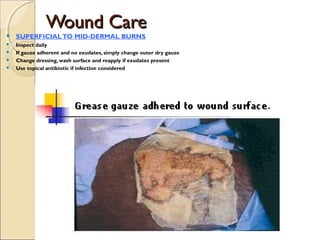
Wound CareWound Care
 SUPERFICIALTO MID-DERMAL BURNS
 Inspect daily
 If gauze adherent and no exudates, simply change outer dry gauze
 Change dressing, wash surface and reapply if exudates present
 Use topical antibiotic if infection considered
Wound CareWound Care
AREAS TREATED OPEN WITH BACITRACIN
 Reapply ointment two to three times daily
 Gently wash off crusts, exudates, especially on face and neck
AREAS COVERED WITH TEMPORARY SKIN SUBSTITUTES
 Change outer dry gauze daily to remove collected exudates
 Roll out small pockets of exudates from beneath substitute
 Can leave open without dressing once  drainage has ceased if substitute well
adhered
 Remove skin substitute if exudate extensive or if nonadherent with topical agent
and change to grease gauze method

Remove once wound reepithelialized
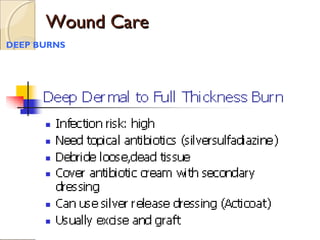
Wound CareWound Care
DEEP BURNS
Wound Care
Why is Surgery Preferred for Deep Dermal Burns?
Primary healing of a deep dermal burn often leads to
hypertrophic scar or skin breakdown, especially if the burn
takes over 6 weeks to heal.
SURGICAL EXCISION & GRAFTINGSURGICAL EXCISION & GRAFTING
MANAGEMENTMANAGEMENT
GENERAL PRINCIPLES FOR BURN EXCISION AND GRAFTING
 The patient must be thermodynamically stable before considering excision
 The potential for significant blood loss must be recognized
 Pulmonary problems clearly present & require a plan of management in the
OR
 Hypothermia must be avoided during surgery
 The stress induced by anesthesia and surgery must be limited to that which
the patient can safely tolerate
 Significant blood loss in a major burn should be replaced with blood
products
Consists of Tangential Excision, Excision to fascia (Escharectomy),
escharotomy etc
Excision to FasciaExcision to Fascia
Skin substitutesSkin substitutes
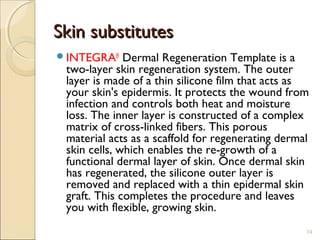
INTEGRA®
 Dermal Regeneration Template is a
two-layer skin regeneration system. The outer
layer is made of a thin silicone film that acts as
your skin's epidermis. It protects the wound from
infection and controls both heat and moisture
loss. The inner layer is constructed of a complex
matrix of cross-linked fibers. This porous
material acts as a scaffold for regenerating dermal
skin cells, which enables the re-growth of a
functional dermal layer of skin. Once dermal skin
has regenerated, the silicone outer layer is
removed and replaced with a thin epidermal skin
graft. This completes the procedure and leaves
you with flexible, growing skin.
74
75
TranscyteTranscyte
77
78
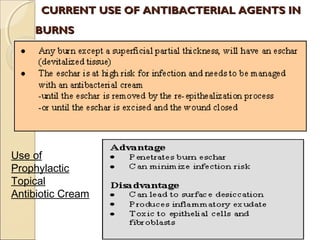
CURRENT USE OF ANTIBACTERIAL AGENTS INCURRENT USE OF ANTIBACTERIAL AGENTS IN
BURNSBURNS
Use of
Prophylactic
Topical
Antibiotic Cream
CURRENT USE OF ANTIBACTERIAL AGENTS IN BURNS
Use of Topical Antibiotics to Treat
Infection
Itch TreatmentItch Treatment
PHYSICAL APPROACH
 skin moisturizers
 compression garments
 cool baths
 massage therapy
PHARMACOLOGICAL APPROACH
 Oral Antihistamines
 Topical Anesthetic Agents
 Pain Medication
 Topical Doxepin Cream
RehabilitationRehabilitation
Goals: to limit loss of motion, prevent/minimize anatomical deformity, return
patient to work ASAP.
83
Reconstructive Surgery
Early aggressive excision and skin grafting will decrease the requirement
for late secondary reconstructions
Usually deferred till hypertrophic scars mature except when there is
compromise of vital functions
Horizons in Burn CareHorizons in Burn Care
 Cultured epithelial grafts (CEA)
Stage A: Identify appropriate patient for
CEA (>50 percent total body surface area
(TBSA) limited donor sites)
Stage B: Obtain biopsy and send to
laboratory
Stage C: Wound preparation Total
excision completed by post-burn day five
to seven. All wounds covered with thick
cryo-preserved allograft.
Stage D: CEA Remove allograft epidermis85
Stage E: Postoperative care CEA exposed
to air two or more times a day.
Stage F: CEA takedown (Performed at
the bedside (POD seven to 10)
Stage G: Post-takedown resume
hydrotherapy. If wound cultures are
negative, use dry dressings. If wound
cultures are positive, then use topical
antimicrobials.
86
87

Burns

  • 1.
    BURNSBURNS  Dr BINUK JOHN  JR1 1
  • 2.
    BURNSBURNS Destruction of skinby heat severe local and systemic physiological alterations 2
  • 3.
    BURNSBURNS Results in 10-20thousand deaths annually Survival best at ages 15-45 Children, elderly, and diabetics Survival best burns cover less than 20% of TBA 3
  • 4.
    TYPES OF BURNSTYPESOF BURNS Thermal exposure to flame or a hot object Chemical exposure to acid, alkali or organic substances Electrical result from the conversion of electrical energy into heat. Extent of injury depends on the type of current, the pathway of flow, local tissue resistance, and duration of contact Radiation result from radiant energy being transferred to the body resulting in production of cellular toxins 4
  • 5.
  • 6.
  • 7.
    BURN WOUNDBURN WOUND ASSESSMENTASSESSMENT Classifiedaccording to depth of injury and extent of body surface area involved Burn wounds differentiated depending on the level of dermis and subcutaneous tissue involved 1. superficial (first-degree) 2. deep (second-degree) 3. full thickness (third and fourth degree) 7
  • 8.
    Depth of burnsDepthof burns First degree : limited to epidermis Second degree : (Partial thickness)  superficial partial thickness- epidermis and superficicial dermis(superficial to papillary dermis)  deep partial thickness- through epidermis and into deep dermis(deep dermal) Third degree : Full thickness Fourth degree: fascia,muscle or bone is involved 8
  • 9.
  • 10.
    SUPERFICIAL BURNSSUPERFICIAL BURNS (FIRSTDEGREE)(FIRST DEGREE) Epidermal tissue only affected Erythema, blanching on pressure, mild swelling no vesicles or blister Not serious unless large areas involved Eg; sunburn 10
  • 11.
    SECOND DEGREESECOND DEGREE *Involvesthe epidermis and deep layer of the dermis Fluid-filled vesicles –red, shiny, wet, severe pain Hospitalization required if over 20% of body surface involved i.e. tar burn, flame 11
  • 12.
  • 13.
    FULL THICKNESS (THIRD/FOURTHFULLTHICKNESS (THIRD/FOURTH DEGREE)DEGREE) Destruction of all skin layers Requires immediate hospitalization Dry, waxy white, leathery, or hard skin, no pain Exposure to flames, electricity or chemicals can cause 3rd degree burns 13
  • 14.
  • 15.
  • 16.
    07/16/16 16 Extent ofBurnsExtent of Burns  Wallace’s rule of nines ◦ Easy to remember, quick method
  • 17.
  • 18.
  • 19.
    07/16/16 19 Lund &Browder More accurate, more time spent calculating TBSA burned
  • 20.
    Lund Browder Chartused forLund Browder Chart used for determining BSAdetermining BSA 4/1/2011 20Evans, 18.1,
  • 21.
    Pathophysiology of burnsPathophysiologyof burns Burn coagulative necrosis of epidermis and underlying tissues Depth depends on temperature,duration of exposure and specific heat of the causative agent 21
  • 22.
    Zones of injuryZonesof injury Zone of coagulation – irreversibly damaged tissue Zone of stasis – moderately damaged with decreased tissue perfusion Zone of hyperaemia – area of vasodilatation from which healing process begins 22
  • 23.
  • 24.
    Local burn injuryLocalburn injury Cytological damage due to protein denaturation by rising temperature Temp in excess of 45 degree C blockage of thermolabile enzymes  When enzymatic activity to 50% of normal, cell death occurs 24
  • 25.
    Local injury (cont’d)Localinjury (cont’d) Factors which determine the extent of injury other than thermal insult are Blood supply Additional trauma Oedema Microbial invasion 25
  • 26.
    Local inflammatory responseLocalinflammatory response Both immediate & delayed vascular & cellular immune response Mediators – histamine, bradykinin, vasoactive amines, prostaglandins, leukotrienes, activated compliment & catecholamines etc. Thermal injury vasoconstriction of arterioles & venules and dilatation of capillaries Capillaries & venules become permeable leakage of fluid, electrolytes and proteins Most rapid fluid loss occurs in the first 12 hours 26
  • 27.
    Systemic responseSystemic response Dropin cardiac ouput of upto 50% Increased interstitial pressure and injured basement membrane massive oedema Direct toxic effect Nearly total body capillary permeability occurs in pts. With >30% burn Fluid enters a functional third space Burn shock 27
  • 28.
    Cardiovascular responseCardiovascular response (cont’d)(cont’d) Besidesthe fluid portion cellular elements also have predictable response Progressive anaemia- due to direct destruction of RBCs by heat, malfunction of normal hypoxic response, red cell trapping by RE system and losses through increased capillary permeability Initial thrombocytopenia followed by thrombocytosis and hypofibrinogenaemia 28
  • 29.
    Renal responseRenal response Highlevels of ADH maximal water reabsorption Maximum Na reabsorption due to aldosterone release from adrenals Increased amounts of myoglobin ,haemoglobin and toxic products acute tubular necrosis unless adequate GFR is maintained. This results in acute renal failure Myoglobin is the most injurious agent 29
  • 30.
    Pulmonary responsePulmonary response Heatcan cause damage to upper airway  oedema and obstruction Hypoxia can lead to release of injurios free oxygen radicals and arachidonic acid metabolites When cardiac output falls, vascular space contracts ventilation-perfusion imbalance During resuscitation large volumes of salt containing fluids can make chest wall heavy and difficult to move or even pulmonary oedema 30
  • 31.
  • 32.
    Gastrointestinal responseGastrointestinal response Splanchnicvasoconstriction Acute gastric dilatation, vomiting, gastric mucosal ulceration curling’s ulcer Translocation of gut bacteria Liver function is altered in major burns Early enteral feeding serves to protect the GIT 32
  • 33.
    Neuroendocrine responseNeuroendocrine response Adrenalineand noradrenaline as a protective mechanism But catecholamine mediated hypermetabolism, tachycardia and hyperdynamic cardiac activity may lead to postburn cardiac dysfunction and death Glucocorticoids and mineralocorticoids are also elevated 33
  • 34.
    Metabolic-nutritional responseMetabolic-nutritional response Metabolicrate of burn victim is greatly accelerated Oxygen consumption Nitrogen losses Proteolysis Lipolysis Gluconeogenesis Evaporative water losses increase at tremendous energy expense body cooling and shivering which adds to energy demands 34
  • 35.
    Immune responseImmune response Inburns both cellular & humoral immunity is depressed Overall lymphopenia, decrease in IL-2, delayed rejection of allograft skin suggest impaired cellular immunity 35
  • 36.
    Cellular immune deficiencyCellularimmune deficiency Lymphocyte depressor substances  arachidonic acid metabolites  interferons  bactrial endotoxin  cutaneous burn toxin denatured protein Corticosteroids Histamine Immunoglobulins,immune complexes Antibiotics 36
  • 37.
    TreatmentTreatment Prehospital Remove from thesource of injury Ensure rescuer safety Cool the burn wound, avoid hypothermia All rings, jewelry,watches and belts should be removed 37
  • 38.
    Evaluation of burnvictimEvaluation of burn victim Airway Breathing and ventilation Circulation Disability Fluid resuscitation 38
  • 39.
    AirwayAirway Burned airway createssymptoms by swelling Early intubation in suspected airway burn is safest Clues of airway burn- blisters on hard palate, burned nasal mucosa, loss of hair in the nose and deep burns around the mouth and in neck 39
  • 40.
  • 41.
    BreathingBreathing Inhalational injury-due tosmoke inhalation Suspect in those trapped in fire, presence of soot in nose C/F-increasing respiratory effort and rate, rising pulse, anxiety and confusion and decreasing O2 saturation Symptoms develop as late as 24 hrs to 5 days 41
  • 42.
    Treatment of inhalationalinjuryTreatment of inhalational injury Physiotherapy Nebulisers Warm humidified O2 Blood gas measurements PPV if condition deteriorates COHb of > 10% high inspired O2 Mechanical block to breathing from FTB escharotomy 42
  • 43.
  • 44.
    Major determinants ofoutcome ofMajor determinants of outcome of burnburn Percentage of surface area involved Depth of burns Presence of an inhalational injury 44
  • 45.
    Fluid resuscitationFluid resuscitation Sufficientvolume to be infused to maintain perfusion not only to vital organs but also to damaged skin I/V resucitation is indicated in burns of > 10%in children and > 15% in adult Types of fluid used – Ringer lactate(Hartman’s solution),Human albumin or FFP, and hypertonic saline 45
  • 46.
    Contd..Contd..  The principleis to maintain IV vol. at a state sufficient to perfuse all vital organs.  Fluid loss depends on BSA involved.  Replacement should be started if 10-15% BSA is involved.
  • 47.
    PARKLAND FORMULAPARKLAND FORMULA Dr.Charles Baxter of PARKLAND Hospital  Total vol. in first 24 hrs= 4ml/Kg Body Weight/% of burn TBSA  Half in first 8hrs  Next half in next 16 hrs  Area more than 50% is taken as 50%
  • 48.
    TIME DEPENDENT VARIABLESSHOULD BETIME DEPENDENT VARIABLES SHOULD BE CALCULATED FROM TIME OF BURNSCALCULATED FROM TIME OF BURNS
  • 49.
    MAINTANENCEMAINTANENCE  For next24 hrs  up to 10 kg-100ml/kg  10-20kg-50ml/kg  more than 20kg-20ml/kg
  • 50.
    MonitoringMonitoring  B.P, Pulse URINE OUTPUT  b/w 0.5-1 ml/Kg/Hr if below this-increase by 50% below this+signs of hypoperfusion -10ml/Kg Bolus
  • 51.
    WHY RINGER LACTATE?WHYRINGER LACTATE?  Composition  Isotonic  Low sodium  High pH-6.5  Buffering effect of lactate
  • 52.
    Role of COLLOIDSRoleof COLLOIDS  Usually in 2nd 24 hr  After capillary leak has subsided  Mostly in burns >40% heart diseases inhalational injuries geriatric age group
  • 53.
  • 54.
    Muir and BarclayMuirand Barclay FormulaFormula  estimates the amount of fluid that needs to be infused during the first 36 hours after a major burn.  It divides up the total time into six periods of varying duration. Each period requires the same volume of fluid.  The volume for each period is calculated from the following formula: (weight in kilograms multiplied by the percentage total body surface area of the burn) divided by two.
  • 55.
    Each infusion volumeis given as follows: first 12 hours - 3 infusions at 4 hour intervals second 12 hours - 2 infusions at 6 hour intervals third 12 hours - 1 infusion The Muir and Barclay Formula was described for albumin as the resuscitation fluid. It tends to give less fluid per unit time than the Parkland Formula favoured by the British Burns Association. 55
  • 56.
    BROOKE FORMULABROOKE FORMULA FIRST24 HOURS RL 1.5ml/kg/%burn COLLOID – 0.5ml/kg/% GLUCOSE IN WATER – 2000ml SECOND 24 HOURS RL - .5ml/kg/%burns Colloids 0.25ml/kg/%burns Glucose in water same as first 24hour
  • 57.
    EVANS FORMULAEVANS FORMULA FIRST 24 HOURS  N.S. – 1ml/kg/%burns  COLLOID – 1ml/kg/%burns  GLUCOSE IN WATER – 2000ml  SECOND 24 HOURS  HALF OF FIRST HOUR REQUIREMENT
  • 58.
    Treatment of theburn woundTreatment of the burn wound Tetanus prophylaxis Escharotomy- in circumferential FTB FTB and obvious deep dermal burn – require operative treatment for excision and skin grafting Till then managed by antibacterial dressing to prevent or delay bacterial colonisation Most common dressings for FTB and contaminated burns -1% silver sulfadiazine cream, silver nitrate solution(0.5%),Mafenide acetate, bacitracin ,neomycin, polymyxin B,mupirocin etc 58
  • 59.
    Superficial partial thicknessandSuperficial partial thickness and mixed depth woundsmixed depth wounds Superficial PTB heal irrespective of the dressing Borderline deep dermal burns may heal without scar if properly dressed with suitable dressing  Topical antimicrobial dressing,synthetic and biological dressings like allograft(cadaver skin), xenograft (pig skin), amniotic membrane, Transcyte, Biobrane,Integra are different options available 59
  • 60.
    Other aspects oftreatmentOther aspects of treatment Analgesia- Oral or Intravenous Can range from Paracetamol and NSAID to opiates depending on the severity of pain Powerful short acting analgesia before dressing changes 60
  • 61.
    NutritionNutrition Hypermetabolism occurs aftersevere burn as high as 200% the BMR High demand is met by mobilisation of carbohydrate, fat and protein stores muscle wasting and wt. Loss Malnutrition leads to functional impairment of many organs and delayed wound healing Diet may be given either enterally or parenterally 61
  • 62.
    Control of infectionControlof infection Burns patients are immunocompromised Burn wound,oedematous lungs and gut, monitoring lines and catheters provide portals for infection Temp>38.5deg.C, leukocytosis,thrombocytosis Increasing signs of catabolism are indicative of infection Control of infection is guided by regular swab cultures, cultures from catheter tips and sputum 62
  • 63.
    Multiorgan failureMultiorgan failure Mostof the deaths in severe burns are attributable to MOF MOF is the sequela of systemic inflammatory response syndrome caused by variety of severe clinical insults like infection, burns, pancreatitis, shock, trauma, ischemia, immune mediated organ injury Carries high mortality 63
  • 64.
  • 65.
    Moist Wound HealingMoistWound Healing  A landmark study in1962 proved that partial thickness wounds re- epithelialized more rapidly under occlusive dressings with the reason being that occlusive dressings maintained a moist wound surface.  Wound bacterial colonization which can occur in a moist healing environment did not appear to retard healing or cause sepsis  Fluid layer on wound surface increases not only the rate of re- epithelialization, but all aspects of healing
  • 66.
    Burn ScarBurn Scar PREVENTION OF HYPERTROPHIC SCAR Early wound closure - Temporary skin substitutes - Skin grafting - Permanent skin substitutes - Wound protection  TREATMENT OF HYPERTROPHIC SCAR Surgery Therapies - excision- laser- cryotherapy Biophysical Therapies - compression- ultrasonic, scar massage Pharmacologic Therapy - corticosteroids- interferon - protein kinase C inhibitors
  • 67.
    Wound CareWound Care SUPERFICIALTO MID-DERMAL BURNS  Inspect daily  If gauze adherent and no exudates, simply change outer dry gauze  Change dressing, wash surface and reapply if exudates present  Use topical antibiotic if infection considered
  • 68.
    Wound CareWound Care AREASTREATED OPEN WITH BACITRACIN  Reapply ointment two to three times daily  Gently wash off crusts, exudates, especially on face and neck AREAS COVERED WITH TEMPORARY SKIN SUBSTITUTES  Change outer dry gauze daily to remove collected exudates  Roll out small pockets of exudates from beneath substitute  Can leave open without dressing once  drainage has ceased if substitute well adhered  Remove skin substitute if exudate extensive or if nonadherent with topical agent and change to grease gauze method  Remove once wound reepithelialized
  • 69.
  • 70.
    Wound Care Why isSurgery Preferred for Deep Dermal Burns? Primary healing of a deep dermal burn often leads to hypertrophic scar or skin breakdown, especially if the burn takes over 6 weeks to heal.
  • 71.
    SURGICAL EXCISION &GRAFTINGSURGICAL EXCISION & GRAFTING MANAGEMENTMANAGEMENT GENERAL PRINCIPLES FOR BURN EXCISION AND GRAFTING  The patient must be thermodynamically stable before considering excision  The potential for significant blood loss must be recognized  Pulmonary problems clearly present & require a plan of management in the OR  Hypothermia must be avoided during surgery  The stress induced by anesthesia and surgery must be limited to that which the patient can safely tolerate  Significant blood loss in a major burn should be replaced with blood products Consists of Tangential Excision, Excision to fascia (Escharectomy), escharotomy etc
  • 72.
  • 73.
    Skin substitutesSkin substitutes INTEGRA®  DermalRegeneration Template is a two-layer skin regeneration system. The outer layer is made of a thin silicone film that acts as your skin's epidermis. It protects the wound from infection and controls both heat and moisture loss. The inner layer is constructed of a complex matrix of cross-linked fibers. This porous material acts as a scaffold for regenerating dermal skin cells, which enables the re-growth of a functional dermal layer of skin. Once dermal skin has regenerated, the silicone outer layer is removed and replaced with a thin epidermal skin graft. This completes the procedure and leaves you with flexible, growing skin. 74
  • 74.
  • 75.
  • 76.
  • 77.
  • 78.
    CURRENT USE OFANTIBACTERIAL AGENTS INCURRENT USE OF ANTIBACTERIAL AGENTS IN BURNSBURNS Use of Prophylactic Topical Antibiotic Cream
  • 79.
    CURRENT USE OFANTIBACTERIAL AGENTS IN BURNS Use of Topical Antibiotics to Treat Infection
  • 80.
    Itch TreatmentItch Treatment PHYSICALAPPROACH  skin moisturizers  compression garments  cool baths  massage therapy PHARMACOLOGICAL APPROACH  Oral Antihistamines  Topical Anesthetic Agents  Pain Medication  Topical Doxepin Cream
  • 81.
    RehabilitationRehabilitation Goals: to limitloss of motion, prevent/minimize anatomical deformity, return patient to work ASAP.
  • 82.
    83 Reconstructive Surgery Early aggressiveexcision and skin grafting will decrease the requirement for late secondary reconstructions Usually deferred till hypertrophic scars mature except when there is compromise of vital functions
  • 83.
    Horizons in BurnCareHorizons in Burn Care  Cultured epithelial grafts (CEA)
  • 84.
    Stage A: Identifyappropriate patient for CEA (>50 percent total body surface area (TBSA) limited donor sites) Stage B: Obtain biopsy and send to laboratory Stage C: Wound preparation Total excision completed by post-burn day five to seven. All wounds covered with thick cryo-preserved allograft. Stage D: CEA Remove allograft epidermis85
  • 85.
    Stage E: Postoperativecare CEA exposed to air two or more times a day. Stage F: CEA takedown (Performed at the bedside (POD seven to 10) Stage G: Post-takedown resume hydrotherapy. If wound cultures are negative, use dry dressings. If wound cultures are positive, then use topical antimicrobials. 86
  • 86.