Justin Lin’s 
“New Structural Economics” 
Lyla Latif 
Seminar on Global Governance and Development 
1 11/10/2014
Table of contents 
 Different perspectives on globalization 
through economics 
 Old perspectives 
 New perspective 
 Highlighting the similarities and differences 
between these 2 perspectives 
 Contemporary application of the new 
perspective 
 Concluding remarks 
11/10/2014 
2
Introduction 
 Take home message from Justin Lin is that 
we need to re examine the strategies for 
achieving sustainable growth 
 He offers a new perspective for economic 
growth based on structural change and 
industrial upgrading 
 Before we discuss this new perspective, it is 
important to understand the contributions 
made by the old perspectives of 
development economics and the challenges 
these perspectives encountered 
11/10/2014 
3
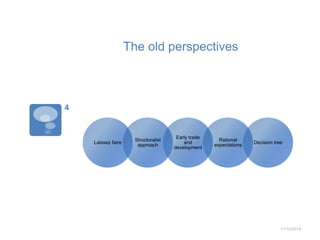
The old perspectives 
Laissez faire 
Structuralist 
approach 
Early trade 
and 
development 
Rational 
expectations 
Decision tree 
11/10/2014 
4
The laissez faire approach 
Liberal market 
No government control (protection of private 
property rights) 
Decisions about resource allocation made by 
the market 
Production increases because the old 
traditional techniques are refined 
No emphasis on successive introduction of 
big innovation or creation of new industries 
or altering methods of production 
11/10/2014 
5
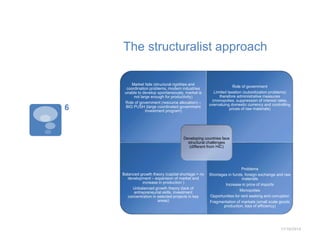
The structuralist approach 
Market fails (structural rigidities and 
coordination problems, modern industries 
unable to develop spontaneously, market is 
not large enough for productivity) 
Role of government (resource allocation) – 
BIG PUSH (large coordinated government 
investment program) 
Role of government 
Limited taxation (subsidization problems) 
therefore administrative measures 
(monopolies, suppression of interest rates, 
overvaluing domestic currency and controlling 
prices of raw materials) 
Developing countries face 
structural challenges 
(different from HIC) 
Balanced growth theory (capital shortage = no 
development – expansion of market and 
increase in production ) 
Unbalanced growth theory (lack of 
entrepreneurial skills, investment 
concentration in selected projects in key 
areas) 
Problems 
Shortages in funds, foreign exchange and raw 
materials 
Increase in price of imports 
Monopolies 
Opportunities for rent seeking and corruption 
Fragmentation of markets (small scale goods 
production, loss of efficiency) 
11/10/2014 
6
Early trade and development 
theories 
Produce what is 
available 
Adopt policy 
of free trade 
(CA only in 
what is 
produced) 
Demand 
could be 
low 
Capital 
accumulation 
is important 
Possible through 
the importation of 
capital goods 
Lead to industrialization 
and domestic economy 
development through 
import substitution 
7 
11/10/2014
Rational expectations approach 
(also known as the free market approach 
or the Washington consensus) 
Structural approach failed 
State’s role in using fiscal and monetary policy for economic 
E.g., Latin American debt crisis (could not pay back loans) 
Government intervention is bound to fail. It should not 
initiate industrialization E.g., collapse of central and eastern 
Promotion 
Results? 
development not helping 
Privatization 
Economic liberalization 
EU 
Stabilization programs 
Controversial whether indeed this approach has produced growth and employment generation 
11/10/2014 
8
Decision tree (also referred to 
as growth diagnostics) 
•Central role in economic development 
Structural 
change 
•BC in each country affect growth 
•Vary over time and across countries 
•Failure to address BC in one area will 
prevent growth even if reforms in other 
areas are satisfactory 
Binding 
constraints 
•Identify the BC 
•Governments cannot reform all sectors 
have to focus on priority areas Key 
11/10/2014 
9
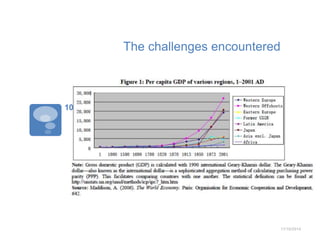
The challenges encountered 
11/10/2014 
10
The new perspective 
Factor 
endowments 
Levels of 
development 
Market and 
government 
11/10/2014 
11
Factor endowments 
Low income agrarian countries 
 Scarcity in capital 
 Abundance in labor and resources 
 Production activities tend to be 
 Labor intensive 
 Resource intensive 
(subsistence agriculture, animal 
husbandry, fishery and mining 
production) 
 Firm sizes are small 
 Markets often informal and limited to local 
markets 
 Hard and soft infrastructure is simple and 
rudimentary 
High income industrialized countries 
 Abundance of capital because they are industrialized 
 Capital intensive industries with economies of scale in 
production 
 Reliance on new technology and products for 
achieving technological innovations and industrial 
upgrading 
 R&D activities to generate no rival public knowledge 
and R&D subsidized 
 Large banks and sophisticated equity markets which 
can mobilize a large amount of capital and are 
capable of diversifying risks 
 Hard and soft infrastructure is built along national and 
global markets for business transactions that are long 
distance, large in quantity and value and no longer 
informal but based on contracts 
12 
11/10/2014
Level of development 
Low income 
agrarian 
economy 
Intermediate 
levels 
High income 
industrialized 
economy 
 For a country to move from low 
income to high income level, it 
must: 
 Upgrade its factor endowments 
 Its stock of capital must grow 
rapidly than its labor force 
 This would then mean; 
 Increase in its scale of 
production since its moving 
closer to global industrial 
frontiers 
 Need bigger markets and 
changes in infrastructure to 
meet its levels of risk (develop 
and expansion of financial 
institutions to share risk) 
13 
11/10/2014
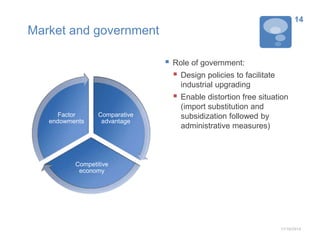
Market and government 
Comparative 
advantage 
Factor 
endowments 
Competitive 
economy 
 Role of government: 
 Design policies to facilitate 
industrial upgrading 
 Enable distortion free situation 
(import substitution and 
subsidization followed by 
administrative measures) 
14 
11/10/2014
Similarities & differences between the 
old & new perspectives 
Similarities 
Structural differences among 
developing and developed 
countries exist 
State plays a crucial role in 
moving the economy from 
lower stage to higher stage of 
development 
Differences 
Old 
perspective 
New 
perspective 
Policies that go 
against an 
economy’s CA 
Advises developing 
countries to develop 
capital intensive 
industries through 
direct administrative 
measures and price 
distortions 
Central role of the 
market in resource 
allocation 
Advises states to 
play a facilitating role 
to assist firms in the 
process of industrial 
upgrading by 
addressing 
externalities and 
coordination issues 
15 
11/10/2014
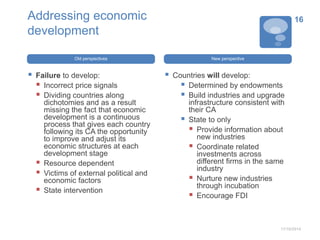
Addressing economic 
development 
Old perspectives 
 Failure to develop: 
 Incorrect price signals 
 Dividing countries along 
dichotomies and as a result 
missing the fact that economic 
development is a continuous 
process that gives each country 
following its CA the opportunity 
to improve and adjust its 
economic structures at each 
development stage 
 Resource dependent 
 Victims of external political and 
economic factors 
 State intervention 
New perspective 
 Countries will develop: 
 Determined by endowments 
 Build industries and upgrade 
infrastructure consistent with 
their CA 
 State to only 
 Provide information about 
new industries 
 Coordinate related 
investments across 
different firms in the same 
industry 
 Nurture new industries 
through incubation 
 Encourage FDI 
16 
11/10/2014
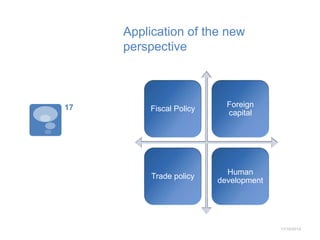
Application of the new 
perspective 
Fiscal Policy 
Foreign 
capital 
Trade policy 
Human 
development 
11/10/2014 
17
Explanations 
Fiscal policy 
 Endowments and CA = sound 
fiscal policy 
 Strong growth 
 Good trade performance 
 No need for subsidization 
(viable firms) 
 End result= fewer home grown 
economic crises 
 External shocks: government 
in good position to implement 
counter cyclical fiscal stimulus 
and invest in infrastructure 
and social projects 
Foreign capital 
 FDI inclined towards 
endowments and CA 
 Brings not only capital but; 
 Technology 
 Management 
 Access to market needed for 
industrial upgrading 
18 
11/10/2014
Explanation continued 
Trade policy 
 Trading based on CA, 
concentrate on exports 
 Trade liberalization for industries 
not consistent with CA and 
subject to imports 
 Industrial upgrading 
 Infrastructure improvement 
 Technology 
Human development 
 Industrial upgrading + 
technological innovation = need 
for training workers to cope with 
change and attain the requisite 
skills 
19 
11/10/2014
Conclusion 
 Is Lin’s New Structural Economics a useful 
perspective or not? 
11/10/2014 
20

New Structural Economics

  • 1.
    Justin Lin’s “NewStructural Economics” Lyla Latif Seminar on Global Governance and Development 1 11/10/2014
  • 2.
    Table of contents  Different perspectives on globalization through economics  Old perspectives  New perspective  Highlighting the similarities and differences between these 2 perspectives  Contemporary application of the new perspective  Concluding remarks 11/10/2014 2
  • 3.
    Introduction  Takehome message from Justin Lin is that we need to re examine the strategies for achieving sustainable growth  He offers a new perspective for economic growth based on structural change and industrial upgrading  Before we discuss this new perspective, it is important to understand the contributions made by the old perspectives of development economics and the challenges these perspectives encountered 11/10/2014 3
  • 4.
    The old perspectives Laissez faire Structuralist approach Early trade and development Rational expectations Decision tree 11/10/2014 4
  • 5.
    The laissez faireapproach Liberal market No government control (protection of private property rights) Decisions about resource allocation made by the market Production increases because the old traditional techniques are refined No emphasis on successive introduction of big innovation or creation of new industries or altering methods of production 11/10/2014 5
  • 6.
    The structuralist approach Market fails (structural rigidities and coordination problems, modern industries unable to develop spontaneously, market is not large enough for productivity) Role of government (resource allocation) – BIG PUSH (large coordinated government investment program) Role of government Limited taxation (subsidization problems) therefore administrative measures (monopolies, suppression of interest rates, overvaluing domestic currency and controlling prices of raw materials) Developing countries face structural challenges (different from HIC) Balanced growth theory (capital shortage = no development – expansion of market and increase in production ) Unbalanced growth theory (lack of entrepreneurial skills, investment concentration in selected projects in key areas) Problems Shortages in funds, foreign exchange and raw materials Increase in price of imports Monopolies Opportunities for rent seeking and corruption Fragmentation of markets (small scale goods production, loss of efficiency) 11/10/2014 6
  • 7.
    Early trade anddevelopment theories Produce what is available Adopt policy of free trade (CA only in what is produced) Demand could be low Capital accumulation is important Possible through the importation of capital goods Lead to industrialization and domestic economy development through import substitution 7 11/10/2014
  • 8.
    Rational expectations approach (also known as the free market approach or the Washington consensus) Structural approach failed State’s role in using fiscal and monetary policy for economic E.g., Latin American debt crisis (could not pay back loans) Government intervention is bound to fail. It should not initiate industrialization E.g., collapse of central and eastern Promotion Results? development not helping Privatization Economic liberalization EU Stabilization programs Controversial whether indeed this approach has produced growth and employment generation 11/10/2014 8
  • 9.
    Decision tree (alsoreferred to as growth diagnostics) •Central role in economic development Structural change •BC in each country affect growth •Vary over time and across countries •Failure to address BC in one area will prevent growth even if reforms in other areas are satisfactory Binding constraints •Identify the BC •Governments cannot reform all sectors have to focus on priority areas Key 11/10/2014 9
  • 10.
  • 11.
    The new perspective Factor endowments Levels of development Market and government 11/10/2014 11
  • 12.
    Factor endowments Lowincome agrarian countries  Scarcity in capital  Abundance in labor and resources  Production activities tend to be  Labor intensive  Resource intensive (subsistence agriculture, animal husbandry, fishery and mining production)  Firm sizes are small  Markets often informal and limited to local markets  Hard and soft infrastructure is simple and rudimentary High income industrialized countries  Abundance of capital because they are industrialized  Capital intensive industries with economies of scale in production  Reliance on new technology and products for achieving technological innovations and industrial upgrading  R&D activities to generate no rival public knowledge and R&D subsidized  Large banks and sophisticated equity markets which can mobilize a large amount of capital and are capable of diversifying risks  Hard and soft infrastructure is built along national and global markets for business transactions that are long distance, large in quantity and value and no longer informal but based on contracts 12 11/10/2014
  • 13.
    Level of development Low income agrarian economy Intermediate levels High income industrialized economy  For a country to move from low income to high income level, it must:  Upgrade its factor endowments  Its stock of capital must grow rapidly than its labor force  This would then mean;  Increase in its scale of production since its moving closer to global industrial frontiers  Need bigger markets and changes in infrastructure to meet its levels of risk (develop and expansion of financial institutions to share risk) 13 11/10/2014
  • 14.
    Market and government Comparative advantage Factor endowments Competitive economy  Role of government:  Design policies to facilitate industrial upgrading  Enable distortion free situation (import substitution and subsidization followed by administrative measures) 14 11/10/2014
  • 15.
    Similarities & differencesbetween the old & new perspectives Similarities Structural differences among developing and developed countries exist State plays a crucial role in moving the economy from lower stage to higher stage of development Differences Old perspective New perspective Policies that go against an economy’s CA Advises developing countries to develop capital intensive industries through direct administrative measures and price distortions Central role of the market in resource allocation Advises states to play a facilitating role to assist firms in the process of industrial upgrading by addressing externalities and coordination issues 15 11/10/2014
  • 16.
    Addressing economic development Old perspectives  Failure to develop:  Incorrect price signals  Dividing countries along dichotomies and as a result missing the fact that economic development is a continuous process that gives each country following its CA the opportunity to improve and adjust its economic structures at each development stage  Resource dependent  Victims of external political and economic factors  State intervention New perspective  Countries will develop:  Determined by endowments  Build industries and upgrade infrastructure consistent with their CA  State to only  Provide information about new industries  Coordinate related investments across different firms in the same industry  Nurture new industries through incubation  Encourage FDI 16 11/10/2014
  • 17.
    Application of thenew perspective Fiscal Policy Foreign capital Trade policy Human development 11/10/2014 17
  • 18.
    Explanations Fiscal policy  Endowments and CA = sound fiscal policy  Strong growth  Good trade performance  No need for subsidization (viable firms)  End result= fewer home grown economic crises  External shocks: government in good position to implement counter cyclical fiscal stimulus and invest in infrastructure and social projects Foreign capital  FDI inclined towards endowments and CA  Brings not only capital but;  Technology  Management  Access to market needed for industrial upgrading 18 11/10/2014
  • 19.
    Explanation continued Tradepolicy  Trading based on CA, concentrate on exports  Trade liberalization for industries not consistent with CA and subject to imports  Industrial upgrading  Infrastructure improvement  Technology Human development  Industrial upgrading + technological innovation = need for training workers to cope with change and attain the requisite skills 19 11/10/2014
  • 20.
    Conclusion  IsLin’s New Structural Economics a useful perspective or not? 11/10/2014 20

Editor's Notes

  • #7 HIC: High Income Countries
  • #8 CA: Comparative Advantage
  • #11 Different results following globalization; some countries and others No convincing agenda for generating and distributing wealth in poor countries; modern, pre modern and after industrial revolution Little convergence between rich and poor countries despite efforts and assistance
  • #13 Economy’s endowments (land, natural resources , labor, capital and physical capital) Firms in an economy can use in production Are a given in any economy and changeable over time Add infrastructure too to endowments; hard and soft infrastructure Hard: highways, port facilities, airports, telecommunications system, electricity grids etc Soft: institutions, regulations, social capital, value systems Countries at different stages of development tend to have different economic structures due to differences in their endowments. Hard and soft infrastructure determines firms transaction costs and how close the economy is to its production possibility Hard: determines transaction costs of obtaining inputs and selling outputs, market size Soft: financial regulations inform how easily a firm can access external funding, the legal framework will inform the cost of writing and implementing a contract; social networks will determine a firm’s access to information, finance and markets