From Harvard Business Review article “Building Your Company’s Vision”
James C. Collins and Jerry I. Porras
September-October 1996
   The companies that enjoy enduring success have core values
    and a core purpose that remain fixed, while their business
    strategies and practices endlessly adapt to a changing world.
     Examples include Hewlett-Packard, 3M, Johnson & Johnson,
      Proctor & Gamble, Merck, Sony, Motorola, and Nordstrom.
   Truly great companies understand the difference between
    what should never change and what should be open to
    change, between what is genuinely sacred and what is not.
     This rare ability to manage continuity and change is closely
      linked to the ability to develop a vision.
                                                                     2
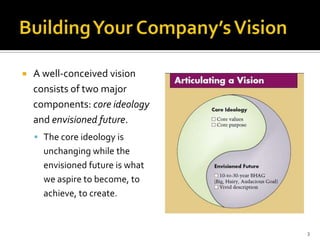
   A well-conceived vision
    consists of two major
    components: core ideology
    and envisioned future.
     The core ideology is
      unchanging while the
      envisioned future is what
      we aspire to become, to
      achieve, to create.


                                  3
 The core ideology consists of the core
  values and core purpose.
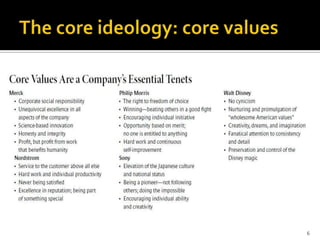
 Core values are the essential and
  enduring tenants of an organization, a
  small set of timeless guiding principles
  that require no external justification.


                                             4
   To identify the core values of your own organization, push
    with relentless honesty to define what values are truly
    central.
   If you articulate more than five or six, chances are you are
    confusing core values (which do not change) with operating
    practice, business strategies, or cultural norms (which should
    be open to change).
   Upon evaluation, if circumstances changed and penalized us
    for holding a core value, would we still keep it?
     If we can’t honestly answer yes, then the value is not core and
      should be dropped from consideration.

                                                                        5
6
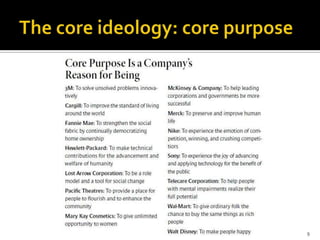
   The core purpose is the organization’s
    reason for being
     not to be confused with a goal or strategy.
   It is the idealistic motivation for doing
    the company’s work. (This can only be
    reached by asking “why”.)


                                                    7
   Core ideology needs to be meaningful and inspirational only
    to people inside the organization; it need not be exciting to
    others.
     It is the people within the corporation who need to commit to
      the organizational ideology over the long term.
   Core ideology can also play a role in determining who is
    inside the organization and who is not.
     You cannot impose new core values or purposes on people;
     they have to be predisposed to share your core values and
      purpose, or let them go elsewhere.


                                                                      8
9
   Core competencies should be well-aligned
    with a company’s core ideology and are often
    rooted it in; but they are not the same thing.
   Core competence is a strategic concept that
    defines your organization’s capabilities –
    what you are particularly good at – whereas
    core ideology captures what you stand for
    and why you exist.

                                                     10
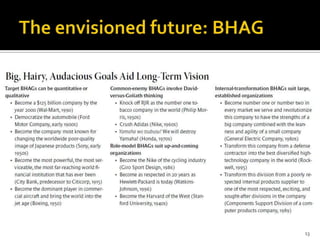
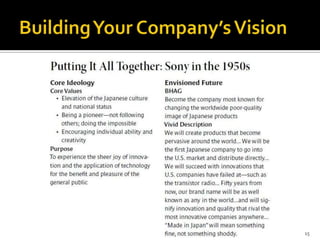
   The envisioned future consists of two parts: a
    10 to 30 year audacious goal plus vivid
    descriptions of what it will be like to achieve
    the goal.
   A company must have a BHAG (pronounced
    Bee-hag), a “big, hairy audacious goal”
     A clear and compelling unifying focal point of
     effort and a catalyst for team spirit.

                                                       11
   It has a finish line, so organization can know
    when it has achieved the goal.
   A BHAG should not be a sure bet,
     it will have perhaps only a 50% to 70% probability
      of success,
     but the organization must believe that it can
      reach the goal anyway.


                                                           12
13
   Vivid descriptions are vibrant, engaging
    and specific descriptions of what it will
    be like to achieve the BHAG.
     Think of it as translating the vision from
     words to pictures.


                                                   14
15
 A direct link to the fundamental
  dynamic of visionary companies:
  preserve the core and stimulate
  progress.
 Building a visionary organization is 1%
  vision and 99% alignment.


                                            16

Building your company's vision

  • 1.
    From Harvard BusinessReview article “Building Your Company’s Vision” James C. Collins and Jerry I. Porras September-October 1996
  • 2.
    The companies that enjoy enduring success have core values and a core purpose that remain fixed, while their business strategies and practices endlessly adapt to a changing world.  Examples include Hewlett-Packard, 3M, Johnson & Johnson, Proctor & Gamble, Merck, Sony, Motorola, and Nordstrom.  Truly great companies understand the difference between what should never change and what should be open to change, between what is genuinely sacred and what is not.  This rare ability to manage continuity and change is closely linked to the ability to develop a vision. 2
  • 3.
    A well-conceived vision consists of two major components: core ideology and envisioned future.  The core ideology is unchanging while the envisioned future is what we aspire to become, to achieve, to create. 3
  • 4.
     The coreideology consists of the core values and core purpose.  Core values are the essential and enduring tenants of an organization, a small set of timeless guiding principles that require no external justification. 4
  • 5.
    To identify the core values of your own organization, push with relentless honesty to define what values are truly central.  If you articulate more than five or six, chances are you are confusing core values (which do not change) with operating practice, business strategies, or cultural norms (which should be open to change).  Upon evaluation, if circumstances changed and penalized us for holding a core value, would we still keep it?  If we can’t honestly answer yes, then the value is not core and should be dropped from consideration. 5
  • 6.
  • 7.
    The core purpose is the organization’s reason for being  not to be confused with a goal or strategy.  It is the idealistic motivation for doing the company’s work. (This can only be reached by asking “why”.) 7
  • 8.
    Core ideology needs to be meaningful and inspirational only to people inside the organization; it need not be exciting to others.  It is the people within the corporation who need to commit to the organizational ideology over the long term.  Core ideology can also play a role in determining who is inside the organization and who is not.  You cannot impose new core values or purposes on people;  they have to be predisposed to share your core values and purpose, or let them go elsewhere. 8
  • 9.
  • 10.
    Core competencies should be well-aligned with a company’s core ideology and are often rooted it in; but they are not the same thing.  Core competence is a strategic concept that defines your organization’s capabilities – what you are particularly good at – whereas core ideology captures what you stand for and why you exist. 10
  • 11.
    The envisioned future consists of two parts: a 10 to 30 year audacious goal plus vivid descriptions of what it will be like to achieve the goal.  A company must have a BHAG (pronounced Bee-hag), a “big, hairy audacious goal”  A clear and compelling unifying focal point of effort and a catalyst for team spirit. 11
  • 12.
    It has a finish line, so organization can know when it has achieved the goal.  A BHAG should not be a sure bet,  it will have perhaps only a 50% to 70% probability of success,  but the organization must believe that it can reach the goal anyway. 12
  • 13.
  • 14.
    Vivid descriptions are vibrant, engaging and specific descriptions of what it will be like to achieve the BHAG.  Think of it as translating the vision from words to pictures. 14
  • 15.
  • 16.
     A directlink to the fundamental dynamic of visionary companies: preserve the core and stimulate progress.  Building a visionary organization is 1% vision and 99% alignment. 16