1
Vision Setting
“There arethose who look at
things the way they are, and ask
why... I dream of things that never
were, and ask why not?”
— Robert Kennedy
Ashleigh McDougall
Tools & Frameworks
2.
2
Vision....often quoted, rarelypracticed
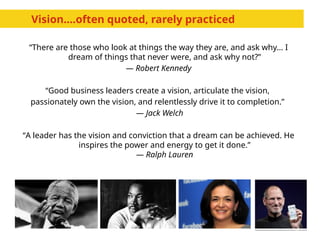
“There are those who look at things the way they are, and ask why... I
dream of things that never were, and ask why not?”
— Robert Kennedy
“Good business leaders create a vision, articulate the vision,
passionately own the vision, and relentlessly drive it to completion.”
— Jack Welch
“A leader has the vision and conviction that a dream can be achieved. He
inspires the power and energy to get it done.”
— Ralph Lauren
3.
3
The Flow
• Whatis “Vision”
• Applications
• Methodology
• Business Example
• Key Sources
4.
Vision: An inspirationaldescription of what success will be at a
particular time in future
4
An effective vision:
• Creates a vivid mental image of the desired
future state
• Sets the broad long-term direction that
does not fluctuate from year to year
• Inspires those who pursue it and pushes
the organization/individuals to see what
they can become
• Ambitious but actionable, focused on the
future but grounded in today
• Provides focus: “Specific enough that
everyone can use it to decide if their work is
moving the company forward.”*
*Stever Robbins Inc
5.
What are thekey elements of a good vision statement?
5
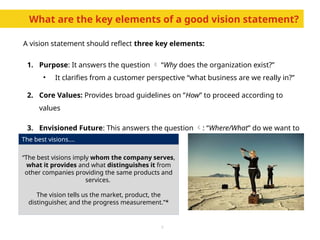
A vision statement should reflect three key elements:
1. Purpose: It answers the question “Why does the organization exist?”
• It clarifies from a customer perspective “what business are we really in?”
2. Core Values: Provides broad guidelines on ”How” to proceed according to
values
3. Envisioned Future: This answers the question : “Where/What” do we want to
get?
“The best visions imply whom the company serves,
what it provides and what distinguishes it from
other companies providing the same products and
services.
The vision tells us the market, product, the
distinguisher, and the progress measurement.”*
The best visions….
6.
6
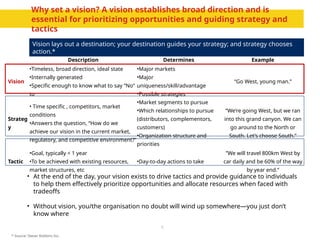
Description Determines Example
Vision
•Timeless,broad direction, ideal state
•Internally generated
•Specific enough to know what to say “No”
to
•Major markets
•Major
uniqueness/skill/advantage
•Possible strategies
“Go West, young man.”
Strateg
y
• Time specific , competitors, market
conditions
•Answers the question, “How do we
achieve our vision in the current market,
regulatory, and competitive environment?”
•Market segments to pursue
•Which relationships to pursue
(distributors, complementors,
customers)
•Organization structure and
priorities
“We’re going West, but we ran
into this grand canyon. We can
go around to the North or
South. Let’s choose South.”
Tactic
•Goal, typically < 1 year
•To be achieved with existing resources,
market structures, etc
•Day-to-day actions to take
”We will travel 800km West by
car daily and be 60% of the way
by year end.”
Why set a vision? A vision establishes broad direction and is
essential for prioritizing opportunities and guiding strategy and
tactics
* Source: Stever Robbins Inc.
Vision lays out a destination; your destination guides your strategy; and strategy chooses
action.*
• At the end of the day, your vision exists to drive tactics and provide guidance to individuals
to help them effectively prioritize opportunities and allocate resources when faced with
tradeoffs
• Without vision, you/the organisation no doubt will wind up somewhere—you just don’t
know where
7.
7
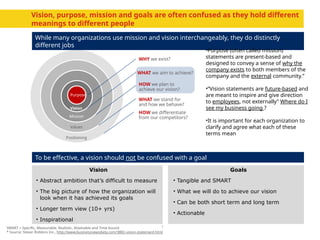
Vision, purpose, missionand goals are often confused as they hold different
meanings to different people
SMART = Specific, Measurable, Realistic, Attainable and Time bound
* Source: Stever Robbins Inc., http://www.businessnewsdaily.com/3882-vision-statement.html
WHY we exist?
WHAT we aim to achieve?
HOW we plan to
achieve our vision?
WHAT we stand for
and how we behave?
HOW we differentiate
from our competitors?
Purpose
Vision
Mission
Values
Positioning
While many organizations use mission and vision interchangeably, they do distinctly
different jobs
•Purpose (often called mission)
statements are present-based and
designed to convey a sense of why the
company exists to both members of the
company and the external community.”
•”Vision statements are future-based and
are meant to inspire and give direction
to employees, not externally” Where do I
see my business going ?
•It is important for each organization to
clarify and agree what each of these
terms mean
To be effective, a vision should not be confused with a goal
Vision Goals
• Abstract ambition that’s difficult to measure
• The big picture of how the organization will
look when it has achieved its goals
• Longer term view (10+ yrs)
• Inspirational
• Tangible and SMART
• What we will do to achieve our vision
• Can be both short term and long term
• Actionable
8.
8
The Flow
• KeySources
• What is “Vision”
• Applications
• Methodology
• Business Example
9.
9
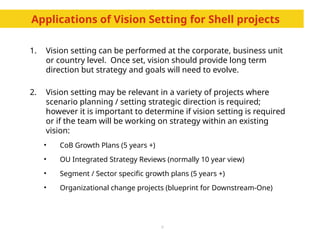
Applications of VisionSetting for Shell projects
1. Vision setting can be performed at the corporate, business unit
or country level. Once set, vision should provide long term
direction but strategy and goals will need to evolve.
2. Vision setting may be relevant in a variety of projects where
scenario planning / setting strategic direction is required;
however it is important to determine if vision setting is required
or if the team will be working on strategy within an existing
vision:
• CoB Growth Plans (5 years +)
• OU Integrated Strategy Reviews (normally 10 year view)
• Segment / Sector specific growth plans (5 years +)
• Organizational change projects (blueprint for Downstream-One)
10.
10
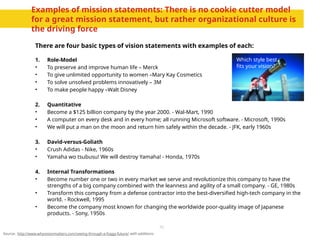
Examples of missionstatements: There is no cookie cutter model
for a great mission statement, but rather organizational culture is
the driving force
There are four basic types of vision statements with examples of each:
1. Role-Model
• To preserve and improve human life – Merck
• To give unlimited opportunity to women –Mary Kay Cosmetics
• To solve unsolved problems innovatively – 3M
• To make people happy –Walt Disney
2. Quantitative
• Become a $125 billion company by the year 2000. - Wal-Mart, 1990
• A computer on every desk and in every home; all running Microsoft software. - Microsoft, 1990s
• We will put a man on the moon and return him safely within the decade. - JFK, early 1960s
3. David-versus-Goliath
• Crush Adidas - Nike, 1960s
• Yamaha wo tsubusu! We will destroy Yamaha! - Honda, 1970s
4. Internal Transformations
• Become number one or two in every market we serve and revolutionize this company to have the
strengths of a big company combined with the leanness and agility of a small company. - GE, 1980s
• Transform this company from a defense contractor into the best-diversified high-tech company in the
world. - Rockwell, 1995
• Become the company most known for changing the worldwide poor-quality image of Japanese
products. - Sony, 1950s
Source: http://www.whyvisionmatters.com/seeing-through-a-foggy-future/ with additions
Which style best
fits your vision?
11.
11
The Flow
• KeySources
• What is “Vision”
• Applications
• Methodology
• Business Example
12.
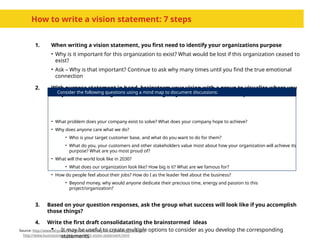
1. When writinga vision statement, you first need to identify your organizations purpose
• Why is it important for this organization to exist? What would be lost if this organization ceased to
exist?
• Ask – Why is that important? Continue to ask why many times until you find the true emotional
connection
2. With purpose statement in hand, brainstorm your vision with a group to visualize where you
see yourself in the long-term. Be sure to agree your vision’s timeframe up front.
• What problem does your company exist to solve? What does your company hope to achieve?
• Why does anyone care what we do?
• Who is your target customer base, and what do you want to do for them?
• What do you, your customers and other stakeholders value most about how your organization will achieve its
purpose? What are you most proud of?
• What will the world look like in 2030?
• What does our organization look like? How big is it? What are we famous for?
• How do people feel about their jobs? How do I as the leader feel about the business?
• Beyond money, why would anyone dedicate their precious time, energy and passion to this
project/organization?
3. Based on your question responses, ask the group what success will look like if you accomplish
those things?
4. Write the first draft consolidatating the brainstormed ideas
It may be useful to create multiple options to consider as you develop the corresponding
statements
How to write a vision statement: 7 steps
Source: http://www.whyvisionmatters.com/seeing-through-a-foggy-future/
http://www.businessnewsdaily.com/3882-vision-statement.html
Consider the following questions using a mind map to document discussions:
13.
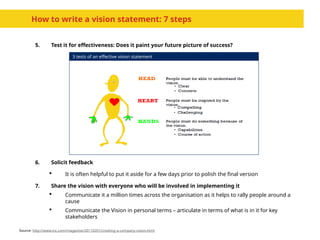
5. Test itfor effectiveness: Does it paint your future picture of success?
6. Solicit feedback
It is often helpful to put it aside for a few days prior to polish the final version
7. Share the vision with everyone who will be involved in implementing it
Communicate it a million times across the organisation as it helps to rally people around a
cause
Communicate the Vision in personal terms – articulate in terms of what is in it for key
stakeholders
How to write a vision statement: 7 steps
Source: http://www.inc.com/magazine/20110201/creating-a-company-vision.html
3 tests of an effective vision statement
14.
14
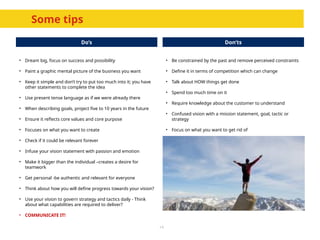
• Be constrainedby the past and remove perceived constraints
• Define it in terms of competition which can change
• Talk about HOW things get done
• Spend too much time on it
• Require knowledge about the customer to understand
• Confused vision with a mission statement, goal, tactic or
strategy
• Focus on what you want to get rid of
Some tips
• Dream big, focus on success and possibility
• Paint a graphic mental picture of the business you want
• Keep it simple and don’t try to put too much into it; you have
other statements to complete the idea
• Use present tense language as if we were already there
• When describing goals, project five to 10 years in the future
• Ensure it reflects core values and core purpose
• Focuses on what you want to create
• Check if it could be relevant forever
• Infuse your vision statement with passion and emotion
• Make it bigger than the individual –creates a desire for
teamwork
• Get personal -be authentic and relevant for everyone
• Think about how you will define progress towards your vision?
• Use your vision to govern strategy and tactics daily - Think
about what capabilities are required to deliver?
• COMMUNICATE IT!
Do’s Don’ts
15.
15
The Flow
• KeySources
• What is “Vision”
• Applications
• Methodology
• Shell Example
16.
16
20
15
16
Dec 2010
CONFIDENTIAL
Indonesia Lubricants
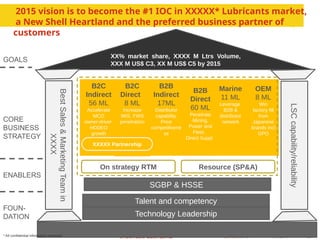
2015vision is to become the #1 IOC in XXXXX* Lubricants market,
a New Shell Heartland and the preferred business partner of
customers
XX% market share, XXXX M Ltrs Volume,
XXX M US$ C3, XX M US$ C5 by 2015
B2C
Indirect
56 ML
Accelerate
MCO
owner-driver
HDDEO
growth
B2B
Indirect
17ML
Distributor
capability,
Price
competitivene
ss
B2B
Direct
60 ML
Penetrate
Mining,
Power and
Fleet,
Direct Supply
OEM
8 ML
Win
factory fill
from
Japanese
brands incl
GPO
On strategy RTM Resource (SP&A)
Best
Sales
&
Marketing
Team
in
XXXX
LSC
capability/reliability
Talent and competency
GOALS
CORE
BUSINESS
STRATEGY
ENABLERS
FOUN-
DATION Technology Leadership
B2C
Direct
8 ML
Increase
IWS, FWS
penetration
Marine
11 ML
Leverage
B2B &
distributor
network
XXXXX Partnership
SGBP & HSSE
* All confidential information removed
17.
17
The Flow
• Whatis “Vision”
• Applications
• Methodology
• Business Example
• Key Sources
18.
18
Key Sources used
•Demystifying the Development of an Organisational Vision – Mark
Lipton, Director The Leadership Centre, Milano Graduate School of
Management
• Built to Last: Successful Habits of Visionary Companies by James C.
Collins and Jerry I. Porras.
• Summary of HBR article by Collins and Porras: http
://www.tecker.com/wp-content/uploads/2011/07/CollinsBuildingVisionSept96.pdf
• Vision Framework workshop document by Jim Collins. Most relevant to
higher level organisational vision. http://www.jimcollins.com/tools/vision-framework.pdf
• Jack – Straight from the Gut. Jack Welch
• Full Steam Ahead!: Unleash the Power of Vision in Your Work and Your
Life. Ken Blanchard and Jesse Lyn Stoner
• GBLP Training Material: Setting Strategic Direction – J Stewart Black,
Professor, Insead
• Video on YouTube:
Jack Welch: http://www.youtube.com/watch?v=LnMTMVqZL8o&&
Editor's Notes
#4 What is a vision?
A statement describing the desired future state
Is based on who/what you want to do
Takes a long term view (+10 years) or can be timeless
“Specific enough that everyone can use it to decide if their work is moving the company forward.” – Stever Robbins Inc
“What does our organization look like? How big is it? What are we famous for? Why does anyone care what we do? How do people feel about their jobs? How do I as the founder feel about the busienss? What is my role in it?” –Ari Zingermans
Defn Source: Ari Zingermans
#5 The writing of Jim Collins and Jerry Porras (see sources slide 18) identifies Vision as the combination of Core Ideology and Envisioned Future (preserving the core while stimulating progress). The Core Ideology defines why the organisation exists and what it stands for (core values and purpose). The Envisioned Future is a vivid description of what or where the organisation wants to be in 10 to 30 years.
Core values: Values need to be clearly described and consistently acted on; i.e. product excellence at P&G, science-based innovation at Merck
#6 Why do we need a vision? A vision:
Sets broad direction: guides strategy and helps to direct prioritize opportunities and resource allocations
Calls for action and drives tactics. “Moments of truth always happen during tactical action. That’s why you need a vision and strategy –without them, people won't have the guidance to ensure they can move the company forward in that moment.” (i.e. CEO refuses to ship a poor quality product even though it will hurt quarterly numbers.”
Eg. Imagine requesting a route from mapquest without plugging in your destination
#7 Vision vs goal:
Abstract = difficult to measure b/c its related to dreams
Goals are more absolute.
The words mission, purpose, vision, values and strategy can hold very different meanings to different people. Each organization must clarify what it means by each of these terms. The priority is to have agreement between the people involved. Possible definitions of these terms (drawn from the Stanford GSB Alumni Consulting Team):
Mission/purpose – A statement of why the organization exists, at the most meaningful level. Captures ‘why’ the organization does the work it does but does not define ‘how’ that work is done
Vision – A clear, specific, compelling picture of what the organisation will look like at a specific time in the future
Value – the boundaries within with the organization will operate in pursuit of its vision
Strategy – a clear plan that describes the path by which an organisation intends to reach its vision
"Mission Statements" and "Vision Statements" do two distinctly different jobs:
“A Mission Statement defines the organization's purpose and primary objectives. Its prime function is internal – to define the key measure or measures of the organization's success – and its prime audience is the leadership team and stockholders.”
“Vision Statements also define the organizations purpose, but this time they do so in terms of the organization's values rather than bottom line measures (values are guiding beliefs about how things should be done.) The vision statement communicates both the purpose and values of the organization. For employees, it gives direction about how they are expected to behave and inspires them to give their best. Shared with customers, it shapes customers' understanding of why they should work with the organization.”
Source: http://www.mindtools.com/pages/article/newLDR_90.htm