



Leading Change
By John Kotter
Harvard Business School
Introduction
First published In 1996, John P. Kotter's Leading Change became a
classic outlining an eight-step program for organizational change
that was embraced by executives around the world. Then, Kotter
and co-author Dan Cohen's The Heart of Change introduced the
revolutionary "see-feel-change" approach, which helped executives
understand the crucial role of emotion in successful change efforts.
The Heart of Change Field Guide written by Dan Cohen and
forwarded by John Kotter provides leaders and managers tools,
frameworks, and advice for bringing these breakthrough change
methods to life within their own organizations.
2
1. Establishing a Sense of Urgency
Forming a Powerful Guiding Coalition
1. Creating a Vision
2. Communicating the Vision
3. Empowering Others to Act on the
Vision
4. Planning for and Creating Short-
Term Wins
5. Consolidating Improvements and
Producing Still More Change
6. Institutionalizing New Approach
3
8 Steps to Transforming
Your Organization
Establishing a Sense of Urgency
Examine market and competitive realities
Identify and discuss crises, potential crises, or major opportunities
• Create the “burning platform”
• 50% of companies fail at this stage
➥ Underestimate difficulty in driving people out of comfort zone
➥ Lack of patience - “get on with it”
➥ Complacency
4
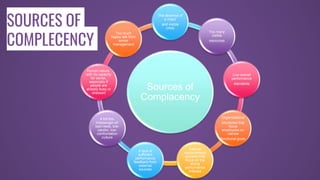
Sources of
Complacency
The absence of
a major
and visible
crisis
Too many
visible
resources
Low overall
performance
standards
Organizational
structures that
focus
employees on
narrow
functional goals
Internal
measurement
systems that
focus on the
wrong
performance
indexes
A lack of
sufficient
performance
feedback from
external
sources
A kill-the-
messenger-of-
bad-news, low-
candor, low-
confrontation
culture
Human nature,
with its capacity
for denial,
especially if
people are
already busy or
stressed
Too much
happy talk from
senior
management
SOURCES OF
COMPLECENCY
Ways to Raise the Urgency Level
• Create a crisis by allowing a financial loss, exposing managers to major weaknesses vis-à-vis
competitors, or allowing error to blow up instead of being corrected at the last minute
• Eliminate obvious examples of excess (e.g., company-owned country club facilities, a large air
force, gourmet executive dining rooms
• Set revenue, income, productivity, customer satisfaction, and cycle-time targets so high
that they can’t be reached by conducting business as usual
• Stop measuring subunit performance based only on narrow functional goals. more people be
held accountable for Broader measures of business performance.
6
Ways to Raise the Urgency Level
• Send more data about customer satisfaction & financial performance to more
employees, especially information that demonstrates weaknesses vis-à-vis the
competition.
• Insist that people talk regularly to unsatisfied customers, unhappy suppliers, and
disgruntled shareholders.
• Use consultants & other means to force more relevant data and honest discussion into
management meetings.
• Put more honest discussions of the firm’s problems in company newspapers & senior
management speeches. management “happy talk.”
• Bombard people with information on future opportunities, on the wonderful rewards
for capitalizing on those opportunities & on The organization’s current inability to pursue
those opportunities. 7
8
• Assemble a group with enough power to lead the change
• effort
• Encourage the group to work together as a team
• Grow team to 20 to 50 range in large companies
• Failures due to:
➥ No history of teamwork at top
➥ Undervalue importance
➥ Select wrong leadership (staff vs. line)
Forming a Powerful Guiding Coalition
9
Find the Right People
• With strong position power, broad expertise & high
credibility
• With leadership & management skills, especially the
former
Create Trust
• Through carefully planned off-site events
With lots of talk and joint activities
Develop a Common Goal
• Sensible to the head
• Appealing to the heart
Building a Coalition That Can Make
Change Happen
10
Creating a Vision
• Create a vision to help direct the change effort.
• Develop strategies for achieving that vision
• A vision says something that clarifies the direction in which and
organization needs to move
• The vision “magnetically” pulls the organization
11
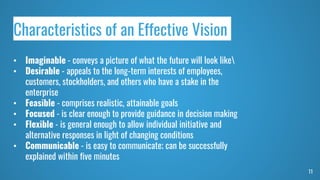
Characteristics of an Effective Vision
• Imaginable - conveys a picture of what the future will look like
• Desirable - appeals to the long-term interests of employees,
customers, stockholders, and others who have a stake in the
enterprise
• Feasible - comprises realistic, attainable goals
• Focused - is clear enough to provide guidance in decision making
• Flexible - is general enough to allow individual initiative and
alternative responses in light of changing conditions
• Communicable - is easy to communicate; can be successfully
explained within five minutes
12
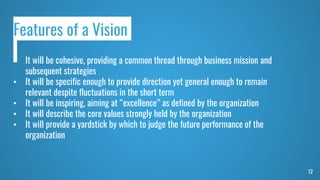
Features of a Vision
• It will be cohesive, providing a common thread through business mission and
subsequent strategies
• It will be specific enough to provide direction yet general enough to remain
relevant despite fluctuations in the short term
• It will be inspiring, aiming at “excellence” as defined by the organization
• It will describe the core values strongly held by the organization
• It will provide a yardstick by which to judge the future performance of the
organization
13
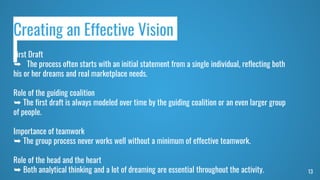
Creating an Effective Vision
First Draft
➥ The process often starts with an initial statement from a single individual, reflecting both
his or her dreams and real marketplace needs.
Role of the guiding coalition
➥ The first draft is always modeled over time by the guiding coalition or an even larger group
of people.
Importance of teamwork
➥ The group process never works well without a minimum of effective teamwork.
Role of the head and the heart
➥ Both analytical thinking and a lot of dreaming are essential throughout the activity.
You must translate the vision from
words to pictures with a vivid
description of what it will be like to
achieve your goal.
14
Source: James C. Collins, Building Your Company’s Vision, Harvard Business Review, September - October 1996
Nightingale © 2002 Massachusetts Institute of Technology
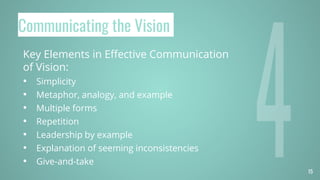
Communicating the Vision
Key Elements in Effective Communication
of Vision:
• Simplicity
• Metaphor, analogy, and example
• Multiple forms
• Repetition
• Leadership by example
• Explanation of seeming inconsistencies
• Give-and-take
15
Empowering Others to Act on the Vision
• Get rid of obstacles to change
• Change systems or structures that seriously undermine the vision
• Encourage risk taking and nontraditional ideas, activities, and actions
• Make tough decisions in removing people who do not ascribe to vision
16
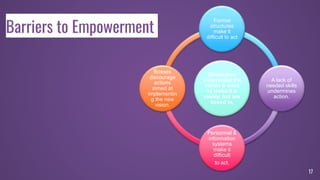
Barriers to Empowerment
17
Employees
understand the
vision & want
to make it a
reality, but are
boxed in.
Formal
structures
make it
difficult to act
A lack of
needed skills
undermines
action.
Personnel &
information
systems
make it
difficult
to act.
Bosses
discourage
actions
aimed at
implementin
g the new
vision.
Empowering People to Effect Change
• Communicate a sensible vision to employees
• Make structures compatible with the vision
• Provide the training employees need
• Align information & personnel systems to the vision
• Confront supervisors who undercut needed change
18
19
• Create and plan for visible performance improvements
• Recognize and reward employees involved in the improvements
Planning for & Creating Short Term Wins
20
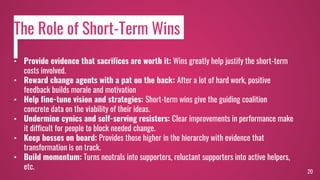
• Provide evidence that sacrifices are worth it: Wins greatly help justify the short-term
costs involved.
• Reward change agents with a pat on the back: After a lot of hard work, positive
feedback builds morale and motivation
• Help fine-tune vision and strategies: Short-term wins give the guiding coalition
concrete data on the viability of their ideas.
• Undermine cynics and self-serving resisters: Clear improvements in performance make
it difficult for people to block needed change.
• Keep bosses on board: Provides those higher in the hierarchy with evidence that
transformation is on track.
• Build momentum: Turns neutrals into supporters, reluctant supporters into active helpers,
etc.
The Role of Short-Term Wins
21
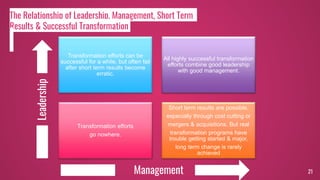
The Relationship of Leadership, Management, Short Term
Results & Successful Transformation
Transformation efforts can be
successful for a while, but often fail
after short term results become
erratic.
All highly successful transformation
efforts combine good leadership
with good management.
Transformation efforts
go nowhere.
Short term results are possible,
especially through cost cutting or
mergers & acquisitions. But real
transformation programs have
trouble getting started & major,
long term change is rarely
achieved
Leadership
Management
22
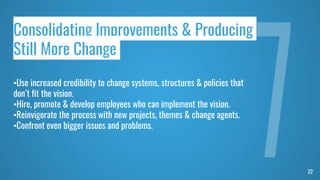
Consolidating Improvements & Producing
Still More Change
•Use increased credibility to change systems, structures & policies that
don’t fit the vision.
•Hire, promote & develop employees who can implement the vision.
•Reinvigorate the process with new projects, themes & change agents.
•Confront even bigger issues and problems.
23
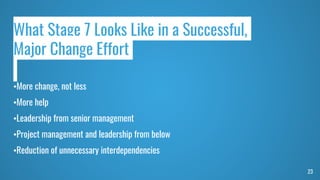
What Stage 7 Looks Like in a Successful,
Major Change Effort
•More change, not less
•More help
•Leadership from senior management
•Project management and leadership from below
•Reduction of unnecessary interdependencies
Institutionalizing New Approaches
• Articulate the connections between the new behaviors & corporate
success.
• Develop the means to ensure leadership development & succession.
• Anchor change in a new culture.
24
Anchoring Change in a Culture
• Comes last, not first
• Depends on results
• Requires a lot of talk
• May involve turnover
• Makes decisions on succession crucial
25
26
“Be the change that
you wish to see in the
world.”
Mahatma Gandhi
27

Leading change

  • 1.
    Leading Change By JohnKotter Harvard Business School
  • 2.
    Introduction First published In1996, John P. Kotter's Leading Change became a classic outlining an eight-step program for organizational change that was embraced by executives around the world. Then, Kotter and co-author Dan Cohen's The Heart of Change introduced the revolutionary "see-feel-change" approach, which helped executives understand the crucial role of emotion in successful change efforts. The Heart of Change Field Guide written by Dan Cohen and forwarded by John Kotter provides leaders and managers tools, frameworks, and advice for bringing these breakthrough change methods to life within their own organizations. 2
  • 3.
    1. Establishing aSense of Urgency Forming a Powerful Guiding Coalition 1. Creating a Vision 2. Communicating the Vision 3. Empowering Others to Act on the Vision 4. Planning for and Creating Short- Term Wins 5. Consolidating Improvements and Producing Still More Change 6. Institutionalizing New Approach 3 8 Steps to Transforming Your Organization
  • 4.
    Establishing a Senseof Urgency Examine market and competitive realities Identify and discuss crises, potential crises, or major opportunities • Create the “burning platform” • 50% of companies fail at this stage ➥ Underestimate difficulty in driving people out of comfort zone ➥ Lack of patience - “get on with it” ➥ Complacency 4
  • 5.
    Sources of Complacency The absenceof a major and visible crisis Too many visible resources Low overall performance standards Organizational structures that focus employees on narrow functional goals Internal measurement systems that focus on the wrong performance indexes A lack of sufficient performance feedback from external sources A kill-the- messenger-of- bad-news, low- candor, low- confrontation culture Human nature, with its capacity for denial, especially if people are already busy or stressed Too much happy talk from senior management SOURCES OF COMPLECENCY
  • 6.
    Ways to Raisethe Urgency Level • Create a crisis by allowing a financial loss, exposing managers to major weaknesses vis-à-vis competitors, or allowing error to blow up instead of being corrected at the last minute • Eliminate obvious examples of excess (e.g., company-owned country club facilities, a large air force, gourmet executive dining rooms • Set revenue, income, productivity, customer satisfaction, and cycle-time targets so high that they can’t be reached by conducting business as usual • Stop measuring subunit performance based only on narrow functional goals. more people be held accountable for Broader measures of business performance. 6
  • 7.
    Ways to Raisethe Urgency Level • Send more data about customer satisfaction & financial performance to more employees, especially information that demonstrates weaknesses vis-à-vis the competition. • Insist that people talk regularly to unsatisfied customers, unhappy suppliers, and disgruntled shareholders. • Use consultants & other means to force more relevant data and honest discussion into management meetings. • Put more honest discussions of the firm’s problems in company newspapers & senior management speeches. management “happy talk.” • Bombard people with information on future opportunities, on the wonderful rewards for capitalizing on those opportunities & on The organization’s current inability to pursue those opportunities. 7
  • 8.
    8 • Assemble agroup with enough power to lead the change • effort • Encourage the group to work together as a team • Grow team to 20 to 50 range in large companies • Failures due to: ➥ No history of teamwork at top ➥ Undervalue importance ➥ Select wrong leadership (staff vs. line) Forming a Powerful Guiding Coalition
  • 9.
    9 Find the RightPeople • With strong position power, broad expertise & high credibility • With leadership & management skills, especially the former Create Trust • Through carefully planned off-site events With lots of talk and joint activities Develop a Common Goal • Sensible to the head • Appealing to the heart Building a Coalition That Can Make Change Happen
  • 10.
    10 Creating a Vision •Create a vision to help direct the change effort. • Develop strategies for achieving that vision • A vision says something that clarifies the direction in which and organization needs to move • The vision “magnetically” pulls the organization
  • 11.
    11 Characteristics of anEffective Vision • Imaginable - conveys a picture of what the future will look like • Desirable - appeals to the long-term interests of employees, customers, stockholders, and others who have a stake in the enterprise • Feasible - comprises realistic, attainable goals • Focused - is clear enough to provide guidance in decision making • Flexible - is general enough to allow individual initiative and alternative responses in light of changing conditions • Communicable - is easy to communicate; can be successfully explained within five minutes
  • 12.
    12 Features of aVision • It will be cohesive, providing a common thread through business mission and subsequent strategies • It will be specific enough to provide direction yet general enough to remain relevant despite fluctuations in the short term • It will be inspiring, aiming at “excellence” as defined by the organization • It will describe the core values strongly held by the organization • It will provide a yardstick by which to judge the future performance of the organization
  • 13.
    13 Creating an EffectiveVision First Draft ➥ The process often starts with an initial statement from a single individual, reflecting both his or her dreams and real marketplace needs. Role of the guiding coalition ➥ The first draft is always modeled over time by the guiding coalition or an even larger group of people. Importance of teamwork ➥ The group process never works well without a minimum of effective teamwork. Role of the head and the heart ➥ Both analytical thinking and a lot of dreaming are essential throughout the activity.
  • 14.
    You must translatethe vision from words to pictures with a vivid description of what it will be like to achieve your goal. 14 Source: James C. Collins, Building Your Company’s Vision, Harvard Business Review, September - October 1996 Nightingale © 2002 Massachusetts Institute of Technology
  • 15.
    Communicating the Vision KeyElements in Effective Communication of Vision: • Simplicity • Metaphor, analogy, and example • Multiple forms • Repetition • Leadership by example • Explanation of seeming inconsistencies • Give-and-take 15
  • 16.
    Empowering Others toAct on the Vision • Get rid of obstacles to change • Change systems or structures that seriously undermine the vision • Encourage risk taking and nontraditional ideas, activities, and actions • Make tough decisions in removing people who do not ascribe to vision 16
  • 17.
    Barriers to Empowerment 17 Employees understandthe vision & want to make it a reality, but are boxed in. Formal structures make it difficult to act A lack of needed skills undermines action. Personnel & information systems make it difficult to act. Bosses discourage actions aimed at implementin g the new vision.
  • 18.
    Empowering People toEffect Change • Communicate a sensible vision to employees • Make structures compatible with the vision • Provide the training employees need • Align information & personnel systems to the vision • Confront supervisors who undercut needed change 18
  • 19.
    19 • Create andplan for visible performance improvements • Recognize and reward employees involved in the improvements Planning for & Creating Short Term Wins
  • 20.
    20 • Provide evidencethat sacrifices are worth it: Wins greatly help justify the short-term costs involved. • Reward change agents with a pat on the back: After a lot of hard work, positive feedback builds morale and motivation • Help fine-tune vision and strategies: Short-term wins give the guiding coalition concrete data on the viability of their ideas. • Undermine cynics and self-serving resisters: Clear improvements in performance make it difficult for people to block needed change. • Keep bosses on board: Provides those higher in the hierarchy with evidence that transformation is on track. • Build momentum: Turns neutrals into supporters, reluctant supporters into active helpers, etc. The Role of Short-Term Wins
  • 21.
    21 The Relationship ofLeadership, Management, Short Term Results & Successful Transformation Transformation efforts can be successful for a while, but often fail after short term results become erratic. All highly successful transformation efforts combine good leadership with good management. Transformation efforts go nowhere. Short term results are possible, especially through cost cutting or mergers & acquisitions. But real transformation programs have trouble getting started & major, long term change is rarely achieved Leadership Management
  • 22.
    22 Consolidating Improvements &Producing Still More Change •Use increased credibility to change systems, structures & policies that don’t fit the vision. •Hire, promote & develop employees who can implement the vision. •Reinvigorate the process with new projects, themes & change agents. •Confront even bigger issues and problems.
  • 23.
    23 What Stage 7Looks Like in a Successful, Major Change Effort •More change, not less •More help •Leadership from senior management •Project management and leadership from below •Reduction of unnecessary interdependencies
  • 24.
    Institutionalizing New Approaches •Articulate the connections between the new behaviors & corporate success. • Develop the means to ensure leadership development & succession. • Anchor change in a new culture. 24
  • 25.
    Anchoring Change ina Culture • Comes last, not first • Depends on results • Requires a lot of talk • May involve turnover • Makes decisions on succession crucial 25
  • 26.
    26 “Be the changethat you wish to see in the world.” Mahatma Gandhi
  • 27.