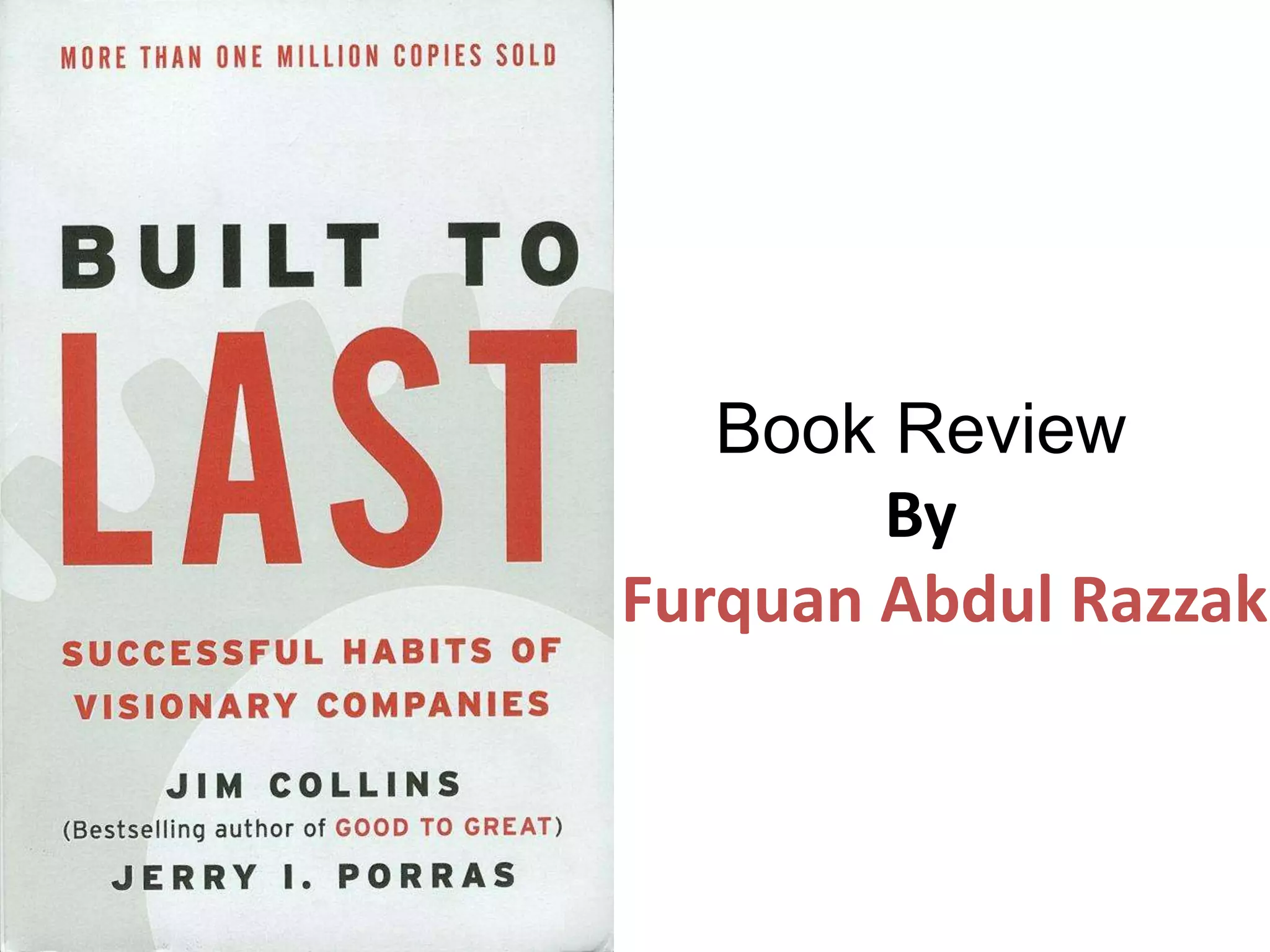
Book Review
        By
Furquan Abdul Razzak
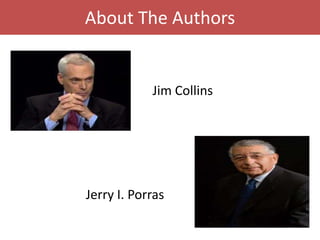
About The Authors


            Jim Collins


Jerry I. Porras
Jim Collins

• He is a professor at the Stanford Graduate School of Business

• Received the Distinguished Teaching Award in 1992

• In 1995, he founded a management laboratory in Colorado

• Served as a senior executive at CNN International

• In his free time, he loves to rock climb and has made it a
  point to conquer Yosemite Valley.
Jerry I. Porras
• He is currently a Professor of Organizational Behavior

• BSEE from Texas Western College in 1960

• MBA from Cornell University in 1968

• PhD from University of California, Los Angeles in 1974

• In 1972 he joined the Stanford University Graduate School
of Business as a professor

• He is the author of many well know books
About The Book
• More than One Million copies sold
• Translated into 13 languages, won the best seller status in
  North America, Japan, South America & parts of Europe
• The book is the result of a thorough research for about 6
  years
• Over 60.000 pages of documents regarding 36 companies
  (18 visionary and 18 comparison companies)
• The objective of finding those characteristics that help a
  company become market leader and last among the top
  companies even more than 100 years
• Built to Last is an analysis of how visionary companies
  should operate
Introduction

 What is VISIONARY COMPANY?
 Criteria for Visionary Company
     Premier institution in its industry
     Widely admired by Knowledgeable business
     Made an indelible imprint on the world
     Had multiple generation of chief executives
     Been through multiple product life cycle
     Founded before 1950
 Selection Process-
   Surveyed 700 CEO‟s from 200 companies
   The youngest company was founded in the year 1945 and the
    oldest was founded in 1812
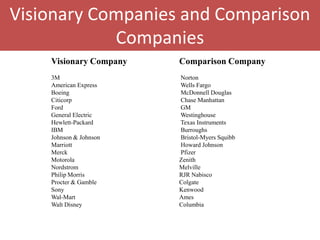
Visionary Companies and Comparison
            Companies
    Visionary Company   Comparison Company
    3M                  Norton
    American Express    Wells Fargo
    Boeing              McDonnell Douglas
    Citicorp            Chase Manhattan
    Ford                GM
    General Electric    Westinghouse
    Hewlett-Packard     Texas Instruments
    IBM                 Burroughs
    Johnson & Johnson   Bristol-Myers Squibb
    Marriott            Howard Johnson
    Merck               Pfizer
    Motorola            Zenith
    Nordstrom           Melville
    Philip Morris       RJR Nabisco
    Procter & Gamble    Colgate
    Sony                Kenwood
    Wal-Mart            Ames
    Walt Disney         Columbia
Best Of The Best

Imagine how different the world would have
 looked and felt without the great companies?
Research Process (Six Steps)-
     What companies should we study?
     A Comparison Group
     History and Evaluation
     Collecting the Data
     Harvesting the fruits of our labor
     Field testing and application in real world
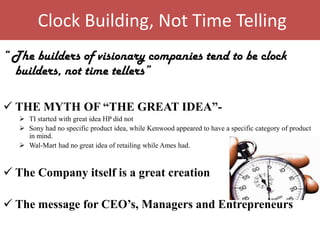
Clock Building, Not Time Telling
“ The builders of visionary companies tend to be clock
  builders, not time tellers”

 THE MYTH OF “THE GREAT IDEA”-
    TI started with great idea HP did not
    Sony had no specific product idea, while Kenwood appeared to have a specific category of product
     in mind.
    Wal-Mart had no great idea of retailing while Ames had.


 The Company itself is a great creation

 The message for CEO’s, Managers and Entrepreneurs
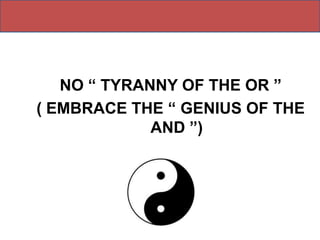
NO “ TYRANNY OF THE OR ”
( EMBRACE THE “ GENIUS OF THE
             AND ”)
More Than Profits
 Core Ideology: Exploding The Profit Myth

 Make the clearest difference between the Visionary
  companies and the Comparison companies

 Is There A “Right” Ideology?
   Certain common factors seen
      in the number of visionary companies
   Great idea for having the core ideology
     and preserving the core ideology as a
     vital shaping force

   Core Ideology = Core value + Purpose
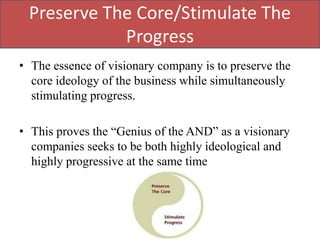
Preserve The Core/Stimulate The
            Progress
• The essence of visionary company is to preserve the
  core ideology of the business while simultaneously
  stimulating progress.

• This proves the “Genius of the AND” as a visionary
  companies seeks to be both highly ideological and
  highly progressive at the same time
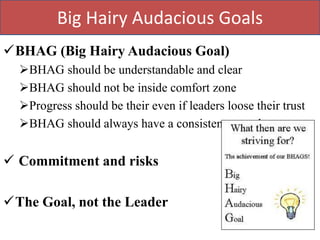
Big Hairy Audacious Goals
BHAG (Big Hairy Audacious Goal)
  BHAG should be understandable and clear
  BHAG should not be inside comfort zone
  Progress should be their even if leaders loose their trust
  BHAG should always have a consistent growth


 Commitment and risks

The Goal, not the Leader
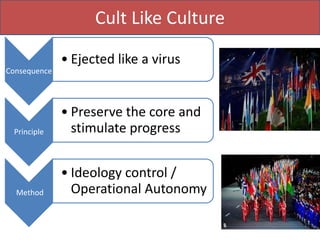
Cult Like Culture

              • Ejected like a virus
Consequence


              • Preserve the core and
 Principle      stimulate progress


              • Ideology control /
  Method        Operational Autonomy
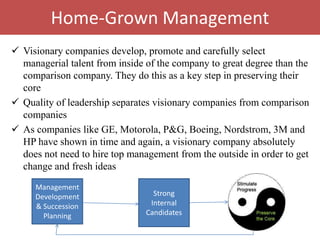
Home-Grown Management
 Visionary companies develop, promote and carefully select
  managerial talent from inside of the company to great degree than the
  comparison company. They do this as a key step in preserving their
  core
 Quality of leadership separates visionary companies from comparison
  companies
 As companies like GE, Motorola, P&G, Boeing, Nordstrom, 3M and
  HP have shown in time and again, a visionary company absolutely
  does not need to hire top management from the outside in order to get
  change and fresh ideas
     Management
     Development                  Strong
     & Succession                Internal       Preserve the
       Planning                 Candidates           core
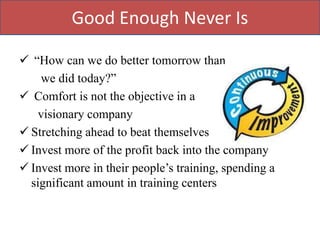
Good Enough Never Is

 “How can we do better tomorrow than
    we did today?”
 Comfort is not the objective in a
    visionary company
 Stretching ahead to beat themselves
 Invest more of the profit back into the company
 Invest more in their people‟s training, spending a
  significant amount in training centers
The End of The Beginning
 It „s become fashionable in recent decades for
  companies to spend countless hours and money
  drafting elegant vision, mission, value, purpose
  statements
 But they are not the essence of visionary
  companies
 The essence of visionary company comes
  in the translation of its core ideology &
  its unique drive for progress
 Visionary companies aligns its core ideology for
  future progress
Conclusion

 Instead of telling time, built a clock that could tell
  the time forever, even when you are dead or gone
 Find the purpose not the profits
 Preserve the core and stimulate progress
 Compete with yourself
 Seek consistent alignment
 Build the core purpose, vision
  and value for your organization
Built to last

Built to last

  • 1.
    Book Review By Furquan Abdul Razzak
  • 2.
    About The Authors Jim Collins Jerry I. Porras
  • 3.
    Jim Collins • Heis a professor at the Stanford Graduate School of Business • Received the Distinguished Teaching Award in 1992 • In 1995, he founded a management laboratory in Colorado • Served as a senior executive at CNN International • In his free time, he loves to rock climb and has made it a point to conquer Yosemite Valley.
  • 4.
    Jerry I. Porras •He is currently a Professor of Organizational Behavior • BSEE from Texas Western College in 1960 • MBA from Cornell University in 1968 • PhD from University of California, Los Angeles in 1974 • In 1972 he joined the Stanford University Graduate School of Business as a professor • He is the author of many well know books
  • 5.
    About The Book •More than One Million copies sold • Translated into 13 languages, won the best seller status in North America, Japan, South America & parts of Europe • The book is the result of a thorough research for about 6 years • Over 60.000 pages of documents regarding 36 companies (18 visionary and 18 comparison companies) • The objective of finding those characteristics that help a company become market leader and last among the top companies even more than 100 years • Built to Last is an analysis of how visionary companies should operate
  • 6.
    Introduction  What isVISIONARY COMPANY?  Criteria for Visionary Company  Premier institution in its industry  Widely admired by Knowledgeable business  Made an indelible imprint on the world  Had multiple generation of chief executives  Been through multiple product life cycle  Founded before 1950  Selection Process-  Surveyed 700 CEO‟s from 200 companies  The youngest company was founded in the year 1945 and the oldest was founded in 1812
  • 7.
    Visionary Companies andComparison Companies Visionary Company Comparison Company 3M Norton American Express Wells Fargo Boeing McDonnell Douglas Citicorp Chase Manhattan Ford GM General Electric Westinghouse Hewlett-Packard Texas Instruments IBM Burroughs Johnson & Johnson Bristol-Myers Squibb Marriott Howard Johnson Merck Pfizer Motorola Zenith Nordstrom Melville Philip Morris RJR Nabisco Procter & Gamble Colgate Sony Kenwood Wal-Mart Ames Walt Disney Columbia
  • 8.
    Best Of TheBest Imagine how different the world would have looked and felt without the great companies? Research Process (Six Steps)-  What companies should we study?  A Comparison Group  History and Evaluation  Collecting the Data  Harvesting the fruits of our labor  Field testing and application in real world
  • 9.
    Clock Building, NotTime Telling “ The builders of visionary companies tend to be clock builders, not time tellers”  THE MYTH OF “THE GREAT IDEA”-  TI started with great idea HP did not  Sony had no specific product idea, while Kenwood appeared to have a specific category of product in mind.  Wal-Mart had no great idea of retailing while Ames had.  The Company itself is a great creation  The message for CEO’s, Managers and Entrepreneurs
  • 10.
    NO “ TYRANNYOF THE OR ” ( EMBRACE THE “ GENIUS OF THE AND ”)
  • 11.
    More Than Profits Core Ideology: Exploding The Profit Myth  Make the clearest difference between the Visionary companies and the Comparison companies  Is There A “Right” Ideology? Certain common factors seen in the number of visionary companies Great idea for having the core ideology and preserving the core ideology as a vital shaping force Core Ideology = Core value + Purpose
  • 12.
    Preserve The Core/StimulateThe Progress • The essence of visionary company is to preserve the core ideology of the business while simultaneously stimulating progress. • This proves the “Genius of the AND” as a visionary companies seeks to be both highly ideological and highly progressive at the same time
  • 13.
    Big Hairy AudaciousGoals BHAG (Big Hairy Audacious Goal) BHAG should be understandable and clear BHAG should not be inside comfort zone Progress should be their even if leaders loose their trust BHAG should always have a consistent growth  Commitment and risks The Goal, not the Leader
  • 14.
    Cult Like Culture • Ejected like a virus Consequence • Preserve the core and Principle stimulate progress • Ideology control / Method Operational Autonomy
  • 15.
    Home-Grown Management  Visionarycompanies develop, promote and carefully select managerial talent from inside of the company to great degree than the comparison company. They do this as a key step in preserving their core  Quality of leadership separates visionary companies from comparison companies  As companies like GE, Motorola, P&G, Boeing, Nordstrom, 3M and HP have shown in time and again, a visionary company absolutely does not need to hire top management from the outside in order to get change and fresh ideas Management Development Strong & Succession Internal Preserve the Planning Candidates core
  • 16.
    Good Enough NeverIs  “How can we do better tomorrow than we did today?”  Comfort is not the objective in a visionary company  Stretching ahead to beat themselves  Invest more of the profit back into the company  Invest more in their people‟s training, spending a significant amount in training centers
  • 17.
    The End ofThe Beginning  It „s become fashionable in recent decades for companies to spend countless hours and money drafting elegant vision, mission, value, purpose statements  But they are not the essence of visionary companies  The essence of visionary company comes in the translation of its core ideology & its unique drive for progress  Visionary companies aligns its core ideology for future progress
  • 18.
    Conclusion  Instead oftelling time, built a clock that could tell the time forever, even when you are dead or gone  Find the purpose not the profits  Preserve the core and stimulate progress  Compete with yourself  Seek consistent alignment  Build the core purpose, vision and value for your organization