C O N T E M P O R A R Y
P R O C E S S O N
A R C H I T E C T U R A L D E S I G N
K.KEDHEESWARAN,M.Arch
Asst,proff.
K.KEDHEESWARAN,M.Arch Asst,prof
This presentation aims at presenting those technologies that comes( or will come) under the ambit of digital architecture.
• The architecture of modern times is characterized by its capacity to take advantage of the specific achievements of that
same modernity: the innovations offered it by present-day science and technology
• The relationship between new technology and futuristic architecture even comprises a fundamental datum of what may
be referred to as avant-garde architectures
• Future will be about integrating computer-aided design with computer-aided fabrication and construction
• Redefining the relationship between designing and producing
• Eliminating many geometric constraints imposed by traditional drawing and production processes— making complex
curved shapes much easier to handle, for example, and
• Reducing dependence on standard, mass-produced components
• It would bridge the gap between designing and producing
K.KEDHEESWARAN,M.Arch Asst,prof
Digital architectures refer to the computationally based processes of form origination and transformations. Several
digital architectures are identified based on the underlying computational concepts such as:
1 . To p o l o g i c a l s p a c e ( To p o l o g i c a l a rc h i t e c t u re s )
2 . I s o m o r p h i c s u r f a c e s ( I s o m o r p h i c a rc h i t e c t u re s )
3 . M o t i o n k i n e m a t i c s & d y n a m i c s ( A n i m a t e a rc h i t e c t u re s )
4 . K e y - s h a p e a n i m a t i o n ( M e t a m o r p h i c a rc h i t e c t u re s )
5 . P a r a m e t r i c d e s i g n ( P a r a m e t r i c a rc h i t e c t u re s )
6 . G e n e t i c a l g o r i t h m s ( E v o l u t i o n a r y a rc h i t e c t u re s )
T O P O L O G I C A L A R C H I T E C T U R E S :
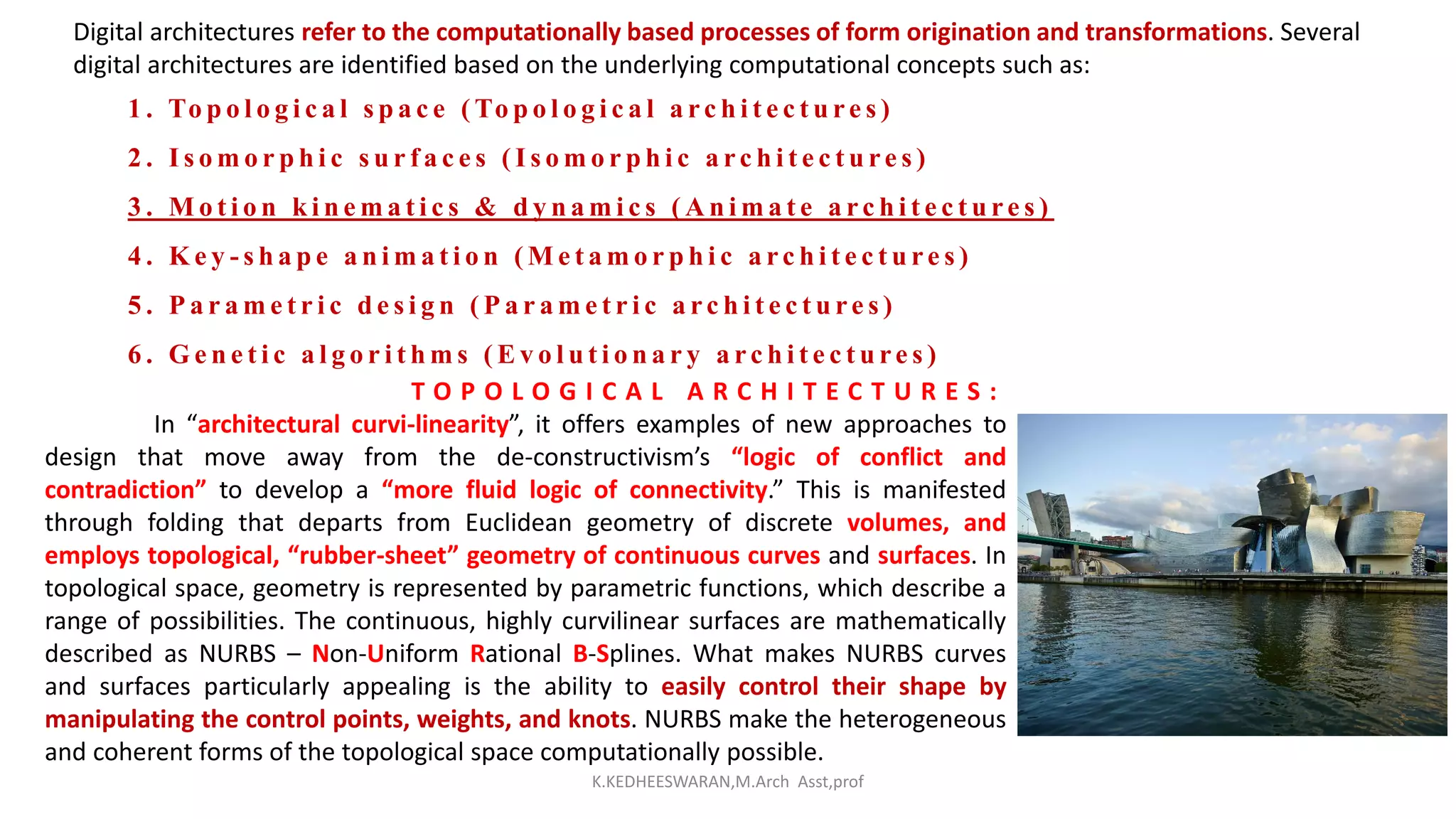
In “architectural curvi-linearity”, it offers examples of new approaches to
design that move away from the de-constructivism’s “logic of conflict and
contradiction” to develop a “more fluid logic of connectivity.” This is manifested
through folding that departs from Euclidean geometry of discrete volumes, and
employs topological, “rubber-sheet” geometry of continuous curves and surfaces. In
topological space, geometry is represented by parametric functions, which describe a
range of possibilities. The continuous, highly curvilinear surfaces are mathematically
described as NURBS – Non-Uniform Rational B-Splines. What makes NURBS curves
and surfaces particularly appealing is the ability to easily control their shape by
manipulating the control points, weights, and knots. NURBS make the heterogeneous
and coherent forms of the topological space computationally possible.
K.KEDHEESWARAN,M.Arch Asst,prof
ISOMORPHIC SURFACES (ISOMORPHIC ARCHITECTURES)
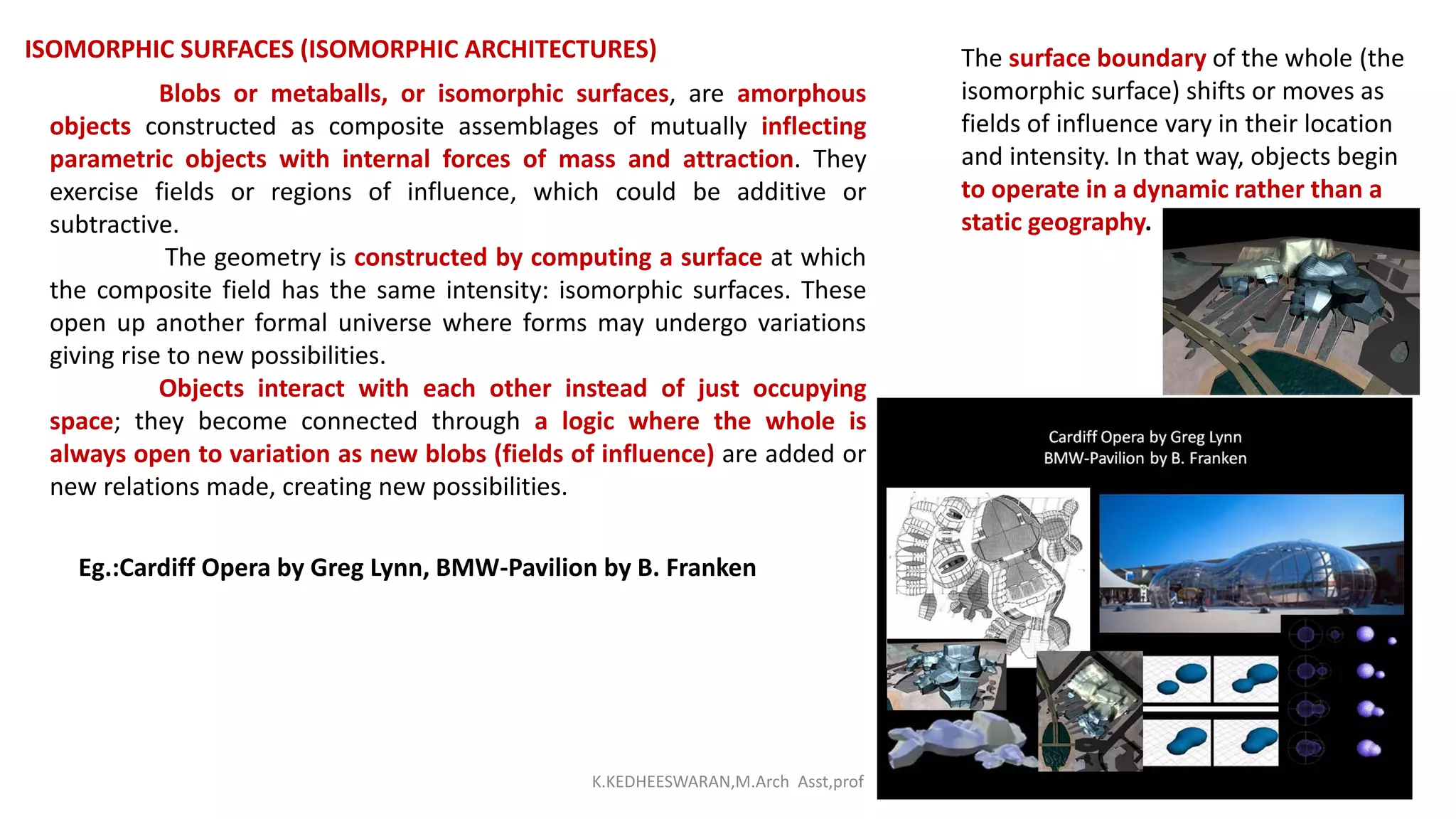
Blobs or metaballs, or isomorphic surfaces, are amorphous
objects constructed as composite assemblages of mutually inflecting
parametric objects with internal forces of mass and attraction. They
exercise fields or regions of influence, which could be additive or
subtractive.
The geometry is constructed by computing a surface at which
the composite field has the same intensity: isomorphic surfaces. These
open up another formal universe where forms may undergo variations
giving rise to new possibilities.
Objects interact with each other instead of just occupying
space; they become connected through a logic where the whole is
always open to variation as new blobs (fields of influence) are added or
new relations made, creating new possibilities.
The surface boundary of the whole (the
isomorphic surface) shifts or moves as
fields of influence vary in their location
and intensity. In that way, objects begin
to operate in a dynamic rather than a
static geography.
Eg.:Cardiff Opera by Greg Lynn, BMW-Pavilion by B. Franken
K.KEDHEESWARAN,M.Arch Asst,prof
Animate Architectures:
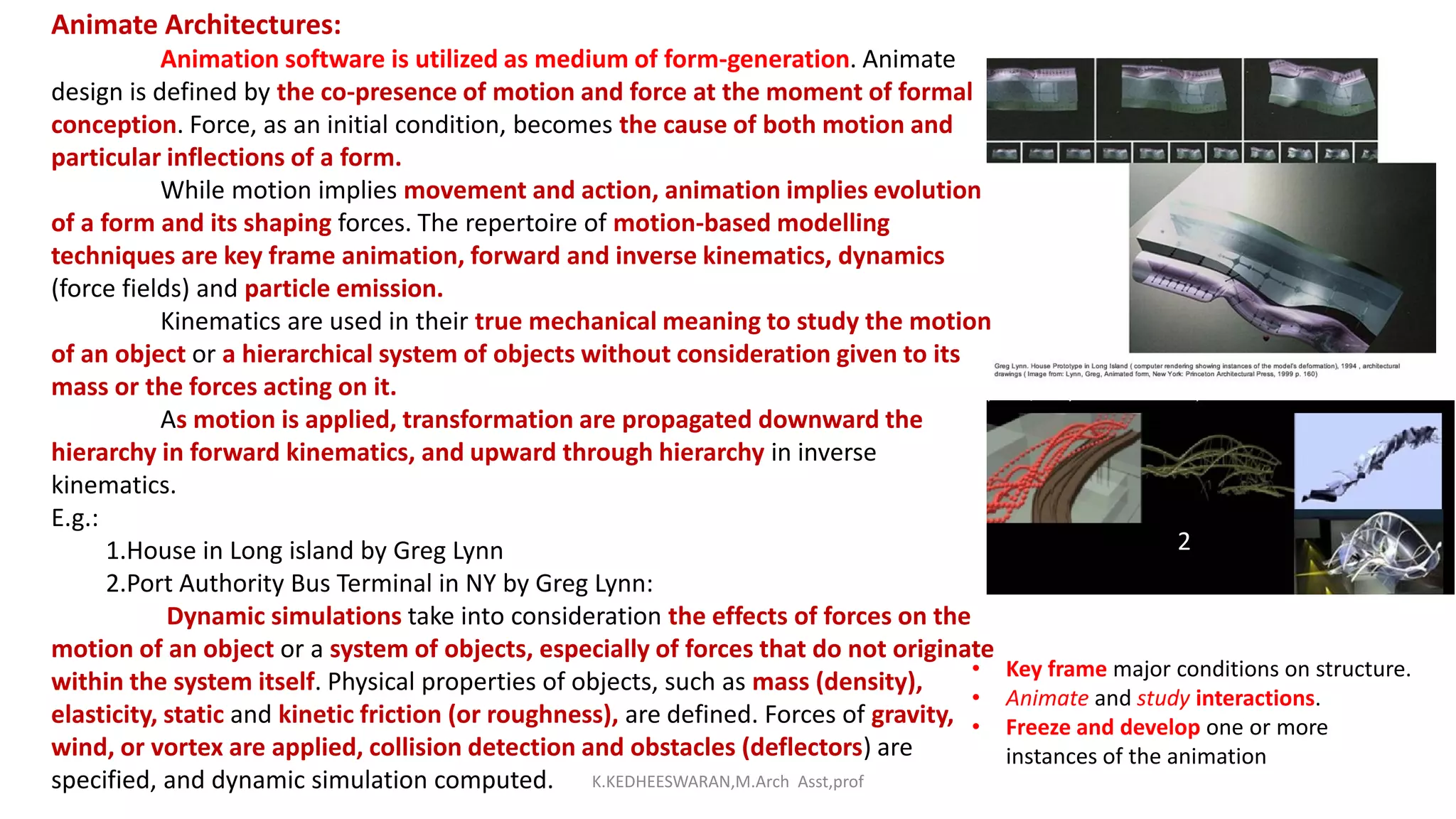
Animation software is utilized as medium of form-generation. Animate
design is defined by the co-presence of motion and force at the moment of formal
conception. Force, as an initial condition, becomes the cause of both motion and
particular inflections of a form.
While motion implies movement and action, animation implies evolution
of a form and its shaping forces. The repertoire of motion-based modelling
techniques are key frame animation, forward and inverse kinematics, dynamics
(force fields) and particle emission.
Kinematics are used in their true mechanical meaning to study the motion
of an object or a hierarchical system of objects without consideration given to its
mass or the forces acting on it.
As motion is applied, transformation are propagated downward the
hierarchy in forward kinematics, and upward through hierarchy in inverse
kinematics.
E.g.:
1.House in Long island by Greg Lynn
2.Port Authority Bus Terminal in NY by Greg Lynn:
Dynamic simulations take into consideration the effects of forces on the
motion of an object or a system of objects, especially of forces that do not originate
within the system itself. Physical properties of objects, such as mass (density),
elasticity, static and kinetic friction (or roughness), are defined. Forces of gravity,
wind, or vortex are applied, collision detection and obstacles (deflectors) are
specified, and dynamic simulation computed.
2
• Key frame major conditions on structure.
• Animate and study interactions.
• Freeze and develop one or more
instances of the animation
K.KEDHEESWARAN,M.Arch Asst,prof
Animate Architectures:-A.Hybridization
The deconstructive methods and buildings constructed by them already
departed from gravity and determination. They were demolishing dogmatic and
structural limits and gave chance to the ‘stranger’.
Everything is self-familiar and not totally a stranger.
The cosmopolitan homelessness and we do not belong to any ‘nation’, ‘race’ or
‘identical type’ anymore in the global continuity, as the critical aspects refuse the
modern universality and homogeneity.
The idea of equality makes connections between differences, namely singularities
and localities, and according to the model the new image of the world is blurred
into a hybrid.
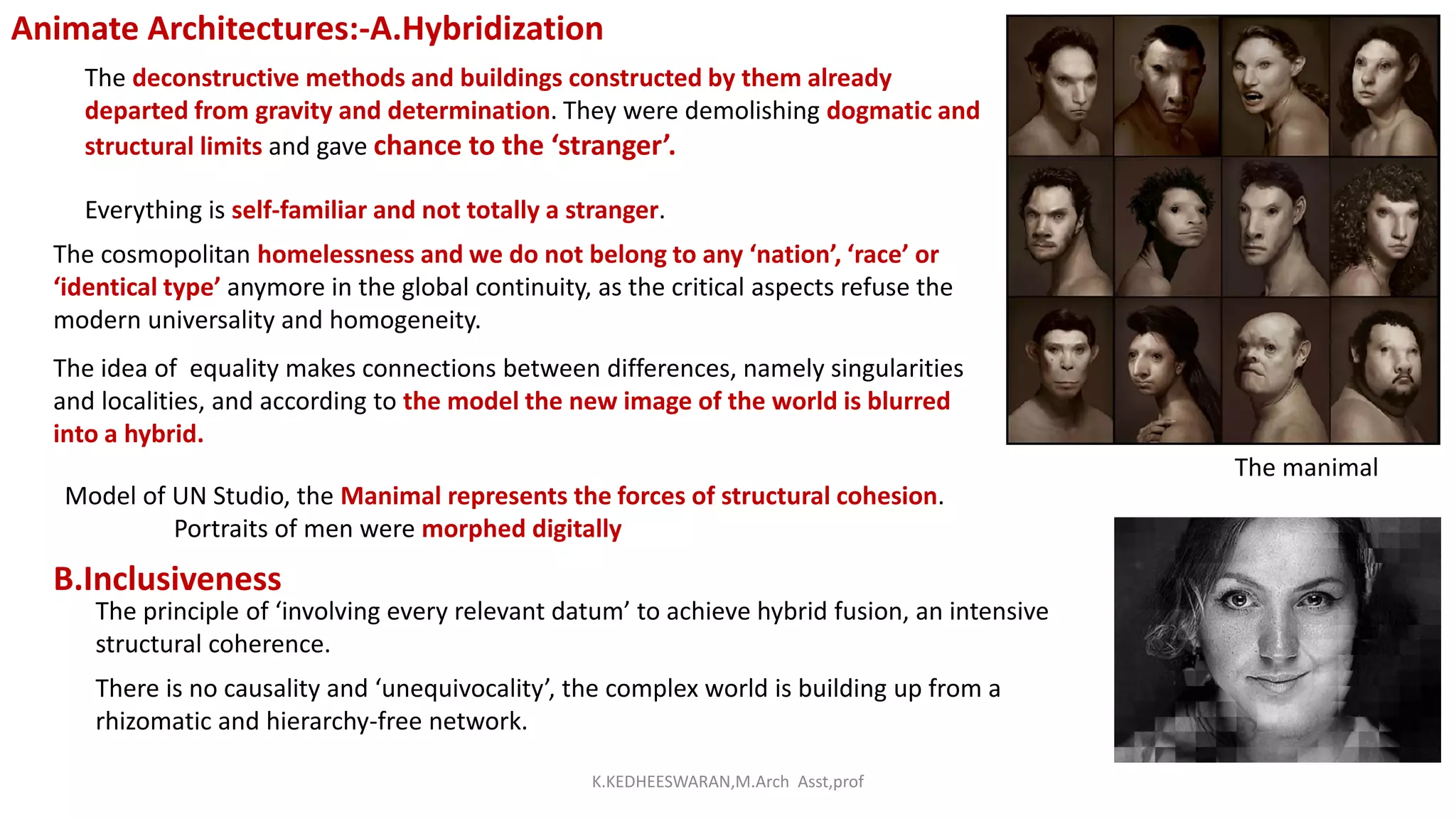
Model of UN Studio, the Manimal represents the forces of structural cohesion.
Portraits of men were morphed digitally
The manimal
B.Inclusiveness
The principle of ‘involving every relevant datum’ to achieve hybrid fusion, an intensive
structural coherence.
There is no causality and ‘unequivocality’, the complex world is building up from a
rhizomatic and hierarchy-free network.
K.KEDHEESWARAN,M.Arch Asst,prof
METAMORPHIC ARCHITECTURES
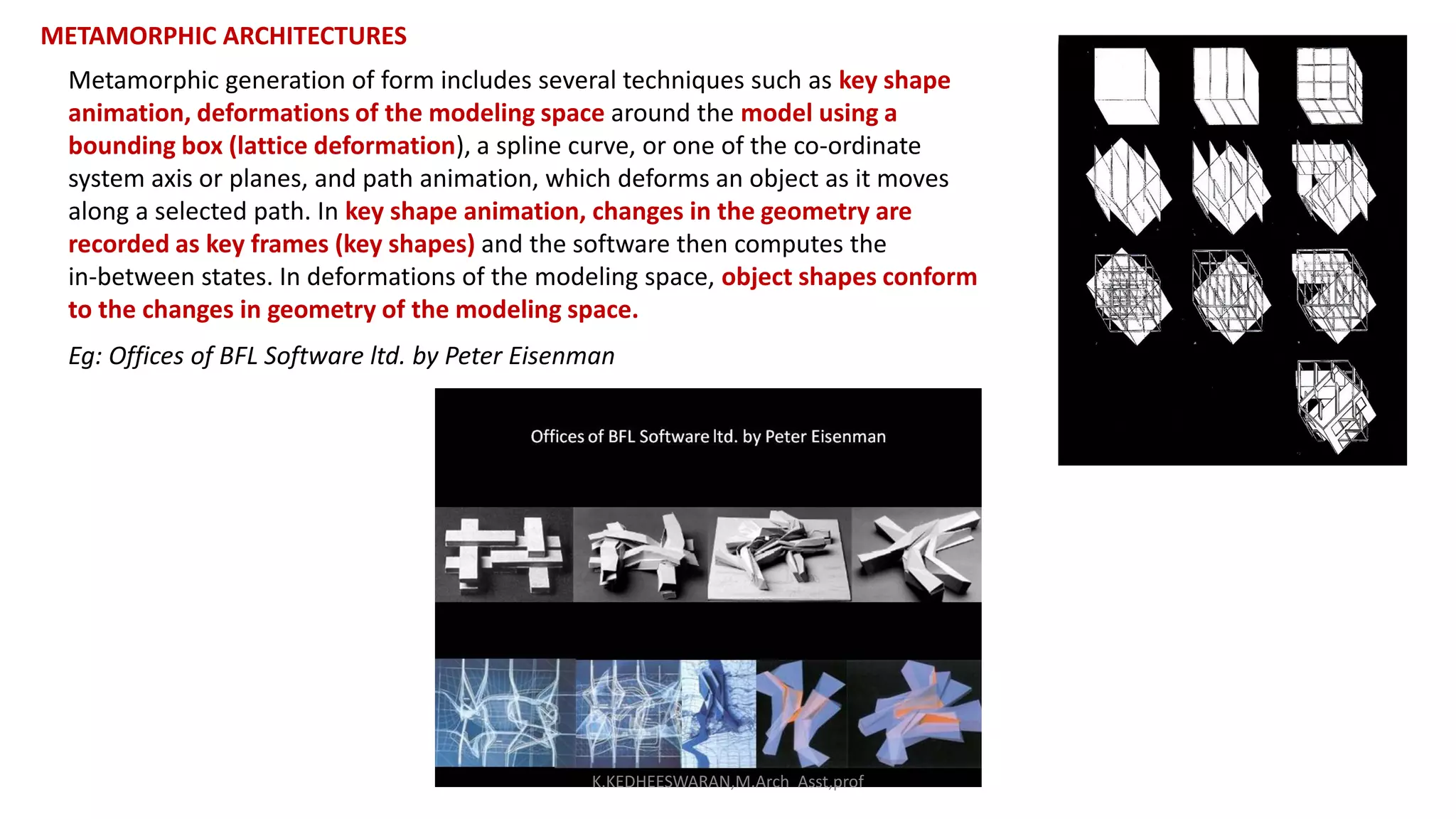
Metamorphic generation of form includes several techniques such as key shape
animation, deformations of the modeling space around the model using a
bounding box (lattice deformation), a spline curve, or one of the co-ordinate
system axis or planes, and path animation, which deforms an object as it moves
along a selected path. In key shape animation, changes in the geometry are
recorded as key frames (key shapes) and the software then computes the
in-between states. In deformations of the modeling space, object shapes conform
to the changes in geometry of the modeling space.
Eg: Offices of BFL Software ltd. by Peter Eisenman
K.KEDHEESWARAN,M.Arch Asst,prof
PARAMETRIC ARCHITECTURES
In parametric design, it is the parameters of a particular
design that are declared, not its shape. By assigning different
values to the parameters, different objects or configurations can
be created.
Equations can be used to describe the relationships
between objects, thus defining an associative geometry. That way,
inter dependencies between objects can be established, and
objects’ behaviour under transformations defined.
Parametric design often entails a procedural, algorithmic
description of geometry.
In this “algorithmic spectaculars”, i.e., algorithmic
explorations of “tectonic production” using mathematical
software, architects can construct mathematical models and
generative procedures that are constrained by numerous variables
initially unrelated to any pragmatic concerns.
Each variable or process is a ‘slot’ into which an external
influence can be mapped, either statically or dynamically.
K.KEDHEESWARAN,M.Arch Asst,prof
EVOLUTIONARY ARCHITECTURES
Evolutionary architecture proposes the evolutionary model of nature as the generating process for
architectural form.
Architectural- concepts are expressed as generative rules so that their evolution and development can be
accelerated and tested by the use of computer models. Concepts are described in a genetic language which produces a
code script of instructions for form generation.
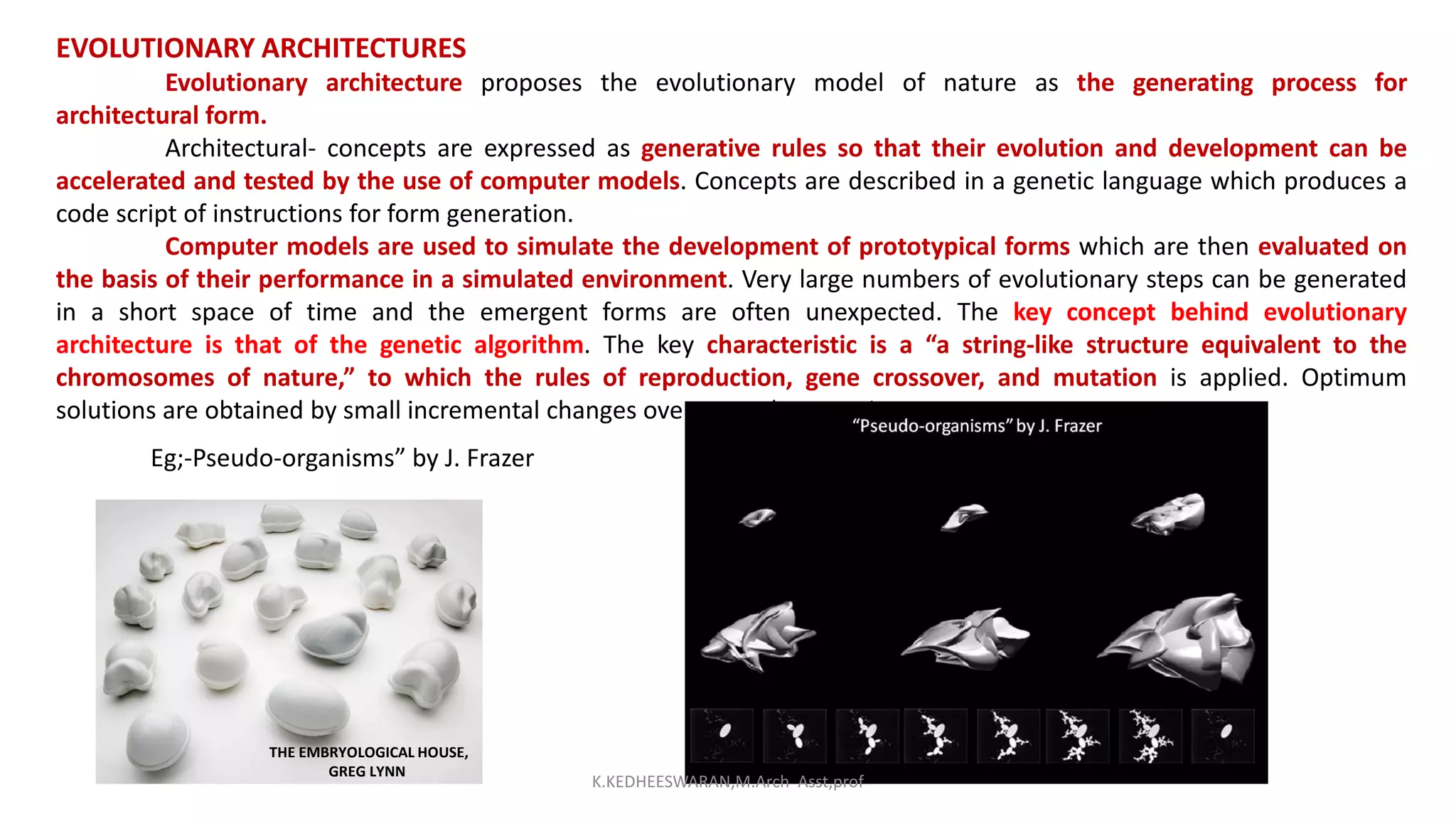
Computer models are used to simulate the development of prototypical forms which are then evaluated on
the basis of their performance in a simulated environment. Very large numbers of evolutionary steps can be generated
in a short space of time and the emergent forms are often unexpected. The key concept behind evolutionary
architecture is that of the genetic algorithm. The key characteristic is a “a string-like structure equivalent to the
chromosomes of nature,” to which the rules of reproduction, gene crossover, and mutation is applied. Optimum
solutions are obtained by small incremental changes over several generations.
Eg;-Pseudo-organisms” by J. Frazer
K.KEDHEESWARAN,M.Arch Asst,prof
THE EMBRYOLOGICAL HOUSE,
GREG LYNN

CONTEMPORARY PROCESS ON ARCHITECTURAL DESIGN

  • 1.
    C O NT E M P O R A R Y P R O C E S S O N A R C H I T E C T U R A L D E S I G N K.KEDHEESWARAN,M.Arch Asst,proff. K.KEDHEESWARAN,M.Arch Asst,prof
  • 2.
    This presentation aimsat presenting those technologies that comes( or will come) under the ambit of digital architecture. • The architecture of modern times is characterized by its capacity to take advantage of the specific achievements of that same modernity: the innovations offered it by present-day science and technology • The relationship between new technology and futuristic architecture even comprises a fundamental datum of what may be referred to as avant-garde architectures • Future will be about integrating computer-aided design with computer-aided fabrication and construction • Redefining the relationship between designing and producing • Eliminating many geometric constraints imposed by traditional drawing and production processes— making complex curved shapes much easier to handle, for example, and • Reducing dependence on standard, mass-produced components • It would bridge the gap between designing and producing K.KEDHEESWARAN,M.Arch Asst,prof
  • 3.
    Digital architectures referto the computationally based processes of form origination and transformations. Several digital architectures are identified based on the underlying computational concepts such as: 1 . To p o l o g i c a l s p a c e ( To p o l o g i c a l a rc h i t e c t u re s ) 2 . I s o m o r p h i c s u r f a c e s ( I s o m o r p h i c a rc h i t e c t u re s ) 3 . M o t i o n k i n e m a t i c s & d y n a m i c s ( A n i m a t e a rc h i t e c t u re s ) 4 . K e y - s h a p e a n i m a t i o n ( M e t a m o r p h i c a rc h i t e c t u re s ) 5 . P a r a m e t r i c d e s i g n ( P a r a m e t r i c a rc h i t e c t u re s ) 6 . G e n e t i c a l g o r i t h m s ( E v o l u t i o n a r y a rc h i t e c t u re s ) T O P O L O G I C A L A R C H I T E C T U R E S : In “architectural curvi-linearity”, it offers examples of new approaches to design that move away from the de-constructivism’s “logic of conflict and contradiction” to develop a “more fluid logic of connectivity.” This is manifested through folding that departs from Euclidean geometry of discrete volumes, and employs topological, “rubber-sheet” geometry of continuous curves and surfaces. In topological space, geometry is represented by parametric functions, which describe a range of possibilities. The continuous, highly curvilinear surfaces are mathematically described as NURBS – Non-Uniform Rational B-Splines. What makes NURBS curves and surfaces particularly appealing is the ability to easily control their shape by manipulating the control points, weights, and knots. NURBS make the heterogeneous and coherent forms of the topological space computationally possible. K.KEDHEESWARAN,M.Arch Asst,prof
  • 4.
    ISOMORPHIC SURFACES (ISOMORPHICARCHITECTURES) Blobs or metaballs, or isomorphic surfaces, are amorphous objects constructed as composite assemblages of mutually inflecting parametric objects with internal forces of mass and attraction. They exercise fields or regions of influence, which could be additive or subtractive. The geometry is constructed by computing a surface at which the composite field has the same intensity: isomorphic surfaces. These open up another formal universe where forms may undergo variations giving rise to new possibilities. Objects interact with each other instead of just occupying space; they become connected through a logic where the whole is always open to variation as new blobs (fields of influence) are added or new relations made, creating new possibilities. The surface boundary of the whole (the isomorphic surface) shifts or moves as fields of influence vary in their location and intensity. In that way, objects begin to operate in a dynamic rather than a static geography. Eg.:Cardiff Opera by Greg Lynn, BMW-Pavilion by B. Franken K.KEDHEESWARAN,M.Arch Asst,prof
  • 5.
    Animate Architectures: Animation softwareis utilized as medium of form-generation. Animate design is defined by the co-presence of motion and force at the moment of formal conception. Force, as an initial condition, becomes the cause of both motion and particular inflections of a form. While motion implies movement and action, animation implies evolution of a form and its shaping forces. The repertoire of motion-based modelling techniques are key frame animation, forward and inverse kinematics, dynamics (force fields) and particle emission. Kinematics are used in their true mechanical meaning to study the motion of an object or a hierarchical system of objects without consideration given to its mass or the forces acting on it. As motion is applied, transformation are propagated downward the hierarchy in forward kinematics, and upward through hierarchy in inverse kinematics. E.g.: 1.House in Long island by Greg Lynn 2.Port Authority Bus Terminal in NY by Greg Lynn: Dynamic simulations take into consideration the effects of forces on the motion of an object or a system of objects, especially of forces that do not originate within the system itself. Physical properties of objects, such as mass (density), elasticity, static and kinetic friction (or roughness), are defined. Forces of gravity, wind, or vortex are applied, collision detection and obstacles (deflectors) are specified, and dynamic simulation computed. 2 • Key frame major conditions on structure. • Animate and study interactions. • Freeze and develop one or more instances of the animation K.KEDHEESWARAN,M.Arch Asst,prof
  • 6.
    Animate Architectures:-A.Hybridization The deconstructivemethods and buildings constructed by them already departed from gravity and determination. They were demolishing dogmatic and structural limits and gave chance to the ‘stranger’. Everything is self-familiar and not totally a stranger. The cosmopolitan homelessness and we do not belong to any ‘nation’, ‘race’ or ‘identical type’ anymore in the global continuity, as the critical aspects refuse the modern universality and homogeneity. The idea of equality makes connections between differences, namely singularities and localities, and according to the model the new image of the world is blurred into a hybrid. Model of UN Studio, the Manimal represents the forces of structural cohesion. Portraits of men were morphed digitally The manimal B.Inclusiveness The principle of ‘involving every relevant datum’ to achieve hybrid fusion, an intensive structural coherence. There is no causality and ‘unequivocality’, the complex world is building up from a rhizomatic and hierarchy-free network. K.KEDHEESWARAN,M.Arch Asst,prof
  • 7.
    METAMORPHIC ARCHITECTURES Metamorphic generationof form includes several techniques such as key shape animation, deformations of the modeling space around the model using a bounding box (lattice deformation), a spline curve, or one of the co-ordinate system axis or planes, and path animation, which deforms an object as it moves along a selected path. In key shape animation, changes in the geometry are recorded as key frames (key shapes) and the software then computes the in-between states. In deformations of the modeling space, object shapes conform to the changes in geometry of the modeling space. Eg: Offices of BFL Software ltd. by Peter Eisenman K.KEDHEESWARAN,M.Arch Asst,prof
  • 8.
    PARAMETRIC ARCHITECTURES In parametricdesign, it is the parameters of a particular design that are declared, not its shape. By assigning different values to the parameters, different objects or configurations can be created. Equations can be used to describe the relationships between objects, thus defining an associative geometry. That way, inter dependencies between objects can be established, and objects’ behaviour under transformations defined. Parametric design often entails a procedural, algorithmic description of geometry. In this “algorithmic spectaculars”, i.e., algorithmic explorations of “tectonic production” using mathematical software, architects can construct mathematical models and generative procedures that are constrained by numerous variables initially unrelated to any pragmatic concerns. Each variable or process is a ‘slot’ into which an external influence can be mapped, either statically or dynamically. K.KEDHEESWARAN,M.Arch Asst,prof
  • 9.
    EVOLUTIONARY ARCHITECTURES Evolutionary architectureproposes the evolutionary model of nature as the generating process for architectural form. Architectural- concepts are expressed as generative rules so that their evolution and development can be accelerated and tested by the use of computer models. Concepts are described in a genetic language which produces a code script of instructions for form generation. Computer models are used to simulate the development of prototypical forms which are then evaluated on the basis of their performance in a simulated environment. Very large numbers of evolutionary steps can be generated in a short space of time and the emergent forms are often unexpected. The key concept behind evolutionary architecture is that of the genetic algorithm. The key characteristic is a “a string-like structure equivalent to the chromosomes of nature,” to which the rules of reproduction, gene crossover, and mutation is applied. Optimum solutions are obtained by small incremental changes over several generations. Eg;-Pseudo-organisms” by J. Frazer K.KEDHEESWARAN,M.Arch Asst,prof THE EMBRYOLOGICAL HOUSE, GREG LYNN