Building secure,
privacy aware,
quality Wi-Fi coverage
via cooperation
Karri Huhtanen
Arch Red Oy &
Open System Consultants Pty Ltd
22.9.2015
quality and the
traditional way of
building coverage
Photo by Karl-Ludwig G. Poggemann
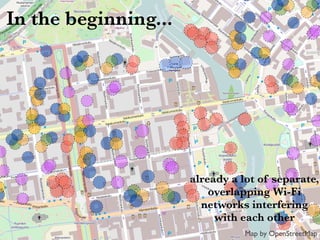
In the beginning...
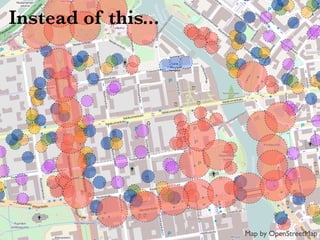
already a lot of separate,
overlapping Wi-Fi
networks interfering
with each other
Map by OpenStreetMap
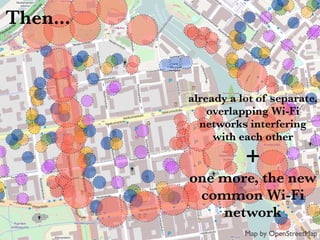
already a lot of separate,
overlapping Wi-Fi
networks interfering
with each other
+
one more, the new
common Wi-Fi
network
Then...
Map by OpenStreetMap
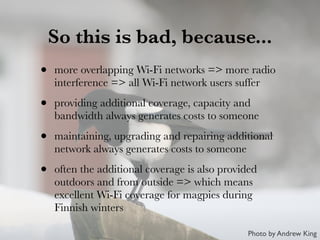
So this is bad, because...
• more overlapping Wi-Fi networks => more radio
interference => all Wi-Fi network users suffer
• providing additional coverage, capacity and
bandwidth always generates costs to someone
• maintaining, upgrading and repairing additional
network always generates costs to someone
• often the additional coverage is also provided
outdoors and from outside => which means
excellent Wi-Fi coverage for magpies during
Finnish winters
Photo by Andrew King
What to do?
Photo by Sean Hobson
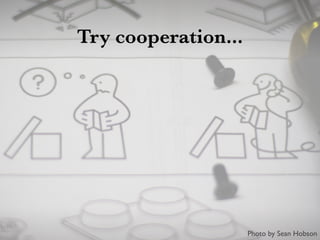
Try cooperation...
Photo by Sean Hobson
Instead of this...
Map by OpenStreetMap
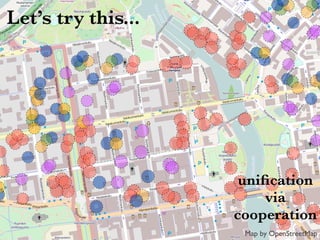
Let’s try this...
Map by OpenStreetMap
unification
via
cooperation
We must be realistic...
• Somebody has to cover the costs of providing coverage, capacity,
bandwidth and maintaining, upgrading and repairing network =>
Dividing work and costs makes sense => Let everyone handle and
control their part of the network
• We need unified policies for network configuration, authentication,
access filtering, IP addressing etc. => Let’s just choose open
standard interfaces and policies, no specific vendors or service
providers
• There will still be overlapping private networks, home networks
etc. => interference cannot be removed but it can be reduced
• Coverage is not really needed everywhere, it is needed where the
existing networks already are => with unified network settings
around it is easier to access Internet in various places
So how can this be done?
Photo by Sean Hobson
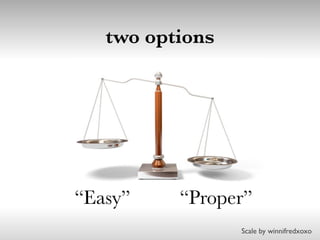
two options
“Easy” “Proper”
Scale by winnifredxoxo
“Easy”
• use common but original Wi-Fi network name for all
cooperating networks, make the name neutral so that it is
easier to adopt
• leave Wi-Fi network without authentication or encryption
or specify common WPA2 pre-shared secret, share this
secret to everyone
• have and enforce a common policy for Internet filtering
and IP addressing everywhere
• wish for the best and believe in the goodness of the people
• that’s it: everyone controls and is responsible of their own
part of network and partially what happens through it
Photo by RobbyVan Moor
For few reasons “easy” option
has not catched on
• People want to have unauthenticated, unencrypted and unfiltered
networks to use, but very few want to provide such ones
themselves.
• People still want to have curtains for privacy, doors for access
control, pin codes for credit cards and mobile phones.
• People responsible of what happens in or through their networks
are even more careful.
• “easy” networks are often filtered so heavily that instead of ‘open’
they often should be called ‘broken’.
• Access and capacity control, monitoring and network
management are still needed, even in so called ‘open’ networks.
Photo by Thomas Guine
Photo by RobbyVan Moor
“Proper”
• use common but original Wi-Fi network name for all
cooperating networks, make the name neutral so that it is
easier to adopt
• use WPA2 Enterprise encryption and authentication for
everyone and every network, connect networks into coverage
area by authentication federation
• have and enforce a common policy for Internet filtering, IP
addressing and network configuration everywhere
• that’s it: everyone controls and is responsible of their own
part of network and partially what happens through it,
visitors leave trails that can be followed, device and visitor
access can be controlled
But has this then catched on?
• Short answer: Yes.
• eduroam(tm) (www.eduroam.org), the global authentication
federation for universities and research organisations is the world’s
3rd most advertised Wi-Fi network and the roaming standard of
academic world
• eduroam(tm) technologies and architecture have been applied in
Wireless Tampere community network and its successor roam.fi,
which is used already in Tampere and neighboring cities
• Belnet has started a pilot in Belgium about government roaming
called govroam(tm) (www.govroam.be)
• The architecture is compatible with operator roaming and
technologies such as SIM card or certificate authentication, elliptic
curves etc. in addition to traditional username and password
What are the additional benefits?
• A common Wi-Fi network with same network configuration
accessible everywhere securely with home organisation credentials
but at the same time protecting the user privacy.
• Access to the network, used capacity and traffic can be controlled
and prioritized. Trail of accountability exists.
• The core infrastructure and architecture is field tested, it has already
been used and developed for over 10 years by operators, by eduroam
etc.
• The core infrastructure can be extended and evolved as
authentication and network technologies develop, in most times even
without changes to the core.
• All technologies and interfaces used are open standards, defined
mostly in IETF. There exists both open source and commercial
options for components and services from several suppliers.
What now and in the
future?
• All the components for building this kind of cooperative
Wi-Fi authentication federation exists.
• Together with Centre of Open Systems and Solutions
(COSS ry), already 2 operators and several cities and
organisations, Wireless Tampere model is migrated and
rebranded to roam.fi concept.
• roam.fi aims to be eduroam for any organisation, city,
company or operator, not just academic organisations
• If interested, come and discuss with me or COSS about
details.
Thank you. Questions?
Karri Huhtanen
https://www.twitter.com/khuhtanen
https://plus.google.com/+KarriHuhtanen/
these and more slides:
http://www.slideshare.net/khuhtanen/
Additional Slides
for technical and non-technical questions
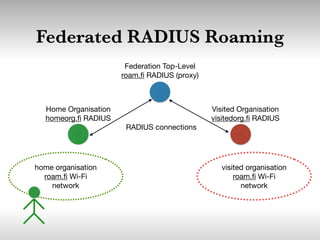
Federated RADIUS Roaming
Federation Top-Level

roam.fi RADIUS (proxy)
Home Organisation

homeorg.fi RADIUS
Visited Organisation

visitedorg.fi RADIUS
home organisation
roam.fi Wi-Fi
network
visited organisation
roam.fi Wi-Fi
network
RADIUS connections
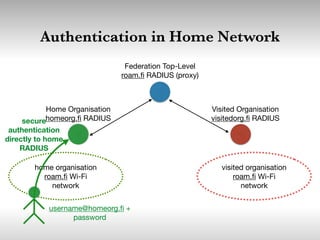
Authentication in Home Network
Federation Top-Level

roam.fi RADIUS (proxy)
Home Organisation

homeorg.fi RADIUS
Visited Organisation

visitedorg.fi RADIUS
home organisation
roam.fi Wi-Fi
network
visited organisation
roam.fi Wi-Fi
network
secure
authentication
directly to home
RADIUS
username@homeorg.fi +
password
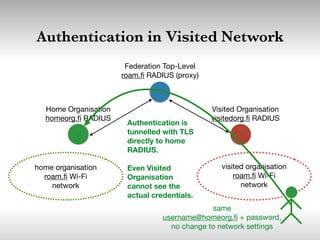
Authentication in Visited Network
Federation Top-Level

roam.fi RADIUS (proxy)
Home Organisation

homeorg.fi RADIUS
Visited Organisation

visitedorg.fi RADIUS
home organisation
roam.fi Wi-Fi
network
visited organisation
roam.fi Wi-Fi
network
Authentication is
tunnelled with TLS
directly to home
RADIUS.
Even Visited
Organisation
cannot see the
actual credentials.
same

username@homeorg.fi + password, 

no change to network settings
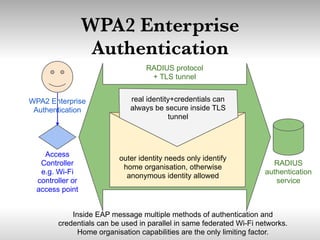
WPA2 Enterprise
Authentication
real identity+credentials can
always be secure inside TLS
tunnel
Access
Controller
e.g. Wi-Fi
controller or
access point
RADIUS
authentication
service
RADIUS protocol
+ TLS tunnel
WPA2 Enterprise
Authentication
outer identity needs only identify
home organisation, otherwise
anonymous identity allowed
Inside EAP message multiple methods of authentication and
credentials can be used in parallel in same federated Wi-Fi networks.
Home organisation capabilities are the only limiting factor.
What about electromagnetic
radiation, Wi-Fi and children?
• There is no scientific evidence or research results,
which would prove that Wi-Fi is in anyway
harmful.
• If additional discussion is needed, author strongly
recommends discussion with for example Vesa
Linja-aho, Lilja Tamminen, or scientists with actual
degrees from relevant fields (physics, medicine, etc.)

Building secure, privacy aware, quality Wi-Fi coverage via cooperation

  • 1.
    Building secure, privacy aware, qualityWi-Fi coverage via cooperation Karri Huhtanen Arch Red Oy & Open System Consultants Pty Ltd 22.9.2015
  • 2.
    quality and the traditionalway of building coverage Photo by Karl-Ludwig G. Poggemann
  • 3.
    In the beginning... alreadya lot of separate, overlapping Wi-Fi networks interfering with each other Map by OpenStreetMap
  • 4.
    already a lotof separate, overlapping Wi-Fi networks interfering with each other + one more, the new common Wi-Fi network Then... Map by OpenStreetMap
  • 5.
    So this isbad, because... • more overlapping Wi-Fi networks => more radio interference => all Wi-Fi network users suffer • providing additional coverage, capacity and bandwidth always generates costs to someone • maintaining, upgrading and repairing additional network always generates costs to someone • often the additional coverage is also provided outdoors and from outside => which means excellent Wi-Fi coverage for magpies during Finnish winters Photo by Andrew King
  • 6.
    What to do? Photoby Sean Hobson
  • 7.
  • 8.
    Instead of this... Mapby OpenStreetMap
  • 9.
    Let’s try this... Mapby OpenStreetMap unification via cooperation
  • 10.
    We must berealistic... • Somebody has to cover the costs of providing coverage, capacity, bandwidth and maintaining, upgrading and repairing network => Dividing work and costs makes sense => Let everyone handle and control their part of the network • We need unified policies for network configuration, authentication, access filtering, IP addressing etc. => Let’s just choose open standard interfaces and policies, no specific vendors or service providers • There will still be overlapping private networks, home networks etc. => interference cannot be removed but it can be reduced • Coverage is not really needed everywhere, it is needed where the existing networks already are => with unified network settings around it is easier to access Internet in various places
  • 11.
    So how canthis be done? Photo by Sean Hobson
  • 12.
  • 13.
    “Easy” • use commonbut original Wi-Fi network name for all cooperating networks, make the name neutral so that it is easier to adopt • leave Wi-Fi network without authentication or encryption or specify common WPA2 pre-shared secret, share this secret to everyone • have and enforce a common policy for Internet filtering and IP addressing everywhere • wish for the best and believe in the goodness of the people • that’s it: everyone controls and is responsible of their own part of network and partially what happens through it Photo by RobbyVan Moor
  • 14.
    For few reasons“easy” option has not catched on • People want to have unauthenticated, unencrypted and unfiltered networks to use, but very few want to provide such ones themselves. • People still want to have curtains for privacy, doors for access control, pin codes for credit cards and mobile phones. • People responsible of what happens in or through their networks are even more careful. • “easy” networks are often filtered so heavily that instead of ‘open’ they often should be called ‘broken’. • Access and capacity control, monitoring and network management are still needed, even in so called ‘open’ networks.
  • 15.
    Photo by ThomasGuine Photo by RobbyVan Moor “Proper” • use common but original Wi-Fi network name for all cooperating networks, make the name neutral so that it is easier to adopt • use WPA2 Enterprise encryption and authentication for everyone and every network, connect networks into coverage area by authentication federation • have and enforce a common policy for Internet filtering, IP addressing and network configuration everywhere • that’s it: everyone controls and is responsible of their own part of network and partially what happens through it, visitors leave trails that can be followed, device and visitor access can be controlled
  • 16.
    But has thisthen catched on? • Short answer: Yes. • eduroam(tm) (www.eduroam.org), the global authentication federation for universities and research organisations is the world’s 3rd most advertised Wi-Fi network and the roaming standard of academic world • eduroam(tm) technologies and architecture have been applied in Wireless Tampere community network and its successor roam.fi, which is used already in Tampere and neighboring cities • Belnet has started a pilot in Belgium about government roaming called govroam(tm) (www.govroam.be) • The architecture is compatible with operator roaming and technologies such as SIM card or certificate authentication, elliptic curves etc. in addition to traditional username and password
  • 17.
    What are theadditional benefits? • A common Wi-Fi network with same network configuration accessible everywhere securely with home organisation credentials but at the same time protecting the user privacy. • Access to the network, used capacity and traffic can be controlled and prioritized. Trail of accountability exists. • The core infrastructure and architecture is field tested, it has already been used and developed for over 10 years by operators, by eduroam etc. • The core infrastructure can be extended and evolved as authentication and network technologies develop, in most times even without changes to the core. • All technologies and interfaces used are open standards, defined mostly in IETF. There exists both open source and commercial options for components and services from several suppliers.
  • 18.
    What now andin the future? • All the components for building this kind of cooperative Wi-Fi authentication federation exists. • Together with Centre of Open Systems and Solutions (COSS ry), already 2 operators and several cities and organisations, Wireless Tampere model is migrated and rebranded to roam.fi concept. • roam.fi aims to be eduroam for any organisation, city, company or operator, not just academic organisations • If interested, come and discuss with me or COSS about details.
  • 19.
    Thank you. Questions? KarriHuhtanen https://www.twitter.com/khuhtanen https://plus.google.com/+KarriHuhtanen/ these and more slides: http://www.slideshare.net/khuhtanen/
  • 20.
    Additional Slides for technicaland non-technical questions
  • 21.
    Federated RADIUS Roaming FederationTop-Level roam.fi RADIUS (proxy) Home Organisation homeorg.fi RADIUS Visited Organisation visitedorg.fi RADIUS home organisation roam.fi Wi-Fi network visited organisation roam.fi Wi-Fi network RADIUS connections
  • 22.
    Authentication in HomeNetwork Federation Top-Level roam.fi RADIUS (proxy) Home Organisation homeorg.fi RADIUS Visited Organisation visitedorg.fi RADIUS home organisation roam.fi Wi-Fi network visited organisation roam.fi Wi-Fi network secure authentication directly to home RADIUS username@homeorg.fi + password
  • 23.
    Authentication in VisitedNetwork Federation Top-Level roam.fi RADIUS (proxy) Home Organisation homeorg.fi RADIUS Visited Organisation visitedorg.fi RADIUS home organisation roam.fi Wi-Fi network visited organisation roam.fi Wi-Fi network Authentication is tunnelled with TLS directly to home RADIUS. Even Visited Organisation cannot see the actual credentials. same username@homeorg.fi + password, no change to network settings
  • 24.
    WPA2 Enterprise Authentication real identity+credentialscan always be secure inside TLS tunnel Access Controller e.g. Wi-Fi controller or access point RADIUS authentication service RADIUS protocol + TLS tunnel WPA2 Enterprise Authentication outer identity needs only identify home organisation, otherwise anonymous identity allowed Inside EAP message multiple methods of authentication and credentials can be used in parallel in same federated Wi-Fi networks. Home organisation capabilities are the only limiting factor.
  • 25.
    What about electromagnetic radiation,Wi-Fi and children? • There is no scientific evidence or research results, which would prove that Wi-Fi is in anyway harmful. • If additional discussion is needed, author strongly recommends discussion with for example Vesa Linja-aho, Lilja Tamminen, or scientists with actual degrees from relevant fields (physics, medicine, etc.)