SCHOOL OF
PLANNING AND
ARCHITECTURE,
DELHI.
NATIONAL DESKTOP STUDY
Overview
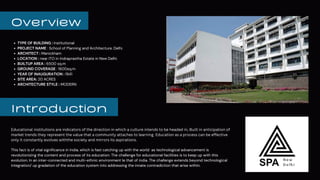
TYPE OF BUILDING : Institutional
PROJECT NAME : School of Planning and Architecture, Delhi.
ARCHITECT : Manickham
LOCATION : near ITO in Indraprastha Estate in New Delhi.
BUILTUP AREA : 6500 sq.m
GROUND COVERAGE : 1600sq.m
YEAR OF INAUGURATION : 1941
SITE AREA: 20 ACRES
ARCHITECTURE STYLE : MODERN
Introduction
Educational institutions are indicators of the direction in which a culture intends to be headed in, Built in anticipation of
market trends they represent the value that a community attaches to learning. Education as a process can be effective
only it constantly evolves withthe society and mirrors its aspirations.
This fact is of vital significance in India, which is fast catching up with the world as technological advancement is
revolutionizing the content and process of its education. The challenge for educational facilities is to keep up with this
evolution. In an inter-connected and multi-ethnic environment le that of india. The challenge extends beyond technological
integration/ up gradation of the education system into addressing the innate contradiction that arise within.
History
It was Walter George who chose to stay back when the British left India. During those days there were hardly any architects in the city. There were only two schools in
India for training architects, and these were located in Bombay and Baroda, Walter George a colleagues thus began the work of establishing the first institution in Delhi
for imparting training to students of architecture.
It was in 1942 that the Department of Architecture came into existence as a part of the Delhi Polytechnic at Kashmiri Gate northern Delhi While Ww Wood became the
first Principal the newly established Delhi Polytechnic, Mi Mirza became the first Head of the Department of Architecture. The first batch of students received their
national diploma in Architecture in 1950
Present Status
Today SPA, New Delhi is a premier central university imparting education in planning, architecture, and design. In the 1980s the School set up state-of-theart Centres
for Advanced Studies attached to each department of studies. Another important initiative was taken to start doctoral programmes , which have produced a
significant number of scholars in the last two decades . It was also during 1980s that the construction of a residential campus at Taimoor Nagar, New Friends Colony
commenced. It provided additional accommodation for students as well as housing for the faculty and staff. The construct ion of new campus for the School at Vasant
Kunj in South Delhi is under way.
At present, S.P.A. operates from three locations. The planning dept. and the architecture dept. are housed in different buildings in different plots. There are 11 distinct
departments presently and all of them are flourishing units in themselves possessing a wealth of knowledge and resources. They are supervised and run by the best
and most experienced faculty of the country. But physical segregation of the institution means that there is very little interaction between the students and faculty of
the various departments. The resource of the institute can not be utilized fully. In the planning building itself , the location of the studios and the faculty areas is such
that one does not get to know about other studios on their way.Hence,inter-department interaction is minimal.
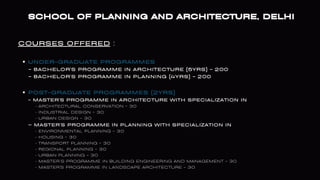
COURSES OFFERED :
SCHOOL OF PLANNING AND ARCHITECTURE, DELHI
UNDER-GRADUATE PROGRAMMES
POST-GRADUATE PROGRAMMES (2YRS)
- BACHELOR'S PROGRAMME IN ARCHITECTURE (5YRS) - 200
- BACHELOR'S PROGRAMME IN PLANNING (4YRS) - 200
- MASTER'S PROGRAMME IN ARCHITECTURE WITH SPECIALIZATION IN
• ARCHITECTURAL CONSERVATION - 30
• INDUSTRIAL DESIGN - 30
• URBAN DESIGN - 30
– MASTER'S PROGRAMME IN PLANNING WITH SPECIALIZATION IN
• ENVIRONMENTAL PLANNING - 30
• HOUSING - 30
• TRANSPORT PLANNING - 30
• REGIONAL PLANNING - 30
• URBAN PLANNING - 30
• MASTER’S PROGRAMME IN BUILDING ENGINEERING AND MANAGEMENT - 30
• MASTER'S PROGRAMME IN LANDSCAPE ARCHITECTURE - 30
The SPA was one of the first institutions to have mixed hostels for girls and boys, but this was
closed in 1993, despite student protests.
The current SPA New Delhi campus is split in two blocks one each for Planning and
Architecture. Both these blocks are housed near ITO in Indraprastha Estate in New Delhi.The
girls hostel is located in the ITO campus itself and the boys hostel and residential campus is
located in New Friends Colony, Maharani Bagh, Delhi.
The construction of a residential campus atTaimoor Nagar, New Friends Colony commenced. It
provided additional accommodation for students as well as housing for the faculty and staff.The
construction of New campus for the school atVasant Kunj in South Delhi is under way.
Till 1993
Present
Future
Expansion
Campus Overview
The site comes under institutional area-educational zone of Vasant Kunj and is governed by MPD-bye laws 2021. The zone under which the
site is located is the Zone -F of Delhi. The site falls under the jurisdiction of Municipal Corporation of Delhi and MCD-bye laws are binding on
the project. Environmental clearance is mandatory as the proposed site falls at the edge of south central ridge. Apart from regulations, there
are height restrictions as the proposed site lies in the flight path of Delhi International Airport.
The Development Controls applicable for the site(educational facilities-higher education)are as follows:
• Maximum Ground Coverage= 35%
• Maximum F.A.R. = 150
• Maximum Height =17m
Maximum height permitted for the site due to close proximity to the airport is l7m calculated the highest point on the site. Upto 15% of max.
FAR can be utilized for residential use of staff and student accommodation . Parking standard @ 1.33 ECS/ 100 sq. m. of floor area.
Site By-Laws
Consolidation and strengthening of the program emphasizing on areas of concern.
Identifying areas of thrust and satisfying them with design .
Improving the quality and standards of education .
Providing best suitable environment for nurturing growth of thoughts .
Providing a landmark institute for reference .
Articulation of spaces and buildings/built environment .
Providing an interactive environment .
Try to achieve green building standards .
Creating an intelligent built and outdoor environment .
Provide space for modern technology equipped workshops.
Aims & Objectives
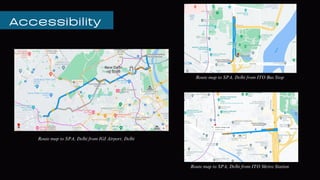
Accessibility
Route map to SPA, Delhi from ITO Bus Stop
Route map to SPA, Delhi from ITO Metro Station
Route map to SPA, Delhi from IGI Airport, Delhi
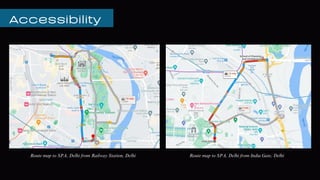
Route map to SPA, Delhi from India Gate, Delhi
Route map to SPA, Delhi from Railway Station, Delhi
Accessibility
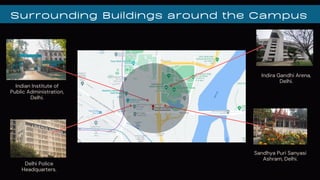
Sandhya Puri Sanyasi
Ashram, Delhi.
Delhi Police
Headquarters.
Indian Institute of
Public Administration,
Delhi.
Indira Gandhi Arena,
Delhi.
Surrounding Buildings around the Campus
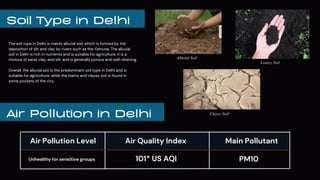
Soil Type in Delhi
The soil type in Delhi is mainly alluvial soil, which is formed by the
deposition of silt and clay by rivers such as the Yamuna. The alluvial
soil in Delhi is rich in nutrients and is suitable for agriculture. It is a
mixture of sand, clay, and silt, and is generally porous and well-draining.
Overall, the alluvial soil is the predominant soil type in Delhi and is
suitable for agriculture, while the loamy and clayey soil is found in
some pockets of the city.
Air Pollution in Delhi
Alluvial Soil
Loamy Soil
Clayey Soil
Air Pollution Level
Unhealthy for sensitive groups
Main Pollutant
Air Quality Index
101* US AQI PM10
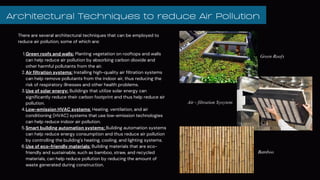
Architectural Techniques to reduce Air Pollution
Green roofs and walls: Planting vegetation on rooftops and walls
can help reduce air pollution by absorbing carbon dioxide and
other harmful pollutants from the air.
Air filtration systems: Installing high-quality air filtration systems
can help remove pollutants from the indoor air, thus reducing the
risk of respiratory illnesses and other health problems.
Use of solar energy: Buildings that utilize solar energy can
significantly reduce their carbon footprint and thus help reduce air
pollution.
Low-emission HVAC systems: Heating, ventilation, and air
conditioning (HVAC) systems that use low-emission technologies
can help reduce indoor air pollution.
Smart building automation systems: Building automation systems
can help reduce energy consumption and thus reduce air pollution
by controlling the building's heating, cooling, and lighting systems.
Use of eco-friendly materials: Building materials that are eco-
friendly and sustainable, such as bamboo, straw, and recycled
materials, can help reduce pollution by reducing the amount of
waste generated during construction.
There are several architectural techniques that can be employed to
reduce air pollution, some of which are:
1.
2.
3.
4.
5.
6.
Green Roofs
Air - filtration Sysytem
Bamboo
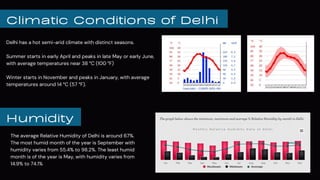
Climatic Conditions of Delhi
Delhi has a hot semi-arid climate with distinct seasons.
Summer starts in early April and peaks in late May or early June,
with average temperatures near 38 °C (100 °F)
Winter starts in November and peaks in January, with average
temperatures around 14 °C (57 °F).
Humidity
The average Relative Humidity of Delhi is around 67%.
The most humid month of the year is September with
humidity varies from 55.4% to 98.2%. The least humid
month is of the year is May, with humidity varies from
14.9% to 74.1%
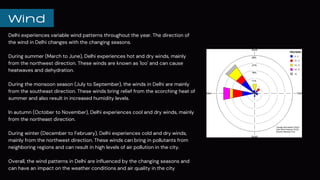
Wind
Delhi experiences variable wind patterns throughout the year. The direction of
the wind in Delhi changes with the changing seasons.
During summer (March to June), Delhi experiences hot and dry winds, mainly
from the northwest direction. These winds are known as 'loo' and can cause
heatwaves and dehydration.
During the monsoon season (July to September), the winds in Delhi are mainly
from the southeast direction. These winds bring relief from the scorching heat of
summer and also result in increased humidity levels.
In autumn (October to November), Delhi experiences cool and dry winds, mainly
from the northeast direction.
During winter (December to February), Delhi experiences cold and dry winds,
mainly from the northwest direction. These winds can bring in pollutants from
neighboring regions and can result in high levels of air pollution in the city.
Overall, the wind patterns in Delhi are influenced by the changing seasons and
can have an impact on the weather conditions and air quality in the city
Solar Radiation
In summers the sun is at high altitude ,the roof receives much more radiation than the
walls , thus horizontal shade is enough , how ever in winters when the position of the
sun is lowered , vertical louvers becomes necessary.
Topography
Seismicity
The terrain is rocky and loose with quartzite rocks. Swales and valleys within the landscape lead to formation of water channels and
collection pools. Rocky substrata promotes storage and retention of water.
Delhi lies in Zone IV and is thus extremely vulnerable to earthquakes . Generally earthquakes here are of 5-6 magnitude with occasional
6-8 magnitude.
The 11kv electric lines run throughout the periphery of the site at a distance of nearly 20-30m . The main source of power to the site is the
roadside poles.
Power Supply
Drainage
Profile
Water supply is through the underground reservoirs connected to Delhi Municipal Corporation. Rainwater and sewage disposal through
drains below the green strips connecting to Nelson Mandela Road
The site is an irregular shaped with two faces of 340m & 208m While the rest is an irregular curve joining the two points. . The lowest
point of the site is at +251m above MSL whereas the highest point is at +266m. The main dominant level is +265.5m.
Topography
The terrain is rocky and loose with quartzite rocks. Swales and valleys within the landscape lead to formation of water channels and
collection pools. Rocky substrata promotes storage and retention of water.
SITE PLAN
Vikas Marg
Ring Road
DDA Vikas Minar
SPA Planning Block ( UG Planning and all PG Dept.)
SPA Girl's Hostel
L.T.P.I
L.T.P.A Office
I.I.P.A Auditorium, UCO Bank
L.A.M.R
Architecture Block ( UG Architecture, BEM & ID)
Graveyard and Wetland
Slums
L.S.L.D
Sales Tax Bhawan
Police Headquarters
A.G.C.R
I.T. Office
1.
2.
3.
4.
5.
6.
7.
8.
9.
10.
11.
12.
13.
14.
15.
16.
17.
Built-Up Area
75%
Open Space
25%
Site Ratio
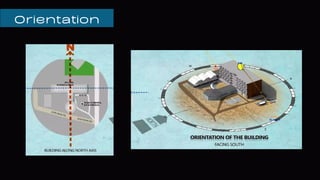
Orientation
Courtyard
Parking &&
Services
Lobby
Ground
Floor
Plan
Basketball
Court
Canteen
Workshop
Courtyard
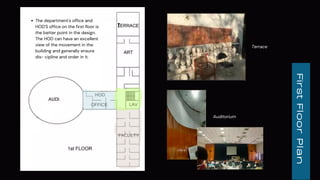
First
Floor
Plan
Auditorium
Terrace
The department's office and
HOD'S office on the first floor is
the better point in the design.
The HOD can have an excellent
view of the movement in the
building and generally ensure
dis- cipline and order in it.
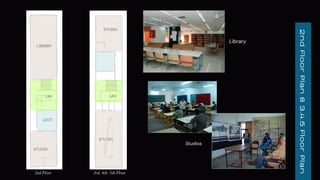
2nd
Floor
Plan
&
3,4,5
Floor
Plan
2nd Floor 3rd, 4th, 5th Floor
Library
Studios
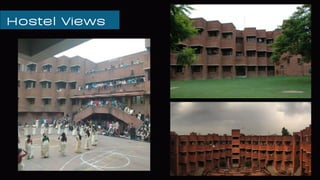
Hostel Views
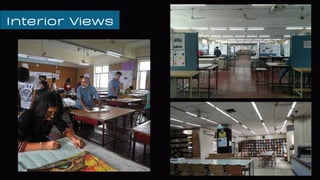
Interior Views
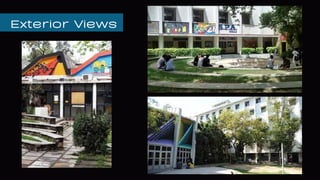
Exterior Views
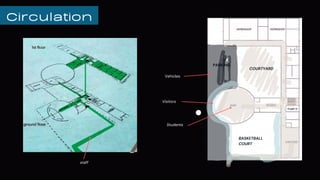
Visitors
Circulation
PARKING
COURTYARD
BASKETBALL
COURT
Vehicles
Students
staff
Lighting and Ventilation
Large windows lets sunlight to pierce into the indoors.
For ventilation there are large ventilators.
These large ventilators also provide light into the room.
Materials used in Building
Wall - Exposed brick, Plaster on surface Double skin
facade (Jaali).
Floor - Kota stone,
Sculpture - Tile brick, Stone
EXTERIOR :
Wall - Brick wall, plaster
Floor - Kota stone, Granite stone
Roof - Rcc slab
INTERIOR :
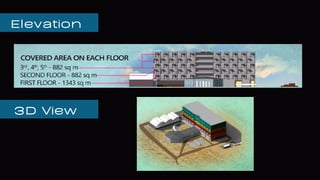
Elevation
3D View
Services
Fire Safety
Electricity
Water
Pump Room
The basic services for the building are provided such as :
Inference
Landing of Staircase is smaller
No fire exit
Corridor wideness is less
Proper parking is not provided
Overcrowding Area
Building Lacks Architectural Character
Height of the Building is too high
THANK YOU

SPA, Delhi Case Study

  • 1.
  • 2.
    Overview TYPE OF BUILDING: Institutional PROJECT NAME : School of Planning and Architecture, Delhi. ARCHITECT : Manickham LOCATION : near ITO in Indraprastha Estate in New Delhi. BUILTUP AREA : 6500 sq.m GROUND COVERAGE : 1600sq.m YEAR OF INAUGURATION : 1941 SITE AREA: 20 ACRES ARCHITECTURE STYLE : MODERN Introduction Educational institutions are indicators of the direction in which a culture intends to be headed in, Built in anticipation of market trends they represent the value that a community attaches to learning. Education as a process can be effective only it constantly evolves withthe society and mirrors its aspirations. This fact is of vital significance in India, which is fast catching up with the world as technological advancement is revolutionizing the content and process of its education. The challenge for educational facilities is to keep up with this evolution. In an inter-connected and multi-ethnic environment le that of india. The challenge extends beyond technological integration/ up gradation of the education system into addressing the innate contradiction that arise within.
  • 3.
    History It was WalterGeorge who chose to stay back when the British left India. During those days there were hardly any architects in the city. There were only two schools in India for training architects, and these were located in Bombay and Baroda, Walter George a colleagues thus began the work of establishing the first institution in Delhi for imparting training to students of architecture. It was in 1942 that the Department of Architecture came into existence as a part of the Delhi Polytechnic at Kashmiri Gate northern Delhi While Ww Wood became the first Principal the newly established Delhi Polytechnic, Mi Mirza became the first Head of the Department of Architecture. The first batch of students received their national diploma in Architecture in 1950 Present Status Today SPA, New Delhi is a premier central university imparting education in planning, architecture, and design. In the 1980s the School set up state-of-theart Centres for Advanced Studies attached to each department of studies. Another important initiative was taken to start doctoral programmes , which have produced a significant number of scholars in the last two decades . It was also during 1980s that the construction of a residential campus at Taimoor Nagar, New Friends Colony commenced. It provided additional accommodation for students as well as housing for the faculty and staff. The construct ion of new campus for the School at Vasant Kunj in South Delhi is under way. At present, S.P.A. operates from three locations. The planning dept. and the architecture dept. are housed in different buildings in different plots. There are 11 distinct departments presently and all of them are flourishing units in themselves possessing a wealth of knowledge and resources. They are supervised and run by the best and most experienced faculty of the country. But physical segregation of the institution means that there is very little interaction between the students and faculty of the various departments. The resource of the institute can not be utilized fully. In the planning building itself , the location of the studios and the faculty areas is such that one does not get to know about other studios on their way.Hence,inter-department interaction is minimal.
  • 4.
    COURSES OFFERED : SCHOOLOF PLANNING AND ARCHITECTURE, DELHI SCHOOL OF PLANNING AND ARCHITECTURE, DELHI UNDER-GRADUATE PROGRAMMES POST-GRADUATE PROGRAMMES (2YRS) - BACHELOR'S PROGRAMME IN ARCHITECTURE (5YRS) - 200 - BACHELOR'S PROGRAMME IN PLANNING (4YRS) - 200 - MASTER'S PROGRAMME IN ARCHITECTURE WITH SPECIALIZATION IN • ARCHITECTURAL CONSERVATION - 30 • INDUSTRIAL DESIGN - 30 • URBAN DESIGN - 30 – MASTER'S PROGRAMME IN PLANNING WITH SPECIALIZATION IN • ENVIRONMENTAL PLANNING - 30 • HOUSING - 30 • TRANSPORT PLANNING - 30 • REGIONAL PLANNING - 30 • URBAN PLANNING - 30 • MASTER’S PROGRAMME IN BUILDING ENGINEERING AND MANAGEMENT - 30 • MASTER'S PROGRAMME IN LANDSCAPE ARCHITECTURE - 30
  • 5.
    The SPA wasone of the first institutions to have mixed hostels for girls and boys, but this was closed in 1993, despite student protests. The current SPA New Delhi campus is split in two blocks one each for Planning and Architecture. Both these blocks are housed near ITO in Indraprastha Estate in New Delhi.The girls hostel is located in the ITO campus itself and the boys hostel and residential campus is located in New Friends Colony, Maharani Bagh, Delhi. The construction of a residential campus atTaimoor Nagar, New Friends Colony commenced. It provided additional accommodation for students as well as housing for the faculty and staff.The construction of New campus for the school atVasant Kunj in South Delhi is under way. Till 1993 Present Future Expansion Campus Overview
  • 6.
    The site comesunder institutional area-educational zone of Vasant Kunj and is governed by MPD-bye laws 2021. The zone under which the site is located is the Zone -F of Delhi. The site falls under the jurisdiction of Municipal Corporation of Delhi and MCD-bye laws are binding on the project. Environmental clearance is mandatory as the proposed site falls at the edge of south central ridge. Apart from regulations, there are height restrictions as the proposed site lies in the flight path of Delhi International Airport. The Development Controls applicable for the site(educational facilities-higher education)are as follows: • Maximum Ground Coverage= 35% • Maximum F.A.R. = 150 • Maximum Height =17m Maximum height permitted for the site due to close proximity to the airport is l7m calculated the highest point on the site. Upto 15% of max. FAR can be utilized for residential use of staff and student accommodation . Parking standard @ 1.33 ECS/ 100 sq. m. of floor area. Site By-Laws Consolidation and strengthening of the program emphasizing on areas of concern. Identifying areas of thrust and satisfying them with design . Improving the quality and standards of education . Providing best suitable environment for nurturing growth of thoughts . Providing a landmark institute for reference . Articulation of spaces and buildings/built environment . Providing an interactive environment . Try to achieve green building standards . Creating an intelligent built and outdoor environment . Provide space for modern technology equipped workshops. Aims & Objectives
  • 7.
    Accessibility Route map toSPA, Delhi from ITO Bus Stop Route map to SPA, Delhi from ITO Metro Station Route map to SPA, Delhi from IGI Airport, Delhi
  • 8.
    Route map toSPA, Delhi from India Gate, Delhi Route map to SPA, Delhi from Railway Station, Delhi Accessibility
  • 9.
    Sandhya Puri Sanyasi Ashram,Delhi. Delhi Police Headquarters. Indian Institute of Public Administration, Delhi. Indira Gandhi Arena, Delhi. Surrounding Buildings around the Campus
  • 10.
    Soil Type inDelhi The soil type in Delhi is mainly alluvial soil, which is formed by the deposition of silt and clay by rivers such as the Yamuna. The alluvial soil in Delhi is rich in nutrients and is suitable for agriculture. It is a mixture of sand, clay, and silt, and is generally porous and well-draining. Overall, the alluvial soil is the predominant soil type in Delhi and is suitable for agriculture, while the loamy and clayey soil is found in some pockets of the city. Air Pollution in Delhi Alluvial Soil Loamy Soil Clayey Soil Air Pollution Level Unhealthy for sensitive groups Main Pollutant Air Quality Index 101* US AQI PM10
  • 11.
    Architectural Techniques toreduce Air Pollution Green roofs and walls: Planting vegetation on rooftops and walls can help reduce air pollution by absorbing carbon dioxide and other harmful pollutants from the air. Air filtration systems: Installing high-quality air filtration systems can help remove pollutants from the indoor air, thus reducing the risk of respiratory illnesses and other health problems. Use of solar energy: Buildings that utilize solar energy can significantly reduce their carbon footprint and thus help reduce air pollution. Low-emission HVAC systems: Heating, ventilation, and air conditioning (HVAC) systems that use low-emission technologies can help reduce indoor air pollution. Smart building automation systems: Building automation systems can help reduce energy consumption and thus reduce air pollution by controlling the building's heating, cooling, and lighting systems. Use of eco-friendly materials: Building materials that are eco- friendly and sustainable, such as bamboo, straw, and recycled materials, can help reduce pollution by reducing the amount of waste generated during construction. There are several architectural techniques that can be employed to reduce air pollution, some of which are: 1. 2. 3. 4. 5. 6. Green Roofs Air - filtration Sysytem Bamboo
  • 12.
    Climatic Conditions ofDelhi Delhi has a hot semi-arid climate with distinct seasons. Summer starts in early April and peaks in late May or early June, with average temperatures near 38 °C (100 °F) Winter starts in November and peaks in January, with average temperatures around 14 °C (57 °F). Humidity The average Relative Humidity of Delhi is around 67%. The most humid month of the year is September with humidity varies from 55.4% to 98.2%. The least humid month is of the year is May, with humidity varies from 14.9% to 74.1%
  • 13.
    Wind Delhi experiences variablewind patterns throughout the year. The direction of the wind in Delhi changes with the changing seasons. During summer (March to June), Delhi experiences hot and dry winds, mainly from the northwest direction. These winds are known as 'loo' and can cause heatwaves and dehydration. During the monsoon season (July to September), the winds in Delhi are mainly from the southeast direction. These winds bring relief from the scorching heat of summer and also result in increased humidity levels. In autumn (October to November), Delhi experiences cool and dry winds, mainly from the northeast direction. During winter (December to February), Delhi experiences cold and dry winds, mainly from the northwest direction. These winds can bring in pollutants from neighboring regions and can result in high levels of air pollution in the city. Overall, the wind patterns in Delhi are influenced by the changing seasons and can have an impact on the weather conditions and air quality in the city
  • 14.
    Solar Radiation In summersthe sun is at high altitude ,the roof receives much more radiation than the walls , thus horizontal shade is enough , how ever in winters when the position of the sun is lowered , vertical louvers becomes necessary. Topography Seismicity The terrain is rocky and loose with quartzite rocks. Swales and valleys within the landscape lead to formation of water channels and collection pools. Rocky substrata promotes storage and retention of water. Delhi lies in Zone IV and is thus extremely vulnerable to earthquakes . Generally earthquakes here are of 5-6 magnitude with occasional 6-8 magnitude.
  • 15.
    The 11kv electriclines run throughout the periphery of the site at a distance of nearly 20-30m . The main source of power to the site is the roadside poles. Power Supply Drainage Profile Water supply is through the underground reservoirs connected to Delhi Municipal Corporation. Rainwater and sewage disposal through drains below the green strips connecting to Nelson Mandela Road The site is an irregular shaped with two faces of 340m & 208m While the rest is an irregular curve joining the two points. . The lowest point of the site is at +251m above MSL whereas the highest point is at +266m. The main dominant level is +265.5m. Topography The terrain is rocky and loose with quartzite rocks. Swales and valleys within the landscape lead to formation of water channels and collection pools. Rocky substrata promotes storage and retention of water.
  • 16.
    SITE PLAN Vikas Marg RingRoad DDA Vikas Minar SPA Planning Block ( UG Planning and all PG Dept.) SPA Girl's Hostel L.T.P.I L.T.P.A Office I.I.P.A Auditorium, UCO Bank L.A.M.R Architecture Block ( UG Architecture, BEM & ID) Graveyard and Wetland Slums L.S.L.D Sales Tax Bhawan Police Headquarters A.G.C.R I.T. Office 1. 2. 3. 4. 5. 6. 7. 8. 9. 10. 11. 12. 13. 14. 15. 16. 17. Built-Up Area 75% Open Space 25% Site Ratio
  • 17.
  • 18.
  • 19.
    First Floor Plan Auditorium Terrace The department's officeand HOD'S office on the first floor is the better point in the design. The HOD can have an excellent view of the movement in the building and generally ensure dis- cipline and order in it.
  • 20.
  • 21.
  • 22.
  • 23.
  • 24.
  • 25.
    Lighting and Ventilation Largewindows lets sunlight to pierce into the indoors. For ventilation there are large ventilators. These large ventilators also provide light into the room. Materials used in Building Wall - Exposed brick, Plaster on surface Double skin facade (Jaali). Floor - Kota stone, Sculpture - Tile brick, Stone EXTERIOR : Wall - Brick wall, plaster Floor - Kota stone, Granite stone Roof - Rcc slab INTERIOR :
  • 26.
  • 27.
    Services Fire Safety Electricity Water Pump Room Thebasic services for the building are provided such as : Inference Landing of Staircase is smaller No fire exit Corridor wideness is less Proper parking is not provided Overcrowding Area Building Lacks Architectural Character Height of the Building is too high
  • 28.