NAME : Y.SRUJANA REDDY
ROLL NO : 18031AA079
SEMESTER : SEM - VI
C.S.I. INSTITUTE OF TECHNOLOGY
SCHOOL OF ARCHITECTURE AND PLANNING
145, MCINTYRE ROAD, OPP. ANAND THEATRE,
SECUNDRABAD,TELANGANA 500003
REMARKS
SCALE :
SHEET NO :
A1
N
ARCHITETURAL DESIGN -V
LITREATURE STUDY - CONVENTION CENTER
EXHIBITION HALL
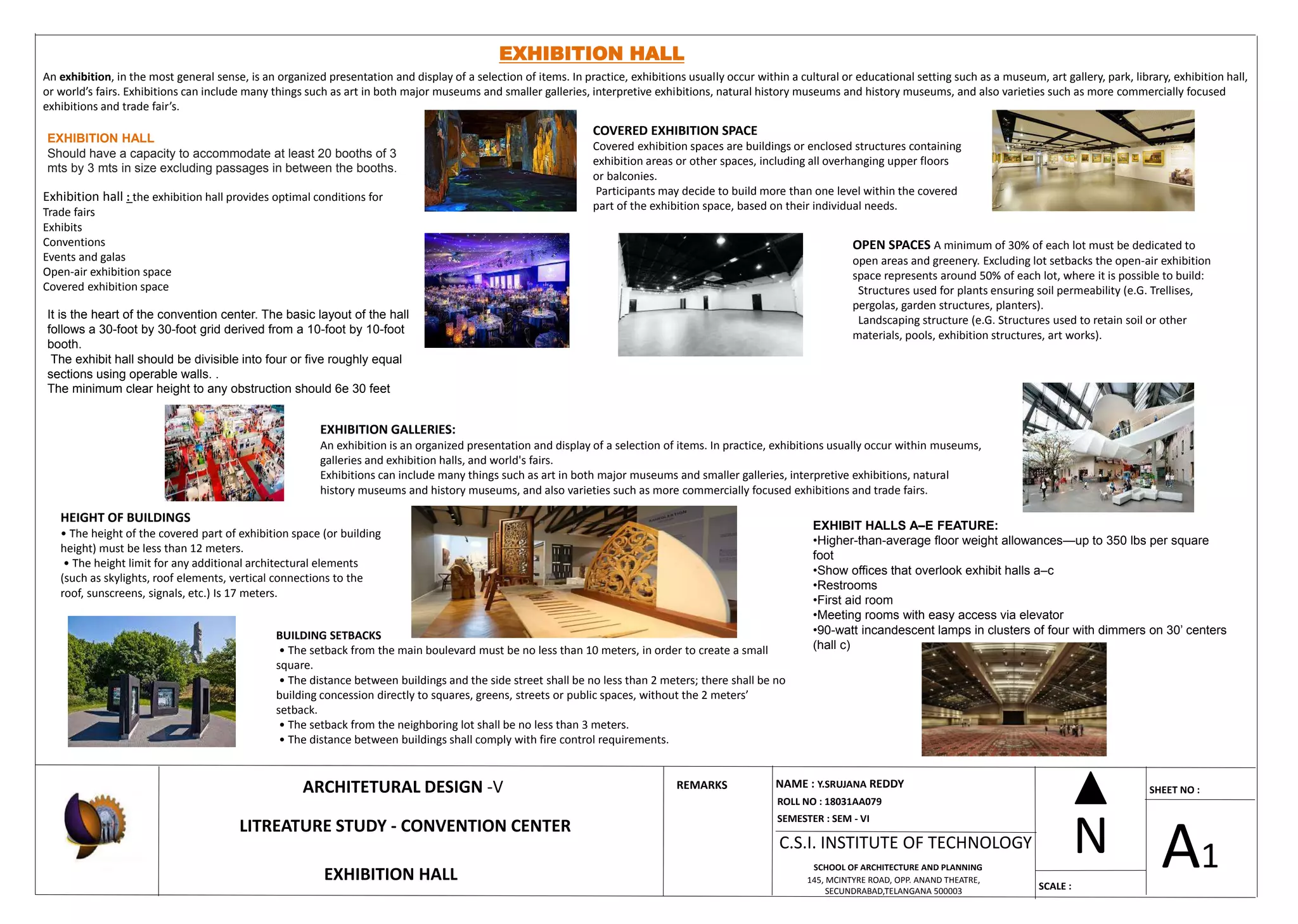
EXHIBITION HALL
Should have a capacity to accommodate at least 20 booths of 3
mts by 3 mts in size excluding passages in between the booths.
EXHIBITION HALL
An exhibition, in the most general sense, is an organized presentation and display of a selection of items. In practice, exhibitions usually occur within a cultural or educational setting such as a museum, art gallery, park, library, exhibition hall,
or world’s fairs. Exhibitions can include many things such as art in both major museums and smaller galleries, interpretive exhibitions, natural history museums and history museums, and also varieties such as more commercially focused
exhibitions and trade fair’s.
Exhibition hall : the exhibition hall provides optimal conditions for
Trade fairs
Exhibits
Conventions
Events and galas
Open-air exhibition space
Covered exhibition space
It is the heart of the convention center. The basic layout of the hall
follows a 30-foot by 30-foot grid derived from a 10-foot by 10-foot
booth.
The exhibit hall should be divisible into four or five roughly equal
sections using operable walls. .
The minimum clear height to any obstruction should 6e 30 feet
COVERED EXHIBITION SPACE
Covered exhibition spaces are buildings or enclosed structures containing
exhibition areas or other spaces, including all overhanging upper floors
or balconies.
Participants may decide to build more than one level within the covered
part of the exhibition space, based on their individual needs.
OPEN SPACES A minimum of 30% of each lot must be dedicated to
open areas and greenery. Excluding lot setbacks the open-air exhibition
space represents around 50% of each lot, where it is possible to build:
Structures used for plants ensuring soil permeability (e.G. Trellises,
pergolas, garden structures, planters).
Landscaping structure (e.G. Structures used to retain soil or other
materials, pools, exhibition structures, art works).
EXHIBITION GALLERIES:
An exhibition is an organized presentation and display of a selection of items. In practice, exhibitions usually occur within museums,
galleries and exhibition halls, and world's fairs.
Exhibitions can include many things such as art in both major museums and smaller galleries, interpretive exhibitions, natural
history museums and history museums, and also varieties such as more commercially focused exhibitions and trade fairs.
EXHIBIT HALLS A–E FEATURE:
•Higher-than-average floor weight allowances—up to 350 lbs per square
foot
•Show offices that overlook exhibit halls a–c
•Restrooms
•First aid room
•Meeting rooms with easy access via elevator
•90-watt incandescent lamps in clusters of four with dimmers on 30’ centers
(hall c)
HEIGHT OF BUILDINGS
• The height of the covered part of exhibition space (or building
height) must be less than 12 meters.
• The height limit for any additional architectural elements
(such as skylights, roof elements, vertical connections to the
roof, sunscreens, signals, etc.) Is 17 meters.
BUILDING SETBACKS
• The setback from the main boulevard must be no less than 10 meters, in order to create a small
square.
• The distance between buildings and the side street shall be no less than 2 meters; there shall be no
building concession directly to squares, greens, streets or public spaces, without the 2 meters’
setback.
• The setback from the neighboring lot shall be no less than 3 meters.
• The distance between buildings shall comply with fire control requirements.

litrature study convention center

  • 1.
    NAME : Y.SRUJANAREDDY ROLL NO : 18031AA079 SEMESTER : SEM - VI C.S.I. INSTITUTE OF TECHNOLOGY SCHOOL OF ARCHITECTURE AND PLANNING 145, MCINTYRE ROAD, OPP. ANAND THEATRE, SECUNDRABAD,TELANGANA 500003 REMARKS SCALE : SHEET NO : A1 N ARCHITETURAL DESIGN -V LITREATURE STUDY - CONVENTION CENTER EXHIBITION HALL EXHIBITION HALL Should have a capacity to accommodate at least 20 booths of 3 mts by 3 mts in size excluding passages in between the booths. EXHIBITION HALL An exhibition, in the most general sense, is an organized presentation and display of a selection of items. In practice, exhibitions usually occur within a cultural or educational setting such as a museum, art gallery, park, library, exhibition hall, or world’s fairs. Exhibitions can include many things such as art in both major museums and smaller galleries, interpretive exhibitions, natural history museums and history museums, and also varieties such as more commercially focused exhibitions and trade fair’s. Exhibition hall : the exhibition hall provides optimal conditions for Trade fairs Exhibits Conventions Events and galas Open-air exhibition space Covered exhibition space It is the heart of the convention center. The basic layout of the hall follows a 30-foot by 30-foot grid derived from a 10-foot by 10-foot booth. The exhibit hall should be divisible into four or five roughly equal sections using operable walls. . The minimum clear height to any obstruction should 6e 30 feet COVERED EXHIBITION SPACE Covered exhibition spaces are buildings or enclosed structures containing exhibition areas or other spaces, including all overhanging upper floors or balconies. Participants may decide to build more than one level within the covered part of the exhibition space, based on their individual needs. OPEN SPACES A minimum of 30% of each lot must be dedicated to open areas and greenery. Excluding lot setbacks the open-air exhibition space represents around 50% of each lot, where it is possible to build: Structures used for plants ensuring soil permeability (e.G. Trellises, pergolas, garden structures, planters). Landscaping structure (e.G. Structures used to retain soil or other materials, pools, exhibition structures, art works). EXHIBITION GALLERIES: An exhibition is an organized presentation and display of a selection of items. In practice, exhibitions usually occur within museums, galleries and exhibition halls, and world's fairs. Exhibitions can include many things such as art in both major museums and smaller galleries, interpretive exhibitions, natural history museums and history museums, and also varieties such as more commercially focused exhibitions and trade fairs. EXHIBIT HALLS A–E FEATURE: •Higher-than-average floor weight allowances—up to 350 lbs per square foot •Show offices that overlook exhibit halls a–c •Restrooms •First aid room •Meeting rooms with easy access via elevator •90-watt incandescent lamps in clusters of four with dimmers on 30’ centers (hall c) HEIGHT OF BUILDINGS • The height of the covered part of exhibition space (or building height) must be less than 12 meters. • The height limit for any additional architectural elements (such as skylights, roof elements, vertical connections to the roof, sunscreens, signals, etc.) Is 17 meters. BUILDING SETBACKS • The setback from the main boulevard must be no less than 10 meters, in order to create a small square. • The distance between buildings and the side street shall be no less than 2 meters; there shall be no building concession directly to squares, greens, streets or public spaces, without the 2 meters’ setback. • The setback from the neighboring lot shall be no less than 3 meters. • The distance between buildings shall comply with fire control requirements.