
BUILDING INFORMATION SYSTEM
SYSTEM AS PLANNED ORGANIZATION
Building a new information system is one kind of planned organizational
change. The introduction of a new information system involves much more
than new hardware and software.
It also includes,
• Changes in jobs,
• Skills,
• Management and,
• Organization.
When we design a new information system, we are redesigning the
organization. System builders must understand how a system will affect
specific business processes and the organization as a whole.
BUILDING INFORMATION SYSTEM
SYSTEMS DEVELOPMENT AND ORGANIZATIONAL CHANGE
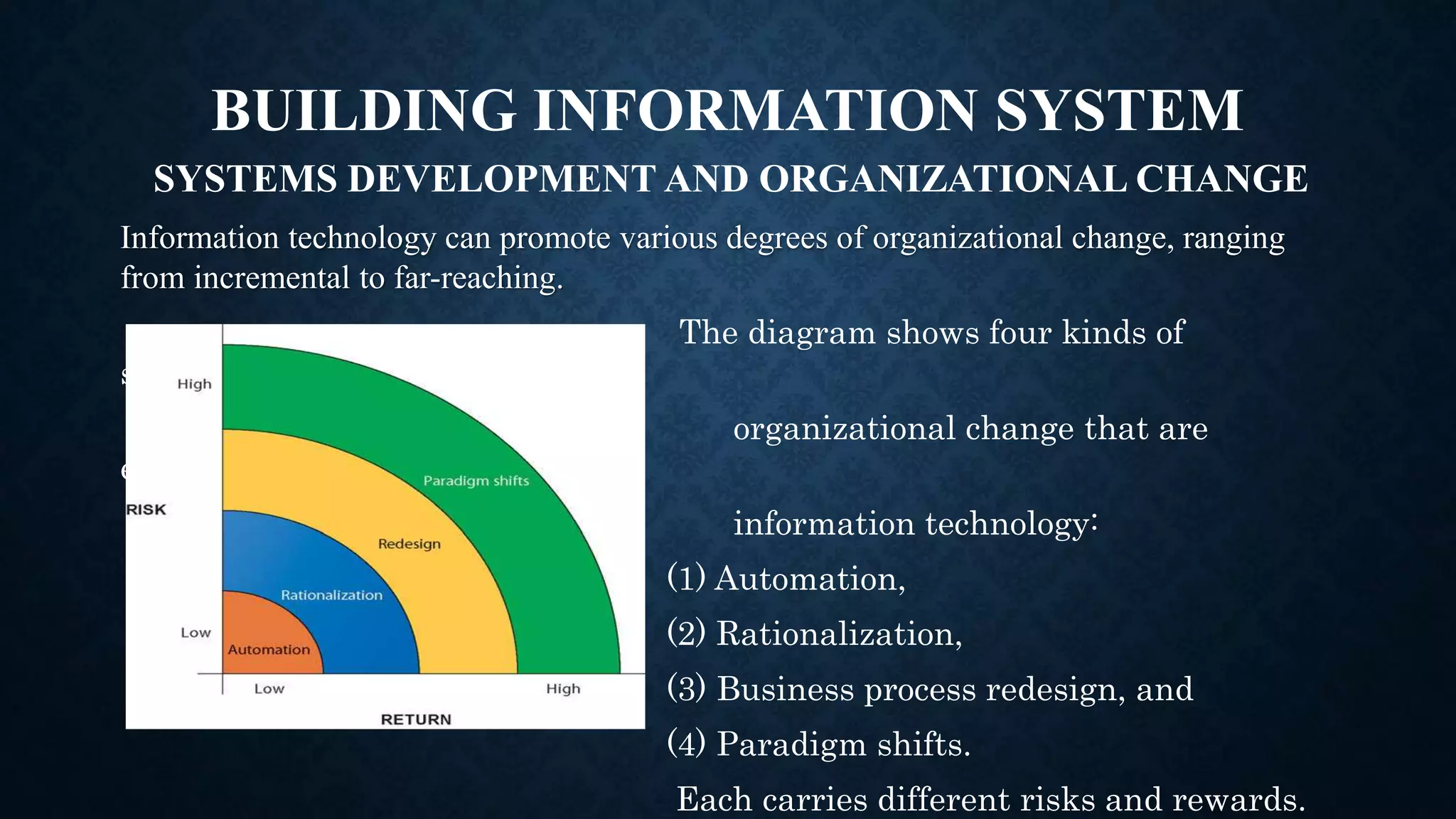
Information technology can promote various degrees of organizational change, ranging
from incremental to far-reaching.
The diagram shows four kinds of
structural
organizational change that are
enabled by
information technology:
(1) Automation,
(2) Rationalization,
(3) Business process redesign, and
(4) Paradigm shifts.
Each carries different risks and rewards.
BUILDING INFORMATION SYSTEM
SYSTEMS DEVELOPMENT AND ORGANIZATIONAL CHANGE
CON’T
• The most common form of IT-enabled organizational change is AUTOMATION.
• The first applications of information technology involved assisting employees with
performing their tasks more efficiently and effectively. Calculating paychecks and
payroll registers, giving bank tellers Machines instant access to customer deposit
records, and developing a nationwide reservation network for airline ticket agents are
all examples of early automation.
• The most common forms of organizational change are automation and rationalization.
• These relatively slow-moving and slow-changing strategies present modest returns but
little risk. Faster and more comprehensive change such as redesign and paradigm
shifts carries high rewards but offers substantial chances of failure.
BUILDING INFORMATION SYSTEM
SYSTEM DEVELOPMENT AND ORGANIZATIONAL CHANGE
CON’T
• A deeper form of organizational change one that follows quickly from early automation
is
• RATIONALIZATION OF PROCEDURES.
• Rationalization of procedures causes the organization to examine its standard
operating procedures, eliminate those no longer needed, and make the organization more
efficient.
• Rationalization of procedures is streamlining of standard operation procedure,
eliminating obvious bottleneck, so that automation can be made more efficient
• Both Automation and Rationalization can cause some disruption, but it's usually
manageable and easily accepted by the people
BUILDING INFORMATION SYSTEM
SYSTEM DEVELOPMENT AND ORGANIZATIONAL CHANGE
CON’T
BUSINESS PROCEDURE REDESIGNING
• Can cause radical disruption.
• The mere mention of the term nowadays strikes fear in the hearts of workers and
managers at all levels. Why?
• Because many companies use it as a guide for downsizing the organization and
laying off workers.
• Business redesigning causes planners to completely
• RETHINK the flow of work,
• How the work will be accomplished, and
• How costs can be reduced by eliminating unnecessary work and workers.
BUILDING INFORMATION SYSTEM
SYSTEM DEVELOPMENT AND ORGANIZATIONAL CHANGE
CON’T
PARADIGM SHIFT
• A paradigm shift involves rethinking the nature of the business and the nature of the
organization.
• This category of Structural Organizational Change is more radical as compared to the Business
Procedure Redesign.
• It changes the very nature of the business and the structure of the organization itself. (A whole
new products or services that didn't even exist before).
• It is major disruption and an extreme change!
• The Internet is causing all kinds of industries and businesses to alter their products, their
services, and their processes in radical ways.
• Online buying opportunities - how can local dealer compete on price
• BPR and Paradigm Shift is dangerous but there no other way to cut cost and streamline
operations and remain competitive.
BUILDING INFORMATION SYSTEM
OVERVIEW OF SYSTEMS DEVELOPMENT
• New information systems are an outgrowth of a process of organizational
problem solving. A new information system is built as a solution to some
type of problem or set of problems the organization perceives it is facing.
• The problem may be one in which managers and employees realize that the
organization is not performing as well as expected, or that the organization
should take advantage of new opportunities to perform more successfully
BUILDING INFORMATION SYSTEM
OVERVIEW OF SYSTEM DEVELOPMENT CON’T
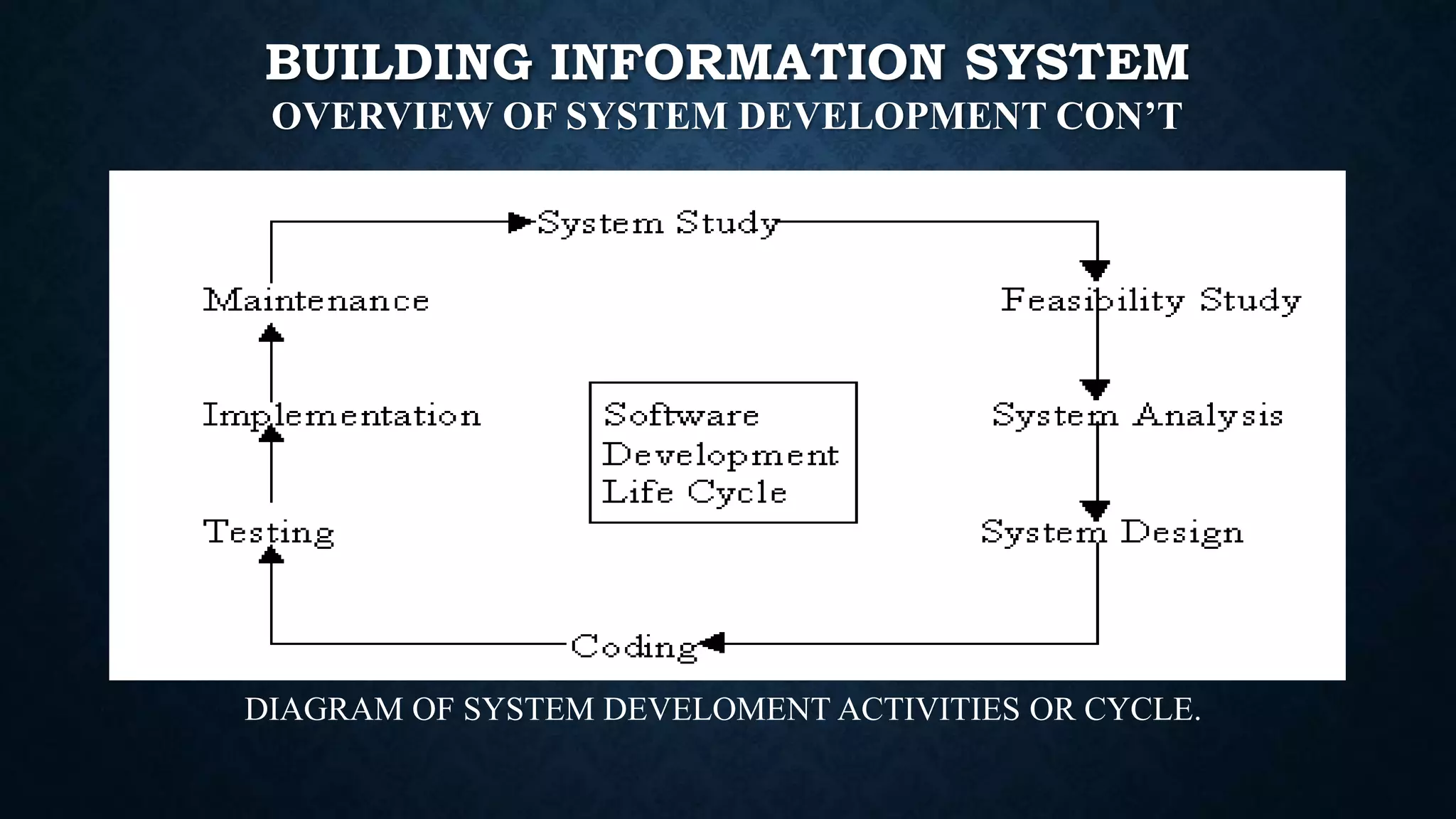
The activities that go into producing an information system solution to
an organizational problem or opportunity are called Systems
Development. Systems development is a structured kind of problem
solved with distinct activities. These activities consist of
• Systems analysis,
• Systems design,
• Programming,
• Testing,
• Conversion, and
• Production and maintenance.
BUILDING INFORMATION SYSTEM
OVERVIEW OF SYSTEM DEVELOPMENT CON’T
DIAGRAM OF SYSTEM DEVELOMENT ACTIVITIES OR CYCLE.
BUILDING INFORMATION SYSTEM
ALTERNATIVE SYSTEMS-BUILDING APPROACHES
Systems differ in terms of their size and technological complexity and in terms of the
organizational problems they are meant to solve. A number of systems building
approaches have been developed to deal with these differences. This section describes
these alternative methods:
• The traditional systems life cycle,
• Prototyping,
• Application software packages,
• End-user development and
• Outsourcing.
BUILDING INFORMATION SYSTEMS SLIDES

BUILDING INFORMATION SYSTEMS SLIDES

  • 1.
    BUILDING INFORMATION SYSTEM SYSTEMAS PLANNED ORGANIZATION Building a new information system is one kind of planned organizational change. The introduction of a new information system involves much more than new hardware and software. It also includes, • Changes in jobs, • Skills, • Management and, • Organization. When we design a new information system, we are redesigning the organization. System builders must understand how a system will affect specific business processes and the organization as a whole.
  • 2.
    BUILDING INFORMATION SYSTEM SYSTEMSDEVELOPMENT AND ORGANIZATIONAL CHANGE Information technology can promote various degrees of organizational change, ranging from incremental to far-reaching. The diagram shows four kinds of structural organizational change that are enabled by information technology: (1) Automation, (2) Rationalization, (3) Business process redesign, and (4) Paradigm shifts. Each carries different risks and rewards.
  • 3.
    BUILDING INFORMATION SYSTEM SYSTEMSDEVELOPMENT AND ORGANIZATIONAL CHANGE CON’T • The most common form of IT-enabled organizational change is AUTOMATION. • The first applications of information technology involved assisting employees with performing their tasks more efficiently and effectively. Calculating paychecks and payroll registers, giving bank tellers Machines instant access to customer deposit records, and developing a nationwide reservation network for airline ticket agents are all examples of early automation. • The most common forms of organizational change are automation and rationalization. • These relatively slow-moving and slow-changing strategies present modest returns but little risk. Faster and more comprehensive change such as redesign and paradigm shifts carries high rewards but offers substantial chances of failure.
  • 4.
    BUILDING INFORMATION SYSTEM SYSTEMDEVELOPMENT AND ORGANIZATIONAL CHANGE CON’T • A deeper form of organizational change one that follows quickly from early automation is • RATIONALIZATION OF PROCEDURES. • Rationalization of procedures causes the organization to examine its standard operating procedures, eliminate those no longer needed, and make the organization more efficient. • Rationalization of procedures is streamlining of standard operation procedure, eliminating obvious bottleneck, so that automation can be made more efficient • Both Automation and Rationalization can cause some disruption, but it's usually manageable and easily accepted by the people
  • 5.
    BUILDING INFORMATION SYSTEM SYSTEMDEVELOPMENT AND ORGANIZATIONAL CHANGE CON’T BUSINESS PROCEDURE REDESIGNING • Can cause radical disruption. • The mere mention of the term nowadays strikes fear in the hearts of workers and managers at all levels. Why? • Because many companies use it as a guide for downsizing the organization and laying off workers. • Business redesigning causes planners to completely • RETHINK the flow of work, • How the work will be accomplished, and • How costs can be reduced by eliminating unnecessary work and workers.
  • 6.
    BUILDING INFORMATION SYSTEM SYSTEMDEVELOPMENT AND ORGANIZATIONAL CHANGE CON’T PARADIGM SHIFT • A paradigm shift involves rethinking the nature of the business and the nature of the organization. • This category of Structural Organizational Change is more radical as compared to the Business Procedure Redesign. • It changes the very nature of the business and the structure of the organization itself. (A whole new products or services that didn't even exist before). • It is major disruption and an extreme change! • The Internet is causing all kinds of industries and businesses to alter their products, their services, and their processes in radical ways. • Online buying opportunities - how can local dealer compete on price • BPR and Paradigm Shift is dangerous but there no other way to cut cost and streamline operations and remain competitive.
  • 7.
    BUILDING INFORMATION SYSTEM OVERVIEWOF SYSTEMS DEVELOPMENT • New information systems are an outgrowth of a process of organizational problem solving. A new information system is built as a solution to some type of problem or set of problems the organization perceives it is facing. • The problem may be one in which managers and employees realize that the organization is not performing as well as expected, or that the organization should take advantage of new opportunities to perform more successfully
  • 8.
    BUILDING INFORMATION SYSTEM OVERVIEWOF SYSTEM DEVELOPMENT CON’T The activities that go into producing an information system solution to an organizational problem or opportunity are called Systems Development. Systems development is a structured kind of problem solved with distinct activities. These activities consist of • Systems analysis, • Systems design, • Programming, • Testing, • Conversion, and • Production and maintenance.
  • 9.
    BUILDING INFORMATION SYSTEM OVERVIEWOF SYSTEM DEVELOPMENT CON’T DIAGRAM OF SYSTEM DEVELOMENT ACTIVITIES OR CYCLE.
  • 10.
    BUILDING INFORMATION SYSTEM ALTERNATIVESYSTEMS-BUILDING APPROACHES Systems differ in terms of their size and technological complexity and in terms of the organizational problems they are meant to solve. A number of systems building approaches have been developed to deal with these differences. This section describes these alternative methods: • The traditional systems life cycle, • Prototyping, • Application software packages, • End-user development and • Outsourcing.