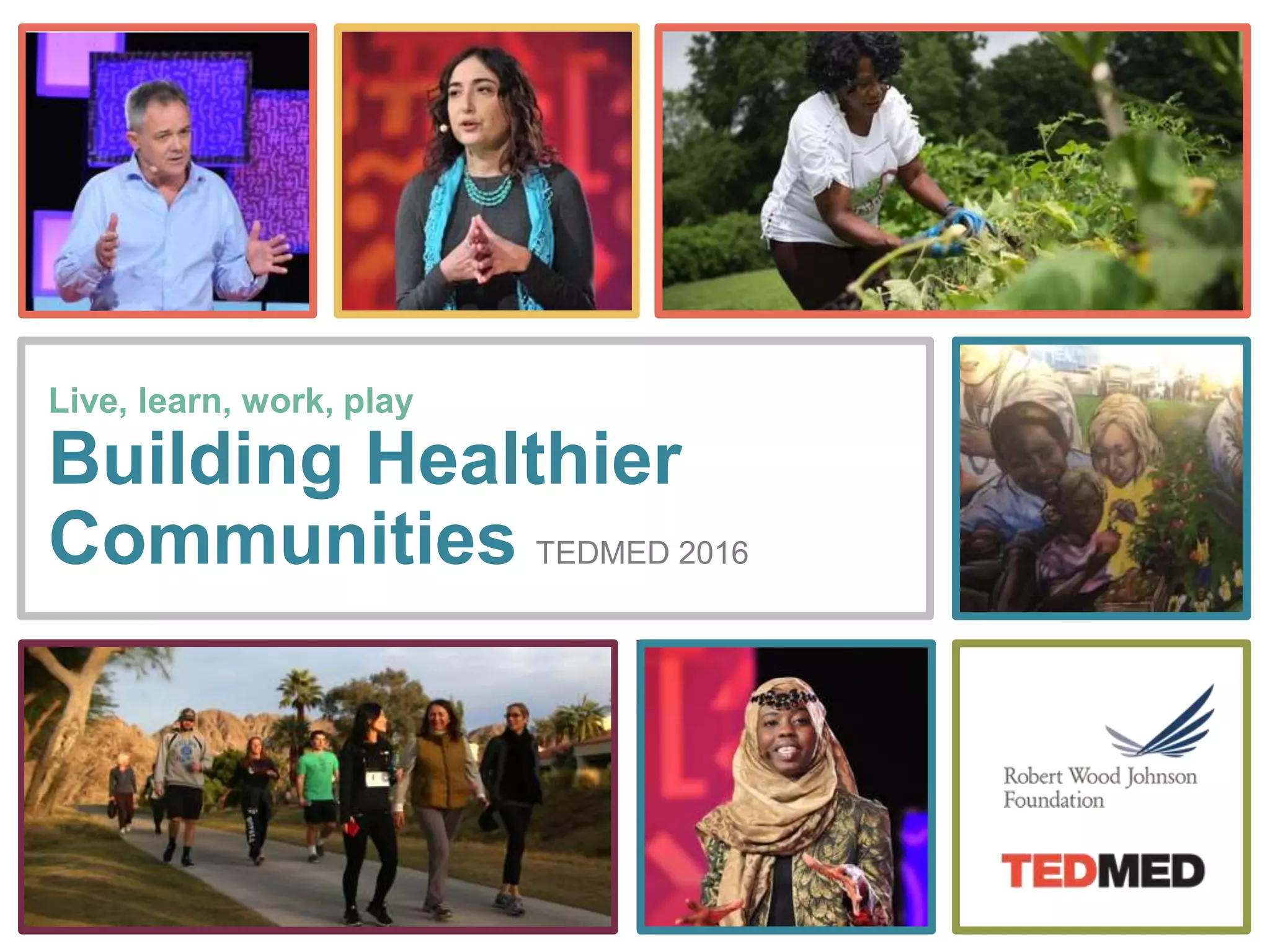
Live, learn, work, play
Building Healthier
Communities TEDMED 2016
Speakers and Hive Innovators
reimagined healthy communities in
their TEDMED Talks.
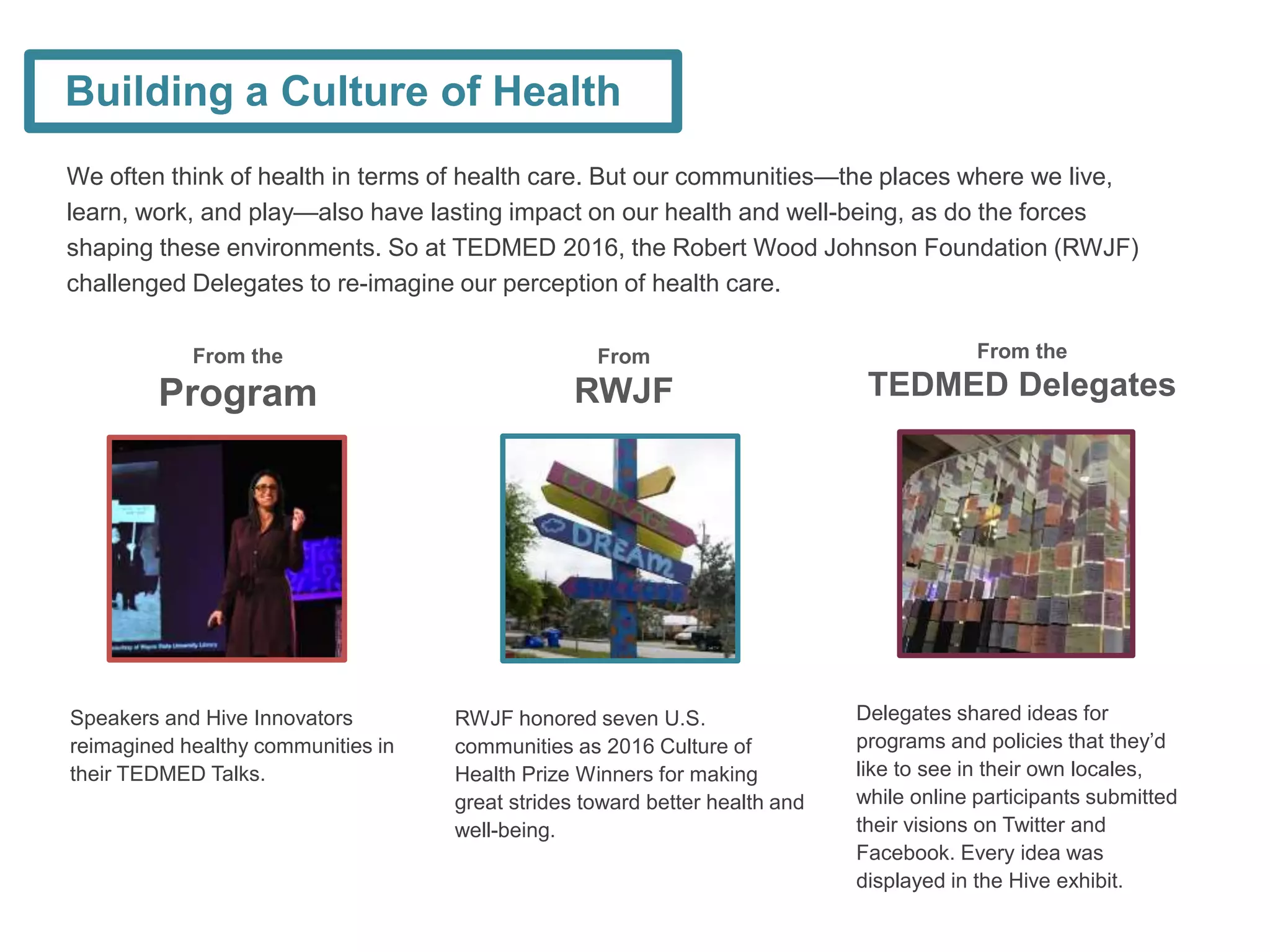
RWJF honored seven U.S.
communities as 2016 Culture of
Health Prize Winners for making
great strides toward better health and
well-being.
From the
Program
From
RWJF
Delegates shared ideas for
programs and policies that they’d
like to see in their own locales,
while online participants submitted
their visions on Twitter and
Facebook. Every idea was
displayed in the Hive exhibit.
From the
TEDMED Delegates
We often think of health in terms of health care. But our communities—the places where we live,
learn, work, and play—also have lasting impact on our health and well-being, as do the forces
shaping these environments. So at TEDMED 2016, the Robert Wood Johnson Foundation (RWJF)
challenged Delegates to re-imagine our perception of health care.
Building a Culture of Health
The Themes
1. Micro shifts can have macro impact
2. Communities are innovation test kitchens
3. Mind the gaps
4. Build community into the business model
5. Art acts as a community cure
6. Our cities define our selves
7. It takes a village
8. Strangers aren’t dangers
Want to change the world? Start small. Pandemics such as
Ebola begin with a single case. Speaker Jeremy Farrar focuses
on community-level responses to stem pandemic destruction,
while Kinnos fights back with visible contamination sprays that
reduce hospital error. Speaker and healthy-eating evangelist
Gunhild Stordalen believes that our individual actions reverberate
across the global food system.
We encourage radical candor, support,
and activities among our neighbors.
- Delegate in Narberth, PA
What if we started with healthy bake sales
at schools to encourage nutritious diets at
an early age?
- Delegate in Durham, NC
Micro shifts
can have
macro impact
1.
”
“
Photo credit: TEDMED
Your local neighborhood can serve as your lab.
Health clinicians can look to the medical marijuana
dispensaries in their neighborhoods to emulate their
personal, customized method of care, as speaker
David Casarett suggests. In the Columbia River
Gorge region of the Pacific Northwest, new
partnerships—like dentists paired up with local
school districts—help connect the dots in health
prevention. And community facilities can be
remixed, too: In New Hampshire, fire stations also
serve as safe havens and intake centers for people
with addictions.
Grocery stores can act like demo kitchens to teach
citizens to prepare healthy foods.
- Delegate in Boston, MA
Community health clinics could prescribe more
than medication: food, housing, or heat.
- Delegate in Portland, ME
Libraries should lend more than books, like bikes
to keep community members moving.
- Delegate in San Diego, CA
Communities
are innovation
test kitchens
2.
”
“
Photo credit: iStock
The key to healthier communities often lies between the
cracks, in what is overlooked and rarely addressed. Speaker
Susie Baldwin helps physicians go beyond the usual vital signs to
identify victims of human trafficking. Speaker Sue Klebold has
devoted her life to advancing mental illnesses treatment before
tragic events occur. Meanwhile, Watsi connects donors to
patients in need so their life-saving treatments can be funded, no
matter how underserved their communities.
Mind the gaps
3.
”
“ Communities need more adult education
programs to up-skill adult learners and open up
new job opportunities.
- Delegate in Philadelphia, PA
Identify the biggest health challenges in specific
areas and create local campaigns to address them;
employ undercover healthcare ambassadors to
penetrate these sights.
- Delegate in Bryce, VA
Chicago is resource-segregated. We should create
more resources, like pharmacies and grocery stores,
and distribute them more evenly across the city,
while improving the safety of public transit stops.
- Delegate in Chicago, ILPhoto credit: TEDMED
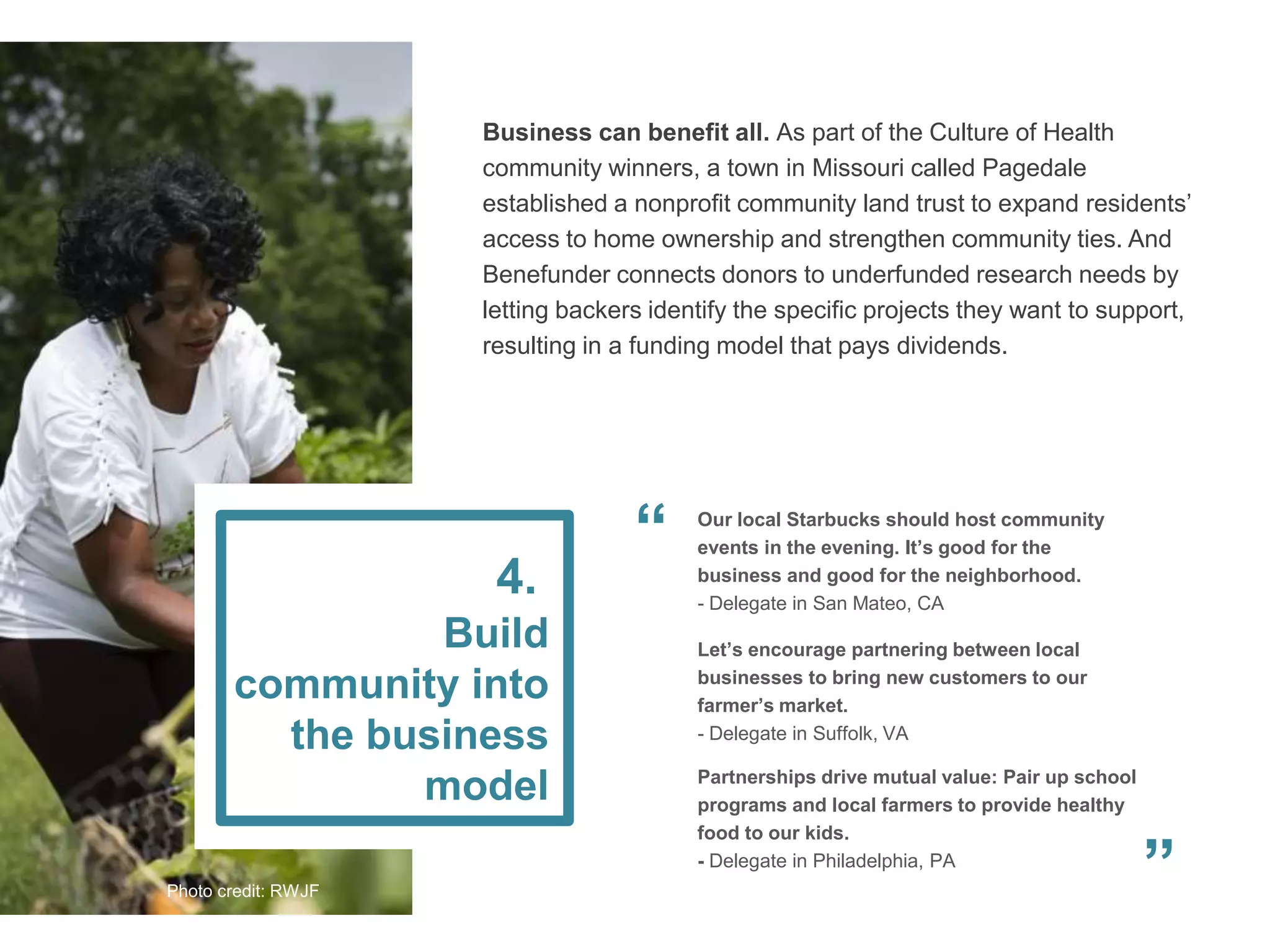
Business can benefit all. As part of the Culture of Health
community winners, a town in Missouri called Pagedale
established a nonprofit community land trust to expand residents’
access to home ownership and strengthen community ties. And
Benefunder connects donors to underfunded research needs by
letting backers identify the specific projects they want to support,
resulting in a funding model that pays dividends.
Partnerships drive mutual value: Pair up school
programs and local farmers to provide healthy
food to our kids.
- Delegate in Philadelphia, PA
Our local Starbucks should host community
events in the evening. It’s good for the
business and good for the neighborhood.
- Delegate in San Mateo, CA
Let’s encourage partnering between local
businesses to bring new customers to our
farmer’s market.
- Delegate in Suffolk, VA
Build
community into
the business
model
4.
”
“
Photo credit: RWJF
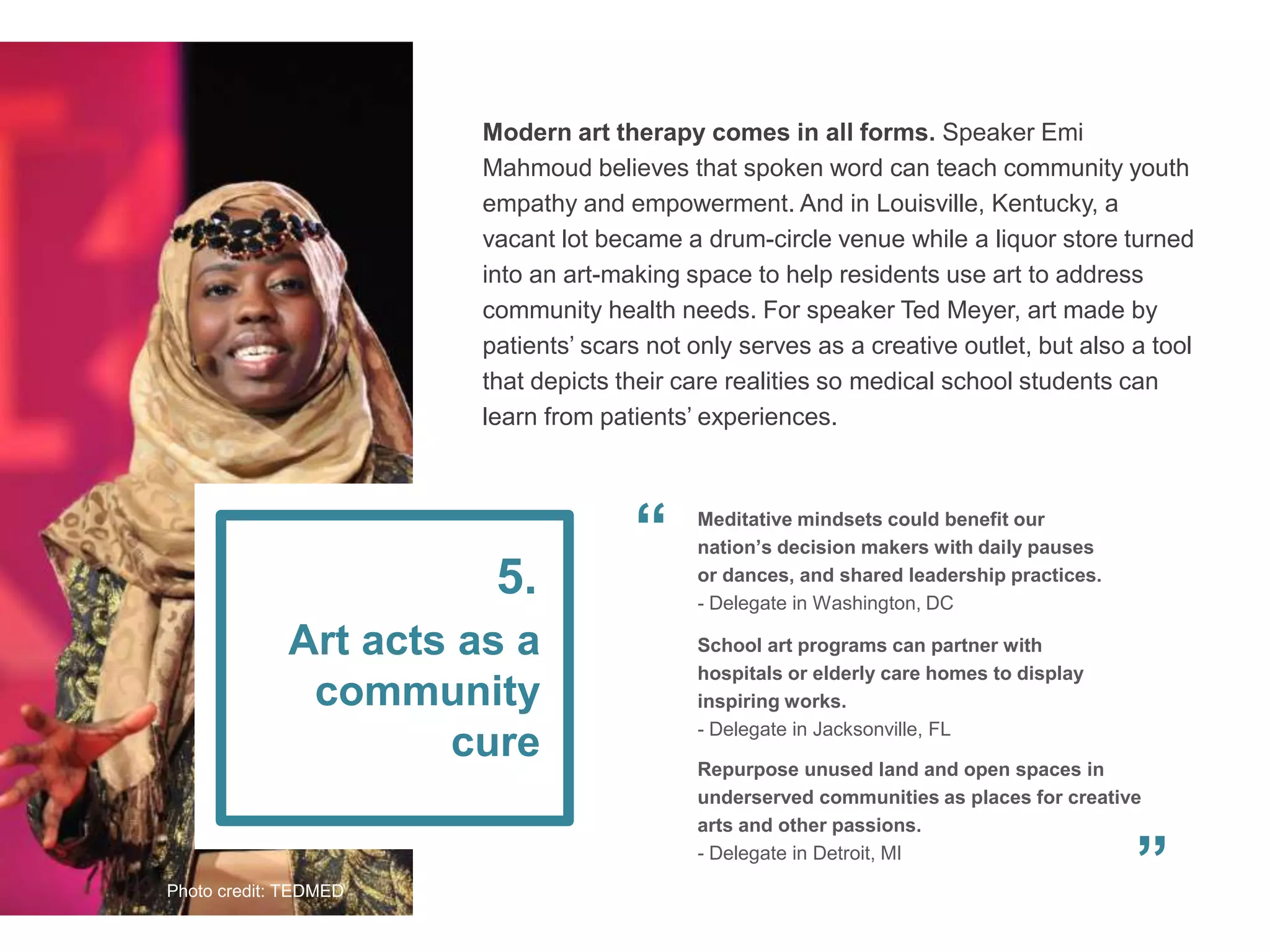
Modern art therapy comes in all forms. Speaker Emi
Mahmoud believes that spoken word can teach community youth
empathy and empowerment. And in Louisville, Kentucky, a
vacant lot became a drum-circle venue while a liquor store turned
into an art-making space to help residents use art to address
community health needs. For speaker Ted Meyer, art made by
patients’ scars not only serves as a creative outlet, but also a tool
that depicts their care realities so medical school students can
learn from patients’ experiences.
School art programs can partner with
hospitals or elderly care homes to display
inspiring works.
- Delegate in Jacksonville, FL
Meditative mindsets could benefit our
nation’s decision makers with daily pauses
or dances, and shared leadership practices.
- Delegate in Washington, DC
Art acts as a
community
cure
5.
”
“
Repurpose unused land and open spaces in
underserved communities as places for creative
arts and other passions.
- Delegate in Detroit, MI
Photo credit: TEDMED
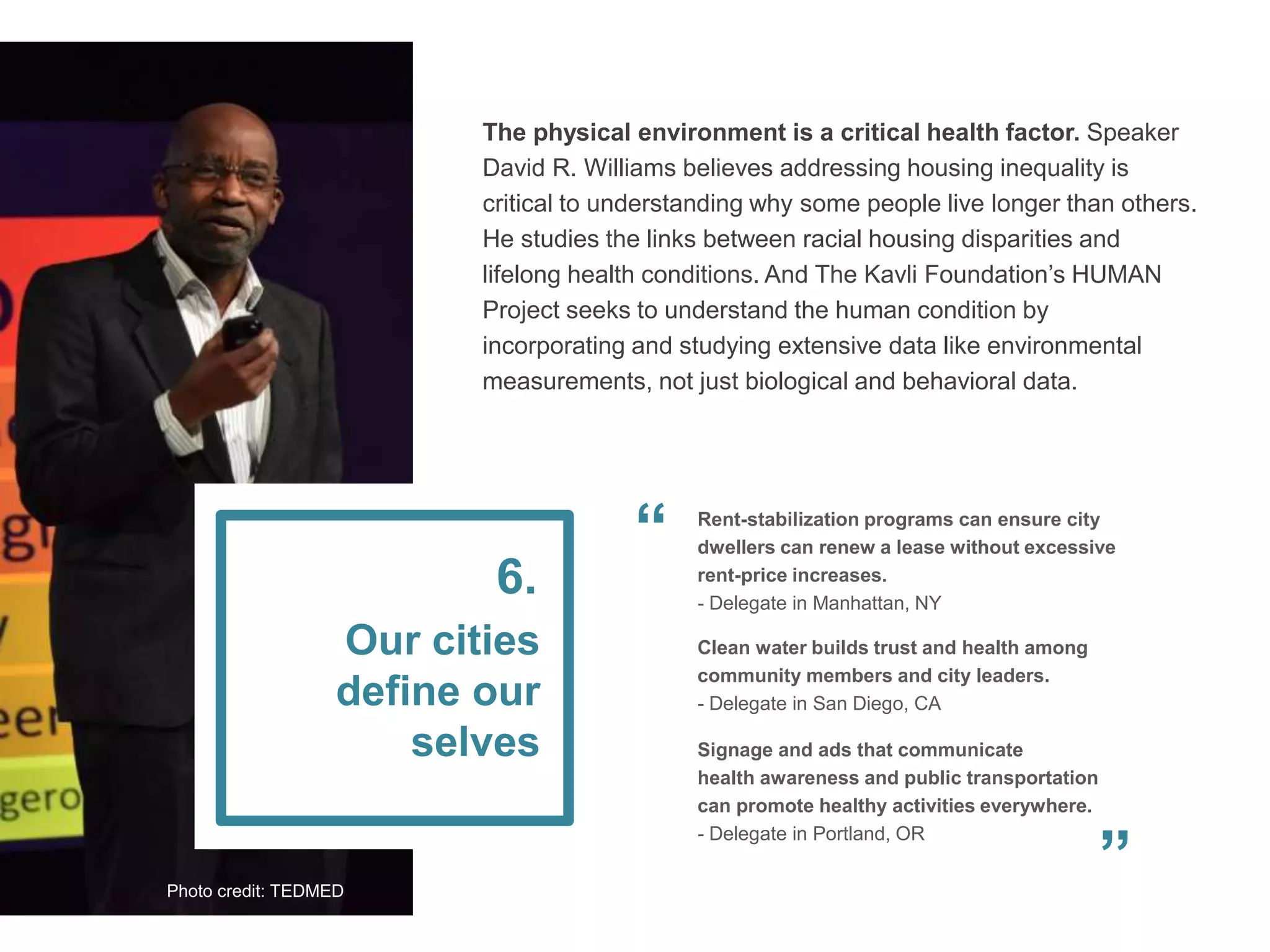
The physical environment is a critical health factor. Speaker
David R. Williams believes addressing housing inequality is
critical to understanding why some people live longer than others.
He studies the links between racial housing disparities and
lifelong health conditions. And The Kavli Foundation’s HUMAN
Project seeks to understand the human condition by
incorporating and studying extensive data like environmental
measurements, not just biological and behavioral data.
Our cities
define our
selves
6.
Signage and ads that communicate
health awareness and public transportation
can promote healthy activities everywhere.
- Delegate in Portland, OR
Rent-stabilization programs can ensure city
dwellers can renew a lease without excessive
rent-price increases.
- Delegate in Manhattan, NY
Clean water builds trust and health among
community members and city leaders.
- Delegate in San Diego, CA
”
“
Photo credit: TEDMED
Together, we can change our neighborhoods. In North St.
Louis, Missouri, 24 municipalities came together to create 24:1, a
coalition of counties determined to build stronger communities,
engaged families, and successful children. From fitness classes
to senior centers to meetings with the mayor, the initiative brings
change by bringing people together. On the West Coast, Santa
Monica, California, uses another collaboration model: Citizens
help the homeless by bringing together police and fire
departments; city human services; health and housing offices;
and nonprofit service providers.
Expand book exchange programs that work
to bring neighbors together to help build
healthy minds.
- Delegate in Brooklyn, NY
Local diners can become places to host
meals and events for neighborhood groups
and nonprofits. Invite local politicians!
- Delegate in Decatur, GA
It takes a
village
7.
”
“
Photo credit: RWJF
Shake a hand, extend a hand. In a world driven by technology,
Delegates reminded us that more than ever, people need to come
together. Speaker Larissa MacFarquhar told the story of extreme
altruists who feel driven to save the lives of total strangers. And
the Shoalwater Bay Indian Tribe in Washington state puts out the
welcome mat for neighbors from surrounding communities. When
the reservation opened a gym, commercial fishermen from a
neighboring town were invited to join for free. Even the tribe’s
small police force is integrated with law enforcement officers from
other nearby areas.
Strangers
aren’t
dangers
8.
Bus stops can include posters that prompt riders
to talk to other members of the community.
- Delegate in Providence, RI
Trash pickup and leaf removal can be
reframed as an opportunity to exercise and
bring people together from all walks of life.
- Delegate in Chevy Chase, MD
Multimodal and economically accessible infrastructure
integrates areas of varying socioeconomic status.
- Via #HealthyCommunities on Twitter
”
“
Photo credit: RWJF
TEDMED
RWJF Culture of Health Prize Winners
#HealthyCommunities
@RWJF
@TEDMED
Learn
More
Share Your
Story
Contributors

Building Healthier Communities: TEDMED 2016

  • 1.
    Live, learn, work,play Building Healthier Communities TEDMED 2016
  • 2.
    Speakers and HiveInnovators reimagined healthy communities in their TEDMED Talks. RWJF honored seven U.S. communities as 2016 Culture of Health Prize Winners for making great strides toward better health and well-being. From the Program From RWJF Delegates shared ideas for programs and policies that they’d like to see in their own locales, while online participants submitted their visions on Twitter and Facebook. Every idea was displayed in the Hive exhibit. From the TEDMED Delegates We often think of health in terms of health care. But our communities—the places where we live, learn, work, and play—also have lasting impact on our health and well-being, as do the forces shaping these environments. So at TEDMED 2016, the Robert Wood Johnson Foundation (RWJF) challenged Delegates to re-imagine our perception of health care. Building a Culture of Health
  • 3.
    The Themes 1. Microshifts can have macro impact 2. Communities are innovation test kitchens 3. Mind the gaps 4. Build community into the business model 5. Art acts as a community cure 6. Our cities define our selves 7. It takes a village 8. Strangers aren’t dangers
  • 4.
    Want to changethe world? Start small. Pandemics such as Ebola begin with a single case. Speaker Jeremy Farrar focuses on community-level responses to stem pandemic destruction, while Kinnos fights back with visible contamination sprays that reduce hospital error. Speaker and healthy-eating evangelist Gunhild Stordalen believes that our individual actions reverberate across the global food system. We encourage radical candor, support, and activities among our neighbors. - Delegate in Narberth, PA What if we started with healthy bake sales at schools to encourage nutritious diets at an early age? - Delegate in Durham, NC Micro shifts can have macro impact 1. ” “ Photo credit: TEDMED
  • 5.
    Your local neighborhoodcan serve as your lab. Health clinicians can look to the medical marijuana dispensaries in their neighborhoods to emulate their personal, customized method of care, as speaker David Casarett suggests. In the Columbia River Gorge region of the Pacific Northwest, new partnerships—like dentists paired up with local school districts—help connect the dots in health prevention. And community facilities can be remixed, too: In New Hampshire, fire stations also serve as safe havens and intake centers for people with addictions. Grocery stores can act like demo kitchens to teach citizens to prepare healthy foods. - Delegate in Boston, MA Community health clinics could prescribe more than medication: food, housing, or heat. - Delegate in Portland, ME Libraries should lend more than books, like bikes to keep community members moving. - Delegate in San Diego, CA Communities are innovation test kitchens 2. ” “ Photo credit: iStock
  • 6.
    The key tohealthier communities often lies between the cracks, in what is overlooked and rarely addressed. Speaker Susie Baldwin helps physicians go beyond the usual vital signs to identify victims of human trafficking. Speaker Sue Klebold has devoted her life to advancing mental illnesses treatment before tragic events occur. Meanwhile, Watsi connects donors to patients in need so their life-saving treatments can be funded, no matter how underserved their communities. Mind the gaps 3. ” “ Communities need more adult education programs to up-skill adult learners and open up new job opportunities. - Delegate in Philadelphia, PA Identify the biggest health challenges in specific areas and create local campaigns to address them; employ undercover healthcare ambassadors to penetrate these sights. - Delegate in Bryce, VA Chicago is resource-segregated. We should create more resources, like pharmacies and grocery stores, and distribute them more evenly across the city, while improving the safety of public transit stops. - Delegate in Chicago, ILPhoto credit: TEDMED
  • 7.
    Business can benefitall. As part of the Culture of Health community winners, a town in Missouri called Pagedale established a nonprofit community land trust to expand residents’ access to home ownership and strengthen community ties. And Benefunder connects donors to underfunded research needs by letting backers identify the specific projects they want to support, resulting in a funding model that pays dividends. Partnerships drive mutual value: Pair up school programs and local farmers to provide healthy food to our kids. - Delegate in Philadelphia, PA Our local Starbucks should host community events in the evening. It’s good for the business and good for the neighborhood. - Delegate in San Mateo, CA Let’s encourage partnering between local businesses to bring new customers to our farmer’s market. - Delegate in Suffolk, VA Build community into the business model 4. ” “ Photo credit: RWJF
  • 8.
    Modern art therapycomes in all forms. Speaker Emi Mahmoud believes that spoken word can teach community youth empathy and empowerment. And in Louisville, Kentucky, a vacant lot became a drum-circle venue while a liquor store turned into an art-making space to help residents use art to address community health needs. For speaker Ted Meyer, art made by patients’ scars not only serves as a creative outlet, but also a tool that depicts their care realities so medical school students can learn from patients’ experiences. School art programs can partner with hospitals or elderly care homes to display inspiring works. - Delegate in Jacksonville, FL Meditative mindsets could benefit our nation’s decision makers with daily pauses or dances, and shared leadership practices. - Delegate in Washington, DC Art acts as a community cure 5. ” “ Repurpose unused land and open spaces in underserved communities as places for creative arts and other passions. - Delegate in Detroit, MI Photo credit: TEDMED
  • 9.
    The physical environmentis a critical health factor. Speaker David R. Williams believes addressing housing inequality is critical to understanding why some people live longer than others. He studies the links between racial housing disparities and lifelong health conditions. And The Kavli Foundation’s HUMAN Project seeks to understand the human condition by incorporating and studying extensive data like environmental measurements, not just biological and behavioral data. Our cities define our selves 6. Signage and ads that communicate health awareness and public transportation can promote healthy activities everywhere. - Delegate in Portland, OR Rent-stabilization programs can ensure city dwellers can renew a lease without excessive rent-price increases. - Delegate in Manhattan, NY Clean water builds trust and health among community members and city leaders. - Delegate in San Diego, CA ” “ Photo credit: TEDMED
  • 10.
    Together, we canchange our neighborhoods. In North St. Louis, Missouri, 24 municipalities came together to create 24:1, a coalition of counties determined to build stronger communities, engaged families, and successful children. From fitness classes to senior centers to meetings with the mayor, the initiative brings change by bringing people together. On the West Coast, Santa Monica, California, uses another collaboration model: Citizens help the homeless by bringing together police and fire departments; city human services; health and housing offices; and nonprofit service providers. Expand book exchange programs that work to bring neighbors together to help build healthy minds. - Delegate in Brooklyn, NY Local diners can become places to host meals and events for neighborhood groups and nonprofits. Invite local politicians! - Delegate in Decatur, GA It takes a village 7. ” “ Photo credit: RWJF
  • 11.
    Shake a hand,extend a hand. In a world driven by technology, Delegates reminded us that more than ever, people need to come together. Speaker Larissa MacFarquhar told the story of extreme altruists who feel driven to save the lives of total strangers. And the Shoalwater Bay Indian Tribe in Washington state puts out the welcome mat for neighbors from surrounding communities. When the reservation opened a gym, commercial fishermen from a neighboring town were invited to join for free. Even the tribe’s small police force is integrated with law enforcement officers from other nearby areas. Strangers aren’t dangers 8. Bus stops can include posters that prompt riders to talk to other members of the community. - Delegate in Providence, RI Trash pickup and leaf removal can be reframed as an opportunity to exercise and bring people together from all walks of life. - Delegate in Chevy Chase, MD Multimodal and economically accessible infrastructure integrates areas of varying socioeconomic status. - Via #HealthyCommunities on Twitter ” “ Photo credit: RWJF
  • 12.
    TEDMED RWJF Culture ofHealth Prize Winners #HealthyCommunities @RWJF @TEDMED Learn More Share Your Story
  • 13.

Editor's Notes

  • #4 Option: These conversations converged into eight themes that point towards how we can build Healthier Communities in the year ahead:
  • #13 Option: These conversations converged into eight themes that point towards how we can build Healthier Communities in the year ahead: