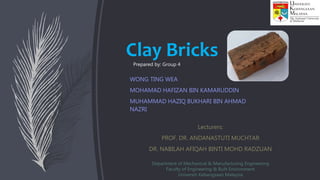
Clay Bricks
WONG TING WEA
MOHAMAD HAFIZAN BIN KAMARUDDIN
MUHAMMAD HAZIQ BUKHARI BIN AHMAD
NAZRI
Department of Mechanical & Manufacturing Engineering
Faculty of Engineering & Built Environment
Universiti Kebangsaan Malaysia
Prepared by: Group 4
Lecturers:
PROF. DR. ANDANASTUTI MUCHTAR
DR. NABILAH AFIQAH BINTI MOHD RADZUAN
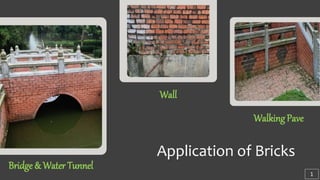
Application of Bricks
Wall
Bridge & Water Tunnel
Walking Pave
1
Common
Materials
Used for
Clay Bricks
Clay (Alumina)
The mineral content in clay determine the
colour of bricks.
Iron oxide in clay would become reddish1.
Lime in clay would have a white or yellow hue.
2
Common
Materials
Used for
Clay Bricks
Sand (Silica)
 Good quality bricks contain 50-60 % of silica .
 Clay (alumina) + Sand (silica)=Aluminosilicates.
 Silica prevents raw bricks from cracking,
shrinking and warping2.
 The shape, texture and durability of the bricks
determined by the proportion of silica and
alumina .
 Excess silica will destroy the cohesion between
the pieces of brick clay and makes the brick
brittle and weaker in strength3. llllllllllllllllll
3
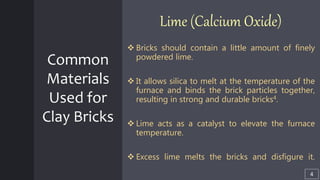
Lime (Calcium Oxide)
 Bricks should contain a little amount of finely
powdered lime.
 It allows silica to melt at the temperature of the
furnace and binds the brick particles together,
resulting in strong and durable bricks4.
 Lime acts as a catalyst to elevate the furnace
temperature.
 Excess lime melts the bricks and disfigure it.
Common
Materials
Used for
Clay Bricks
4
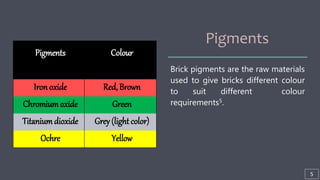
Pigments
Brick pigments are the raw materials
used to give bricks different colour
to suit different colour
requirements5.
Pigments Colour
Carbon black Black, Grey
Ironoxide Red, Brown
Chromiumoxide Green
Titaniumdioxide Grey (light color)
Ochre Yellow
5
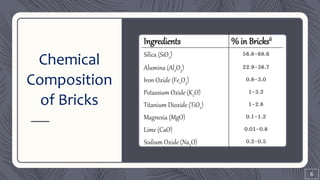
Chemical
Composition
of Bricks
Ingredients % in Bricks6
Silica (SiO2) 56.8-68.6
Alumina (Al2O3) 22.9-38.7
Iron Oxide (Fe2O3) 0.8-3.0
Potassium Oxide (K2O) 1-3.2
Titanium Dioxide (TiO2) 1-2.8
Magnesia (MgO) 0.1-1.2
Lime (CaO) 0.01-0.8
Sodium Oxide (Na2O) 0.2-0.5
6
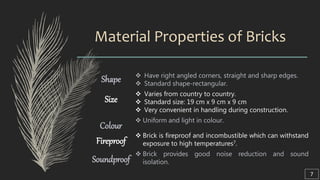
Material Properties of Bricks
Shape  Have right angled corners, straight and sharp edges.
 Standard shape-rectangular.
Size
 Varies from country to country.
 Standard size: 19 cm x 9 cm x 9 cm
 Very convenient in handling during construction.
Colour
 Uniform and light in colour.
Fireproof
 Brick is fireproof and incombustible which can withstand
exposure to high temperatures7.
Soundproof
 Brick provides good noise reduction and sound
isolation.
7
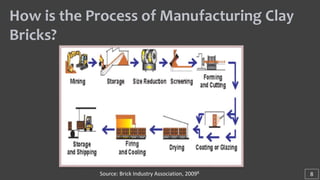
How is the Process of Manufacturing Clay
Bricks?
8Source: Brick Industry Association, 20098
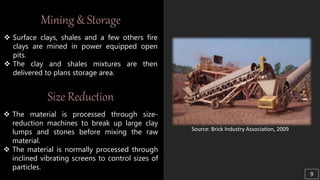
Mining & Storage
 Surface clays, shales and a few others fire
clays are mined in power equipped open
pits.
 The clay and shales mixtures are then
delivered to plans storage area.
Size Reduction
 The material is processed through size-
reduction machines to break up large clay
lumps and stones before mixing the raw
material.
 The material is normally processed through
inclined vibrating screens to control sizes of
particles.
9
Source: Brick Industry Association, 2009
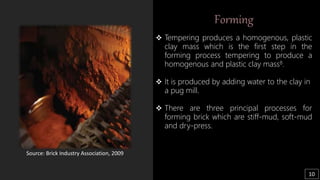
Forming
 Tempering produces a homogenous, plastic
clay mass which is the first step in the
forming process tempering to produce a
homogenous and plastic clay mass8.
 It is produced by adding water to the clay in
a pug mill.
 There are three principal processes for
forming brick which are stiff-mud, soft-mud
and dry-press.
10
Source: Brick Industry Association, 2009
Stiff-Mud Process
 To order to achieve plasticity, water in the range of 10-15% is blended into
the clay. The tempered clay moves into a deairing chamber after pugging,
which maintains a vacuum of 375-725mm of mercury.
 De-airing remove air holes and bubbles, improving workability and
plasticity of the material, resulting in greater strength.
Soft-Mud Process
 Exclusive for clays that contain excessive water for the stiff-mud
process to be extruded.
 Clays are mixed to contain 20-30% water and then formed into
molded bricks.
 Sand / water used as the lubrication of mold to prevent sticking of
clay by "sand-struck" / "water-struck".
Dry-Press Process
 Especially well suited for very low plasticity clays.
 Clay is mixed with stringent amount of water thus undergo hydraulic
press into steel molds at pressure 3.4-10.3MPa.
11
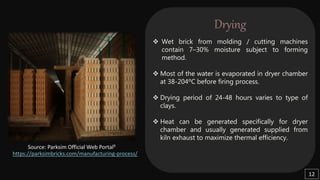
Drying
 Wet brick from molding / cutting machines
contain 7–30% moisture subject to forming
method.
 Most of the water is evaporated in dryer chamber
at 38-204ºC before firing process.
 Drying period of 24-48 hours varies to type of
clays.
 Heat can be generated specifically for dryer
chamber and usually generated supplied from
kiln exhaust to maximize thermal efficiency.
12
https://parksimbricks.com/manufacturing-process/
Source: Parksim Official Web Portal9
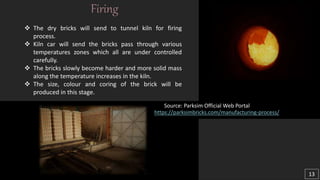
Firing
 The dry bricks will send to tunnel kiln for firing
process.
 Kiln car will send the bricks pass through various
temperatures zones which all are under controlled
carefully.
 The bricks slowly become harder and more solid mass
along the temperature increases in the kiln.
 The size, colour and coring of the brick will be
produced in this stage.
13
Source: Parksim Official Web Portal
https://parksimbricks.com/manufacturing-process/
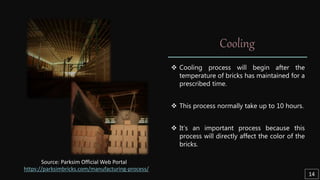
 Cooling process will begin after the
temperature of bricks has maintained for a
prescribed time.
 This process normally take up to 10 hours.
 It’s an important process because this
process will directly affect the color of the
bricks.
Cooling
14
https://parksimbricks.com/manufacturing-process/
Source: Parksim Official Web Portal
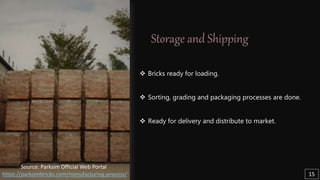
 Bricks ready for loading.
 Sorting, grading and packaging processes are done.
 Ready for delivery and distribute to market.
Storage and Shipping
15
Source: Parksim Official Web Portal
https://parksimbricks.com/manufacturing-process/
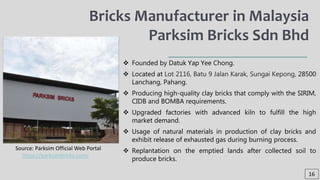
 Founded by Datuk Yap Yee Chong.
 Located at Lot 2116, Batu 9 Jalan Karak, Sungai Kepong, 28500
Lanchang, Pahang.
 Producing high-quality clay bricks that comply with the SIRIM,
CIDB and BOMBA requirements.
 Upgraded factories with advanced kiln to fulfill the high
market demand.
 Usage of natural materials in production of clay bricks and
exhibit release of exhausted gas during burning process.
 Replantation on the emptied lands after collected soil to
produce bricks.
Bricks Manufacturer in Malaysia
Parksim Bricks Sdn Bhd
16
Source: Parksim Official Web Portal
https://parksimbricks.com/
Alternative Manufacturing Method
by Haziq
Additive Manufacturing of Bricks
Additive manufacturing represents a new horizon in the field of concrete and cement-based
materials. Processing bricks using AM have many advantages and can be one of the alternative
in bricks process compared to the conventional process11.
 Reducing the quantity of the workforce associated with development and, therefore,
reducing the cost of servicing staff, protection, charges, emergency clinics, etc. This is
because AM can do many task alone compared to others conventional process which is
need more workers to handle it.
 Reduction in manufacturing time: 3D printer does not require a break for lunch and
weekend, it can work without interruption and faster than human labour.
 Architectural freedom: a 3D printer based on 3 degrees of freedom (x, y, z) manufacturing.
This feature allows the development of highly complex shapes and geometry.
 Improving the quality and unwavering quality of a structure by taking out the human factor:
staff insufficiency and development errors. This aspect is also related to the decrease in
injuries and fatalities in the workplace.
17
Alternative Manufacturing
Method by Hafizan
 Natural fibre is sustainability and eco-friendly material, since they
can be sourced from animal or plants. An addition of natural fibre as
reinforcement of composites in the raw material of the brick can
increase mechanical properties, such as shear strength, toughness,
tensile strength and energy absorption capacity12.
 Raut & Gomez (2017) was investigated the development of
thermally efficient natural fibre based eco-friendly brick reusing
locally available waste materials to reduce the dependence on non-
eco-friendly insulation material by developing thermally efficient
eco- friendly bricks13.
 From this research, a thermally efficient prototype mixing design
using glass powder and palm oil fly ash along with lime as binder
can provide strength to the bricks. Furthermore, the use of oil palm
fibres has been effective at reducing brick thermal conductivity
which indicates that the proposed bricks may be an alternative to
non-eco-friendly commercial common bricks.
18
Alternative Manufacturing Method
by Wong
 Utilization of waste glass in the manufacturing process of clay bricks to increase
the compressive strength of bricks.
 Based on the research of Phonphuak, Kanyakam & Chindaprasirt (2016), the
optimum waste glass content is 10 wt.%14.
 The clay brick with addition of waste glass fired at 900°C have similar
compressive strength with the normal clay bricks fired at 1000°C.
 There is also a slightly increase in porosity.
 Reuse of the waste and promote green environment.
19
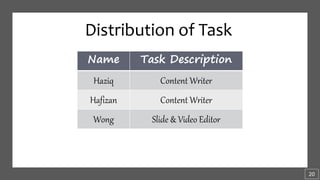
Name Task Description
Haziq Content Writer
Hafizan Content Writer
Wong Slide & Video Editor
Distribution of Task
20
References
1. Karaman, S., Gunal, H., & Ersahin, S. (2006). Assesment of clay bricks compressive strength using
quantitative values of colour components. Construction and Building Materials, 20(5), 348–354.
2. Khaled Jamal Abu Haweila & Ahmad Mostafa Hanhan. (2017). Lime – Enhanced properties of clay
bricks as a green building material.
3. Tahsina Alam. (2020). Composition of Bricks - Function of Ingredients. https://civiltoday.com/civil-
engineering-materials/brick/132-brick-composition-ingredients-with-functions. [17 July 2020]
4. Susmita B. (2020). Bricks: Composition, Qualities, Uses, Tests and Shape | Materials | Engineering
https://www.engineeringenotes.com/engineering-materials-2/bricks/bricks-composition-qualities-
uses-tests-and-shape-materials-engineering/46368 [13 July 2020]
5. Thomas Publishing Company. (2020). Types of Bricks Used in Construction and Civil Engineering.
https://www.thomasnet.com/articles/plant-facility-equipment/types-of-bricks-used-in-construction-
and-civil-engineering/ [15 July 2020]
6. HH Abdeen. (2016). Properties of Fired Clay Bricks Mixed with Waste Glass.
7. Anon. (2020). Characteristics of Good Bricks. https://civiltoday.com/civil-engineering-
materials/brick/69-characteristics-and-qualities-of-good-bricks-for-construction [16 July 2020]
8. Fernandes F.M., Lourenço P.B., Castro F. (2010) Ancient Clay Bricks: Manufacture and
Properties. In: Dan M.B., Přikryl R., Török Á. (eds) Materials, Technologies and Practice in
Historic Heritage Structures. Springer, Dordrecht.
9. Brick Industry Association. (2009). Technical Notes on Brick Construction, Manufacturing of
Brick TN9. Virginia: Brick Industry Association.
10. Parksim Sdn. Bhd. Official Web Portal
https://parksimbricks.com/ [8 July 2020]
References
11. Valente, M., Sibai, A. & Sambucci, M. 2019. Extrusion-Based Additive Manufacturing of
Concrete Products: Revolutionizing and Remodeling the Construction Industry. Journal
of Composites Science 3(3): 88.
12. Sanal, I. & Verma, D. 2019. Construction materials reinforced with natural products.
Handbook of Ecomaterials 3: 2119–2142.
13. Raut, A. N. & Gomez, C. P. 2017. Development of thermally efficient fibre-based eco-
friendly brick reusing locally available waste materials. Construction and Building
Materials 133: 275–284.
14. Phonphuak, N., Kanyakam, S., & Chindaprasirt, P. (2016). Utilization of waste glass to
enhance physical-mechanical properties of fired clay brick. Journal of Cleaner
Production, 112, 3057–3062.
References

Manufacturing Process of Clay Bricks

  • 1.
    Clay Bricks WONG TINGWEA MOHAMAD HAFIZAN BIN KAMARUDDIN MUHAMMAD HAZIQ BUKHARI BIN AHMAD NAZRI Department of Mechanical & Manufacturing Engineering Faculty of Engineering & Built Environment Universiti Kebangsaan Malaysia Prepared by: Group 4 Lecturers: PROF. DR. ANDANASTUTI MUCHTAR DR. NABILAH AFIQAH BINTI MOHD RADZUAN
  • 2.
    Application of Bricks Wall Bridge& Water Tunnel Walking Pave 1
  • 3.
    Common Materials Used for Clay Bricks Clay(Alumina) The mineral content in clay determine the colour of bricks. Iron oxide in clay would become reddish1. Lime in clay would have a white or yellow hue. 2
  • 4.
    Common Materials Used for Clay Bricks Sand(Silica)  Good quality bricks contain 50-60 % of silica .  Clay (alumina) + Sand (silica)=Aluminosilicates.  Silica prevents raw bricks from cracking, shrinking and warping2.  The shape, texture and durability of the bricks determined by the proportion of silica and alumina .  Excess silica will destroy the cohesion between the pieces of brick clay and makes the brick brittle and weaker in strength3. llllllllllllllllll 3
  • 5.
    Lime (Calcium Oxide) Bricks should contain a little amount of finely powdered lime.  It allows silica to melt at the temperature of the furnace and binds the brick particles together, resulting in strong and durable bricks4.  Lime acts as a catalyst to elevate the furnace temperature.  Excess lime melts the bricks and disfigure it. Common Materials Used for Clay Bricks 4
  • 6.
    Pigments Brick pigments arethe raw materials used to give bricks different colour to suit different colour requirements5. Pigments Colour Carbon black Black, Grey Ironoxide Red, Brown Chromiumoxide Green Titaniumdioxide Grey (light color) Ochre Yellow 5
  • 7.
    Chemical Composition of Bricks Ingredients %in Bricks6 Silica (SiO2) 56.8-68.6 Alumina (Al2O3) 22.9-38.7 Iron Oxide (Fe2O3) 0.8-3.0 Potassium Oxide (K2O) 1-3.2 Titanium Dioxide (TiO2) 1-2.8 Magnesia (MgO) 0.1-1.2 Lime (CaO) 0.01-0.8 Sodium Oxide (Na2O) 0.2-0.5 6
  • 8.
    Material Properties ofBricks Shape  Have right angled corners, straight and sharp edges.  Standard shape-rectangular. Size  Varies from country to country.  Standard size: 19 cm x 9 cm x 9 cm  Very convenient in handling during construction. Colour  Uniform and light in colour. Fireproof  Brick is fireproof and incombustible which can withstand exposure to high temperatures7. Soundproof  Brick provides good noise reduction and sound isolation. 7
  • 9.
    How is theProcess of Manufacturing Clay Bricks? 8Source: Brick Industry Association, 20098
  • 10.
    Mining & Storage Surface clays, shales and a few others fire clays are mined in power equipped open pits.  The clay and shales mixtures are then delivered to plans storage area. Size Reduction  The material is processed through size- reduction machines to break up large clay lumps and stones before mixing the raw material.  The material is normally processed through inclined vibrating screens to control sizes of particles. 9 Source: Brick Industry Association, 2009
  • 11.
    Forming  Tempering producesa homogenous, plastic clay mass which is the first step in the forming process tempering to produce a homogenous and plastic clay mass8.  It is produced by adding water to the clay in a pug mill.  There are three principal processes for forming brick which are stiff-mud, soft-mud and dry-press. 10 Source: Brick Industry Association, 2009
  • 12.
    Stiff-Mud Process  Toorder to achieve plasticity, water in the range of 10-15% is blended into the clay. The tempered clay moves into a deairing chamber after pugging, which maintains a vacuum of 375-725mm of mercury.  De-airing remove air holes and bubbles, improving workability and plasticity of the material, resulting in greater strength. Soft-Mud Process  Exclusive for clays that contain excessive water for the stiff-mud process to be extruded.  Clays are mixed to contain 20-30% water and then formed into molded bricks.  Sand / water used as the lubrication of mold to prevent sticking of clay by "sand-struck" / "water-struck". Dry-Press Process  Especially well suited for very low plasticity clays.  Clay is mixed with stringent amount of water thus undergo hydraulic press into steel molds at pressure 3.4-10.3MPa. 11
  • 13.
    Drying  Wet brickfrom molding / cutting machines contain 7–30% moisture subject to forming method.  Most of the water is evaporated in dryer chamber at 38-204ºC before firing process.  Drying period of 24-48 hours varies to type of clays.  Heat can be generated specifically for dryer chamber and usually generated supplied from kiln exhaust to maximize thermal efficiency. 12 https://parksimbricks.com/manufacturing-process/ Source: Parksim Official Web Portal9
  • 14.
    Firing  The drybricks will send to tunnel kiln for firing process.  Kiln car will send the bricks pass through various temperatures zones which all are under controlled carefully.  The bricks slowly become harder and more solid mass along the temperature increases in the kiln.  The size, colour and coring of the brick will be produced in this stage. 13 Source: Parksim Official Web Portal https://parksimbricks.com/manufacturing-process/
  • 15.
     Cooling processwill begin after the temperature of bricks has maintained for a prescribed time.  This process normally take up to 10 hours.  It’s an important process because this process will directly affect the color of the bricks. Cooling 14 https://parksimbricks.com/manufacturing-process/ Source: Parksim Official Web Portal
  • 16.
     Bricks readyfor loading.  Sorting, grading and packaging processes are done.  Ready for delivery and distribute to market. Storage and Shipping 15 Source: Parksim Official Web Portal https://parksimbricks.com/manufacturing-process/
  • 17.
     Founded byDatuk Yap Yee Chong.  Located at Lot 2116, Batu 9 Jalan Karak, Sungai Kepong, 28500 Lanchang, Pahang.  Producing high-quality clay bricks that comply with the SIRIM, CIDB and BOMBA requirements.  Upgraded factories with advanced kiln to fulfill the high market demand.  Usage of natural materials in production of clay bricks and exhibit release of exhausted gas during burning process.  Replantation on the emptied lands after collected soil to produce bricks. Bricks Manufacturer in Malaysia Parksim Bricks Sdn Bhd 16 Source: Parksim Official Web Portal https://parksimbricks.com/
  • 18.
    Alternative Manufacturing Method byHaziq Additive Manufacturing of Bricks Additive manufacturing represents a new horizon in the field of concrete and cement-based materials. Processing bricks using AM have many advantages and can be one of the alternative in bricks process compared to the conventional process11.  Reducing the quantity of the workforce associated with development and, therefore, reducing the cost of servicing staff, protection, charges, emergency clinics, etc. This is because AM can do many task alone compared to others conventional process which is need more workers to handle it.  Reduction in manufacturing time: 3D printer does not require a break for lunch and weekend, it can work without interruption and faster than human labour.  Architectural freedom: a 3D printer based on 3 degrees of freedom (x, y, z) manufacturing. This feature allows the development of highly complex shapes and geometry.  Improving the quality and unwavering quality of a structure by taking out the human factor: staff insufficiency and development errors. This aspect is also related to the decrease in injuries and fatalities in the workplace. 17
  • 19.
    Alternative Manufacturing Method byHafizan  Natural fibre is sustainability and eco-friendly material, since they can be sourced from animal or plants. An addition of natural fibre as reinforcement of composites in the raw material of the brick can increase mechanical properties, such as shear strength, toughness, tensile strength and energy absorption capacity12.  Raut & Gomez (2017) was investigated the development of thermally efficient natural fibre based eco-friendly brick reusing locally available waste materials to reduce the dependence on non- eco-friendly insulation material by developing thermally efficient eco- friendly bricks13.  From this research, a thermally efficient prototype mixing design using glass powder and palm oil fly ash along with lime as binder can provide strength to the bricks. Furthermore, the use of oil palm fibres has been effective at reducing brick thermal conductivity which indicates that the proposed bricks may be an alternative to non-eco-friendly commercial common bricks. 18
  • 20.
    Alternative Manufacturing Method byWong  Utilization of waste glass in the manufacturing process of clay bricks to increase the compressive strength of bricks.  Based on the research of Phonphuak, Kanyakam & Chindaprasirt (2016), the optimum waste glass content is 10 wt.%14.  The clay brick with addition of waste glass fired at 900°C have similar compressive strength with the normal clay bricks fired at 1000°C.  There is also a slightly increase in porosity.  Reuse of the waste and promote green environment. 19
  • 21.
    Name Task Description HaziqContent Writer Hafizan Content Writer Wong Slide & Video Editor Distribution of Task 20
  • 22.
    References 1. Karaman, S.,Gunal, H., & Ersahin, S. (2006). Assesment of clay bricks compressive strength using quantitative values of colour components. Construction and Building Materials, 20(5), 348–354. 2. Khaled Jamal Abu Haweila & Ahmad Mostafa Hanhan. (2017). Lime – Enhanced properties of clay bricks as a green building material. 3. Tahsina Alam. (2020). Composition of Bricks - Function of Ingredients. https://civiltoday.com/civil- engineering-materials/brick/132-brick-composition-ingredients-with-functions. [17 July 2020] 4. Susmita B. (2020). Bricks: Composition, Qualities, Uses, Tests and Shape | Materials | Engineering https://www.engineeringenotes.com/engineering-materials-2/bricks/bricks-composition-qualities- uses-tests-and-shape-materials-engineering/46368 [13 July 2020] 5. Thomas Publishing Company. (2020). Types of Bricks Used in Construction and Civil Engineering. https://www.thomasnet.com/articles/plant-facility-equipment/types-of-bricks-used-in-construction- and-civil-engineering/ [15 July 2020]
  • 23.
    6. HH Abdeen.(2016). Properties of Fired Clay Bricks Mixed with Waste Glass. 7. Anon. (2020). Characteristics of Good Bricks. https://civiltoday.com/civil-engineering- materials/brick/69-characteristics-and-qualities-of-good-bricks-for-construction [16 July 2020] 8. Fernandes F.M., Lourenço P.B., Castro F. (2010) Ancient Clay Bricks: Manufacture and Properties. In: Dan M.B., Přikryl R., Török Á. (eds) Materials, Technologies and Practice in Historic Heritage Structures. Springer, Dordrecht. 9. Brick Industry Association. (2009). Technical Notes on Brick Construction, Manufacturing of Brick TN9. Virginia: Brick Industry Association. 10. Parksim Sdn. Bhd. Official Web Portal https://parksimbricks.com/ [8 July 2020] References
  • 24.
    11. Valente, M.,Sibai, A. & Sambucci, M. 2019. Extrusion-Based Additive Manufacturing of Concrete Products: Revolutionizing and Remodeling the Construction Industry. Journal of Composites Science 3(3): 88. 12. Sanal, I. & Verma, D. 2019. Construction materials reinforced with natural products. Handbook of Ecomaterials 3: 2119–2142. 13. Raut, A. N. & Gomez, C. P. 2017. Development of thermally efficient fibre-based eco- friendly brick reusing locally available waste materials. Construction and Building Materials 133: 275–284. 14. Phonphuak, N., Kanyakam, S., & Chindaprasirt, P. (2016). Utilization of waste glass to enhance physical-mechanical properties of fired clay brick. Journal of Cleaner Production, 112, 3057–3062. References