Concepts of Sustainable Buildings –
(Social, Economical and Environmental Aspects) and
Climate Classification
What is Sustainable Development
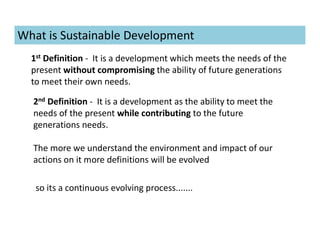
1st Definition - It is a development which meets the needs of the
present without compromising the ability of future generations
to meet their own needs.
2nd Definition - It is a development as the ability to meet the
needs of the present while contributing to the future
generations needs.
The more we understand the environment and impact of our
actions on it more definitions will be evolved
so its a continuous evolving process.......
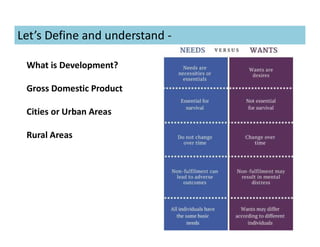
What is Development?
Gross Domestic Product
Cities or Urban Areas
Rural Areas
Let’s Define and understand -
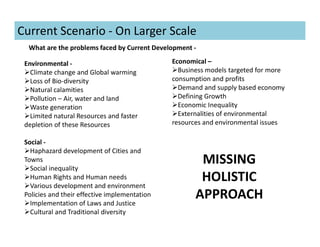
Current Scenario - On Larger Scale
Environmental -
Climate change and Global warming
Loss of Bio-diversity
Natural calamities
Pollution – Air, water and land
Waste generation
Limited natural Resources and faster
depletion of these Resources
Social -
Haphazard development of Cities and
Towns
Social inequality
Human Rights and Human needs
Various development and environment
Policies and their effective implementation
Implementation of Laws and Justice
Cultural and Traditional diversity
Economical –
Business models targeted for more
consumption and profits
Demand and supply based economy
Defining Growth
Economic Inequality
Externalities of environmental
resources and environmental issues
What are the problems faced by Current Development -
MISSING
HOLISTIC
APPROACH
What is Sustainable Development
It is the development that is likely to achieve lasting
satisfaction of human improvement of the quality of life
Helps the poorest to survive.
Has cost effective development using different economic
criteria
Emphasizes issues of health control, appropriate
technologies, reliance, clean water and shelter for all.
Treating human beings as resources for carrying out different
activities
What is Sustainable Development
Sustainable development is often divided into three major
aspects –
Ecological Sustainability - Environmental Quality
Economical Sustainability - Economic Prosperity
Social Sustainability – Social equity, Health, Safety, cultural
and traditional values
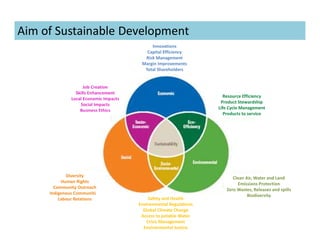
Aim of Sustainable Development
Innovations
Capital Efficiency
Risk Management
Margin Improvements
Total Shareholders
Resource Efficiency
Product Stewardship
Life Cycle Management
Products to service
Clean Air, Water and Land
Emissions Protection
Zero Wastes, Releases and spills
Biodiversity
Safety and Health
Environmental Regulations
Global Climate Change
Access to potable Water
Crisis Management
Environmental Justice
Diversity
Human Rights
Community Outreach
Indigenous Communities
Labour Relations
Job Creation
Skills Enhancement
Local Economic Impacts
Social Impacts
Business Ethics
Sustainable Buildings – Scope and Contribution
Building Industries play major role in environment, economy
and social aspects of Sustainable development
Buildings and other Constructions consumes lot of natural
recourses
Buildings and other construction needs and consume lot of
energy (contributes to almost 30 %-40% of total energy
consumption)
Buildings reflect traditional and cultural values of the society
Life cycle span of the buildings are longer and hence has larger
impact on all the aspects of Sustainable development
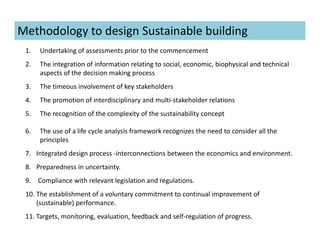
1. Undertaking of assessments prior to the commencement
2. The integration of information relating to social, economic, biophysical and technical
aspects of the decision making process
3. The timeous involvement of key stakeholders
4. The promotion of interdisciplinary and multi-stakeholder relations
5. The recognition of the complexity of the sustainability concept
6. The use of a life cycle analysis framework recognizes the need to consider all the
principles
7. Integrated design process -interconnections between the economics and environment.
8. Preparedness in uncertainty.
9. Compliance with relevant legislation and regulations.
10. The establishment of a voluntary commitment to continual improvement of
(sustainable) performance.
11. Targets, monitoring, evaluation, feedback and self-regulation of progress.
Methodology to design Sustainable building
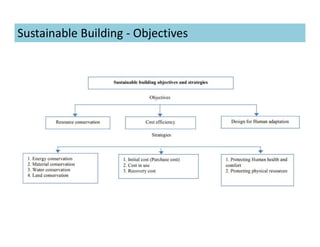
Sustainable Building - Objectives
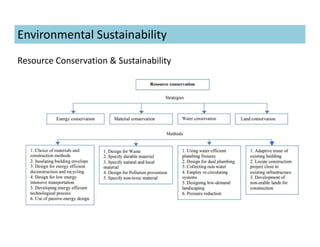
Environmental Sustainability
Resource Conservation & Sustainability
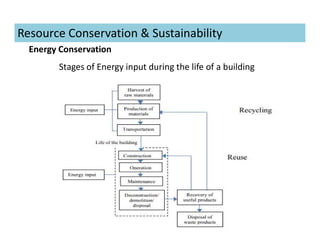
Stages of Energy input during the life of a building
Energy Conservation
Resource Conservation & Sustainability
Materials Conservation
1. Design for Waste Minimization.
a. Reducing and recovering construction waste:
b. Reuse and Recycling
c. The storage and disposal of construction waste.
2. Specify durable materials
3. Specify Natural and Local Materials.
4. Design for Pollution prevention.
5. Specify Non-Toxic or Less-Toxic Materials
Resource Conservation & Sustainability
Water Conservation
Utilizing water-efficient plumbing fixtures
Design for dual plumbing to use recycled water
Collecting rainwater using rainwater and grey water storage
for irrigation
Employ re-circulating systems for centralized hot water
distribution
Designing low-demand landscaping using plants native
Pressure Reduction
Resource Conservation & Sustainability
Land Conservation
Land is an important resource upon which the construction
industry depends.
Changing Land use and urban expansion
Reclamation, Deforestation and conversion of different Biomes to
non-agricultural lands
Soil erosion, groundwater contamination, acid rain and soil
contamination
Resource Conservation & Sustainability
1. Provision of equal opportunities;
2. Health, safety and conducive working environment;
3. Maintaining morale and employee satisfaction;
4. Participation in decision-making;
5. Building effective channels of communication;
6. Contributing to the local economy through local employment and
procurement;
7. Delivering services that enhance the local environment;
8. Building long-term relationships with clients;
9. Building long-term relationships with local suppliers;
10. Provision of effective training and appraisals;
11. Gender equality
12. Aspirations, Growth and Happiness
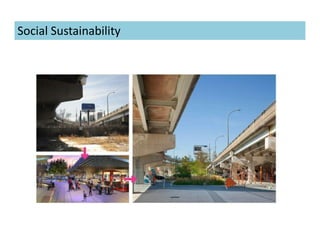
Social Sustainability
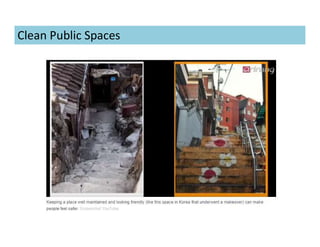
Clean Public Spaces
Economic Sustainability
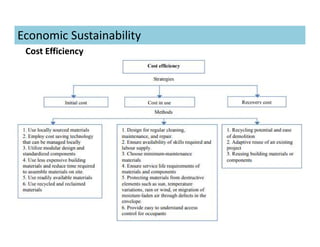
Cost Efficiency
Initial Cost
The design should optimize the use of locally-available materials
Use of cost saving construction technology
Utilize modular design and standardized components
Identify opportunities to minimize initial construction costs,
through use of modular designs and standardized components
Use common, readily available components
Using recycled and reclaimed materials.
Economic Sustainability
Cost in Use
Taking adequate measures within the design of key building
elements
Ensuring that the skills required are within the competence of
available labour supply.
Choosing minimum-maintenance
Adopting an appropriate process during the design stage to
protect materials from destructive elements
While fully meeting the operational requirements of the
building, provide easy-to-understand and easy-to-use building
control systems
Economic Sustainability
Recovery Cost
Recycling potential and ease of demolition
The adaptive reuse of an existing project
Reusing building materials or components
Economic Sustainability
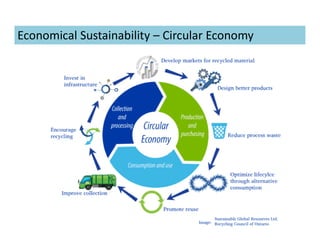
Economical Sustainability – Circular Economy
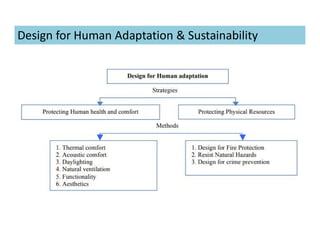
Design for Human Adaptation & Sustainability
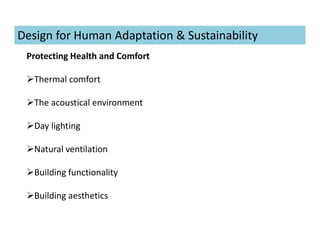
Protecting Health and Comfort
Thermal comfort
The acoustical environment
Day lighting
Natural ventilation
Building functionality
Building aesthetics
Design for Human Adaptation & Sustainability
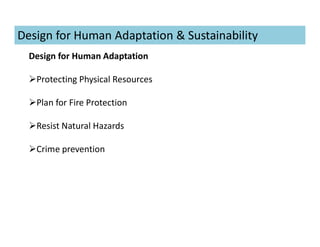
Design for Human Adaptation
Protecting Physical Resources
Plan for Fire Protection
Resist Natural Hazards
Crime prevention
Design for Human Adaptation & Sustainability
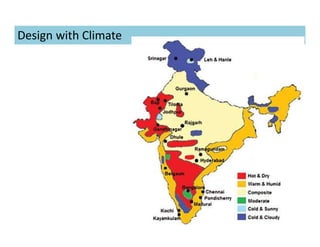
Design with Climate
What is Weather and Climate –
The Weather of any place represents an integrated effects of all
atmospheric variables over a brief period of time.
Climate is an average weather over a period of many years and is
generally known as the micro-climate.
Both Climate and weather are described by following variables
known as Climatic Factors –
a) Solar Radiation
b) Ambient Temperature
c) Air Humidity
d) Precipitation
e) Wind
f) Sky Conditions
Design with Climate
Focusing on Demand and Supply chain model.......
We need to demand sustainable commodities thus replacing
them with non-eco-friendly commodities
Consumerism shall be stopped and new definition of Growth
shall be established.
Zero Waste generation – An important milestone
Way Forward .........
3rd Definition - It is a development as the willingness to
compromise the “wants” of the present thus contributing to
the future generations needs...............
3rd Definition – Sustainable Development
THANK YOU...........!!

Environment.pdf

  • 1.
    Concepts of SustainableBuildings – (Social, Economical and Environmental Aspects) and Climate Classification
  • 2.
    What is SustainableDevelopment 1st Definition - It is a development which meets the needs of the present without compromising the ability of future generations to meet their own needs. 2nd Definition - It is a development as the ability to meet the needs of the present while contributing to the future generations needs. The more we understand the environment and impact of our actions on it more definitions will be evolved so its a continuous evolving process.......
  • 3.
    What is Development? GrossDomestic Product Cities or Urban Areas Rural Areas Let’s Define and understand -
  • 4.
    Current Scenario -On Larger Scale Environmental - Climate change and Global warming Loss of Bio-diversity Natural calamities Pollution – Air, water and land Waste generation Limited natural Resources and faster depletion of these Resources Social - Haphazard development of Cities and Towns Social inequality Human Rights and Human needs Various development and environment Policies and their effective implementation Implementation of Laws and Justice Cultural and Traditional diversity Economical – Business models targeted for more consumption and profits Demand and supply based economy Defining Growth Economic Inequality Externalities of environmental resources and environmental issues What are the problems faced by Current Development - MISSING HOLISTIC APPROACH
  • 5.
    What is SustainableDevelopment It is the development that is likely to achieve lasting satisfaction of human improvement of the quality of life Helps the poorest to survive. Has cost effective development using different economic criteria Emphasizes issues of health control, appropriate technologies, reliance, clean water and shelter for all. Treating human beings as resources for carrying out different activities
  • 6.
    What is SustainableDevelopment Sustainable development is often divided into three major aspects – Ecological Sustainability - Environmental Quality Economical Sustainability - Economic Prosperity Social Sustainability – Social equity, Health, Safety, cultural and traditional values
  • 7.
    Aim of SustainableDevelopment Innovations Capital Efficiency Risk Management Margin Improvements Total Shareholders Resource Efficiency Product Stewardship Life Cycle Management Products to service Clean Air, Water and Land Emissions Protection Zero Wastes, Releases and spills Biodiversity Safety and Health Environmental Regulations Global Climate Change Access to potable Water Crisis Management Environmental Justice Diversity Human Rights Community Outreach Indigenous Communities Labour Relations Job Creation Skills Enhancement Local Economic Impacts Social Impacts Business Ethics
  • 8.
    Sustainable Buildings –Scope and Contribution Building Industries play major role in environment, economy and social aspects of Sustainable development Buildings and other Constructions consumes lot of natural recourses Buildings and other construction needs and consume lot of energy (contributes to almost 30 %-40% of total energy consumption) Buildings reflect traditional and cultural values of the society Life cycle span of the buildings are longer and hence has larger impact on all the aspects of Sustainable development
  • 9.
    1. Undertaking ofassessments prior to the commencement 2. The integration of information relating to social, economic, biophysical and technical aspects of the decision making process 3. The timeous involvement of key stakeholders 4. The promotion of interdisciplinary and multi-stakeholder relations 5. The recognition of the complexity of the sustainability concept 6. The use of a life cycle analysis framework recognizes the need to consider all the principles 7. Integrated design process -interconnections between the economics and environment. 8. Preparedness in uncertainty. 9. Compliance with relevant legislation and regulations. 10. The establishment of a voluntary commitment to continual improvement of (sustainable) performance. 11. Targets, monitoring, evaluation, feedback and self-regulation of progress. Methodology to design Sustainable building
  • 10.
  • 11.
  • 12.
    Stages of Energyinput during the life of a building Energy Conservation Resource Conservation & Sustainability
  • 13.
    Materials Conservation 1. Designfor Waste Minimization. a. Reducing and recovering construction waste: b. Reuse and Recycling c. The storage and disposal of construction waste. 2. Specify durable materials 3. Specify Natural and Local Materials. 4. Design for Pollution prevention. 5. Specify Non-Toxic or Less-Toxic Materials Resource Conservation & Sustainability
  • 15.
    Water Conservation Utilizing water-efficientplumbing fixtures Design for dual plumbing to use recycled water Collecting rainwater using rainwater and grey water storage for irrigation Employ re-circulating systems for centralized hot water distribution Designing low-demand landscaping using plants native Pressure Reduction Resource Conservation & Sustainability
  • 16.
    Land Conservation Land isan important resource upon which the construction industry depends. Changing Land use and urban expansion Reclamation, Deforestation and conversion of different Biomes to non-agricultural lands Soil erosion, groundwater contamination, acid rain and soil contamination Resource Conservation & Sustainability
  • 17.
    1. Provision ofequal opportunities; 2. Health, safety and conducive working environment; 3. Maintaining morale and employee satisfaction; 4. Participation in decision-making; 5. Building effective channels of communication; 6. Contributing to the local economy through local employment and procurement; 7. Delivering services that enhance the local environment; 8. Building long-term relationships with clients; 9. Building long-term relationships with local suppliers; 10. Provision of effective training and appraisals; 11. Gender equality 12. Aspirations, Growth and Happiness Social Sustainability
  • 18.
  • 19.
  • 20.
  • 21.
    Initial Cost The designshould optimize the use of locally-available materials Use of cost saving construction technology Utilize modular design and standardized components Identify opportunities to minimize initial construction costs, through use of modular designs and standardized components Use common, readily available components Using recycled and reclaimed materials. Economic Sustainability
  • 22.
    Cost in Use Takingadequate measures within the design of key building elements Ensuring that the skills required are within the competence of available labour supply. Choosing minimum-maintenance Adopting an appropriate process during the design stage to protect materials from destructive elements While fully meeting the operational requirements of the building, provide easy-to-understand and easy-to-use building control systems Economic Sustainability
  • 23.
    Recovery Cost Recycling potentialand ease of demolition The adaptive reuse of an existing project Reusing building materials or components Economic Sustainability
  • 24.
  • 25.
    Design for HumanAdaptation & Sustainability
  • 26.
    Protecting Health andComfort Thermal comfort The acoustical environment Day lighting Natural ventilation Building functionality Building aesthetics Design for Human Adaptation & Sustainability
  • 27.
    Design for HumanAdaptation Protecting Physical Resources Plan for Fire Protection Resist Natural Hazards Crime prevention Design for Human Adaptation & Sustainability
  • 28.
  • 29.
    What is Weatherand Climate – The Weather of any place represents an integrated effects of all atmospheric variables over a brief period of time. Climate is an average weather over a period of many years and is generally known as the micro-climate. Both Climate and weather are described by following variables known as Climatic Factors – a) Solar Radiation b) Ambient Temperature c) Air Humidity d) Precipitation e) Wind f) Sky Conditions Design with Climate
  • 30.
    Focusing on Demandand Supply chain model....... We need to demand sustainable commodities thus replacing them with non-eco-friendly commodities Consumerism shall be stopped and new definition of Growth shall be established. Zero Waste generation – An important milestone Way Forward .........
  • 31.
    3rd Definition -It is a development as the willingness to compromise the “wants” of the present thus contributing to the future generations needs............... 3rd Definition – Sustainable Development
  • 32.