Building A Winning Team
A VALUABLE JOURNEY
First, Assess Your
Team
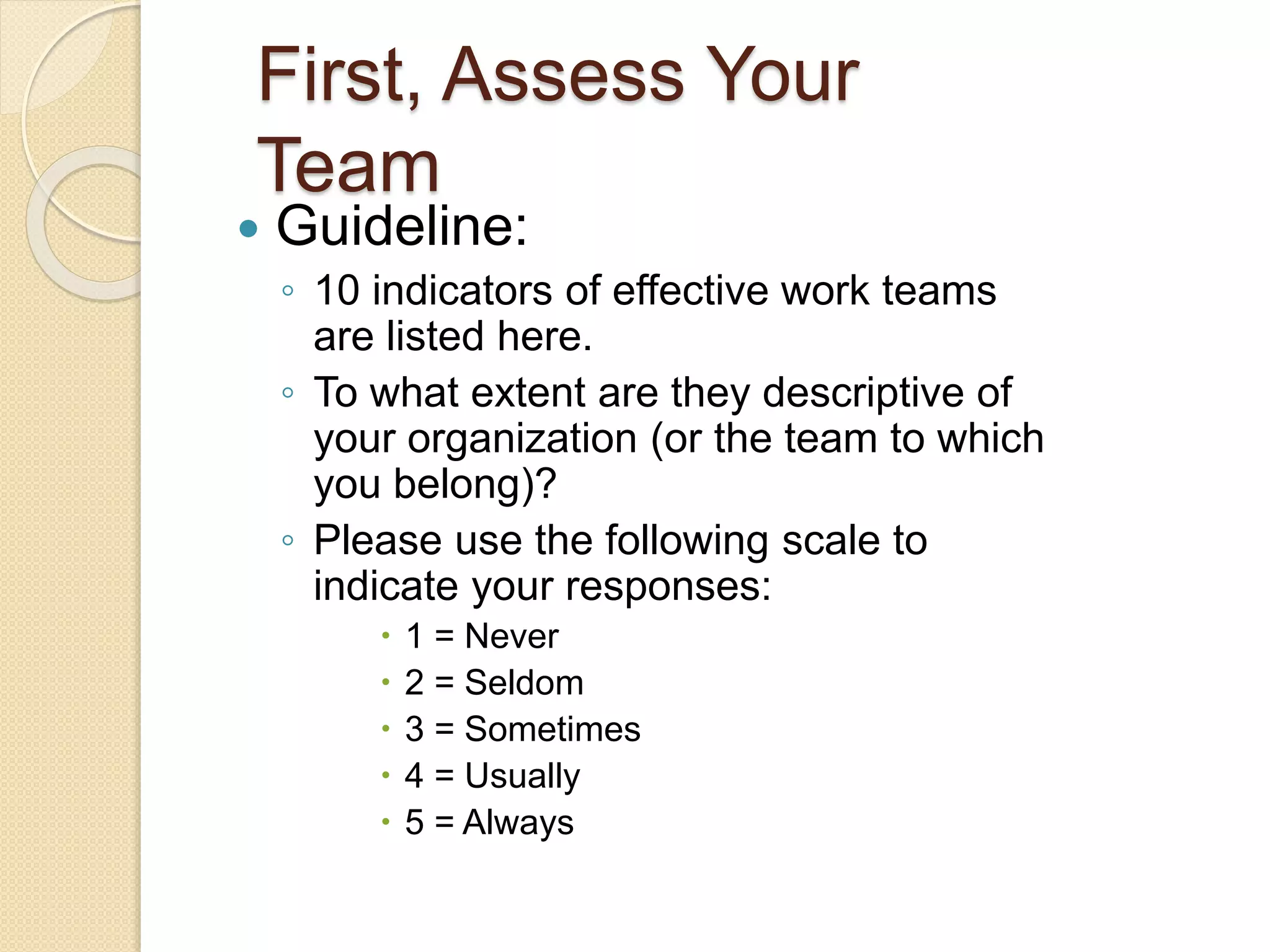
 Guideline:
◦ 10 indicators of effective work teams
are listed here.
◦ To what extent are they descriptive of
your organization (or the team to which
you belong)?
◦ Please use the following scale to
indicate your responses:
 1 = Never
 2 = Seldom
 3 = Sometimes
 4 = Usually
 5 = Always
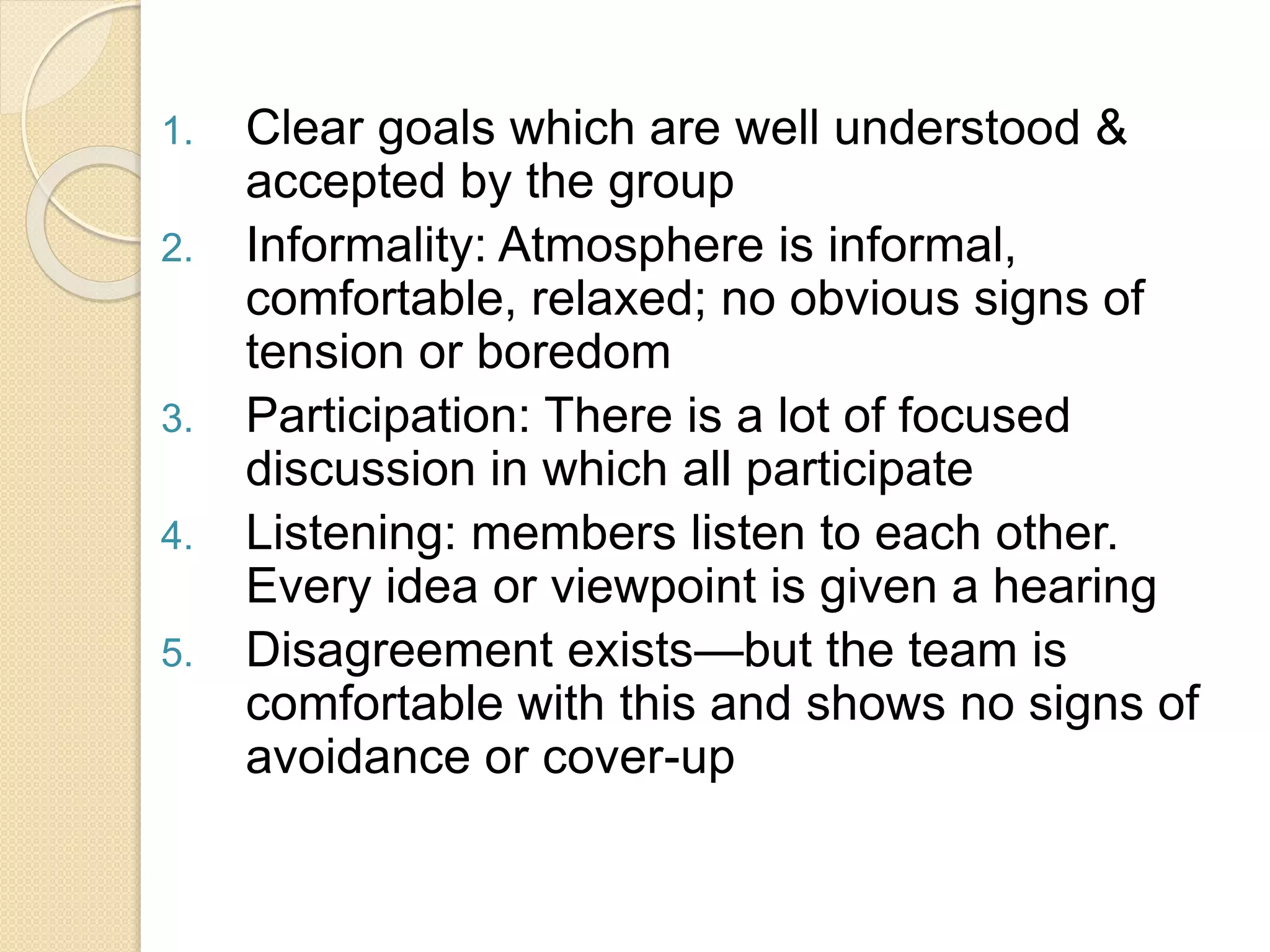
1. Clear goals which are well understood &
accepted by the group
2. Informality: Atmosphere is informal,
comfortable, relaxed; no obvious signs of
tension or boredom
3. Participation: There is a lot of focused
discussion in which all participate
4. Listening: members listen to each other.
Every idea or viewpoint is given a hearing
5. Disagreement exists—but the team is
comfortable with this and shows no signs of
avoidance or cover-up
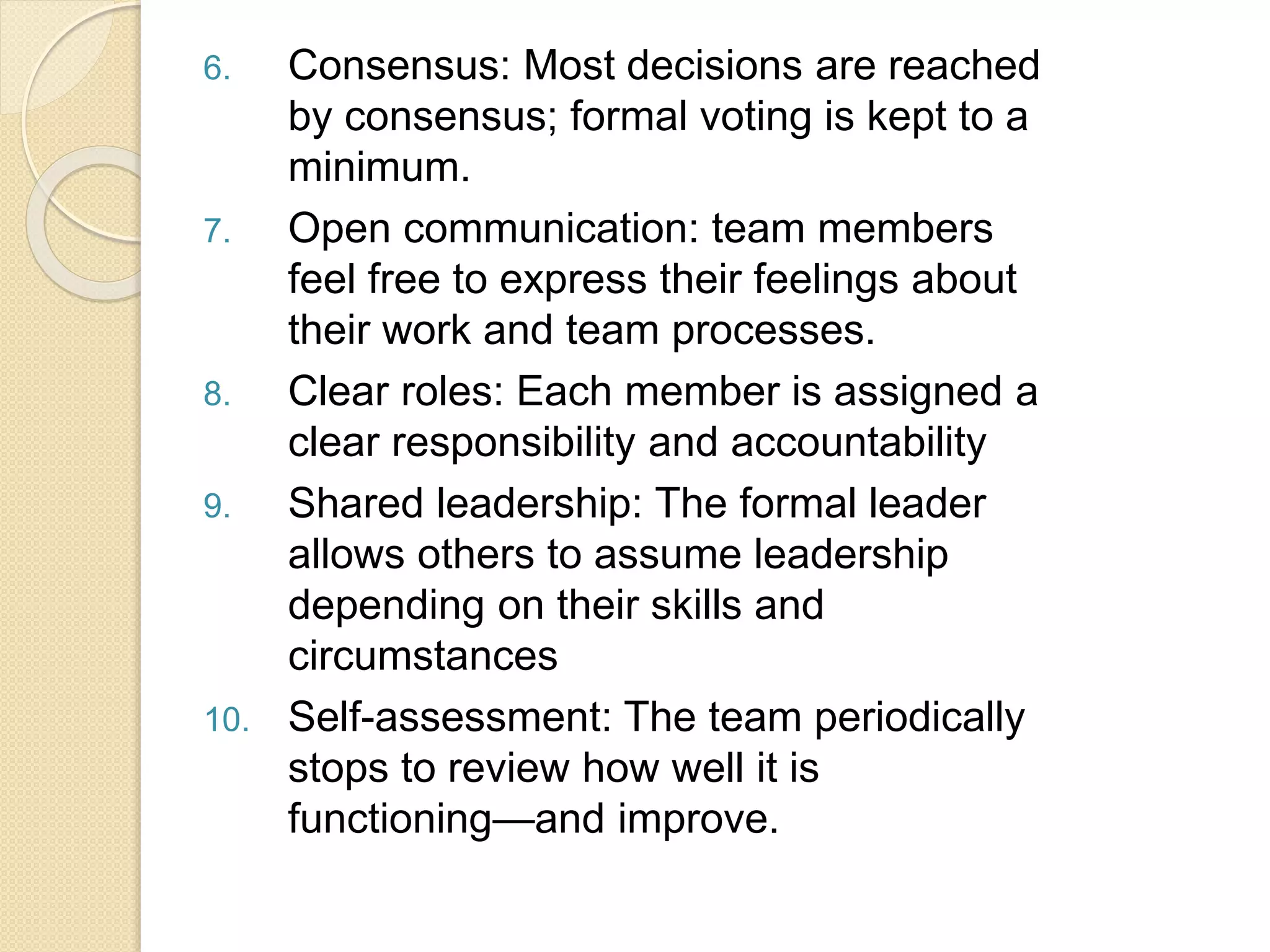
6. Consensus: Most decisions are reached
by consensus; formal voting is kept to a
minimum.
7. Open communication: team members
feel free to express their feelings about
their work and team processes.
8. Clear roles: Each member is assigned a
clear responsibility and accountability
9. Shared leadership: The formal leader
allows others to assume leadership
depending on their skills and
circumstances
10. Self-assessment: The team periodically
stops to review how well it is
functioning—and improve.
How Did Your Team
Fare?
 Please add the scale values
you assigned to each
statement
 Divide the total by 10 to get
an average “team index”
 Higher indices better
teams
Teambuilding
 What is a team?
◦ A group of people who are
committed to achieve common
objectives, who work well
together and produce high quality
results.
 What is teambuilding?
◦ Any planned event designed to
improve the way a group of
people work together.
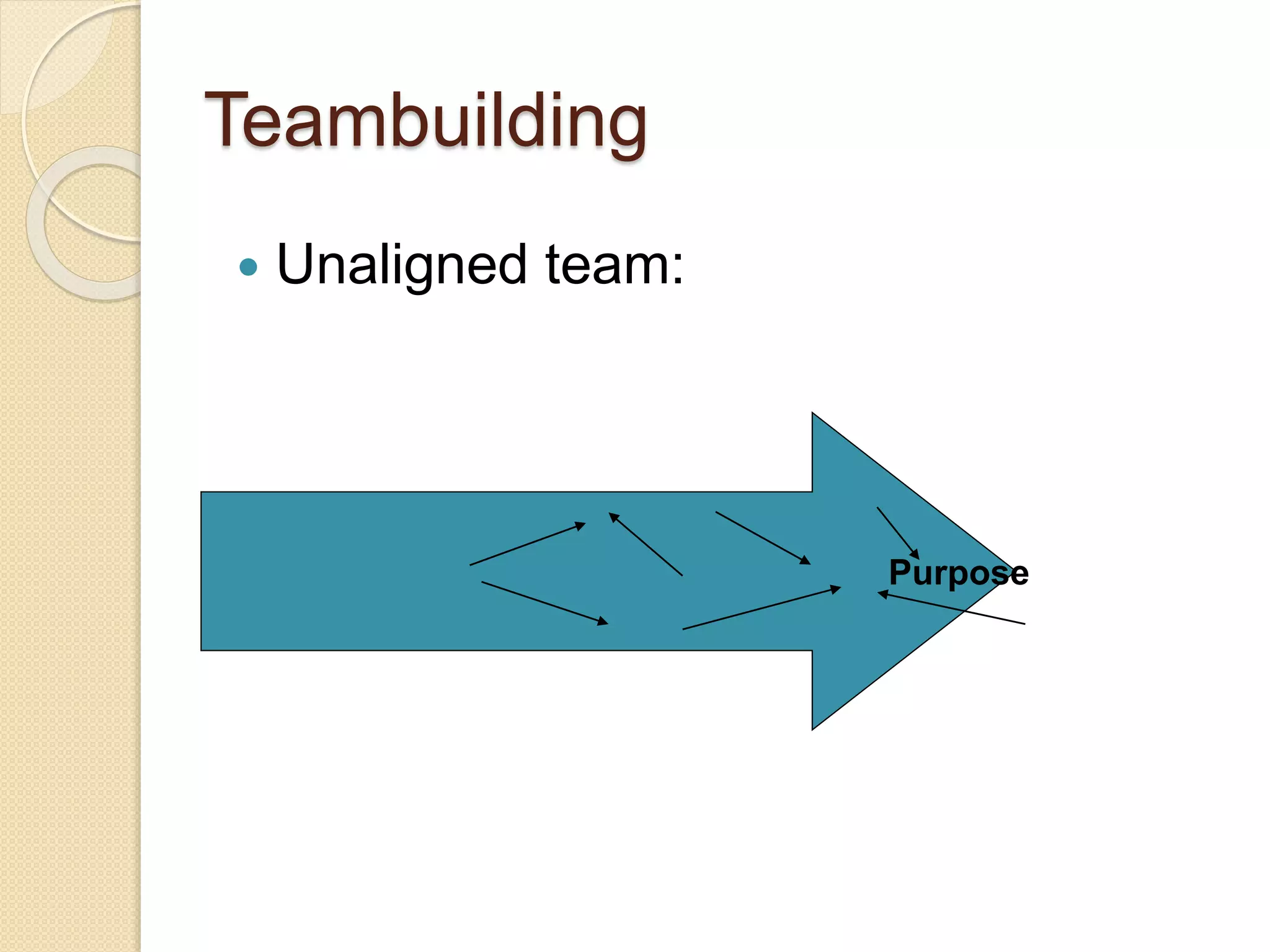
Teambuilding
 Unaligned team:
Purpose
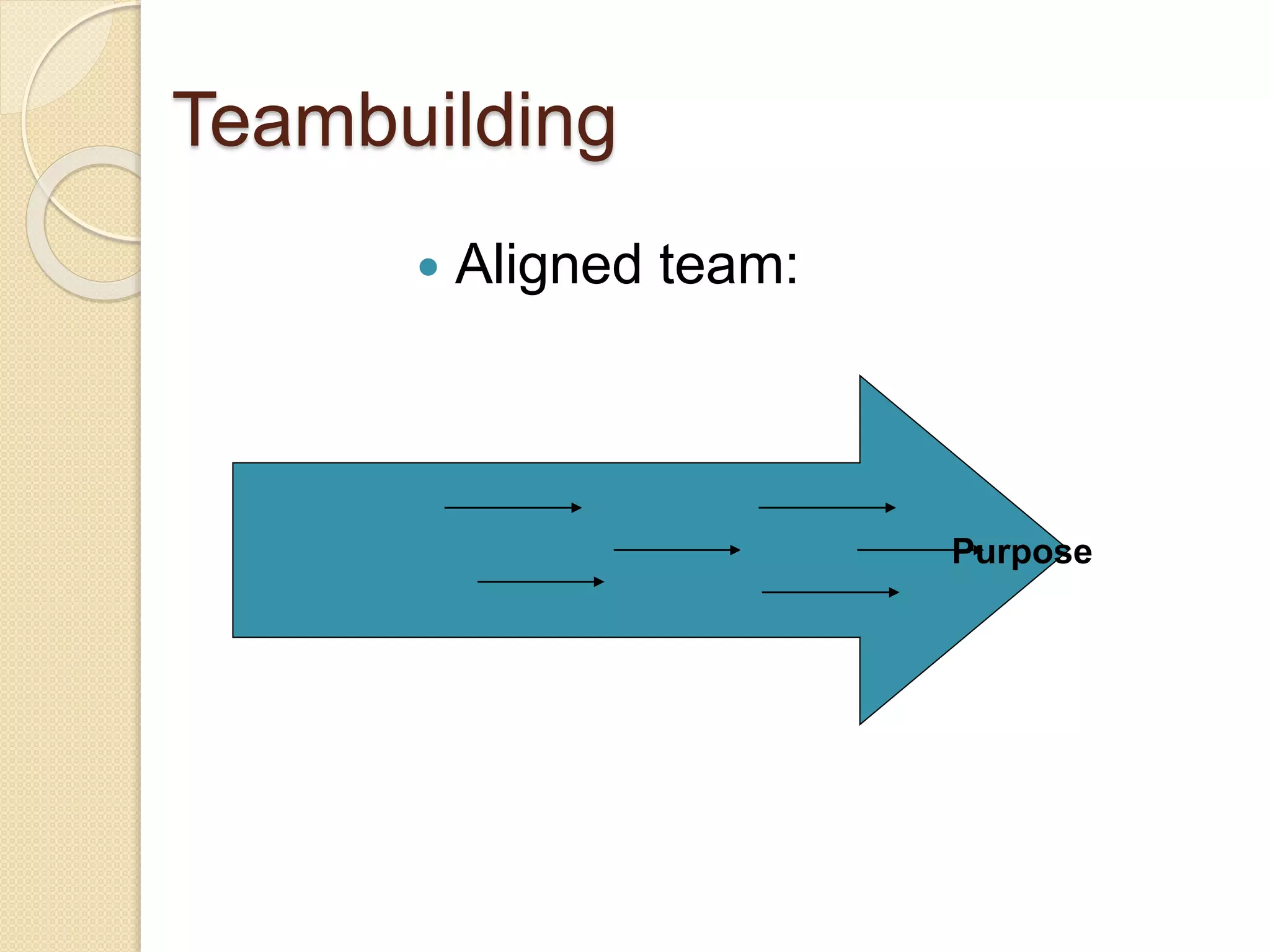
Teambuilding
 Aligned team:
Purpose
Team Formation &
Membership
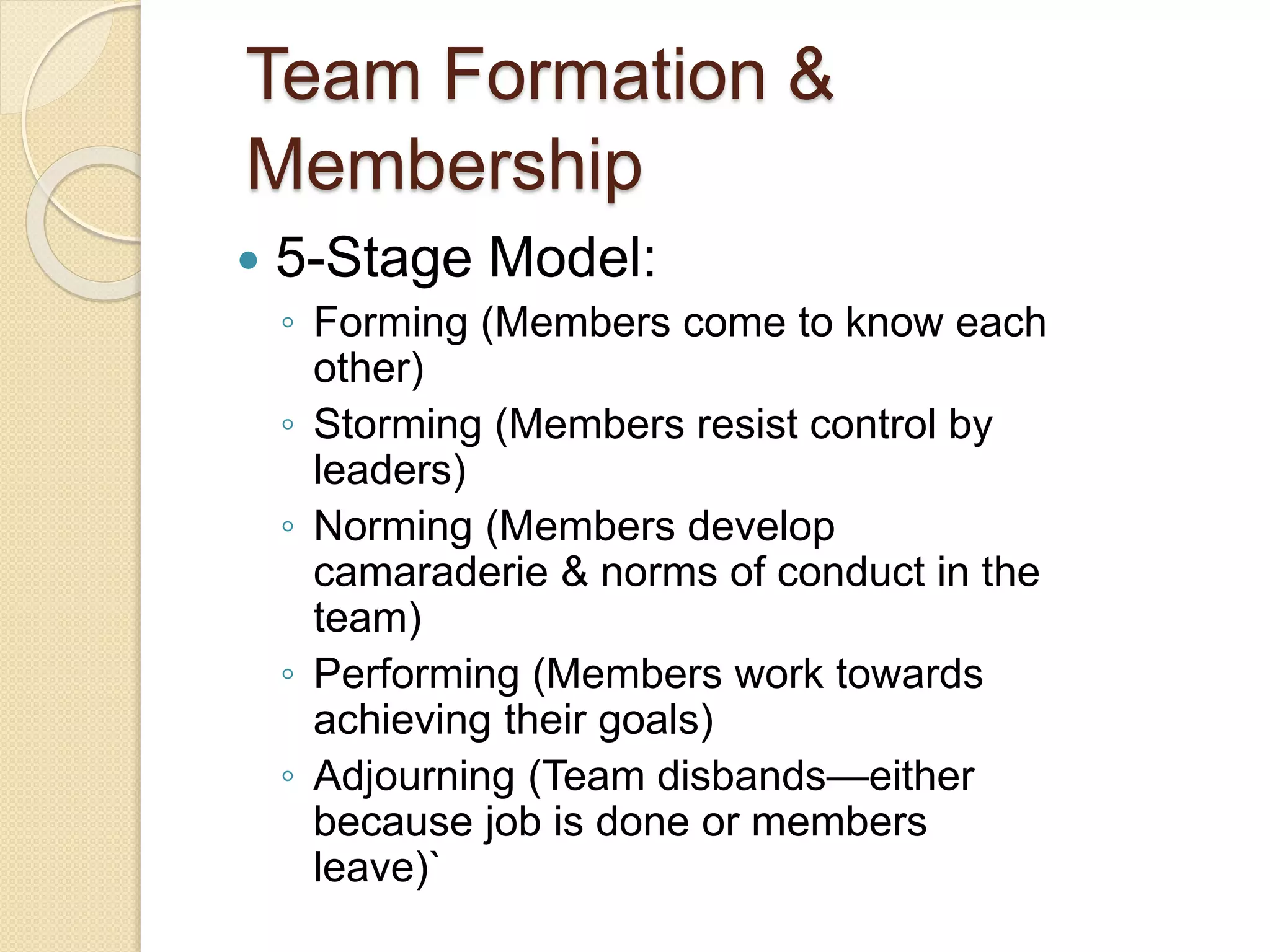
 5-Stage Model:
◦ Forming (Members come to know each
other)
◦ Storming (Members resist control by
leaders)
◦ Norming (Members develop
camaraderie & norms of conduct in the
team)
◦ Performing (Members work towards
achieving their goals)
◦ Adjourning (Team disbands—either
because job is done or members
leave)`
Teambuilding
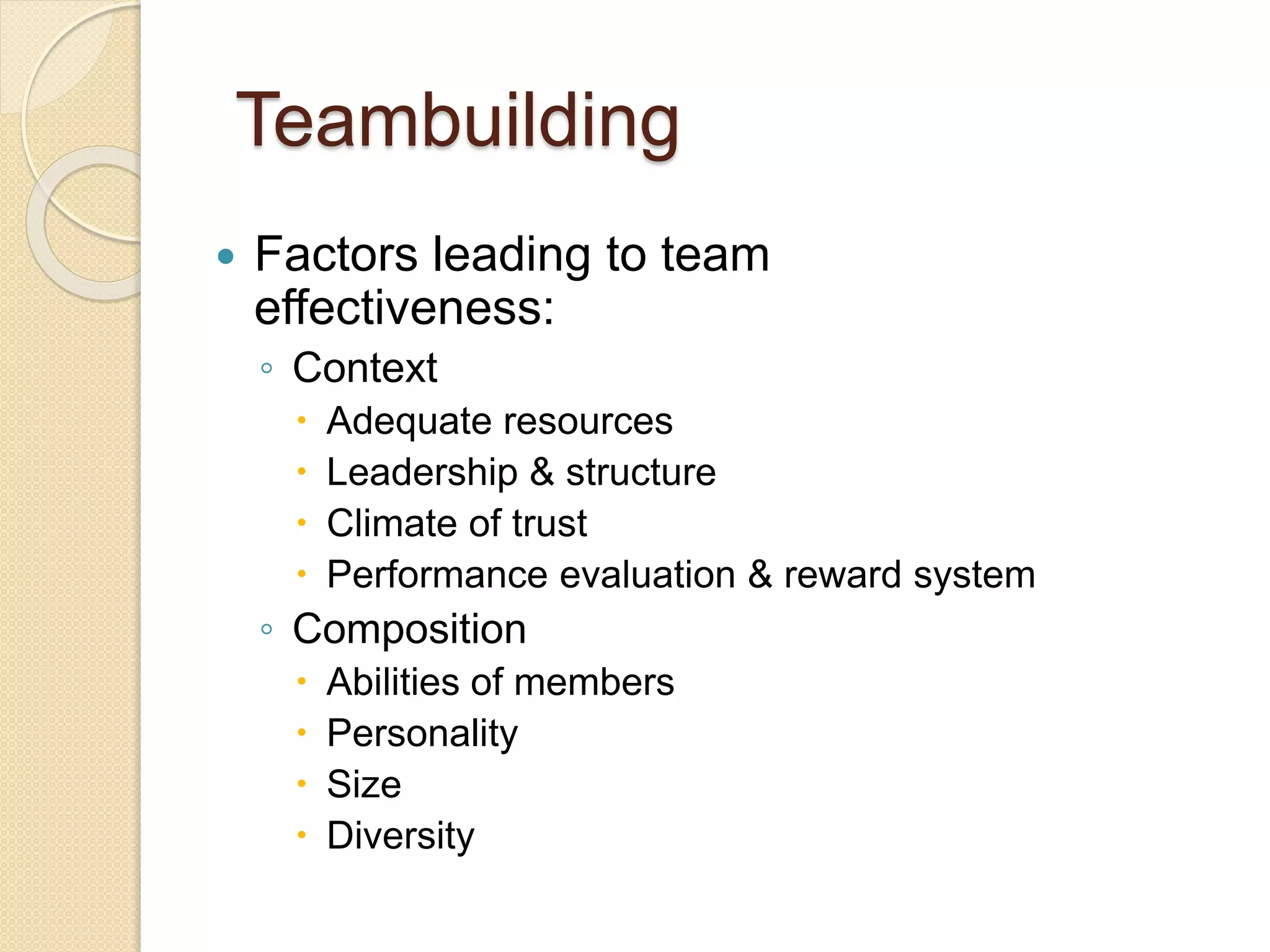
 Factors leading to team
effectiveness:
◦ Context
 Adequate resources
 Leadership & structure
 Climate of trust
 Performance evaluation & reward system
◦ Composition
 Abilities of members
 Personality
 Size
 Diversity
Teambuilding
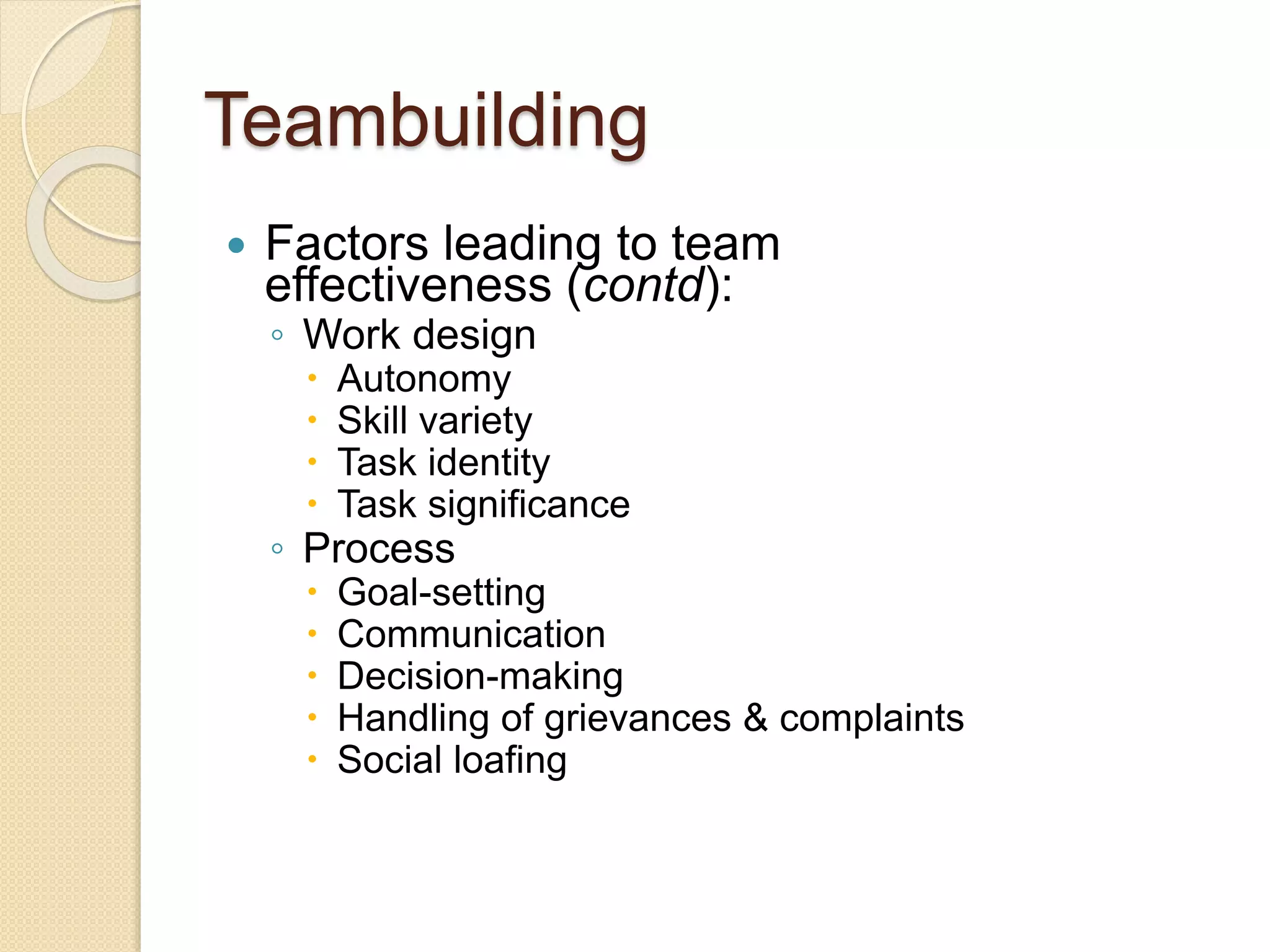
 Factors leading to team
effectiveness (contd):
◦ Work design
 Autonomy
 Skill variety
 Task identity
 Task significance
◦ Process
 Goal-setting
 Communication
 Decision-making
 Handling of grievances & complaints
 Social loafing
Profile of Effective Teams
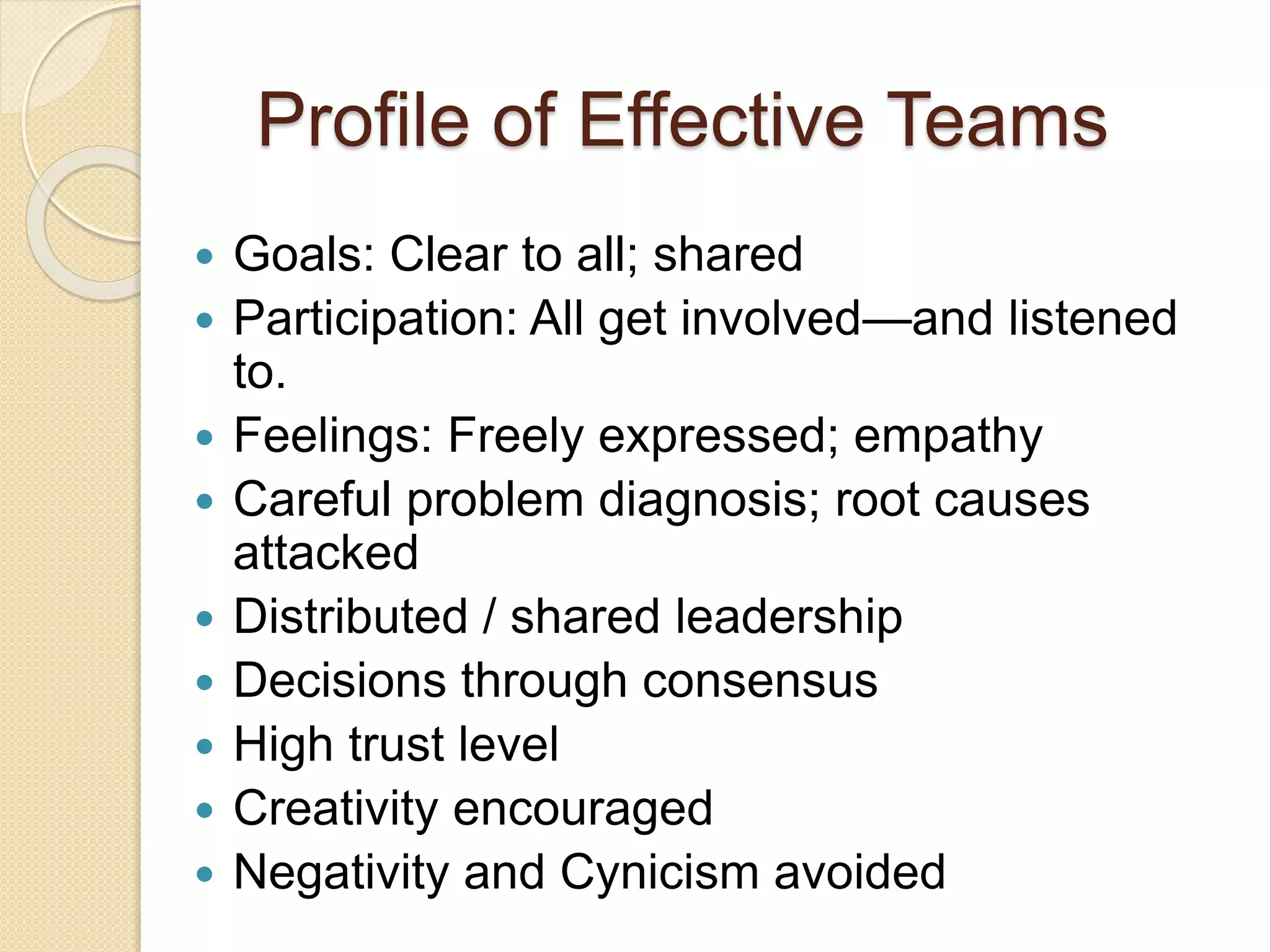
 Goals: Clear to all; shared
 Participation: All get involved—and listened
to.
 Feelings: Freely expressed; empathy
 Careful problem diagnosis; root causes
attacked
 Distributed / shared leadership
 Decisions through consensus
 High trust level
 Creativity encouraged
 Negativity and Cynicism avoided
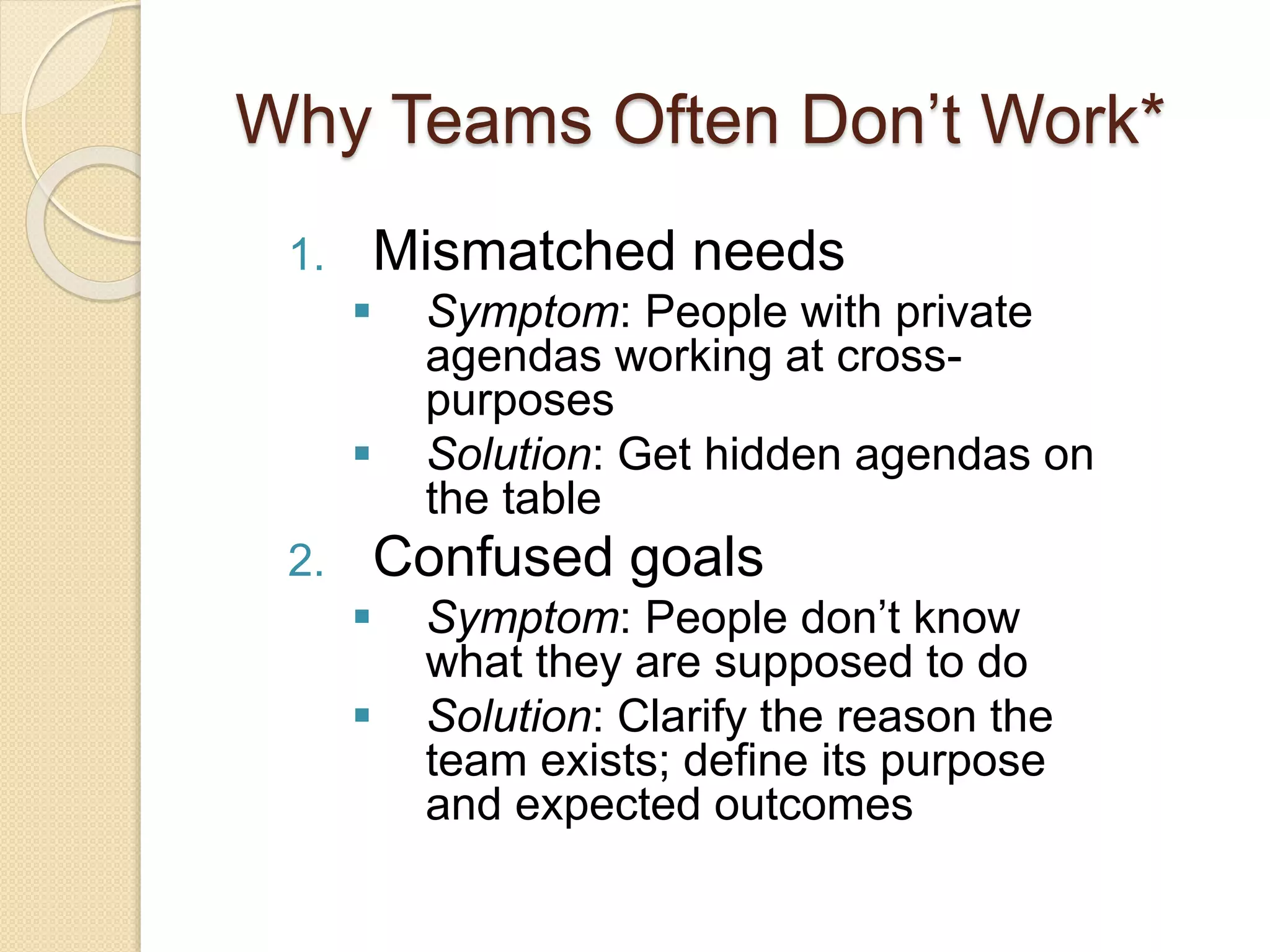
Why Teams Often Don’t Work*
1. Mismatched needs
 Symptom: People with private
agendas working at cross-
purposes
 Solution: Get hidden agendas on
the table
2. Confused goals
 Symptom: People don’t know
what they are supposed to do
 Solution: Clarify the reason the
team exists; define its purpose
and expected outcomes
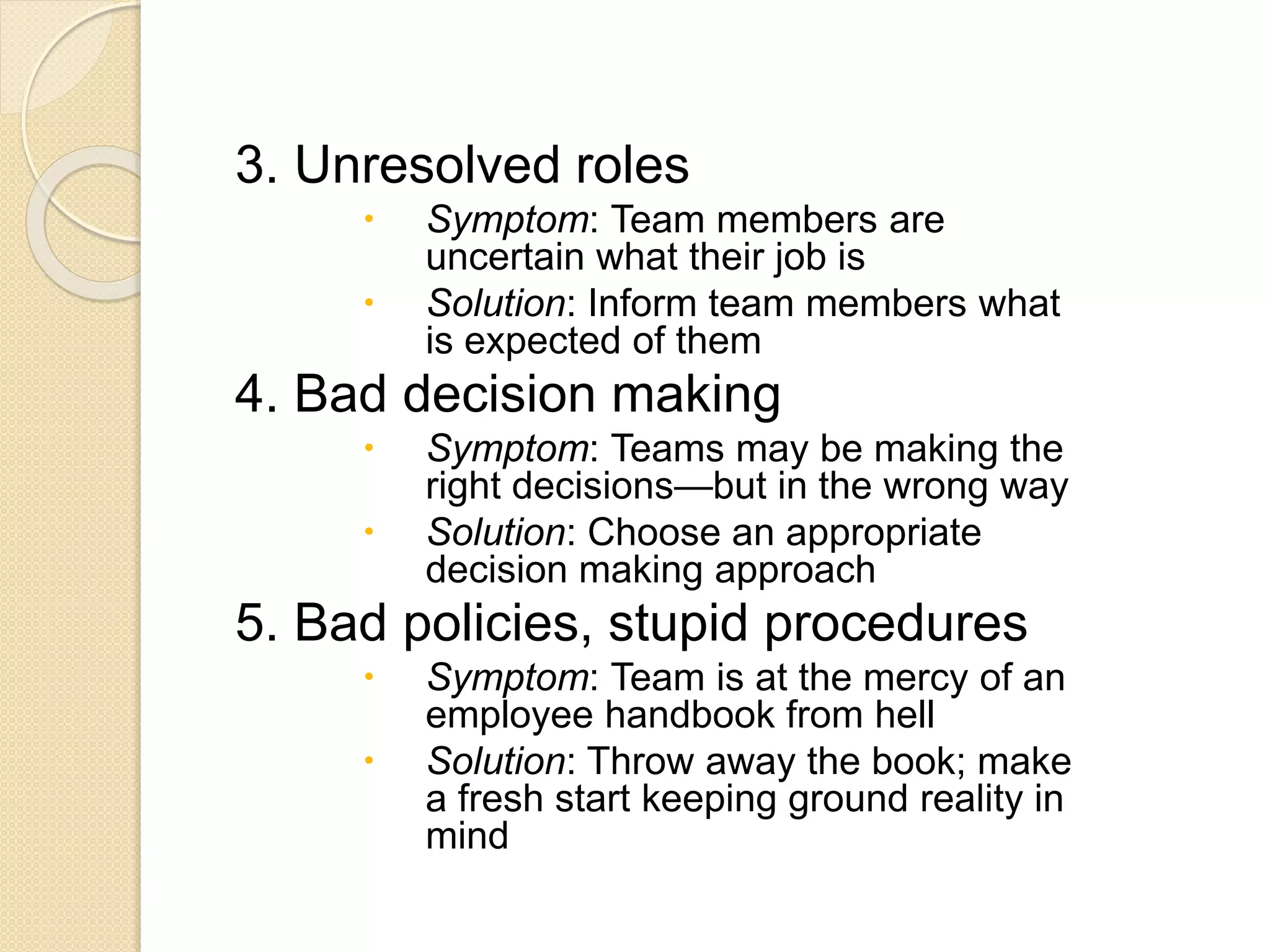
3. Unresolved roles
 Symptom: Team members are
uncertain what their job is
 Solution: Inform team members what
is expected of them
4. Bad decision making
 Symptom: Teams may be making the
right decisions—but in the wrong way
 Solution: Choose an appropriate
decision making approach
5. Bad policies, stupid procedures
 Symptom: Team is at the mercy of an
employee handbook from hell
 Solution: Throw away the book; make
a fresh start keeping ground reality in
mind
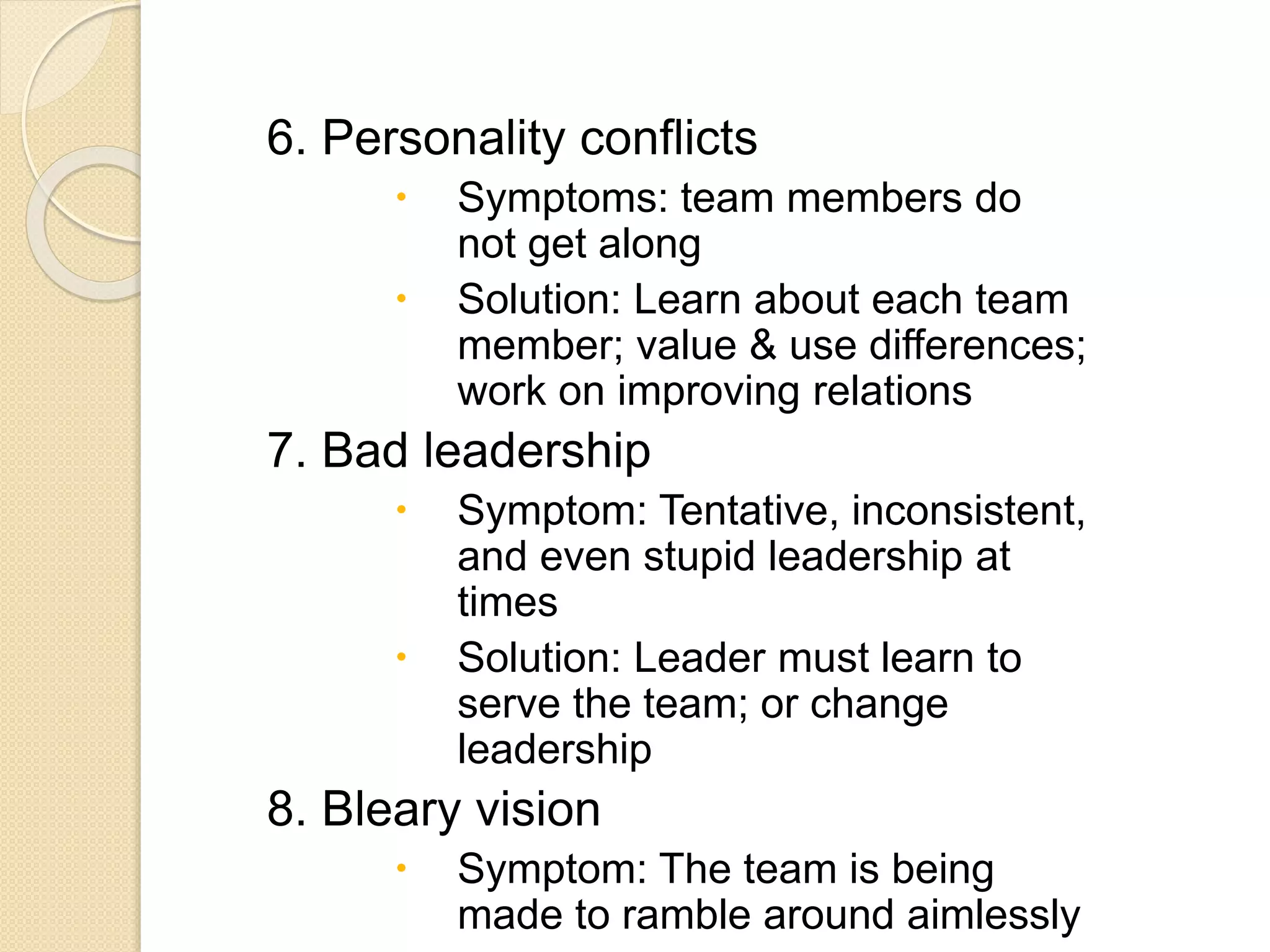
6. Personality conflicts
 Symptoms: team members do
not get along
 Solution: Learn about each team
member; value & use differences;
work on improving relations
7. Bad leadership
 Symptom: Tentative, inconsistent,
and even stupid leadership at
times
 Solution: Leader must learn to
serve the team; or change
leadership
8. Bleary vision
 Symptom: The team is being
made to ramble around aimlessly
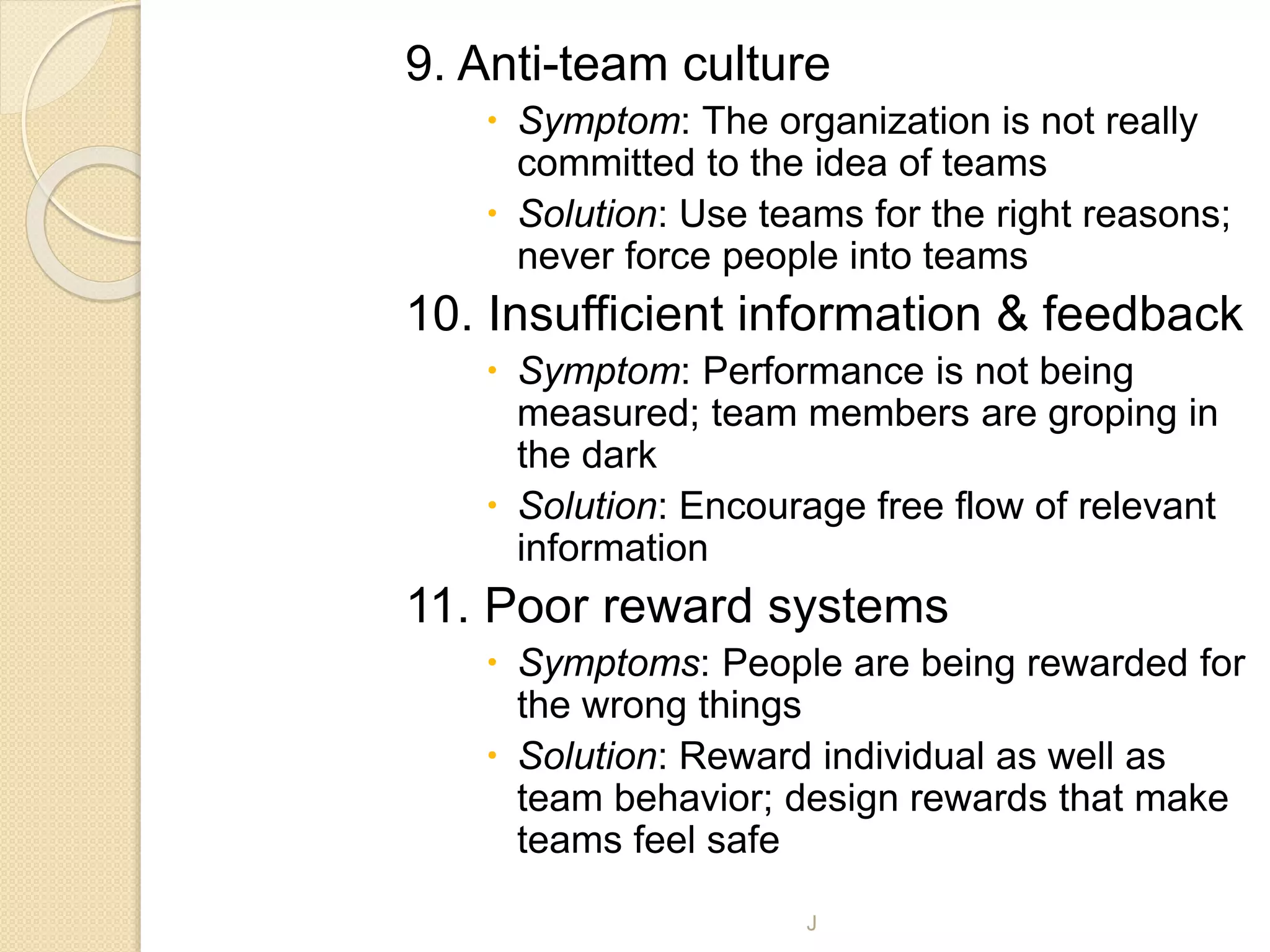
9. Anti-team culture
 Symptom: The organization is not really
committed to the idea of teams
 Solution: Use teams for the right reasons;
never force people into teams
10. Insufficient information & feedback
 Symptom: Performance is not being
measured; team members are groping in
the dark
 Solution: Encourage free flow of relevant
information
11. Poor reward systems
 Symptoms: People are being rewarded for
the wrong things
 Solution: Reward individual as well as
team behavior; design rewards that make
teams feel safe
J
12. Lack of trust
 Symptom: Defensive behavior; lack of
coordination
 Solution: Earn trust by being trustworthy;
reconstitute team if necessary
13. Unwillingness to change
 Symptom: A visible ‘knowing-doing gap’
 Solution: Find out what the blockage is; use
dynamite or grease to remove it.
14. The wrong tools
 Symptom: The team lacks required / appropriate
resources
 Solution: Equip the team well for its tasks
* Gary Hamel & C K Prahalad: Competing for the Future (HBS; 1994)
3 Main Qualities Of Team
Players
 Responsibility
◦ Doing one’s best in one’s own and
company’s interest
◦ Expression of one’s commitment to
company’s success
◦ Responsibility for self-development—
and company’s development
◦ Management must give
responsibility—and people must be
willing to take responsibility
◦ How much do you give and take
responsibility?
3 Main Qualities……(2)
 Loyalty
◦ Being happy when the company succeeds
◦ Taking action when it is threatened
◦ Being proud of membership
◦ Talking positively about it
◦ Put forward constructive criticism—but keep it
within the company
◦ Loyalty is not blind obedience. It is OK to say
“no”. It is not OK to say “yes’ and not keep your
promise
3 Main Qualities………(3)
 Initiative
◦ To solve problems, improve and
innovate
◦ Take ownership
◦ Can you list the initiatives you
have taken in the last 6 months
to strengthen your team?
Conclusion
 You can’t simply buy, or wish for, a
ready-made winning team.
 You’ve got to invest time and effort in
building a team—and keeping it
together.
 This investment has a very high ROI:
A Winning Team !

Building a winning team

  • 1.
    Building A WinningTeam A VALUABLE JOURNEY
  • 2.
    First, Assess Your Team Guideline: ◦ 10 indicators of effective work teams are listed here. ◦ To what extent are they descriptive of your organization (or the team to which you belong)? ◦ Please use the following scale to indicate your responses:  1 = Never  2 = Seldom  3 = Sometimes  4 = Usually  5 = Always
  • 3.
    1. Clear goalswhich are well understood & accepted by the group 2. Informality: Atmosphere is informal, comfortable, relaxed; no obvious signs of tension or boredom 3. Participation: There is a lot of focused discussion in which all participate 4. Listening: members listen to each other. Every idea or viewpoint is given a hearing 5. Disagreement exists—but the team is comfortable with this and shows no signs of avoidance or cover-up
  • 4.
    6. Consensus: Mostdecisions are reached by consensus; formal voting is kept to a minimum. 7. Open communication: team members feel free to express their feelings about their work and team processes. 8. Clear roles: Each member is assigned a clear responsibility and accountability 9. Shared leadership: The formal leader allows others to assume leadership depending on their skills and circumstances 10. Self-assessment: The team periodically stops to review how well it is functioning—and improve.
  • 5.
    How Did YourTeam Fare?  Please add the scale values you assigned to each statement  Divide the total by 10 to get an average “team index”  Higher indices better teams
  • 6.
    Teambuilding  What isa team? ◦ A group of people who are committed to achieve common objectives, who work well together and produce high quality results.  What is teambuilding? ◦ Any planned event designed to improve the way a group of people work together.
  • 7.
  • 8.
  • 9.
    Team Formation & Membership 5-Stage Model: ◦ Forming (Members come to know each other) ◦ Storming (Members resist control by leaders) ◦ Norming (Members develop camaraderie & norms of conduct in the team) ◦ Performing (Members work towards achieving their goals) ◦ Adjourning (Team disbands—either because job is done or members leave)`
  • 10.
    Teambuilding  Factors leadingto team effectiveness: ◦ Context  Adequate resources  Leadership & structure  Climate of trust  Performance evaluation & reward system ◦ Composition  Abilities of members  Personality  Size  Diversity
  • 11.
    Teambuilding  Factors leadingto team effectiveness (contd): ◦ Work design  Autonomy  Skill variety  Task identity  Task significance ◦ Process  Goal-setting  Communication  Decision-making  Handling of grievances & complaints  Social loafing
  • 12.
    Profile of EffectiveTeams  Goals: Clear to all; shared  Participation: All get involved—and listened to.  Feelings: Freely expressed; empathy  Careful problem diagnosis; root causes attacked  Distributed / shared leadership  Decisions through consensus  High trust level  Creativity encouraged  Negativity and Cynicism avoided
  • 13.
    Why Teams OftenDon’t Work* 1. Mismatched needs  Symptom: People with private agendas working at cross- purposes  Solution: Get hidden agendas on the table 2. Confused goals  Symptom: People don’t know what they are supposed to do  Solution: Clarify the reason the team exists; define its purpose and expected outcomes
  • 14.
    3. Unresolved roles Symptom: Team members are uncertain what their job is  Solution: Inform team members what is expected of them 4. Bad decision making  Symptom: Teams may be making the right decisions—but in the wrong way  Solution: Choose an appropriate decision making approach 5. Bad policies, stupid procedures  Symptom: Team is at the mercy of an employee handbook from hell  Solution: Throw away the book; make a fresh start keeping ground reality in mind
  • 15.
    6. Personality conflicts Symptoms: team members do not get along  Solution: Learn about each team member; value & use differences; work on improving relations 7. Bad leadership  Symptom: Tentative, inconsistent, and even stupid leadership at times  Solution: Leader must learn to serve the team; or change leadership 8. Bleary vision  Symptom: The team is being made to ramble around aimlessly
  • 16.
    9. Anti-team culture Symptom: The organization is not really committed to the idea of teams  Solution: Use teams for the right reasons; never force people into teams 10. Insufficient information & feedback  Symptom: Performance is not being measured; team members are groping in the dark  Solution: Encourage free flow of relevant information 11. Poor reward systems  Symptoms: People are being rewarded for the wrong things  Solution: Reward individual as well as team behavior; design rewards that make teams feel safe J
  • 17.
    12. Lack oftrust  Symptom: Defensive behavior; lack of coordination  Solution: Earn trust by being trustworthy; reconstitute team if necessary 13. Unwillingness to change  Symptom: A visible ‘knowing-doing gap’  Solution: Find out what the blockage is; use dynamite or grease to remove it. 14. The wrong tools  Symptom: The team lacks required / appropriate resources  Solution: Equip the team well for its tasks * Gary Hamel & C K Prahalad: Competing for the Future (HBS; 1994)
  • 18.
    3 Main QualitiesOf Team Players  Responsibility ◦ Doing one’s best in one’s own and company’s interest ◦ Expression of one’s commitment to company’s success ◦ Responsibility for self-development— and company’s development ◦ Management must give responsibility—and people must be willing to take responsibility ◦ How much do you give and take responsibility?
  • 19.
    3 Main Qualities……(2) Loyalty ◦ Being happy when the company succeeds ◦ Taking action when it is threatened ◦ Being proud of membership ◦ Talking positively about it ◦ Put forward constructive criticism—but keep it within the company ◦ Loyalty is not blind obedience. It is OK to say “no”. It is not OK to say “yes’ and not keep your promise
  • 20.
    3 Main Qualities………(3) Initiative ◦ To solve problems, improve and innovate ◦ Take ownership ◦ Can you list the initiatives you have taken in the last 6 months to strengthen your team?
  • 21.
    Conclusion  You can’tsimply buy, or wish for, a ready-made winning team.  You’ve got to invest time and effort in building a team—and keeping it together.  This investment has a very high ROI: A Winning Team !