Chris Bernard ID  teaming  workshop Look for me on Twitter, FaceBook and LinkedIn This presentation is for educations purposes only. Photos from istockphoto.com unless otherwise noted.
What’s going to happen today?
We’ll learn about collaborating  effectively
Making hard things  easier
Picking the  right  approaches
Understanding how we’re  different
Learn how to  not  ignore dysfunction
Push  our teams in the right direction
What to do when  we get  stuck
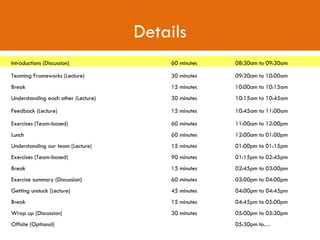
Details Introductions (Discussion) 60 minutes 08:30am to 09:30am  Teaming Frameworks (Lecture) 30 minutes 09:30am to 10:00am  Break 15 minutes 10:00am to 10:15am  Understanding each other (Lecture) 30 minutes 10:15am to 10:45am Feedback (Lecture) 15 minutes 10:45am to 11:00am  Exercises (Team-based) 60 minutes 11:00am to 12:00pm  Lunch 60 minutes 12:00am to 01:00pm  Understanding our team (Lecture) 15 minutes  01:00pm to 01:15pm  Exercises (Team-based) 90 minutes 01:15pm to 02:45pm Break 15 minutes 02:45pm to 03:00pm Exercise summary (Discussion) 60 minutes 03:00pm to 04:00pm  Getting unstuck (Lecture) 45 minutes 04:00pm to 04:45pm  Break 15 minutes 04:45pm to 05:00pm  Wrap up (Discussion) 30 minutes 05:00pm to 05:30pm  Offsite (Optional)   05:30pm to…
Who am I? An ID alumni, MDM 2006 Designer Consultant Equal mix of work at small companies and the enterprise
What do people think of designers?
Designer  Tracker Project Methodology: 10k designers, 15 countries Goal: surface key “essence” of the designer audience Results have guided v1 of product offerings 95% black is favorite color (except Japan, where charcoal black is top) 55% wear turtlenecks 5+ days a month (81% of those are black) Ponytails are  disproportionately common (32% of men 86% of women)
Leadership Stewardship Resource Management Marketing Technology Design = = = = = = CEO COO CFO CMO CTO ?
Identifying Opportunities GOOD BAD GOOD Vision + Invention =
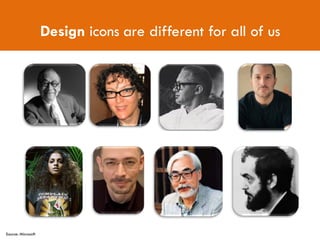
Design  icons are different for all of us Source: Microsoft
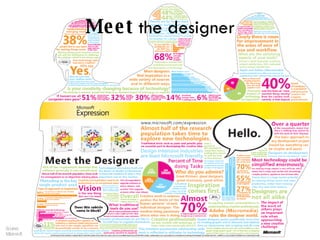
Meet  the designer Source:  Microsoft
What do our peers  think ? Clement Mok “ There has clearly been a steady  decline  in the design profession for over 30 years, and the source of that decline is the profession’s intractable  stasis .  We are  unchanged  professionals in a  changing  professional climate, clutching at old idols, while failing to create new offerings, failing to reinvent and reinvigorate the practice when needed, failing to inculcate a professional culture that is  accessible  and fair.” Source: Communication Arts
Nobody knows how much to spend It’s the process and not the pocketbook Collaboration  is the key What does business  think ? Source: Strategy+Business
What do  we  think? Which of the following have  been characteristics of  good  team experiences at ID? Source: Dave McGaw, ID
Team members have a mix of levels of  experience Team members have a mix of  skills At least one person has project  management   skills People take  turns  leading the project Team makes clear  assignments  at each meeting for who does the work Team has  regular  weekly meetings scheduled Teams use  tools  like blogs…etc., to collaborate and share files remotely Teams meet  socially  at least once during the project Teams members  evaluate  each other periodically during the project What do  we  think? Source: Dave McGaw, ID
What do  we  think? Which of the following have  been characteristics of  bad  team experiences at ID? Source: Dave McGaw, ID
What do  we  think? Team members have the  same  skills The  same  person is the leader for most of the project The project operates by  consensus —no single leader at any time Teams  improvising  solutions just before presenting Source: Dave McGaw, ID
What do  we  want? I expect  good  teamwork skills to be an important part of my design  career I have  good  teamwork skills right now I would benefit from  improving  my teamwork skills Source: Dave McGaw, ID
Agenda We have a full day We have three 15 minute breaks We have 60 minutes for lunch
Code of conduct Engage , turn off the cell-phone, use the laptop for notes only One  voice at a time Respect  your fellow participants Meet  your fellow participants
Things I’ve learned The best insights in this class come at the seams During team exercises During team feedback During the breaks and ad hoc conversations over lunch, after class and online
Details Introductions (Discussion) 60 minutes 08:30am to 09:30am  Teaming Frameworks (Lecture) 30 minutes 09:30am to 10:00am  Break 15 minutes 10:00am to 10:15am  Understanding each other (Lecture) 30 minutes 10:15am to 10:45am Feedback (Lecture) 15 minutes 10:45am to 11:00am  Exercises (Team-based) 60 minutes 11:00am to 12:00pm  Lunch 60 minutes 12:00am to 01:00pm  Understanding our team (Lecture) 15 minutes  01:00pm to 01:15pm  Exercises (Team-based) 90 minutes 01:15pm to 02:45pm Break 15 minutes 02:45pm to 03:00pm Exercise summary (Discussion) 60 minutes 03:00pm to 04:00pm  Getting unstuck (Lecture) 45 minutes 04:00pm to 04:45pm  Break 15 minutes 04:45pm to 05:00pm  Wrap up (Discussion) 30 minutes 05:00pm to 05:30pm  Offsite (Optional)   05:30pm to…
A  framework  for teams 30 Minutes
 
Are you  really  a team? Are you  ready  for heavy lifting? Two things to ask yourself when thinking about teaming… Source: Wisdom of Teams
What we want to learn How to determine if a team is the right choice How to chose the right kind of team Understanding what is required to enable the success of the team Source: Wisdom of Teams
At the Institute of Design we care about…
High Performance Teams
But, be careful
 
Sometimes you don’t need a high performance team to get the job done
Effective Groups
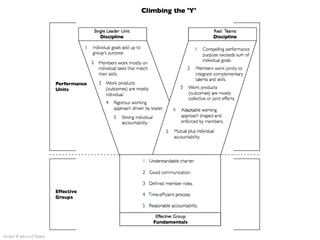
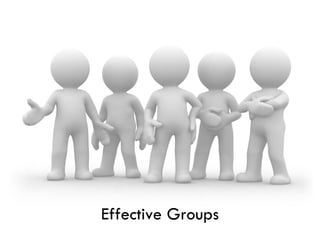
An  effective group   doesn’t require the discipline and rigor of a  performance unit. When the characteristics of a performance unit are applied to a group it can  frustrate  and  overburden  users. Typical effective groups merely requires an…  understandable charter good communication defined member roles time-efficient processes reasonable accountability Effective groups  versus  high performance teams Source: Wisdom of Teams
Single-leader Units
Single-leader units  versus  high performance teams Single-leader units  function differently than a  performing team  in that the traditional management style of leadership is imposed with a designate that…  makes the key decisions delegates and monitors individual assignments and accountability chooses how and when to modify specific approaches.  The benefit of this approach is that it is more agile and familiar to most individuals than the techniques required to be a  performing  team. Source: Wisdom of Teams
High Performance Teams
Six things to know about teams
In  The Wisdom of Teams  Katzenbach and Smith identified six basics criteria that were required for effective performing teams. Characteristics of  high performance teams Source: Wisdom of Teams
Small numbers
Small numbers Large numbers of people have trouble interacting constructively as a group.  Performing teams typically function best when there are a small number of people working together with four to six people often being a good target.  Single leader and effective groups also benefit from smallness but the less resource intensive nature of process required for this types of teams typically means they can be a little larger, in the range of twelve to twenty-five people. Source: Wisdom of Teams
Complementary skills
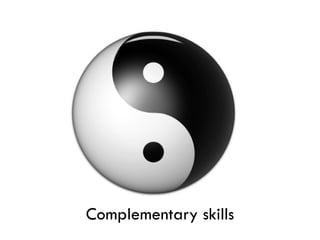
Complementary skills In the enterprise high performance companies build teams based on complementary skills—this of course requires an understanding of what skills people have.  It’s further complicated in a learning institution around not only understanding what skills people have but also what skills they would like to develop.  Insights into technical and functional expertise, problem solving and decision making skills and interpersonal skills are all factors that go into the creation of effective teams. Source: Wisdom of Teams
Common purpose
Common purpose A team’s  eventual  performance is directly correlated to its  purpose . If team members have a different purpose or that the purpose of the team is unknown, it’s difficult for teams to perform effectively. Source: Wisdom of Teams
Common goals Common goals
Common set of specific performance goals Specific  performance goals are also   essential for most teams to function   effectively and they need to be defined   for or developed by the team.  Source: Wisdom of Teams
Common working approach
Commonly agreed upon working approach Teams that can’t standardize on the same  working environments  and  tools  often do not function well. Incompatible software and collaboration tools can cripple teams and cause massive hits to productivity and effectiveness. Source: Wisdom of Teams
Mutual accountability
Mutual accountability Teams need to hold  themselves  accountable and be  evaluated as a team .  Organizations that expect team performance but only reward individual contribution in absence of accountability to a team are often ineffective.  If we don’t incent the performance we want, we wont get the performance we want. Source: Wisdom of Teams
ID Teaming Workshop Source: Wisdom of Teams
Take a   Break 15 minutes
Details Introductions (Discussion) 60 minutes 08:30am to 09:30am  Teaming Frameworks (Lecture) 30 minutes 09:30am to 10:00am  Break 15 minutes 10:00am to 10:15am  Understanding each other (Lecture) 30 minutes 10:15am to 10:45am Feedback (Lecture) 15 minutes 10:45am to 11:00am  Exercises (Team-based) 60 minutes 11:00am to 12:00pm  Lunch 60 minutes 12:00am to 01:00pm  Understanding our team (Lecture) 15 minutes  01:00pm to 01:15pm  Exercises (Team-based) 90 minutes 01:15pm to 02:45pm Break 15 minutes 02:45pm to 03:00pm Exercise summary (Discussion) 60 minutes 03:00pm to 04:00pm  Getting unstuck (Lecture) 45 minutes 04:00pm to 04:45pm  Break 15 minutes 04:45pm to 05:00pm  Wrap up (Discussion) 30 minutes 05:00pm to 05:30pm  Offsite (Optional)   05:30pm to…
Understanding  each other 30 Minutes
We’re different
Individual  differences What makes it hard to work with other folks? How does this manifest itself at ID? Do we have similarities, what are they? How can we learn more about similarities and differences  before  we start teaming?
What is a Meyers Briggs Type Indicator? The Meyers Briggs Type Indicator (MBTI) is a personality profiling tool that has over 50 years of data behind it. There are no right or wrong answers and the findings are not absolute, it’s not fate and it’s not destiny. It’s simply a tool to help facilitate your understanding of your own patterns of behavior and have a common language and set of tools to understand others. Source: Description for Self-Discovery
Personality  has several aspects The contextual self The developed self The true self Understanding personality… …patterns, processes, structure, purpose Source: Description for Self-Discovery
If you prefer to direct your energy to deal with people, things, situations, or "the outer world", then your preference is for  Extraversion . This is denoted by the letter "E". If you prefer to direct your energy to deal with ideas, information, explanations or beliefs, or "the inner world", then your preference is for  Introversion . This is denoted by the letter "I". Where, primarily, do you prefer to  direct your energy? Source: Team Technology
Where, primarily, do you prefer to  direct your energy? Extraversion (E) Sociability Interaction External Breadth Outside thrust Relationships Action External events Do-think-do 75% Introversion (I) Solitary Concentration Internal Depth Inside pull Deep friendship Reflection Internal reations Think-do-think 25% Source: IBM
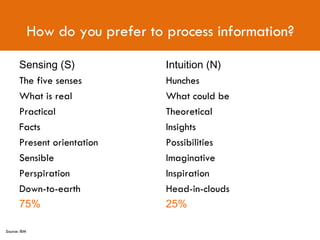
If you prefer to deal with facts, what you know, to have clarity, or to describe what you see, then your preference is for  Sensing . This is denoted by the letter "S". If you prefer to deal with ideas, look into the unknown, to generate new possibilities or to anticipate what isn't obvious, then your preference is for  Intuition . This is denoted by the letter "N" (the letter I has already been used for Introversion). How do you prefer to process information? Source: Team Technology
Sensing (S) The five senses What is real Practical Facts Present orientation Sensible Perspiration Down-to-earth 75% Intuition (N) Hunches What could be Theoretical Insights Possibilities Imaginative Inspiration Head-in-clouds 25% How do you prefer to process information? Source: IBM
How do you prefer to make decisions? If you prefer to decide on the basis of objective logic, using an analytic and detached approach, then your preference is for  Thinking . This is denoted by the letter "T". If you prefer to decide using values and/or personal beliefs, on the basis of what you believe is important or what you or others care about, then your preference is for  Feeling . This is denoted by the letter "F". Source: Team Technology
Thinking (T) Head Logical system Objective Critique Reason Firm but fair Impersonal Firmness 50% Feeling (F) Heart Value system Subjective Compliment Empathy Compassionate Personal Persuasion 50% How do you prefer to make decisions? Source: IBM
How do you prefer to organize your life? If you prefer your life to be planned, stable and organized then your preference is for  Judging  (not to be confused with 'Judgmental', which is quite different). This is denoted by the letter "J". If you prefer to go with the flow, to maintain flexibility and respond to things as they arise, then your preference is for  Perception . This is denoted by the letter "P". Source: Team Technology
Judging (J) Planning Control Settled Run one’s life Set goals Decisive Organized Structured 50% Perceiving (P) Spontaneous Adapt Tentative Let life happen Get information Open Flexible Unstructured 50% How do you prefer to organize your life? Source: IBM
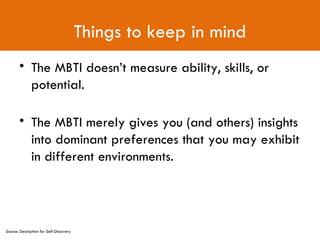
Things to keep in mind The MBTI doesn’t measure ability, skills, or potential. The MBTI merely gives you (and others) insights into dominant preferences that you may exhibit in different environments. Source: Description for Self-Discovery
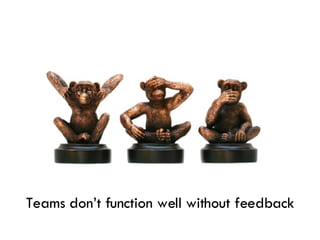
Teams don’t function well without feedback
Giving  feedback 15 Minutes
Three concepts around feedback How to  listen How to  give How to  receive
How can we  listen  more effectively? We can… Establish rapport Suspend judgment Demonstrate interest Encourage the person to talk Maintain appropriate silence Clarify understanding Respond to the message Source: IBM
How should we  give  feedback? Use a positive approach Be specific Give feedback on things that a person can change Check for understanding Discuss what you way or heard Source: IBM
How should we  receive  feedback? Relax Listen carefully, avoid interrupting Ask questions for clarity Acknowledge valid points Take time to sort out what you heard Source: IBM
A word about  coaching Sharing experience, giving feedback, and enabling people can be augmented with coaching. Coaching is like fishing and therapy all wrapped up into one Good coaches help people understand how to solve their own problems Source: IBM
A coaching model
Let’s try it
Team  Exercises 60 Minutes
Conclusions What have we learned so far?
Details Introductions (Discussion) 60 minutes 08:30am to 09:30am  Teaming Frameworks (Lecture) 30 minutes 09:30am to 10:00am  Break 15 minutes 10:00am to 10:15am  Understanding each other (Lecture) 30 minutes 10:15am to 10:45am Feedback (Lecture) 15 minutes 10:45am to 11:00am  Exercises (Team-based) 60 minutes 11:00am to 12:00pm  Lunch 60 minutes 12:00am to 01:00pm  Understanding our team (Lecture) 15 minutes  01:00pm to 01:15pm  Exercises (Team-based) 90 minutes 01:15pm to 02:45pm Break 15 minutes 02:45pm to 03:00pm Exercise summary (Discussion) 60 minutes 03:00pm to 04:00pm  Getting unstuck (Lecture) 45 minutes 04:00pm to 04:45pm  Break 15 minutes 04:45pm to 05:00pm  Wrap up (Discussion) 30 minutes 05:00pm to 05:30pm  Offsite (Optional)   05:30pm to…
Eat  Lunch 45 minutes
Details Introductions (Discussion) 60 minutes 08:30am to 09:30am  Teaming Frameworks (Lecture) 30 minutes 09:30am to 10:00am  Break 15 minutes 10:00am to 10:15am  Understanding each other (Lecture) 30 minutes 10:15am to 10:45am Feedback (Lecture) 15 minutes 10:45am to 11:00am  Exercises (Team-based) 60 minutes 11:00am to 12:00pm  Lunch 60 minutes 12:00am to 01:00pm  Understanding our team (Lecture) 15 minutes  01:00pm to 01:15pm  Exercises (Team-based) 90 minutes 01:15pm to 02:45pm Break 15 minutes 02:45pm to 03:00pm Exercise summary (Discussion) 60 minutes 03:00pm to 04:00pm  Getting unstuck (Lecture) 45 minutes 04:00pm to 04:45pm  Break 15 minutes 04:45pm to 05:00pm  Wrap up (Discussion) 30 minutes 05:00pm to 05:30pm  Offsite (Optional)   05:30pm to…
Understanding  our  teams
Introduction 15 minutes
The Basadur Creative Problem Solving Profile (CPSP) Inventory measures an individual's unique blend of preferences for four stages of what is defined as the creative process. One's largest quadrant on the graph represents one's preferred or dominant style, while the sizes of the other quadrants represent supporting orientations in turn. The resulting unique blend of styles is one's profile. What is the Creative Problem Solving Profile (CPSP)? Source: Min Basadur and GK Van Patter (www.nextd.org)
What is the Creative Problem Solving Profile (CPSP)? Source: Min Basadur and GK Van Patter (www.nextd.org)
Each unique style reflects individual preferences for ways of gaining and using knowledge. Some people prefer to understand things more by experiencing while others prefer to use abstract thinking and analysis to understand. Also, some prefer to use understanding for generating options while others prefer to use understanding to evaluate options. The Basadur CPS Profile is not a personality test. It measures  states , not  traits .  What is the Creative Problem Solving Profile (CPSP)? Source: Min Basadur and GK Van Patter (www.nextd.org)
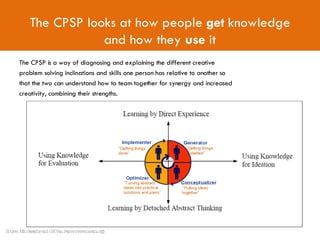
The creative problem solving profile is constructed on two of these dimensions. First, by two opposite ways of gaining knowledge:  (1) By direct experience and (2) By abstract, analytical, logical thinking.  Second, by two opposite ways of using knowledge:  (1) By ideation (making new possibilities, breaking connections, diverging)  (2) By evaluation (testing and verifying new possibilities, making connections, converging). The CPSP looks at how people  get  knowledge and how they  use  it Source: Min Basadur and GK Van Patter (www.nextd.org)
The CPSP is a way of diagnosing and explaining the different creative problem solving inclinations and skills one person has relative to another so that the two can understand how to team together for synergy and increased creativity, combining their strengths. The CPSP looks at how people  get  knowledge and how they  use  it Source: Min Basadur and GK Van Patter (www.nextd.org)
Let’s try  it 90 minutes
Details Introductions (Discussion) 60 minutes 08:30am to 09:30am  Teaming Frameworks (Lecture) 30 minutes 09:30am to 10:00am  Break 15 minutes 10:00am to 10:15am  Understanding each other (Lecture) 30 minutes 10:15am to 10:45am Feedback (Lecture) 15 minutes 10:45am to 11:00am  Exercises (Team-based) 60 minutes 11:00am to 12:00pm  Lunch 60 minutes 12:00am to 01:00pm  Understanding our team (Lecture) 15 minutes  01:00pm to 01:15pm  Exercises (Team-based) 90 minutes 01:15pm to 02:45pm Break 15 minutes 02:45pm to 03:00pm Exercise summary (Discussion) 60 minutes 03:00pm to 04:00pm  Getting unstuck (Lecture) 45 minutes 04:00pm to 04:45pm  Break 15 minutes 04:45pm to 05:00pm  Wrap up (Discussion) 30 minutes 05:00pm to 05:30pm  Offsite (Optional)   05:30pm to…
Take a   Break 15 minutes
Details Introductions (Discussion) 60 minutes 08:30am to 09:30am  Teaming Frameworks (Lecture) 30 minutes 09:30am to 10:00am  Break 15 minutes 10:00am to 10:15am  Understanding each other (Lecture) 30 minutes 10:15am to 10:45am Feedback (Lecture) 15 minutes 10:45am to 11:00am  Exercises (Team-based) 60 minutes 11:00am to 12:00pm  Lunch 60 minutes 12:00am to 01:00pm  Understanding our team (Lecture) 15 minutes  01:00pm to 01:15pm  Exercises (Team-based) 90 minutes 01:15pm to 02:45pm Break 15 minutes 02:45pm to 03:00pm Exercise summary (Discussion) 60 minutes 03:00pm to 04:00pm  Getting unstuck (Lecture) 45 minutes 04:00pm to 04:45pm  Break 15 minutes 04:45pm to 05:00pm  Wrap up (Discussion) 30 minutes 05:00pm to 05:30pm  Offsite (Optional)   05:30pm to…
Summary on the CPSP 45 minutes
Some stuff is missing… This next section contains copyrighted content that I’ve pulled from this presentation because I’m not permitted to show it out of a classroom setting. However you can get the gist of everything I’m saying by going to  NextD.org  where they’ve thoughtfully posted all this content. Check it out for yourselves and make the investment of profiling yourself and your teams. It’s the best tool I’ve found for creative teams.
Generator Description The Generator’s two dominant creative problem solving inclinations are (1) learning by direct experience, that is, sensing the world around by touch, smell, taste, hearing and seeing; absorbing knowledge by getting involved personally and experiencing and gathering information, and (2) ideation, that is, imagining possibilities, seeing relevance in everything, seeing different points of view; dreaming about what might be; wondering why things seem to be what they are; speculating about the future. The combination of these two inclinations indicate a preference for problem sensing and fact finding kinds of activities in the creative process. The Generator is an initiator, a proliferator of opportunities, problems, facts and feelings - very sensitive to the world around, absorbing diverse information and possibilities that might have relevance to the organization or to oneself. The Generator is very comfortable with high ambiguity and proliferation of much information and potential opportunity. He loves to get things started and is likely strong in Steps 1 and 2 of the creative process. Generators are idea starters. Source: Min Basadur
Conceptualizer Description The Conceptualizer’s creative problem solving inclinations are (1) using knowledge for ideation (as above) and (2) learning by abstract analysis, logic and conceptualization (trying to develop an understanding or explanation or theory which offers an explanation of a situation; being detached and objective; doing rational, logical thinking; having things make sense in the abstract). The Conceptualizer’s combination of these two inclinations indicate a preference for problem definition and idea generation (Steps 3 and 4 of the Basadur creative process) via a propensity to patiently take a wide range of seemingly disparate facts or idea fragments and possibilities and combine or assimilate them into integrated explanations, theories, problem definitions and ideas to be tested. Conceptualizers are good at extracting and defining the opportunity or problem posing it and developing a list of ideas which may solve it. They are idea developers. Source: Min Basadur
Optimizer Description The Optimizer’s creative problem solving inclinations are (1) learning by abstract analysis, logic and conceptualizing and (2) using the knowledge for evaluation by testing possibilities, that is, experimentation (trying to verify theories; confirming ideas and notions; learnings and pinning down practical knowledge gained during testing). These two inclinations indicate the optimizer to be involved in the practical application of ideas, planning how to make ideas work in the real world and optimizing solutions.  In the creative process, this involves testing and rational, logical evaluation of ideas, selection  of the best ones and planning concrete steps for making them practical and implementable (Step 5 and 6 of the process). Optimizers are solution developers. Source: Min Basadur
Implementer Description The Implementer’s combination of inclinations toward (1) using knowledge for evaluation and (2) learning by direct experience indicate a great deal of implementation activity - gaining acceptance from others for changes and making those changes work and stick. (Steps 7 and 8 of the creative process) The Implementer does not worry a great deal about understanding the theory behind the new idea, plan or product. He wants to take it and “run with it”, work with it, show others how to use it, fit it to others’ needs, adapt it to various circumstances, try it one way and if it doesn’t work, try it another way. The Implementer’s combination of inclinations toward (1) using knowledge for evaluation and (2) learning by direct experience indicate a great deal of implementation activity - gaining acceptance from others for changes and making those changes work and stick. (Steps 7 and 8 of the creative process) The Implementer does not worry a great deal about understanding the theory behind the new idea, plan or product. He wants to take it and “run with it”, work with it, show others how to use it, fit it to others’ needs, adapt it to various circumstances, try it one way and if it doesn’t work, try it another way. Source: Min Basadur
Conclusions about how to use the CPSP For any organizational team to be an effective creative problem solver, strengths in all four quadrants is important. This is achieved through the blend of people on the team. It is also important that the individuals in that organization or team use their strengths in a complementary way and not get frustrated by others who may have opposite inclinations (e.g., optimizers and generators, implementers and conceptualizers).  To achieve the best outcomes, projects in organizations need to move through the “generation conceptualization- optimization-implementation” cycle. Ideas for new projects must start somewhere - that is, the generator function, to be sensitive to the world around picking up data and cues and suggesting possible opportunities. Thus, the generator function raises a wealth of ideas and facts - usually not fully thought through, but simply in the form of starting points for new projects.  Next the conceptualizer function is needed to pull together the facts and idea fragments from the generator phase into well thought out and developed ideas and defined problems and concepts worthy of further development. The conceptualizers give sound structure to fledgling ideas and problems. The optimizer function is to take the selected structured project, problem or idea and find a practical solution or action plan that is well detailed, efficient and optimum.  Finally, it is up to the implementation function to carry the practical solutions and plans for the project forward and get them implemented - convincing management or customers or other employees as necessary and adapting the solutions and plans as necessary to make them fit into the real world. Source: Min Basadur
When you get  stuck
Getting  unstuck 45 minutes
Some stuff is missing… This next section contains some content that is copyrighted that I can’t display out of an academic setting. The good news is that you can get the gist of this presentation by going to  www.unstuck.com , explore the site, buy the book!  But first, look at  www.unstuck.com/pdf/UNSTUCK_excerpt.pdf  to get an idea of what this section is about.
So, how  stuck  are you? Do you have a clear, inspiring purpose? Do you have the right people, in the right roles to make a difference? Do you work effectively as a team? Can you always get the right stuff done? Does the team truly get the most from diversity—in skills, geography, gender, age, ethnicity—to broaden it’s thinking? Source: Unstuck
So, how  stuck  are you? Do you know how to make decisions? Do those decisions stick? Is your team capable of radical ideas? If your team leader quit today, could your team carry on? Source: Unstuck
Figuring out  why  we’re stuck
Diagnosing why you’re stuck The  serious  seven Source: Unstuck
Diagnosing why you’re stuck Overwhelmed Exhausted Directionless Hopeless Battle-torn Worthless Alone Source: Unstuck
Details Introductions (Discussion) 60 minutes 08:30am to 09:30am  Teaming Frameworks (Lecture) 30 minutes 09:30am to 10:00am  Break 15 minutes 10:00am to 10:15am  Understanding each other (Lecture) 30 minutes 10:15am to 10:45am Feedback (Lecture) 15 minutes 10:45am to 11:00am  Exercises (Team-based) 60 minutes 11:00am to 12:00pm  Lunch 60 minutes 12:00am to 01:00pm  Understanding our team (Lecture) 15 minutes  01:00pm to 01:15pm  Exercises (Team-based) 90 minutes 01:15pm to 02:45pm Break 15 minutes 02:45pm to 03:00pm Exercise summary (Discussion) 60 minutes 03:00pm to 04:00pm  Getting unstuck (Lecture) 45 minutes 04:00pm to 04:45pm  Break 15 minutes 04:45pm to 05:00pm  Wrap up (Discussion) 30 minutes 05:00pm to 05:30pm  Offsite (Optional)   05:30pm to…
Take a   Break 15 minutes, but be on time, we’re almost there!
Connecting the  dots 15 minutes
Resources & what’s next So, we’re  doomed , what do we do now? We take the learnings from this workshop and apply them to our design methods toolkit. We already know how to solve hard business problems and the serious seven are simply a more contained version of the problems we address every day. Source: Unstuck
If you buy two books buy these
Other reading Getting Things Done, David Allen Time Management Info: http://www.davidco.com/what_is_gtd.php The Art of Project Management, Scott Berkun Project Management Get a free chapter of this book here: http://www.scottberkun.com/books/artofpm/artofpmch03.pdf Learn more here: http://www.scottberkun.com Unstuck, Keith Yamashita & Sandra Spataro Team Effectiveness Info: http://www.unstuck.com/ The Wisdom of Teams, Jon Katzenbach and Douglas Smith Team Effectiveness The Five Dysfunctions of a Team, Patrick Lencioni Team Effectiveness
Next steps Complete feedback Post thoughts and observations to the teaming blog Teach your fellow classmates what you learned here today
Thank  you ! Namaste *Apologies to my favorite fake blogger, FSJ
Extras for those that love death by PowerPoint
Collaboration   tools 20 minutes
Types  of tools Internet messaging VOIP software Group chat Group presentation Group collaboration Email Notification systems
Process  matters most Pick a tool set for your team and stick with it Templates or custom? In Design or PowerPoint? Version control Workflow Fonts Copyright
Project management   basics 20 minutes
Project management  truth Project management is not a sacred art The simpler the view of what we do, the more power and focus we can have in accomplishing things Simple doesn’t mean easy Source: The Art of Project Management
On  schedules Schedules have three purposes: They allow the team to make commitments about when something will get done. Encourage everyone to understand that their individual effort is part of a whole and that it requires her investment to make her contributions work with others They give the team a tool with which to track progress and break work into manageable chunks Source: The Art of Project Management
Making schedules  work Milestone length should match project volatility Be optimistic in the vision and skeptical in the schedule Bet on design Plan checkpoints for add/cut discussions Inform and get the team aligned around planning methodology Collectively gauge the team’s experience with the problem space Collectively gauge the teams confidence and experience in working together Take on risks early Source: The Art of Project Management
Time management   basics 20 minutes
Meetings… Will get you in trouble if… You let them  break up  your natural workflow and interrupt commitments that require you to work individually They focus  too  much on words, abstract concepts and things that aren’t real that are discussed without structures and frameworks to guide the conversation. The require no  preparation  on your part or other participants in the meeting They are convened without an  agenda  that is distributed before hand Source: Getting Real
Personal  Time Management Understand the basic concepts of GTD Identify all the stuff in your life that isn’t in the right place (close all open loops) Get rid of the stuff that isn’t yours or you don’t need right now Create a right place that you trust and that supports your working style and values Put your stuff in the right place, consistently Do your stuff in a way that honors your time, your energy, and the context of any given moment Iterate and re-factor mercilessly Source: DIYPlanner.com
How  GTD  works Source: Getting Thinks Done
End

Institute of Design: Teaming Workshop By Chris Bernard

  • 1.
    Chris Bernard ID teaming workshop Look for me on Twitter, FaceBook and LinkedIn This presentation is for educations purposes only. Photos from istockphoto.com unless otherwise noted.
  • 2.
    What’s going tohappen today?
  • 3.
    We’ll learn aboutcollaborating effectively
  • 4.
  • 5.
    Picking the right approaches
  • 6.
  • 7.
    Learn how to not ignore dysfunction
  • 8.
    Push ourteams in the right direction
  • 9.
    What to dowhen we get stuck
  • 10.
    Details Introductions (Discussion)60 minutes 08:30am to 09:30am Teaming Frameworks (Lecture) 30 minutes 09:30am to 10:00am Break 15 minutes 10:00am to 10:15am Understanding each other (Lecture) 30 minutes 10:15am to 10:45am Feedback (Lecture) 15 minutes 10:45am to 11:00am Exercises (Team-based) 60 minutes 11:00am to 12:00pm Lunch 60 minutes 12:00am to 01:00pm Understanding our team (Lecture) 15 minutes 01:00pm to 01:15pm Exercises (Team-based) 90 minutes 01:15pm to 02:45pm Break 15 minutes 02:45pm to 03:00pm Exercise summary (Discussion) 60 minutes 03:00pm to 04:00pm Getting unstuck (Lecture) 45 minutes 04:00pm to 04:45pm Break 15 minutes 04:45pm to 05:00pm Wrap up (Discussion) 30 minutes 05:00pm to 05:30pm Offsite (Optional) 05:30pm to…
  • 11.
    Who am I?An ID alumni, MDM 2006 Designer Consultant Equal mix of work at small companies and the enterprise
  • 12.
    What do peoplethink of designers?
  • 13.
    Designer TrackerProject Methodology: 10k designers, 15 countries Goal: surface key “essence” of the designer audience Results have guided v1 of product offerings 95% black is favorite color (except Japan, where charcoal black is top) 55% wear turtlenecks 5+ days a month (81% of those are black) Ponytails are disproportionately common (32% of men 86% of women)
  • 14.
    Leadership Stewardship ResourceManagement Marketing Technology Design = = = = = = CEO COO CFO CMO CTO ?
  • 15.
    Identifying Opportunities GOODBAD GOOD Vision + Invention =
  • 16.
    Design iconsare different for all of us Source: Microsoft
  • 17.
    Meet thedesigner Source: Microsoft
  • 18.
    What do ourpeers think ? Clement Mok “ There has clearly been a steady decline in the design profession for over 30 years, and the source of that decline is the profession’s intractable stasis . We are unchanged professionals in a changing professional climate, clutching at old idols, while failing to create new offerings, failing to reinvent and reinvigorate the practice when needed, failing to inculcate a professional culture that is accessible and fair.” Source: Communication Arts
  • 19.
    Nobody knows howmuch to spend It’s the process and not the pocketbook Collaboration is the key What does business think ? Source: Strategy+Business
  • 20.
    What do we think? Which of the following have been characteristics of good team experiences at ID? Source: Dave McGaw, ID
  • 21.
    Team members havea mix of levels of experience Team members have a mix of skills At least one person has project management skills People take turns leading the project Team makes clear assignments at each meeting for who does the work Team has regular weekly meetings scheduled Teams use tools like blogs…etc., to collaborate and share files remotely Teams meet socially at least once during the project Teams members evaluate each other periodically during the project What do we think? Source: Dave McGaw, ID
  • 22.
    What do we think? Which of the following have been characteristics of bad team experiences at ID? Source: Dave McGaw, ID
  • 23.
    What do we think? Team members have the same skills The same person is the leader for most of the project The project operates by consensus —no single leader at any time Teams improvising solutions just before presenting Source: Dave McGaw, ID
  • 24.
    What do we want? I expect good teamwork skills to be an important part of my design career I have good teamwork skills right now I would benefit from improving my teamwork skills Source: Dave McGaw, ID
  • 25.
    Agenda We havea full day We have three 15 minute breaks We have 60 minutes for lunch
  • 26.
    Code of conductEngage , turn off the cell-phone, use the laptop for notes only One voice at a time Respect your fellow participants Meet your fellow participants
  • 27.
    Things I’ve learnedThe best insights in this class come at the seams During team exercises During team feedback During the breaks and ad hoc conversations over lunch, after class and online
  • 28.
    Details Introductions (Discussion)60 minutes 08:30am to 09:30am Teaming Frameworks (Lecture) 30 minutes 09:30am to 10:00am Break 15 minutes 10:00am to 10:15am Understanding each other (Lecture) 30 minutes 10:15am to 10:45am Feedback (Lecture) 15 minutes 10:45am to 11:00am Exercises (Team-based) 60 minutes 11:00am to 12:00pm Lunch 60 minutes 12:00am to 01:00pm Understanding our team (Lecture) 15 minutes 01:00pm to 01:15pm Exercises (Team-based) 90 minutes 01:15pm to 02:45pm Break 15 minutes 02:45pm to 03:00pm Exercise summary (Discussion) 60 minutes 03:00pm to 04:00pm Getting unstuck (Lecture) 45 minutes 04:00pm to 04:45pm Break 15 minutes 04:45pm to 05:00pm Wrap up (Discussion) 30 minutes 05:00pm to 05:30pm Offsite (Optional) 05:30pm to…
  • 29.
    A framework for teams 30 Minutes
  • 30.
  • 31.
    Are you really a team? Are you ready for heavy lifting? Two things to ask yourself when thinking about teaming… Source: Wisdom of Teams
  • 32.
    What we wantto learn How to determine if a team is the right choice How to chose the right kind of team Understanding what is required to enable the success of the team Source: Wisdom of Teams
  • 33.
    At the Instituteof Design we care about…
  • 34.
  • 35.
  • 36.
  • 37.
    Sometimes you don’tneed a high performance team to get the job done
  • 38.
  • 39.
    An effectivegroup doesn’t require the discipline and rigor of a performance unit. When the characteristics of a performance unit are applied to a group it can frustrate and overburden users. Typical effective groups merely requires an… understandable charter good communication defined member roles time-efficient processes reasonable accountability Effective groups versus high performance teams Source: Wisdom of Teams
  • 40.
  • 41.
    Single-leader units versus high performance teams Single-leader units function differently than a performing team in that the traditional management style of leadership is imposed with a designate that… makes the key decisions delegates and monitors individual assignments and accountability chooses how and when to modify specific approaches. The benefit of this approach is that it is more agile and familiar to most individuals than the techniques required to be a performing team. Source: Wisdom of Teams
  • 42.
  • 43.
    Six things toknow about teams
  • 44.
    In TheWisdom of Teams Katzenbach and Smith identified six basics criteria that were required for effective performing teams. Characteristics of high performance teams Source: Wisdom of Teams
  • 45.
  • 46.
    Small numbers Largenumbers of people have trouble interacting constructively as a group. Performing teams typically function best when there are a small number of people working together with four to six people often being a good target. Single leader and effective groups also benefit from smallness but the less resource intensive nature of process required for this types of teams typically means they can be a little larger, in the range of twelve to twenty-five people. Source: Wisdom of Teams
  • 47.
  • 48.
    Complementary skills Inthe enterprise high performance companies build teams based on complementary skills—this of course requires an understanding of what skills people have. It’s further complicated in a learning institution around not only understanding what skills people have but also what skills they would like to develop. Insights into technical and functional expertise, problem solving and decision making skills and interpersonal skills are all factors that go into the creation of effective teams. Source: Wisdom of Teams
  • 49.
  • 50.
    Common purpose Ateam’s eventual performance is directly correlated to its purpose . If team members have a different purpose or that the purpose of the team is unknown, it’s difficult for teams to perform effectively. Source: Wisdom of Teams
  • 51.
  • 52.
    Common set ofspecific performance goals Specific performance goals are also essential for most teams to function effectively and they need to be defined for or developed by the team. Source: Wisdom of Teams
  • 53.
  • 54.
    Commonly agreed uponworking approach Teams that can’t standardize on the same working environments and tools often do not function well. Incompatible software and collaboration tools can cripple teams and cause massive hits to productivity and effectiveness. Source: Wisdom of Teams
  • 55.
  • 56.
    Mutual accountability Teamsneed to hold themselves accountable and be evaluated as a team . Organizations that expect team performance but only reward individual contribution in absence of accountability to a team are often ineffective. If we don’t incent the performance we want, we wont get the performance we want. Source: Wisdom of Teams
  • 57.
    ID Teaming WorkshopSource: Wisdom of Teams
  • 58.
    Take a Break 15 minutes
  • 59.
    Details Introductions (Discussion)60 minutes 08:30am to 09:30am Teaming Frameworks (Lecture) 30 minutes 09:30am to 10:00am Break 15 minutes 10:00am to 10:15am Understanding each other (Lecture) 30 minutes 10:15am to 10:45am Feedback (Lecture) 15 minutes 10:45am to 11:00am Exercises (Team-based) 60 minutes 11:00am to 12:00pm Lunch 60 minutes 12:00am to 01:00pm Understanding our team (Lecture) 15 minutes 01:00pm to 01:15pm Exercises (Team-based) 90 minutes 01:15pm to 02:45pm Break 15 minutes 02:45pm to 03:00pm Exercise summary (Discussion) 60 minutes 03:00pm to 04:00pm Getting unstuck (Lecture) 45 minutes 04:00pm to 04:45pm Break 15 minutes 04:45pm to 05:00pm Wrap up (Discussion) 30 minutes 05:00pm to 05:30pm Offsite (Optional) 05:30pm to…
  • 60.
    Understanding eachother 30 Minutes
  • 61.
  • 62.
    Individual differencesWhat makes it hard to work with other folks? How does this manifest itself at ID? Do we have similarities, what are they? How can we learn more about similarities and differences before we start teaming?
  • 63.
    What is aMeyers Briggs Type Indicator? The Meyers Briggs Type Indicator (MBTI) is a personality profiling tool that has over 50 years of data behind it. There are no right or wrong answers and the findings are not absolute, it’s not fate and it’s not destiny. It’s simply a tool to help facilitate your understanding of your own patterns of behavior and have a common language and set of tools to understand others. Source: Description for Self-Discovery
  • 64.
    Personality hasseveral aspects The contextual self The developed self The true self Understanding personality… …patterns, processes, structure, purpose Source: Description for Self-Discovery
  • 65.
    If you preferto direct your energy to deal with people, things, situations, or "the outer world", then your preference is for Extraversion . This is denoted by the letter "E". If you prefer to direct your energy to deal with ideas, information, explanations or beliefs, or "the inner world", then your preference is for Introversion . This is denoted by the letter "I". Where, primarily, do you prefer to direct your energy? Source: Team Technology
  • 66.
    Where, primarily, doyou prefer to direct your energy? Extraversion (E) Sociability Interaction External Breadth Outside thrust Relationships Action External events Do-think-do 75% Introversion (I) Solitary Concentration Internal Depth Inside pull Deep friendship Reflection Internal reations Think-do-think 25% Source: IBM
  • 67.
    If you preferto deal with facts, what you know, to have clarity, or to describe what you see, then your preference is for Sensing . This is denoted by the letter "S". If you prefer to deal with ideas, look into the unknown, to generate new possibilities or to anticipate what isn't obvious, then your preference is for Intuition . This is denoted by the letter "N" (the letter I has already been used for Introversion). How do you prefer to process information? Source: Team Technology
  • 68.
    Sensing (S) Thefive senses What is real Practical Facts Present orientation Sensible Perspiration Down-to-earth 75% Intuition (N) Hunches What could be Theoretical Insights Possibilities Imaginative Inspiration Head-in-clouds 25% How do you prefer to process information? Source: IBM
  • 69.
    How do youprefer to make decisions? If you prefer to decide on the basis of objective logic, using an analytic and detached approach, then your preference is for Thinking . This is denoted by the letter "T". If you prefer to decide using values and/or personal beliefs, on the basis of what you believe is important or what you or others care about, then your preference is for Feeling . This is denoted by the letter "F". Source: Team Technology
  • 70.
    Thinking (T) HeadLogical system Objective Critique Reason Firm but fair Impersonal Firmness 50% Feeling (F) Heart Value system Subjective Compliment Empathy Compassionate Personal Persuasion 50% How do you prefer to make decisions? Source: IBM
  • 71.
    How do youprefer to organize your life? If you prefer your life to be planned, stable and organized then your preference is for Judging (not to be confused with 'Judgmental', which is quite different). This is denoted by the letter "J". If you prefer to go with the flow, to maintain flexibility and respond to things as they arise, then your preference is for Perception . This is denoted by the letter "P". Source: Team Technology
  • 72.
    Judging (J) PlanningControl Settled Run one’s life Set goals Decisive Organized Structured 50% Perceiving (P) Spontaneous Adapt Tentative Let life happen Get information Open Flexible Unstructured 50% How do you prefer to organize your life? Source: IBM
  • 73.
    Things to keepin mind The MBTI doesn’t measure ability, skills, or potential. The MBTI merely gives you (and others) insights into dominant preferences that you may exhibit in different environments. Source: Description for Self-Discovery
  • 74.
    Teams don’t functionwell without feedback
  • 75.
    Giving feedback15 Minutes
  • 76.
    Three concepts aroundfeedback How to listen How to give How to receive
  • 77.
    How can we listen more effectively? We can… Establish rapport Suspend judgment Demonstrate interest Encourage the person to talk Maintain appropriate silence Clarify understanding Respond to the message Source: IBM
  • 78.
    How should we give feedback? Use a positive approach Be specific Give feedback on things that a person can change Check for understanding Discuss what you way or heard Source: IBM
  • 79.
    How should we receive feedback? Relax Listen carefully, avoid interrupting Ask questions for clarity Acknowledge valid points Take time to sort out what you heard Source: IBM
  • 80.
    A word about coaching Sharing experience, giving feedback, and enabling people can be augmented with coaching. Coaching is like fishing and therapy all wrapped up into one Good coaches help people understand how to solve their own problems Source: IBM
  • 81.
  • 82.
  • 83.
    Team Exercises60 Minutes
  • 84.
    Conclusions What havewe learned so far?
  • 85.
    Details Introductions (Discussion)60 minutes 08:30am to 09:30am Teaming Frameworks (Lecture) 30 minutes 09:30am to 10:00am Break 15 minutes 10:00am to 10:15am Understanding each other (Lecture) 30 minutes 10:15am to 10:45am Feedback (Lecture) 15 minutes 10:45am to 11:00am Exercises (Team-based) 60 minutes 11:00am to 12:00pm Lunch 60 minutes 12:00am to 01:00pm Understanding our team (Lecture) 15 minutes 01:00pm to 01:15pm Exercises (Team-based) 90 minutes 01:15pm to 02:45pm Break 15 minutes 02:45pm to 03:00pm Exercise summary (Discussion) 60 minutes 03:00pm to 04:00pm Getting unstuck (Lecture) 45 minutes 04:00pm to 04:45pm Break 15 minutes 04:45pm to 05:00pm Wrap up (Discussion) 30 minutes 05:00pm to 05:30pm Offsite (Optional) 05:30pm to…
  • 86.
    Eat Lunch45 minutes
  • 87.
    Details Introductions (Discussion)60 minutes 08:30am to 09:30am Teaming Frameworks (Lecture) 30 minutes 09:30am to 10:00am Break 15 minutes 10:00am to 10:15am Understanding each other (Lecture) 30 minutes 10:15am to 10:45am Feedback (Lecture) 15 minutes 10:45am to 11:00am Exercises (Team-based) 60 minutes 11:00am to 12:00pm Lunch 60 minutes 12:00am to 01:00pm Understanding our team (Lecture) 15 minutes 01:00pm to 01:15pm Exercises (Team-based) 90 minutes 01:15pm to 02:45pm Break 15 minutes 02:45pm to 03:00pm Exercise summary (Discussion) 60 minutes 03:00pm to 04:00pm Getting unstuck (Lecture) 45 minutes 04:00pm to 04:45pm Break 15 minutes 04:45pm to 05:00pm Wrap up (Discussion) 30 minutes 05:00pm to 05:30pm Offsite (Optional) 05:30pm to…
  • 88.
  • 89.
  • 90.
    The Basadur CreativeProblem Solving Profile (CPSP) Inventory measures an individual's unique blend of preferences for four stages of what is defined as the creative process. One's largest quadrant on the graph represents one's preferred or dominant style, while the sizes of the other quadrants represent supporting orientations in turn. The resulting unique blend of styles is one's profile. What is the Creative Problem Solving Profile (CPSP)? Source: Min Basadur and GK Van Patter (www.nextd.org)
  • 91.
    What is theCreative Problem Solving Profile (CPSP)? Source: Min Basadur and GK Van Patter (www.nextd.org)
  • 92.
    Each unique stylereflects individual preferences for ways of gaining and using knowledge. Some people prefer to understand things more by experiencing while others prefer to use abstract thinking and analysis to understand. Also, some prefer to use understanding for generating options while others prefer to use understanding to evaluate options. The Basadur CPS Profile is not a personality test. It measures states , not traits . What is the Creative Problem Solving Profile (CPSP)? Source: Min Basadur and GK Van Patter (www.nextd.org)
  • 93.
    The creative problemsolving profile is constructed on two of these dimensions. First, by two opposite ways of gaining knowledge: (1) By direct experience and (2) By abstract, analytical, logical thinking. Second, by two opposite ways of using knowledge: (1) By ideation (making new possibilities, breaking connections, diverging) (2) By evaluation (testing and verifying new possibilities, making connections, converging). The CPSP looks at how people get knowledge and how they use it Source: Min Basadur and GK Van Patter (www.nextd.org)
  • 94.
    The CPSP isa way of diagnosing and explaining the different creative problem solving inclinations and skills one person has relative to another so that the two can understand how to team together for synergy and increased creativity, combining their strengths. The CPSP looks at how people get knowledge and how they use it Source: Min Basadur and GK Van Patter (www.nextd.org)
  • 95.
    Let’s try it 90 minutes
  • 96.
    Details Introductions (Discussion)60 minutes 08:30am to 09:30am Teaming Frameworks (Lecture) 30 minutes 09:30am to 10:00am Break 15 minutes 10:00am to 10:15am Understanding each other (Lecture) 30 minutes 10:15am to 10:45am Feedback (Lecture) 15 minutes 10:45am to 11:00am Exercises (Team-based) 60 minutes 11:00am to 12:00pm Lunch 60 minutes 12:00am to 01:00pm Understanding our team (Lecture) 15 minutes 01:00pm to 01:15pm Exercises (Team-based) 90 minutes 01:15pm to 02:45pm Break 15 minutes 02:45pm to 03:00pm Exercise summary (Discussion) 60 minutes 03:00pm to 04:00pm Getting unstuck (Lecture) 45 minutes 04:00pm to 04:45pm Break 15 minutes 04:45pm to 05:00pm Wrap up (Discussion) 30 minutes 05:00pm to 05:30pm Offsite (Optional) 05:30pm to…
  • 97.
    Take a Break 15 minutes
  • 98.
    Details Introductions (Discussion)60 minutes 08:30am to 09:30am Teaming Frameworks (Lecture) 30 minutes 09:30am to 10:00am Break 15 minutes 10:00am to 10:15am Understanding each other (Lecture) 30 minutes 10:15am to 10:45am Feedback (Lecture) 15 minutes 10:45am to 11:00am Exercises (Team-based) 60 minutes 11:00am to 12:00pm Lunch 60 minutes 12:00am to 01:00pm Understanding our team (Lecture) 15 minutes 01:00pm to 01:15pm Exercises (Team-based) 90 minutes 01:15pm to 02:45pm Break 15 minutes 02:45pm to 03:00pm Exercise summary (Discussion) 60 minutes 03:00pm to 04:00pm Getting unstuck (Lecture) 45 minutes 04:00pm to 04:45pm Break 15 minutes 04:45pm to 05:00pm Wrap up (Discussion) 30 minutes 05:00pm to 05:30pm Offsite (Optional) 05:30pm to…
  • 99.
    Summary on theCPSP 45 minutes
  • 100.
    Some stuff ismissing… This next section contains copyrighted content that I’ve pulled from this presentation because I’m not permitted to show it out of a classroom setting. However you can get the gist of everything I’m saying by going to NextD.org where they’ve thoughtfully posted all this content. Check it out for yourselves and make the investment of profiling yourself and your teams. It’s the best tool I’ve found for creative teams.
  • 101.
    Generator Description TheGenerator’s two dominant creative problem solving inclinations are (1) learning by direct experience, that is, sensing the world around by touch, smell, taste, hearing and seeing; absorbing knowledge by getting involved personally and experiencing and gathering information, and (2) ideation, that is, imagining possibilities, seeing relevance in everything, seeing different points of view; dreaming about what might be; wondering why things seem to be what they are; speculating about the future. The combination of these two inclinations indicate a preference for problem sensing and fact finding kinds of activities in the creative process. The Generator is an initiator, a proliferator of opportunities, problems, facts and feelings - very sensitive to the world around, absorbing diverse information and possibilities that might have relevance to the organization or to oneself. The Generator is very comfortable with high ambiguity and proliferation of much information and potential opportunity. He loves to get things started and is likely strong in Steps 1 and 2 of the creative process. Generators are idea starters. Source: Min Basadur
  • 102.
    Conceptualizer Description TheConceptualizer’s creative problem solving inclinations are (1) using knowledge for ideation (as above) and (2) learning by abstract analysis, logic and conceptualization (trying to develop an understanding or explanation or theory which offers an explanation of a situation; being detached and objective; doing rational, logical thinking; having things make sense in the abstract). The Conceptualizer’s combination of these two inclinations indicate a preference for problem definition and idea generation (Steps 3 and 4 of the Basadur creative process) via a propensity to patiently take a wide range of seemingly disparate facts or idea fragments and possibilities and combine or assimilate them into integrated explanations, theories, problem definitions and ideas to be tested. Conceptualizers are good at extracting and defining the opportunity or problem posing it and developing a list of ideas which may solve it. They are idea developers. Source: Min Basadur
  • 103.
    Optimizer Description TheOptimizer’s creative problem solving inclinations are (1) learning by abstract analysis, logic and conceptualizing and (2) using the knowledge for evaluation by testing possibilities, that is, experimentation (trying to verify theories; confirming ideas and notions; learnings and pinning down practical knowledge gained during testing). These two inclinations indicate the optimizer to be involved in the practical application of ideas, planning how to make ideas work in the real world and optimizing solutions. In the creative process, this involves testing and rational, logical evaluation of ideas, selection of the best ones and planning concrete steps for making them practical and implementable (Step 5 and 6 of the process). Optimizers are solution developers. Source: Min Basadur
  • 104.
    Implementer Description TheImplementer’s combination of inclinations toward (1) using knowledge for evaluation and (2) learning by direct experience indicate a great deal of implementation activity - gaining acceptance from others for changes and making those changes work and stick. (Steps 7 and 8 of the creative process) The Implementer does not worry a great deal about understanding the theory behind the new idea, plan or product. He wants to take it and “run with it”, work with it, show others how to use it, fit it to others’ needs, adapt it to various circumstances, try it one way and if it doesn’t work, try it another way. The Implementer’s combination of inclinations toward (1) using knowledge for evaluation and (2) learning by direct experience indicate a great deal of implementation activity - gaining acceptance from others for changes and making those changes work and stick. (Steps 7 and 8 of the creative process) The Implementer does not worry a great deal about understanding the theory behind the new idea, plan or product. He wants to take it and “run with it”, work with it, show others how to use it, fit it to others’ needs, adapt it to various circumstances, try it one way and if it doesn’t work, try it another way. Source: Min Basadur
  • 105.
    Conclusions about howto use the CPSP For any organizational team to be an effective creative problem solver, strengths in all four quadrants is important. This is achieved through the blend of people on the team. It is also important that the individuals in that organization or team use their strengths in a complementary way and not get frustrated by others who may have opposite inclinations (e.g., optimizers and generators, implementers and conceptualizers). To achieve the best outcomes, projects in organizations need to move through the “generation conceptualization- optimization-implementation” cycle. Ideas for new projects must start somewhere - that is, the generator function, to be sensitive to the world around picking up data and cues and suggesting possible opportunities. Thus, the generator function raises a wealth of ideas and facts - usually not fully thought through, but simply in the form of starting points for new projects. Next the conceptualizer function is needed to pull together the facts and idea fragments from the generator phase into well thought out and developed ideas and defined problems and concepts worthy of further development. The conceptualizers give sound structure to fledgling ideas and problems. The optimizer function is to take the selected structured project, problem or idea and find a practical solution or action plan that is well detailed, efficient and optimum. Finally, it is up to the implementation function to carry the practical solutions and plans for the project forward and get them implemented - convincing management or customers or other employees as necessary and adapting the solutions and plans as necessary to make them fit into the real world. Source: Min Basadur
  • 106.
  • 107.
    Getting unstuck45 minutes
  • 108.
    Some stuff ismissing… This next section contains some content that is copyrighted that I can’t display out of an academic setting. The good news is that you can get the gist of this presentation by going to www.unstuck.com , explore the site, buy the book! But first, look at www.unstuck.com/pdf/UNSTUCK_excerpt.pdf to get an idea of what this section is about.
  • 109.
    So, how stuck are you? Do you have a clear, inspiring purpose? Do you have the right people, in the right roles to make a difference? Do you work effectively as a team? Can you always get the right stuff done? Does the team truly get the most from diversity—in skills, geography, gender, age, ethnicity—to broaden it’s thinking? Source: Unstuck
  • 110.
    So, how stuck are you? Do you know how to make decisions? Do those decisions stick? Is your team capable of radical ideas? If your team leader quit today, could your team carry on? Source: Unstuck
  • 111.
    Figuring out why we’re stuck
  • 112.
    Diagnosing why you’restuck The serious seven Source: Unstuck
  • 113.
    Diagnosing why you’restuck Overwhelmed Exhausted Directionless Hopeless Battle-torn Worthless Alone Source: Unstuck
  • 114.
    Details Introductions (Discussion)60 minutes 08:30am to 09:30am Teaming Frameworks (Lecture) 30 minutes 09:30am to 10:00am Break 15 minutes 10:00am to 10:15am Understanding each other (Lecture) 30 minutes 10:15am to 10:45am Feedback (Lecture) 15 minutes 10:45am to 11:00am Exercises (Team-based) 60 minutes 11:00am to 12:00pm Lunch 60 minutes 12:00am to 01:00pm Understanding our team (Lecture) 15 minutes 01:00pm to 01:15pm Exercises (Team-based) 90 minutes 01:15pm to 02:45pm Break 15 minutes 02:45pm to 03:00pm Exercise summary (Discussion) 60 minutes 03:00pm to 04:00pm Getting unstuck (Lecture) 45 minutes 04:00pm to 04:45pm Break 15 minutes 04:45pm to 05:00pm Wrap up (Discussion) 30 minutes 05:00pm to 05:30pm Offsite (Optional) 05:30pm to…
  • 115.
    Take a Break 15 minutes, but be on time, we’re almost there!
  • 116.
    Connecting the dots 15 minutes
  • 117.
    Resources & what’snext So, we’re doomed , what do we do now? We take the learnings from this workshop and apply them to our design methods toolkit. We already know how to solve hard business problems and the serious seven are simply a more contained version of the problems we address every day. Source: Unstuck
  • 118.
    If you buytwo books buy these
  • 119.
    Other reading GettingThings Done, David Allen Time Management Info: http://www.davidco.com/what_is_gtd.php The Art of Project Management, Scott Berkun Project Management Get a free chapter of this book here: http://www.scottberkun.com/books/artofpm/artofpmch03.pdf Learn more here: http://www.scottberkun.com Unstuck, Keith Yamashita & Sandra Spataro Team Effectiveness Info: http://www.unstuck.com/ The Wisdom of Teams, Jon Katzenbach and Douglas Smith Team Effectiveness The Five Dysfunctions of a Team, Patrick Lencioni Team Effectiveness
  • 120.
    Next steps Completefeedback Post thoughts and observations to the teaming blog Teach your fellow classmates what you learned here today
  • 121.
    Thank you! Namaste *Apologies to my favorite fake blogger, FSJ
  • 122.
    Extras for thosethat love death by PowerPoint
  • 123.
    Collaboration tools 20 minutes
  • 124.
    Types oftools Internet messaging VOIP software Group chat Group presentation Group collaboration Email Notification systems
  • 125.
    Process mattersmost Pick a tool set for your team and stick with it Templates or custom? In Design or PowerPoint? Version control Workflow Fonts Copyright
  • 126.
    Project management basics 20 minutes
  • 127.
    Project management truth Project management is not a sacred art The simpler the view of what we do, the more power and focus we can have in accomplishing things Simple doesn’t mean easy Source: The Art of Project Management
  • 128.
    On schedulesSchedules have three purposes: They allow the team to make commitments about when something will get done. Encourage everyone to understand that their individual effort is part of a whole and that it requires her investment to make her contributions work with others They give the team a tool with which to track progress and break work into manageable chunks Source: The Art of Project Management
  • 129.
    Making schedules work Milestone length should match project volatility Be optimistic in the vision and skeptical in the schedule Bet on design Plan checkpoints for add/cut discussions Inform and get the team aligned around planning methodology Collectively gauge the team’s experience with the problem space Collectively gauge the teams confidence and experience in working together Take on risks early Source: The Art of Project Management
  • 130.
    Time management basics 20 minutes
  • 131.
    Meetings… Will getyou in trouble if… You let them break up your natural workflow and interrupt commitments that require you to work individually They focus too much on words, abstract concepts and things that aren’t real that are discussed without structures and frameworks to guide the conversation. The require no preparation on your part or other participants in the meeting They are convened without an agenda that is distributed before hand Source: Getting Real
  • 132.
    Personal TimeManagement Understand the basic concepts of GTD Identify all the stuff in your life that isn’t in the right place (close all open loops) Get rid of the stuff that isn’t yours or you don’t need right now Create a right place that you trust and that supports your working style and values Put your stuff in the right place, consistently Do your stuff in a way that honors your time, your energy, and the context of any given moment Iterate and re-factor mercilessly Source: DIYPlanner.com
  • 133.
    How GTD works Source: Getting Thinks Done
  • 134.

Editor's Notes

  • #2 The goal of this workshop is teach all ID students, faculty, staff and adjuncts how to team and collaborate more effectively. This is the third time we’ve taught this workshop and after we are done a little under a half of our community will have been exposed to it. Your job is to be evangelists for what we collectively learn in this workshop so that your other ID peers can be effective collaborators and synthesizers too.