Teaming workshopsFacilitator: Danielle MacInnis
Why Dan?Been part of large and small teams – HP corporate team to start up organisationsHigh emotional intelligence, secure, expert facilitatorNumber of roles, sales, marketing, HR, trainingPersonality traits: honest, transparent, fair, intelligent, great team builderWhy facilitator?Keep focus on the team goalsMove the discussion, facilitate active learningGive permission to challengeCall out unproductive behavioursDanielle MacInnis
Why do teams fail?Many reasons, too many to list them allPersonal agendas become more important than team effortInsecurities and self-protected-ness create defensive posturing by team membersLack of a compelling vision by team members that all can agree is more important than their own agendasFailure to communicate Many, many more reasons
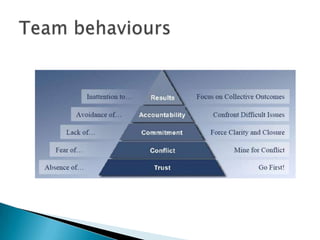
Team behaviours
“The Five Dysfunctions of a Team” By Patrick LencioniLack of TRUSTINVULNERABILITY
Trust means team  mates get comfortable being vulnerable with one anotherOpening yourself up. Showing your weaknessesDevelopmental opportunitiesMistakes, skill deficienciesInterpersonal communication skillsRequests for helpSource: The Five Dysfunctions of a team – Patrick LencioniBehaviour 1. Trust – confidence that the intensions of the team members are good and there is no reason to be protective or careful around the group.
Assess your team.Step 1. Assessment – Get a baseline. This requires a level of transparency and trust as well as vulnerability to go through this process.Team assessment online survey as a leadership teamOr another team MBTI survey toolTeam exercise 1.
Activity: go around the room and get everyone to answer these questions for the group.Describe these experiences for us? Number of sibilingsHome townUnique challenges of childhoodFavorite hobbyFirst jobWorst jobSource: The Five Dysfunctions of a team – Patrick LencioniBehaviour 1.  Personal History ExerciseMinimum time 30 mins
Single most important contribution that each of your team mates makes to the team.Also the area that they must improve upon or eliminate for the  good of the team.Begin with one person at a time being with the leader.Team effectiveness exercise –60 minutes
Myer Briggs - personality insightshttp://www.humanmetrics.com/cgi-win/JTypes2.aspSkillset and Mindset – strengths and developmental opportunitieshttp://www.liveinthetwo.com/?cid=ad140&source=INTWCA140RDNA – Relationship Diagnostic Tool http://fg.qualtrics.com/SE/?SID=SV_77pFnQ0XZIlcHju&SVID=Prod(I am qualified to interpret Myer Briggs and 360 surveys with a company called PDI)Profile tools – 1 hr per person
Remove it from performance elevation.Identify strengths and weaknessesGive people some feedback and insight to grow.360 vendor360 program feedback
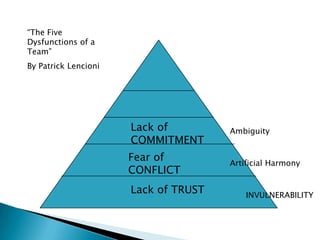
“The Five Dysfunctions of a Team” By Patrick LencioniFear of CONFLICTArtificial HarmonyLack of TRUSTINVULNERABILITY
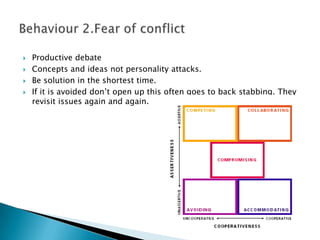
Productive debateConcepts and ideas not personality attacks.Be solution in the shortest time.If it is avoided don’t open up this often goes to back stabbing. They revisit issues again and again.Behaviour 2.Fear of conflict
10yieldresolveIssue110winwithdraw1Relationship
Acknowledge that conflict is positiveMinding – minder of conflict. Someone who extracts issues that are sensitive and force members to work through them. (objectivity and to stay with it till the issues is resolved).Coach one another not to retreat from debate. Remind them to the goal.Use personality tools to anticipate responses to conflict.TKI Thomas Kilmman Conflict tool is the world’s best-selling assessment for understanding how different conflict-handling styles affect interpersonal and group dynamics.Engaging in healthy conflict
Have lively, interesting meetingsExtract and exploit the ideas of all team membersSolve real problems quicklyMinimize politicsPut critical topics on table for discussionHealthy conflict in teams..
“The Five Dysfunctions of a Team” By Patrick LencioniLack of COMMITMENTAmbiguityFear of CONFLICTArtificial HarmonyLack of TRUSTINVULNERABILITY
Clarity and buy in. (everyone in the team)Everyone’s ideas are considered and heardLeader is allowed to make the callCertainty – A decision is better than no decision. Not clear decisions this creates discord.Are we all on the same page. Which decisions should be confidential and which should be shared.Deadlines – clear times and honoring these.Okay to make decisions that are wrong.Behaviour 3. Lack of Commitment
Two Dangers to AvoidGoing with the consensus of the strong leaders instead of mining out disagreementsWaiting until the perfect moment for the perfect decision“A good plan today is better than a perfect plan tomorrow.”Healthy teams unite around the decision even if later it is proven to be wrong
“The Five Dysfunctions of a Team” By Patrick LencioniAvoidance of ACCOUNTABILITYLow StandardsLack of COMMITMENTAmbiguityFear of CONFLICTArtificial HarmonyLack of TRUSTINVULNERABILITY
Willing to call out performance or behaviours that might hurt the team.Avoidance of difficult conversationsRegularly communicate on how the team is goingPublication of goals and behavioural standardsSharing role descriptionsList of teaming guidelines- accountability is a shared team responsibilityTeam rewards – team accountabilityBehaviour 4.  Avoidance  of Accountability
IdeasAmbiguity is the enemy of accountabilityClearly publish exactly what the team needs to do to succeedAnd what every member needs to do to succeedClearly publish a set of behavior standards
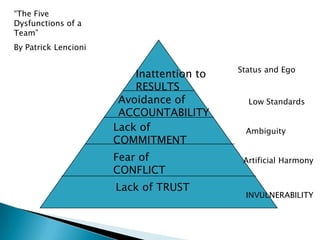
“The Five Dysfunctions of a Team” By Patrick LencioniStatus and EgoInattention to RESULTSAvoidance of ACCOUNTABILITYLow StandardsLack of COMMITMENTAmbiguityFear of CONFLICTArtificial HarmonyLack of TRUSTINVULNERABILITY
Own needs or collective resultsIndividual Status – their mission is more important than the teamRetain achievement-oriented membersMinimize disruptive individualismEnjoy success and suffer failure acutelyBenefit true team playersAvoid distractionsBehaviour 5. Inattention to results
High standardsClarityGenuine harmonyVulnerability
Build your own team rules
Jack Welch’s team rulesBe yourself, be authentic, be real
Create an atmosphere of candour
Disagree without fear

Teaming Workshops

  • 1.
  • 2.
    Why Dan?Been partof large and small teams – HP corporate team to start up organisationsHigh emotional intelligence, secure, expert facilitatorNumber of roles, sales, marketing, HR, trainingPersonality traits: honest, transparent, fair, intelligent, great team builderWhy facilitator?Keep focus on the team goalsMove the discussion, facilitate active learningGive permission to challengeCall out unproductive behavioursDanielle MacInnis
  • 3.
    Why do teamsfail?Many reasons, too many to list them allPersonal agendas become more important than team effortInsecurities and self-protected-ness create defensive posturing by team membersLack of a compelling vision by team members that all can agree is more important than their own agendasFailure to communicate Many, many more reasons
  • 4.
  • 5.
    “The Five Dysfunctionsof a Team” By Patrick LencioniLack of TRUSTINVULNERABILITY
  • 6.
    Trust means team mates get comfortable being vulnerable with one anotherOpening yourself up. Showing your weaknessesDevelopmental opportunitiesMistakes, skill deficienciesInterpersonal communication skillsRequests for helpSource: The Five Dysfunctions of a team – Patrick LencioniBehaviour 1. Trust – confidence that the intensions of the team members are good and there is no reason to be protective or careful around the group.
  • 7.
    Assess your team.Step1. Assessment – Get a baseline. This requires a level of transparency and trust as well as vulnerability to go through this process.Team assessment online survey as a leadership teamOr another team MBTI survey toolTeam exercise 1.
  • 8.
    Activity: go aroundthe room and get everyone to answer these questions for the group.Describe these experiences for us? Number of sibilingsHome townUnique challenges of childhoodFavorite hobbyFirst jobWorst jobSource: The Five Dysfunctions of a team – Patrick LencioniBehaviour 1. Personal History ExerciseMinimum time 30 mins
  • 9.
    Single most importantcontribution that each of your team mates makes to the team.Also the area that they must improve upon or eliminate for the good of the team.Begin with one person at a time being with the leader.Team effectiveness exercise –60 minutes
  • 10.
    Myer Briggs -personality insightshttp://www.humanmetrics.com/cgi-win/JTypes2.aspSkillset and Mindset – strengths and developmental opportunitieshttp://www.liveinthetwo.com/?cid=ad140&source=INTWCA140RDNA – Relationship Diagnostic Tool http://fg.qualtrics.com/SE/?SID=SV_77pFnQ0XZIlcHju&SVID=Prod(I am qualified to interpret Myer Briggs and 360 surveys with a company called PDI)Profile tools – 1 hr per person
  • 11.
    Remove it fromperformance elevation.Identify strengths and weaknessesGive people some feedback and insight to grow.360 vendor360 program feedback
  • 12.
    “The Five Dysfunctionsof a Team” By Patrick LencioniFear of CONFLICTArtificial HarmonyLack of TRUSTINVULNERABILITY
  • 13.
    Productive debateConcepts andideas not personality attacks.Be solution in the shortest time.If it is avoided don’t open up this often goes to back stabbing. They revisit issues again and again.Behaviour 2.Fear of conflict
  • 14.
  • 15.
    Acknowledge that conflictis positiveMinding – minder of conflict. Someone who extracts issues that are sensitive and force members to work through them. (objectivity and to stay with it till the issues is resolved).Coach one another not to retreat from debate. Remind them to the goal.Use personality tools to anticipate responses to conflict.TKI Thomas Kilmman Conflict tool is the world’s best-selling assessment for understanding how different conflict-handling styles affect interpersonal and group dynamics.Engaging in healthy conflict
  • 16.
    Have lively, interestingmeetingsExtract and exploit the ideas of all team membersSolve real problems quicklyMinimize politicsPut critical topics on table for discussionHealthy conflict in teams..
  • 17.
    “The Five Dysfunctionsof a Team” By Patrick LencioniLack of COMMITMENTAmbiguityFear of CONFLICTArtificial HarmonyLack of TRUSTINVULNERABILITY
  • 18.
    Clarity and buyin. (everyone in the team)Everyone’s ideas are considered and heardLeader is allowed to make the callCertainty – A decision is better than no decision. Not clear decisions this creates discord.Are we all on the same page. Which decisions should be confidential and which should be shared.Deadlines – clear times and honoring these.Okay to make decisions that are wrong.Behaviour 3. Lack of Commitment
  • 19.
    Two Dangers toAvoidGoing with the consensus of the strong leaders instead of mining out disagreementsWaiting until the perfect moment for the perfect decision“A good plan today is better than a perfect plan tomorrow.”Healthy teams unite around the decision even if later it is proven to be wrong
  • 20.
    “The Five Dysfunctionsof a Team” By Patrick LencioniAvoidance of ACCOUNTABILITYLow StandardsLack of COMMITMENTAmbiguityFear of CONFLICTArtificial HarmonyLack of TRUSTINVULNERABILITY
  • 21.
    Willing to callout performance or behaviours that might hurt the team.Avoidance of difficult conversationsRegularly communicate on how the team is goingPublication of goals and behavioural standardsSharing role descriptionsList of teaming guidelines- accountability is a shared team responsibilityTeam rewards – team accountabilityBehaviour 4. Avoidance of Accountability
  • 22.
    IdeasAmbiguity is theenemy of accountabilityClearly publish exactly what the team needs to do to succeedAnd what every member needs to do to succeedClearly publish a set of behavior standards
  • 23.
    “The Five Dysfunctionsof a Team” By Patrick LencioniStatus and EgoInattention to RESULTSAvoidance of ACCOUNTABILITYLow StandardsLack of COMMITMENTAmbiguityFear of CONFLICTArtificial HarmonyLack of TRUSTINVULNERABILITY
  • 24.
    Own needs orcollective resultsIndividual Status – their mission is more important than the teamRetain achievement-oriented membersMinimize disruptive individualismEnjoy success and suffer failure acutelyBenefit true team playersAvoid distractionsBehaviour 5. Inattention to results
  • 25.
  • 26.
    Build your ownteam rules
  • 27.
    Jack Welch’s teamrulesBe yourself, be authentic, be real
  • 28.
  • 29.

Editor's Notes

  • #9 Turn your instincts off. Be vulnerable. Take risks.Build trust. Shared experiences, credibility. In-depth.It is a amazing how much we don’t know about one another.
  • #10 Gain team leaders go first to show real vulnerability. Must be geniune.
  • #11 Behavioural description of team members. Non judgemental. Basis in research.
  • #14 Should be encourage it
  • #16 Good for the team growth. By engaging in productive communication and debate the team can confidently buyin knowing they have heard everyone’s ideas. Make decisions without the perfect data all the time.
  • #19 No one isharbouring doubt.