Building a Scalable
Record Linkage System
with Apache Spark, Python 3, and Machine Learning
#Py6SAIS
Nicholas Chammas and Eddie Pantridge
MassMutual
#Py6SAIS
The Business Problem
• What: Comprehensive view of the customer
• Why: Marketing and underwriting
• Problem:
• Customer information scattered across many
systems
• No global key to link them all together
• Variations in name and address
!2
#Py6SAIS
The Technical Challenge
• 330M+ records that need to be linked
• Records come from various systems with
differing schemas
• No global key; SSN generally not available
• No differential extracts of source systems
• Need to link everything, all at once, every night
!3
#Py6SAIS
Record Linkage Prior Art
• Dedupe
• Mature, sophisticated
• Local processing
• Previous team found did not scale enough
!4
#Py6SAIS
Record Linkage Prior Art
• Splinkr 2
• In-house system built on Spark’s RDD API in
late 2015 / early 2016
• 8+ hours to run; problems with stability, code
maintainability, and link quality
• Successful as an experiment, but needed
replacement for production
!5
#Py6SAIS
Splinkr 3
• All-new project started in late 2016, targeting
Spark’s DataFrame API
• Goal: Build a production-ready record linkage
system, leveraging the lessons from Splinkr 2
!6
#Py6SAIS
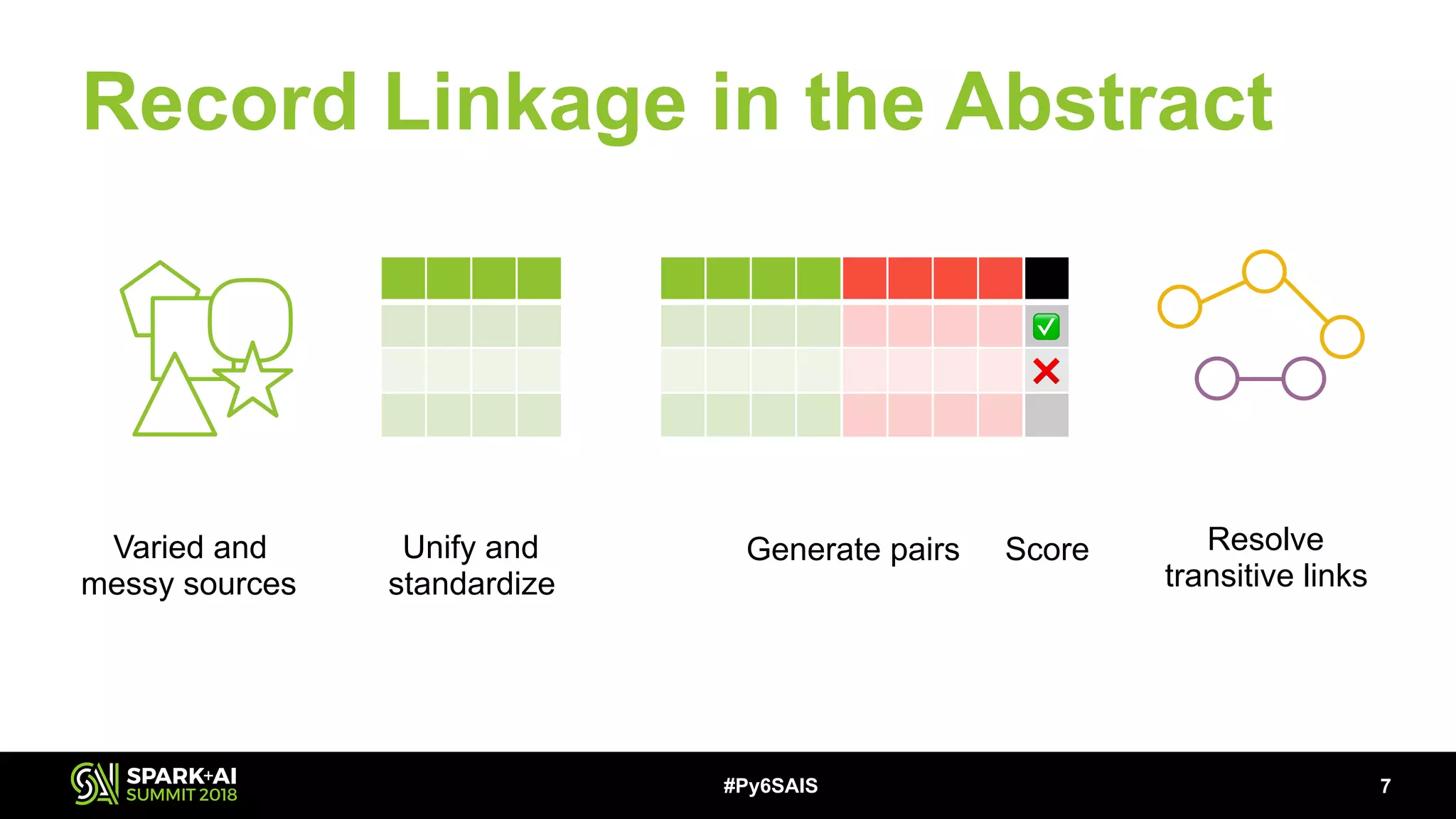
Record Linkage in the Abstract
!7
Unify and
standardize
Varied and
messy sources
Generate pairs
✅
❌
Score Resolve
transitive links
#Py6SAIS
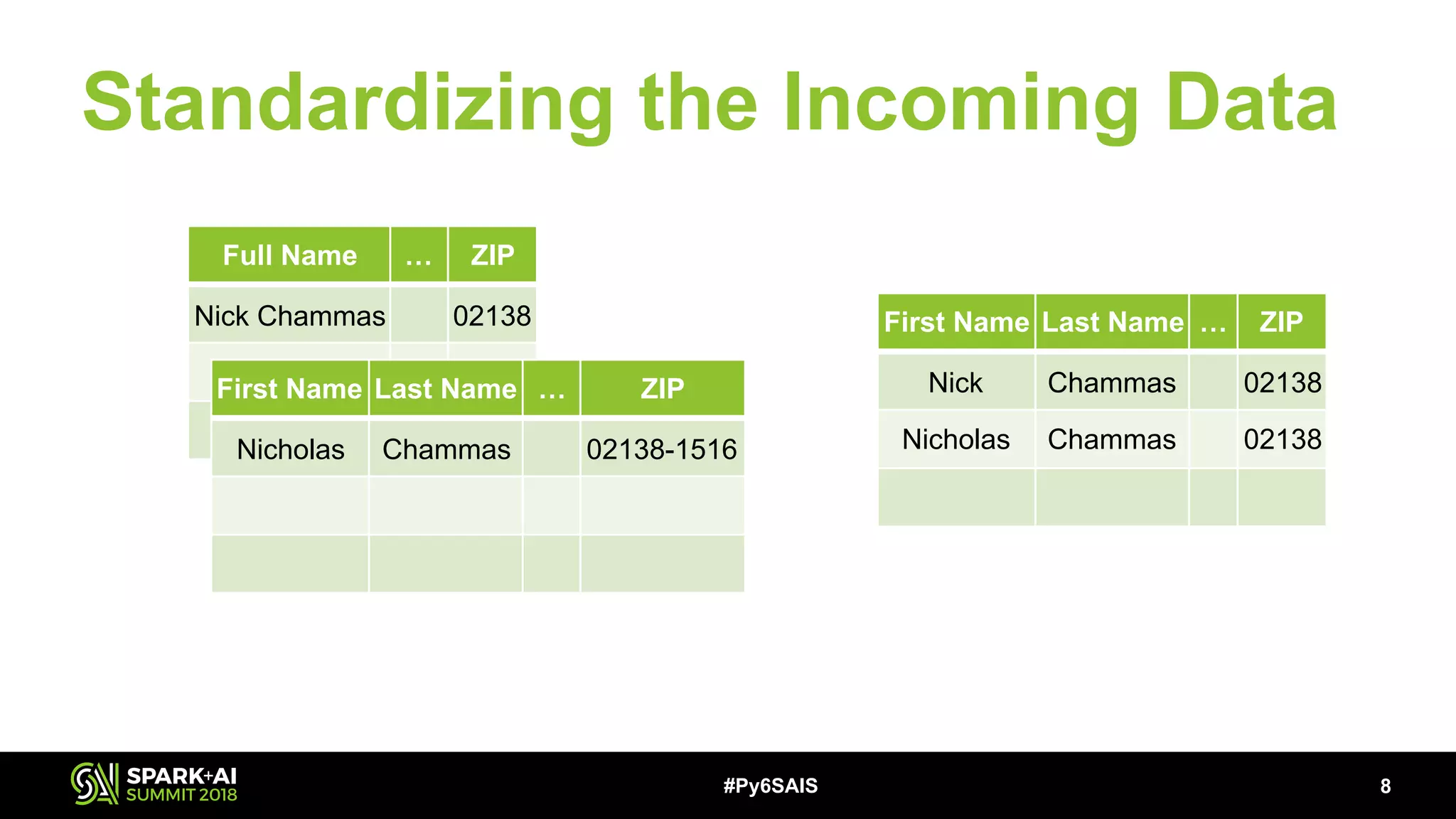
Standardizing the Incoming Data
!8
Full Name … ZIP
Nick Chammas 02138
First Name Last Name … ZIP
Nicholas Chammas 02138-1516
First Name Last Name … ZIP
Nick Chammas 02138
Nicholas Chammas 02138
#Py6SAIS
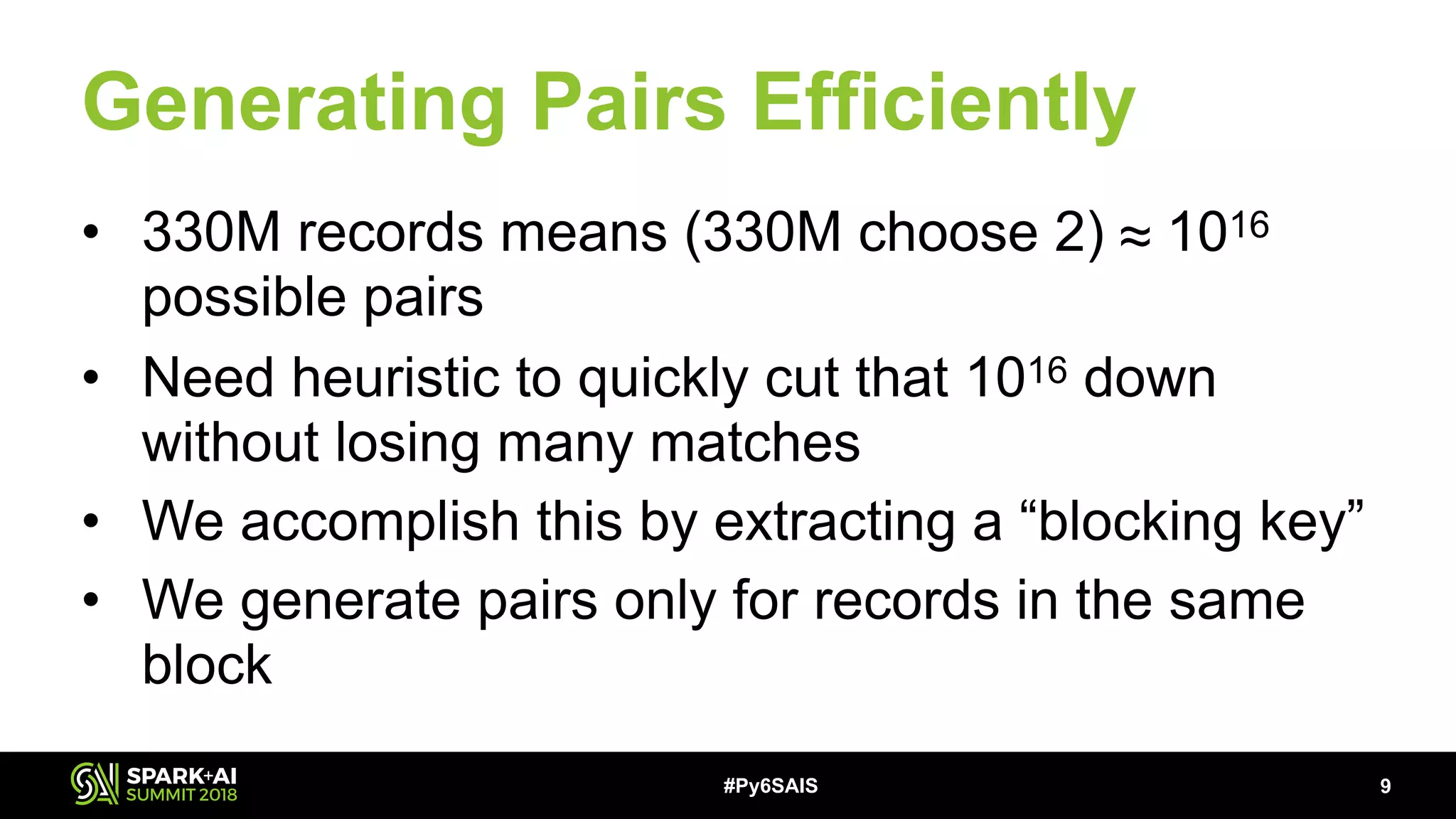
Generating Pairs Efficiently
• 330M records means (330M choose 2) ≈ 1016
possible pairs
• Need heuristic to quickly cut that 1016 down
without losing many matches
• We accomplish this by extracting a “blocking key”
• We generate pairs only for records in the same
block
!9
#Py6SAIS
Generating Pairs Efficiently
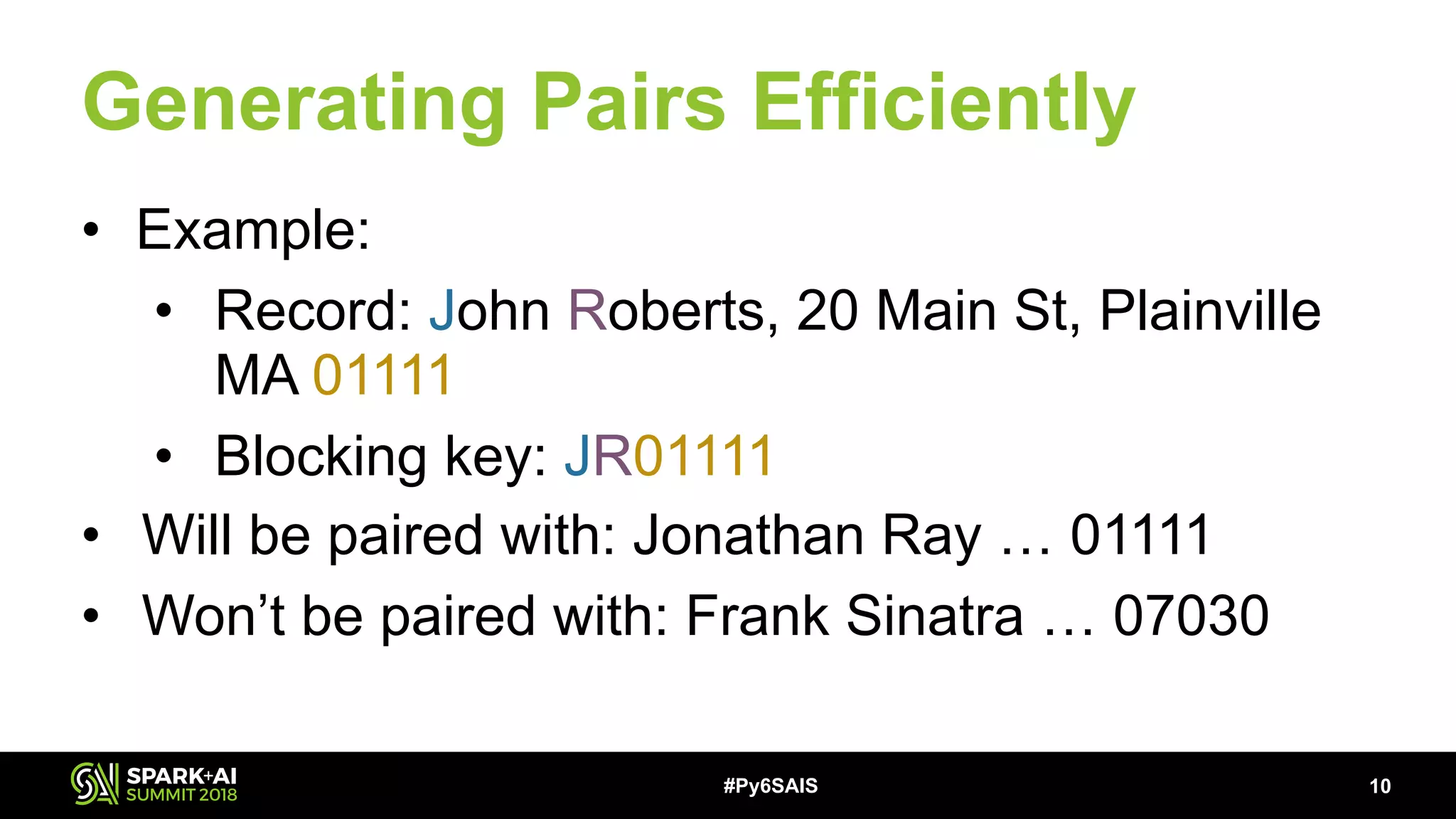
• Example:
• Record: John Roberts, 20 Main St, Plainville
MA 01111
• Blocking key: JR01111
• Will be paired with: Jonathan Ray … 01111
• Won’t be paired with: Frank Sinatra … 07030
!10
#Py6SAIS
Generating Pairs Efficiently
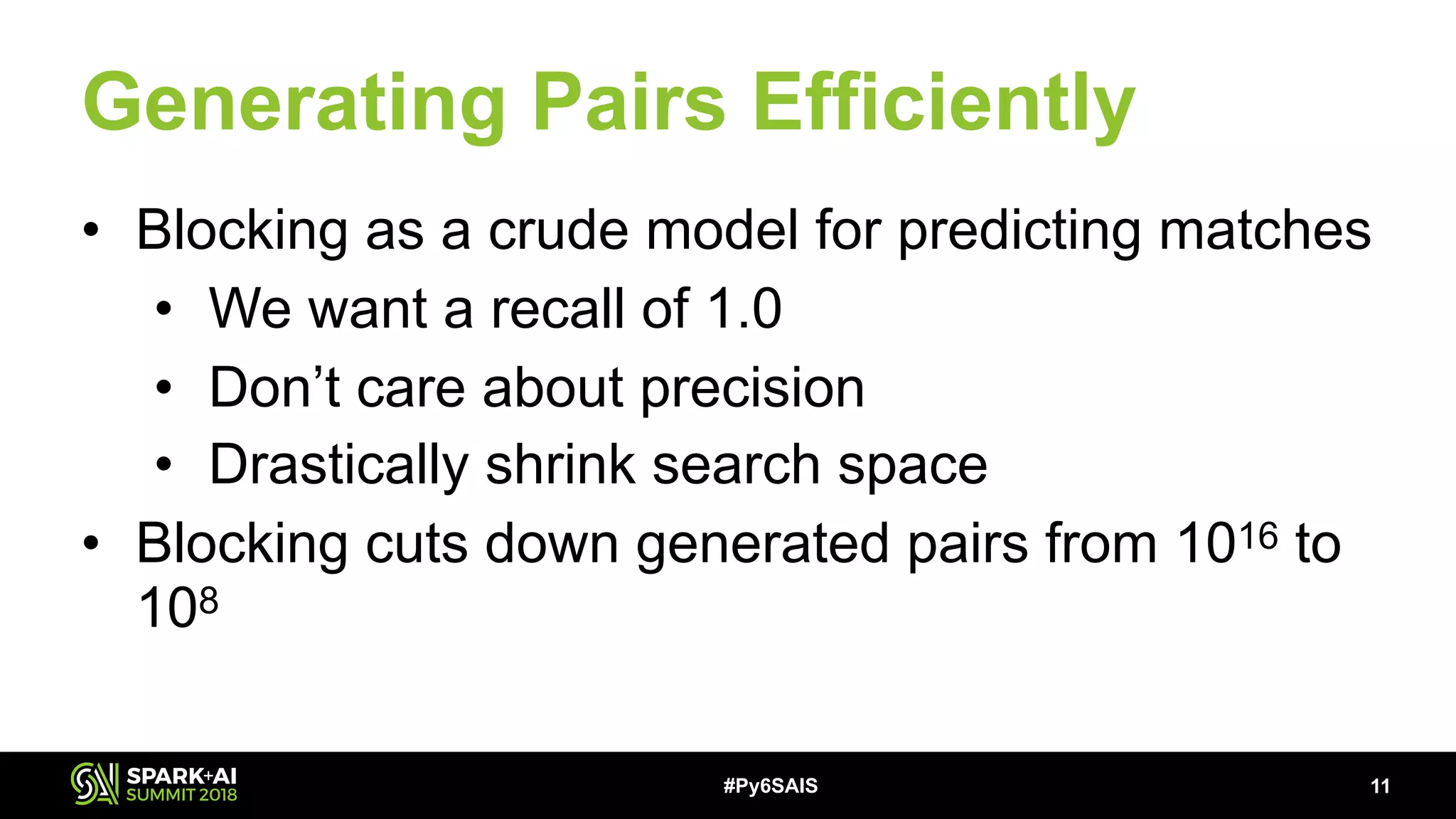
• Blocking as a crude model for predicting matches
• We want a recall of 1.0
• Don’t care about precision
• Drastically shrink search space
• Blocking cuts down generated pairs from 1016 to
108
!11
#Py6SAIS
Generating Pairs Efficiently
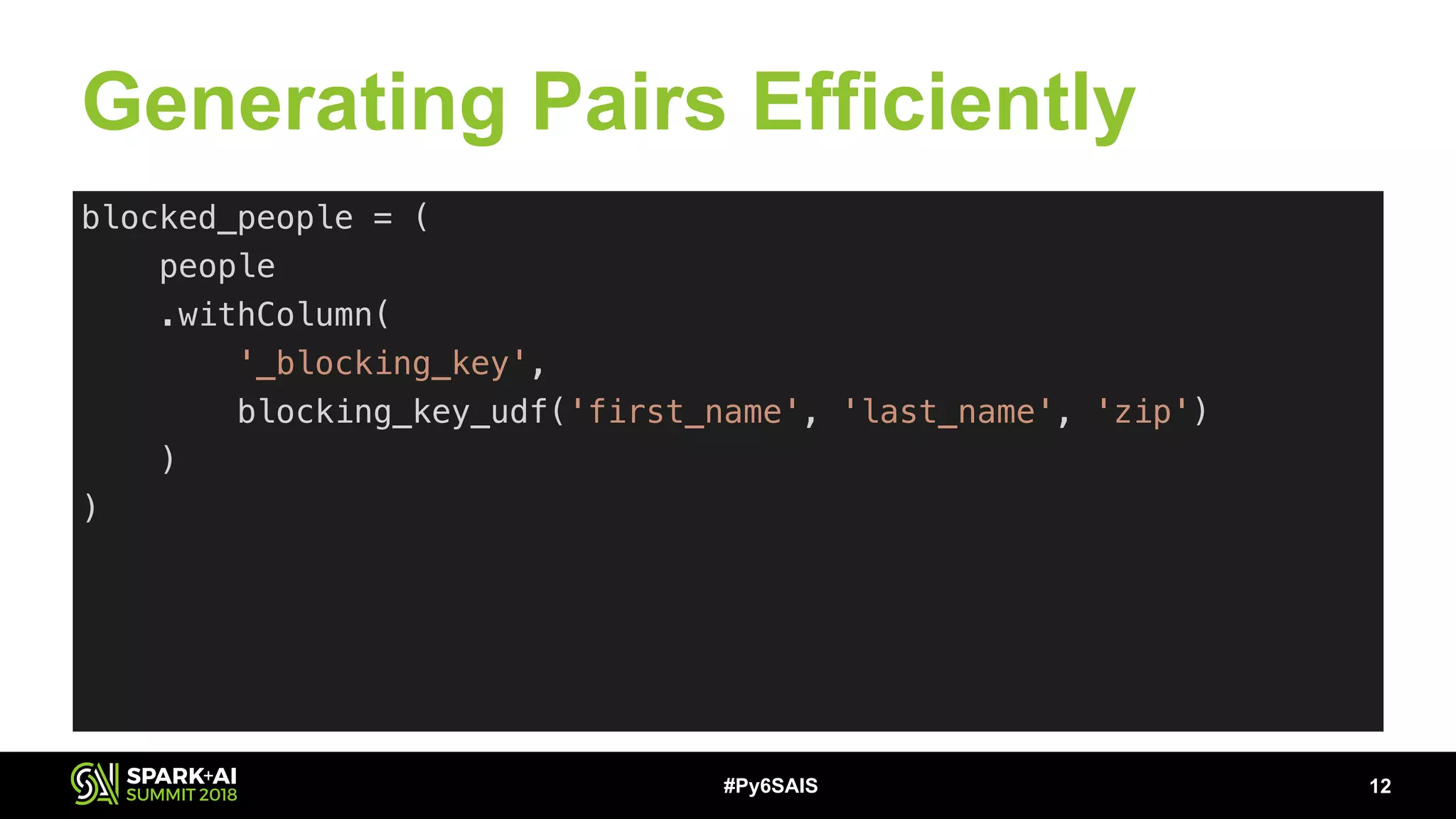
blocked_people = (
people
.withColumn(
'_blocking_key',
blocking_key_udf('first_name', 'last_name', 'zip')
)
)
!12
#Py6SAIS
Generating Pairs Efficiently
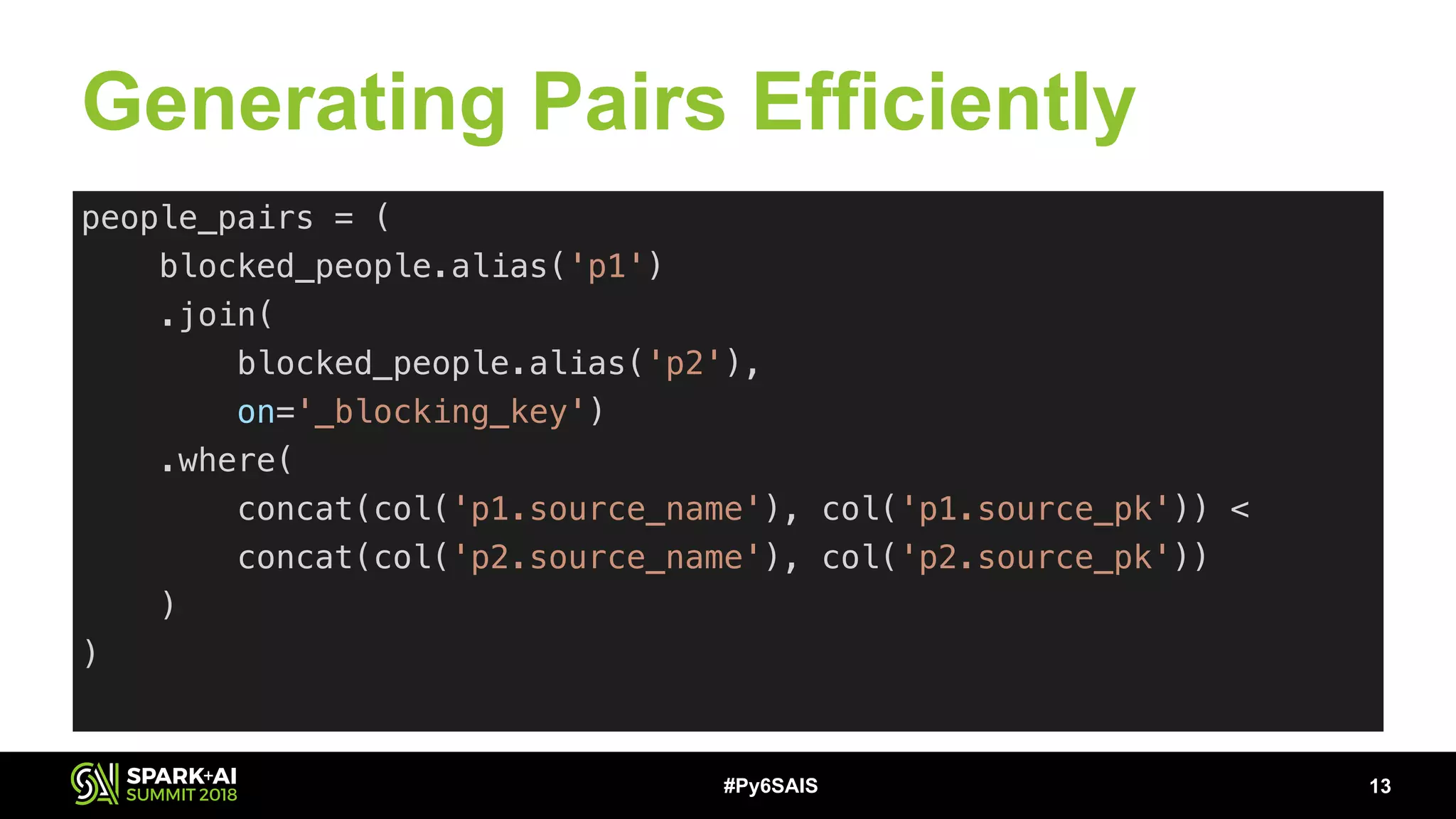
people_pairs = (
blocked_people.alias('p1')
.join(
blocked_people.alias('p2'),
on='_blocking_key')
.where(
concat(col('p1.source_name'), col('p1.source_pk')) <
concat(col('p2.source_name'), col('p2.source_pk'))
)
)
!13
#Py6SAIS
Identifying Matches
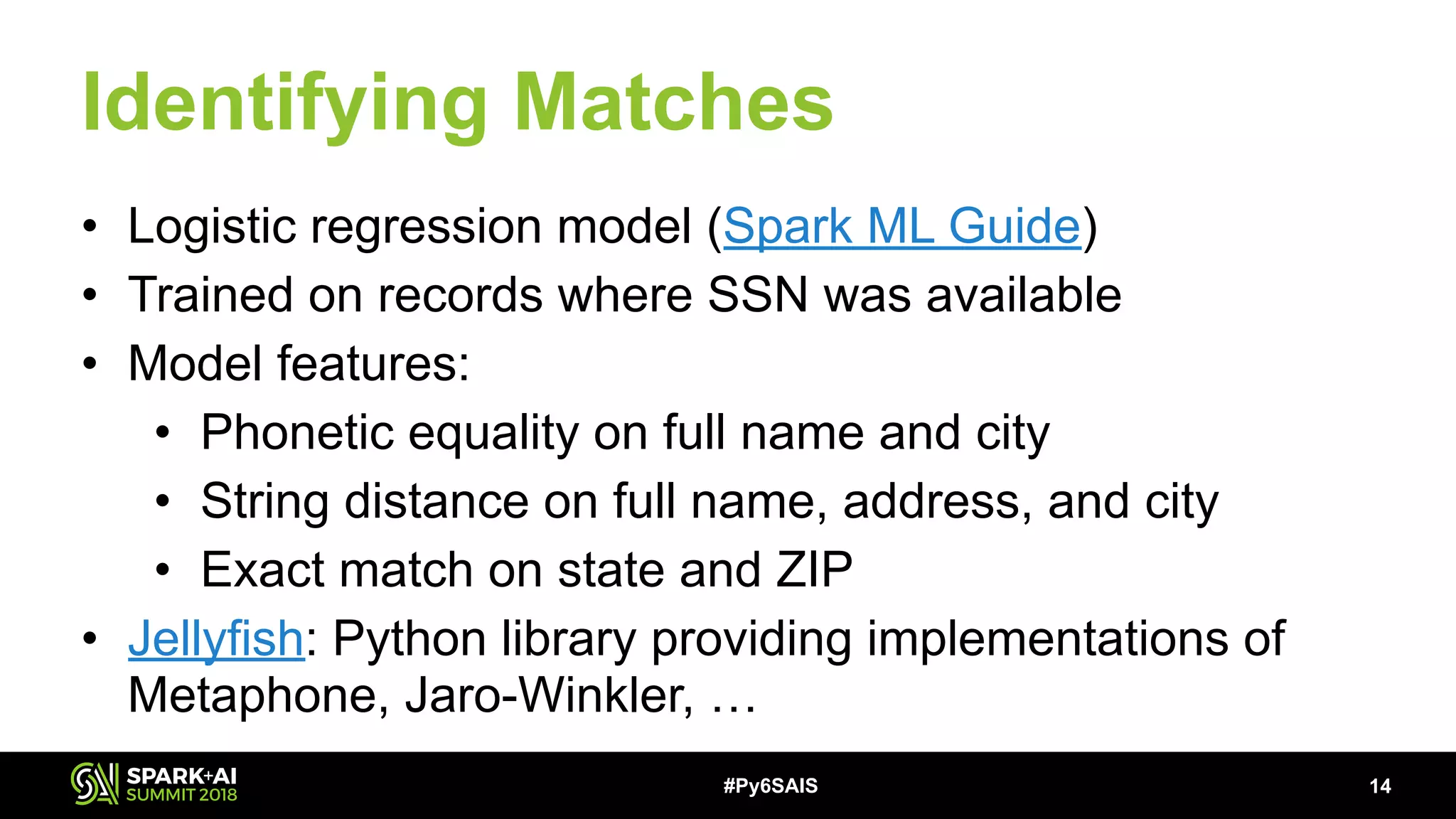
• Logistic regression model (Spark ML Guide)
• Trained on records where SSN was available
• Model features:
• Phonetic equality on full name and city
• String distance on full name, address, and city
• Exact match on state and ZIP
• Jellyfish: Python library providing implementations of
Metaphone, Jaro-Winkler, …
!14
#Py6SAIS
Identifying Matches
!15
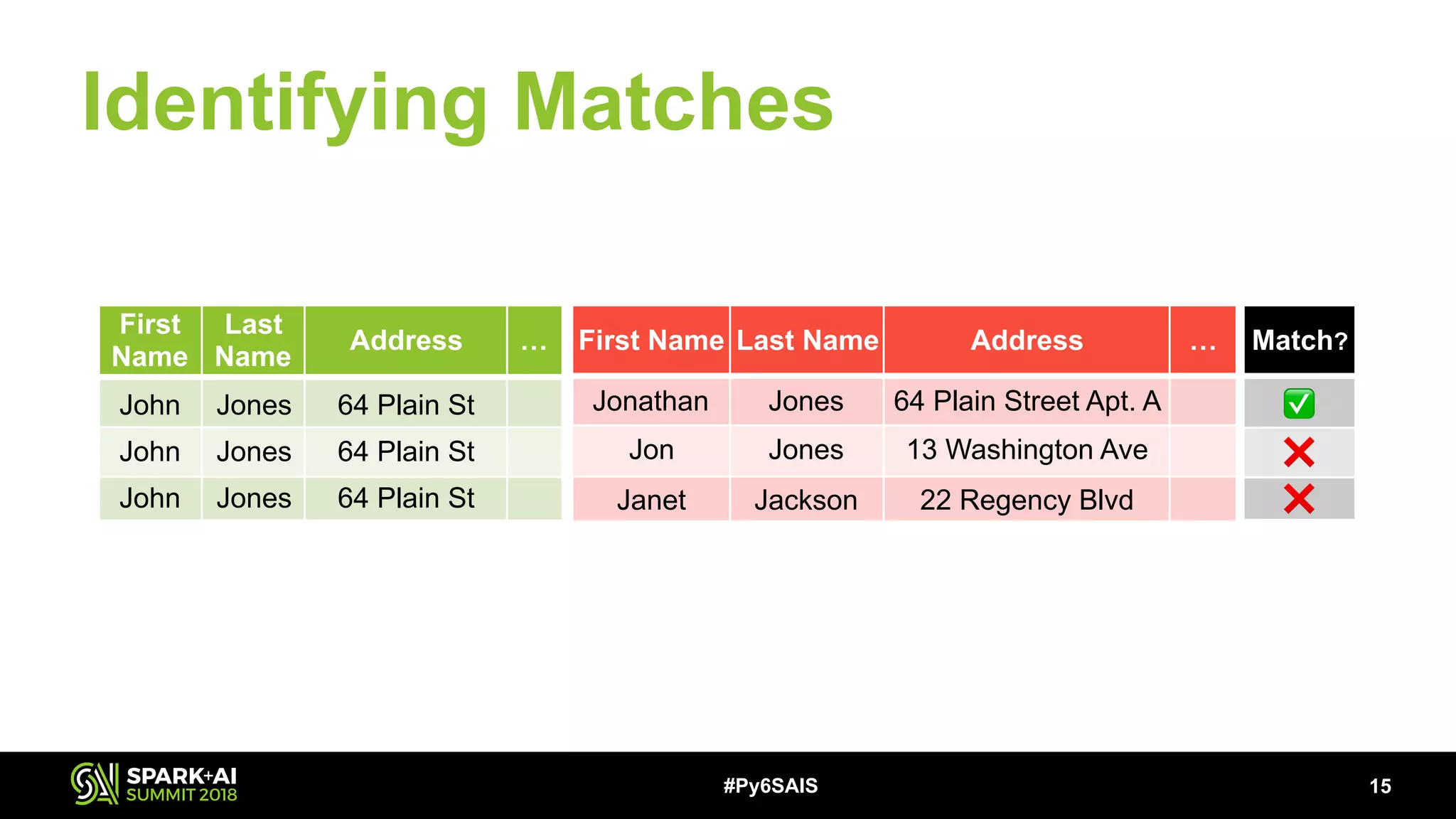
First
Name
Last
Name
Address …
John Jones 64 Plain St
First Name Last Name Address …
Jonathan Jones 64 Plain Street Apt. A
Jon Jones 13 Washington Ave
Janet Jackson 22 Regency Blvd
Match?
✅
❌
❌
#Py6SAIS
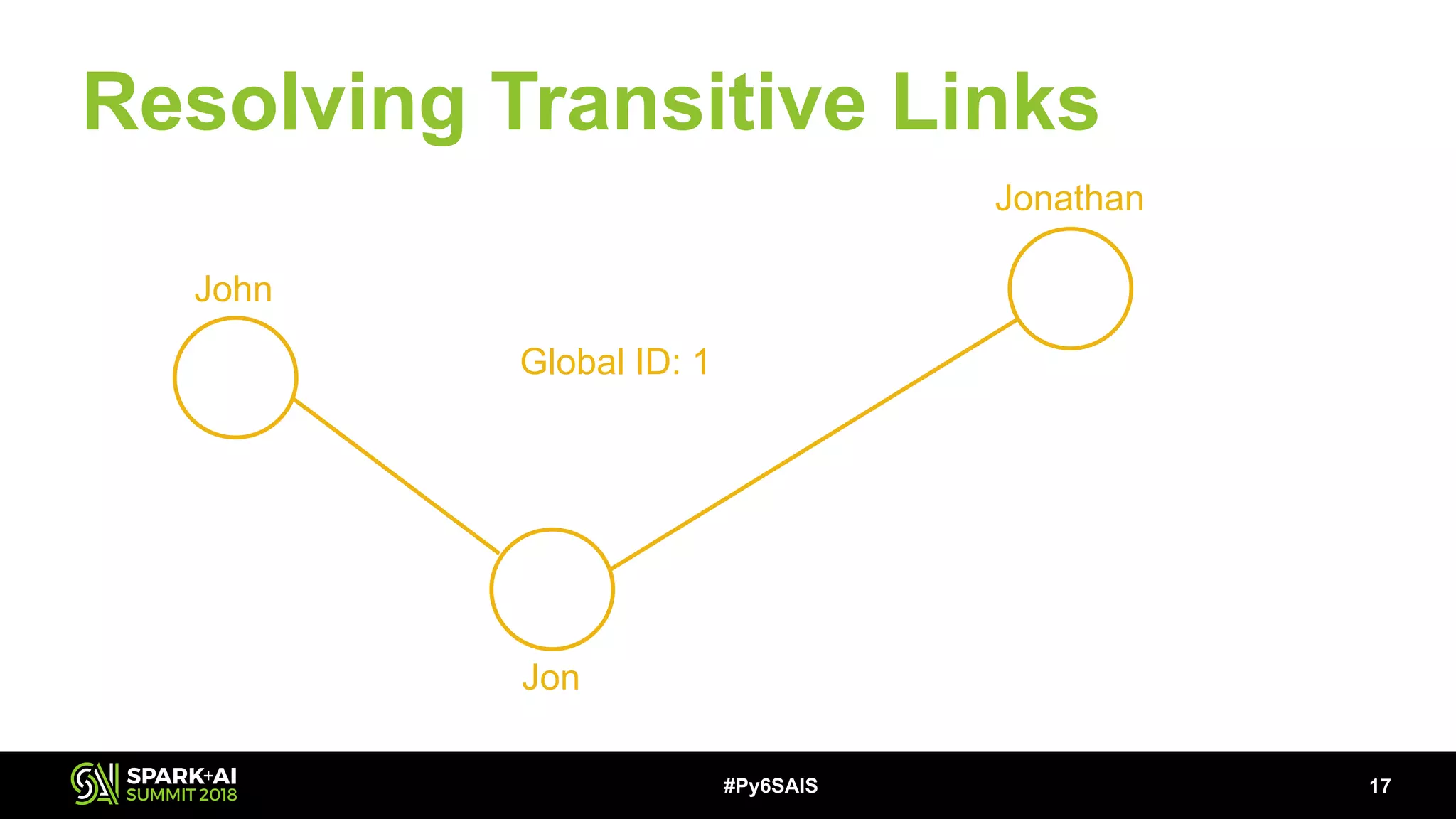
Resolving Transitive Links
!16
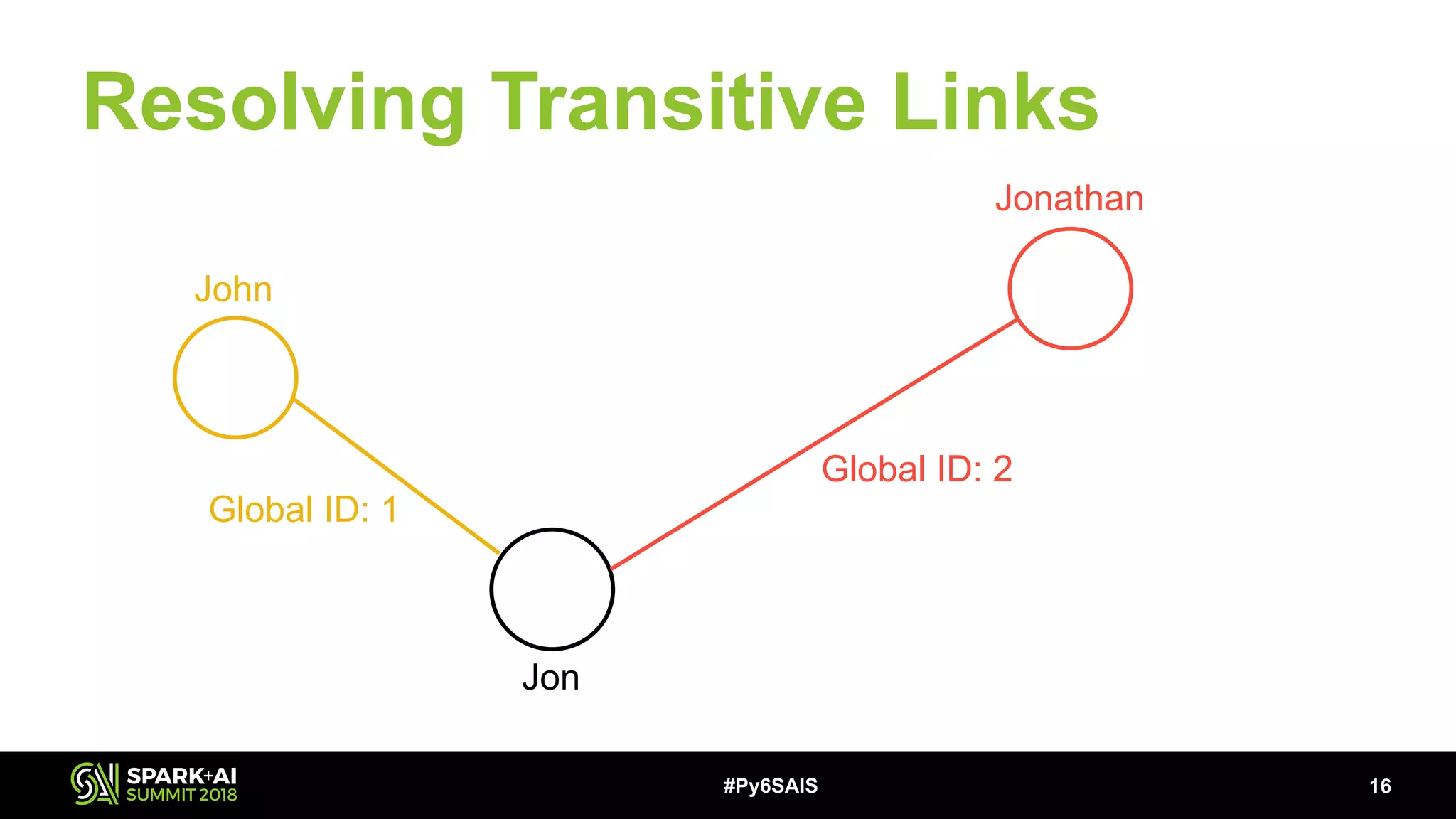
Jon
John
Jonathan
Global ID: 1
Global ID: 2
#Py6SAIS
Resolving Transitive Links
!17
Jon
John
Jonathan
Global ID: 1
#Py6SAIS
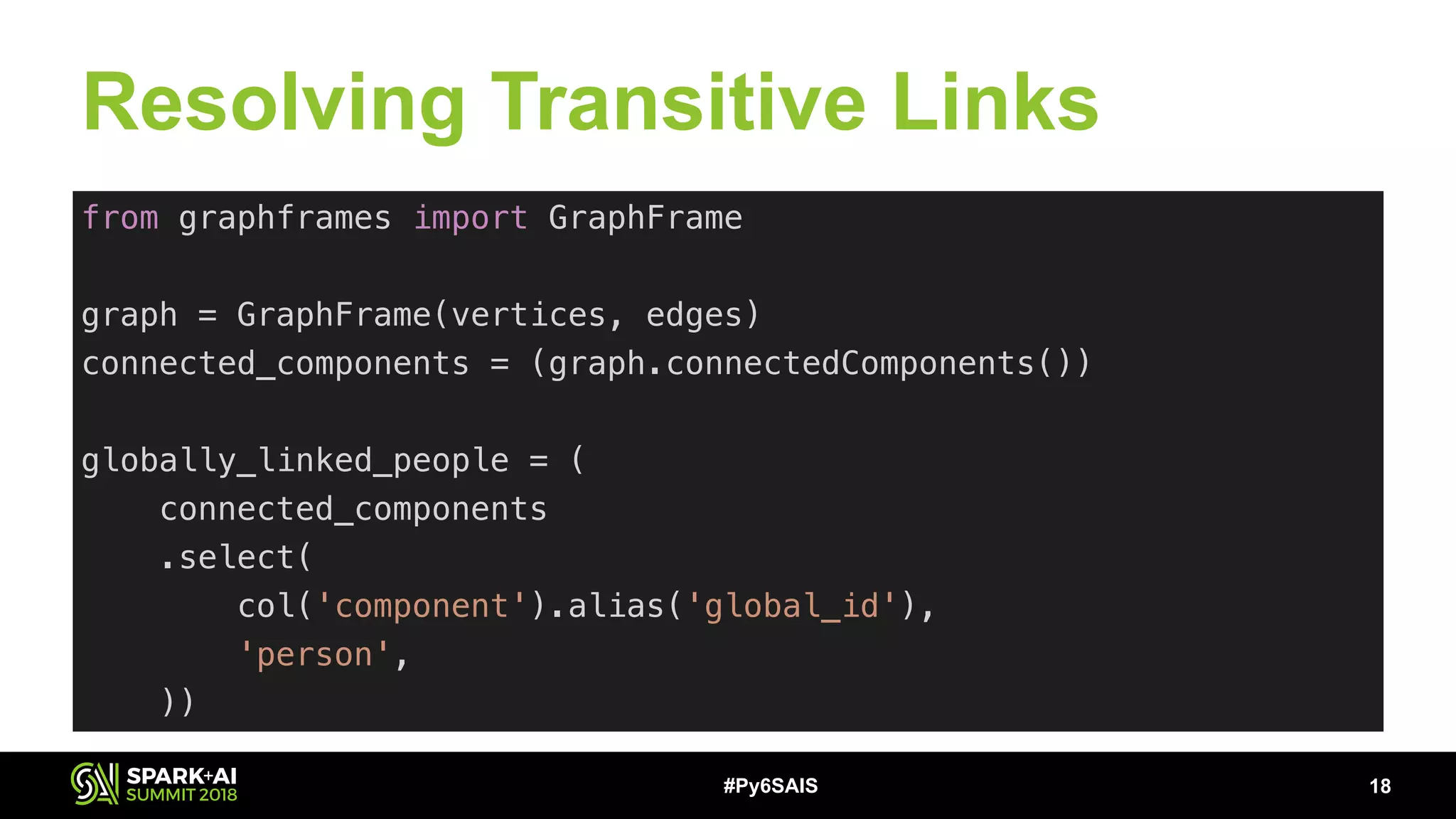
Resolving Transitive Links
from graphframes import GraphFrame
graph = GraphFrame(vertices, edges)
connected_components = (graph.connectedComponents())
globally_linked_people = (
connected_components
.select(
col('component').alias('global_id'),
'person',
))
!18
#Py6SAIS
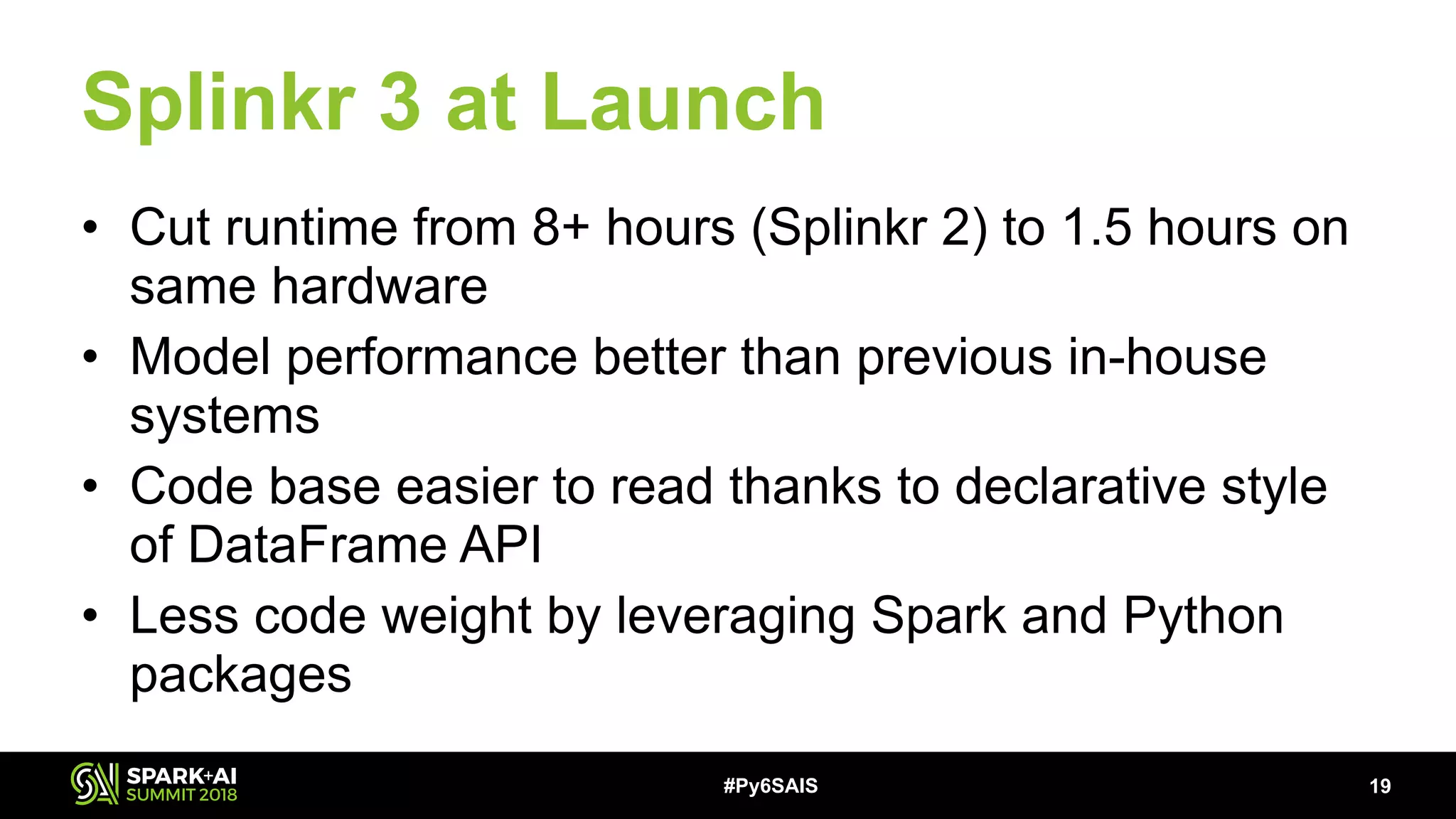
Splinkr 3 at Launch
• Cut runtime from 8+ hours (Splinkr 2) to 1.5 hours on
same hardware
• Model performance better than previous in-house
systems
• Code base easier to read thanks to declarative style
of DataFrame API
• Less code weight by leveraging Spark and Python
packages
!19
#Py6SAIS
Experiments with Neural Networks
• Prompted by idea shared during Riot Games talk
at Spark Summit 2017
• Goals:
• Handle edge cases better than logistic
regression model
• Simplify code while maintaining model
performance
!20
#Py6SAIS
Experiments with Neural Networks
• Experimented with convolutional neural networks
• Model trained on raw text; no explicit features
extracted
• Minor hacking required to integrate Keras model
into Spark
!21
#Py6SAIS
Experiments with Neural Networks
• Results:
• Marginal increase in accuracy; recall up,
precision down
• Neural network did not seem to learn anything
not already captured by logistic regression
• Code simplified at expense of interpretability,
memory requirements, and run time
!22
#Py6SAIS
Biggest Hurdles in Building Splinkr 3
• Poor quality labels on our training data
• SSN is not a great way to generate training
pairs
• Poor training data limited potential for linkage
improvements
• Manual cleanup helped, but turking or
synthetic training data would have been better
!23
#Py6SAIS
Biggest Hurdles in Building Splinkr 3
• Bugs and API gaps working with Spark 2.0
• Code generation bugs (SPARK-18492,
SPARK-18866)
• Optimizer problems related to UDFs
(SPARK-18254, SPARK-18589)
• GraphFrames Python 3 compatibility
(graphframes#85)
• GraphFrames correctness bug (graphframes#159)
!24
#Py6SAIS
Take-aways from Building Splinkr 3
• Spark makes building a scalable linkage pipeline
approachable
• Declarative style of DataFrame API facilitates
good design
• Access to Spark and Python ecosystems saves
time (GraphFrames, Jellyfish)
!25
#Py6SAIS
Take-aways from Building Splinkr 3
• Good training data is critical and worth the
upfront investment
• Good heuristics are often a better starting point
than machine learning (Google’s ML Engineering
Rule #1)
• Building with cutting-edge tools (at the time,
Spark 2.0) comes with risk
!26
Building a Scalable
Record Linkage System
with Apache Spark, Python 3, and Machine Learning
#Py6SAIS
Nicholas Chammas and Eddie Pantridge
MassMutual

Building a Scalable Record Linkage System with Apache Spark, Python 3, and Machine Learning with Nicholas Chammas and Edward Pantridge

  • 1.
    Building a Scalable RecordLinkage System with Apache Spark, Python 3, and Machine Learning #Py6SAIS Nicholas Chammas and Eddie Pantridge MassMutual
  • 2.
    #Py6SAIS The Business Problem •What: Comprehensive view of the customer • Why: Marketing and underwriting • Problem: • Customer information scattered across many systems • No global key to link them all together • Variations in name and address !2
  • 3.
    #Py6SAIS The Technical Challenge •330M+ records that need to be linked • Records come from various systems with differing schemas • No global key; SSN generally not available • No differential extracts of source systems • Need to link everything, all at once, every night !3
  • 4.
    #Py6SAIS Record Linkage PriorArt • Dedupe • Mature, sophisticated • Local processing • Previous team found did not scale enough !4
  • 5.
    #Py6SAIS Record Linkage PriorArt • Splinkr 2 • In-house system built on Spark’s RDD API in late 2015 / early 2016 • 8+ hours to run; problems with stability, code maintainability, and link quality • Successful as an experiment, but needed replacement for production !5
  • 6.
    #Py6SAIS Splinkr 3 • All-newproject started in late 2016, targeting Spark’s DataFrame API • Goal: Build a production-ready record linkage system, leveraging the lessons from Splinkr 2 !6
  • 7.
    #Py6SAIS Record Linkage inthe Abstract !7 Unify and standardize Varied and messy sources Generate pairs ✅ ❌ Score Resolve transitive links
  • 8.
    #Py6SAIS Standardizing the IncomingData !8 Full Name … ZIP Nick Chammas 02138 First Name Last Name … ZIP Nicholas Chammas 02138-1516 First Name Last Name … ZIP Nick Chammas 02138 Nicholas Chammas 02138
  • 9.
    #Py6SAIS Generating Pairs Efficiently •330M records means (330M choose 2) ≈ 1016 possible pairs • Need heuristic to quickly cut that 1016 down without losing many matches • We accomplish this by extracting a “blocking key” • We generate pairs only for records in the same block !9
  • 10.
    #Py6SAIS Generating Pairs Efficiently •Example: • Record: John Roberts, 20 Main St, Plainville MA 01111 • Blocking key: JR01111 • Will be paired with: Jonathan Ray … 01111 • Won’t be paired with: Frank Sinatra … 07030 !10
  • 11.
    #Py6SAIS Generating Pairs Efficiently •Blocking as a crude model for predicting matches • We want a recall of 1.0 • Don’t care about precision • Drastically shrink search space • Blocking cuts down generated pairs from 1016 to 108 !11
  • 12.
    #Py6SAIS Generating Pairs Efficiently blocked_people= ( people .withColumn( '_blocking_key', blocking_key_udf('first_name', 'last_name', 'zip') ) ) !12
  • 13.
    #Py6SAIS Generating Pairs Efficiently people_pairs= ( blocked_people.alias('p1') .join( blocked_people.alias('p2'), on='_blocking_key') .where( concat(col('p1.source_name'), col('p1.source_pk')) < concat(col('p2.source_name'), col('p2.source_pk')) ) ) !13
  • 14.
    #Py6SAIS Identifying Matches • Logisticregression model (Spark ML Guide) • Trained on records where SSN was available • Model features: • Phonetic equality on full name and city • String distance on full name, address, and city • Exact match on state and ZIP • Jellyfish: Python library providing implementations of Metaphone, Jaro-Winkler, … !14
  • 15.
    #Py6SAIS Identifying Matches !15 First Name Last Name Address … JohnJones 64 Plain St John Jones 64 Plain St John Jones 64 Plain St First Name Last Name Address … Jonathan Jones 64 Plain Street Apt. A Jon Jones 13 Washington Ave Janet Jackson 22 Regency Blvd Match? ✅ ❌ ❌
  • 16.
  • 17.
  • 18.
    #Py6SAIS Resolving Transitive Links fromgraphframes import GraphFrame graph = GraphFrame(vertices, edges) connected_components = (graph.connectedComponents()) globally_linked_people = ( connected_components .select( col('component').alias('global_id'), 'person', )) !18
  • 19.
    #Py6SAIS Splinkr 3 atLaunch • Cut runtime from 8+ hours (Splinkr 2) to 1.5 hours on same hardware • Model performance better than previous in-house systems • Code base easier to read thanks to declarative style of DataFrame API • Less code weight by leveraging Spark and Python packages !19
  • 20.
    #Py6SAIS Experiments with NeuralNetworks • Prompted by idea shared during Riot Games talk at Spark Summit 2017 • Goals: • Handle edge cases better than logistic regression model • Simplify code while maintaining model performance !20
  • 21.
    #Py6SAIS Experiments with NeuralNetworks • Experimented with convolutional neural networks • Model trained on raw text; no explicit features extracted • Minor hacking required to integrate Keras model into Spark !21
  • 22.
    #Py6SAIS Experiments with NeuralNetworks • Results: • Marginal increase in accuracy; recall up, precision down • Neural network did not seem to learn anything not already captured by logistic regression • Code simplified at expense of interpretability, memory requirements, and run time !22
  • 23.
    #Py6SAIS Biggest Hurdles inBuilding Splinkr 3 • Poor quality labels on our training data • SSN is not a great way to generate training pairs • Poor training data limited potential for linkage improvements • Manual cleanup helped, but turking or synthetic training data would have been better !23
  • 24.
    #Py6SAIS Biggest Hurdles inBuilding Splinkr 3 • Bugs and API gaps working with Spark 2.0 • Code generation bugs (SPARK-18492, SPARK-18866) • Optimizer problems related to UDFs (SPARK-18254, SPARK-18589) • GraphFrames Python 3 compatibility (graphframes#85) • GraphFrames correctness bug (graphframes#159) !24
  • 25.
    #Py6SAIS Take-aways from BuildingSplinkr 3 • Spark makes building a scalable linkage pipeline approachable • Declarative style of DataFrame API facilitates good design • Access to Spark and Python ecosystems saves time (GraphFrames, Jellyfish) !25
  • 26.
    #Py6SAIS Take-aways from BuildingSplinkr 3 • Good training data is critical and worth the upfront investment • Good heuristics are often a better starting point than machine learning (Google’s ML Engineering Rule #1) • Building with cutting-edge tools (at the time, Spark 2.0) comes with risk !26
  • 27.
    Building a Scalable RecordLinkage System with Apache Spark, Python 3, and Machine Learning #Py6SAIS Nicholas Chammas and Eddie Pantridge MassMutual