






 TEACHERS: Many school districts
  require probationary teachers to
  develop a portfolio before being
  recommended for tenure.
 Shows your content knowledge and
  expertise in a field in a quick
  snapshot.
 Makes you stand out from other
  applicants to a job.
 Purpose is to collect evidence that
  demonstrates your effective work
  (classroom, school, District, field)
 Analyzes progress over the year(s)
 Records and tracks your professional
  development experiences and how they
  effect your work
 A working document
 Demonstrates your skills.
 Meaningful collections of artifacts based
  on a set of professional growth goals.
 A timeline for sampling work & reflection
  statements.
 TWO MAIN PARTS: Evidence & Reflection
 Help you articulate your professional
  goals and the work you have been
  doing to achieve them.
 to record your professional
  accomplishments.
 to help you have materials ready for a
  job search.
 Organize goals and experience prior to
  an interview.
 Communicate your professional
  experience and accomplishments to a
  potential employer.
 Expand on your one-page resume by
  providing a fuller, richer portrayal of your
  abilities and experience.
 Portfolios may be either hardcopy or
  electronic.
 Each year, you should have a
  professional development goal.
 Select artifacts that demonstrate how
  this professional development goal has
  impacted your work.
 Develop goals and plans for future
  professional growth.
 Statement of professional goals and philosophy
 Resume or Curriculum Vitae
 Narrative description of experiences you want to highlight; for
  example:
    ›   Academic Work
    ›   Research
    ›   Teaching
    ›   Leadership
    ›   Service
    ›   Publications
    ›   Conference Participation
    ›   Work Experience and Skills
    ›   Performance Reviews
    ›   Recognition and Awards
   Appendices:
    ›   Annotated materials and examples to illustrate or elaborate on your
        statement of goals, philosophy, and the experiences referred to in your
        narrative description
   For the purposes of this
    demonstration, we will
    focus on a teacher’s
    portfolio.

   WHY?
    › Closest to the work you
      have been doing.
    › May be altered to fit into
      any desired profession.
Content Knowledge
1.   How have you increased capacity to determine
     which instructional techniques are most
     appropriate for building students’ understanding
     of varying forms of content?
2.   What aspects of content knowledge continue to
     shift and evolve, and how have you worked to
     keep pace with these changes?
3.   How do you work to enhance your knowledge of
     content related to curricula prior to and beyond
     the grade level of the students you serve?
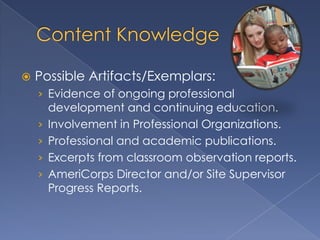
   Possible Artifacts/Exemplars:
    › Evidence of ongoing professional
        development and continuing education.
    ›   Involvement in Professional Organizations.
    ›   Professional and academic publications.
    ›   Excerpts from classroom observation reports.
    ›   AmeriCorps Director and/or Site Supervisor
        Progress Reports.
Preparation
1.   Describe the process you utilize to plan or map
     out your curriculum or academic interventions.
2.   What process do you use to ensure appropriate
     differentiation of instruction during your planning
     process? What data do you use to make these
     decisions?
3.   What strategies have you found most effective for
     establishing a rationale for how your students best
     learn? What strategies do you find most effective
     for implementing lesson plans with your students?
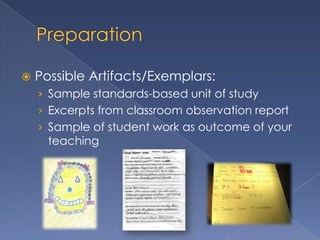
   Possible Artifacts/Exemplars:
    › Sample standards-based unit of study
    › Excerpts from classroom observation report
    › Sample of student work as outcome of your
      teaching
Instructional Delivery
1.   Consider the instructional strategies you have
     found to be consistently effective in increasing
     student involvement in discussions, linking learning
     with prior knowledge, and fostering engagement.
2.   Consider instructional methods you have
     experimented with and chosen to discard. What
     data, observations, and other indicators led you
     to discontinue those methods?
3.   Describe an example lesson plan which initially
     failed to meet your anticipated goals, but
     succeeded after you revised it.
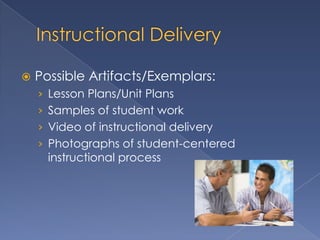
   Possible Artifacts/Exemplars:
    › Lesson Plans/Unit Plans
    › Samples of student work
    › Video of instructional delivery
    › Photographs of student-centered
      instructional process
Classroom Management
1.   What systems have you established to provide
     smooth and efficient transitions in your classroom
     or after school program?
2.   Describe how you monitor student behavior and
     respond to student misbehavior in an appropriate
     manner.
3.   Describe your process for establishing effective
     routines and systems for handling materials and
     supplies.
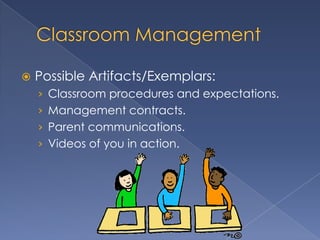
   Possible Artifacts/Exemplars:
    › Classroom procedures and expectations.
    › Management contracts.
    › Parent communications.
    › Videos of you in action.
 Student Development
 Student Assessment
 Collaboration
 Reflective and Responsive Practice
 Record Keeping and Communication
 Teacher Professionalism
 Start as early as possible
 Work collaboratively with supervisors in
  building your portfolio to make it part of
  your annual review process. You can
  work with your supervisor to focus on
  your goals and objectives for each year
  and discuss how you are reaching your
  goals.
 Building your portfolio should be an
  integral part of your professional growth.
  It should help you and your supervisor
  focus on your strengths and areas for
  growth and development.
 It should be a powerful tool for self-
  reflection and development.
   Make it RELEVANT:
    › Include your goals
    › Make sure it’s tied to criteria for evaluating
      effective teachers
    › Include supportive examples of student work
      and performance that reflect those criteria.
   Organize your portfolio
    › Clearly labeled sections.
    › Professional and high quality.
    › If you can incorporate technology it will
      make you that give you an added edge
      over competition.
 Develop the practice of collecting
  materials that represent your skills and
  achievements.
 Know your audience: Study job
  announcements and learn what
  professionals in your field value when
  hiring.
 Select an organizing principle that best
  reflects your work; for
  example, chronological, functional, or
  thematic
   Association of American Geographers:
    http://www.aag.org/Careers/UW/Profportfolios.html
   Colorado State:
    http://www.biz.colostate.edu/career/portfolio.htm
   Florida State:
    http://www.career.fsu.edu/ccis/guides/port.html
   Michigan State:
    http://www.csp.msu.edu/cdc/explore/proport.htm
   Northwestern University:
    http://www.northwestern.edu/careers/STUDENTS/job-
    skills/portfolio.htm
   RLS Career Center:
    http://www.rlscareercenter.org/portfolio.htm
   www.professionalportfolio.net
•What do you
think about this
ePortfolio?

•Is it appropriate
for the career
goals of this
person?

•What would
you change
about it?
•What do you
think about this
ePortfolio?

•Is it appropriate
for the career
goals of this
person?

•What would
you change
about it?
•What do you
think about this
ePortfolio?

•Is it appropriate
for the career
goals of this
person?

•What would
you change
about it?
•What do you
think about this
ePortfolio?

•Is it appropriate
for the career
goals of this
person?

•What would
you change
about it?
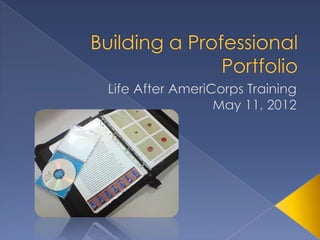
Building a Professional Portfolio

Building a Professional Portfolio

  • 2.
     TEACHERS: Manyschool districts require probationary teachers to develop a portfolio before being recommended for tenure.  Shows your content knowledge and expertise in a field in a quick snapshot.  Makes you stand out from other applicants to a job.
  • 3.
     Purpose isto collect evidence that demonstrates your effective work (classroom, school, District, field)  Analyzes progress over the year(s)  Records and tracks your professional development experiences and how they effect your work  A working document
  • 4.
     Demonstrates yourskills.  Meaningful collections of artifacts based on a set of professional growth goals.  A timeline for sampling work & reflection statements.  TWO MAIN PARTS: Evidence & Reflection
  • 5.
     Help youarticulate your professional goals and the work you have been doing to achieve them.  to record your professional accomplishments.  to help you have materials ready for a job search.
  • 6.
     Organize goalsand experience prior to an interview.  Communicate your professional experience and accomplishments to a potential employer.  Expand on your one-page resume by providing a fuller, richer portrayal of your abilities and experience.
  • 7.
     Portfolios maybe either hardcopy or electronic.  Each year, you should have a professional development goal.  Select artifacts that demonstrate how this professional development goal has impacted your work.  Develop goals and plans for future professional growth.
  • 8.
     Statement ofprofessional goals and philosophy  Resume or Curriculum Vitae  Narrative description of experiences you want to highlight; for example: › Academic Work › Research › Teaching › Leadership › Service › Publications › Conference Participation › Work Experience and Skills › Performance Reviews › Recognition and Awards  Appendices: › Annotated materials and examples to illustrate or elaborate on your statement of goals, philosophy, and the experiences referred to in your narrative description
  • 9.
    For the purposes of this demonstration, we will focus on a teacher’s portfolio.  WHY? › Closest to the work you have been doing. › May be altered to fit into any desired profession.
  • 10.
    Content Knowledge 1. How have you increased capacity to determine which instructional techniques are most appropriate for building students’ understanding of varying forms of content? 2. What aspects of content knowledge continue to shift and evolve, and how have you worked to keep pace with these changes? 3. How do you work to enhance your knowledge of content related to curricula prior to and beyond the grade level of the students you serve?
  • 11.
    Possible Artifacts/Exemplars: › Evidence of ongoing professional development and continuing education. › Involvement in Professional Organizations. › Professional and academic publications. › Excerpts from classroom observation reports. › AmeriCorps Director and/or Site Supervisor Progress Reports.
  • 12.
    Preparation 1. Describe the process you utilize to plan or map out your curriculum or academic interventions. 2. What process do you use to ensure appropriate differentiation of instruction during your planning process? What data do you use to make these decisions? 3. What strategies have you found most effective for establishing a rationale for how your students best learn? What strategies do you find most effective for implementing lesson plans with your students?
  • 13.
    Possible Artifacts/Exemplars: › Sample standards-based unit of study › Excerpts from classroom observation report › Sample of student work as outcome of your teaching
  • 14.
    Instructional Delivery 1. Consider the instructional strategies you have found to be consistently effective in increasing student involvement in discussions, linking learning with prior knowledge, and fostering engagement. 2. Consider instructional methods you have experimented with and chosen to discard. What data, observations, and other indicators led you to discontinue those methods? 3. Describe an example lesson plan which initially failed to meet your anticipated goals, but succeeded after you revised it.
  • 15.
    Possible Artifacts/Exemplars: › Lesson Plans/Unit Plans › Samples of student work › Video of instructional delivery › Photographs of student-centered instructional process
  • 16.
    Classroom Management 1. What systems have you established to provide smooth and efficient transitions in your classroom or after school program? 2. Describe how you monitor student behavior and respond to student misbehavior in an appropriate manner. 3. Describe your process for establishing effective routines and systems for handling materials and supplies.
  • 17.
    Possible Artifacts/Exemplars: › Classroom procedures and expectations. › Management contracts. › Parent communications. › Videos of you in action.
  • 18.
     Student Development Student Assessment  Collaboration  Reflective and Responsive Practice  Record Keeping and Communication  Teacher Professionalism
  • 19.
     Start asearly as possible  Work collaboratively with supervisors in building your portfolio to make it part of your annual review process. You can work with your supervisor to focus on your goals and objectives for each year and discuss how you are reaching your goals.
  • 20.
     Building yourportfolio should be an integral part of your professional growth. It should help you and your supervisor focus on your strengths and areas for growth and development.  It should be a powerful tool for self- reflection and development.
  • 21.
    Make it RELEVANT: › Include your goals › Make sure it’s tied to criteria for evaluating effective teachers › Include supportive examples of student work and performance that reflect those criteria.
  • 22.
    Organize your portfolio › Clearly labeled sections. › Professional and high quality. › If you can incorporate technology it will make you that give you an added edge over competition.
  • 23.
     Develop thepractice of collecting materials that represent your skills and achievements.  Know your audience: Study job announcements and learn what professionals in your field value when hiring.  Select an organizing principle that best reflects your work; for example, chronological, functional, or thematic
  • 24.
    Association of American Geographers: http://www.aag.org/Careers/UW/Profportfolios.html  Colorado State: http://www.biz.colostate.edu/career/portfolio.htm  Florida State: http://www.career.fsu.edu/ccis/guides/port.html  Michigan State: http://www.csp.msu.edu/cdc/explore/proport.htm  Northwestern University: http://www.northwestern.edu/careers/STUDENTS/job- skills/portfolio.htm  RLS Career Center: http://www.rlscareercenter.org/portfolio.htm
  • 25.
    www.professionalportfolio.net
  • 26.
    •What do you thinkabout this ePortfolio? •Is it appropriate for the career goals of this person? •What would you change about it?
  • 27.
    •What do you thinkabout this ePortfolio? •Is it appropriate for the career goals of this person? •What would you change about it?
  • 28.
    •What do you thinkabout this ePortfolio? •Is it appropriate for the career goals of this person? •What would you change about it?
  • 29.
    •What do you thinkabout this ePortfolio? •Is it appropriate for the career goals of this person? •What would you change about it?

Editor's Notes

  • #4 Usually spans 2-3 years. Should be updated regularly.
  • #5 A professional portfolio is simply a collection of physical evidence that helps document and describe your professional accomplishments. Portfolios can be very useful in encouraging your systematic collection of evidence of professional development over time and in promoting reflection about your professional growth
  • #7 The night before an interview you should review your portfolio to recall accomplishment and help you prepare for the interview.