Professional Portfolio
Overview
Professional
Portfolio
Teacher candidates will create a showcase
portfolio, to document and highlight learning
throughout the program. The portfolio will
contain a minimum of 9 pieces of evidence
with corresponding reflective essays aligned
with 9 out of the 10 InTASC Standards.
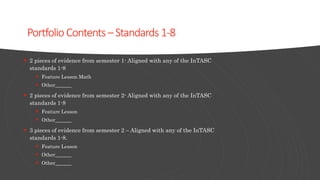
Portfolio Contents–Standards 1-8
 2 pieces of evidence from semester 1- Aligned with any of the InTASC
standards 1-8
 Feature Lesson Math
 Other
 2 pieces of evidence from semester 2- Aligned with any of the InTASC
standards 1-8
 Feature Lesson
 Other
 3 pieces of evidence from semester 2 – Aligned with any of the InTASC
standards 1-8.
 Feature Lesson
 Other
 Other
InTASC
Standards
1-3
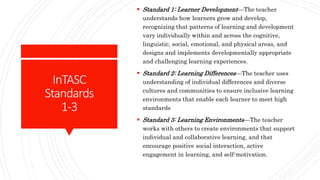
 Standard 1: Learner Development—The teacher
understands how learners grow and develop,
recognizing that patterns of learning and development
vary individually within and across the cognitive,
linguistic, social, emotional, and physical areas, and
designs and implements developmentally appropriate
and challenging learning experiences.
 Standard 2: Learning Differences—The teacher uses
understanding of individual differences and diverse
cultures and communities to ensure inclusive learning
environments that enable each learner to meet high
standards
 Standard 3: Learning Environments—The teacher
works with others to create environments that support
individual and collaborative learning, and that
encourage positive social interaction, active
engagement in learning, and self-motivation.
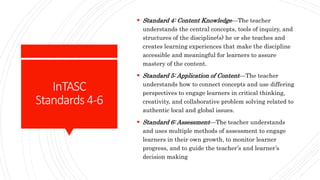
InTASC
Standards4-6
 Standard 4: Content Knowledge—The teacher
understands the central concepts, tools of inquiry, and
structures of the discipline(s) he or she teaches and
creates learning experiences that make the discipline
accessible and meaningful for learners to assure
mastery of the content.
 Standard 5: Application of Content—The teacher
understands how to connect concepts and use differing
perspectives to engage learners in critical thinking,
creativity, and collaborative problem solving related to
authentic local and global issues.
 Standard 6: Assessment—The teacher understands
and uses multiple methods of assessment to engage
learners in their own growth, to monitor learner
progress, and to guide the teacher’s and learner’s
decision making
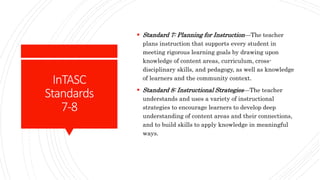
InTASC
Standards
7-8
 Standard 7: Planning for Instruction—The teacher
plans instruction that supports every student in
meeting rigorous learning goals by drawing upon
knowledge of content areas, curriculum, cross-
disciplinary skills, and pedagogy, as well as knowledge
of learners and the community context.
 Standard 8: Instructional Strategies—The teacher
understands and uses a variety of instructional
strategies to encourage learners to develop deep
understanding of content areas and their connections,
and to build skills to apply knowledge in meaningful
ways.
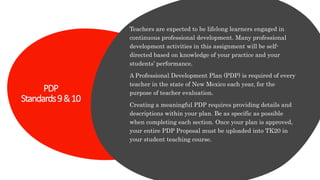
PDP
Standards9&10
Teachers are expected to be lifelong learners engaged in
continuous professional development. Many professional
development activities in this assignment will be self-
directed based on knowledge of your practice and your
students’ performance.
A Professional Development Plan (PDP) is required of every
teacher in the state of New Mexico each year, for the
purpose of teacher evaluation.
Creating a meaningful PDP requires providing details and
descriptions within your plan. Be as specific as possible
when completing each section. Once your plan is approved,
your entire PDP Proposal must be uploaded into TK20 in
your student teaching course.
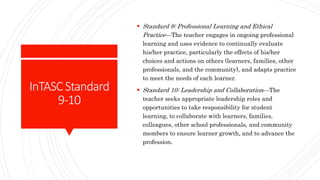
InTASCStandard
9-10
 Standard 9: Professional Learning and Ethical
Practice—The teacher engages in ongoing professional
learning and uses evidence to continually evaluate
his/her practice, particularly the effects of his/her
choices and actions on others (learners, families, other
professionals, and the community), and adapts practice
to meet the needs of each learner.
 Standard 10: Leadership and Collaboration—The
teacher seeks appropriate leadership roles and
opportunities to take responsibility for student
learning, to collaborate with learners, families,
colleagues, other school professionals, and community
members to ensure learner growth, and to advance the
profession.
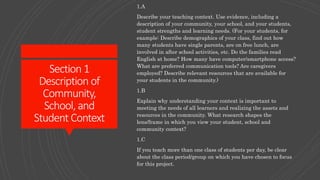
Section1
Description of
Community,
School, and
Student Context
1.A
Describe your teaching context. Use evidence, including a
description of your community, your school, and your students,
student strengths and learning needs. (For your students, for
example: Describe demographics of your class, find out how
many students have single parents, are on free lunch, are
involved in after school activities, etc. Do the families read
English at home? How many have computer/smartphone access?
What are preferred communication tools? Are caregivers
employed? Describe relevant resources that are available for
your students in the community.)
1.B
Explain why understanding your context is important to
meeting the needs of all learners and realizing the assets and
resources in the community. What research shapes the
lens/frame in which you view your student, school and
community context?
1.C
If you teach more than one class of students per day, be clear
about the class period/group on which you have chosen to focus
for this project.
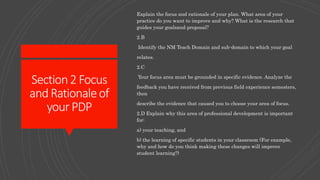
Section2Focus
andRationaleof
yourPDP
Explain the focus and rationale of your plan. What area of your
practice do you want to improve and why? What is the research that
guides your goalsand proposal?
2.B
Identify the NM Teach Domain and sub-domain to which your goal
relates.
2.C
Your focus area must be grounded in specific evidence. Analyze the
feedback you have received from previous field experience semesters,
then
describe the evidence that caused you to choose your area of focus.
2.D Explain why this area of professional development is important
for:
a) your teaching, and
b) the learning of specific students in your classroom (For example,
why and how do you think making these changes will improve
student learning?)
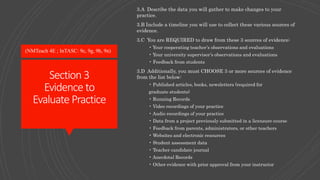
Section3
Evidence to
Evaluate Practice
3.A Describe the data you will gather to make changes to your
practice.
3.B Include a timeline you will use to collect these various sources of
evidence.
3.C You are REQUIRED to draw from these 3 sources of evidence:
• Your cooperating teacher’s observations and evaluations
• Your university supervisor’s observations and evaluations
• Feedback from students
3.D Additionally, you must CHOOSE 3 or more sources of evidence
from the list below:
• Published articles, books, newsletters (required for
graduate students)
• Running Records
• Video recordings of your practice
• Audio recordings of your practice
• Data from a project previously submitted in a licensure course
• Feedback from parents, administrators, or other teachers
• Websites and electronic resources
• Student assessment data
• Teacher candidate journal
• Anecdotal Records
• Other evidence with prior approval from your instructor
(NMTeach 4E ; InTASC: 9c, 9g, 9h, 9n)
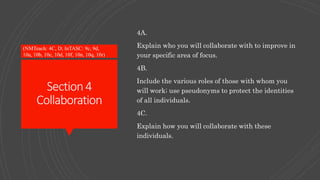
Section4
Collaboration
4A.
Explain who you will collaborate with to improve in
your specific area of focus.
4B.
Include the various roles of those with whom you
will work; use pseudonyms to protect the identities
of all individuals.
4C.
Explain how you will collaborate with these
individuals.
(NMTeach: 4C, D; InTASC: 9c, 9d,
10a, 10b, 10c, 10d, 10f, 10n, 10q, 10r)
Section5
Impact of
Personal Identity
5A.
Describe your personal and professional identity.
5B.
Be explicit in explaining how you believe your own
perspectives and professional identity influences your
work.
5C.
Consider how your identity plays a role in the plan you
have described.
(InTASC: 9e, 9i, 9m)
Academic
Writing
 Attend to spelling, grammar, capitalization,
and punctuation conventions.
 Feel free to use headings to indicate
important sections or organization of your
work.
 Ensure the PDP is one you would be proud to
share with other teachers, your principal,
and community/family members.
 Use pseudonyms to protect the identities of
all individuals.

Portfolio PowerPoint

  • 1.
  • 2.
    Professional Portfolio Teacher candidates willcreate a showcase portfolio, to document and highlight learning throughout the program. The portfolio will contain a minimum of 9 pieces of evidence with corresponding reflective essays aligned with 9 out of the 10 InTASC Standards.
  • 3.
    Portfolio Contents–Standards 1-8 2 pieces of evidence from semester 1- Aligned with any of the InTASC standards 1-8  Feature Lesson Math  Other  2 pieces of evidence from semester 2- Aligned with any of the InTASC standards 1-8  Feature Lesson  Other  3 pieces of evidence from semester 2 – Aligned with any of the InTASC standards 1-8.  Feature Lesson  Other  Other
  • 4.
    InTASC Standards 1-3  Standard 1:Learner Development—The teacher understands how learners grow and develop, recognizing that patterns of learning and development vary individually within and across the cognitive, linguistic, social, emotional, and physical areas, and designs and implements developmentally appropriate and challenging learning experiences.  Standard 2: Learning Differences—The teacher uses understanding of individual differences and diverse cultures and communities to ensure inclusive learning environments that enable each learner to meet high standards  Standard 3: Learning Environments—The teacher works with others to create environments that support individual and collaborative learning, and that encourage positive social interaction, active engagement in learning, and self-motivation.
  • 5.
    InTASC Standards4-6  Standard 4:Content Knowledge—The teacher understands the central concepts, tools of inquiry, and structures of the discipline(s) he or she teaches and creates learning experiences that make the discipline accessible and meaningful for learners to assure mastery of the content.  Standard 5: Application of Content—The teacher understands how to connect concepts and use differing perspectives to engage learners in critical thinking, creativity, and collaborative problem solving related to authentic local and global issues.  Standard 6: Assessment—The teacher understands and uses multiple methods of assessment to engage learners in their own growth, to monitor learner progress, and to guide the teacher’s and learner’s decision making
  • 6.
    InTASC Standards 7-8  Standard 7:Planning for Instruction—The teacher plans instruction that supports every student in meeting rigorous learning goals by drawing upon knowledge of content areas, curriculum, cross- disciplinary skills, and pedagogy, as well as knowledge of learners and the community context.  Standard 8: Instructional Strategies—The teacher understands and uses a variety of instructional strategies to encourage learners to develop deep understanding of content areas and their connections, and to build skills to apply knowledge in meaningful ways.
  • 7.
    PDP Standards9&10 Teachers are expectedto be lifelong learners engaged in continuous professional development. Many professional development activities in this assignment will be self- directed based on knowledge of your practice and your students’ performance. A Professional Development Plan (PDP) is required of every teacher in the state of New Mexico each year, for the purpose of teacher evaluation. Creating a meaningful PDP requires providing details and descriptions within your plan. Be as specific as possible when completing each section. Once your plan is approved, your entire PDP Proposal must be uploaded into TK20 in your student teaching course.
  • 8.
    InTASCStandard 9-10  Standard 9:Professional Learning and Ethical Practice—The teacher engages in ongoing professional learning and uses evidence to continually evaluate his/her practice, particularly the effects of his/her choices and actions on others (learners, families, other professionals, and the community), and adapts practice to meet the needs of each learner.  Standard 10: Leadership and Collaboration—The teacher seeks appropriate leadership roles and opportunities to take responsibility for student learning, to collaborate with learners, families, colleagues, other school professionals, and community members to ensure learner growth, and to advance the profession.
  • 9.
    Section1 Description of Community, School, and StudentContext 1.A Describe your teaching context. Use evidence, including a description of your community, your school, and your students, student strengths and learning needs. (For your students, for example: Describe demographics of your class, find out how many students have single parents, are on free lunch, are involved in after school activities, etc. Do the families read English at home? How many have computer/smartphone access? What are preferred communication tools? Are caregivers employed? Describe relevant resources that are available for your students in the community.) 1.B Explain why understanding your context is important to meeting the needs of all learners and realizing the assets and resources in the community. What research shapes the lens/frame in which you view your student, school and community context? 1.C If you teach more than one class of students per day, be clear about the class period/group on which you have chosen to focus for this project.
  • 10.
    Section2Focus andRationaleof yourPDP Explain the focusand rationale of your plan. What area of your practice do you want to improve and why? What is the research that guides your goalsand proposal? 2.B Identify the NM Teach Domain and sub-domain to which your goal relates. 2.C Your focus area must be grounded in specific evidence. Analyze the feedback you have received from previous field experience semesters, then describe the evidence that caused you to choose your area of focus. 2.D Explain why this area of professional development is important for: a) your teaching, and b) the learning of specific students in your classroom (For example, why and how do you think making these changes will improve student learning?)
  • 11.
    Section3 Evidence to Evaluate Practice 3.ADescribe the data you will gather to make changes to your practice. 3.B Include a timeline you will use to collect these various sources of evidence. 3.C You are REQUIRED to draw from these 3 sources of evidence: • Your cooperating teacher’s observations and evaluations • Your university supervisor’s observations and evaluations • Feedback from students 3.D Additionally, you must CHOOSE 3 or more sources of evidence from the list below: • Published articles, books, newsletters (required for graduate students) • Running Records • Video recordings of your practice • Audio recordings of your practice • Data from a project previously submitted in a licensure course • Feedback from parents, administrators, or other teachers • Websites and electronic resources • Student assessment data • Teacher candidate journal • Anecdotal Records • Other evidence with prior approval from your instructor (NMTeach 4E ; InTASC: 9c, 9g, 9h, 9n)
  • 12.
    Section4 Collaboration 4A. Explain who youwill collaborate with to improve in your specific area of focus. 4B. Include the various roles of those with whom you will work; use pseudonyms to protect the identities of all individuals. 4C. Explain how you will collaborate with these individuals. (NMTeach: 4C, D; InTASC: 9c, 9d, 10a, 10b, 10c, 10d, 10f, 10n, 10q, 10r)
  • 13.
    Section5 Impact of Personal Identity 5A. Describeyour personal and professional identity. 5B. Be explicit in explaining how you believe your own perspectives and professional identity influences your work. 5C. Consider how your identity plays a role in the plan you have described. (InTASC: 9e, 9i, 9m)
  • 14.
    Academic Writing  Attend tospelling, grammar, capitalization, and punctuation conventions.  Feel free to use headings to indicate important sections or organization of your work.  Ensure the PDP is one you would be proud to share with other teachers, your principal, and community/family members.  Use pseudonyms to protect the identities of all individuals.