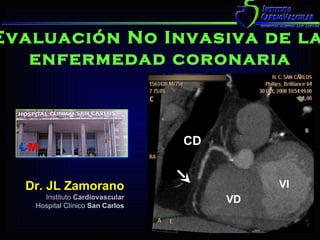
CD VI VD Evaluación No Invasiva de la enfermedad coronaria Dr. JL Zamorano Instituto  Cardiovascular Hospital Clínico  San Carlos
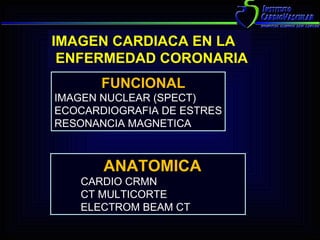
IMAGEN CARDIACA EN LA ENFERMEDAD CORONARIA   FUNCIONAL IMAGEN NUCLEAR (SPECT) ECOCARDIOGRAFIA DE ESTRES RESONANCIA MAGNETICA   ANATOMICA   CARDIO CRMN   CT MULTICORTE   ELECTROM BEAM CT
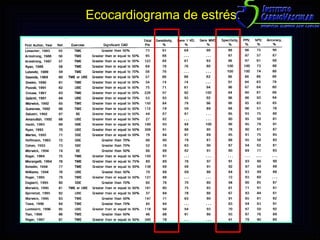
Ecocardiograma de estrés.
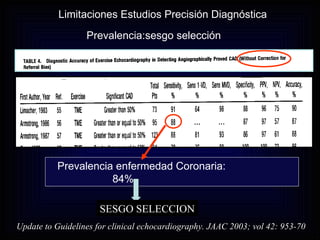
Prevalencia enfermedad Coronaria:  84% SESGO SELECCION Update to Guidelines for clinical echocardiography. JAAC 2003; vol 42: 953-70 Limitaciones Estudios Precisión Diagnóstica Prevalencia:sesgo selección
La selección de pacientes a la técnica “patrón oro” se realiza en base a : Resultados del test no invasivo : Muchos  Test positivos son referidos a Coronariografia Pocos test negativos son referidos a Coronariografia No diagnosticamos muchos falsos negativos Características del paciente :   Los pacientes mas enfermos son los remitidos a coronario Aumentamos la sensibilidad Disminuimos especificidad S = VP VP+ FN E = VN VN+FP Sesgo verificación
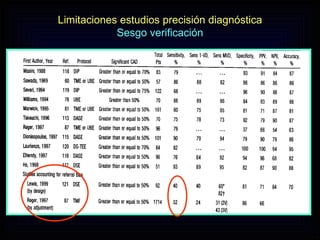
Limitaciones estudios precisión diagnóstica Sesgo verificación
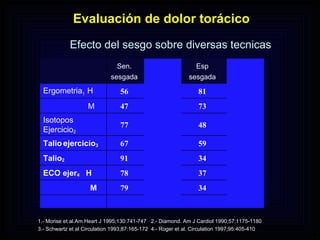
Evaluación de dolor torácico   1.- Morise et al.Am Heart J 1995;130:741-747  2.- Diamond. Am J Cardiol 1990;57:1175-1180 3.- Schwartz et al Circulation 1993;87:165-172  4.- Roger et al. Circulation 1997;95:405-410 Efecto del sesgo sobre diversas tecnicas Sen. sesgada Sen No sesgada Esp sesgada Esp. No  sesgada Ergometria 1  H 56 40 81 96 M 47 33 73 89 Isotopos Ejercicio 2 77 57 48 70 Talio   ejercicio 3 67 45 59 78 Talio 2 91 68 34 71 ECO ejer 4  H 78 42 37 83 M 79 32 34 86
IMAGEN CARDIACA EN LA ENFERMEDAD CORONARIA   FUNCIONAL IMAGEN NUCLEAR (SPECT) ECOCARDIOGRAFIA DE ESTRES RESONANCIA MAGNETICA   ANATOMICA   CARDIO CRMN   CT MULTICORTE   ELECTROM BEAM CT
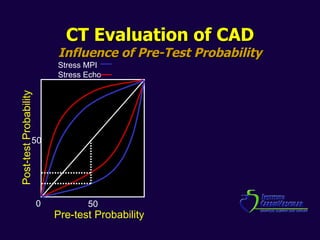
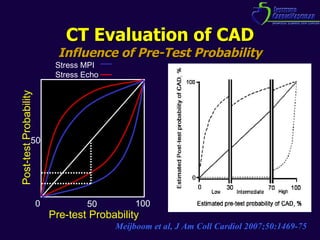
CT Evaluation of CAD Influence of Pre-Test Probability Pre-test Probability Post-test Probability 0 50 50 Stress MPI Stress Echo
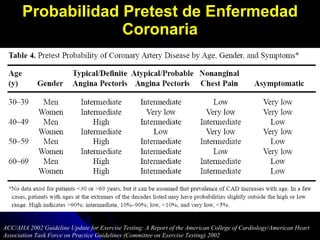
Probabilidad Pretest de Enfermedad Coronaria ACC/AHA 2002 Guideline Update for Exercise Testing: A Report of the American College of Cardiology/American Heart Association Task Force on Practice Guidelines (Committee on Exercise Testing) 2002
 
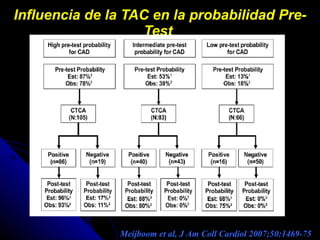
Influencia de la TAC en la probabilidad Pre-Test  Meijboom et al, J Am Coll Cardiol 2007;50:1469-75
CT Evaluation of CAD Influence of Pre-Test Probability Pre-test Probability Post-test Probability 0 50 50 Stress MPI Stress Echo Meijboom et al, J Am Coll Cardiol 2007;50:1469-75 100
Preguntas clave Es preciso en su diagnóstico. En qué pacientes es útil. Asintomáticos ?.
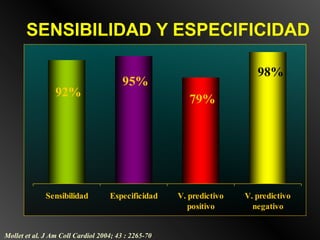
SENSIBILIDAD Y ESPECIFICIDAD Mollet et al. J Am Coll Cardiol 2004; 43 : 2265-70
CORE 64: Objectives To evaluate the diagnostic performance of 64 detector MDCT in the ability to identify  patients  with significant CAD compared with coronary angiography. Significant:>50% stenosis by quantitative coronary anglography Per  vessel  diagnostic accurancy with QCA
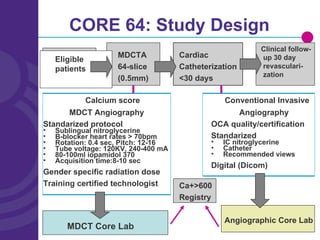
CORE 64: Study Design Eligible patients Calcium score MDCT Angiography Standarized protocol Sublingual nitroglycerine B-blocker heart rates > 70bpm Rotation: 0.4 sec, Pitch: 12-16 Tube voltage: 120KV, 240-400 mA 80-100ml iopamidol 370 Acquisition time:8-10 sec Gender specific radiation dose Training certified technologist MDCTA 64-slice (0.5mm) Cardiac Catheterization  <30 days Clinical follow-up 30 day revasculari-zation Conventional Invasive Angiography OCA quality/certification Standarized IC nitroglycerine Catheter Recommended views Digital (Dicom) Ca+>600 Registry Angiographic Core Lab MDCT Core Lab
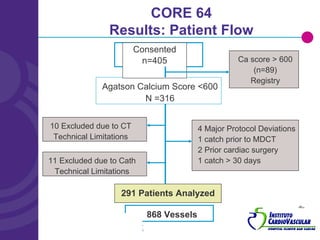
Consented n=405 CORE 64 Results: Patient Flow Agatson Calcium Score <600 N =316 10 Excluded due to CT Technical Limitations 291 Patients Analyzed 868 Vessels 4 Major Protocol Deviations 1 catch prior to MDCT 2 Prior cardiac surgery 1 catch > 30 days Ca score > 600 (n=89) Registry 11 Excluded due to Cath Technical Limitations
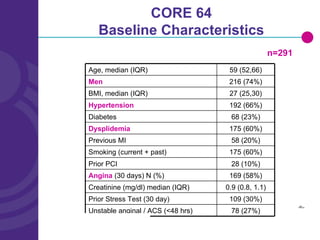
CORE 64 Baseline Characteristics n=291 Age, median (IQR) 59 (52,66) Men 216 (74%) BMI, median (IQR) 27 (25,30) Hypertension 192 (66%) Diabetes 68 (23%) Dysplidemia 175 (60%) Previous MI 58 (20%) Smoking (current + past) 175 (60%) Prior PCI 28 (10%) Angina  (30 days) N (%) 169 (58%) Creatinine (mg/dl) median (IQR) 0.9 (0.8, 1.1) Prior Stress Test (30 day) 109 (30%) Unstable anginal / ACS (<48 hrs) 78 (27%)
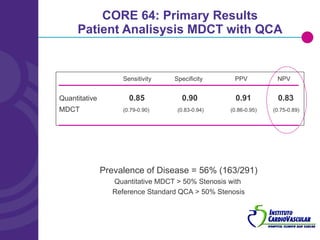
CORE 64: Primary Results Patient Analisysis MDCT with QCA Sensitivity   Specificity   PPV   NPV Quantitative   0.85   0.90  0.91  0.83 MDCT (0.79-0.90)    (0.83-0.94)  (0.86-0.95)  (0.75-0.89) Prevalence of Disease = 56% (163/291) Quantitative MDCT > 50% Stenosis with  Reference Standard QCA > 50% Stenosis
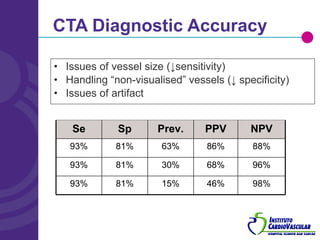
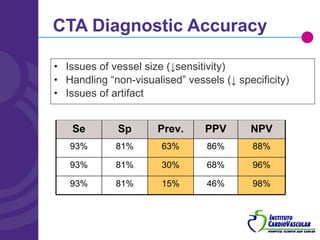
CTA Diagnostic Accuracy Issues of vessel size (↓sensitivity) Handling “non-visualised” vessels (↓ specificity) Issues of artifact Se Sp Prev. PPV NPV 93% 81% 63% 86% 88% 93% 81% 30% 68% 96% 93% 81% 15% 46% 98%
Preguntas clave Es preciso en su diagnóstico. En qué pacientes es útil. Asintomáticos ?.
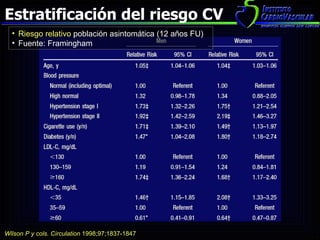
Estratificación del riesgo CV Riesgo relativo  población asintomática (12 años FU) Fuente: Framingham  Wilson P y cols. Circulation  1998;97;1837-1847
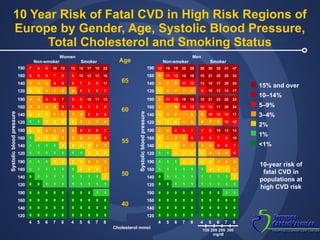
10 Year Risk of Fatal CVD in High Risk Regions of Europe by Gender, Age, Systolic Blood Pressure, Total Cholesterol and Smoking Status 190 160 140 120 190 160 140 120 190 160 140 120 190 160 140 120 190 160 140 120 Systolic blood pressure 4 5 6 7 8 4 5 6 7 8 Non-smoker Smoker Women 15% and over 10–14% 5–9% 3–4% 2% 1% <1% 10-year risk of fatal CVD in populations at high CVD risk 190 160 140 120 190 160 140 120 190 160 140 120 190 160 140 120 190 160 140 120 Systolic blood pressure 4 5 6 7 8 4 5 6 7 8 Non-smoker Smoker Age Men 65 60 55 50 40 Cholesterol mmol 150 200 250 300 mg/dl 7 8 9 10 12 5 5 6 7 8 3 3 4 5 6 2 2 3 3 4 4 4 5 6 7 3 3 3 4 5 2 2 2 3 3 1 1 2 2 2 2 2 3 3 4 1 2 2 2 3 1 1 1 1 2 1 1 1 1 1 1 1 1 2 2 1 1 1 1 1 0 1 1 1 1 0 0 1 1 1 0 0 0 0 0 0 0 0 0 0 0 0 0 0 0 0 0 0 0 0 13 15 17 19 22 9 10 12 13 16 6 7 8 9 11 4 5 5 6 7 8 9 10 11 13 5 6 7 8 9 3 4 5 5 6 2 3 3 4 4 4 5 5 6 7 3 3 4 4 5 2 2 2 3 3 1 1 2 2 2 2 2 3 3 4 1 2 2 2 3 1 1 1 1 2 1 1 1 1 1 0 0 0 1 1 0 0 0 0 0 0 0 0 0 0 0 0 0 0 0 14 16 19 22 26 9 11 13 15 16 6 8 9 11 13 4 5 6 7 9 9 11 13 15 18 6 7 9 10 12 4 5 6 7 9 3 3 4 5 6 4 4 5 6 7 2 3 3 4 5 2 2 2 3 3 1 1 2 2 2 1 1 1 2 2 1 1 1 1 1 0 1 1 1 1 0 0 1 1 1 0 0 0 0 0 0 0 0 0 0 0 0 0 0 0 0 0 0 0 0 26 30 35 41 47 18 21 25 29 34 13 15 17 20 24 9 10 12 14 17 18 21 24 28 33 12 14 17 20 24 8 10 12 14 17 6 7 8 10 12 7 8 10 12 14 5 6 7 8 10 3 4 5 6 7 2 3 3 4 5 2 2 3 3 4 1 2 2 2 3 1 1 1 1 2 1 1 1 1 1 0 0 0 1 1 0 0 0 0 0 0 0 0 0 0 0 0 0 0 0
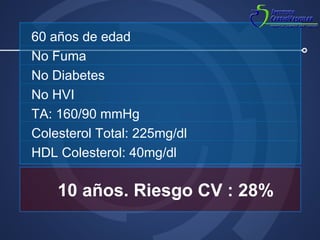
60 años de edad No Fuma No Diabetes No HVI TA: 160/90 mmHg Colesterol Total: 225mg/dl HDL Colesterol: 40mg/dl 10 años. Riesgo CV : 28%
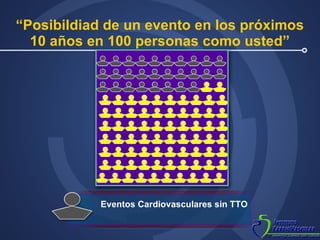
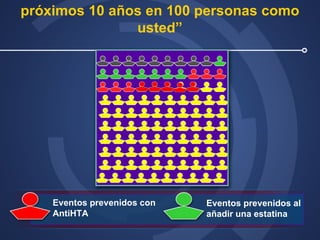
“ Posibildiad de un evento en los próximos 10 años en 100 personas como usted” Eventos Cardiovasculares sin TTO
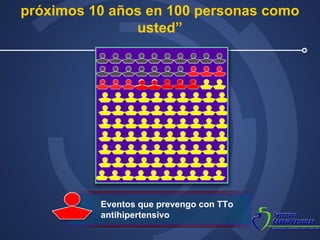
“ Posibildiad de un evento en los próximos 10 años en 100 personas como usted” Eventos que prevengo con TTo antihipertensivo
Eventos prevenidos con  AntiHTA Eventos prevenidos al añadir una estatina “ Posibildiad de un evento en los próximos 10 años en 100 personas como usted”
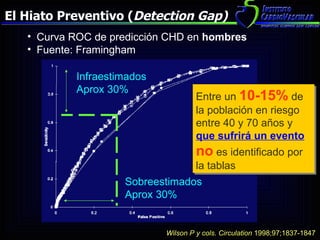
El Hiato Preventivo ( Detection Gap) Wilson P y cols. Circulation  1998;97;1837-1847 Infraestimados Aprox 30% Sobreestimados Aprox 30% Curva ROC de predicción CHD en  hombres Fuente: Framingham Entre un  10-15%  de la población en riesgo entre 40 y 70 años y  que sufrirá un evento   no  es identificado por la tablas
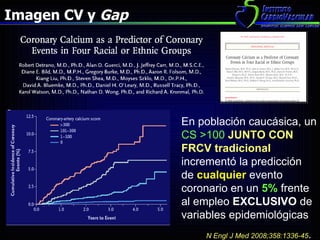
Imagen CV y  Gap N Engl J Med 2008;358:1336-45 . En población caucásica, un  CS >100   JUNTO CON FRCV tradicional  incrementó la predicción de  cualquier  evento coronario en un  5%  frente al empleo  EXCLUSIVO  de variables epidemiológicas
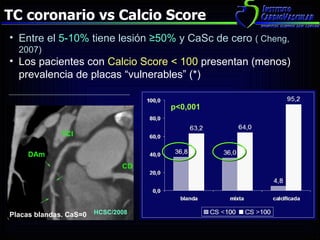
TC coronario vs Calcio Score Entre el  5-10%  tiene lesión  ≥50%  y CaSc de cero  ( Cheng, 2007) Los pacientes con  Calcio Score < 100  presentan (menos) prevalencia de placas “vulnerables” (*) HCSC/2008 Placas blandas. CaS=0 p<0,001
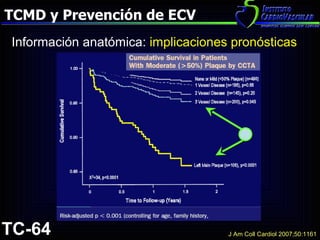
TCMD y Prevención de ECV Información anatómica:  implicaciones pronósticas  J Am Coll Cardiol 2007;50:1161 TC-64
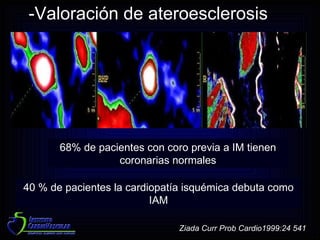
68% de pacientes con coro previa a IM tienen coronarias normales Ziada Curr Prob Cardio1999:24 541 40 % de pacientes la cardiopatía isquémica debuta como IAM -Valoración de ateroesclerosis
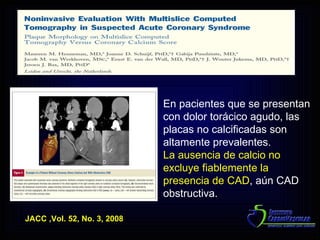
JACC ,Vol. 52, No. 3, 2008 En pacientes que se presentan con dolor torácico agudo, las placas no calcificadas son altamente prevalentes. La ausencia de calcio no excluye fiablemente la presencia de CAD , aún CAD obstructiva.
Es  desconocido el riesgo  de IAM en pacientes con placa blanda detectados con TAC multicorte. Es  desconocido el valor aditivo  de encontrar una placa blanda sobre el valor del score calcio No sabemos  cual es la estrategia adecuada  para la prevención de complicaciones cardiovasculares en los pacientes con placa no calcificada - Los grandes interrogantes
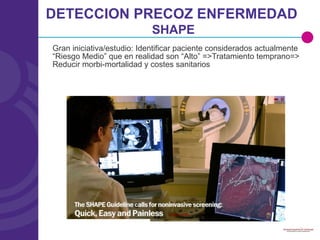
Gran iniciativa/estudio: Identificar paciente considerados actualmente “Riesgo Medio” que en realidad son “Alto” =>Tratamiento temprano=> Reducir morbi-mortalidad y costes sanitarios DETECCION PRECOZ ENFERMEDAD   SHAPE
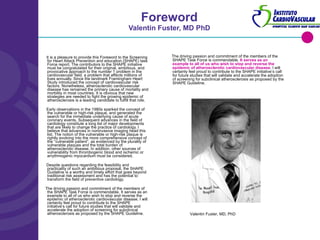
Foreword Valentin Fuster, MD PhD It is a pleasure to provide this Foreword to the Screening for Heart Attack Prevention and education (SHAPE) task Force report. The contributors to the SHAPE initiative must be congratulated for their original, ambitious, and provocative approach to the number 1 problem in the cardiovascular field, a problem that affects millions of lives annually. Since the landmark Framingham Heart Study introduced the concept of cardiovascular risk factors. Nonetheless, atherosclerotic cardiovascular disease has remained the primary cause of mortality and morbility in most countries. It is obvious that new strategies are needed to fight the growing epidemic of atherosclerosis is a leading candidate to fulfill that role. Early observations in the 1980s sparked the concept of the vulnerable or high-risk plaque, and generated the search for the immediate underlying cause of acute coronary events. Subsequent advances in the field of cardiology constitute a long list of major developments that are likely to change the practice of cardiology. I believe that advances in noninvasive imaging head this list. The notion of the vulnerable or high-risk plaque is rightly evolving into the more comprehensive concept of the “vulnerable patient”, as evidenced by the plurality of vulnerable plaques and the total burden of atherosclerotic disease. In addition, other sources of vulnerability from thrombogenic blood and ischemic or arrythmogenic myocardium must be considered. Despite questions regarding the feasibility and practicality of such an ambitious proposal, the SHAPE Guideline is a worthy and timely effort that goes beyond traditional risk assessment and has the potential to transform the field of preventive cardiology. The driving passion and commitment of the members of the SHAPE Task Force is commendable. It serves as an example to all of us who wish to stop and reverse the epidemic of atherosclerotic cardiovascular disease. I will certainly feel proud to contribute to the SHAPE initiative’s call for future studies that will validate and accelerate the adoption of screening for subclinical atherosclerosis as proposed by the SHAPE Guideline. The driving passion and commitment of the members of the SHAPE Task Force is commendable.  It serves as an example to all of us who wish to stop and reverse the epidemic of atherosclerotic cardiovascular disease . I will certainly feel proud to contribute to the SHAPE initiative’s call for future studies that will validate and accelerate the adoption of screening for subclinical atherosclerosis as proposed by the SHAPE Guideline. Valentin Fuster, MD, PhD
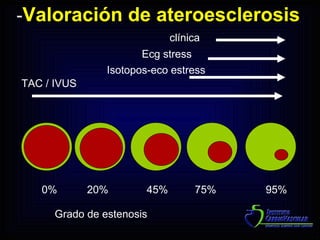
0%  20%   45%  75% 95% Grado de estenosis TAC / IVUS Isotopos-eco estress Ecg stress clínica - Valoración de ateroesclerosis
Conclusión Entre el 30 y 50% de la población, según su edad, presentará un   episodio cardiovascular grave o mortal Las exploraciones FUNCIONALES son claves en el estudio de la aterosclerosis. El TAC aporta sin duda estudios morfológicos de gran precisión diagnóstica Datos preliminares en pacientes seleccionados apoyan el  uso de  TC coronario  como  add-on  en la estratificación del riesgo CV y  potencialmente superior   al Calcio Score Ensayos o redes colaborativas son necesarias para  demostrar de modo definitivo la  justificación   del uso del TC coronario en PP asintomáticos en riesgo
Reflexión. “” Awaiting  overt signs and symptoms of coronary disease before treatment is  no longer justified.” “ In some respects, the occurrence of symptoms may be regarded more properly as a  medical failure  than as the initial indication for treatment.”   William B. Kannel, MD   Boston University Medical Center

Dr. Jose Luis Zamorano. Evolución no invasiva de la enfermedad aterosclerótica

  • 1.
    CD VI VDEvaluación No Invasiva de la enfermedad coronaria Dr. JL Zamorano Instituto Cardiovascular Hospital Clínico San Carlos
  • 2.
    IMAGEN CARDIACA ENLA ENFERMEDAD CORONARIA FUNCIONAL IMAGEN NUCLEAR (SPECT) ECOCARDIOGRAFIA DE ESTRES RESONANCIA MAGNETICA ANATOMICA CARDIO CRMN CT MULTICORTE ELECTROM BEAM CT
  • 3.
  • 4.
    Prevalencia enfermedad Coronaria: 84% SESGO SELECCION Update to Guidelines for clinical echocardiography. JAAC 2003; vol 42: 953-70 Limitaciones Estudios Precisión Diagnóstica Prevalencia:sesgo selección
  • 5.
    La selección depacientes a la técnica “patrón oro” se realiza en base a : Resultados del test no invasivo : Muchos Test positivos son referidos a Coronariografia Pocos test negativos son referidos a Coronariografia No diagnosticamos muchos falsos negativos Características del paciente : Los pacientes mas enfermos son los remitidos a coronario Aumentamos la sensibilidad Disminuimos especificidad S = VP VP+ FN E = VN VN+FP Sesgo verificación
  • 6.
    Limitaciones estudios precisióndiagnóstica Sesgo verificación
  • 7.
    Evaluación de dolortorácico 1.- Morise et al.Am Heart J 1995;130:741-747 2.- Diamond. Am J Cardiol 1990;57:1175-1180 3.- Schwartz et al Circulation 1993;87:165-172 4.- Roger et al. Circulation 1997;95:405-410 Efecto del sesgo sobre diversas tecnicas Sen. sesgada Sen No sesgada Esp sesgada Esp. No sesgada Ergometria 1 H 56 40 81 96 M 47 33 73 89 Isotopos Ejercicio 2 77 57 48 70 Talio ejercicio 3 67 45 59 78 Talio 2 91 68 34 71 ECO ejer 4 H 78 42 37 83 M 79 32 34 86
  • 8.
    IMAGEN CARDIACA ENLA ENFERMEDAD CORONARIA FUNCIONAL IMAGEN NUCLEAR (SPECT) ECOCARDIOGRAFIA DE ESTRES RESONANCIA MAGNETICA ANATOMICA CARDIO CRMN CT MULTICORTE ELECTROM BEAM CT
  • 9.
    CT Evaluation ofCAD Influence of Pre-Test Probability Pre-test Probability Post-test Probability 0 50 50 Stress MPI Stress Echo
  • 10.
    Probabilidad Pretest deEnfermedad Coronaria ACC/AHA 2002 Guideline Update for Exercise Testing: A Report of the American College of Cardiology/American Heart Association Task Force on Practice Guidelines (Committee on Exercise Testing) 2002
  • 11.
  • 12.
    Influencia de laTAC en la probabilidad Pre-Test Meijboom et al, J Am Coll Cardiol 2007;50:1469-75
  • 13.
    CT Evaluation ofCAD Influence of Pre-Test Probability Pre-test Probability Post-test Probability 0 50 50 Stress MPI Stress Echo Meijboom et al, J Am Coll Cardiol 2007;50:1469-75 100
  • 14.
    Preguntas clave Espreciso en su diagnóstico. En qué pacientes es útil. Asintomáticos ?.
  • 15.
    SENSIBILIDAD Y ESPECIFICIDADMollet et al. J Am Coll Cardiol 2004; 43 : 2265-70
  • 16.
    CORE 64: ObjectivesTo evaluate the diagnostic performance of 64 detector MDCT in the ability to identify patients with significant CAD compared with coronary angiography. Significant:>50% stenosis by quantitative coronary anglography Per vessel diagnostic accurancy with QCA
  • 17.
    CORE 64: StudyDesign Eligible patients Calcium score MDCT Angiography Standarized protocol Sublingual nitroglycerine B-blocker heart rates > 70bpm Rotation: 0.4 sec, Pitch: 12-16 Tube voltage: 120KV, 240-400 mA 80-100ml iopamidol 370 Acquisition time:8-10 sec Gender specific radiation dose Training certified technologist MDCTA 64-slice (0.5mm) Cardiac Catheterization <30 days Clinical follow-up 30 day revasculari-zation Conventional Invasive Angiography OCA quality/certification Standarized IC nitroglycerine Catheter Recommended views Digital (Dicom) Ca+>600 Registry Angiographic Core Lab MDCT Core Lab
  • 18.
    Consented n=405 CORE64 Results: Patient Flow Agatson Calcium Score <600 N =316 10 Excluded due to CT Technical Limitations 291 Patients Analyzed 868 Vessels 4 Major Protocol Deviations 1 catch prior to MDCT 2 Prior cardiac surgery 1 catch > 30 days Ca score > 600 (n=89) Registry 11 Excluded due to Cath Technical Limitations
  • 19.
    CORE 64 BaselineCharacteristics n=291 Age, median (IQR) 59 (52,66) Men 216 (74%) BMI, median (IQR) 27 (25,30) Hypertension 192 (66%) Diabetes 68 (23%) Dysplidemia 175 (60%) Previous MI 58 (20%) Smoking (current + past) 175 (60%) Prior PCI 28 (10%) Angina (30 days) N (%) 169 (58%) Creatinine (mg/dl) median (IQR) 0.9 (0.8, 1.1) Prior Stress Test (30 day) 109 (30%) Unstable anginal / ACS (<48 hrs) 78 (27%)
  • 20.
    CORE 64: PrimaryResults Patient Analisysis MDCT with QCA Sensitivity Specificity PPV NPV Quantitative 0.85 0.90 0.91 0.83 MDCT (0.79-0.90) (0.83-0.94) (0.86-0.95) (0.75-0.89) Prevalence of Disease = 56% (163/291) Quantitative MDCT > 50% Stenosis with Reference Standard QCA > 50% Stenosis
  • 21.
    CTA Diagnostic AccuracyIssues of vessel size (↓sensitivity) Handling “non-visualised” vessels (↓ specificity) Issues of artifact Se Sp Prev. PPV NPV 93% 81% 63% 86% 88% 93% 81% 30% 68% 96% 93% 81% 15% 46% 98%
  • 22.
    CTA Diagnostic AccuracyIssues of vessel size (↓sensitivity) Handling “non-visualised” vessels (↓ specificity) Issues of artifact Se Sp Prev. PPV NPV 93% 81% 63% 86% 88% 93% 81% 30% 68% 96% 93% 81% 15% 46% 98%
  • 23.
    Preguntas clave Espreciso en su diagnóstico. En qué pacientes es útil. Asintomáticos ?.
  • 24.
    Estratificación del riesgoCV Riesgo relativo población asintomática (12 años FU) Fuente: Framingham Wilson P y cols. Circulation 1998;97;1837-1847
  • 25.
    10 Year Riskof Fatal CVD in High Risk Regions of Europe by Gender, Age, Systolic Blood Pressure, Total Cholesterol and Smoking Status 190 160 140 120 190 160 140 120 190 160 140 120 190 160 140 120 190 160 140 120 Systolic blood pressure 4 5 6 7 8 4 5 6 7 8 Non-smoker Smoker Women 15% and over 10–14% 5–9% 3–4% 2% 1% <1% 10-year risk of fatal CVD in populations at high CVD risk 190 160 140 120 190 160 140 120 190 160 140 120 190 160 140 120 190 160 140 120 Systolic blood pressure 4 5 6 7 8 4 5 6 7 8 Non-smoker Smoker Age Men 65 60 55 50 40 Cholesterol mmol 150 200 250 300 mg/dl 7 8 9 10 12 5 5 6 7 8 3 3 4 5 6 2 2 3 3 4 4 4 5 6 7 3 3 3 4 5 2 2 2 3 3 1 1 2 2 2 2 2 3 3 4 1 2 2 2 3 1 1 1 1 2 1 1 1 1 1 1 1 1 2 2 1 1 1 1 1 0 1 1 1 1 0 0 1 1 1 0 0 0 0 0 0 0 0 0 0 0 0 0 0 0 0 0 0 0 0 13 15 17 19 22 9 10 12 13 16 6 7 8 9 11 4 5 5 6 7 8 9 10 11 13 5 6 7 8 9 3 4 5 5 6 2 3 3 4 4 4 5 5 6 7 3 3 4 4 5 2 2 2 3 3 1 1 2 2 2 2 2 3 3 4 1 2 2 2 3 1 1 1 1 2 1 1 1 1 1 0 0 0 1 1 0 0 0 0 0 0 0 0 0 0 0 0 0 0 0 14 16 19 22 26 9 11 13 15 16 6 8 9 11 13 4 5 6 7 9 9 11 13 15 18 6 7 9 10 12 4 5 6 7 9 3 3 4 5 6 4 4 5 6 7 2 3 3 4 5 2 2 2 3 3 1 1 2 2 2 1 1 1 2 2 1 1 1 1 1 0 1 1 1 1 0 0 1 1 1 0 0 0 0 0 0 0 0 0 0 0 0 0 0 0 0 0 0 0 0 26 30 35 41 47 18 21 25 29 34 13 15 17 20 24 9 10 12 14 17 18 21 24 28 33 12 14 17 20 24 8 10 12 14 17 6 7 8 10 12 7 8 10 12 14 5 6 7 8 10 3 4 5 6 7 2 3 3 4 5 2 2 3 3 4 1 2 2 2 3 1 1 1 1 2 1 1 1 1 1 0 0 0 1 1 0 0 0 0 0 0 0 0 0 0 0 0 0 0 0
  • 26.
    60 años deedad No Fuma No Diabetes No HVI TA: 160/90 mmHg Colesterol Total: 225mg/dl HDL Colesterol: 40mg/dl 10 años. Riesgo CV : 28%
  • 27.
    “ Posibildiad deun evento en los próximos 10 años en 100 personas como usted” Eventos Cardiovasculares sin TTO
  • 28.
    “ Posibildiad deun evento en los próximos 10 años en 100 personas como usted” Eventos que prevengo con TTo antihipertensivo
  • 29.
    Eventos prevenidos con AntiHTA Eventos prevenidos al añadir una estatina “ Posibildiad de un evento en los próximos 10 años en 100 personas como usted”
  • 30.
    El Hiato Preventivo( Detection Gap) Wilson P y cols. Circulation 1998;97;1837-1847 Infraestimados Aprox 30% Sobreestimados Aprox 30% Curva ROC de predicción CHD en hombres Fuente: Framingham Entre un 10-15% de la población en riesgo entre 40 y 70 años y que sufrirá un evento no es identificado por la tablas
  • 31.
    Imagen CV y Gap N Engl J Med 2008;358:1336-45 . En población caucásica, un CS >100 JUNTO CON FRCV tradicional incrementó la predicción de cualquier evento coronario en un 5% frente al empleo EXCLUSIVO de variables epidemiológicas
  • 32.
    TC coronario vsCalcio Score Entre el 5-10% tiene lesión ≥50% y CaSc de cero ( Cheng, 2007) Los pacientes con Calcio Score < 100 presentan (menos) prevalencia de placas “vulnerables” (*) HCSC/2008 Placas blandas. CaS=0 p<0,001
  • 33.
    TCMD y Prevenciónde ECV Información anatómica: implicaciones pronósticas J Am Coll Cardiol 2007;50:1161 TC-64
  • 34.
    68% de pacientescon coro previa a IM tienen coronarias normales Ziada Curr Prob Cardio1999:24 541 40 % de pacientes la cardiopatía isquémica debuta como IAM -Valoración de ateroesclerosis
  • 35.
    JACC ,Vol. 52,No. 3, 2008 En pacientes que se presentan con dolor torácico agudo, las placas no calcificadas son altamente prevalentes. La ausencia de calcio no excluye fiablemente la presencia de CAD , aún CAD obstructiva.
  • 36.
    Es desconocidoel riesgo de IAM en pacientes con placa blanda detectados con TAC multicorte. Es desconocido el valor aditivo de encontrar una placa blanda sobre el valor del score calcio No sabemos cual es la estrategia adecuada para la prevención de complicaciones cardiovasculares en los pacientes con placa no calcificada - Los grandes interrogantes
  • 37.
    Gran iniciativa/estudio: Identificarpaciente considerados actualmente “Riesgo Medio” que en realidad son “Alto” =>Tratamiento temprano=> Reducir morbi-mortalidad y costes sanitarios DETECCION PRECOZ ENFERMEDAD SHAPE
  • 38.
    Foreword Valentin Fuster,MD PhD It is a pleasure to provide this Foreword to the Screening for Heart Attack Prevention and education (SHAPE) task Force report. The contributors to the SHAPE initiative must be congratulated for their original, ambitious, and provocative approach to the number 1 problem in the cardiovascular field, a problem that affects millions of lives annually. Since the landmark Framingham Heart Study introduced the concept of cardiovascular risk factors. Nonetheless, atherosclerotic cardiovascular disease has remained the primary cause of mortality and morbility in most countries. It is obvious that new strategies are needed to fight the growing epidemic of atherosclerosis is a leading candidate to fulfill that role. Early observations in the 1980s sparked the concept of the vulnerable or high-risk plaque, and generated the search for the immediate underlying cause of acute coronary events. Subsequent advances in the field of cardiology constitute a long list of major developments that are likely to change the practice of cardiology. I believe that advances in noninvasive imaging head this list. The notion of the vulnerable or high-risk plaque is rightly evolving into the more comprehensive concept of the “vulnerable patient”, as evidenced by the plurality of vulnerable plaques and the total burden of atherosclerotic disease. In addition, other sources of vulnerability from thrombogenic blood and ischemic or arrythmogenic myocardium must be considered. Despite questions regarding the feasibility and practicality of such an ambitious proposal, the SHAPE Guideline is a worthy and timely effort that goes beyond traditional risk assessment and has the potential to transform the field of preventive cardiology. The driving passion and commitment of the members of the SHAPE Task Force is commendable. It serves as an example to all of us who wish to stop and reverse the epidemic of atherosclerotic cardiovascular disease. I will certainly feel proud to contribute to the SHAPE initiative’s call for future studies that will validate and accelerate the adoption of screening for subclinical atherosclerosis as proposed by the SHAPE Guideline. The driving passion and commitment of the members of the SHAPE Task Force is commendable. It serves as an example to all of us who wish to stop and reverse the epidemic of atherosclerotic cardiovascular disease . I will certainly feel proud to contribute to the SHAPE initiative’s call for future studies that will validate and accelerate the adoption of screening for subclinical atherosclerosis as proposed by the SHAPE Guideline. Valentin Fuster, MD, PhD
  • 39.
    0% 20% 45% 75% 95% Grado de estenosis TAC / IVUS Isotopos-eco estress Ecg stress clínica - Valoración de ateroesclerosis
  • 40.
    Conclusión Entre el30 y 50% de la población, según su edad, presentará un episodio cardiovascular grave o mortal Las exploraciones FUNCIONALES son claves en el estudio de la aterosclerosis. El TAC aporta sin duda estudios morfológicos de gran precisión diagnóstica Datos preliminares en pacientes seleccionados apoyan el uso de TC coronario como add-on en la estratificación del riesgo CV y potencialmente superior al Calcio Score Ensayos o redes colaborativas son necesarias para demostrar de modo definitivo la justificación del uso del TC coronario en PP asintomáticos en riesgo
  • 41.
    Reflexión. “” Awaiting overt signs and symptoms of coronary disease before treatment is no longer justified.” “ In some respects, the occurrence of symptoms may be regarded more properly as a medical failure than as the initial indication for treatment.” William B. Kannel, MD Boston University Medical Center

Editor's Notes

  • #8 En esta diapo se refieren los datos de diversos test no invasivos, tanto en muestras sesgadas ( los estudios habituales) como no sesgados
  • #17 Se ha presentado el ensayo CORE 64. este ensayo pretende valroar la sensibilidad y especificidad del TAC de 64 detectores frentea la cateterismo cardiaco en la deteccion de lesiones coronarias
  • #18 Se realizara un TAC coornario a pacientes que por criterios clinicos s ehaya inidcado la realizacion d eun cateterismo., El protocolo incluye betabloqueo y administracion d enitroglicerina atodos los pacientes antes de la realizacion del TAC. LA estimacion d e la severidad de las lesione sen el cateterismo se realizo con angiografia cuantitiatva.
  • #19 Aquellos pacientes que el score de calcio del TAC era superior a 600 fueron ex Al final del reclutamiento 291 pacientes fueron incluidos en el estudio.cluidos del estudio. Confirmando la escasa utilidad del TAC a la hora de la evaluacion de la severidad de las lesiones coronarias.
  • #20 Los pacientes obviamente eran enfermos de alto riesgo. Todos iban a ser sometidos a cateterismo cardiaco por razones clinicas. LA mayoria eran varones, con hipertension e hiperlipidemia. El 20% habian tenido infarto previo y angina.
  • #21 El valor predictivo neativo de la prueba ha sido menor que el obtenido en otros estudios no randomizados previos. LA explicacion de esto puede se rdebido a la gtran dependencia de estos valores de acuerdo a la prevalencia de enfermdad coronaria de los enfermos seleccionados para el estudio.
  • #22 Esta diapositva ilustra lo comentado en la previa. Podemos ver la gran dependencia d elos resultados de valor predictivo negativo y positivo dependiendo de la prevalencia de enfermdad coronaria de los pacientes seleccionados
  • #23 Esta diapositva ilustra lo comentado en la previa. Podemos ver la gran dependencia d elos resultados de valor predictivo negativo y positivo dependiendo de la prevalencia de enfermdad coronaria de los pacientes seleccionados
  • #25 La presencia de ciertas variables epidemiológicas (llamadas factores de riesgo ) confieren un riesgo mayor de CHD frente a su ausencia
  • #31 Está ampliamente reconocido que los scores de estratificación del riesgo cardiovascular presentan una potencia diagnóstica de aproximadamente el 70%. Es decir, un 30% de la población presentan una infraestimación o sobreestimación de su riesgo CV. Dado que la probabilidad de eventos oscila según la edad entre el 50 y el 30% hablamos de entre un 10 y un 15% de población que sabiendo que van a sufrir un evento no podrán ser identificados por las tablas.
  • #32 La imagen cardiaca tiene mucho que decir al respecto. El Calcio Score ha abierto la puerta a intentar reclasificar por la imagen a pacientes asintomáticos en riesgo. Estamos diciendo que de ese 10-15% de pacientes que no es adecuadamente clasificado por las tablas tipo SCORE, el Calcio Score podría reducirlo a entre un 7-10% y, acompañado de la oportuna intervención, el número de eventos se reduciría.
  • #33 Y es que el Calcio Score no es perfecto. Es una variable subrogada. Como herramienta para reducir el Gap en la detección de ECV, la capacidad del TCMC de detectar lesiones significativas (&gt;50%) en PP con carga de calcio por debajo del umbral considerado de riesgo (100 U.H.) debería resultar en una reducción del Gap superior al que logra el Calcio Score y estimado en aproximadamente un 5% que es menor que la PCR hs ( 10%) y LEJOS de la meta (15%) .
  • #34 Con el TC-64 hay datos que sugieren lo mismo.
  • #38 S ehja presentado el programa SHAPE donde se pretende a 50 Millones de personas estratificar su riesgo con prueba de imagen. Iniclamente con ultrasonidos y medicion del grosor intima media cartoideo y en iun grupo amplio d epacoentes se va atratar tambien de realizar un scopre de calcio. Con esto s epretende , en base a patrones de imagen cardiovascular ver las diferencias en la estratificacion de riesgo comparado con los criterios clinicos clasicos y ademas realizar un seguimiento d elos pacientes para poder ver caracteristicas pronosticas.