

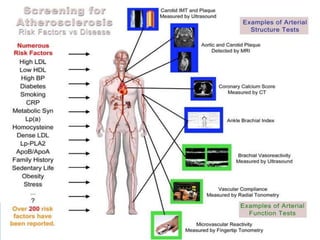

Dr. Daniel Meneses
Cardiólogo Intervencionista
4
V
SINDROME
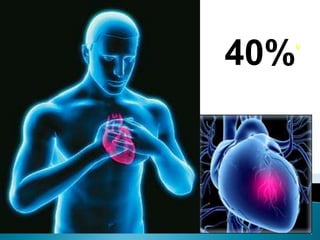
CO40%
RONARIO
AGUDO
Dr. DANIEL MENESES
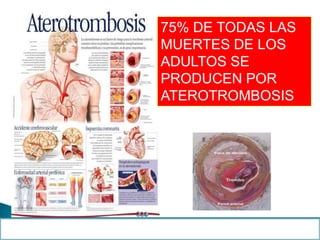
75% DE TODAS LAS
MUERTES DE LOS
ADULTOS SE
PRODUCEN POR
ATEROTROMBOSIS
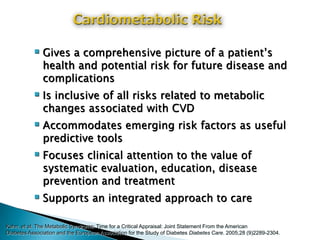
 Gives a comprehensive picture of a patient’s
health and potential risk for future disease and
complications
 Is inclusive of all risks related to metabolic
changes associated with CVD
 Accommodates emerging risk factors as useful
predictive tools
 Focuses clinical attention to the value of
systematic evaluation, education, disease
prevention and treatment
 Supports an integrated approach to care
Kahn, et al. The Metabolic Syndrome: Time for a Critical Appraisal: Joint Statement From the American
Diabetes Association and the European Association for the Study of Diabetes Diabetes Care. 2005;28 (9)2289-2304.
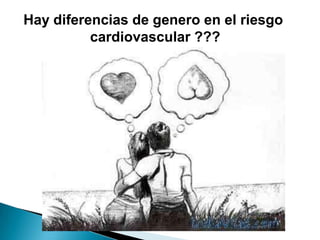
Hay diferencias de genero en el riesgo
cardiovascular ???
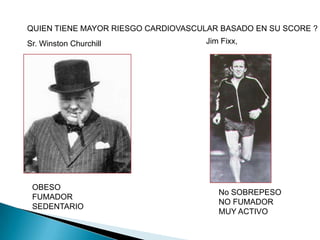
OBESO
FUMADOR
SEDENTARIO
Sr. Winston Churchill
No SOBREPESO
NO FUMADOR
MUY ACTIVO
Jim Fixx,
QUIEN TIENE MAYOR RIESGO CARDIOVASCULAR BASADO EN SU SCORE ?
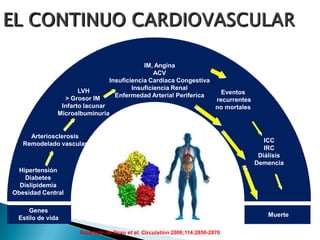
Hipertensión
Diabetes
Dislipidemia
Obesidad Central
Arteriosclerosis
Remodelado vascular
LVH
> Grosor IM
Infarto lacunar
Microalbuminuria
IM, Angina
ACV
Insuficiencia Cardiaca Congestiva
Insuficiencia Renal
Enfermedad Arterial Periferica Eventos
recurrentes
no mortales
ICC
IRC
Diálisis
Demencia
Genes
Estilo de vida
Muerte
Adaptado de Dzau et al. Circulation 2006;114:2850-2870.
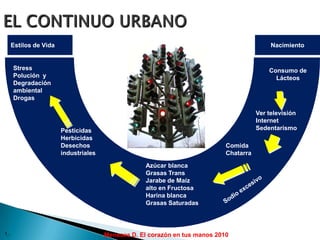
Consumo de
Lácteos
Muerte
1..
Ver televisión
Internet
Sedentarismo
Comida
Chatarra
Azúcar blanca
Grasas Trans
Jarabe de Maíz
alto en Fructosa
Harina blanca
Grasas Saturadas
Pesticidas
Herbicidas
Desechos
industriales
Stress
Polución y
Degradación
ambiental
Drogas
Sodio excesivo
NacimientoEstilos de Vida
Meneses D. El corazón en tus manos 2010
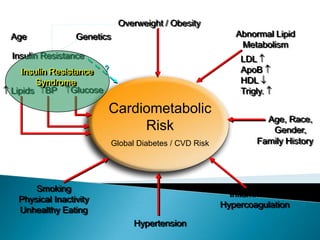
Abnormal Lipid
Metabolism
LDL
ApoB
HDL
Trigly.
Cardiometabolic
Risk
Global Diabetes / CVD Risk
Overweight / Obesity
Inflammation
Hypercoagulation
Hypertension
Smoking
Physical Inactivity
Unhealthy Eating
Age, Race,
Gender,
Family History
GlucoseBPLipids
Age Genetics
Insulin Resistance
?Insulin Resistance
Syndrome
 Paciente masculino, 45ª. Casado,
comerciante.
 Motivo de Consulta: evaluaciòn CV anual.
 Hx. Actual: asintomàtico CV.
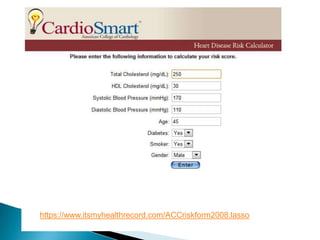
 Antecedentes personales: tabaquismo 20/dìa
desde los 15ª. Bebe: 4-6 cervezas por
semana y un promedio de ½ botella de licor
semanal. No refiere alergias y hace ejercicio
en gimnasio 1 hora diaria.
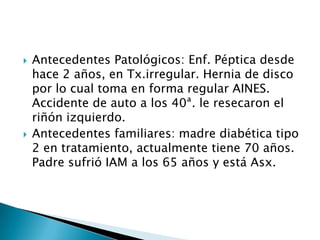
 Antecedentes Patológicos: Enf. Péptica desde
hace 2 años, en Tx.irregular. Hernia de disco
por lo cual toma en forma regular AINES.
Accidente de auto a los 40ª. le resecaron el
riñón izquierdo.
 Antecedentes familiares: madre diabética tipo
2 en tratamiento, actualmente tiene 70 años.
Padre sufrió IAM a los 65 años y está Asx.
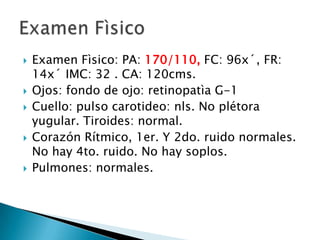
 Examen Fìsico: PA: 170/110, FC: 96x´, FR:
14x´ IMC: 32 . CA: 120cms.
 Ojos: fondo de ojo: retinopatìa G-1
 Cuello: pulso carotideo: nls. No plétora
yugular. Tiroides: normal.
 Corazón Rítmico, 1er. Y 2do. ruido normales.
No hay 4to. ruido. No hay soplos.
 Pulmones: normales.
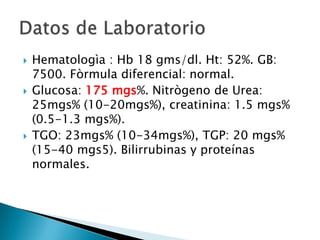
 Hematologìa : Hb 18 gms/dl. Ht: 52%. GB:
7500. Fòrmula diferencial: normal.
 Glucosa: 175 mgs%. Nitrògeno de Urea:
25mgs% (10-20mgs%), creatinina: 1.5 mgs%
(0.5-1.3 mgs%).
 TGO: 23mgs% (10-34mgs%), TGP: 20 mgs%
(15-40 mgs5). Bilirrubinas y proteínas
normales.
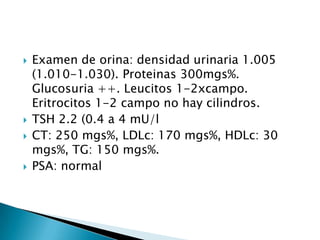
 Examen de orina: densidad urinaria 1.005
(1.010-1.030). Proteinas 300mgs%.
Glucosuria ++. Leucitos 1-2xcampo.
Eritrocitos 1-2 campo no hay cilindros.
 TSH 2.2 (0.4 a 4 mU/l
 CT: 250 mgs%, LDLc: 170 mgs%, HDLc: 30
mgs%, TG: 150 mgs%.
 PSA: normal
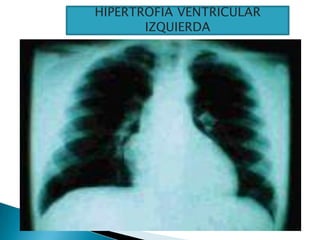
HIPERTROFIA VENTRICULAR
IZQUIERDA
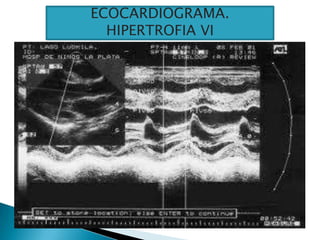
ECOCARDIOGRAMA.
HIPERTROFIA VI
 Protocolo de Bruce suspendida en la III etapa.
 Molestia precordial inespecífica
 Alteraciones inespecificas del segmento ST
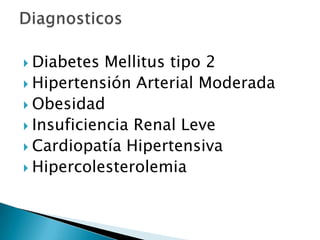
 Diabetes Mellitus tipo 2
 Hipertensión Arterial Moderada
 Obesidad
 Insuficiencia Renal Leve
 Cardiopatía Hipertensiva
 Hipercolesterolemia
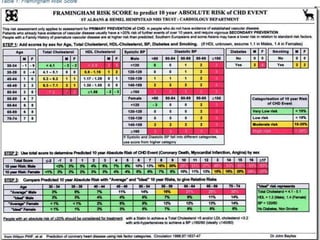
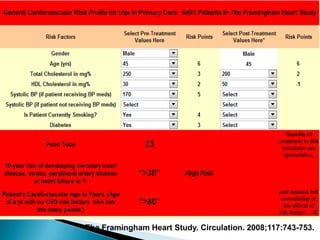
The Framingham Heart Study. Circulation. 2008;117:743-753.
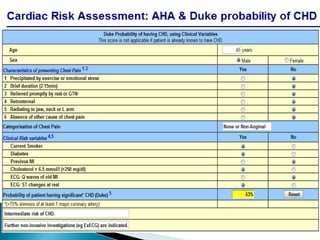
Es util el score de Framingham en este
paciente para predecir riesgo Cardiovascular?
a)SI
b)No
This tool is only useful for assessing the risk of
suffering a heart attack or dying due to coronary
disease for people age 20 or older who do not
already have heart disease and have not been
diagnosed with diabetes.
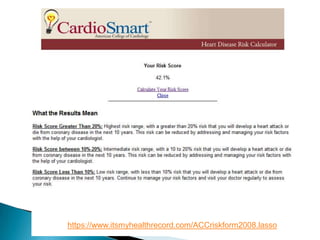
https://www.itsmyhealthrecord.com/ACCriskform2008.lasso
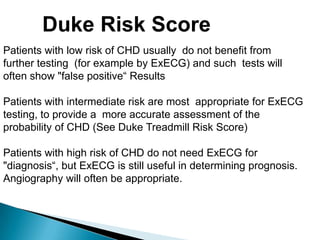
Patients with low risk of CHD usually do not benefit from
further testing (for example by ExECG) and such tests will
often show "false positive“ Results
Patients with intermediate risk are most appropriate for ExECG
testing, to provide a more accurate assessment of the
probability of CHD (See Duke Treadmill Risk Score)
Patients with high risk of CHD do not need ExECG for
"diagnosis“, but ExECG is still useful in determining prognosis.
Angiography will often be appropriate.
Duke Risk Score
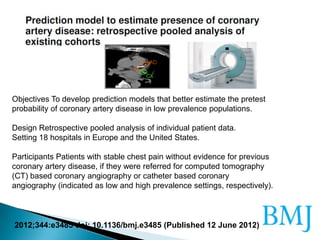
2012;344:e3485 doi: 10.1136/bmj.e3485 (Published 12 June 2012)
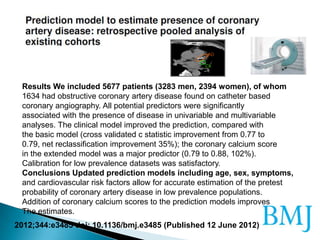
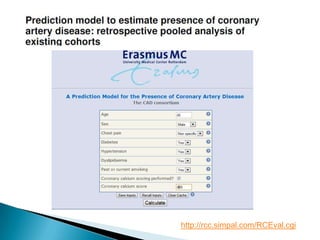
Objectives To develop prediction models that better estimate the pretest
probability of coronary artery disease in low prevalence populations.
Design Retrospective pooled analysis of individual patient data.
Setting 18 hospitals in Europe and the United States.
Participants Patients with stable chest pain without evidence for previous
coronary artery disease, if they were referred for computed tomography
(CT) based coronary angiography or catheter based coronary
angiography (indicated as low and high prevalence settings, respectively).
2012;344:e3485 doi: 10.1136/bmj.e3485 (Published 12 June 2012)
Results We included 5677 patients (3283 men, 2394 women), of whom
1634 had obstructive coronary artery disease found on catheter based
coronary angiography. All potential predictors were significantly
associated with the presence of disease in univariable and multivariable
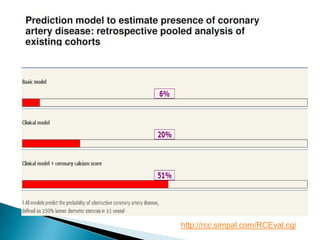
analyses. The clinical model improved the prediction, compared with
the basic model (cross validated c statistic improvement from 0.77 to
0.79, net reclassification improvement 35%); the coronary calcium score
in the extended model was a major predictor (0.79 to 0.88, 102%).
Calibration for low prevalence datasets was satisfactory.
Conclusions Updated prediction models including age, sex, symptoms,
and cardiovascular risk factors allow for accurate estimation of the pretest
probability of coronary artery disease in low prevalence populations.
Addition of coronary calcium scores to the prediction models improves
The estimates.
http://rcc.simpal.com/RCEval.cgi
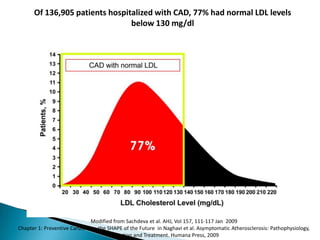
Of 136,905 patients hospitalized with CAD, 77% had normal LDL levels
below 130 mg/dl
Modified from Sachdeva et al. AHJ, Vol 157, 111-117 Jan 2009
Chapter 1: Preventive Cardiology; the SHAPE of the Future in Naghavi et al. Asymptomatic Atherosclerosis: Pathophysiology,
Detection and Treatment. Humana Press, 2009
Modified from Sachdeva et al. AHJ, Vol 157, 111-117 Jan 2009
Chapter 1: Preventive Cardiology; the SHAPE of the Future in Naghavi et al. Asymptomatic Atherosclerosis: Pathophysiology,
Detection and Treatment. Humana Press, 2009
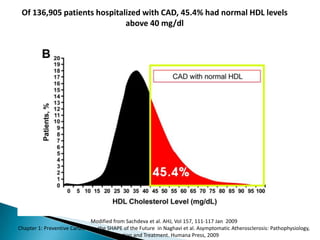
Of 136,905 patients hospitalized with CAD, 45.4% had normal HDL levels
above 40 mg/dl
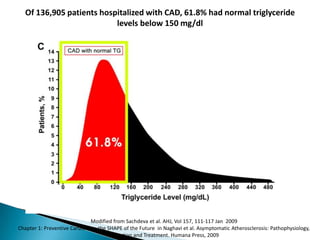
Of 136,905 patients hospitalized with CAD, 61.8% had normal triglyceride
levels below 150 mg/dl
Modified from Sachdeva et al. AHJ, Vol 157, 111-117 Jan 2009
Chapter 1: Preventive Cardiology; the SHAPE of the Future in Naghavi et al. Asymptomatic Atherosclerosis: Pathophysiology,
Detection and Treatment. Humana Press, 2009
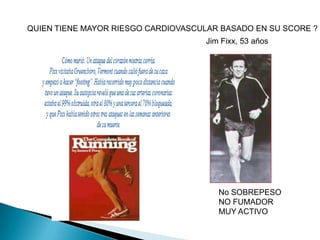
No SOBREPESO
NO FUMADOR
MUY ACTIVO
Jim Fixx, 53 años
QUIEN TIENE MAYOR RIESGO CARDIOVASCULAR BASADO EN SU SCORE ?
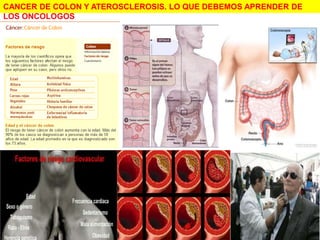
CANCER DE COLON Y ATEROSCLEROSIS. LO QUE DEBEMOS APRENDER DE
LOS ONCOLOGOS
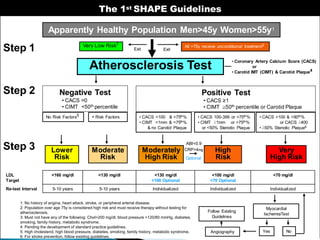
Atherosclerosis Test
Very Low Risk3
Negative Test
• CACS =0
• CIMT <50th percentile
Lower
Risk
Moderate
Risk
Positive Test
• CACS ≥1
• CIMT 50th percentile or Carotid Plaque
Moderately
High Risk
High
Risk
Very
High Risk
No Risk Factors5 + Risk Factors • CACS <100 & <75th%
• CIMT <1mm & <75th%
& no Carotid Plaque
• Coronary Artery Calcium Score (CACS)
or
• Carotid IMT (CIMT) & Carotid Plaque4
• CACS 100-399 or >75th%
• CIMT 1mm or >75th%
or <50% Stenotic Plaque
• CACS >100 & >90th%
or CACS 400
• 50% Stenotic Plaque6
LDL
Target
<160 mg/dl <130 mg/dl <130 mg/dl
<100 Optional
<100 mg/dl
<70 Optional
<70 mg/dl
Re-test Interval 5-10 years 5-10 years Individualized Individualized Individualized
All >75y receive unconditional treatment2
Apparently Healthy Population Men>45y Women>55y1
ExitExit
Myocardial
IschemiaTest
NoAngiography
Follow Existing
Guidelines
Yes
The 1st SHAPE Guidelines
Step 1
Step 2
Step 3
Optional
CRP>4mg
ABI<0.9
1: No history of angina, heart attack, stroke, or peripheral arterial disease.
2: Population over age 75y is considered high risk and must receive therapy without testing for
atherosclerosis.
3: Must not have any of the following: Chol>200 mg/dl, blood pressure >120/80 mmHg, diabetes,
smoking, family history, metabolic syndrome.
4: Pending the development of standard practice guidelines.
5: High cholesterol, high blood pressure, diabetes, smoking, family history, metabolic syndrome.
6: For stroke prevention, follow existing guidelines.
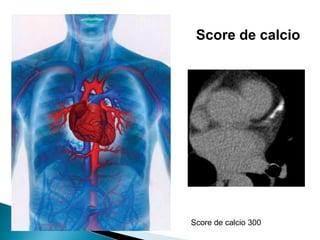
Score de calcio
Score de calcio 300
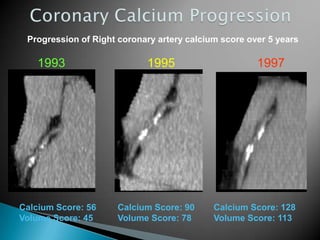
MASCULNO DE 70 AÑOS, HIPERTRIGLICERIDEMIA, HIPERTENSION,
PRUEBAS DE ESFUERZO NEGATIVAS CADA AÑO POR CINCO AÑOS
Calcium Score: 56 Calcium Score: 90 Calcium Score: 128
Volume Score: 45 Volume Score: 78 Volume Score: 113
1993 1995 1997
Progression of Right coronary artery calcium score over 5 years
 Direct in vivo measurement of thickness of carotid
artery wall by B-mode ultrasound
 Vessel wall thickness correlates with status of
atherosclerosis and CV events
 Atherosclerosis is a systemic disorder
◦ Atherosclerosis in the carotid artery is predictive of disease in
other vascular beds
de Groot E, et al. Circulation. (2004) 109[Suppl III]:III-33-III-38.
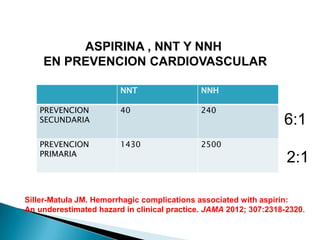
NNT NNH
PREVENCION
SECUNDARIA
40 240
PREVENCION
PRIMARIA
1430 2500
ASPIRINA , NNT Y NNH
EN PREVENCION CARDIOVASCULAR
6:1
Siller-Matula JM. Hemorrhagic complications associated with aspirin:
An underestimated hazard in clinical practice. JAMA 2012; 307:2318-2320.
2:1
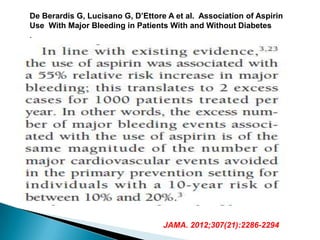
JAMA. 2012;307(21):2286-2294
De Berardis G, Lucisano G, D’Ettore A et al. Association of Aspirin
Use With Major Bleeding in Patients With and Without Diabetes
.
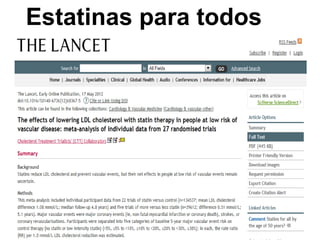
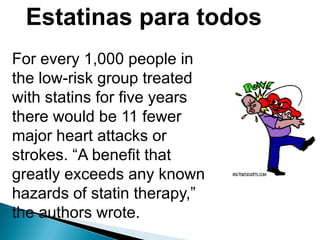
Estatinas para todos
For every 1,000 people in
the low-risk group treated
with statins for five years
there would be 11 fewer
major heart attacks or
strokes. “A benefit that
greatly exceeds any known
hazards of statin therapy,”
the authors wrote.
 Monoterapia dosis plena
 Terapia dual dosis intermedia
 Terapia triple dosis bajas
 Terapia triple dosis
intermedias
 Terapia cuadruple
 Paciente diabètico
 Hay evidencia de proteinuria
 Se detectò hipertrofia ventricular
 Es un paciente jòven
 El nivel de PA es muy elevado
 La cifra objetivo de reducciòn en este caso es
mayor a 20/10 mmHg
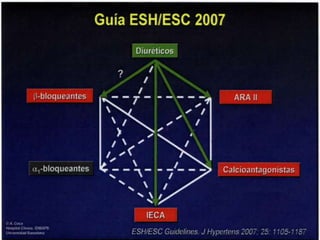
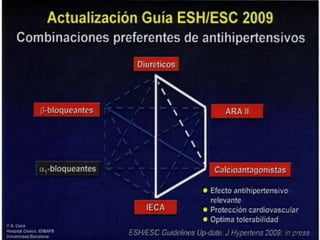
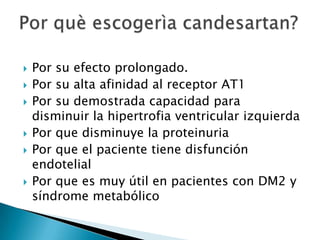
 Por su efecto prolongado.
 Por su alta afinidad al receptor AT1
 Por su demostrada capacidad para
disminuir la hipertrofia ventricular izquierda
 Por que disminuye la proteinuria
 Por que el paciente tiene disfunción
endotelial
 Por que es muy útil en pacientes con DM2 y
síndrome metabólico
xx/xx/xxxx Editor: Presentation name here 66
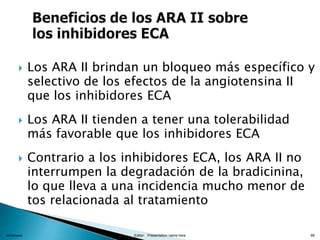
 Los ARA II brindan un bloqueo más específico y
selectivo de los efectos de la angiotensina II
que los inhibidores ECA
 Los ARA II tienden a tener una tolerabilidad
más favorable que los inhibidores ECA
 Contrario a los inhibidores ECA, los ARA II no
interrumpen la degradación de la bradicinina,
lo que lleva a una incidencia mucho menor de
tos relacionada al tratamiento
xx/xx/xxxx Editor: Presentation name here 67
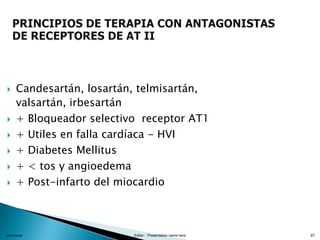
 Candesartán, losartán, telmisartán,
valsartán, irbesartán
 + Bloqueador selectivo receptor AT1
 + Utiles en falla cardíaca - HVI
 + Diabetes Mellitus
 + < tos y angioedema
 + Post-infarto del miocardio
xx/xx/xxxx Editor: Presentation name here 69
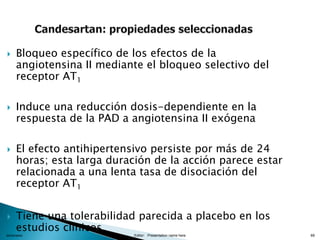
 Bloqueo específico de los efectos de la
angiotensina II mediante el bloqueo selectivo del
receptor AT1
 Induce una reducción dosis-dependiente en la
respuesta de la PAD a angiotensina II exógena
 El efecto antihipertensivo persiste por más de 24
horas; esta larga duración de la acción parece estar
relacionada a una lenta tasa de disociación del
receptor AT1
 Tiene una tolerabilidad parecida a placebo en los
estudios clínicos
xx/xx/xxxx Editor: Presentation name here 70
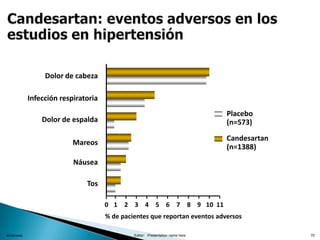
Candesartan
(n=1388)
Placebo
(n=573)
Dolor de cabeza
Infección respiratoria
Dolor de espalda
Mareos
Náusea
Tos
% de pacientes que reportan eventos adversos
114321 5 6 7 10980
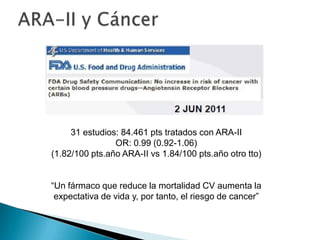
31 estudios: 84.461 pts tratados con ARA-II
OR: 0.99 (0.92-1.06)
(1.82/100 pts.año ARA-II vs 1.84/100 pts.año otro tto)
“Un fármaco que reduce la mortalidad CV aumenta la
expectativa de vida y, por tanto, el riesgo de cancer”
RIESGO CARDIOMETABOLICO

RIESGO CARDIOMETABOLICO

  • 1.
  • 4.
  • 5.
    75% DE TODASLAS MUERTES DE LOS ADULTOS SE PRODUCEN POR ATEROTROMBOSIS
  • 6.
     Gives acomprehensive picture of a patient’s health and potential risk for future disease and complications  Is inclusive of all risks related to metabolic changes associated with CVD  Accommodates emerging risk factors as useful predictive tools  Focuses clinical attention to the value of systematic evaluation, education, disease prevention and treatment  Supports an integrated approach to care Kahn, et al. The Metabolic Syndrome: Time for a Critical Appraisal: Joint Statement From the American Diabetes Association and the European Association for the Study of Diabetes Diabetes Care. 2005;28 (9)2289-2304.
  • 7.
    Hay diferencias degenero en el riesgo cardiovascular ???
  • 8.
    OBESO FUMADOR SEDENTARIO Sr. Winston Churchill NoSOBREPESO NO FUMADOR MUY ACTIVO Jim Fixx, QUIEN TIENE MAYOR RIESGO CARDIOVASCULAR BASADO EN SU SCORE ?
  • 9.
    Hipertensión Diabetes Dislipidemia Obesidad Central Arteriosclerosis Remodelado vascular LVH >Grosor IM Infarto lacunar Microalbuminuria IM, Angina ACV Insuficiencia Cardiaca Congestiva Insuficiencia Renal Enfermedad Arterial Periferica Eventos recurrentes no mortales ICC IRC Diálisis Demencia Genes Estilo de vida Muerte Adaptado de Dzau et al. Circulation 2006;114:2850-2870.
  • 10.
    Consumo de Lácteos Muerte 1.. Ver televisión Internet Sedentarismo Comida Chatarra Azúcarblanca Grasas Trans Jarabe de Maíz alto en Fructosa Harina blanca Grasas Saturadas Pesticidas Herbicidas Desechos industriales Stress Polución y Degradación ambiental Drogas Sodio excesivo NacimientoEstilos de Vida Meneses D. El corazón en tus manos 2010
  • 11.
    Abnormal Lipid Metabolism LDL ApoB HDL Trigly. Cardiometabolic Risk Global Diabetes/ CVD Risk Overweight / Obesity Inflammation Hypercoagulation Hypertension Smoking Physical Inactivity Unhealthy Eating Age, Race, Gender, Family History GlucoseBPLipids Age Genetics Insulin Resistance ?Insulin Resistance Syndrome
  • 12.
     Paciente masculino,45ª. Casado, comerciante.  Motivo de Consulta: evaluaciòn CV anual.  Hx. Actual: asintomàtico CV.  Antecedentes personales: tabaquismo 20/dìa desde los 15ª. Bebe: 4-6 cervezas por semana y un promedio de ½ botella de licor semanal. No refiere alergias y hace ejercicio en gimnasio 1 hora diaria.
  • 14.
     Antecedentes Patológicos:Enf. Péptica desde hace 2 años, en Tx.irregular. Hernia de disco por lo cual toma en forma regular AINES. Accidente de auto a los 40ª. le resecaron el riñón izquierdo.  Antecedentes familiares: madre diabética tipo 2 en tratamiento, actualmente tiene 70 años. Padre sufrió IAM a los 65 años y está Asx.
  • 15.
     Examen Fìsico:PA: 170/110, FC: 96x´, FR: 14x´ IMC: 32 . CA: 120cms.  Ojos: fondo de ojo: retinopatìa G-1  Cuello: pulso carotideo: nls. No plétora yugular. Tiroides: normal.  Corazón Rítmico, 1er. Y 2do. ruido normales. No hay 4to. ruido. No hay soplos.  Pulmones: normales.
  • 16.
     Hematologìa :Hb 18 gms/dl. Ht: 52%. GB: 7500. Fòrmula diferencial: normal.  Glucosa: 175 mgs%. Nitrògeno de Urea: 25mgs% (10-20mgs%), creatinina: 1.5 mgs% (0.5-1.3 mgs%).  TGO: 23mgs% (10-34mgs%), TGP: 20 mgs% (15-40 mgs5). Bilirrubinas y proteínas normales.
  • 17.
     Examen deorina: densidad urinaria 1.005 (1.010-1.030). Proteinas 300mgs%. Glucosuria ++. Leucitos 1-2xcampo. Eritrocitos 1-2 campo no hay cilindros.  TSH 2.2 (0.4 a 4 mU/l  CT: 250 mgs%, LDLc: 170 mgs%, HDLc: 30 mgs%, TG: 150 mgs%.  PSA: normal
  • 18.
  • 19.
  • 21.
     Protocolo deBruce suspendida en la III etapa.  Molestia precordial inespecífica  Alteraciones inespecificas del segmento ST
  • 22.
     Diabetes Mellitustipo 2  Hipertensión Arterial Moderada  Obesidad  Insuficiencia Renal Leve  Cardiopatía Hipertensiva  Hipercolesterolemia
  • 25.
    The Framingham HeartStudy. Circulation. 2008;117:743-753.
  • 26.
    Es util elscore de Framingham en este paciente para predecir riesgo Cardiovascular? a)SI b)No
  • 27.
    This tool isonly useful for assessing the risk of suffering a heart attack or dying due to coronary disease for people age 20 or older who do not already have heart disease and have not been diagnosed with diabetes.
  • 28.
  • 29.
  • 31.
    Patients with lowrisk of CHD usually do not benefit from further testing (for example by ExECG) and such tests will often show "false positive“ Results Patients with intermediate risk are most appropriate for ExECG testing, to provide a more accurate assessment of the probability of CHD (See Duke Treadmill Risk Score) Patients with high risk of CHD do not need ExECG for "diagnosis“, but ExECG is still useful in determining prognosis. Angiography will often be appropriate. Duke Risk Score
  • 33.
    2012;344:e3485 doi: 10.1136/bmj.e3485(Published 12 June 2012) Objectives To develop prediction models that better estimate the pretest probability of coronary artery disease in low prevalence populations. Design Retrospective pooled analysis of individual patient data. Setting 18 hospitals in Europe and the United States. Participants Patients with stable chest pain without evidence for previous coronary artery disease, if they were referred for computed tomography (CT) based coronary angiography or catheter based coronary angiography (indicated as low and high prevalence settings, respectively).
  • 34.
    2012;344:e3485 doi: 10.1136/bmj.e3485(Published 12 June 2012) Results We included 5677 patients (3283 men, 2394 women), of whom 1634 had obstructive coronary artery disease found on catheter based coronary angiography. All potential predictors were significantly associated with the presence of disease in univariable and multivariable analyses. The clinical model improved the prediction, compared with the basic model (cross validated c statistic improvement from 0.77 to 0.79, net reclassification improvement 35%); the coronary calcium score in the extended model was a major predictor (0.79 to 0.88, 102%). Calibration for low prevalence datasets was satisfactory. Conclusions Updated prediction models including age, sex, symptoms, and cardiovascular risk factors allow for accurate estimation of the pretest probability of coronary artery disease in low prevalence populations. Addition of coronary calcium scores to the prediction models improves The estimates.
  • 35.
  • 36.
  • 39.
    Of 136,905 patientshospitalized with CAD, 77% had normal LDL levels below 130 mg/dl Modified from Sachdeva et al. AHJ, Vol 157, 111-117 Jan 2009 Chapter 1: Preventive Cardiology; the SHAPE of the Future in Naghavi et al. Asymptomatic Atherosclerosis: Pathophysiology, Detection and Treatment. Humana Press, 2009
  • 40.
    Modified from Sachdevaet al. AHJ, Vol 157, 111-117 Jan 2009 Chapter 1: Preventive Cardiology; the SHAPE of the Future in Naghavi et al. Asymptomatic Atherosclerosis: Pathophysiology, Detection and Treatment. Humana Press, 2009 Of 136,905 patients hospitalized with CAD, 45.4% had normal HDL levels above 40 mg/dl
  • 41.
    Of 136,905 patientshospitalized with CAD, 61.8% had normal triglyceride levels below 150 mg/dl Modified from Sachdeva et al. AHJ, Vol 157, 111-117 Jan 2009 Chapter 1: Preventive Cardiology; the SHAPE of the Future in Naghavi et al. Asymptomatic Atherosclerosis: Pathophysiology, Detection and Treatment. Humana Press, 2009
  • 44.
    No SOBREPESO NO FUMADOR MUYACTIVO Jim Fixx, 53 años QUIEN TIENE MAYOR RIESGO CARDIOVASCULAR BASADO EN SU SCORE ?
  • 45.
    CANCER DE COLONY ATEROSCLEROSIS. LO QUE DEBEMOS APRENDER DE LOS ONCOLOGOS
  • 47.
    Atherosclerosis Test Very LowRisk3 Negative Test • CACS =0 • CIMT <50th percentile Lower Risk Moderate Risk Positive Test • CACS ≥1 • CIMT 50th percentile or Carotid Plaque Moderately High Risk High Risk Very High Risk No Risk Factors5 + Risk Factors • CACS <100 & <75th% • CIMT <1mm & <75th% & no Carotid Plaque • Coronary Artery Calcium Score (CACS) or • Carotid IMT (CIMT) & Carotid Plaque4 • CACS 100-399 or >75th% • CIMT 1mm or >75th% or <50% Stenotic Plaque • CACS >100 & >90th% or CACS 400 • 50% Stenotic Plaque6 LDL Target <160 mg/dl <130 mg/dl <130 mg/dl <100 Optional <100 mg/dl <70 Optional <70 mg/dl Re-test Interval 5-10 years 5-10 years Individualized Individualized Individualized All >75y receive unconditional treatment2 Apparently Healthy Population Men>45y Women>55y1 ExitExit Myocardial IschemiaTest NoAngiography Follow Existing Guidelines Yes The 1st SHAPE Guidelines Step 1 Step 2 Step 3 Optional CRP>4mg ABI<0.9 1: No history of angina, heart attack, stroke, or peripheral arterial disease. 2: Population over age 75y is considered high risk and must receive therapy without testing for atherosclerosis. 3: Must not have any of the following: Chol>200 mg/dl, blood pressure >120/80 mmHg, diabetes, smoking, family history, metabolic syndrome. 4: Pending the development of standard practice guidelines. 5: High cholesterol, high blood pressure, diabetes, smoking, family history, metabolic syndrome. 6: For stroke prevention, follow existing guidelines.
  • 48.
    Score de calcio Scorede calcio 300
  • 49.
    MASCULNO DE 70AÑOS, HIPERTRIGLICERIDEMIA, HIPERTENSION, PRUEBAS DE ESFUERZO NEGATIVAS CADA AÑO POR CINCO AÑOS
  • 50.
    Calcium Score: 56Calcium Score: 90 Calcium Score: 128 Volume Score: 45 Volume Score: 78 Volume Score: 113 1993 1995 1997 Progression of Right coronary artery calcium score over 5 years
  • 52.
     Direct invivo measurement of thickness of carotid artery wall by B-mode ultrasound  Vessel wall thickness correlates with status of atherosclerosis and CV events  Atherosclerosis is a systemic disorder ◦ Atherosclerosis in the carotid artery is predictive of disease in other vascular beds de Groot E, et al. Circulation. (2004) 109[Suppl III]:III-33-III-38.
  • 53.
    NNT NNH PREVENCION SECUNDARIA 40 240 PREVENCION PRIMARIA 14302500 ASPIRINA , NNT Y NNH EN PREVENCION CARDIOVASCULAR 6:1 Siller-Matula JM. Hemorrhagic complications associated with aspirin: An underestimated hazard in clinical practice. JAMA 2012; 307:2318-2320. 2:1
  • 54.
    JAMA. 2012;307(21):2286-2294 De BerardisG, Lucisano G, D’Ettore A et al. Association of Aspirin Use With Major Bleeding in Patients With and Without Diabetes .
  • 55.
  • 58.
  • 59.
    Estatinas para todos Forevery 1,000 people in the low-risk group treated with statins for five years there would be 11 fewer major heart attacks or strokes. “A benefit that greatly exceeds any known hazards of statin therapy,” the authors wrote.
  • 61.
     Monoterapia dosisplena  Terapia dual dosis intermedia  Terapia triple dosis bajas  Terapia triple dosis intermedias  Terapia cuadruple
  • 62.
     Paciente diabètico Hay evidencia de proteinuria  Se detectò hipertrofia ventricular  Es un paciente jòven  El nivel de PA es muy elevado  La cifra objetivo de reducciòn en este caso es mayor a 20/10 mmHg
  • 65.
     Por suefecto prolongado.  Por su alta afinidad al receptor AT1  Por su demostrada capacidad para disminuir la hipertrofia ventricular izquierda  Por que disminuye la proteinuria  Por que el paciente tiene disfunción endotelial  Por que es muy útil en pacientes con DM2 y síndrome metabólico
  • 66.
    xx/xx/xxxx Editor: Presentationname here 66  Los ARA II brindan un bloqueo más específico y selectivo de los efectos de la angiotensina II que los inhibidores ECA  Los ARA II tienden a tener una tolerabilidad más favorable que los inhibidores ECA  Contrario a los inhibidores ECA, los ARA II no interrumpen la degradación de la bradicinina, lo que lleva a una incidencia mucho menor de tos relacionada al tratamiento
  • 67.
    xx/xx/xxxx Editor: Presentationname here 67  Candesartán, losartán, telmisartán, valsartán, irbesartán  + Bloqueador selectivo receptor AT1  + Utiles en falla cardíaca - HVI  + Diabetes Mellitus  + < tos y angioedema  + Post-infarto del miocardio
  • 69.
    xx/xx/xxxx Editor: Presentationname here 69  Bloqueo específico de los efectos de la angiotensina II mediante el bloqueo selectivo del receptor AT1  Induce una reducción dosis-dependiente en la respuesta de la PAD a angiotensina II exógena  El efecto antihipertensivo persiste por más de 24 horas; esta larga duración de la acción parece estar relacionada a una lenta tasa de disociación del receptor AT1  Tiene una tolerabilidad parecida a placebo en los estudios clínicos
  • 70.
    xx/xx/xxxx Editor: Presentationname here 70 Candesartan (n=1388) Placebo (n=573) Dolor de cabeza Infección respiratoria Dolor de espalda Mareos Náusea Tos % de pacientes que reportan eventos adversos 114321 5 6 7 10980
  • 71.
    31 estudios: 84.461pts tratados con ARA-II OR: 0.99 (0.92-1.06) (1.82/100 pts.año ARA-II vs 1.84/100 pts.año otro tto) “Un fármaco que reduce la mortalidad CV aumenta la expectativa de vida y, por tanto, el riesgo de cancer”

Editor's Notes

  • #40 CAD = coronary artery disease = CHD = coronary heart diseaseSlide indicates that 77% of the population with coronary heart disease had normal LDL
  • #42 TG = triglyceridesNormal = below 150
  • #48 Chart summarizes the details of SHAPE guidelines for cardiologists