B I T S Y C O H N
C O E T C D E V E L O P M E N T A L E D U C A T I O N C O O R D I N A T O R
DEVELOPMENTAL EDUCATION TASKFORCE
COLORADO COMMUNITY
COLLEGE SYSTEM
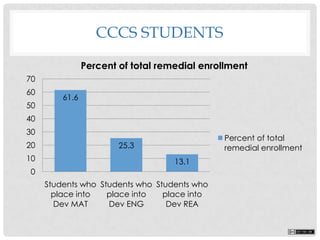
CCCS STUDENTS
61.6
25.3
13.1
0
10
20
30
40
50
60
70
Students who
place into
Dev MAT
Students who
place into
Dev ENG
Students who
place into
Dev REA
Percent of total remedial enrollment
Percent of total
remedial enrollment
THE PROBLEM
• Students stop out or drop out of the developmental
sequence before they complete the gateway
• Students who begin at the developmental level in
one or more subjects complete college at
significantly lower rates
• Time, not student learning, is the greatest barrier to
student success
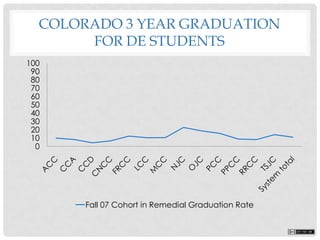
COLORADO 3 YEAR GRADUATION
FOR DE STUDENTS
0
10
20
30
40
50
60
70
80
90
100
Fall 07 Cohort in Remedial Graduation Rate
THE VISION
The DETF has been charged with reviewing
developmental education practices and with making
recommendations about what steps the system
will take to become the premier purveyor of
developmental education in more streamlined and
efficient ways, resulting in greater student success.
The group, comprised of faculty and administrators
from across Colorado, will make recommendations
about:
Assessment, contextualization, online learning,
student support services, modular options,
accelerated/compressed/mainstreaming of
developmental education, and options for
students.
THE GROUP
The DETF is working to identify the best
practices in each area and then to make
recommendations about implementation
at the CCCS.
The DETF will holistically examine the role
that developmental education plays in
overall student success.
THE WORK
THE CHARGE
• Review and clarify the purpose of developmental
education and analyze implications for policy and
practice resulting from a clarified purpose.
• Review current system policies and practices
related to developmental education and propose
revisions that will promote greater student success in
alignment with sound academic principles and
practice
• Investigate and analyze measures of success, data
reports and studies on success of developmental
education students.
• Examine structures for developmental
education, highlighting innovative and successful
strategies, improving the student experience and
identifying barriers to success.
THE CHARGE
• On the basis of a comprehensive
review, recommend broad strategies and specific
initiatives related to developmental education that
should be pursued by Colorado's Community
College System Colleges, leading to enhanced
outcomes for student learning and success.
THE CHARGE
WHERE ARE WE SO FAR?
TAA and CCA grant
Research - Presentations
Discussion points
Subcommittee work
WHAT ARE THE INNOVATIONS?
• Open entry/exit Math Labs
• Mainstreaming
• Accelerated and Compressed Courses
• Contextualization
INNOVATIONS
• Online or Hybrid OTL
• Diagnostic Assessments for Modular Math
• Modular Math
WHAT DO YOU WANT TO KNOW?
CREATIVE COMMONS
ATTRIBUTION
This work by Colorado Community College System COETC Grant is licensed under a Creative Commons Attribution 3.0
Unported License. The material was created with funds from the Trade Adjustment Assistance Community College and Career
Training (TAACCCT) Grant awarded to the Colorado Online Energy Training Consortium (COETC).Based on a work at
www.cccs.edu.Permissions beyond the scope of this license may be available at www.cccs.edu.

Detf presentation 2 8 12

  • 1.
    B I TS Y C O H N C O E T C D E V E L O P M E N T A L E D U C A T I O N C O O R D I N A T O R DEVELOPMENTAL EDUCATION TASKFORCE COLORADO COMMUNITY COLLEGE SYSTEM
  • 2.
    CCCS STUDENTS 61.6 25.3 13.1 0 10 20 30 40 50 60 70 Students who placeinto Dev MAT Students who place into Dev ENG Students who place into Dev REA Percent of total remedial enrollment Percent of total remedial enrollment
  • 3.
    THE PROBLEM • Studentsstop out or drop out of the developmental sequence before they complete the gateway • Students who begin at the developmental level in one or more subjects complete college at significantly lower rates • Time, not student learning, is the greatest barrier to student success
  • 4.
    COLORADO 3 YEARGRADUATION FOR DE STUDENTS 0 10 20 30 40 50 60 70 80 90 100 Fall 07 Cohort in Remedial Graduation Rate
  • 5.
    THE VISION The DETFhas been charged with reviewing developmental education practices and with making recommendations about what steps the system will take to become the premier purveyor of developmental education in more streamlined and efficient ways, resulting in greater student success.
  • 6.
    The group, comprisedof faculty and administrators from across Colorado, will make recommendations about: Assessment, contextualization, online learning, student support services, modular options, accelerated/compressed/mainstreaming of developmental education, and options for students. THE GROUP
  • 7.
    The DETF isworking to identify the best practices in each area and then to make recommendations about implementation at the CCCS. The DETF will holistically examine the role that developmental education plays in overall student success. THE WORK
  • 8.
    THE CHARGE • Reviewand clarify the purpose of developmental education and analyze implications for policy and practice resulting from a clarified purpose. • Review current system policies and practices related to developmental education and propose revisions that will promote greater student success in alignment with sound academic principles and practice
  • 9.
    • Investigate andanalyze measures of success, data reports and studies on success of developmental education students. • Examine structures for developmental education, highlighting innovative and successful strategies, improving the student experience and identifying barriers to success. THE CHARGE
  • 10.
    • On thebasis of a comprehensive review, recommend broad strategies and specific initiatives related to developmental education that should be pursued by Colorado's Community College System Colleges, leading to enhanced outcomes for student learning and success. THE CHARGE
  • 11.
    WHERE ARE WESO FAR? TAA and CCA grant Research - Presentations Discussion points Subcommittee work
  • 12.
    WHAT ARE THEINNOVATIONS? • Open entry/exit Math Labs • Mainstreaming • Accelerated and Compressed Courses • Contextualization
  • 13.
    INNOVATIONS • Online orHybrid OTL • Diagnostic Assessments for Modular Math • Modular Math
  • 14.
    WHAT DO YOUWANT TO KNOW?
  • 15.
    CREATIVE COMMONS ATTRIBUTION This workby Colorado Community College System COETC Grant is licensed under a Creative Commons Attribution 3.0 Unported License. The material was created with funds from the Trade Adjustment Assistance Community College and Career Training (TAACCCT) Grant awarded to the Colorado Online Energy Training Consortium (COETC).Based on a work at www.cccs.edu.Permissions beyond the scope of this license may be available at www.cccs.edu.

Editor's Notes

  • #5 System total = 11%