Redbus.in
Automating The Bus Travel Industry
The Team
• Bernard Fernandes
(A011)
• Joylyn Fernandes
(A012)
• Shirin Khetani
(A063)
• Biju Thomas
(A051)
Case Synopsis
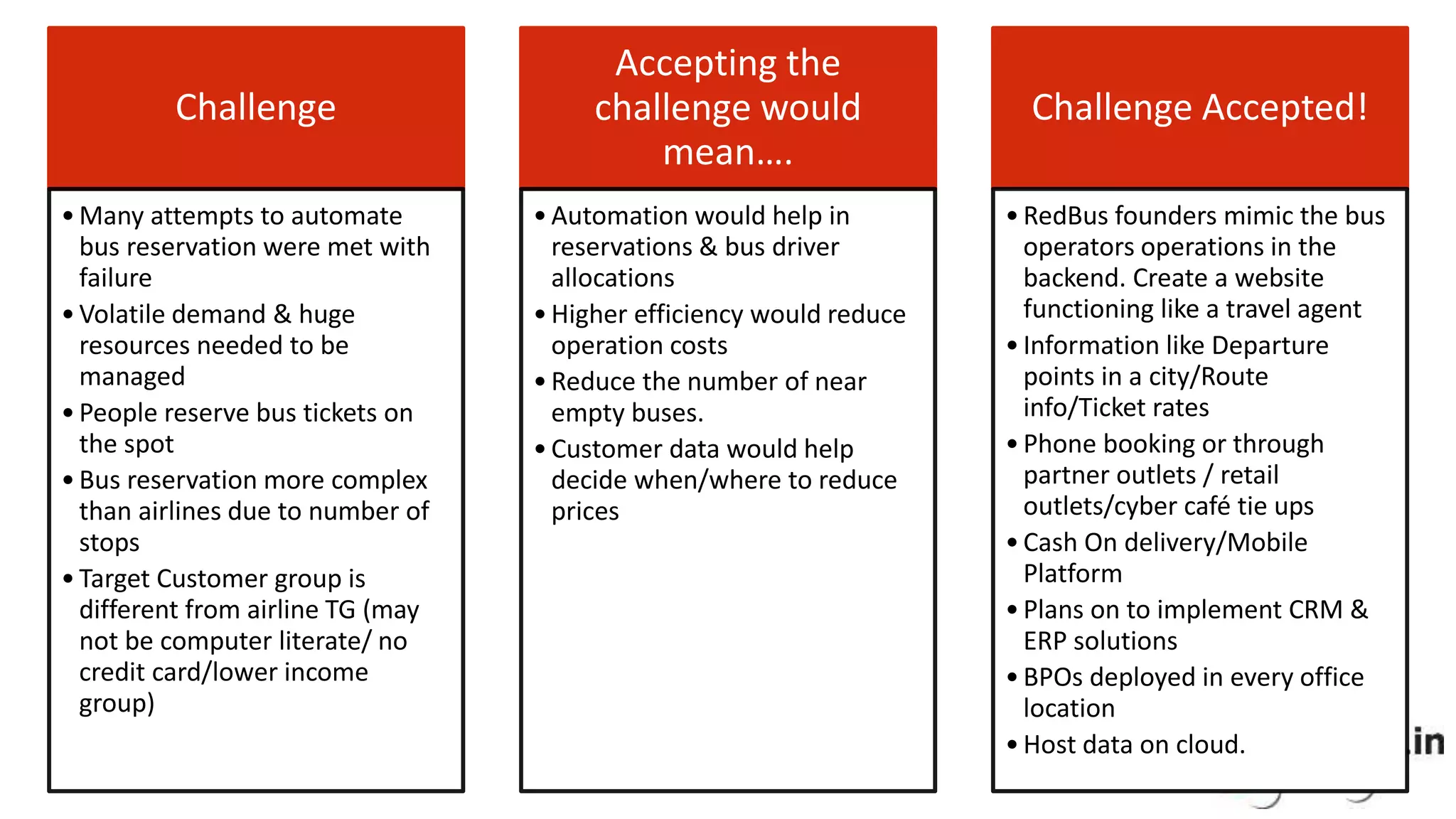
Challenge
•Many attempts to automate
bus reservation were met with
failure
•Volatile demand & huge
resources needed to be
managed
•People reserve bus tickets on
the spot
•Bus reservation more complex
than airlines due to number of
stops
•Target Customer group is
different from airline TG (may
not be computer literate/ no
credit card/lower income
group)
Accepting the
challenge would
mean….
•Automation would help in
reservations & bus driver
allocations
•Higher efficiency would reduce
operation costs
•Reduce the number of near
empty buses.
•Customer data would help
decide when/where to reduce
prices
Challenge Accepted!
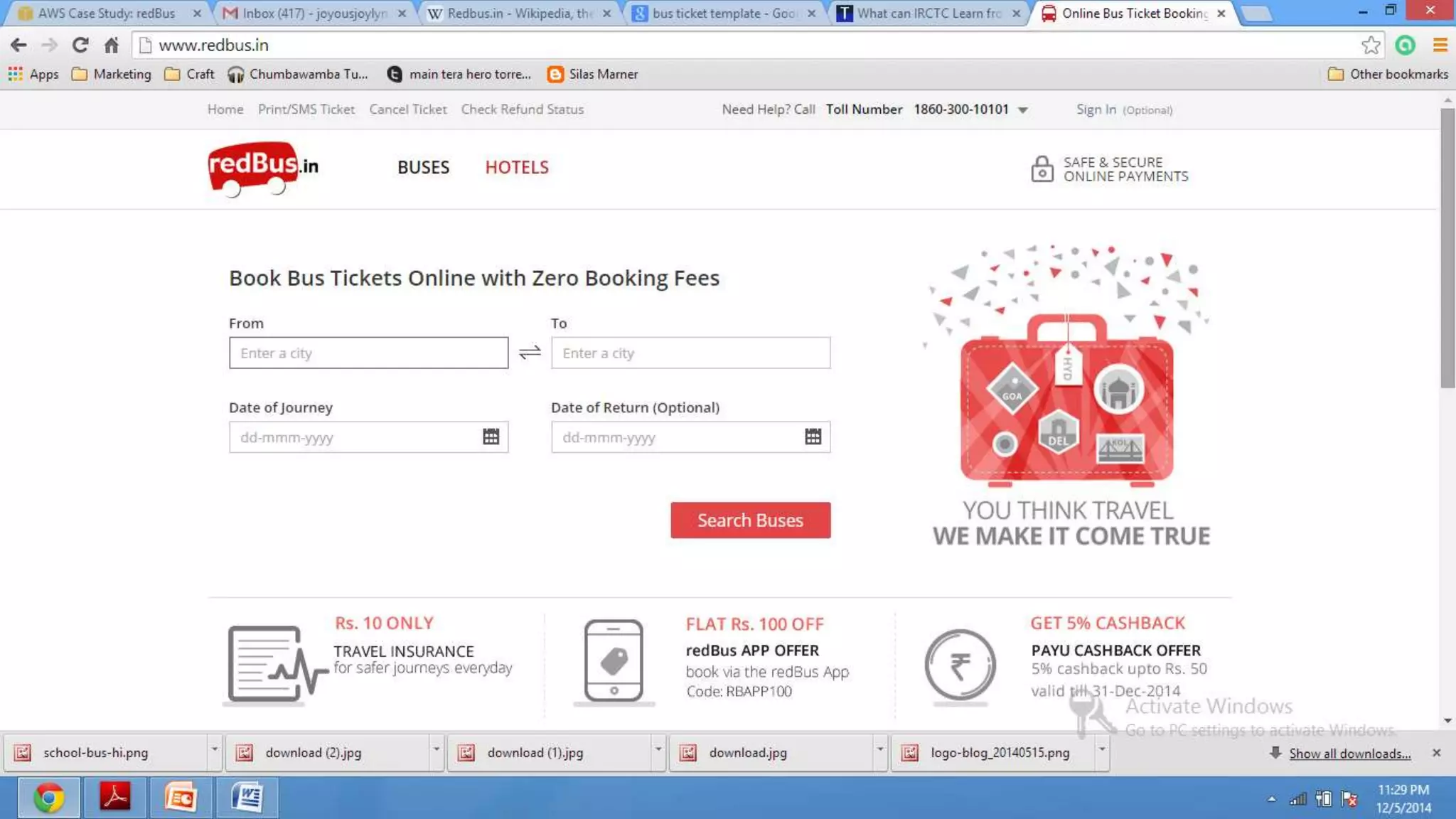
•RedBus founders mimic the bus
operators operations in the
backend. Create a website
functioning like a travel agent
•Information like Departure
points in a city/Route
info/Ticket rates
•Phone booking or through
partner outlets / retail
outlets/cyber café tie ups
•Cash On delivery/Mobile
Platform
•Plans on to implement CRM &
ERP solutions
•BPOs deployed in every office
location
•Host data on cloud.
Information Management Systems
observed in this case study
• Moving to the Cloud has helped create a
competitive advantage.
• VPN Network with data stored on a central
server hosted by GoDaddy
• Plans to implement ERP & CRM solutions
Rivalry Among existing Firms
[MEDIUM]
•Existing firms who could go big in
the bus reservation service
•People tend to depend on agents
for a personalized service
Determinants of Buyer
Power
•Customers looking for
bargains
•Low Product Differentiation
Threat of New Entrants
[LOW]
•Easy entry for new players as
its an internet based industry
•Has the first entrant advantage
Determinants of Supplier
Power[MEDIIUM]
•Operators depend on
RedBus.in to bring in
customers
Threat of Substitutes[HIGH]
•Offline reservation/ Travel
agents
•On the spot reservation
Question 1.(i)
Use the Competitive Force
Models to Analyze the Bus
Industry Online
Reservation Situation.
Question 1. (ii)
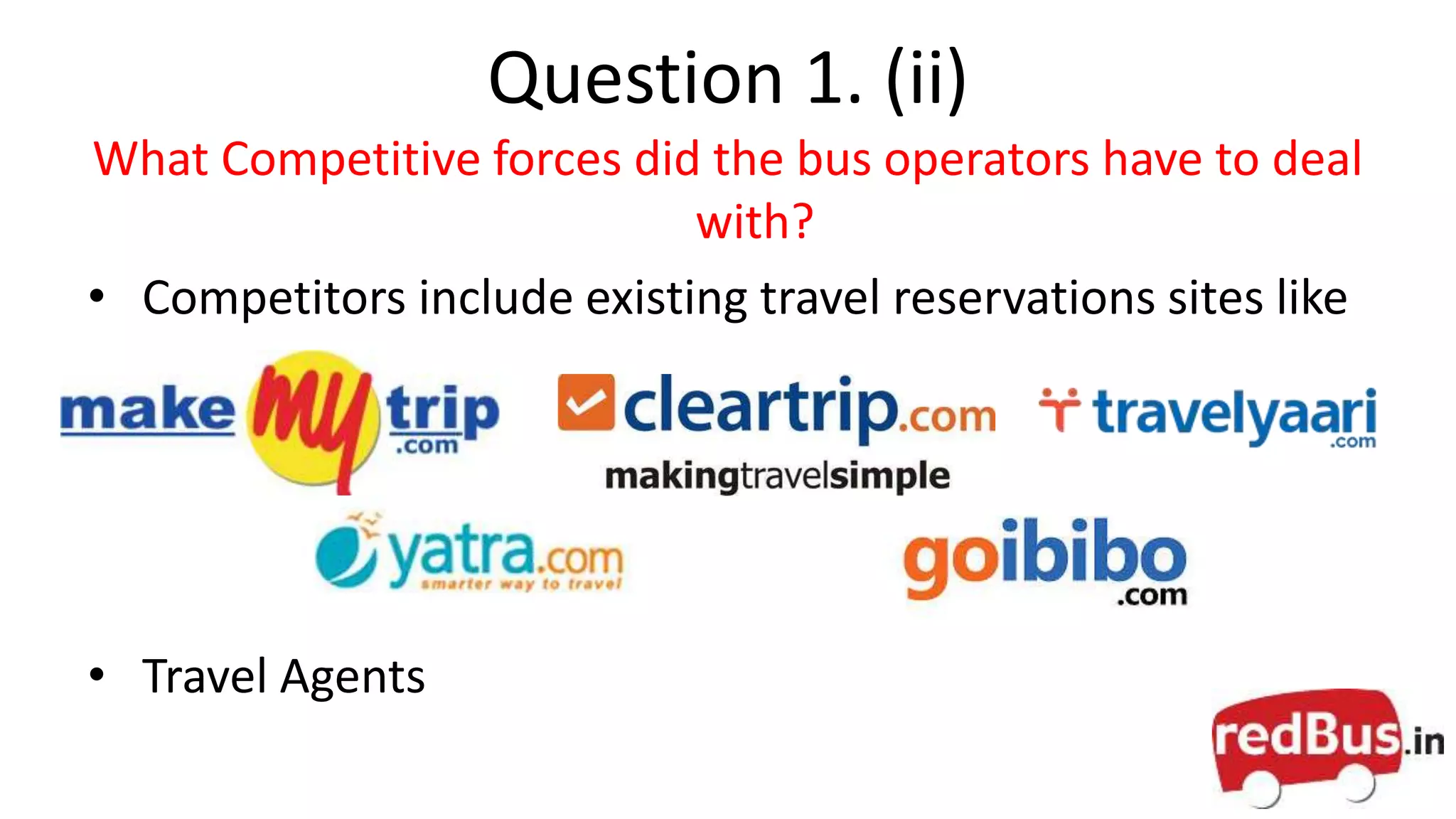
What Competitive forces did the bus operators have to deal
with?
• Competitors include existing travel reservations sites like
• Travel Agents
Question 1. (iii)
What kinds of Strategic Information Systems this
industry needs?
• CRM software : To manage customer data
– Offer coupons to nudge repeat purchases of
tickets
– Manage customer preferences like timings, routes,
operators, price preferences
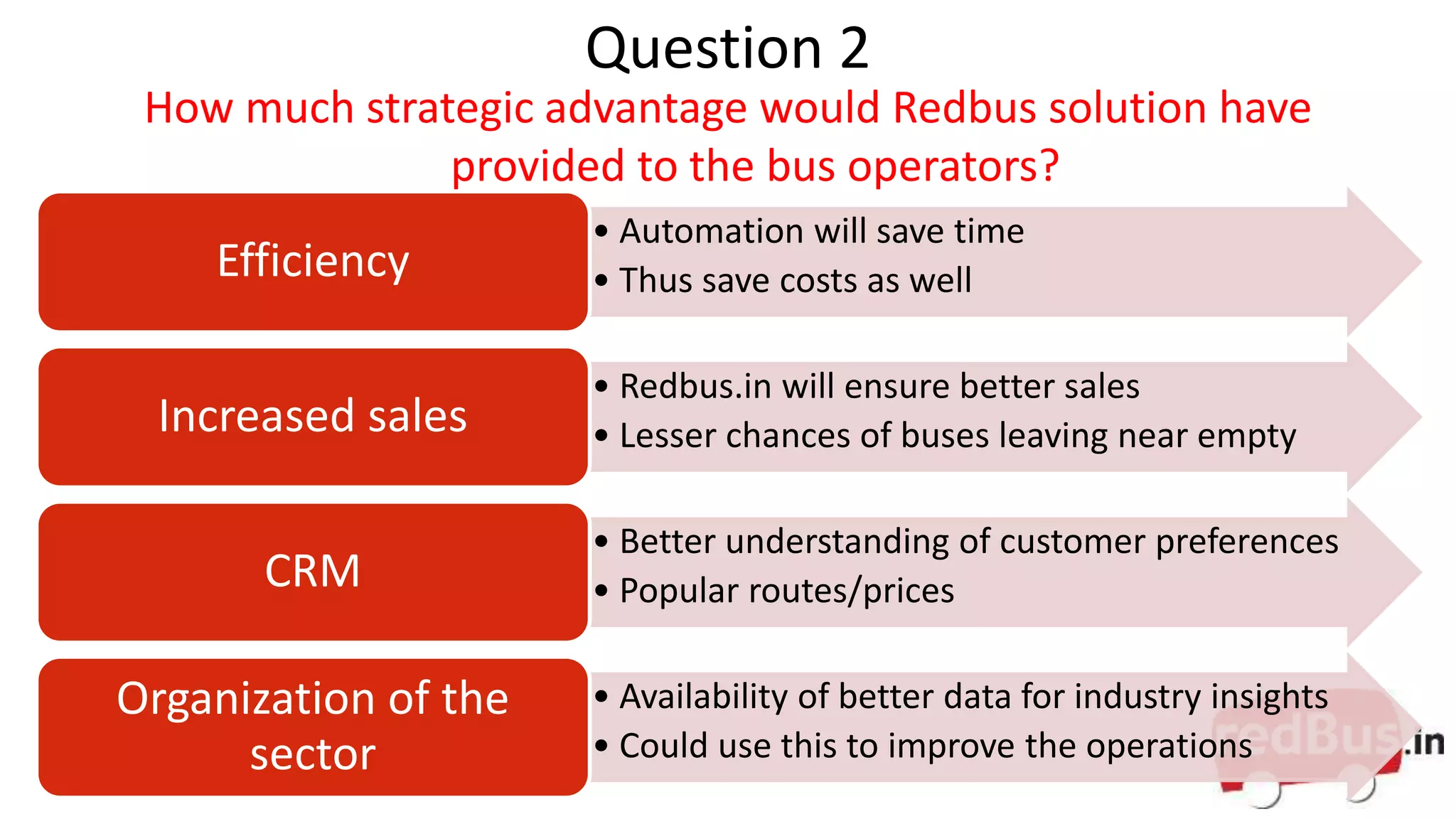
Question 2
How much strategic advantage would Redbus solution have
provided to the bus operators?
• Automation will save time
• Thus save costs as wellEfficiency
• Redbus.in will ensure better sales
• Lesser chances of buses leaving near emptyIncreased sales
• Better understanding of customer preferences
• Popular routes/pricesCRM
• Availability of better data for industry insights
• Could use this to improve the operations
Organization of the
sector
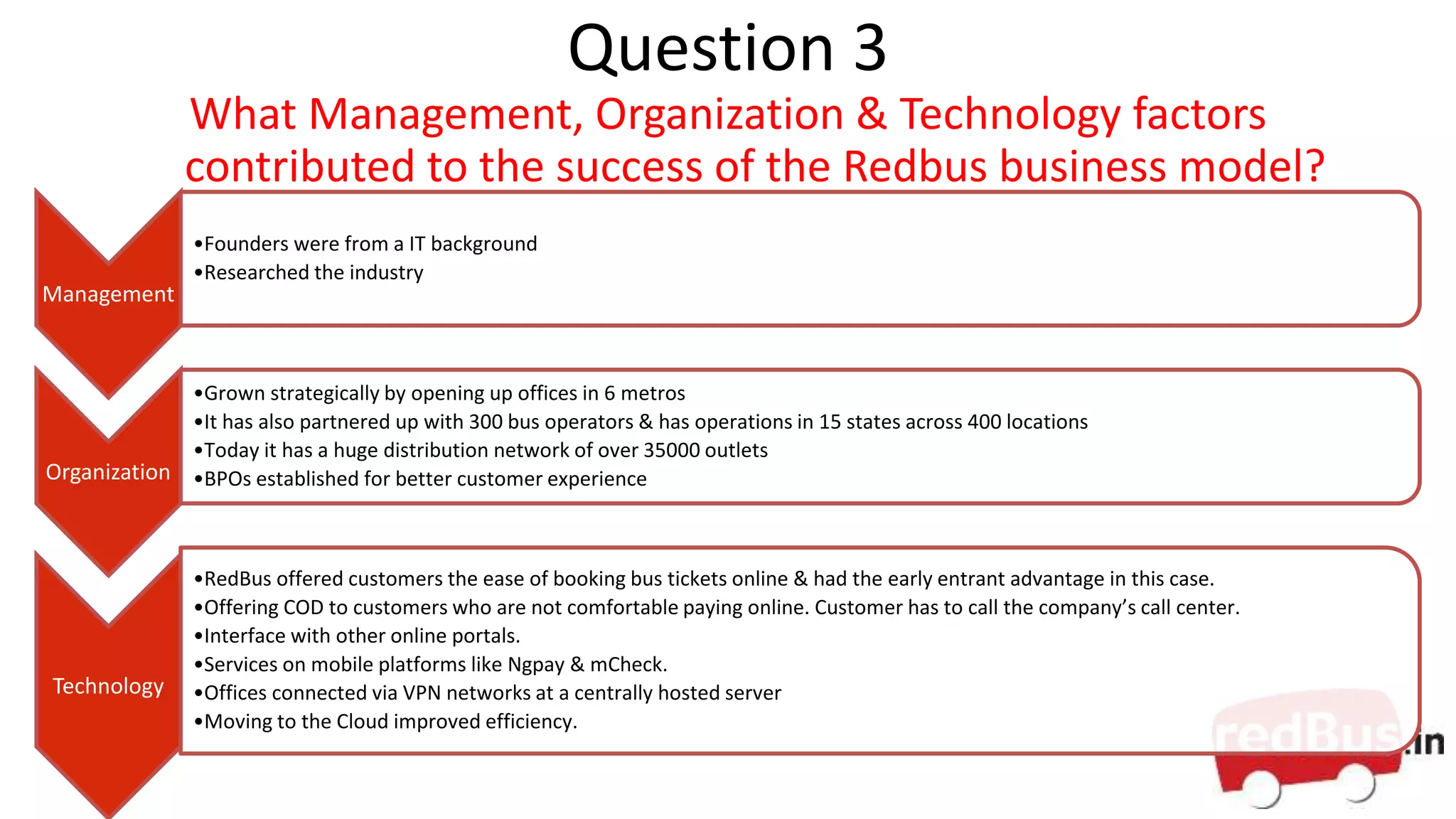
Question 3
What Management, Organization & Technology factors
contributed to the success of the Redbus business model?
Management
•Founders were from a IT background
•Researched the industry
Organization
•Grown strategically by opening up offices in 6 metros
•It has also partnered up with 300 bus operators & has operations in 15 states across 400 locations
•Today it has a huge distribution network of over 35000 outlets
•BPOs established for better customer experience
Technology
•RedBus offered customers the ease of booking bus tickets online & had the early entrant advantage in this case.
•Offering COD to customers who are not comfortable paying online. Customer has to call the company’s call center.
•Interface with other online portals.
•Services on mobile platforms like Ngpay & mCheck.
•Offices connected via VPN networks at a centrally hosted server
•Moving to the Cloud improved efficiency.
Thank you

Presentation - Case Study: RedBus.in – Automating the Bus Travel Industry (Information Management Systems:MBA project)

  • 1.
  • 2.
    The Team • BernardFernandes (A011) • Joylyn Fernandes (A012) • Shirin Khetani (A063) • Biju Thomas (A051)
  • 3.
  • 4.
    Challenge •Many attempts toautomate bus reservation were met with failure •Volatile demand & huge resources needed to be managed •People reserve bus tickets on the spot •Bus reservation more complex than airlines due to number of stops •Target Customer group is different from airline TG (may not be computer literate/ no credit card/lower income group) Accepting the challenge would mean…. •Automation would help in reservations & bus driver allocations •Higher efficiency would reduce operation costs •Reduce the number of near empty buses. •Customer data would help decide when/where to reduce prices Challenge Accepted! •RedBus founders mimic the bus operators operations in the backend. Create a website functioning like a travel agent •Information like Departure points in a city/Route info/Ticket rates •Phone booking or through partner outlets / retail outlets/cyber café tie ups •Cash On delivery/Mobile Platform •Plans on to implement CRM & ERP solutions •BPOs deployed in every office location •Host data on cloud.
  • 6.
    Information Management Systems observedin this case study • Moving to the Cloud has helped create a competitive advantage. • VPN Network with data stored on a central server hosted by GoDaddy • Plans to implement ERP & CRM solutions
  • 7.
    Rivalry Among existingFirms [MEDIUM] •Existing firms who could go big in the bus reservation service •People tend to depend on agents for a personalized service Determinants of Buyer Power •Customers looking for bargains •Low Product Differentiation Threat of New Entrants [LOW] •Easy entry for new players as its an internet based industry •Has the first entrant advantage Determinants of Supplier Power[MEDIIUM] •Operators depend on RedBus.in to bring in customers Threat of Substitutes[HIGH] •Offline reservation/ Travel agents •On the spot reservation Question 1.(i) Use the Competitive Force Models to Analyze the Bus Industry Online Reservation Situation.
  • 8.
    Question 1. (ii) WhatCompetitive forces did the bus operators have to deal with? • Competitors include existing travel reservations sites like • Travel Agents
  • 9.
    Question 1. (iii) Whatkinds of Strategic Information Systems this industry needs? • CRM software : To manage customer data – Offer coupons to nudge repeat purchases of tickets – Manage customer preferences like timings, routes, operators, price preferences
  • 10.
    Question 2 How muchstrategic advantage would Redbus solution have provided to the bus operators? • Automation will save time • Thus save costs as wellEfficiency • Redbus.in will ensure better sales • Lesser chances of buses leaving near emptyIncreased sales • Better understanding of customer preferences • Popular routes/pricesCRM • Availability of better data for industry insights • Could use this to improve the operations Organization of the sector
  • 11.
    Question 3 What Management,Organization & Technology factors contributed to the success of the Redbus business model? Management •Founders were from a IT background •Researched the industry Organization •Grown strategically by opening up offices in 6 metros •It has also partnered up with 300 bus operators & has operations in 15 states across 400 locations •Today it has a huge distribution network of over 35000 outlets •BPOs established for better customer experience Technology •RedBus offered customers the ease of booking bus tickets online & had the early entrant advantage in this case. •Offering COD to customers who are not comfortable paying online. Customer has to call the company’s call center. •Interface with other online portals. •Services on mobile platforms like Ngpay & mCheck. •Offices connected via VPN networks at a centrally hosted server •Moving to the Cloud improved efficiency.
  • 12.