The	
  Power-­‐Sharing	
  Struggle	
  in	
  
	
   Chinese	
  Village	
  Elections	


by	
  
Zilong	
  Li	
  
Department	
  of	
  Political	
  Science	
  
Duke	
  University	
  
Date:	
  _________________________	


Approved:	
  
________________________________________	
  
Herbert	
  P.	
  Kitschelt,	
  Supervisor	


________________________________________	
  
Edmund	
  J.	
  Malesky	


_________________________________________	
  
Georg	
  Vanberg	


Thesis	
  submitted	
  in	
  partial	
  fulfillment	
  of	
   	
  
the	
  requirements	
  for	
  the	
  degree	
  of	
   	
  
Master	
  of	
  Arts	
  in	
  the	
  Department	
  of	
  Political	
  Science	
  
in	
  the	
  Graduate	
  School	
  of	
   	
  
Duke	
  Univeristy	


2014	


ABSTRACT	
  
The	
  Power-­‐Sharing	
  Struggle	
  in	
  
	
   Chinese	
  Village	
  Elections	


by	
  
Zilong	
  Li	
  
Department	
  of	
  Political	
  Science	
  
Duke	
  University	
  
Date:	
  ___________________________	


Approved:	
  
________________________________________	
  
Herbert	
  P.	
  Kitschelt,	
  Supervisor	


________________________________________	
  
Edmund	
  J.	
  Malesky	


_________________________________________	
  
Georg	
  Vanberg	


An	
  abstract	
  of	
  a	
  thesis	
  submitted	
  in	
  partial	
  fulfillment	
  of	
   	
  
the	
  requirements	
  for	
  the	
  degree	
  of	
   	
  
Master	
  of	
  Arts	
  in	
  the	
  Department	
  of	
  Political	
  Science	
  
in	
  the	
  Graduate	
  School	
  of	
   	
  
Duke	
  Univeristy	


2014	


Copyright	
  by	
  
Zilong	
  Li	
  
2014
 
	
   IV	
  
ABSTRACT	
  
After	
   initiating	
   the	
   economic	
   reform	
   in	
   1978	
   and	
   the	
   subsequent	
   political	
  
decentralization,	
  Chinese	
  Communist	
  Party	
  (CCP)	
  largely	
  lost	
  its	
  political	
  control	
  
in	
  rural	
  areas.	
  To	
  regain	
  the	
  power,	
  senior	
  leaders	
  of	
  CCP	
  decided	
  to	
  introduce	
  
local	
  elections	
  as	
  a	
  strategy	
  to	
  rebuild	
  the	
  legitimacy.	
  After	
  enforced	
  all	
  over	
  the	
  
country,	
  village	
  elections	
  did	
  help	
  ameliorate	
  the	
  local	
  governance	
  and	
  prompt	
  
the	
  provision	
  of	
  public	
  goods.	
  However,	
  the	
  unclear	
  stipulation	
  in	
  the	
  Organic	
  
Law	
  of	
  Village	
  Elections	
  simultaneously	
  resulted	
  in	
  some	
  institutional	
  outcomes,	
  
leading	
  to	
  a	
  power-­‐sharing	
  puzzle	
  between	
  local	
  party	
  branch	
  and	
  the	
  elected	
  
village	
  committee.	
  Using	
  the	
  local	
  public	
  policy	
  as	
  an	
  indicator,	
  I	
  will	
  develop	
  a	
  
formal	
   model	
   in	
   this	
   paper	
   to	
   explain	
   this	
   puzzle	
   and	
   argue	
   that	
   when	
   facing	
  
unpopular	
  policies,	
  conflicts	
  between	
  local	
  party	
  secretary	
  and	
  village	
  chief	
  is	
  in	
  
equilibrium.	
   To	
   maintain	
   the	
   stability	
   in	
   rural	
   areas,	
   government	
   leaders	
   in	
  
different	
  provinces	
  have	
  put	
  forward	
  various	
  solutions	
  to	
  deal	
  with	
  the	
  conflict,	
  
including	
   a	
   political	
   experiment,	
   which	
   was	
   called	
   “Qingxian	
   Model”	
   later,	
  
conducted	
   in	
   Qing	
   County	
   of	
   Hebei	
   Province.	
   I	
   argue	
   in	
   this	
   paper	
   that	
   by	
  
resurrecting	
   the	
   Villager	
   Representative	
   Assembly,	
   this	
   political	
   reform	
  
essentially	
   reconcentrates	
   the	
   power	
   on	
   the	
   party	
   branch	
   and	
   sabotages	
   the	
  
local	
  democracy	
  in	
  the	
  long	
  run.	
  
	
   Key	
  Words:	
  Chinese	
  Village	
  Election	
   	
   Power-­‐Sharing	
  Puzzle	


   V	
  
Contents	


Abstract	
  ................................................................................................................................................................	
  IV	
  
List	
  of	
  Figures	
  ....................................................................................................................................................	
  VI	
  
List	
  of	
  Table	
  ......................................................................................................................................................	
  VII	
  
Chapter	
  One:	
  Introduction	
  ............................................................................................................................	
  1	
  
Chapter	
  Two:	
  Literature	
  Review	
  ................................................................................................................	
  7	
  
Chapter	
  Three:	
  Background	
  of	
  Chinese	
  Village	
  Elections	
  .............................................................	
  15	
  
Chapter	
  Four:	
  The	
  Model	
  and	
  Supportive	
  Evidences	
  ......................................................................	
  24	
  
4.1	
  The	
  Formal	
  Model	
  ...............................................................................................................................	
  28	
  
4.1.1.	
  Model	
  1:	
  Pure	
  Strategic	
  Game	
  on	
  Consistent	
  Policies	
  ...............................................	
  30	
  
4.1.2.	
  Model	
  2:	
  Pure	
  Strategic	
  Game	
  on	
  Contentious	
  State	
  Policies	
  ................................	
  32	
  
4.2	
  The	
  Implications	
  of	
  the	
  Models	
  .....................................................................................................	
  35	
  
4.3	
  The	
  Supportive	
  Evidences	
  of	
  the	
  Models	
  .................................................................................	
  38	
  
Chapter	
  Five:	
  The	
  Case	
  Study,	
  Qingxian	
  Model	
  ..................................................................................	
  44	
  
5.1	
  The	
  Basic	
  Content	
  and	
  Mechanism	
  of	
  “Qingxian	
  Model”	
  ...................................................	
  45	
  
5.2	
  The	
  Case	
  Study	
  in	
  Gengguantun	
  Village	
  ....................................................................................	
  48	
  
5.2.1.	
  Background	
  of	
  Gengguantun	
  Village	
  .................................................................................	
  48	
  
5.2.2.	
  The	
  Application	
  of	
  “Qingxian	
  Model”	
  in	
  Gengguantun	
  Village	
  ..............................	
  51	
  
5.3.	
  The	
  Analysis	
  of	
  “Qingxian	
  Model”	
  ...............................................................................................	
  56	
  
Chapter	
  Six:	
  Conclusion	
  ................................................................................................................................	
  60	
  
References	
  ..........................................................................................................................................................	
  63	


   VI	
  
List	
  of	
  Figures	


Figure	
  1:	
  The	
  Procedures	
  of	
  Chinese	
  Village	
  Election	
  .....................................................	
  19	
  
Figure	
   2:	
   The	
   Power	
   Structure	
   of	
   Chinese	
   Political	
   Authorities	
   after	
   1988	
  
Organic	
  Law	
  .......................................................................................................................................	
  24	
  
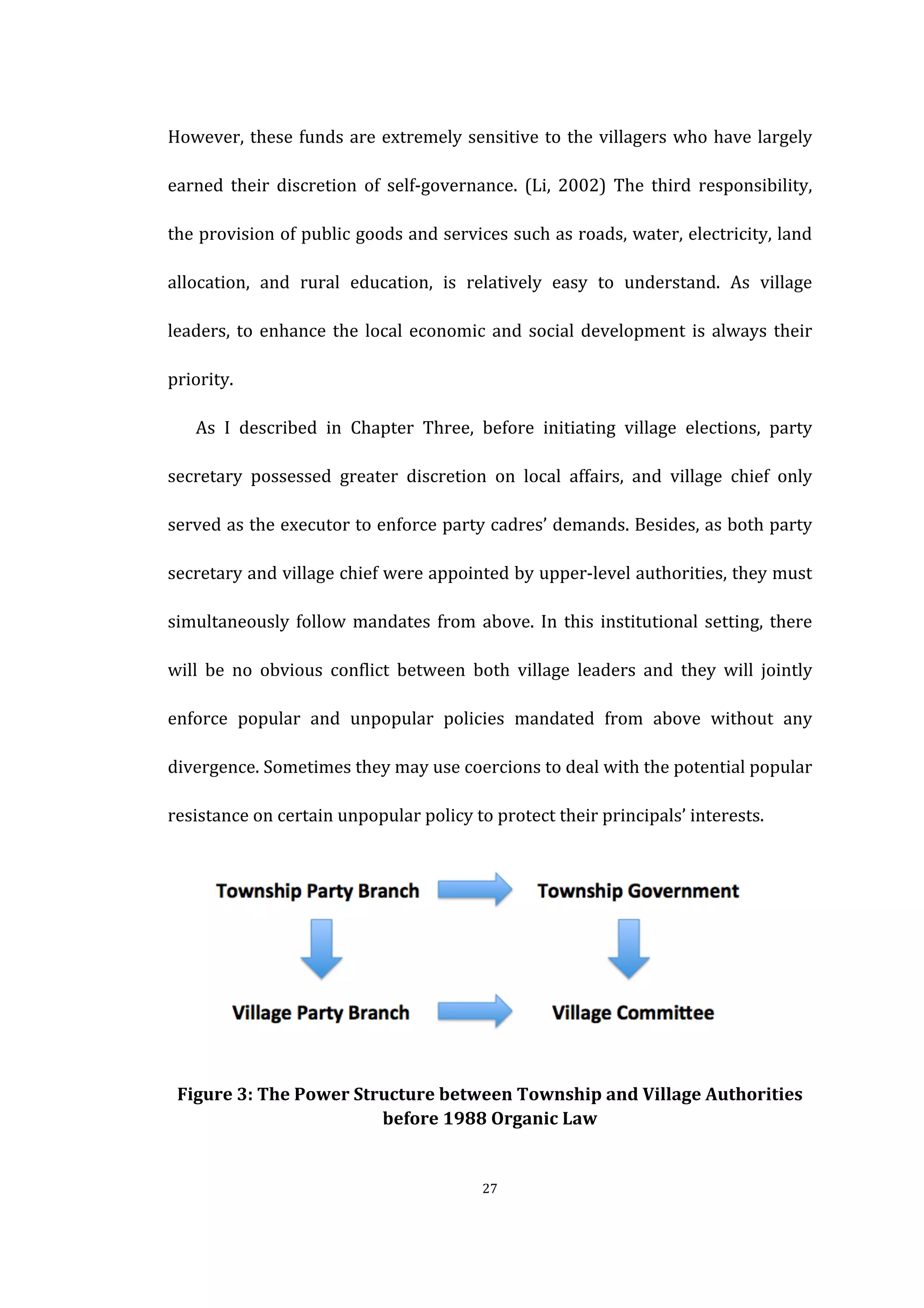
Figure	
  3:	
  The	
  Power	
  Structure	
  between	
  Township	
  and	
  Village	
  Authorities	
  before	
  
1988	
  Organic	
  Law	
  ............................................................................................................................	
  27	
  
Figure	
  4:	
  Pure	
  Strategic	
  Game	
  on	
  Consistent	
  Public	
  Policies	
  .......................................	
  30	
  
Figure	
  5:	
  Pure	
  Strategic	
  Game	
  on	
  Contentious	
  Public	
  Policies	
  ....................................	
  34	


   VII	
  
List	
  of	
  Table	


Table	
  1:	
  Village	
  Elections’	
  Impact	
  on	
  Local	
  Public	
  Policies	
  ...........................................	
  40	


   1	
  
Chapter	
  One:	
  Introduction	
  
Accompanied	
   with	
   the	
   high-­‐speed	
   economic	
   growth	
   and	
   the	
   continuously	
  
loose	
  control	
  of	
  Chinese	
  Communist	
  Party	
  (CCP)	
  in	
  rural	
  China,	
  mass	
  incidents	
  
came	
   out	
   all	
   over	
   the	
   country	
   from	
   time	
   to	
   time,	
   among	
   which	
   the	
   “Wukan	
  
Incident”,	
  or	
  “Siege	
  of	
  Wukan”,	
  drew	
  a	
  lot	
  of	
  attention.	
  Began	
  in	
  September	
  2011,	
  
thousand	
   villagers	
   from	
   Wukan	
   Village,	
   located	
   in	
   Guangdong	
   Province,	
  
protested	
   in	
   front	
   of	
   the	
   municipal	
   government	
   building	
   and	
   police	
   office	
   to	
  
express	
   their	
   indignation	
   against	
   the	
   village	
   leaders’	
   corruptions.	
   This	
   protest	
  
soon	
  evolved	
  into	
  a	
  severe	
  crash	
  between	
  the	
  police	
  and	
  protesters	
  and	
  finally	
  
resulted	
   in	
   a	
   month-­‐long	
   confrontation.	
   Simultaneously,	
   incumbent	
   village	
  
leaders	
  were	
  ousted	
  out	
  of	
  village.	
  In	
  February	
  2012,	
  according	
  to	
  the	
  Organic	
  
Law	
  of	
  Village	
  Committee,	
  villagers	
  in	
  Wukan	
  successively	
  reelected	
  members	
  of	
  
Village	
   Election	
   Committee,	
   Village	
   Representative	
   Assembly,	
   and	
   Village	
  
Committee	
  in	
  a	
  completely	
  free	
  and	
  competitive	
  way.	
  After	
  that,	
  elected	
  village	
  
cadres	
   continued	
   appealing	
   to	
   the	
   higher-­‐level	
   government	
   until	
   finally	
   their	
  
requirements	
  were	
  accepted	
  and	
  former	
  villager	
  leaders	
  were	
  put	
  in	
  jail.	
  
Despite	
  the	
  protest	
  details	
  of	
  this	
  incident,	
  we	
  can	
  see	
  that	
  villagers	
  in	
  Wukan	
  
village	
   can	
   automatically	
   conduct	
   the	
   village	
   election	
   well	
   based	
   on	
   the	
   legal	
  
provision	
   even	
   without	
   any	
   supervision	
   from	
   above,	
   proving	
   that	
   after	
   near	
  
thirty	
  years’	
  development,	
  the	
  experiment	
  of	
  village	
  self-­‐governance	
  in	
  China	
  has	


   2	
  
generated	
   a	
   solid	
   bass	
   of	
   support	
   and	
   earned	
   widespread	
   recognition	
   of	
   local	
  
villagers.	
   	
  
Following	
  the	
  economic	
  reforms	
  initiated	
  in	
  China	
  since	
  1978,	
  the	
  communal	
  
system	
  and	
  collectivization	
  policies,	
  originally	
  serving	
  as	
  tools	
  to	
  control	
  rural	
  
areas,	
   collapsed	
   gradually.	
   Instead,	
   family	
   per	
   se	
   became	
   the	
   main	
   unit	
   of	
  
production,	
   making	
   villagers	
   less	
   dependent	
   on	
   the	
   state.	
   Besides,	
   as	
   the	
  
decision-­‐making	
   process	
   largely	
   decentralized,	
   local	
   cadres	
   achieved	
   greater	
  
discretion	
   in	
   determining	
   local	
   affairs,	
   which	
   made	
   the	
   central	
   government	
  
harder	
  to	
  exert	
  effective	
  monitor	
  on	
  local	
  cadres.	
  Consequently,	
  corruption	
  and	
  
speculation	
   were	
   rampant	
   over	
   local	
   areas,	
   which	
   stimulated	
   villagers’	
   great	
  
dissatisfaction.	
   In	
   this	
   context,	
   public	
   policies,	
   especially	
   some	
   unpopular	
  
policies	
  such	
  as	
  grain	
  procurement,	
  tax	
  collection,	
  and	
  birth	
  control	
  were	
  even	
  
harder	
  to	
  enforce	
  in	
  villages	
  due	
  to	
  the	
  severer	
  cadre-­‐villager	
  conflict.	
  
In	
   order	
   to	
   regain	
   the	
   power	
   and	
   legitimacy	
   in	
   rural	
   areas,	
   Chinese	
   senior	
  
leaders,	
  paradoxically	
  to	
  some	
  degree,	
  decided	
  to	
  gradually	
  initiate	
  the	
  political	
  
reform	
   at	
   the	
   local	
   level	
   after	
   an	
   intense	
   argument	
   between	
   liberal	
   and	
  
conservative	
   factions.	
   By	
   endowing	
   more	
   autonomous	
   rights	
   to	
   villagers	
   to	
  
decide	
  their	
  own	
  business,	
  Chinese	
  autocrats	
  expected	
  to	
  maintain	
  the	
  stability	
  
and	
   the	
   smooth	
   enforcement	
   of	
   public	
   policies,	
   especially	
   unpopular	
   ones.	
   In	
  
1982,	
  China	
  began	
  to	
  officially	
  exert	
  the	
  grassroots	
  self-­‐governance	
  in	
  rural	
  areas	
  
across	
   the	
   whole	
   country.	
   In	
   1988,	
   with	
   the	
   enactment	
   of	
   the	
   Organic	
   Law	
   of	


   3	
  
Village	
  Committee,	
  villagers	
  achieved	
  the	
  right	
  to	
  directly	
  elect	
  their	
  government	
  
officials.	
  (China	
  Legal	
  Publishing	
  House,	
  2010)	
  By	
  this	
  institutional	
  design,	
  the	
  
elected	
  village	
  committees	
  are	
  composed	
  of	
  three	
  to	
  seven	
  members,	
  including	
  
one	
   village	
   chief,	
   with	
   a	
   three-­‐year	
   term	
   and	
   no	
   term	
   limits.	
   All	
   committee	
  
members	
  are	
  chosen	
  by	
  popular	
  election,	
  in	
  which	
  all	
  adult	
  villagers	
  who	
  satisfy	
  
the	
  requirements	
  have	
  the	
  right	
  to	
  vote	
  and	
  be	
  voted.	
  Regarding	
  the	
  nomination	
  
process,	
  at	
  the	
  first	
  stage	
  of	
  the	
  reform,	
  the	
  upper-­‐level	
  government	
  controlled	
  
the	
  power	
  to	
  nominate	
  candidates.	
  In	
  1998,	
  the	
  revised	
  Organic	
  Law	
  removed	
  
this	
  qualification	
  so	
  that	
  the	
  provincial	
  government	
  can	
  decide	
  specific	
  rules	
  in	
  
their	
  own	
  convenience.	
  (Martinez-­‐Bravo	
  et	
  al	
  2011;	
  Li	
  &	
  O’Brien	
  1999)	
  
	
   Actually,	
   China	
   is	
   neither	
   the	
   first,	
   nor	
   the	
   only	
   country	
   to	
   conduct	
   this	
  
partially	
  local	
  democratization	
  in	
  the	
  world.	
  Such	
  local	
  elections	
  also	
  existed	
  in	
  
other	
   authoritarian	
   countries	
   such	
   as	
   India,	
   Brazil,	
   and	
   Indonesia	
   previously.	
  
(Besley	
   &	
   Burgess	
   2002;	
   Foster	
   &	
   Rosenzweig	
   2001;	
   Olken	
   2010).	
   Village	
  
elections	
   in	
   China	
   proved	
   to	
   be	
   effective	
   in	
   monitoring	
   village	
   leaders’	
  
governance	
  and	
  prompting	
  the	
  provision	
  of	
  public	
  goods.	
  Besides,	
  proponents	
  of	
  
this	
  political	
  reform	
  also	
  expect	
  it	
  to	
  be	
  the	
  first	
  step	
  of	
  further	
  democratization,	
  
though	
  until	
  now	
  there	
  is	
  still	
  no	
  clear	
  sign	
  of	
  expansion	
  of	
  local	
  democracy	
  to	
  a	
  
higher-­‐level	
  government.	


   Despite	
   the	
   contributions	
   that	
   Chinese	
   village	
   elections	
   have	
   made	
   to	
   the	
  
local	
   governance	
   and	
   stability,	
   problems	
   also	
   came	
   out,	
   among	
   which	
   the	


   4	
  
power-­‐sharing	
   puzzle	
   between	
   the	
   local	
   party	
   branch	
   and	
   the	
   elected	
   village	
  
committee	
  is	
  the	
  most	
  prominent	
  one	
  as	
  there	
  is	
  no	
  clear	
  stipulations	
  in	
  legal	
  
provisions	
  related	
  to	
  their	
  power	
  demarcation.	
  According	
  to	
  the	
  Regulation	
  of	
  
CCP’s	
  Organization	
  Work	
  in	
  Rural	
  Area,	
  the	
  main	
  responsibility	
  of	
  a	
  party	
  branch	
  
in	
  village	
  is	
  to	
  discuss	
  and	
  decide	
  “important	
  issues”	
  related	
  to	
  local	
  economic	
  
and	
  social	
  development	
  (Zhongguofangzheng	
  Press,	
  2004);	
  While	
  in	
  terms	
  of	
  the	
  
Organic	
  Law	
  of	
  Village	
  Committee,	
  “big	
  issues”	
  in	
  village	
  should	
  be	
  decided	
  by	
  
autonomous	
   organizations	
   such	
   as	
   village	
   committee,	
   village	
   assembly,	
   and	
  
village	
   representative	
   assembly.	
   In	
   this	
   sense,	
   both	
   organizations	
   possess	
  
paralleled	
  de	
  jure	
  power	
  since	
  it	
  is	
  hard	
  to	
  differentiate	
  “important	
  issues”	
  and	
  
“big	
   issues”	
   in	
   small	
   villages.	
   (Guo,	
   2001)	
   However,	
   this	
   de	
   jure	
   power	
   is	
  
endowed	
   by	
   different	
   authorities.	
   Based	
   on	
   a	
   Leninist	
   principle	
   called	
  
democratic	
   centralism*	
   (Chinese	
   People’s	
   Publishing	
   House,	
   2012),	
   the	
   party	
  
branch	
  in	
  Chinese	
  village	
  is	
  empowered	
  by	
  the	
  upper-­‐level	
  party	
  committee.	
  The	
  
elected	
  village	
  committee,	
  in	
  contrast,	
  is	
  empowered	
  by	
  local	
  electorates.	
  In	
  this	
  
sense,	
   provided	
   that	
   village	
   elections	
   are	
   competitive	
   and	
   fair,	
   the	
   party	
  
secretary	
  will	
  follow	
  upper-­‐level	
  government’s	
  mandate,	
  but	
  village	
  chief	
  will	
  be	
  
accountable	
   to	
   villagers.	
   Consequently,	
   this	
   power-­‐sharing	
   puzzle	
   and	
   the	
  
accountability	
   problem	
   may	
   lead	
   to	
   conflicts	
   between	
   village	
   chief	
   and	
   party	
  
secretary.	


*	
  Due	
  to	
  this	
  democratic	
  centralism,	
  once	
  a	
  new	
  policy	
  being	
  suggested,	
  the	
  lower-­‐level	
  party	
  branch	
  can	
  
enjoy	
  full	
  discussion	
  before	
  the	
  upper-­‐level	
  party	
  committee	
  makes	
  the	
  final	
  decision.	
  But	
  once	
  the	
  decision	
  
is	
  made,	
  the	
  low-­‐level	
  party	
  branch	
  will	
  have	
  no	
  bargain	
  space	
  but	
  fully	
  accept	
  and	
  implement	
  the	
  policy.	


   5	
  
	
   Given	
  this	
  institutional	
  deficiency	
  on	
  Chinese	
  local	
  governance,	
  when	
  will	
  the	
  
conflict	
  emerge	
  between	
  village	
  chief	
  and	
  party	
  secretary?	
  Why	
  does	
  this	
  conflict	
  
emerge?	
  If	
  there	
  do	
  exist	
  different	
  preferences,	
  is	
  there	
  any	
  incentive	
  for	
  certain	
  
player	
  to	
  defect	
  for	
  an	
  agreement?	
  In	
  this	
  paper,	
  I	
  will	
  develop	
  a	
  pure	
  strategic	
  
model	
  to	
  explain	
  these	
  research	
  questions.	
  I	
  argue	
  that	
  as	
  the	
  village	
  chief	
  and	
  
party	
   secretary	
   are	
   accountable	
   to	
   different	
   authorities,	
   they	
   may	
   possess	
  
different	
   preferences	
   towards	
   certain	
   public	
   policies.	
   When	
   facing	
   consistent	
  
policies,	
  towards	
  which	
  villagers	
  and	
  upper-­‐level	
  government	
  possess	
  the	
  same	
  
preference,	
   both	
   party	
   secretary	
   and	
   village	
   chief	
   will	
   prefer	
   to	
   enforce	
   them.	
  
However,	
   when	
   dealing	
   with	
   contentious	
   policies,	
   towards	
   which	
   villagers’	
  
interest	
  is	
  largely	
  deprived	
  by	
  the	
  upper-­‐level	
  government,	
  while	
  party	
  secretary	
  
still	
  prefer	
  to	
  enforce	
  them,	
  village	
  chief,	
  on	
  the	
  contrary,	
  tends	
  to	
  reject	
  them.	
  
Both	
  village	
  chief	
  and	
  party	
  secretary	
  have	
  no	
  incentive	
  to	
  defect	
  in	
  these	
  two	
  
situations	
  as	
  the	
  outcomes	
  in	
  my	
  model	
  are	
  in	
  equilibrium.	


   Regarding	
  this	
  outcome,	
  my	
  next	
  research	
  question	
  in	
  this	
  paper	
  is	
  how	
  to	
  
deal	
   with	
   the	
   conflict	
   between	
   village	
   chief	
   and	
   party	
   secretary.	
   In	
   practice,	
  
government	
  leaders	
  in	
  different	
  provinces	
  have	
  put	
  forward	
  various	
  solutions.	
  A	
  
simple	
  solution	
  is	
  to	
  merge	
  the	
  two	
  sets	
  personnel	
  and	
  let	
  party	
  secretary	
  hold	
  
concurrent	
   position	
   of	
   village	
   chief.	
   Besides,	
   leaders	
   of	
   Qing	
   County	
   in	
   Hebei	
  
Province	
  designed	
  a	
  new	
  method	
  in	
  2002	
  and	
  soon	
  spread	
  its	
  use	
  to	
  the	
  whole	
  
county.	
  This	
  political	
  experiment	
  was	
  named	
  “Qingxian	
  Model”	
  later	
  by	
  Chinese	


   6	
  
scholars.	
   To	
   probe	
   into	
   its	
   processing	
   mechanism	
   and	
   practical	
   outcome,	
   I	
  
conducted	
  a	
  field	
  study	
  in	
  Qing	
  County	
  in	
  2010	
  with	
  three	
  team	
  members.	
  We	
  
found	
  that	
  by	
  resurrecting	
  the	
  power	
  of	
  Village	
  Representative	
  Assembly	
  (VRA)	
  
nominally	
  and	
  assigning	
  the	
  party	
  secretary	
  to	
  run	
  for	
  the	
  president	
  of	
  VRA,	
  the	
  
party	
  branch	
  in	
  village	
  regains	
  its	
  power	
  over	
  the	
  village	
  committee.	
  Thus,	
  we	
  
concluded	
  that	
  in	
  the	
  long	
  run,	
  the	
  “Qingxian	
  Model”	
  would	
  sabotage	
  the	
  local	
  
democracy	
  in	
  China.	
  
	
   In	
   the	
   following	
   paper,	
   I	
   will	
   first	
   review	
   some	
   existing	
   research	
   works	
  
related	
  to	
  Chinese	
  village	
  elections.	
  After	
  that,	
  I	
  will	
  lay	
  out	
  some	
  background	
  
knowledge	
  of	
  Chinese	
  village	
  elections	
  in	
  the	
  third	
  section,	
  and	
  then	
  elaborate	
  
the	
  formal	
  model	
  based	
  on	
  political	
  interactions	
  between	
  village	
  chief	
  and	
  party	
  
secretary	
  regarding	
  different	
  types	
  of	
  public	
  policies	
  in	
  Section	
  Four.	
  In	
  Section	
  
Five,	
  I	
  will	
  discuss	
  the	
  “Qingxian	
  Model”	
  in	
  detail	
  as	
  a	
  solution	
  to	
  deal	
  with	
  the	
  
power-­‐sharing	
  puzzle	
  between	
  village	
  chief	
  and	
  party	
  secretary.	
  A	
  conclusion	
  of	
  
the	
  whole	
  paper	
  will	
  come	
  at	
  the	
  end.	


   7	
  
Chapter	
  Two:	
  Literature	
  Review	
  
There	
   are	
   various	
   research	
   works	
   focusing	
   on	
   China’s	
   local	
   level	
  
self-­‐autonomy	
  issue	
  since	
  its	
  initiation	
  in	
  1982,	
  most	
  of	
  which,	
  however,	
  were	
  
engaged	
  in	
  analyzing	
  village	
  elections,	
  which	
  were	
  seen	
  as	
  the	
  core	
  content	
  of	
  the	
  
self-­‐governance	
  in	
  rural	
  China.	
  Among	
  these	
  various	
  studies,	
  three	
  questions	
  are	
  
generally	
  put	
  forward	
  and	
  explained	
  by	
  scholars,	
  namely	
  incentives	
  for	
  Chinese	
  
central	
  leaders	
  to	
  initiate	
  popular	
  elections	
  at	
  the	
  local	
  level,	
  the	
  competitiveness	
  
and	
   fairness	
   of	
   the	
   popular	
   elections,	
   and	
   potential	
   outcomes	
   of	
   such	
   village	
  
elections.	
  
Regarding	
  the	
  first	
  question,	
  scholars	
  tend	
  to	
  explain	
  it	
  in	
  a	
  similar	
  way	
  that	
  
Chinese	
  leaders	
  mainly	
  treat	
  village	
  elections	
  as	
  a	
  strategy	
  to	
  regain	
  the	
  political	
  
power	
  and	
  legitimacy	
  in	
  rural	
  areas.	
  Based	
  on	
  abundant	
  historical	
  documents,	
  Li	
  
and	
  O’Brien	
  (1999)	
  argued	
  explicitly	
  that	
  before	
  the	
  enactment	
  of	
  the	
  Organic	
  
Law	
  of	
  Village	
  Committee	
  in	
  1988,	
  contentions	
  were	
  widespread	
  among	
  Chinese	
  
senior	
  leaders	
  as	
  well	
  as	
  the	
  local	
  officials.	
  While	
  the	
  opponents	
  were	
  afraid	
  that	
  
introducing	
  local	
  elections	
  and	
  endowing	
  more	
  autonomous	
  rights	
  to	
  peasants	
  
may	
   exacerbate	
   the	
   loose	
   central-­‐local	
   and	
   cadre-­‐villager	
   relations,	
   the	
  
proponents,	
  among	
  whom	
  two	
  senior	
  leaders,	
  Peng	
  Zhen	
  and	
  Bo	
  Yibo	
  stood	
  out,	
  
believed	
   that	
   in	
   the	
   reform	
   era,	
   as	
   the	
   decision-­‐making	
   process	
   was	
   largely	
  
decentralized	
  to	
  local	
  officials,	
  it	
  was	
  harder	
  to	
  monitor	
  local	
  cadres’	
  behavior.	


   8	
  
Besides,	
   as	
   peasants	
   became	
   less	
   dependent	
   on	
   the	
   state,	
   unpopular	
   public	
  
policies	
  would	
  encounter	
  more	
  resistance	
  from	
  below.	
  Consequently,	
  initiating	
  
village	
  elections	
  will	
  on	
  one	
  hand	
  transfer	
  the	
  previously	
  imperfect	
  monitoring	
  
job	
  to	
  vernacular	
  villagers,	
  thus	
  improving	
  the	
  quality	
  of	
  village	
  leadership,	
  and	
  
on	
   the	
   other	
   hand	
   mitigate	
   the	
   severe	
   cadre-­‐villager	
   relations,	
   thus	
   making	
  
unpopular	
  policies	
  more	
  acceptable.	
  (O’Brien	
  1994,	
  Kelliher	
  1997,	
  Manion	
  1996,	
  
Li	
   &	
   O’Brien	
   2006,	
   Tsai	
   2007).	
   For	
   me,	
   I	
   tend	
   to	
   agree	
   with	
   these	
   scholars’	
  
analysis	
  that	
  virtually	
  village	
  elections	
  just	
  served	
  as	
  a	
  tool	
  for	
  CCP	
  to	
  rebuild	
  the	
  
support	
  in	
  rural	
  areas.	
  
In	
  terms	
  of	
  questions	
  related	
  to	
  the	
  competitiveness	
  and	
  fairness	
  of	
  electoral	
  
process,	
  the	
  Carter	
  Center,	
  with	
  the	
  help	
  of	
  the	
  Chinese	
  Ministry	
  of	
  Civil	
  Affairs	
  
(MCA),	
   has	
   contributed	
   valuable	
   research	
   documents.	
   Starting	
   in	
   1997,	
   the	
  
Carter	
  Center	
  has	
  sent	
  several	
  research	
  groups	
  to	
  different	
  provinces	
  in	
  China,	
  
such	
  as	
  Yunnan,	
  Guangdong,	
  Fujian,	
  Hebei,	
  Hunan,	
  and	
  Heilongjiang,	
  to	
  observe	
  
the	
   electoral	
   process,	
   collective	
   data,	
   and	
   make	
   relative	
   analyses.	
   Their	
  
observation	
  and	
  research	
  basically	
  cover	
  the	
  whole	
  process	
  of	
  a	
  village	
  election,	
  
including	
   the	
   formulation	
   of	
   Village	
   Election	
   Committee	
   and	
   Village	
  
Representative	
   Assembly,	
   the	
   primary	
   nomination	
   and	
   the	
   final	
   election	
   of	
  
candidates,	
  the	
  ballot	
  casting,	
  and	
  the	
  publication	
  of	
  electoral	
  results.	
  According	
  
to	
   their	
   evaluation	
   report,	
   there	
   is	
   a	
   significant	
   improvement	
   in	
   the	
  
standardization	
   and	
   quality	
   of	
   village	
   elections	
   with	
   time	
   passing.	
   (The	
   Carter	


   9	
  
Center,	
  1998)	
  Besides,	
  most	
  scholars	
  tend	
  to	
  believe	
  that	
  initially	
  local	
  elections	
  
are	
  uncompetitive,	
  which	
  was	
  reflected	
  in	
  two	
  aspects.	
  First,	
  based	
  on	
  original	
  
electoral	
   procedures,	
   the	
   nomination	
   process	
   is	
   conducted	
   by	
   the	
   upper-­‐level	
  
government	
   rather	
   than	
   the	
   general	
   public,	
   which	
   largely	
   weakens	
   villagers’	
  
discretion	
  in	
  deciding	
  their	
  leaders.	
  (Manion	
  1996)	
  Second,	
  previous	
  local	
  cadres	
  
were	
  generally	
  hostile	
  to	
  village	
  elections	
  for	
  fear	
  of	
  losing	
  their	
  vested	
  interests	
  
unless	
  they	
  were	
  confident	
  that	
  they	
  could	
  still	
  win	
  out	
  in	
  competitive	
  elections.	
  
To	
   maintain	
   their	
   power,	
   local	
   cadres	
   were	
   engaged	
   in	
   manipulating	
   the	
  
elections,	
  either	
  offering	
  money	
  to	
  higher-­‐level	
  officials	
  for	
  support,	
  or	
  directly	
  
buy	
   votes	
   from	
   villagers.	
   (Li	
   &	
   O’Brien	
   1999,	
   Wang	
   2009).	
   However,	
   some	
  
scholars	
   point	
   out	
   that	
   the	
   competitiveness	
   issue	
   has	
   largely	
   been	
   solved,	
  
especially	
   after	
   the	
   revision	
   of	
   Organic	
   Law	
   of	
   Village	
   Committee	
   in	
   1998,	
   in	
  
which	
  the	
  nomination	
  process	
  has	
  generally	
  opened	
  to	
  all	
  villagers.	
  Besides,	
  as	
  
villagers	
   became	
   more	
   familiar	
   and	
   knowledgeable	
   about	
   democratic	
   settings,	
  
they	
   were	
   more	
   inclined	
   to	
   defend	
   the	
   electoral	
   system	
   by	
   petitioning	
   to	
   a	
  
higher-­‐level	
   authority	
   if	
   local	
   cadres	
   violated	
   regulations.	
   (O’Brien	
   1996,	
   Li	
   &	
  
O’Brien	
  1995)	
  Another	
  set	
  of	
  papers	
  move	
  further	
  to	
  explain	
  what	
  factors	
  may	
  
influence	
  the	
  competitiveness.	
  O’Brien	
  and	
  Li	
  (2000)	
  maintained	
  that	
  relatively	
  
well	
  off	
  villages	
  tend	
  to	
  have	
  more	
  competitive	
  elections.	
  While	
  Shi	
  (1999)	
  and	
  
Epstein	
   (1997)	
   argued	
   that	
   villages	
   with	
   average	
   wealth	
   and	
   median	
   income	
  
were	
  more	
  likely	
  to	
  hold	
  competitive	
  elections.	
  Besides,	
  Oi	
  and	
  Rozelle	
  (2000),	


   10	
  
explained	
  that	
  it	
  is	
  the	
  source	
  of	
  outcome,	
  village’s	
  industrial	
  structure	
  and	
  the	
  
participation	
  of	
  villagers	
  in	
  assemblies	
  and	
  representative	
  assemblies	
  that	
  jointly	
  
determine	
  the	
  competitiveness	
  of	
  village	
  elections.	
   	
  
The	
   third	
   research	
   topic	
   focused	
   on	
   potential	
   political	
   outcomes	
   of	
   village	
  
elections.	
   First,	
   one	
   group	
   of	
   scholars	
   probed	
   into	
   the	
   possibility	
   that	
   village	
  
elections	
  could	
  contribute	
  to	
  the	
  higher-­‐level	
  democratization	
  (Pei	
  1995,	
  Wang	
  
1998,	
  Shi	
  1999)	
  and	
  the	
  development	
  of	
  civil	
  society	
  (Chan,	
  1998).	
  Besides,	
  by	
  
observing	
  the	
  experiment	
  of	
  township	
  elections	
  in	
  several	
  provinces,	
  Li	
  (2002)	
  
argued	
  that	
  the	
  village	
  elections	
  might	
  help	
  initiate	
  the	
  further	
  electoral	
  reform,	
  
and	
  the	
  widespread	
  attention	
  from	
  international	
  community	
  may	
  press	
  the	
  local	
  
government	
   to	
   improve	
   its	
   human	
   right	
   record.	
   However,	
   some	
   scholars	
  
questioned	
   the	
   significance	
   of	
   village	
   elections	
   and	
   argued	
   that	
   the	
   local	
  
democracy	
  can	
  only	
  make	
  peripheral	
  contributions	
  to	
  China’s	
  democratization.	
  
(Louie,	
  2001)	
  Besides,	
  the	
  second	
  group	
  of	
  scholars	
  focused	
  more	
  on	
  whether	
  
village	
   elections	
   can	
   prompt	
   the	
   amelioration	
   of	
   local	
   governance	
   and	
   the	
  
accountability	
  of	
  local	
  cadres.	
  Manion	
  (1994)	
  argued	
  that	
  as	
  the	
  elected	
  village	
  
chief	
  will	
  be	
  more	
  accountable	
  to	
  the	
  villagers,	
  state	
  involvement	
  will	
  be	
  less	
  in	
  
local	
   economy.	
   However,	
   in	
   one	
   of	
   her	
   later	
   research	
   works,	
   Manion	
   (1996)	
  
revised	
   her	
   argument.	
   By	
   observing	
   the	
   villager	
   and	
   local	
   official’s	
   attitudes	
  
towards	
   the	
   state	
   role	
   in	
   the	
   local	
   economy,	
   she	
   argued	
   that	
   village	
   chief	
   is	
  
simultaneously	
   accountable	
   to	
   the	
   upper-­‐level	
   government	
   and	
   local	
   villagers.	


   11	
  
Tsai	
  (2002),	
  and	
  Brandt	
  and	
  Turner	
  (2007)	
  both	
  demonstrated	
  in	
  their	
  papers	
  
that	
  openly	
  elected	
  leaders	
  do	
  respond	
  to	
  villager	
  complaints	
  for	
  fear	
  of	
  being	
  
voted	
  out	
  of	
  office.	
  Mu	
  and	
  Zhang	
  (2011)	
  maintained	
  that	
  village	
  chief	
  could	
  only	
  
respond	
   to	
   certain	
   groups	
   of	
   villagers.	
   They	
   categorize	
   China’s	
   villages	
   into	
  
natural	
   villages	
   and	
   administrative	
   villages*,	
   and	
   argued	
   that	
   group	
   identity	
  
influences	
  the	
  election	
  results	
  of	
  village	
  cadres,	
  who	
  in	
  turn	
  offers	
  more	
  targeted	
  
public	
   goods	
   to	
   their	
   own	
   natural	
   villages.	
   Besides,	
   they	
   also	
   maintain	
   that	
  
elected	
  village	
  chief	
  will	
  show	
  less	
  favoritism	
  in	
  the	
  allocations	
  of	
  public	
  goods	
  
than	
   unelected	
   secretary,	
   who	
   tends	
   to	
   allocate	
   more	
   resources	
   to	
   her	
   own	
  
ethnic	
   group.	
   Alpermann	
   (2001)	
   began	
   to	
   discuss	
   the	
   accountability	
   issue	
   of	
  
local	
  cadres	
  in	
  the	
  context	
  of	
  certain	
  policies.	
  He	
  argued	
  that	
  when	
  dealing	
  with	
  
some	
   contentious	
   policies,	
   such	
   as	
   the	
   one-­‐child	
   policy	
   and	
   policies	
   related	
   to	
  
local	
  economic	
  development,	
  party	
  secretary	
  still	
  plays	
  decisive	
  role	
  and	
  village	
  
chief	
   only	
   acts	
   as	
   the	
   “agents”	
   of	
   the	
   party.	
   However,	
   Kennedy	
   et	
   al.	
   (2004)	
  
opposed	
  this	
  argument	
  by	
  proving	
  that	
  competitive	
  village	
  elections	
  will	
  press	
  
elected	
   leaders	
   to	
   be	
   more	
   accountable	
   to	
   villagers	
   when	
   making	
   local	
   land	
  
policies.	
  Martinez-­‐Bravo	
  et	
  al.	
  (2011)’s	
  paper	
  further	
  divided	
  the	
  state	
  policies	
  
into	
  congruent	
  and	
  incongruent	
  policies	
  and	
  argued	
  that	
  as	
  long	
  as	
  village	
  chiefs	
  
possess	
  certain	
  discretion	
  over	
  the	
  decision-­‐making	
  of	
  these	
  policies,	
  they	
  will	


*	
  The	
  natural	
  villages	
  are	
  formed	
  spontaneously	
  and	
  naturally	
  through	
  a	
  long	
  time,	
  mostly	
  influenced	
  by	
  the	
  
geographic	
  characteristics	
  and	
  living	
  patterns;	
  while	
  the	
  administrative	
  villages	
  are	
  created	
  by	
  CCP	
  in	
  
convenience	
  of	
  control,	
  mostly	
  bigger	
  than	
  the	
  natural	
  villages	
  and	
  composed	
  by	
  several	
  adjacent	
  natural	
  
villages.	


   12	
  
tend	
  to	
  represent	
  the	
  villagers’	
  interest	
  in	
  both	
  popular	
  and	
  unpopular	
  policies.	
   	
  
The	
   scholars	
   above	
   have	
   contributed	
   valuable	
   knowledge	
   to	
   this	
   certain	
  
research	
  field,	
  but	
  several	
  arguments	
  need	
  to	
  be	
  further	
  discussed	
  and	
  improved.	
  
First,	
   though	
   Chinese	
   central	
   leaders	
   still	
   mainly	
   focus	
   on	
   maximizing	
   the	
  
strategic	
  effects	
  of	
  local	
  elections,	
  i.e.	
  to	
  maintain	
  local	
  stability	
  and	
  prompt	
  the	
  
enforcement	
   of	
   state	
   policies,	
   the	
   election,	
   as	
   a	
   democratic	
   setting,	
   will	
  
spontaneously	
   create	
   some	
   institutional	
   effects.	
   Given	
   that	
   village	
   elections	
  
become	
  more	
  competitive	
  and	
  widespread	
  with	
  time	
  passing,	
  these	
  institutional	
  
effects	
  will	
  further	
  stand	
  out.	
  Thus	
  when	
  discussing	
  political	
  outcomes	
  of	
  such	
  
elections,	
  we	
  should	
  not	
  simply	
  neglect	
  the	
  institutional	
  effects.	
  Second,	
  previous	
  
research	
  works	
  mainly	
  focus	
  on	
  the	
  accountability	
  issue	
  of	
  village	
  chief,	
  while	
  the	
  
role	
   party	
   secretary	
   plays	
   in	
   local	
   affairs	
   is	
   largely	
   ignored.	
   Actually,	
   party	
  
branch	
   still	
   possesses	
   paralleled	
   de	
   jure	
   and	
   de	
   facto	
   power	
   in	
   local	
  
decision-­‐making	
   process,	
   and	
   nominally,	
   party	
   secretary	
   is	
   still	
   the	
   boss	
   and	
  
“first	
   hand”	
   (“Yibashou”	
   in	
   Chinese)	
   in	
   village.	
   (Oi	
   &	
   Rozelle	
   2000,	
   Alpermann	
  
2001)	
   Consequently,	
   we	
   should	
   take	
   party	
   secretary’s	
   preference,	
   and	
   most	
  
importantly	
   the	
   interactions	
   between	
   village	
   chief	
   and	
   party	
   secretary,	
   into	
  
consideration.	
   Finally,	
   we	
   must	
   avoid	
   the	
   generalization	
   problem	
   during	
   the	
  
research.	
  As	
  the	
  Organic	
  Law	
  of	
  Village	
  Committee	
  only	
  provides	
  an	
  outline	
  of	
  
village	
  elections,	
  different	
  provinces	
  can	
  formulate	
  different	
  electoral	
  rules	
  based	
  
on	
  their	
  own	
  reality.	
  Thus,	
  the	
  concrete	
  interactions	
  between	
  party	
  secretary	
  and	


   13	
  
village	
   chief	
   may	
   be	
   largely	
   influenced	
   by	
   peculiar	
   formal	
   and	
   informal	
  
institutions.	
   	
  
In	
   terms	
   of	
   the	
   power-­‐sharing	
   puzzle	
   between	
   village	
   chief	
   and	
   party	
  
secretary,	
   though	
   some	
   scholars	
   have	
   mentioned	
   this	
   problem,	
   few	
   conduct	
  
deeper	
  research.	
  Guo	
  and	
  Bernstein	
  (2004)	
  argued	
  that	
  the	
  conflict	
  could	
  arise	
  
because	
  the	
  foundation	
  of	
  their	
  legitimacy	
  and	
  authority	
  differs,	
  and	
  a	
  possible	
  
solution	
  is	
  to	
  merge	
  these	
  two	
  institutions	
  by	
  asking	
  party	
  secretary	
  to	
  run	
  for	
  
the	
  post	
  of	
  village	
  chief.	
  Besides,	
  He	
  (2003)	
  argued	
  that	
  the	
  relation	
  between	
  the	
  
self-­‐governing	
   village	
   and	
   the	
   upper-­‐level	
   government	
   may	
   also	
   be	
   in	
   trouble.	
  
While	
   the	
   party	
   secretary	
   in	
   villages	
   serves	
   as	
   the	
   agent	
   of	
   upper-­‐level	
   party	
  
branch,	
   the	
   elected	
   village	
   committee	
   is	
   not	
   necessarily	
   obedient	
   to	
   the	
  
upper-­‐level	
  authorities.	
  Li	
  (2002)	
  further	
  explained	
  the	
  two-­‐committee	
  conflict	
  
within	
  the	
  context	
  of	
  the	
  relation	
  between	
  the	
  party	
  and	
  villagers.	
  He	
  argued	
  that	
  
the	
   functions	
   of	
   these	
   two	
   committees	
   are	
   overlapped	
   in	
   terms	
   of	
   the	
   village	
  
governance,	
   resulting	
   in	
   a	
   paradox	
   that	
   emphasizing	
   the	
   party	
   leadership	
   will	
  
paralyze	
   the	
   self-­‐governance,	
   while	
   highlighting	
   the	
   self-­‐governance	
   will	
  
deteriorate	
  the	
  party	
  leadership.	
  
Regarding	
   “Qingxian	
  Model”,	
  only	
  a	
  few	
  scholars,	
  all	
  of	
  whom	
  are	
  Chinese,	
  
focused	
  on	
  its	
  function	
  and	
  implication.	
  Among	
  these	
  research	
  works,	
  there	
  do	
  
have	
   some	
   valuable	
   pieces,	
   such	
   as	
   Peng	
   and	
   Shangguan	
   (2008)’s	
   paper	
   “the	
  
political	
   participation	
   after	
   local	
   election:	
   an	
   example	
   of	
   the	
   villagers	


   14	
  
representative	
  assembly	
  in	
  ‘Qingxian	
  Model’”,	
  Wang	
  (2009)’s	
  paper	
  “improving	
  
the	
   village	
   self-­‐autonomy:	
  the	
  analysis	
  of	
  ‘Qingxian	
  Model’”,	
  Liu	
  et	
  al.	
  (2010)’s	
  
paper	
  “from	
  grassroots	
  democracy	
  to	
  the	
  rule	
  of	
  law:	
  a	
  survey	
  of	
  Qing	
  County’s	
  
villager	
   self-­‐autonomy”,	
   and	
   Lian	
   et	
   al.	
   (2009)’s	
   paper	
   “get	
   rid	
   of	
   the	
  
two-­‐dimension	
  dilemma	
  in	
  the	
  authority	
  delineation	
  of	
  party	
  branch	
  and	
  village	
  
committee:	
  a	
  reconsideration	
  of	
  ‘Qingxian	
  Model’”.	
  However,	
  the	
  basic	
  argument	
  
of	
   these	
   papers	
   is	
   similar.	
   They	
   all	
   first	
   describe	
   causes	
   and	
   functions	
   of	
  
“Qingxian	
   Model”	
   in	
   detail	
   and	
   then	
   basically	
   affirm	
   the	
   positive	
   influence	
   of	
  
“Qingxian	
  Model”	
  on	
  enhancing	
  the	
  party’s	
  leadership,	
  overcoming	
  the	
  existing	
  
conflict	
   and	
   protecting	
   villagers’	
   rights.	
   However,	
   few	
   of	
   these	
   studies	
   have	
  
mentioned	
   the	
   institutional	
   problem	
   inside	
   the	
   “Qingxian	
   Model”	
   and	
   the	
  
potential	
  harm	
  it	
  can	
  exert	
  on	
  Chinese	
  local	
  democracy.	


   15	
  
Chapter	
  Three:	
  Background	
  of	
  Chinese	
  Village	
  Elections	
  
Local	
  leaders	
  in	
  China’s	
  administrative	
  structure	
  have	
  always	
  played	
  a	
  crucial	
  
role	
  in	
  enforcing	
  state	
  policies	
  and	
  fulfilling	
  the	
  well-­‐being	
  of	
  local	
  villagers	
  due	
  
to	
  the	
  large	
  geographic	
  scope	
  and	
  the	
  decentralization	
  nature	
  inherited	
  since	
  as	
  
early	
   as	
   the	
   Mao	
   era.	
   (Cai	
   &	
   Treisman,	
   2006)	
   Up	
   to	
   2009,	
   there	
   have	
   been	
  
691,510	
   administrative	
   villages	
   in	
   China,	
   which	
   widely	
   distributed	
   across	
   the	
  
Chinese	
  territory.	
  Even	
  though	
  the	
  village	
  is	
  not	
  an	
  official	
  level	
  of	
  government,	
  
leaders	
   at	
   this	
   level	
   still	
   serve	
   as	
   key	
   political	
   and	
   economic	
   actors	
   in	
  
determining	
  the	
  fate	
  of	
  China’s	
  villagers.	
  
During	
  the	
  collectivization	
  era,	
  the	
  production	
  team	
  (shengchan	
  dadui)	
  was	
  
the	
  only	
  legal	
  organization	
  in	
  local	
  areas.	
  Basically,	
  all	
  villagers	
  and	
  households	
  
in	
  a	
  certain	
  area	
  must	
  be	
  enrolled	
  in	
  a	
  local	
  production	
  team.	
  Though	
  the	
  size	
  of	
  
production	
   teams	
   varied	
   depending	
   on	
   the	
   local	
   population,	
   their	
   main	
  
responsibilities	
   were	
   the	
   same,	
   consisting	
   of	
   organizing	
   team	
   members	
   to	
  
conduct	
  collective	
  economic	
  activities,	
  allocating	
  local	
  goods	
  and	
  compensations,	
  
and	
   conducting	
   political	
   and	
   ideological	
   educations.	
   (Oi,	
   1989)	
   In	
   such	
   an	
  
organization	
  simultaneously	
  possessing	
  the	
  economic	
  and	
  political	
  function,	
  the	
  
power	
  delineation	
  was	
  clear.	
  The	
  production	
  team	
  leader,	
  who	
  is	
  almost	
  always	
  a	
  
party	
  member,	
  served	
  a	
  dualistic	
  role.	
  Towards	
  the	
  general	
  team	
  members,	
  the	
  
team	
  leader	
  strictly	
  controls	
  the	
  over-­‐all	
  power,	
  most	
  importantly	
  the	
  allocation	


   16	
  
power	
   of	
   public	
   resources.	
   However,	
   as	
   the	
   agent	
   of	
   upper-­‐level	
   communal	
  
officials,	
   the	
   team	
   leader	
   has	
   to	
   follow	
   their	
   command	
   and	
   finish	
   the	
   task	
  
mandated	
  by	
  them.	
  In	
  this	
  sense,	
  it	
  is	
  a	
  perfect	
  vertical	
  power	
  structure,	
  in	
  which	
  
the	
  team	
  leader	
  is	
  the	
  gatekeeper	
  of	
  resources	
  and	
  opportunities	
  for	
  the	
  team	
  
and	
  its	
  members,	
  but	
  also	
  the	
  executor	
  and	
  enforcer	
  of	
  mandated	
  policies	
  from	
  
above.	
   Although	
   local	
   governments	
   had	
   already	
   emerged	
   before	
   popular	
  
elections,	
  they	
  could	
  seldom	
  exert	
  any	
  leverage	
  to	
  the	
  existing	
  power	
  structure	
  
as	
  team	
  leaders,	
  who	
  are	
  also	
  party	
  cadres,	
  still	
  strictly	
  held	
  the	
  general	
  power,	
  
and	
   government	
   leaders	
   in	
   this	
   system	
   served	
   only	
   as	
   the	
   executor	
   under	
   the	
  
control	
  of	
  production	
  team.	
  Though	
  there	
  were	
  elections	
  of	
  local	
  party	
  leaders,	
  
due	
  to	
  the	
  “intra-­‐party	
  democracy”	
  rule	
  of	
  CCP,	
  villagers	
  had	
  no	
  influence	
  at	
  all	
  as	
  
the	
   candidates	
   were	
   pre-­‐selected	
   by	
   the	
   upper-­‐level	
   party	
   committee	
   and	
   the	
  
election	
   was	
   only	
   open	
   to	
   party	
   members.	
   In	
   this	
   sense,	
   we	
   can	
   see	
   that	
   this	
  
vertical	
  power	
  structure	
  is	
  adaptable	
  to	
  the	
  collective	
  economy	
  pattern	
  as	
  it	
  can	
  
maximize	
  party	
  cadres’	
  allocation	
  and	
  distribution	
  power	
  of	
  public	
  resources.	
  
However,	
  since	
  Deng	
  Xiaoping	
  initiated	
  the	
  decollectivization	
  reform	
  in	
  1978,	
  
the	
  social	
  and	
  economic	
  changes	
  have	
  largely	
  influenced	
  the	
  CCP	
  governance	
  in	
  
rural	
   areas.	
   First,	
   after	
   initiating	
   the	
   decollectivization	
   reform,	
   most	
   original	
  
production	
   teams	
   became	
   village	
   small	
   groups	
   (xiaozu),	
   a	
   subordinate	
  
organization	
  in	
  villages	
  retaining	
  little	
  economic	
  power.	
  Instead,	
  the	
  family	
  per	
  se	
  
became	
   the	
   unit	
   of	
   production	
   and	
   accounting,	
   taking	
   care	
   of	
   its	
   resources	


   17	
  
allocation,	
   such	
   as	
   the	
   grain,	
   fertilizer,	
   and	
   harvest	
   alone.	
   Unlike	
   the	
  
circumstances	
   during	
   collectivization	
   era	
   when	
   rural	
   households	
   mainly	
  
depended	
  on	
  the	
  sharing	
  of	
  public	
  goods,	
  villagers	
  basically	
  controlled	
  their	
  own	
  
fates	
   after	
   the	
   reform,	
   making	
   them	
   cherish	
   more	
   on	
   private	
   surplus	
   and	
  
simultaneously	
   became	
   more	
   resistant	
   to	
   unpopular	
   policies	
   mandated	
   from	
  
above	
  as	
  these	
  policies	
  would	
  deprive	
  certain	
  part	
  of	
  their	
  private	
  goods.	
  This	
  
transformation	
   therefore	
   made	
   unpopular	
   policies	
   harder	
   to	
   enforce	
   in	
   local	
  
areas.	
  Since	
  local	
  cadres	
  are	
  the	
  agents	
  of	
  central	
  government,	
  villagers	
  would	
  
naturally	
  express	
  their	
  anger	
  to	
  these	
  cadres,	
  which	
  deteriorated	
  the	
  cadre-­‐mass	
  
relations.	
   	
  
Besides,	
  local	
  party	
  secretaries	
  themselves	
  also	
  became	
  less	
  prestigious	
  since	
  
the	
  decollectivization	
  reform.	
  Age	
  and	
  corruption	
  were	
  two	
  main	
  problems.	
  First,	
  
the	
  aging	
  problem	
  of	
  local	
  cadres	
  began	
  to	
  perplex	
  CCP	
  senior	
  leaders	
  as	
  early	
  as	
  
in	
  1970s.	
  (Li	
  &	
  O’Brien,	
  1995)	
  As	
  there	
  was	
  no	
  genuine	
  limit	
  on	
  party	
  cadres’	
  
tenure,	
   most	
   of	
   them,	
   who	
   assumed	
   the	
   position	
   since	
   the	
   foundation	
   of	
   new	
  
China,	
  never	
  stepped	
  down.	
  This	
  problem	
  became	
  severer	
  after	
  the	
  reform	
  was	
  
initiated	
  as	
  these	
  old	
  “local	
  emperors”	
  who	
  were	
  armed	
  with	
  the	
  Mao	
  doctrines	
  
can	
  hardly	
  understand	
  and	
  keep	
  up	
  with	
  the	
  new	
  development.	
  As	
  of	
  2001,	
  there	
  
were	
  1,357,000	
  party	
  branches	
  in	
  rural	
  China	
  with	
  a	
  total	
  party	
  membership	
  of	
  
29.5	
   million,	
   but	
   among	
   these	
   local	
   branches,	
   as	
   many	
   as	
   356,000	
   were	
  
experienced	
   rectifications	
   from	
   1994	
   to	
   2000	
   due	
   to	
   their	
   weakness.	
   (Guo	
   &	


   18	
  
Bernstein,	
   2004)	
   Besides,	
   the	
   corruptive	
   problem	
   also	
   became	
  furious	
  in	
  local	
  
areas	
  after	
  decollectivization.	
  Since	
  CCP	
  largely	
  decentralized	
  decisive	
  power	
  to	
  
local	
   cadres	
   to	
   decide	
   local	
   affairs,	
   party	
   secretaries	
   then	
   possessed	
   the	
   final	
  
discretion	
  on	
  the	
  surplus	
  of	
  public	
  goods	
  as	
  long	
  as	
  they	
  submitted	
  the	
  required	
  
amount	
   of	
   money	
   and	
   goods	
   to	
   higher-­‐level	
   authorities.	
   In	
   this	
   situation,	
   the	
  
high-­‐speed	
  economic	
  development	
  in	
  local	
  areas	
  would	
  create	
  great	
  incentives	
  
for	
   these	
   cadres	
   to	
   seek	
   illegal	
   rents	
   without	
   effective	
   monitor	
   from	
   above,	
  
resulting	
  in	
  the	
  large	
  agency	
  costs	
  of	
  central	
  government.	
   	
  
Based	
   on	
   these	
   realities,	
   CCP	
   senior	
   leaders	
   decided	
   to	
   introduce	
   popular	
  
elections	
  in	
  rural	
  areas	
  in	
  1987	
  with	
  the	
  initiation	
  of	
  the	
  Organic	
  Law	
  of	
  Village	
  
Committee.	
  The	
  original	
  purposes	
  of	
  holding	
  local	
  elections	
  were	
  on	
  one	
  hand	
  
letting	
  villagers	
  to	
  decide	
  their	
  own	
  leaders	
  so	
  that	
  the	
  popularly	
  elected	
  cadres	
  
could	
   help	
   enforce	
   unpopular	
   policies	
   from	
   above,	
   and	
   on	
   the	
   other	
   hand	
  
transferring	
  the	
  monitoring	
  responsibility	
  on	
  local	
  cadres	
  to	
  vernacular	
  villagers	
  
so	
   that	
   the	
   corruptive	
   activities	
   can	
   be	
   effectively	
   contained.	
   Then	
   with	
   this	
  
political	
  experiment,	
  cadre-­‐mass	
  relations	
  were	
  expected	
  to	
  be	
  mitigated	
  and	
  the	
  
provision	
   of	
   public	
   goods	
   was	
   expected	
   to	
   be	
   prompted.	
   (The	
   Carter	
   Center,	
  
1998)	
  
However,	
  as	
  the	
  1987	
  Organic	
  Law	
  only	
  provided	
  the	
  basic	
  principles	
  for	
  the	
  
village	
   elections	
   without	
   a	
   specific	
   stipulation	
   on	
   electoral	
   process,	
   every	
  
province	
   produced	
   its	
   own	
   electoral	
   rules	
   and	
   measurements	
   based	
   on	
   these	


   19	
  
principles.	
  In	
  1998,	
  the	
  revised	
  version	
  of	
  the	
  Organic	
  Law	
  was	
  put	
  forward	
  with	
  
more	
  detailed	
  stipulations	
  on	
  the	
  electoral	
  process,	
  but	
  formal	
  regulations	
  on	
  the	
  
whole	
  electoral	
  process	
  were	
  still	
  absent	
  and	
  one	
  continued	
  to	
  observe	
  a	
  great	
  
deal	
   of	
   variations	
   across	
   provinces.	
   (Wang,	
   2008)	
   According	
   to	
   the	
   record	
   of	
  
Ministry	
   of	
   Civil	
   Affairs	
   (MCA),	
   the	
   first	
   province	
   to	
   conduct	
   province-­‐wide	
  
village	
   elections	
   was	
   Fujian	
   in	
   1982,	
   and	
   the	
   last	
   province	
   to	
   conduct	
   local	
  
elections	
  was	
  Yunnan	
  in	
  2001.	
  By	
  the	
  year	
  of	
  2005,	
  98%	
  of	
  villages	
  in	
  China	
  had	
  
initiated	
  at	
  least	
  one	
  election.	
  (Wang,	
  2009)	


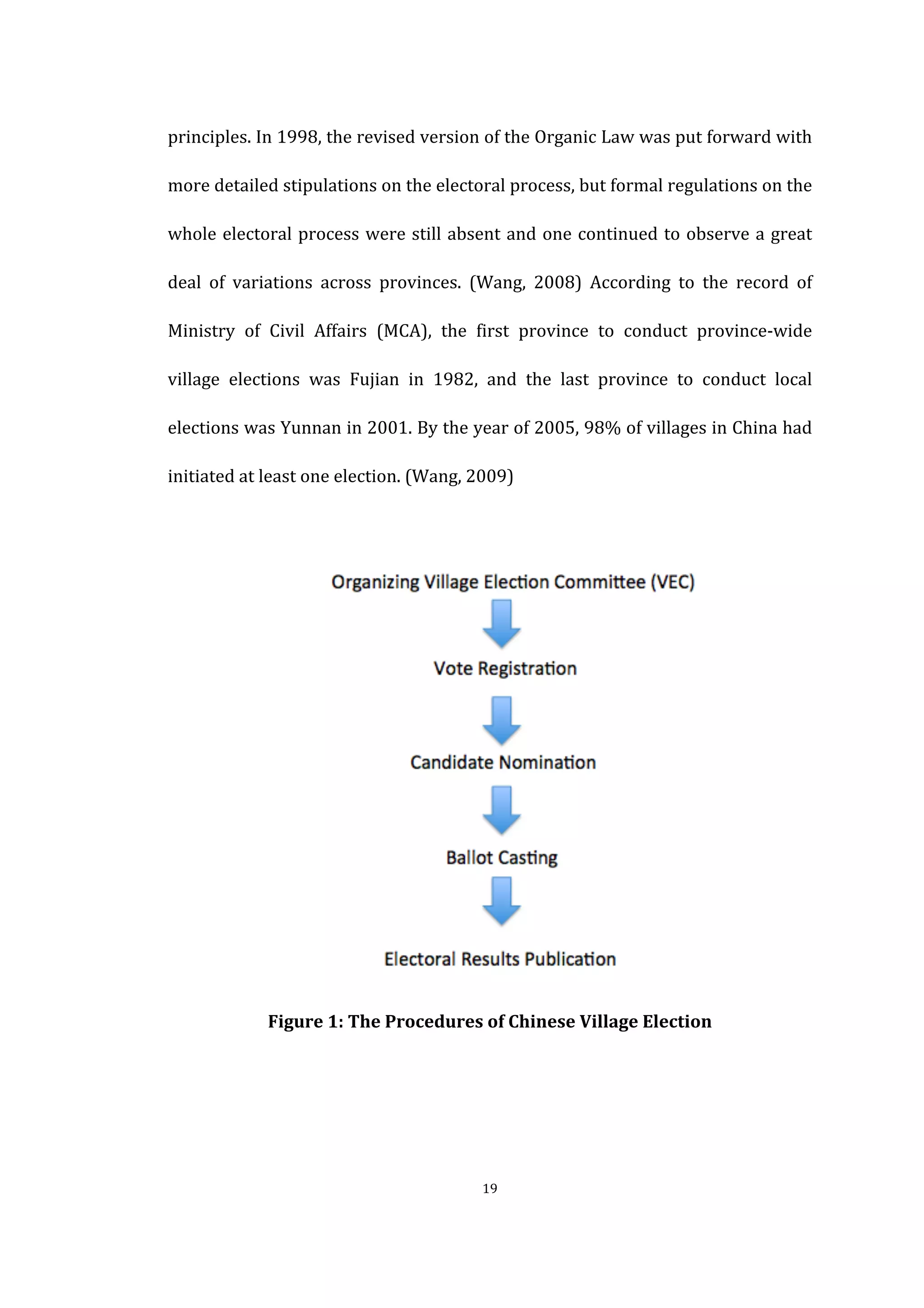
Figure	
  1:	
  The	
  Procedures	
  of	
  Chinese	
  Village	
  Election	


   20	
  
There	
  are	
  five	
  stages	
  of	
  a	
  whole	
  electoral	
  process	
  for	
  Chinese	
  village	
  elections	
  
based	
   on	
   the	
   stipulations	
   of	
   Organic	
   Law,	
   namely	
   organizing	
   Village	
   Election	
  
Committee	
   (VEC),	
   voter	
   registration,	
   candidate	
   nomination,	
   ballot	
   casting,	
   and	
  
the	
  publication	
  of	
  electoral	
  results.	
  
To	
  start	
  an	
  election,	
  the	
  village	
  must	
  first	
  organize	
  a	
  VEC.	
  The	
  VEC	
  member	
  
should	
   be	
   nominated	
   and	
   elected	
   by	
   the	
   Village	
   Assembly	
   (VA),	
   Village	
  
Representative	
   Assembly	
   (VRA),	
   and	
   the	
   Village	
   Team	
   (cunmin	
   xiaozu).	
  
According	
  to	
  the	
  “avoidance	
  rule”,	
  a	
  VEC	
  member	
  should	
  quit	
  the	
  committee	
  if	
  
she	
  or	
  her	
  relatives	
  later	
  becomes	
  the	
  candidate.	
  (Article	
  12)	
   	
  
After	
  the	
  VEC	
  has	
  been	
  organized,	
  the	
  committee	
  should	
  be	
  in	
  charge	
  of	
  the	
  
next	
  step,	
  voter	
  registration.	
  According	
  to	
  the	
  Organic	
  Law,	
  all	
  villagers	
  whose	
  
age	
  has	
  past	
  eighteen	
  years	
  possess	
  the	
  right	
  to	
  vote	
  and	
  to	
  be	
  voted,	
  regardless	
  
of	
  their	
  ethnics,	
  races,	
  genders,	
  occupations,	
  family	
  background,	
  religious	
  belief,	
  
education	
  level,	
  financial	
  status,	
  and	
  residential	
  length.	
  The	
  only	
  exception	
  is	
  that	
  
the	
  people	
  who	
  have	
  been	
  deprived	
  of	
  political	
  rights	
  cannot	
  vote.	
  (Article	
  13)	
  
When	
   the	
   vote	
   registration	
   is	
   finished,	
   the	
   VEC	
   should	
   publish	
   the	
   voter	
   list	
  
twenty	
  days	
  before	
  the	
  election	
  day.	
  
In	
   terms	
   of	
   the	
   candidate	
   nomination,	
   the	
   Organic	
   Law	
   stipulates	
   that	
   the	
  
candidates	
   should	
   be	
   nominated	
   directly	
   by	
   registered	
   voters.	
   Besides,	
   the	
  
candidate’s	
  number	
  should	
  exceed	
  the	
  number	
  of	
  seats.	
  (Article	
  15)	
  In	
  practice,	
  
different	
   provinces	
   develop	
   their	
   own	
   nomination	
   ways.	
   Candidates	
   can	
   be	


   21	
  
nominated	
  by	
  individual	
  voters	
  as	
  well	
  as	
  by	
  groups	
  (group	
  nomination).	
  Besides,	
  
a	
  voter	
  can	
  nominate	
  others	
  or	
  himself	
  (self	
  nomination).	
   	
  
Then	
  on	
  the	
  election	
  day,	
  all	
  ballot	
  should	
  be	
  cast	
  anonymously	
  and	
  counted	
  
publically.	
  Once	
  the	
  counting	
  process	
  is	
  finished,	
  the	
  result	
  must	
  be	
  published	
  at	
  
once.	
  (Article	
  15)	
  For	
  those	
  who	
  are	
  disabled,	
  a	
  roving	
  box	
  should	
  be	
  applied.	
  
The	
  election	
  is	
  valid	
  only	
  if	
  more	
  than	
  half	
  of	
  registered	
  voters	
  come	
  to	
  vote.	
  To	
  
win	
  a	
  position,	
  the	
  candidate	
  must	
  obtain	
  more	
  than	
  half	
  of	
  valid	
  votes.	
  If	
  two	
  
candidates	
   running	
   for	
   the	
   same	
   position	
   obtain	
   the	
   same	
   number	
   of	
   votes,	
   a	
  
run-­‐off	
  election	
  should	
  be	
  held	
  to	
  determine	
  the	
  final	
  result.	
  (Article	
  15)	
  
From	
  the	
  description	
  of	
  electoral	
  rules	
  above,	
  we	
  can	
  see	
  that	
  if	
  those	
  rules	
  
are	
   followed	
   well,	
   the	
   elected	
   village	
   committee	
   can	
   be	
   counted	
   as	
   a	
  
self-­‐governance	
   organization	
   in	
   Chinese	
   rural	
   area.	
   However,	
   as	
   China	
   is	
   a	
  
party-­‐state,	
   in	
   which	
   Chinese	
   Communist	
   Party	
   (CCP)	
   is	
   the	
   only	
   incumbent	
  
party,	
  the	
  party	
  branch	
  in	
  the	
  village	
  will	
  also	
  obtain	
  certain	
  discretion	
  over	
  local	
  
affairs	
   in	
   order	
   to	
   maintain	
   the	
   CCP	
   control	
   in	
   rural	
   areas.	
   Though	
   the	
   CCP	
  
demands	
  that	
  members	
  of	
  the	
  party	
  branch	
  should	
  also	
  be	
  elected	
  by	
  the	
  party	
  
members	
   in	
   village,	
   the	
   positions,	
   in	
   practice,	
   are	
   mostly	
   assigned	
   by	
   the	
  
upper-­‐level	
   party	
   organization,	
   i.e.,	
   the	
   villagers	
   have	
   no	
   rights	
   to	
   decide	
   the	
  
party	
   branch	
   member.	
   Then	
   what	
   is	
   the	
   relation	
   between	
   the	
   assigned	
   party	
  
branch	
  and	
  elected	
  village	
  committee?	
  At	
  least	
  in	
  the	
  Organic	
  Law,	
  there	
  is	
  no	
  
clear	
  answer.	
  According	
  to	
  Article	
  3,	
  the	
  party	
  branch	
  should	
  take	
  a	
  leadership	


   22	
  
role	
  in	
  supporting	
  and	
  protecting	
  villagers’	
  self-­‐governance,	
  while	
  in	
  Article	
  5,	
  
the	
   law	
   stipulates	
   that	
   the	
   village	
   committee	
   should	
   support	
   and	
   organize	
  
villagers	
  to	
  conduct	
  economic	
  activities,	
  and	
  take	
  the	
  responsibility	
  for	
  the	
  local	
  
productive	
  service.	
  The	
  potential	
  power-­‐sharing	
  puzzle	
  just	
  lies	
  in	
  the	
  unclear	
  
power	
  demarcation	
  above.	
  
It	
  is	
  not	
  hard	
  to	
  perceive	
  the	
  contradiction	
  of	
  the	
  CCP’s	
  legislators.	
  On	
  one	
  
hand,	
   pressed	
   by	
   the	
   rural	
   decollectivization	
   and	
   development,	
   the	
   central	
  
government	
   has	
   to	
   endow	
   more	
   autonomous	
   rights	
   to	
   villagers	
   to	
   keep	
   the	
  
stability	
  there,	
  but	
  on	
  the	
  other	
  hand,	
  the	
  800	
  million	
  populations	
  of	
  peasants	
  are	
  
always	
  a	
  big	
  group	
  of	
  the	
  potential	
  revolts	
  if	
  the	
  CCP	
  losing	
  the	
  control,	
  especially	
  
when	
   the	
   central	
   elites	
   are	
   instructed	
   by	
   thousand	
   times	
   that	
   it	
   was	
   the	
  
dependence	
  on	
  peasants	
  that	
  led	
  to	
  the	
  CCP’s	
  victory	
  in	
  the	
  civil	
  war	
  against	
  the	
  
former	
   KMT.	
   Thus,	
   this	
   contradiction	
   caused	
   the	
   unclear	
   power	
   delineation	
   of	
  
party	
  branches	
  and	
  village	
  committees,	
  which	
  further	
  led	
  to	
  the	
  conflict	
  between	
  
party	
  cadres	
  and	
  village	
  chiefs	
  in	
  practice.	
  For	
  party	
  cadres,	
  they	
  are	
  confused	
  
about	
   the	
   meaning	
   to	
   have	
   elected	
   VC	
   as	
   long	
   as	
   the	
   party	
   secretary	
   still	
  
possesses	
  the	
  “core	
  leadership”.	
  Elected	
  village	
  chiefs	
  are	
  also	
  perplexed	
  that	
  if	
  
the	
  leadership	
  of	
  the	
  CCP	
  must	
  be	
  adhered	
  to,	
  why	
  bother	
  initiating	
  democratic	
  
elections	
  in	
  the	
  first	
  place.	
  While	
  for	
  upper-­‐level	
  officials,	
  what	
  their	
  concerned	
  
most	
  are	
  whether	
  the	
  elected	
  VCs	
  would	
  fully	
  carry	
  out	
  instructions	
  from	
  above	
  
in	
  the	
  same	
  way	
  as	
  when	
  party	
  secretaries	
  are	
  in	
  charge.	


   23	
  
In	
  the	
  following	
  section,	
  I	
  will	
  develop	
  a	
  pure	
  strategic	
  model	
  to	
  explain	
  how	
  
village	
  elections	
  influence	
  the	
  interactions	
  between	
  party	
  secretary	
  and	
  village	
  
chief	
  regarding	
  different	
  types	
  of	
  public	
  policies.	


   24	
  
Chapter	
  Four:	
  The	
  Model	
  and	
  Supportive	
  Evidences	
  
China	
   is	
   a	
   dominant-­‐party	
   state,	
   in	
   which	
   the	
   formal	
   institutions	
   of	
   the	
  
Chinese	
  Communist	
  Party	
  (CCP)	
  and	
  of	
  the	
  government	
  are	
  tightly	
  intertwined	
  
from	
  the	
  center	
  to	
  the	
  lowest	
  level.	


Figure	
  2:	
  The	
  Power	
  Structure	
  of	
  Chinese	
  Political	
  Authorities	
  after	
  1988	
  
Organic	
  Law	


In	
   Figure	
   two,	
   we	
   can	
   see	
   that	
   vertically,	
   there	
   are	
   six-­‐level	
   party	
  
organizations	
  and	
  correspond	
  governments,	
  namely	
  the	
  state,	
  province,	
  city	
  or	
  
prefecture,	
   county,	
   township,	
   and	
   village.	
   Vertically,	
   the	
   upper-­‐level	
   authority	
  
leads	
  the	
  lower-­‐level	
  one,	
  with	
  only	
  one	
  exception,	
  which	
  is	
  the	
  relation	
  between	
  
township-­‐level	
  government	
  and	
  village	
  committee.	
  According	
  to	
  the	
  Organic	
  Law	
  
of	
   Village	
   Committee,	
   the	
   township-­‐level	
   government	
   can	
   only	
   offer	
   “support,	


   25	
  
help,	
   and	
   guidance”	
   to	
   the	
   village	
   committee’s	
   work,	
   but	
   cannot	
   intervene	
   the	
  
village	
   committee	
   to	
   run	
   their	
   own	
   business.	
   (Article	
   3)	
   Besides,	
   the	
   village	
  
committee	
   just	
   needs	
   to	
   “help”	
   township	
   authority	
   to	
   conduct	
   their	
   work,	
  
without	
  necessity	
  to	
  be	
  governed	
  by	
  the	
  upper-­‐level	
  government.	
  In	
  this	
  sense,	
  
unlike	
  relations	
  between	
  other	
  vertical	
  authorities,	
  the	
  village	
  committee	
  owns	
  
its	
  own	
  independence.	
  
Horizontally,	
  the	
  party	
  organization	
  leads	
  the	
  administrative	
  unit	
  in	
  each	
  of	
  
the	
  first	
  five	
  levels.	
  The	
  only	
  exception	
  also	
  occurs	
  at	
  the	
  lowest	
  level	
  between	
  
village	
   committee	
   and	
   local	
   party	
   branch.	
   Just	
   as	
   I	
   have	
   described	
   above,	
  
relations	
   between	
   these	
   two	
   authorities	
   are	
   not	
   well	
   defined.	
   Besides,	
   the	
  
selection	
   methods	
   of	
   members	
   in	
   these	
   two	
   authorities	
   are	
   totally	
   different.	
  
Members	
   in	
   party	
   branch	
   are	
   mostly	
   assigned	
   by	
   the	
   upper-­‐level	
   party	
  
organization,	
  which	
  means	
  that	
  the	
  party	
  branch	
  in	
  village	
  will	
  be	
  accountable	
  to	
  
upper-­‐level	
  authorities.	
  As	
  for	
  members	
  in	
  the	
  village	
  committee,	
  if	
  we	
  assume	
  
that	
  the	
  village	
  election	
  is	
  free	
  and	
  competitive,	
  they	
  will	
  be	
  elected	
  by	
  eligible	
  
villagers,	
  and	
  according	
  to	
  the	
  Organic	
  Law,	
  if	
  more	
  than	
  one	
  fifth	
  of	
  the	
  voters	
  
jointly	
   sign	
   their	
   names,	
   they	
   can	
   propose	
   to	
   dismiss	
   the	
   irresponsible	
  
committee	
   members	
   with	
   a	
   justifiable	
   reason.	
   In	
   this	
   sense,	
   the	
   village	
  
committee	
  is	
  accountable	
  to	
  villagers.	
  (Guo,	
  2004)	
  
Then	
  what	
  are	
  the	
  main	
  tasks	
  for	
  village	
  officials?	
  In	
  China,	
  village	
  leaders	
  
basically	
  have	
  three	
  responsibilities,	
  namely	
  the	
  enforcement	
  of	
  state	
  directives,	


   26	
  
the	
   fulfillment	
   of	
   township	
   demands,	
   and	
   the	
   provision	
   of	
   public	
   goods.	
  
Traditionally,	
   state	
   policies	
   include	
   the	
   birth	
   control,	
   land	
   expropriation,	
   and	
  
state	
  tax	
  collection.	
  But	
  with	
  the	
  abolition	
  of	
  agricultural	
  tax	
  in	
  2006,	
  villagers’	
  
burden	
   has	
   been	
   largely	
   relieved.	
   Regarding	
   the	
   requirements	
   from	
   township	
  
authorities,	
  before	
  the	
  political	
  decentralization	
  in	
  1980s	
  when	
  villages	
  were	
  still	
  
under	
  tightly	
  control,	
  the	
  township	
  government	
  had	
  the	
  financial	
  responsibility	
  
to	
  fund	
  the	
  village	
  public	
  goods	
  and	
  services.	
  In	
  return,	
  villages	
  need	
  to	
  share	
  a	
  
certain	
   ratio	
   of	
   their	
   revenue	
   with	
   township	
   authorities.	
   After	
   the	
  
decentralization,	
   nominally	
   each	
   level	
   government	
   has	
   been	
   responsible	
   for	
  
funding	
   and	
   organizing	
   public	
   goods	
   for	
   citizens	
   under	
   their	
   jurisdiction,	
   and	
  
simultaneously	
   keeps	
   any	
   revenues	
   in	
   excess	
   of	
   a	
   preset	
   amount	
   they	
   are	
  
required	
  to	
  deliver	
  upwards.	
  (Tsai,	
  2007)	
  In	
  reality,	
  villages	
  can	
  hardly	
  get	
  any	
  
fund	
  from	
  above	
  and	
  have	
  to	
  mainly	
  count	
  on	
  themselves	
  to	
  generate	
  revenues	
  
because	
  the	
  state	
  funds	
  allocated	
  to	
  provinces	
  have	
  been	
  “shared”	
  by	
  each	
  level	
  
governments	
   and	
   when	
   they	
   come	
   to	
   the	
   lowest	
   level,	
   nothing	
   is	
   barely	
   left.	
  
Simultaneously,	
  township	
  governments	
  lose	
  the	
  justifiable	
  reason	
  to	
  share	
  the	
  
revenues	
  generated	
  by	
  village.	
  Instead,	
  they	
  have	
  to	
  open	
  some	
  informal	
  channel	
  
to	
   fund	
   their	
   public	
   expenditures.	
   These	
   informal	
   institutions	
   include	
   the	
  
establishment	
   of	
   various	
   levies,	
   fees,	
   and	
   fines,	
   which	
   are	
   generally	
   called	
  
“extrabudgetary	
  funds”	
  as	
  raising	
  these	
  funds	
  do	
  not	
  need	
  explicit	
  authorization	
  
from	
   above	
   as	
   long	
   as	
   they	
   are	
   not	
   violating	
   existing	
   regulations.	
   (Tsai,	
   2007)	


   27	
  
However,	
  these	
  funds	
  are	
  extremely	
  sensitive	
  to	
  the	
  villagers	
  who	
  have	
  largely	
  
earned	
   their	
   discretion	
   of	
   self-­‐governance.	
   (Li,	
   2002)	
   The	
   third	
   responsibility,	
  
the	
  provision	
  of	
  public	
  goods	
  and	
  services	
  such	
  as	
  roads,	
  water,	
  electricity,	
  land	
  
allocation,	
   and	
   rural	
   education,	
   is	
   relatively	
   easy	
   to	
   understand.	
   As	
   village	
  
leaders,	
  to	
  enhance	
  the	
  local	
  economic	
  and	
  social	
  development	
  is	
  always	
  their	
  
priority.	
  
As	
   I	
   described	
   in	
   Chapter	
   Three,	
   before	
   initiating	
   village	
   elections,	
   party	
  
secretary	
   possessed	
   greater	
   discretion	
   on	
   local	
   affairs,	
   and	
   village	
   chief	
   only	
  
served	
  as	
  the	
  executor	
  to	
  enforce	
  party	
  cadres’	
  demands.	
  Besides,	
  as	
  both	
  party	
  
secretary	
  and	
  village	
  chief	
  were	
  appointed	
  by	
  upper-­‐level	
  authorities,	
  they	
  must	
  
simultaneously	
  follow	
  mandates	
  from	
  above.	
  In	
  this	
  institutional	
  setting,	
  there	
  
will	
   be	
   no	
   obvious	
   conflict	
   between	
   both	
   village	
   leaders	
   and	
   they	
   will	
   jointly	
  
enforce	
   popular	
   and	
   unpopular	
   policies	
   mandated	
   from	
   above	
   without	
   any	
  
divergence.	
  Sometimes	
  they	
  may	
  use	
  coercions	
  to	
  deal	
  with	
  the	
  potential	
  popular	
  
resistance	
  on	
  certain	
  unpopular	
  policy	
  to	
  protect	
  their	
  principals’	
  interests.	


Figure	
  3:	
  The	
  Power	
  Structure	
  between	
  Township	
  and	
  Village	
  Authorities	
  
before	
  1988	
  Organic	
  Law	


   28	


Though	
   this	
   governance	
   type	
   can	
   effectively	
   prompt	
   the	
   delivery	
   of	
   public	
  
policies,	
  it	
  may	
  also	
  instigate	
  villagers’	
  dissatisfactions,	
  and	
  the	
  accumulation	
  of	
  
anger	
  may	
  finally	
  result	
  in	
  the	
  instability	
  of	
  local	
  areas.	
  Besides,	
  as	
  upper-­‐level	
  
principals	
   can	
   hardly	
   exert	
   effective	
   monitor	
   on	
   local	
   cadres	
   and	
   villagers	
  
possess	
   no	
   right	
   to	
   do	
   so,	
   village	
   leaders	
   then	
   have	
   strong	
   incentives	
   to	
  
participate	
  in	
  illegal	
  rent-­‐seeking	
  activities,	
  which	
  will	
  sabotage	
  the	
  provision	
  of	
  
public	
  goods	
  and	
  generate	
  great	
  agency	
  lost	
  for	
  upper-­‐level	
  authorities.	
  
After	
   1988	
   Organic	
   Law,	
   the	
   local	
   governance	
   pattern	
   has	
   been	
   changed	
  
greatly	
   since	
   village	
   chief	
   and	
   party	
   secretary	
   are	
   accountable	
   to	
   different	
  
principals.	
   Then,	
   when	
   facing	
   the	
   tasks	
   above,	
   will	
   they	
   have	
   conflict	
   policy	
  
preferences?	
   If	
   so,	
   in	
   what	
   kind	
   of	
   specific	
   public	
   policy	
   will	
   they	
   fight	
   each	
  
other?	
  
4.1	
  The	
  Formal	
  Model	
  
I	
  will	
  develop	
  two	
  separate	
  models	
  to	
  formulate	
  interactions	
  between	
  party	
  
branch	
   and	
   village	
   committee	
   when	
   dealing	
   with	
   two	
   types	
   of	
   public	
   policies,	
  
consistent	
  policies	
  and	
  contentious	
  policies.	
  Basically,	
  consistent	
  policies	
  mainly	
  
focus	
   on	
   the	
   provision	
   of	
   certain	
   public	
   goods,	
   such	
   as	
   the	
   construction	
   of	
  
modern	
  roads,	
  the	
  advanced	
  irrigation	
  system,	
  the	
  establishment	
  of	
  rural	
  schools,	
  
and	
   the	
   allocation	
   of	
   public	
   lands.	
   As	
   villagers	
   will	
   generally	
   benefit	
   from	
   this	
  
type	
  of	
  policies,	
  the	
  enforcement	
  of	
  such	
  policies	
  will	
  be	
  acceptable	
  and	
  welcome.	


   29	
  
However,	
  contentious	
  policies,	
  such	
  as	
  the	
  birth	
  control,	
  the	
  land	
  expropriation,	
  
and	
   the	
   illegal	
   levy	
   of	
   revenue	
   from	
   the	
   township	
   government,	
   are	
   relatively	
  
difficult	
  to	
  execute	
  in	
  rural	
  areas	
  they	
  jeopardize	
  villagers’	
  interests.	
   	
  
In	
  both	
  models,	
  there	
  are	
  two	
  players,	
  the	
  village	
  chief	
  (VC),	
  who	
  represents	
  
the	
   village	
   committee,	
   and	
   the	
   party	
   secretary	
   (PS)	
   representing	
   local	
   party	
  
branch.	
   Regarding	
   both	
   types	
   of	
   public	
   policies,	
   both	
   players	
   can	
   choose	
   to	
  
accept	
  (A)	
  and	
  enforce	
  them	
  in	
  village,	
  or	
  reject	
  (R)	
  and	
  appeal	
  to	
  a	
  higher-­‐level	
  
office	
  to	
  protect	
  the	
  villagers’	
  interests.	
  For	
  both	
  players,	
  I	
  assume	
  that:	
   	
  
(A).	
   They	
   both	
   possess	
   paralleled	
   discretion	
   over	
   the	
   decision-­‐making	
  
process	
  of	
  certain	
  policies;	
  
(B).	
   Institutional	
   effect	
   outweighs	
   strategic	
   effect,	
   meaning	
   that	
   their	
  
preferences	
  are	
  determined	
  by	
  legal	
  provisions	
  and	
  institutional	
  settings	
  rather	
  
than	
  the	
  expectations	
  from	
  upper-­‐level	
  authorities;	
  
(C).	
  Both	
  players	
  are	
  rational	
  players,	
  caring	
  only	
  about	
  their	
  own	
  interests;	
  
(D).	
   As	
   both	
   players	
   have	
   the	
   same	
   discretion,	
   when	
   they	
   choose	
   different	
  
actions,	
  they	
  will	
  both	
  have	
  the	
  same	
  chance	
  to	
  win	
  out.	
  
In	
  terms	
  of	
  the	
  payoff,	
  “a”	
  denotes	
  the	
  benefits	
  for	
  both	
  players	
  if	
  the	
  outcome	
  
is	
  consistent	
  with	
  their	
  preferences;	
  “w”	
  denotes	
  the	
  punishment	
  for	
  the	
  party	
  
secretary	
   if	
   her	
   choice	
   is	
   inconsistent	
   with	
   her	
   principal,	
   i.e.,	
   the	
   upper-­‐level	
  
authorities;	
  “x”	
  denotes	
  the	
  cost	
  for	
  village	
  chief	
  if	
  her	
  action	
  is	
  inconsistent	
  with	
  
villagers’	
  interest;	
  and	
  “t”	
  denotes	
  the	
  transaction	
  cost	
  in	
  the	
  circumstance	
  when	


   30	
  
player	
  choose	
  different	
  actions.	
  To	
  better	
  understand	
  it,	
  we	
  can	
  assume	
  it	
  to	
  be	
  
the	
   extra	
   punishment	
   on	
   both	
   players	
   for	
   the	
   delay	
   of	
   the	
   initiation	
   of	
   public	
  
policies	
   resulting	
   from	
   conflict	
   preferences	
   between	
   the	
   village	
   chief	
   and	
   the	
  
party	
   secretary.	
   Besides,	
   we	
   further	
   assume	
   that	
   compared	
   with	
   benefits	
   and	
  
punishments,	
  the	
  extra	
  transaction	
  cost	
  “t”	
  is	
  relatively	
  small.	
  Below	
  are	
  the	
  two	
  
models	
  respectively.	
  
4.1.1.	
  Model	
  1:	
  Pure	
  Strategic	
  Game	
  on	
  Consistent	
  Policies	
  
The	
  concrete	
  payoff	
  for	
  both	
  players	
  regarding	
  different	
  actions	
  is	
  shown	
  in	
  
Figure	
  4.	
  As	
  this	
  type	
  of	
  policies	
  is	
  mainly	
  related	
  to	
  the	
  provision	
  and	
  allocation	
  
of	
  certain	
  public	
  goods,	
  villagers	
  will	
  generally	
  gain	
  benefits.	
  In	
  this	
  sense,	
  both	
  
village	
  chief	
  and	
  party	
  secretary	
  will	
  tend	
  to	
  enforce	
  such	
  policies.	


Figure	
  4:	
  Pure	
  Strategic	
  Game	
  on	
  Consistent	
  Public	
  Policies	


   31	
  
In	
   this	
   figure,	
   when	
   both	
   players	
   choose	
   to	
   accept,	
   policies	
   will	
   surely	
   be	
  
enforced	
  and	
  both	
  players	
  will	
  gain	
  the	
  total	
  benefit	
  “a”.	
  If	
  one	
  player	
  chooses	
  to	
  
accept	
  while	
  the	
  other	
  chooses	
  to	
  reject,	
  certain	
  policy	
  will	
  have	
  half	
  chance	
  to	
  be	
  
enforced	
   and	
   half	
   chance	
   to	
   be	
   tabled.	
   Regardless	
   of	
   the	
   result,	
   as	
   players	
   in	
  
these	
  two	
  situations	
  have	
  different	
  choices,	
  transaction	
  cost	
  “t”	
  will	
  be	
  added	
  to	
  
both	
  players.	
  Besides,	
  the	
  player	
  who	
  chooses	
  to	
  reject	
  the	
  policies	
  will	
  assume	
  
an	
   additional	
   cost	
   (“x”	
   for	
   village	
   chief	
   and	
   “w”	
   for	
   party	
   secretary)	
   as	
   their	
  
actions	
  are	
  controvert	
  with	
  their	
  principals’	
  preferences.	
  If	
  both	
  players	
  choose	
  
to	
   reject,	
   policies	
   will	
   surely	
   be	
   tabled.	
   In	
   this	
   situation,	
   no	
   profits	
   will	
   be	
  
distributed	
  on	
  either	
  side.	
  Besides,	
  they	
  all	
  have	
  to	
  suffer	
  from	
  the	
  punishment.	
  
By	
  solving	
  this	
  game,	
  we	
  can	
  easily	
  figure	
  out	
  that	
  the	
  only	
  Nash	
  Equilibrium	
  
is	
  the	
  situation	
  in	
  which	
  both	
  players	
  choose	
  to	
  accept	
  and	
  enforce	
  the	
  public	
  
policies.	
   This	
   result	
   is	
   quite	
   intuitive.	
   For	
   the	
   party	
   secretary,	
   she	
   will	
   always	
  
prefer	
  to	
  follow	
  upper-­‐level	
  mandates	
  regardless	
  of	
  concrete	
  policy	
  types.	
  In	
  this	
  
particular	
  situation,	
  the	
  provision	
  of	
  public	
  goods	
  and	
  services	
  will	
  surely	
  help	
  
maintain	
  the	
  stability	
  in	
  rural	
  areas,	
  which	
  for	
  CCP	
  is	
  the	
  highest	
  priority.	
  For	
  the	
  
village	
  chief,	
  although	
  she	
  also	
  chooses	
  to	
  accept	
  the	
  policies,	
  the	
  motivation	
  is	
  
not	
  originated	
  from	
  upper-­‐level	
  authorities’	
  demand,	
  but	
  from	
  villagers’	
  needs.	
  
In	
  sum,	
  there	
  will	
  be	
  no	
  conflict	
  between	
  the	
  village	
  chief	
  and	
  the	
  party	
  secretary	
  
when	
  consistent	
  policies	
  are	
  mandated	
  from	
  above.	


   32	
  
4.1.2.	
  Model	
  2:	
  Pure	
  Strategic	
  Game	
  on	
  Contentious	
  State	
  Policies	
  
In	
  this	
  model,	
  this	
  type	
  of	
  public	
  policies	
  must	
  fulfill	
  two	
  requirements.	
  First,	
  
there	
   are	
   divergent	
   preferences	
   between	
   state	
   villagers	
   and	
   upper-­‐level	
  
governments.	
  Enforcing	
  such	
  policies	
  in	
  villages	
  will	
  surely	
  jeopardize	
  villagers’	
  
interest.	
   Second,	
   elected	
   village	
   chiefs	
   must	
   possess	
   certain	
   discretion	
   in	
   the	
  
implementation	
  process	
  of	
  such	
  policies.	
  With	
  these	
  qualifications,	
  the	
  one-­‐child	
  
policy,	
  land	
  expropriation	
  policy,	
  and	
  the	
  illegal	
  revenue	
  levy	
  from	
  upper-­‐level	
  
governments	
  can	
  perfectly	
  fit	
  into	
  this	
  type.	
  
The	
  one-­‐child	
  policy,	
  initiated	
  in	
  1979,	
  regulates	
  that	
  each	
  family	
  could	
  only	
  
have	
   one	
   child	
   in	
   order	
   to	
   control	
   the	
   birth	
   fertility.	
   However,	
   this	
   policy	
   is	
  
strongly	
   controversial	
   to	
   Chinese	
   traditional	
   thought,	
   which	
   is	
   still	
   popular	
  
nowadays	
   in	
   most	
   Chinese	
   rural	
   areas.	
   In	
   this	
   sense,	
   the	
   tension	
   between	
   the	
  
central	
  authorities’	
  demand	
  of	
  shrinking	
  the	
  fertility	
  and	
  villagers’	
  will	
  to	
  have	
  
more	
  children	
  is	
  still	
  existing,	
  even	
  though	
  there	
  are	
  some	
  exemptions	
  permitted	
  
by	
  the	
  state.	
  For	
  example	
  in	
  some	
  area,	
  if	
  the	
  first	
  child	
  is	
  a	
  girl,	
  the	
  family	
  can	
  
have	
  one	
  more	
  child,	
  and	
  if	
  the	
  couple	
  are	
  all	
  single	
  child	
  of	
  their	
  parents,	
  they	
  
can	
  have	
  at	
  most	
  two	
  children.	
  Under	
  the	
  pressure	
  of	
  this	
  tension,	
  village	
  leaders,	
  
who	
  possess	
  certain	
  discretion	
  over	
  the	
  enforcement	
  of	
  birth	
  control,	
  can	
  choose	
  
either	
  to	
  fulfill	
  the	
  mandate	
  from	
  above,	
  or	
  to	
  be	
  accountable	
  to	
  the	
  villagers	
  by	
  
helping	
  them	
  petition	
  for	
  more	
  ratios.	
  
The	
   land	
   expropriation	
   policy	
   is	
   also	
   under	
   great	
   debate	
   in	
   current	
   China.	


   33	
  
According	
   to	
   the	
   Organic	
   Law	
   of	
   China’s	
   Land	
   (China	
   Legal	
   Publishing	
   House,	
  
2011),	
   the	
   upper-­‐level	
   government	
   can	
   expropriate	
   certain	
   amount	
   of	
   land	
   in	
  
rural	
   areas	
   to	
   satisfy	
   modern	
   use,	
   including	
   the	
   public	
   use	
   such	
   as	
   the	
  
construction	
  of	
  national	
  or	
  provincial	
  highways,	
  and	
  the	
  private	
  use	
  such	
  as	
  the	
  
establishment	
   of	
   township	
   enterprises.	
   These	
   activities	
   will	
   result	
   in	
   the	
  
permanent	
  loss	
  of	
  farmland	
  to	
  villagers.	
  (Cai	
  2003)	
  Although	
  strict	
  limitations	
  
are	
  imposed	
  on	
  this	
  behavior	
  by	
  legal	
  provisions,	
  they	
  are	
  occasionally	
  violated	
  
by	
  the	
  upper-­‐level	
  governments,	
  which	
  exacerbates	
  villagers’	
  hostility.	
  Similar	
  to	
  
the	
  one-­‐child	
  policy,	
  the	
  village	
  chief	
  still	
  possesses	
  certain	
  discretion	
  to	
  choose	
  
whether	
  to	
  follow	
  the	
  command	
  above	
  or	
  delay	
  the	
  expropriation	
  by	
  lobbying	
  
upper-­‐level	
  government.	
  
In	
   terms	
   of	
   “extrabudgetary	
   funds”	
   that	
   the	
   township	
   leaders	
   collect	
   from	
  
villages,	
  just	
  as	
  I	
  described	
  above,	
  are	
  also	
  extremely	
  sensitive	
  to	
  villagers	
  once	
  
they	
   figure	
   out	
   the	
   truth.	
   As	
   villagers	
   can	
   hardly	
   gain	
   any	
   regular	
   funds	
   from	
  
above,	
  they	
  will	
  cherish	
  any	
  coin	
  they	
  earn	
  by	
  their	
  own	
  hands.	
  In	
  this	
  sense,	
  
village	
  leaders	
  are	
  always	
  under	
  great	
  pressure	
  to	
  help	
  levy	
  this	
  illegal	
  money	
  in	
  
villages.	
  Instead,	
  the	
  village	
  chief	
  can	
  petition	
  to	
  the	
  higher-­‐level	
  government	
  to	
  
ask	
   for	
   the	
   abolition	
   of	
   this	
   informal	
   extraction	
   of	
   revenue,	
   thus	
   defending	
  
villagers’	
  interests.	


   34	


Figure	
  5:	
  Pure	
  Strategic	
  Game	
  on	
  Contentious	
  Public	
  Policies	


   The	
  payoff	
  of	
  both	
  players	
  is	
  shown	
  in	
  figure	
  5.	
  In	
  this	
  game,	
  the	
  interactions	
  
between	
  village	
  chief	
  and	
  party	
  secretary	
  are	
  surely	
  zero-­‐sum,	
  meaning	
  that	
  the	
  
profits	
  gained	
  by	
  one	
  player	
  will	
  cause	
  the	
  equal	
  value	
  loss	
  of	
  the	
  other.	
  In	
  this	
  
situation,	
  when	
  both	
  players	
  choose	
  to	
  accept	
  and	
  enforce	
  certain	
  policies,	
  party	
  
secretary	
  will	
  achieve	
  the	
  total	
  amount	
  of	
  profit	
  “a”,	
  while	
  village	
  chief	
  will	
  suffer	
  
the	
  punishment	
  exerted	
  by	
  villagers	
  as	
  the	
  policy	
  outcome	
  contravenes	
  villagers’	
  
preference.	
  Correspondingly,	
  when	
  both	
  players	
  choose	
  to	
  reject	
  certain	
  public	
  
policies,	
  village	
  chief	
  will	
  achieve	
  the	
  total	
  amount	
  of	
  profits	
  at	
  the	
  expense	
  of	
  
party	
  secretary’s	
  loss.	
  When	
  the	
  village	
  chief	
  chooses	
  to	
  accept	
  the	
  policies	
  while	
  
the	
   party	
   secretary	
   rejects	
   them,	
   both	
   players	
   will	
   at	
   first	
   assume	
   the	
  
punishment	
  by	
  their	
  principals	
  as	
  neither	
  of	
  them	
  follows	
  principals’	
  preferences.	


   35	
  
Besides,	
  as	
  both	
  players	
  have	
  different	
  actions,	
  they	
  both	
  have	
  half	
  chance	
  to	
  win	
  
and	
  half	
  chance	
  to	
  lose	
  during	
  their	
  fight,	
  causing	
  both	
  of	
  them	
  to	
  assume	
  extra	
  
transaction	
   costs.	
   Finally,	
   when	
   village	
   chief	
   chooses	
   to	
   reject	
   and	
   party	
  
secretary	
  chooses	
  to	
  accept,	
  the	
  punishment	
  is	
  avoided	
  as	
  both	
  players	
  stay	
  with	
  
their	
   principals’	
   preferences.	
   Since	
   both	
   players	
   have	
   the	
   same	
   chance	
   to	
   win,	
  
they	
  will	
  only	
  possess	
  half	
  of	
  their	
  profit	
  “a”	
  plus	
  the	
  extra	
  transaction	
  cost.	
  
	
   Compared	
   these	
   two	
   models,	
   we	
   may	
   find	
   that	
   when	
   state	
   and	
   villagers’	
  
preferences	
  change,	
  the	
  payoff	
  for	
  both	
  players	
  are	
  totally	
  different.	
  In	
  this	
  model,	
  
the	
   situation	
   that	
   both	
   players	
   choose	
   to	
   accept	
   the	
   policies	
   is	
   no	
   longer	
  
equilibrium	
  as	
  when	
  public	
  policies	
  jeopardize	
  villagers’	
  interest,	
  accepting	
  them	
  
will	
  be	
  worse	
  off	
  for	
  village	
  chief.	
  Instead,	
  the	
  only	
  Nash	
  Equilibrium	
  in	
  this	
  game	
  
is	
   the	
   situation	
   in	
   which	
   village	
   chief	
   rejects	
   and	
   party	
   secretary	
   accepts	
   the	
  
policy.	
  
	
   4.2	
  The	
  Implications	
  of	
  the	
  Models	
  
	
   By	
   developing	
   two	
   pure	
   strategic	
   models	
   of	
   interactions	
   between	
   villager	
  
chief	
  and	
  party	
  secretary	
  regarding	
  two	
  different	
  types	
  of	
  state	
  policies,	
  we	
  find	
  
two	
  Nash	
  Equilibra.	
  When	
  dealing	
  with	
  consistent	
  public	
  policies,	
  both	
  players	
  
will	
   choose	
   to	
   accept.	
   When	
   dealing	
   with	
   contentious	
   policies,	
   party	
   secretary	
  
chooses	
  to	
  accept	
  while	
  village	
  chief	
  chooses	
  to	
  refuse	
  is	
  the	
  only	
  stable	
  situation.	
   	
  
This	
   result	
   perfectly	
   answers	
   the	
   research	
   questions	
   I	
   put	
   forward	
   at	
   the	


   36	
  
beginning	
  of	
  this	
  paper.	
  Since	
  there	
  exists	
  power-­‐sharing	
  puzzle	
  between	
  village	
  
chief	
  and	
  party	
  secretary,	
  both	
  organizations	
  possess	
  same	
  discretion	
  over	
  the	
  
decision-­‐making	
   process	
   of	
   the	
   enforcement	
   of	
   certain	
   public	
   policy.	
   Conflicts	
  
between	
  these	
  two	
  organizations	
  will	
  emerge	
  only	
  when	
  state	
  intends	
  to	
  impose	
  
certain	
  unpopular	
  policies	
  at	
  the	
  expense	
  of	
  villagers’	
  cost.	
  In	
  this	
  situation,	
  while	
  
party	
  secretary	
  chooses	
  to	
  follow	
  the	
  mandate	
  above,	
  elected	
  village	
  chief	
  will	
  be	
  
accountable	
  to	
  villagers	
  by	
  manipulating	
  to	
  delay	
  the	
  execution	
  of	
  such	
  policies.	
  
This	
   conflict,	
   according	
   to	
   the	
   second	
   model,	
   is	
   stable	
   as	
   both	
   players	
   will	
   be	
  
worse	
  off	
  if	
  defecting	
  to	
  the	
  other	
  choice.	


   What	
  can	
  we	
  learn	
  from	
  this	
  analysis?	
  What	
  political	
  outcomes	
  will	
  emerge	
  
by	
  introducing	
  popular	
  elections	
  in	
  rural	
  areas?	
  First,	
  if	
  we	
  believe	
  that	
  formal	
  
institutions	
   do	
   matter	
   once	
   put	
   into	
   effect,	
   we	
   should	
   confirm	
   that	
   with	
   the	
  
expansion	
  and	
  amelioration	
  of	
  Chinese	
  village	
  elections,	
  village	
  chief	
  will	
  tend	
  to	
  
be	
  more	
  accountable	
  to	
  the	
  general	
  public	
  for	
  fear	
  of	
  being	
  voted	
  out	
  of	
  office.	
  
Regarding	
   party	
   secretaries	
   in	
   the	
   local	
   party	
   branch,	
   though	
   they	
   are	
   not	
  
accountable	
   to	
   villagers,	
   they	
   still	
   under	
   the	
   direct	
   supervision	
   of	
   the	
   general	
  
public,	
   which	
   means	
   that	
   villagers	
   have	
   the	
   potential	
   to	
   lodge	
   complaints	
   to	
  
higher-­‐level	
   authorities	
   if	
   party	
   secretary	
   commits	
   any	
   malfeasance.	
   If	
   this	
  
happens,	
   the	
   party	
   secretary’s	
   career	
   may	
   face	
   severe	
   challenge	
   with	
   the	
  
potential	
  punishment	
  from	
  above.	
  In	
  this	
  sense,	
  when	
  dealing	
  with	
  the	
  consistent	
  
public	
   policies,	
   both	
   party	
   secretary	
   and	
   village	
   chief	
   will	
   tend	
   to	
   accept	
   and	


   37	
  
enforce	
  them	
  in	
  the	
  village.	
  At	
  the	
  same	
  time,	
  as	
  the	
  monitoring	
  responsibility	
  on	
  
local	
  cadres	
  has	
  been	
  transferred	
  from	
  upper-­‐level	
  authorities	
  to	
  villagers	
  after	
  
village	
   elections,	
   villagers	
   can	
   exert	
   more	
   effective	
   and	
   direct	
   supervision	
   on	
  
local	
   cadres’	
   behavior,	
   thus	
   avoiding	
   potential	
   loss	
   of	
   profits	
   by	
   preventing	
  
potential	
   embezzlement	
   and	
   corruptive	
   activities	
   from	
   local	
   cadres,	
   which	
   are	
  
quite	
  normal	
  in	
  the	
  era	
  of	
  communal	
  system.	
  To	
  conclude,	
  by	
  studying	
  the	
  village	
  
leaders’	
   interactions	
   toward	
   consistent	
   public	
   policies,	
   we	
   can	
   see	
   that	
   village	
  
elections	
   can	
   effectively	
   prompt	
   the	
   provision	
   of	
   public	
   goods	
   and	
   services	
   in	
  
villages.	


   In	
  terms	
  of	
  the	
  contentious	
  policies,	
  before	
  initiating	
  village	
  elections,	
  these	
  
unpopular	
   were	
   enforced	
   coercively	
   by	
   upper-­‐level	
   government	
   with	
   no	
   legal	
  
latitude	
   for	
   villagers	
   to	
   resist.	
   In	
   that	
   situation,	
   upper-­‐level	
   authorities	
   will	
  
achieve	
   their	
   best	
   preference	
   at	
   the	
   expense	
   of	
   the	
   loss	
   of	
   villagers.	
   By	
  
introducing	
   village	
   elections,	
   while	
   the	
   party	
   secretary’s	
   preference	
   remains	
  
unchanged,	
  the	
  village	
  chief	
  shifts	
  her	
  accountability	
  to	
  represent	
  villagers	
  below	
  
rather	
  than	
  simply	
  following	
  the	
  mandate	
  above.	
  Therefore,	
  the	
  interactions	
  and	
  
the	
  subsequent	
  payoffs	
  of	
  party	
  secretary	
  and	
  village	
  chief	
  have	
  totally	
  changed.	
  
Though	
  both	
  players	
  still	
  maintain	
  rewards	
  from	
  their	
  principals,	
  they	
  have	
  to	
  
assume	
  an	
  extra	
  transaction	
  cost	
  due	
  to	
  the	
  policy	
  divergence.	
  Based	
  on	
  this	
  logic,	
  
we	
  can	
  infer	
  that	
  initiating	
  village	
  elections	
  will	
  exacerbate	
  rather	
  than	
  mitigate	
  
the	
  difficulty	
  of	
  the	
  enforcement	
  of	
  unpopular	
  public	
  policies	
  in	
  village.	


   38	
  
	
   Then,	
   if	
   we	
   further	
   compare	
   the	
   two	
   different	
   local	
   governance	
   patterns	
  
before	
  and	
  after	
  initiating	
  village	
  elections,	
  we	
  may	
  find	
  the	
  CCP	
  faces	
  a	
  dilemma.	
  
The	
   original	
   purpose	
   of	
   this	
   political	
   experiment	
   is	
   to	
   mitigate	
   the	
   severe	
  
cadre-­‐mass	
  conflicts	
  and	
  to	
  exert	
  more	
  effective	
  monitor	
  on	
  local	
  cadres	
  in	
  case	
  
of	
   their	
   corruptive	
   activities	
   and	
   the	
   subsequent	
   agency	
   lost	
   for	
   central	
  
government.	
   Once	
   putting	
   village	
   elections	
   into	
   effect,	
   although	
   the	
   illegal	
  
rent-­‐seeking	
   has	
   been	
   largely	
   mitigated,	
   and	
   cadre-­‐mass	
   relations	
   are	
   also	
  
ameliorated,	
  some	
  other	
  problems	
  came	
  simultaneously.	
  The	
  conflicts	
  have	
  been	
  
transferred	
   from	
   former	
   cadre-­‐mass	
   relations	
   to	
   two-­‐committee	
   relations	
  
between	
  party	
  secretary	
  and	
  village	
  chief.	
  Besides,	
  village	
  elections	
  may	
  result	
  in	
  
those	
  unpopular	
  policies	
  even	
  harder	
  to	
  be	
  enforced.	
  
	
   4.3	
  The	
  Supportive	
  Evidences	
  of	
  the	
  Models	
  
	
   Based	
  on	
  the	
  models	
  I	
  developed	
  above,	
  we	
  have	
  come	
  to	
  two	
  intermediate	
  
conclusions.	
  That	
  is	
  after	
  initiating	
  the	
  village	
  elections:	
  
(1) Regarding	
  consistent	
  public	
  policies,	
  village	
  chief	
  and	
  party	
  secretary	
  will	
  
both	
   tend	
   to	
   be	
   more	
   willing	
   to	
   accept	
   and	
   enforce	
   such	
   policies	
   than	
  
before	
  because	
  the	
  transfer	
  of	
  monitoring	
  responsibility	
  from	
  upper-­‐level	
  
authorities	
  to	
  villagers	
  will	
  exert	
  more	
  direct	
  and	
  effective	
  supervision	
  on	
  
villager	
  leaders’	
  behavior;	
  
(2) Regarding	
  contentious	
  public	
  policies,	
  village	
  chief	
  and	
  party	
  secretary	
  will	


   39	
  
tend	
  to	
  possess	
  different	
  preferences	
  as	
  they	
  are	
  accountable	
  to	
  different	
  
principals,	
  which	
  may	
  result	
  in	
  the	
  delay	
  and	
  dysfunction	
  of	
  such	
  policies	
  in	
  
village.	
  
To	
   prove	
   whether	
   the	
   initiation	
   of	
   village	
   elections	
   result	
   in	
   the	
  
transformation	
   of	
   the	
   execution	
   of	
   certain	
   local	
   polices,	
   advanced	
   quantitative	
  
research	
  will	
  surely	
  provide	
  us	
  more	
  solid	
  evidences.	
  However,	
  data	
  collection,	
  
especially	
   for	
   the	
   record	
   of	
   sensitive	
   topics,	
   is	
   always	
   a	
   severe	
   obstacle	
   for	
  
conducting	
  research	
  in	
  an	
  authoritarian	
  state	
  such	
  as	
  China.	
  Even	
  if	
  researchers	
  
have	
   enough	
   funds,	
   personal	
   ties	
   with	
   officials	
   in	
   charge	
   is	
   also	
   a	
   necessary	
  
prerequisite.	
  That	
  may	
  largely	
  explain	
  why	
  most	
  of	
  previous	
  research	
  works	
  on	
  
Chinese	
   village	
   elections	
   are	
   case	
   studies	
   instead	
   of	
   statistical	
   research	
   with	
  
large	
  samples.	
  Unfortunately,	
  I	
  cannot	
  collect	
  enough	
  data	
  related	
  to	
  my	
  research	
  
questions	
  above	
  at	
  the	
  present,	
  but	
  there	
  do	
  exist	
  several	
  previous	
  quantitative	
  
studies	
   working	
   on	
   the	
   accountability	
   problems	
   of	
   Chinese	
   village	
   elections,	
  
which	
  may	
  well	
  prove	
  my	
  models	
  above.	
   	
  
The	
  study	
  I	
  will	
  describe	
  in	
  this	
  paper	
  was	
  conduct	
  by	
  Shuna	
  Wang	
  and	
  Yang	
  
Yao	
  (2006).	
  Their	
  research	
  mainly	
  focuses	
  on	
  the	
  impacts	
  of	
  village	
  elections	
  on	
  
the	
  accountability	
  of	
  village	
  committee,	
  local	
  fiscal	
  sharing,	
  and	
  state	
  taxation	
  by	
  
collecting	
  data	
  from	
  48	
  villages	
  in	
  eight	
  provinces	
  for	
  a	
  time	
  period	
  from	
  1986	
  to	
  
2002.	
   They	
   found	
   that	
   village	
   elections	
   in	
   China	
   substantially	
   increase	
   local	
  
public	
   expenditures,	
   and	
   reduce	
   administrative	
   costs	
   and	
   revenues	
   handed	
   to	


   40	
  
upper-­‐level	
   authorities.	
   Besides,	
   they	
   found	
   no	
   significant	
   influence	
   of	
   village	
  
elections	
   on	
   the	
   state	
   taxation.	
   Though	
   they	
   did	
   not	
   emphasize	
   the	
   different	
  
types	
  of	
  public	
  polices,	
  the	
  dependent	
  variables	
  in	
  their	
  model	
  basically	
  include	
  
all	
  parameters	
  I	
  discussed	
  above.	


Table	
  1:	
  Village	
  Elections’	
  Impact	
  on	
  Local	
  Public	
  Policies	


Source:	
  Wang,	
  2006.	
  
	
   From	
   the	
   table	
   above,	
   we	
   can	
   see	
   that	
   the	
   dependent	
   variable	
   “share	
   of	
  
public	
   expenditures”,	
   which	
   represents	
   the	
   provision	
   of	
   public	
   goods	
   and	
  
services	
  I	
  discussed	
  above,	
  is	
  increasing	
  significantly	
  after	
  the	
  initiation	
  of	
  village	
  
elections.	
  At	
  the	
  same	
  time,	
  the	
  dependent	
  variable	
  “share	
  of	
  income	
  handed	
  to	
  
township”,	
   which	
   largely	
   represents	
   the	
   township’s	
   illegal	
   revenue	
   levy	
   from	
  
village	
  I	
  talked	
  before,	
  is	
  significantly	
  decreasing	
  after	
  the	
  elections.	
  Both	
  of	
  them	
  
prove	
  my	
  models.	
  In	
  terms	
  of	
  the	
  dependent	
  variable	
  “share	
  of	
  administration	


   41	
  
cost”,	
  which	
  refers	
  to	
  the	
  agency	
  cost	
  I	
  discussed	
  above,	
  the	
  decreasing	
  tendency	
  
of	
  administrative	
  cost	
  also	
  proves	
  that	
  village	
  elections	
  significantly	
  ameliorate	
  
the	
  local	
  governance.	
  As	
  for	
  the	
  state	
  taxation,	
   unlike	
   the	
   unpopular	
   policies	
   I	
  
stated	
  above,	
  village	
  chief	
  has	
  little	
  discretion	
  on	
  the	
  execution	
  of	
  such	
  policies	
  
because	
  the	
  tax	
  rate	
  has	
  already	
  been	
  tightly	
  fixed.	
  Besides,	
  since	
  the	
  agricultural	
  
tax,	
   which	
   was	
   main	
   source	
   of	
   state	
   tax,	
   has	
   been	
   abolished	
   in	
   2006,	
   the	
   tax	
  
burden	
  on	
  villagers	
  has	
  been	
  largely	
  relieved.	
  Thus,	
  this	
  variable	
  can	
  exert	
  little	
  
influence	
   on	
   the	
   local	
   governance	
   and	
   interactions	
   between	
   village	
   chief	
   and	
  
party	
  secretary.	


   Another	
   research	
   work	
   conducted	
   by	
   Martinez-­‐Bravo	
   et	
   al.	
   (2011)	
   also	
  
proved	
   my	
   models.	
   Their	
   study	
   used	
   the	
   village-­‐level	
   data	
   from	
   217	
   villages	
  
selected	
  from	
  25	
  provinces	
  for	
  the	
  time	
  period	
  from	
  1980	
  to	
  2005.	
  Though	
  this	
  
study	
  did	
  not	
  directly	
  point	
  to	
  the	
  two-­‐committee	
  conflicts,	
  we	
  can	
  still	
  infer	
  this	
  
conflict	
  from	
  their	
  statistical	
  results.	
  First,	
  by	
  introducing	
  a	
  survey	
  in	
  the	
  sample	
  
villages,	
   they	
   found	
   that	
   village	
   elections	
   have	
   significantly	
   increased	
   the	
  
unilateral	
  power	
  of	
  village	
  chief	
  and	
  simultaneously	
  decreased	
  the	
  discretion	
  of	
  
the	
   party	
   secretary.	
   Then,	
   researchers	
   of	
   this	
   study	
   further	
   probed	
   into	
   the	
  
village	
   chief’s	
   behavior	
   by	
   focusing	
   on	
   the	
   management	
   of	
   public	
   policies	
   in	
  
villages.	
   They	
   categorized	
   public	
   policies	
   by	
   two	
   parameters,	
   namely	
   whether	
  
certain	
   policy	
   is	
   popular	
   and	
   whether	
   village	
   chief	
   has	
   discretion	
   over	
   certain	
  
policy.	
   Using	
   the	
   data	
   collected	
   from	
   these	
   sample	
   villages,	
   they	
   found	
   that	


   42	
  
regarding	
  unpopular	
  policies	
  that	
  village	
  chiefs	
  have	
  decisive	
  power,	
  they	
  tend	
  to	
  
fulfill	
  these	
  policies	
  based	
  on	
  villagers’	
  rather	
  than	
  the	
  upper-­‐level	
  authorities’	
  
preferences,	
  which	
  prove	
  my	
  second	
  model	
  that	
  when	
  dealing	
  with	
  contentious	
  
policies,	
  the	
  village	
  chief	
  tends	
  to	
  reject	
  them.	
  In	
  terms	
  of	
  the	
  popular	
  policies	
  
that	
  village	
  chiefs	
  have	
  discretion,	
  they	
  maintained	
  that	
  village	
  leaders	
  also	
  tend	
  
to	
  make	
  decisions	
  in	
  accordance	
  with	
  villagers’	
  preference,	
  which	
  proves	
  my	
  first	
  
model	
  above	
  that	
  village	
  elections	
  help	
  intensify	
  the	
  monitor	
  on	
  village	
  leaders	
  
and	
   reduce	
   agency	
   costs.	
   Besides,	
   this	
   study	
   also	
   introduced	
   a	
   third	
   placebo	
  
group	
   to	
   test	
   village	
   chiefs’	
   behavior	
   on	
   policies	
   that	
   they	
   have	
   no	
   discretion,	
  
whether	
  the	
  policies	
  are	
  popular	
  or	
  not,	
  and	
  they	
  found	
  that	
  there	
  is	
  no	
  obvious	
  
change	
  of	
  policy	
  preferences,	
  proving	
  that	
  village	
  chiefs	
  can	
  only	
  exert	
  influence	
  
on	
  policies	
  they	
  have	
  discretional	
  power.	
  
	
   Apart	
  from	
  the	
  quantitative	
  studies	
  above,	
  there	
  are	
  also	
  some	
  case	
  studies	
  
directly	
   discussing	
   the	
   two-­‐committee	
   conflicts.	
   Guo	
   and	
   Bernstein	
   (2004)	
  
discussed	
   a	
   case	
   happened	
   in	
   Da’ao	
   Village	
   of	
   Guangdong	
   Province.	
   The	
   party	
  
secretary	
   in	
   this	
   village	
   sold	
   a	
   great	
   amount	
   of	
   collectively	
   owned	
   land	
   to	
   the	
  
local	
  private	
  enterprises	
  and	
  embezzled	
  the	
  money	
  earned	
  from	
  the	
  land	
  sale.	
  
Dissatisfied	
   by	
   the	
   party	
   secretary’s	
   corruptive	
   activity,	
   villagers,	
   led	
   by	
   the	
  
village	
   chief,	
   urged	
   the	
   party	
   secretary	
   to	
   submit	
   the	
   account	
   book	
   for	
   check.	
  
However,	
   the	
   party	
   secretary	
   adamantly	
   refused	
   villagers’	
   demand	
   in	
   case	
   his	
  
corruption	
   was	
   exposed.	
   Finally,	
   the	
   village	
   chief	
   lodged	
   complaint	
   to	
   the	


   43	
  
upper-­‐level	
   authorities	
   to	
   furiously	
   expose	
   the	
   malfeasance	
   of	
   local	
   party	
  
secretary.	
  Pressed	
  by	
  local	
  villagers’	
  dissatisfaction,	
  the	
  upper-­‐level	
  party	
  branch	
  
deprived	
  the	
  party	
  secretary’s	
  position	
  and	
  charged	
  him	
  for	
  his	
  embezzlement.	


   Another	
  case	
  study	
  was	
  conducted	
  by	
  Li	
  (2002)	
  in	
  Dongcun	
  Village	
  of	
  Hunan	
  
Province.	
  In	
  this	
  case,	
  after	
  the	
  villagers	
  realized	
  that	
  the	
  township	
  government	
  
levied	
   an	
   excessive	
   fee	
   related	
   to	
   children’s	
   education,	
   which	
   was	
   essentially	
  
against	
  the	
  Regulation	
  Concerning	
  Peasants’	
  Fees	
  and	
  Labor	
  that	
  designed	
  by	
  the	
  
State	
   Council,	
   they	
   lodged	
   a	
   collective	
   complaint	
   to	
   the	
   township	
   government	
  
under	
   the	
   leadership	
   of	
   the	
   village	
   chief.	
   Without	
   an	
   acceptable	
   answer	
   from	
  
township	
  leaders,	
  the	
  peaceful	
  complaint	
  soon	
  became	
  a	
  violent	
  protest.	
  During	
  
the	
  whole	
  protest,	
  the	
  party	
  secretary	
  in	
  Dongcun	
  Village	
  remained	
  silent	
  in	
  his	
  
own	
  home.	
  This	
  protest	
  soon	
  spread	
  to	
  another	
  six	
  villages	
  located	
  in	
  the	
  same	
  
county	
  and	
  finally	
  drew	
  the	
  attention	
  of	
  provincial	
  leaders.	
  After	
  the	
  provincial	
  
government	
  sent	
  a	
  special	
  research	
  team	
  to	
  the	
  township,	
  they	
  quickly	
  cancelled	
  
the	
  illegal	
  revenue	
  extraction	
  and	
  dismissed	
  the	
  township	
  governors.	


   44	
  
Chapter	
  Five:	
  The	
  Case	
  Study,	
  Qingxian	
  Model	
  
After	
  discussing	
  the	
  interactions	
  between	
  village	
  chief	
  and	
  party	
  secretary,	
  it	
  
is	
   not	
   hard	
   to	
   find	
   that	
   the	
   power-­‐sharing	
   puzzle	
   may	
   cause	
   great	
   conflict	
  
between	
  these	
  two	
  organizations,	
  especially	
  when	
  they	
  face	
  unpopular	
  policies	
  
mandated	
   from	
   above.	
   Their	
   conflict	
   may	
   cause	
   the	
   delay	
   of	
   the	
   execution	
   of	
  
certain	
   policies,	
   which	
   may	
   result	
   in	
   great	
   negative	
   effects	
   on	
   the	
   local	
  
governance.	
  For	
  example,	
  if	
  villagers	
  are	
  unsatisfied	
  with	
  the	
  local	
  governance,	
  
they	
   can	
   lodge	
   complaints	
   to	
   higher-­‐level	
   authorities,	
   which	
   may	
   lead	
   to	
  
instability	
   in	
   local	
   areas.	
   (Li	
   &	
   O’Brien	
   1996,	
   Li	
   2002).	
   Then	
   here	
   comes	
   my	
  
second	
  research	
  question	
  in	
  this	
  paper,	
  which	
  is	
  how	
  to	
  solve	
  the	
  power-­‐sharing	
  
conflict	
  in	
  Chinese	
  local	
  areas?	
  
In	
   fact,	
   some	
   institutional	
   designers	
   and	
   academic	
   scholars	
   have	
   already	
  
perceived	
   this	
   conflict	
   and	
   were	
   engaged	
   in	
   some	
   innovations	
   to	
   solve	
   this	
  
problem.	
   For	
   example,	
   in	
   Guangdong	
   Province,	
   local	
   CCP	
   secretaries	
   were	
  
required	
  to	
  run	
  for	
  the	
  village	
  chief	
  in	
  order	
  to	
  merge	
  the	
  personnel	
  of	
  these	
  two	
  
committees	
   and	
   retake	
   the	
   village	
   committee	
   under	
   CCP’s	
   control.	
   Besides,	
   in	
  
Shanxi	
   Province,	
   with	
   the	
   purpose	
   of	
   improving	
   the	
   legitimacy	
   of	
   the	
   party	
  
secretary	
  in	
  the	
  rural	
  area,	
  a	
  two-­‐ballot	
  system	
  was	
  introduced.	
  In	
  this	
  system,	
  
the	
  upper-­‐level	
  party	
  committee	
  first	
  selects	
  some	
  candidates	
  eligible	
  to	
  run	
  for	
  
the	
  party	
  secretary	
  in	
  a	
  village.	
  Then	
  the	
  villagers	
  rule	
  out	
  the	
  candidates	
  they	


   45	
  
don’t	
  like	
  by	
  election	
  at	
  the	
  first	
  run.	
  After	
  that,	
  party	
  members	
  will	
  then	
  elect	
  the	
  
secretary	
  among	
  the	
  rest	
  candidates	
  at	
  the	
  second	
  run.	
  (Li,	
  1999)	
   	
  
“Qingxian	
  Model”	
  is	
  another	
  example	
  to	
  solve	
  the	
  power-­‐sharing	
  problem.	
  In	
  
September	
   2002,	
   leaders	
   in	
   Qing	
   County	
   of	
   Hebei	
   Province	
   started	
   to	
   conduct	
  
this	
  new	
  experiment	
  in	
  selected	
  23	
  villages.	
  Since	
  the	
  beginning	
  of	
  2003,	
  the	
  new	
  
institution	
  has	
  been	
  established	
  around	
  the	
  county.	
  Up	
  to	
  now,	
  all	
  345	
  villages	
  of	
  
the	
   county	
   have	
   established	
   Village	
   Representative	
   Assembly	
   (VRA)	
   and	
   there	
  
are	
  6325	
  representatives	
  in	
  total.	
   	
  
5.1	
  The	
  Basic	
  Content	
  and	
  Mechanism	
  of	
  “Qingxian	
  Model”	
  
According	
  to	
  the	
  official	
  record,	
  the	
  standard	
  definition	
  of	
  “Qingxian	
  Model”	
  
is	
  a	
  new	
  mechanism	
  of	
  self-­‐autonomy	
  in	
  a	
  rural	
  area	
  organized	
  and	
  led	
  by	
  the	
  
CCP.	
   In	
   this	
   mechanism,	
   the	
   main	
   specialty	
   is	
   to	
   resurrect	
   villagers	
  
representative	
   assembly	
   as	
   a	
   permanent	
   political	
   organization,	
   and	
   the	
   power	
  
demarcation	
   is	
   that	
   party	
   branch	
   possesses	
   the	
   top	
   leadership,	
   villagers	
  
representative	
  assembly	
  makes	
  the	
  decision,	
  while	
  village	
  committee	
  execute	
  the	
  
concrete	
  policy.	
  (The	
  Official	
  Records	
  of	
  Qing	
  County’s	
  Villages,	
  2009).	
  
In	
   this	
   model,	
   the	
   resurrection	
   of	
   VRA	
   is	
   the	
   main	
   focus,	
   but	
   actually,	
   the	
  
assembly	
   is	
   not	
   innovative	
   at	
   all.	
   According	
   to	
   the	
   Organic	
   Law	
   of	
   Village	
  
Committee,	
  the	
  villagers	
  assembly	
  (VA)	
  is	
  the	
  top	
  decision	
  maker,	
  and	
  for	
  those	
  
large	
   administrative	
   villages	
   where	
   the	
   population	
   are	
   distributed	
   relatively	


   46	
  
dispersive,	
   it	
   is	
   necessary	
   to	
   construct	
   the	
   VRA	
   to	
   execute	
   the	
   function	
   of	
  
villagers	
  assembly.	
  The	
  representative,	
  who	
  is	
  normally	
  recommended	
  by	
  every	
  
five	
  to	
  fifteen	
  households,	
  is	
  responsible	
  for	
  discussing	
  and	
  deciding	
  important	
  
issues	
  related	
  to	
  village	
  in	
  regular	
  representative	
  meetings.	
  (Article	
  25)	


   However,	
  in	
  reality,	
  in	
  most	
  areas	
  of	
  Chinese	
  villages,	
  the	
  VA	
  and	
  VRA	
  have	
  
waned	
  or	
  even	
  been	
  suspended.	
  In	
  most	
  areas,	
  the	
  VA	
  and	
  VRA	
  meetings	
  are	
  only	
  
held	
  no	
  more	
  than	
  four	
  times	
  per	
  year.	
  (Oi	
  &	
  Rozelle,	
  2000)	
  Thus	
  their	
  functions	
  
cannot	
   be	
   fulfilled.	
   This	
   phenomenon	
   is	
   largely	
   due	
   to	
   the	
   weak	
   awareness	
   of	
  
political	
   conceptions	
   of	
   general	
   villagers.	
   Achieving	
   their	
   own	
   land	
   through	
  
China’s	
  economic	
  reform,	
  what	
  villagers	
  mostly	
  concerned	
  is	
  their	
  own	
  economic	
  
status.	
  In	
  terms	
  of	
  the	
  political	
  power,	
  they	
  think	
  it	
  either	
  belongs	
  to	
  the	
  VC	
  or	
  
belongs	
  to	
  the	
  secretary,	
  but	
  not	
  themselves.	
  
	
   Leaders	
   in	
   Qing	
   County	
   perceived	
   the	
   dysfunction	
   of	
   VA	
   and	
   VRA.	
   After	
  
applying	
   the	
   “Qingxian	
   Model”,	
   a	
   detailed	
   decision-­‐making	
   process	
   on	
   certain	
  
issues	
  in	
  each	
  village	
  becomes	
  more	
  complicated,	
  at	
  least	
  nominally.	
  In	
  the	
  first	
  
stage,	
  a	
  draft	
  resolution	
  is	
  put	
  forward	
  by	
  one	
  of	
  the	
  following	
  units:	
  the	
  party	
  
branch,	
  the	
  village	
  committee,	
  1/10	
  of	
  all	
  villagers,	
  or	
  1/3	
  of	
  all	
  representatives.	
  
After	
   that,	
   the	
   party	
   branch	
   would	
   examine	
   the	
   draft	
   resolution	
   and	
   have	
  
preliminary	
   comments	
   on	
   it.	
   Then	
   the	
   joint	
   meeting	
   attended	
   by	
   all	
   members	
  
from	
  both	
  party	
  branch	
  and	
  village	
  committee	
  would	
  be	
  held	
  to	
  set	
  the	
  agenda	
  
for	
  a	
  subsequent	
  discussion.	
  Next	
  the	
  joint	
  meeting	
  attended	
  by	
  all	
  members	
  of	


   47	
  
the	
  party	
  and	
  of	
  the	
  two	
  committees	
  would	
  scrutinize	
  the	
  draft.	
  Then	
  comes	
  the	
  
most	
  important	
  part.	
  The	
  draft	
  would	
  be	
  discussed	
  and	
  be	
  voted	
  in	
  VRA	
  where	
  
representatives	
  have	
  to	
  affix	
  their	
  own	
  stamps	
  to	
  assume	
  the	
  responsibility	
  of	
  
decision-­‐making.	
  The	
  content	
  of	
  the	
  resolution	
  would	
  be	
  publicized	
  in	
  the	
  village,	
  
and	
  would	
  be	
  executed	
  by	
  village	
  committee	
  who	
  has	
  the	
  responsibility	
  to	
  report	
  
the	
  result	
  of	
  execution	
  to	
  party	
  branch,	
  the	
  representative	
  conference,	
  and	
  finally,	
  
common	
  villagers.	
  
	
   The	
   “Qingxian	
   Model”	
   soon	
   drew	
   Chinese	
   scholars’	
   attention	
   and	
   positive	
  
response	
  after	
  its	
  initiation.	
  For	
  example,	
  Xu	
  Fuqun	
  insists	
  that	
  this	
  model	
  is	
  a	
  
hopeful	
   approach	
   for	
   the	
   solution	
   to	
   the	
   conflict	
   of	
   the	
   two	
   committees.	
   Cao	
  
Guoying	
  concludes	
  that	
  “Qing	
  Model”	
  is	
  an	
  ideal	
  choice	
  in	
  the	
  consideration	
  of	
  
limitations	
  in	
  reality.	
  Wen	
  Tiejun	
  Points	
  out	
  that	
  this	
  model	
  would	
  not	
  cost	
  too	
  
much	
  for	
  reformation	
  and	
  therefore	
  it	
  is	
  effective.	
  Li	
  Qiang	
  also	
  thinks	
  that	
  the	
  
model	
  is	
  both	
  progressive	
  and	
  conservative	
  and	
  has	
  taken	
  the	
  consideration	
  of	
  
short	
  term	
  as	
  well	
  as	
  long	
  term	
  objectives.	
  Yu	
  Jianrong	
  himself	
  speaks	
  highly	
  of	
  
this	
  pattern,	
  saying	
  that	
  the	
  secretary	
  of	
  Qing	
  County	
  is	
  so	
  wise	
  that	
  he	
  not	
  only	
  
brings	
  out	
  solution	
  to	
  the	
  paradox	
  in	
  the	
  governance	
  of	
  village,	
  but	
  also	
  brings	
  
out	
  solution	
  to	
  problems	
  that	
  have	
  a	
  decisive	
  effect	
  on	
  the	
  vitality	
  of	
  CCP.	
  (The	
  
Official	
  Records	
  of	
  Qing	
  County’s	
  Villages,	
  2009)	


   48	
  
	
   5.2	
  The	
  Case	
  Study	
  in	
  Gengguantun	
  Village	
  
	
   In	
  order	
  to	
  examine	
  the	
  effectiveness	
  of	
  Qing	
  County	
  in	
  practice,	
  I	
  developed	
  
a	
  field	
  study	
  in	
  Gengguantun	
  Village	
  of	
  Qing	
  County	
  in	
  July	
  2010,	
  together	
  with	
  
my	
   three	
   undergraduate	
   classmates.	
   During	
   these	
   eight-­‐day	
   field	
   work,	
   we	
  
audited	
   the	
   whole	
   process	
   of	
   VRA	
   meeting	
   as	
   observers,	
   held	
   a	
   number	
   of	
  
interviews	
   with	
   the	
   secretary	
   of	
   the	
   party	
   branch,	
   Pan	
   Bingzhong,	
   as	
   well	
   as	
  
other	
  relevant	
  officials	
  in	
  the	
  village,	
  and	
  had	
  conversations	
  with	
  representatives	
  
of	
  villagers	
  and	
  party	
  members.	
  Meanwhile	
  we	
  were	
  also	
  interviewing	
  general	
  
villagers	
   in	
   Gengguantun	
   Village	
   in	
   order	
   to	
   learn	
   more	
   about	
   their	
   opinions	
  
concerned	
  about	
  the	
  practice	
  of	
  “Qing	
  Model”,	
  the	
  development	
  of	
  the	
  village,	
  the	
  
conflicts	
  between	
  the	
  two	
  committees.	
  
	
   5.2.1.	
  Background	
  of	
  Gengguantun	
  Village	
  
	
   Gengguantun	
  Village	
  is	
  located	
  in	
  Qing	
  County	
  of	
  Hebei	
  Province.	
  It	
  is	
  0.5	
  km	
  
far	
  from	
  the	
  downtown	
  of	
  Qing	
  County	
  and	
  close	
  to	
  No.104	
  National	
  Highway	
  
that	
  provides	
  the	
  village	
  with	
  convenient	
  transportation.	
  It	
  is	
  also	
  not	
  far	
  from	
  
Beijing,	
   the	
   capital	
   of	
   China,	
   with	
   only	
   three	
   hours’	
   driving	
   distance.	
   The	
  
geographical	
   advantages	
   have	
   provided	
   favorable	
   conditions	
   to	
   the	
   economic	
  
development	
  of	
  the	
  village.	
  Besides,	
  the	
  village	
  is	
  in	
  the	
  east	
  of	
  Mid-­‐Hebei	
  Plain	
  
where	
  there	
  are	
  few	
  mountains	
  or	
  hills.	
  Climate	
  conditions	
  are	
  also	
  favorable.	
  In	
  
2007,	
  the	
  gross	
  industrial	
  output	
  value	
  is	
  35	
  million	
  dollar,	
  the	
  yearly	
  average	


   49	
  
net	
  income	
  of	
  villagers	
  is	
  2000	
  dollar.	
  It	
  has	
  become	
  famous	
  for	
  prosperity	
  and	
  
civilization	
   among	
   nearby	
   areas.	
   In	
   2005,	
   the	
   village	
   built	
   the	
   first	
   large-­‐scale	
  
straw	
  gasification	
  station	
  that	
  was	
  able	
  to	
  provide	
  enough	
  energy	
  for	
  cooking	
  for	
  
the	
  whole	
  village.	
  Many	
  projects	
  in	
  the	
  village	
  have	
  also	
  won	
   various	
  rewards	
  
from	
  upper-­‐level	
  authorities.	
  
	
   The	
  secretary	
  of	
  party	
  branch	
  is	
  Pan	
  Bingzhong,	
  who	
  started	
  to	
  assume	
  the	
  
position	
  in	
  1994.	
  He	
  gave	
  others	
  an	
  impression	
  of	
  efficiency	
  and	
  resolution.	
  At	
  
the	
   end	
   of	
   1980s	
   and	
   the	
   beginning	
   of	
   1990s,	
   the	
   collective	
   economy	
   of	
   the	
  
village	
  was	
  close	
  to	
  collapse	
  because	
  of	
  a	
  series	
  of	
  negative	
  factors.	
  At	
  that	
  time,	
  
Pan,	
  who	
  was	
  a	
  successful	
  private	
  entrepreneur	
  then	
  started	
  to	
  come	
  into	
  power	
  
and	
   saved	
   the	
   collective	
   economy	
   through	
   attracting	
   investment	
   and	
   building	
  
factories.	
   Though	
   Pan	
   had	
   been	
   emphasizing	
   his	
   selflessness	
   during	
   the	
  
interview,	
   we	
   found	
   the	
   opposite	
   opinion	
   when	
   having	
   conversations	
   with	
  
general	
  villagers.	
  According	
  to	
  their	
  description,	
  Pan	
  assumed	
  the	
  party	
  branch	
  
position	
  without	
  giving	
  up	
  all	
  his	
  business,	
  but	
  instead	
  remain	
  to	
  be	
  the	
  main	
  
shareholder	
   of	
   his	
   enterprises.	
   They	
   believe	
   many	
   projects	
   in	
   the	
   village	
   are	
  
associated	
  with	
  Pan’s	
  business	
  in	
  a	
  way	
  after	
  his	
  came	
  into	
  power,	
  in	
  which	
  he	
  
embezzled	
  enormous	
  illegal	
  profits.	
  Besides,	
  villagers	
  complained	
  that	
  Pan’s	
  life	
  
is	
  quite	
  luxurious.	


   In	
   terms	
   of	
   the	
   two-­‐committee	
   conflict,	
   according	
   to	
   the	
   official	
   record	
   of	
  
Qing	
   County,	
   the	
   conflict	
   between	
   the	
   elected	
   village	
   chief	
   and	
   the	
   party	


   50	
  
secretary	
   was	
   widespread	
   across	
   the	
   whole	
   county	
   before	
   initiating	
   the	
  
“Qingxian	
  Model”.	
  In	
  Gengguantun	
  Village,	
  the	
  conflict	
  was	
  mainly	
  between	
  the	
  
party	
   secretary,	
   Mr.	
   Pan,	
   and	
   the	
   former	
   village	
   chief,	
   Mr.	
   Liu.	
   As	
   I	
   described	
  
above,	
  Pan	
  collected	
  great	
  amount	
  of	
  money	
  by	
  selling	
  collectively	
  owned	
  land	
  
and	
  by	
  embezzling	
  public	
  resources	
  through	
  his	
  private	
  enterprise.	
  However,	
  the	
  
former	
   village	
   chief	
   Mr.	
   Liu	
   was	
   just	
   a	
   general	
   farmer	
   who	
   made	
   a	
   living	
   by	
  
cultivating	
  his	
  own	
  land.	
  He	
  was	
  elected	
  because	
  of	
  his	
  righteous,	
  laborious,	
  and	
  
amiable	
  characters.	
  As	
  Liu	
  preferred	
  to	
  protect	
  the	
  arable	
  land	
  from	
  the	
  modern	
  
use,	
  he	
  was	
  extremely	
  against	
  Pan’s	
  idea	
  of	
  selling	
  collective	
  land.	
  According	
  to	
  
the	
   villagers	
   in	
   Gengguantun	
   Village,	
   these	
   two	
   village	
   leaders	
   were	
   seldom	
  
talking	
  to	
  each	
  other.	
  When	
  participating	
  village	
  meetings,	
  they	
  often	
  sat	
  far	
  from	
  
each	
   other.	
   When	
   one	
   of	
   them	
   launched	
   a	
   speech,	
   the	
   other	
   would	
   express	
  
nothing	
  but	
  indifference	
  and	
  disdain.	
  
	
   Liu	
   also	
   tried	
   to	
   lodge	
   complaint	
   to	
   the	
   upper-­‐level	
   government,	
   but	
  
achieved	
   nothing	
   as	
   Pan’s	
   personal	
   ties,	
   constructed	
   and	
   intensified	
   through	
  
countless	
  and	
  ceaseless	
  briberies,	
  were	
  much	
  stronger	
  than	
  his.	
  Finally,	
  Liu	
  had	
  
to	
  quit	
  the	
  position.	
  
	
   After	
  Liu’s	
  resignation,	
  some	
  villagers	
  also	
  expressed	
  their	
  dissatisfactions	
  
towards	
  Pan’s	
  malfeasance,	
  but	
  suffered	
  grave	
  consequences.	
  Some	
  villagers	
  told	
  
me	
  during	
  secret	
  interviews	
  that	
  once	
  a	
  villager	
  burned	
  Pan’s	
  brand-­‐new	
  BMW	
  
car	
   because	
   Pan	
   forcefully	
   removed	
   his	
   home	
   for	
   the	
   construction	
   of	
   new	


   51	
  
apartments.	
  After	
  knowing	
  the	
  truth,	
  Pan	
  first	
  hired	
  some	
  members	
  of	
  criminal	
  
syndicate	
  to	
  break	
  one	
  leg	
  of	
  this	
  villager,	
  and	
  then	
  accused	
  the	
  villager	
  in	
  the	
  
upper-­‐level	
   court	
   for	
   intentionally	
   damaging	
   his	
   private	
   goods.	
   Finally,	
   the	
  
villager	
  was	
  put	
  in	
  jail.	
  Soon	
  after	
  that,	
  Pan	
  bought	
  a	
  new	
  BMW	
  car	
  same	
  to	
  the	
  
former	
  one.	


   5.2.2.	
  The	
  Application	
  of	
  “Qingxian	
  Model”	
  in	
  Gengguantun	
  Village	
  
	
   As	
  the	
  “pilot	
  village”	
  in	
  Qing	
  County,	
  Gengguantun	
  Village	
  started	
  to	
  apply	
  
the	
   “Qingxian	
   Model”	
   as	
   early	
   as	
   its	
   initiation.	
   Though	
   in	
   many	
   official	
  
conferences,	
   Zhao	
   Chaoying,	
   the	
   party	
   secretary	
   of	
   Qing	
   County	
   and	
   also	
   the	
  
designer	
  of	
  “Qing	
  Model”,	
  has	
  emphasized	
  the	
  positive	
  effect	
  of	
  the	
  resurrection	
  
of	
  VRA	
  on	
  the	
  removal	
  of	
  power-­‐sharing	
  conflict	
  between	
  village	
  chief	
  and	
  party	
  
secretary,	
   realities	
   are	
   much	
   complicated.	
   We	
   noticed	
   some	
   phenomenon	
   that	
  
both	
  officials	
  and	
  scholars	
  seldom	
  pay	
  attention	
  to.	
  
	
   First,	
  the	
  practice	
  of	
  “Qingxian	
  Model”	
  indicates	
  that	
  the	
  resurrection	
  of	
  VRA	
  
can	
  effectively	
  mitigate	
  the	
  two-­‐committee	
  conflict,	
  but	
  it	
  also	
  leads	
  the	
  power	
  
skewing	
   lopsided	
   to	
   the	
   party	
   branch.	
   During	
   our	
   interviews	
   with	
   common	
  
villagers,	
  they	
  all	
  claim	
  that	
  there	
  exists	
  no	
  conflict	
  between	
  the	
  two	
  committees	
  
and	
   their	
   heads.	
   The	
   leadership	
   of	
   the	
   party	
   branch	
   on	
   village	
   committee	
   is	
  
strong.	
  The	
  village	
  chief	
  in	
  Gengguantun	
  Village,	
  Qi,	
  also	
  spoke	
  highly	
  of	
  Pan’s	
  
role	
  and	
  ability	
  in	
  the	
  interview.	
  He	
  said,	
  “Without	
  Secretary	
  Pan	
  there	
  would	
  not	


   52	
  
have	
  today’s	
  Gengguantun	
  Village.	
  It’s	
  just	
  his	
  personal	
  capability.”	
  
	
   However,	
   the	
   party	
   branch	
   and	
   the	
   secretary	
   also	
   become	
   too	
   powerful	
  
accompanied	
   with	
   the	
   strengthening	
   of	
   party’s	
   leadership	
   as	
   well	
   as	
   the	
  
eliminating	
   of	
   the	
   conflict.	
   Firstly,	
   the	
   representative	
   committee	
   can	
   not	
  
implement	
  any	
  effective	
  oversight	
  of	
  the	
  party	
  branch.	
  The	
  15th,	
  July	
  2010	
  is	
  the	
  
Political	
  Discussion	
  Day	
  for	
  all	
  villages	
  in	
  Qing	
  County	
  when	
  the	
  president	
  of	
  VRA	
  
(it	
   is	
   Pan	
   actually	
   run	
   as	
   a	
   concurrent	
   post),	
   representatives,	
   members	
   of	
   the	
  
party	
   branch,	
   all	
   officials	
   of	
   the	
   village	
   committee	
   participated	
   in	
   discussions.	
  
There	
  were	
  six	
  sections	
  in	
  total	
  including	
  first	
  half	
  year’	
  report	
  on	
  work,	
  first	
  half	
  
year’s	
   report	
   on	
   finance,	
   second	
   half	
   years’	
   planning,	
   democratic	
   appraisal	
  
through	
  democratic	
  discussions,	
  the	
  speeches	
  made	
  by	
  the	
  township	
  official,	
  and	
  
the	
  conclusion	
  of	
  the	
  discussions	
  made	
  by	
  the	
  party	
  secretary.	
  When	
  it	
  was	
  the	
  
turn	
   of	
   representatives	
   to	
   comment,	
   some	
   of	
   them	
   highly	
   praised	
   the	
   work	
   of	
  
leaders	
  in	
  the	
  village,	
  some	
  of	
  them	
  emphasized	
  that	
  they	
  could	
  have	
  democratic	
  
rights	
  only	
  because	
  of	
  the	
  leadership	
  of	
  the	
  party	
  secretary.	
  Some	
  of	
  them	
  even	
  
cited	
   Chairman	
   Mao’s	
   poems	
   to	
   speak	
   highly	
   of	
   the	
   leadership	
   of	
   the	
   party.	

  
Obviously,	
  they	
  said	
  nothing	
  substantive	
  except	
  flattery.	
  After	
  the	
  discussion,	
  the	
  
representatives	
  and	
  party	
  members	
  voted	
  for	
  the	
  policy	
  resolutions	
  and	
  signed	
  
their	
   names.	
   All	
   decisions	
   won	
   a	
   unanimous	
   vote.	
   In	
   fact,	
   according	
   to	
  
representatives	
   and	
   village	
   officials,	
   since	
   the	
   establishment	
   of	
   VRA,	
   all	
  
resolutions	
  won	
  a	
  unanimous	
  vote.	


   53	
  
	
   Secondly,	
   the	
   VRA	
   and	
   its	
   representatives	
   not	
   only	
   fail	
   to	
   implement	
   any	
  
oversight	
  of	
  the	
  party	
  branch	
  and	
  its	
  party	
  secretary,	
  Pan	
  also	
  makes	
  use	
  of	
  the	
  
conference	
  as	
  a	
  way	
  to	
  strengthen	
  his	
  power	
  and	
  influence	
  in	
  pursuit	
  of	
  his	
  own	
  
interests.	
  Here	
  is	
  an	
  interview	
  between	
  a	
  representative	
  and	
  us.	
  
	
   …	
  
Interviewer:	
  How’s	
  the	
  frequency	
  of	
  the	
  meeting	
  of	
  villagers	
  assembly?	
  
Representative:	
  It’s	
  too	
  frequent.	
  We	
  usually	
  have	
  meetings	
  at	
  night	
  which	
  last	
  for	
  1	
  or	
  2	
  
hours.	
   	
  
…	
  
Interviewer:	
  What	
  do	
  you	
  often	
  do	
  during	
  the	
  meeting?	
  
Representative:	
  Villagers	
  can	
  have	
  discussions	
  with	
  our	
  representatives	
  to	
  find	
  out	
  solutions	
  
to	
  some	
  problems.	
  
Interviewer:	
  Does	
  the	
  smaller	
  neighboring	
  village	
  also	
  have	
  such	
  meetings?	
  
Representative:	
   Other	
   villages	
   never	
   have	
   meetings,	
   if	
   nothing	
   happens.	
   Gengguantun	
  
Village	
  is	
  just	
  a	
  model,	
  and	
  is	
  the	
  only	
  model.	
  Frankly	
  speaking,	
  what	
  you	
  have	
  just	
  seen	
  is	
  the	
  
most	
  positive	
  and	
  brightest	
  side	
  of	
  the	
  village	
  and	
  you	
  can	
  only	
  see	
  this	
  side.	
  
…	
  
	
   Interviewer:	
  Have	
  there	
  ever	
  been	
  big	
  problems.	
  
Representative:	
  No,	
  and	
  we	
  can	
  solute	
  small	
  problems	
  through	
  negotiations.	
  
Based	
  on	
  their	
  words,	
  when	
  encountering	
  some	
  tough	
  problems	
  that	
  party	
  
secretary	
  can	
  hardly	
  solve	
  through	
  direct	
  demand,	
  people	
  will	
  seek	
  the	
  help	
  with	
  
some	
   informal	
   institutions,	
   such	
   negotiations	
   in	
   clan’s	
   meetings	
   or	
   religious	
  
groups,	
  rather	
  than	
  VA	
  and	
  VRA.	
  In	
  this	
  sense,	
  the	
  VRA	
  is	
  just	
  a	
  form	
  without	
  any	
  
substance.	
  
Moreover,	
  based	
  on	
  our	
  field	
  study,	
  the	
  VRA	
  in	
  Gengguantun	
  Village	
  has	
  not	


   54	
  
become	
  the	
  channel	
  and	
  platform	
  for	
  villagers	
  to	
  participate	
  and	
  discuss	
  local	
  
politics.	
   Villagers	
   are	
   unclear	
   of	
   the	
   selection	
   process	
   of	
   villagers’	
  
representatives	
  at	
  all.	
   	
  
Interviewer:	
  Do	
  you	
  know	
  anything	
  about	
  villagers’	
  representative?	
  
Villager	
  A:	
  I	
  am	
  not	
  one	
  of	
  them,	
  and	
  they	
  are	
  appointed	
  by	
  the	
  party	
  secretary.	
  
Interview:	
  They	
  tell	
  us	
  they	
  are	
  elected.	
  
Villager	
  A:	
  They	
  just	
  tell	
  you	
  the	
  good	
  things.	
  In	
  fact	
  it’s	
  just	
  like	
  your	
  school.	
  The	
  teacher	
  
will	
  only	
  appoint	
  those	
  who	
  have	
  good	
  relation	
  with	
  him	
  or	
  her	
  as	
  class	
  leaders.	
  It’s	
  the	
  same	
  
here.	
   If	
   you	
   don’t	
   have	
   good	
   relation	
   with	
   the	
   production	
   team,	
   you	
   are	
   not	
   allowed	
   to	
   be	
   a	
  
representative.	
  
Interviewer:	
  Are	
  there	
  any	
  benefits	
  of	
  being	
  representative?	
  
Villager	
  A:	
  You	
  can	
  get	
  paid.	
  
…	
  
Interviewer:	
  What	
  kind	
  of	
  people	
  can	
  be	
  representatives?	
  
Villager	
  A:	
  What	
  kind	
  of	
  people?	
  Flatterers	
  can!	
  You	
  can	
  tell	
  that	
  from	
  their	
  speeches.	
  They	
  
never	
  tell	
  you	
  the	
  truth	
  and	
  in	
  villagers’	
  eyes	
  they	
  are	
  just	
  the	
  minion.	
  
Interviewer:	
  But	
  they	
  are	
  quite	
  old,	
  aren’t	
  they?	
  
Villager	
  A:	
  Sure.	
  At	
  their	
  ages,	
  they	
  can	
  just	
  get	
  some	
  money	
  by	
  flattering.	
  You	
  only	
  need	
  to	
  
flatter,	
  then	
  you	
  get	
  paid.	
  Why	
  do	
  they	
  only	
  say	
  something	
  good?	
  If	
  they	
  say	
  something	
  bad,	
  they	
  
can	
  get	
  no	
  money.	
  
…	
  
Interviewer:	
  Have	
  you	
  ever	
  voted	
  for	
  representatives?	
  
Villager	
  B:	
  Yes,	
  I	
  have.	
  And	
  every	
  time	
  candidates	
  are	
  the	
  same.	
  They	
  are	
  those	
  who	
  have	
  
prestige	
  and	
  whose	
  words	
  matter.	
  
…	
  
Interviewer:	
  Have	
  you	
  ever	
  participated	
  in	
  the	
  election?	
  
Villager	
  C:	
  Yes.	


   55	
  
Interviewer:	
  Whom	
  did	
  you	
  vote	
  for?	
  
Villager	
  C:	
  Those	
  old	
  people.	
  Those	
  who	
  are	
  now	
  representatives	
  will	
  continue	
  to	
  be.	
  We	
  are	
  
too	
  young	
  to	
  understand	
  these	
  affairs.	
  
We	
  can	
  tell	
  that	
  villagers	
  are	
  not	
  very	
  keen	
  on	
  the	
  election,	
  partly	
  because	
  
some	
  of	
  them	
  have	
  no	
  idea	
  on	
  the	
  political	
  affairs	
  of	
  the	
  village.	
  More	
  importantly,	
  
many	
   villagers	
   believe	
   that	
   the	
   party	
   secretary	
   have	
   intervened	
   the	
   elections.	
  
This	
  strongly	
  affects	
  the	
  legitimacy	
  of	
  the	
  elections.	
  
Besides,	
  we	
  also	
  find	
  out	
  that	
  representatives	
  seldom	
  have	
  essential	
  contact	
  
with	
   common	
   villagers,	
   who	
   also	
   seldom	
   call	
   on	
   representatives	
   when	
   facing	
  
problems.	
  These	
  records	
  can	
  reflect	
  the	
  situation	
  very	
  well.	
  
…	
  
Interviewer:	
  Have	
  you	
  had	
  any	
  contacts	
  with	
  representatives?	
  
Villager	
  D:	
  No.	
  
Interviewer:	
  Who	
  is	
  in	
  charge	
  of	
  the	
  informing	
  if	
  there	
  are	
  some	
  events?	
  
Villager	
  D:	
  Not	
  representatives.	
  The	
  village	
  committee	
  will	
  send	
  their	
  men	
  to	
  each	
  house.	
  
…	
  
Interviewer:	
  How	
  do	
  you	
  think	
  of	
  the	
  development	
  in	
  the	
  village?	
  
Villager	
   D:	
   It’s	
   very	
   good.	
   But	
   we	
   have	
   no	
   contacts	
   with	
   the	
   village	
   committee,	
   and	
   we	
  
cannot	
  understand	
  many	
  policies.	
  Many.	
  
Interviewer:	
  If	
  you	
  are	
  not	
  satisfied,	
  how	
  can	
  you	
  deal	
  with	
  it?	
  
Villager	
  D:	
  If	
  we	
  are	
  not	
  satisfied,	
  we	
  can	
  only	
  be	
  unsatisfied	
  at	
  home.	
  No	
  one	
  would	
  reflect	
  
the	
  situation	
  to	
  higher	
  rank	
  and	
  it	
  is	
  useless	
  to	
  do	
  so.	
  In	
  other	
  villagers	
  there	
  may	
  be	
  such	
  actions,	
  
but	
  not	
  here	
  at	
  Gengguantun.	
  We	
  just	
  follow	
  the	
  mainstream	
  and	
  do	
  our	
  own	
  business	
  quietly.	
  
We	
  don’t	
  want	
  to	
  stir	
  up	
  trouble,	
  and	
  we	
  don’t	
  care	
  much	
  about	
  matters	
  concerned	
  about	
  a	
  lot	
  of	
  
people	
  either.	


   56	
  
Besides,	
  as	
  far	
  as	
  we	
  know,	
  several	
  years	
  ago,	
  some	
  unsatisfied	
  villagers	
  did	
  
lodge	
  complaints	
  to	
  higher-­‐level	
  authorities	
  to	
  complain	
  about	
  Pan’s	
  malfeasance,	
  
but	
  came	
  back	
  with	
  no	
  good	
  news.	
  Instead,	
  Pan	
  threatened	
  the	
  villagers	
  that	
  if	
  
the	
   “troublemakers”	
   did	
   not	
   lodge	
   complaint	
   successfully,	
   he	
   would	
   make	
  
reprisals	
  on	
  them	
  one	
  by	
  one.	
  
In	
   conclusion,	
   the	
   resurrection	
   of	
   VRA	
   in	
   Gengguantun	
   Village	
   did	
   help	
  
mitigate	
  the	
  two-­‐committee	
  conflict,	
  but	
  it	
  also	
  adds	
  more	
  power	
  to	
  the	
  party	
  
secretary	
  improperly.	
  No	
  effective	
  oversight	
  from	
  the	
  VRA	
  of	
  the	
  party	
  branch	
  
exists.	
   What’s	
   more,	
   the	
   experience	
   and	
   practice	
   in	
   Gengguantun	
   Village	
   also	
  
suggest	
   that	
   the	
   establishment	
   of	
   the	
   VRA	
   does	
   not	
   provide	
   any	
   platform	
   or	
  
channel	
   for	
   villagers	
   to	
   participate	
   in	
   politics,	
   as	
   it	
   is	
   originally	
   expected.	
   The	
  
conflict	
  between	
  masses	
  and	
  cadres	
  continue,	
  while	
  the	
  harmony	
  in	
  the	
  village	
  is	
  
still	
  far	
  away.	
  Then	
  what	
  goes	
  wrong	
  inside	
  the	
  “Qingxian	
  Model”?	
  
5.3.	
  The	
  Analysis	
  of	
  “Qingxian	
  Model”	
  
Different	
   from	
   other	
   solutions,	
   the	
   institutional	
   designers	
   of	
   Qing	
   County	
  
mainly	
  focus	
  on	
  the	
  resurrection	
  of	
  the	
  VRA.	
  By	
  setting	
  the	
  VRA	
  as	
  the	
  hub	
  of	
  the	
  
model,	
  the	
  power-­‐sharing	
  puzzle	
  between	
  village	
  chief	
  and	
  party	
  secretary	
  are	
  
largely	
  solved.	
  According	
  to	
  the	
  Organic	
  Law	
  of	
  Village	
  Committee,	
  the	
  VRA	
  is	
  
defined	
  as	
  the	
  representative	
  institution	
  of	
  the	
  VA.	
  While	
  under	
  the	
  regulations	
  
of	
   Qing	
   County,	
   the	
   VRA	
   is	
   raised	
   as	
   a	
   standing	
   body	
   whose	
   missions	
   are	


   57	
  
discussing,	
   policy-­‐making	
   and	
   supervising	
   through	
   the	
   meetings	
   held	
   once	
   a	
  
month.	
  Therefore,	
  it	
  is	
  transformed	
  into	
  a	
  real	
  power	
  from	
  a	
  nominal	
  institution.	
  
At	
   the	
   same	
   time,	
   the	
   designers	
   of	
   “Qingxian	
   Model”	
   created	
   a	
   new	
   position	
  
called	
  the	
  president	
  of	
  the	
  VRA	
  and	
  strongly	
  encourage	
  the	
  party	
  secretary	
  in	
  
village	
  to	
  run	
  for	
  this	
  position	
  in	
  order	
  to	
  keep	
  the	
  leadership	
  of	
  the	
  CCP	
  in	
  local	
  
areas.	
   In	
   contrast,	
   the	
   village	
   committee	
   in	
   the	
   context	
   of	
   the	
   new	
   model	
   is	
  
settled	
  just	
  as	
  the	
  executive	
  administration	
  of	
  the	
  VRA	
  and	
  the	
  VA.	
  Village	
  chief	
  in	
  
this	
   sense	
   must	
   accept	
   the	
   legal	
   leadership	
   of	
   these	
   “democratic”	
   institutions,	
  
which	
  means	
  to	
  accept	
  the	
  leadership	
  of	
  CCP	
  meanwhile.	
  
We	
  can	
  also	
  perceive	
  the	
  genuine	
  purpose	
  of	
  the	
  application	
  of	
  the	
  “Qingxian	
  
Model”	
  through	
  speeches	
  of	
  the	
  designer,	
  party	
  secretary	
  Zhao	
  of	
  Qing	
  County.	
  
Zhao	
  points	
  out	
  that	
  the	
  innovative	
  part	
  of	
  Qing	
  Xian	
  Pattern	
  is	
  that	
  the	
  secretary	
  
of	
  the	
  party	
  branch	
  is	
  recommended	
  to	
  assume	
  the	
  president	
  of	
  VRA,	
  who	
  have	
  
the	
  right	
  to	
  convene	
  and	
  preside	
  over	
  the	
  conference.	
  At	
  the	
  same	
  time,	
  those	
  
who	
  could	
  not	
  successfully	
  elected	
  in	
  the	
  chairperson	
  would	
  also	
  be	
  required	
  to	
  
resign	
  the	
  secretary	
  position	
  or	
  be	
  exempted	
  by	
  the	
  party,	
  so	
  that	
  the	
  authority	
  
of	
  the	
  secretary	
  of	
  the	
  party	
  branch	
  could	
  be	
  guaranteed	
  in	
  the	
  village.	
  During	
  
the	
  process	
  of	
  decision-­‐making,	
  the	
  secretary	
  of	
  the	
  party	
  branch,	
  who	
  is	
  also	
  the	
  
president	
  of	
  the	
  VRA	
  in	
  reality,	
  must	
  do	
  his	
  job	
  among	
  representatives	
  before	
  
they	
   vote	
   on	
   any	
   resolution	
   that	
   could	
   direct	
   the	
   execution	
   of	
   the	
   village	
  
committee.	
   Besides,	
   the	
   party	
   branch	
   could	
   also	
   launch	
   within	
   the	
   VRA	
   an	


   58	
  
impeachment	
   of	
   the	
   village	
   chief	
   who	
   disobeys	
   these	
   resolutions.	
   Zhao	
   argues	
  
that	
   it	
   is	
   in	
   this	
   way	
   that	
   the	
   leadership	
   exerted	
   by	
   the	
   party	
   over	
   the	
   village	
  
committee	
   could	
   be	
   ensured,	
   that	
   the	
   conflict	
   between	
   the	
   two	
   committees	
   as	
  
well	
  as	
  conflict	
  between	
  masses	
  and	
  cadres	
  could	
  be	
  eliminated	
  essentially,	
  that	
  
villagers	
  could	
  finally	
  be	
  provided	
  a	
  channel	
  and	
  a	
  platform	
  for	
  the	
  participation	
  
in	
  political	
  affairs.	
  What’s	
  more,	
  Zhao	
  is	
  also	
  optimistic	
  on	
  the	
  positive	
  effect	
  of	
  
the	
   new	
   pattern	
   on	
   the	
   atmosphere	
   of	
   the	
   party	
   in	
   grassroots	
   as	
   well	
   as	
   the	
  
village.	
  According	
  to	
  the	
  introductions	
  of	
  local	
  officials,	
  87%	
  of	
  the	
  villages	
  all	
  
over	
   the	
   Qing	
   Xian	
   County	
   have	
   secretaries	
   of	
   party	
   branches	
   who	
   are	
   also	
  
president	
  of	
  VRA	
  at	
  the	
  same	
  time.	
  The	
  representative	
  conference	
  has	
  become	
  
the	
  tool	
  for	
  the	
  leadership	
  of	
  the	
  party	
  in	
  villages.	
  
Concretely	
  speaking,	
  the	
  “Qingxian	
  Model”	
  reconstructs	
  the	
  power	
  structure	
  
by	
   a	
   two-­‐level	
   vertical	
   power	
   system.	
   The	
   first	
   vertical	
   power	
   delineation	
   is	
  
between	
   the	
   VRA	
   and	
   village	
   committee.	
   As	
   the	
   VRA	
   possesses	
   the	
   authority	
  
endowed	
  by	
  the	
  law,	
  the	
  VRA	
  should	
  be	
  the	
  top	
  decision	
  maker	
  in	
  the	
  village.	
  In	
  
this	
  sense,	
  it	
  is	
  rational	
  to	
  put	
  the	
  village	
  committee	
  under	
  the	
  control	
  of	
  the	
  VRA.	
  
Thus	
  the	
  village	
  committee	
  should	
  be	
  accountable	
  to	
  the	
  VRA,	
  and	
  the	
  VRA	
  can	
  
exert	
  its	
  de	
  jure	
  power	
  to	
  override	
  the	
  decision	
  made	
  by	
  village	
  committee.	
  The	
  
second	
   vertical	
   power	
   delineation	
   is	
   between	
   the	
   party	
   branch	
   and	
   the	
   VRA.	
  
Originally,	
   there	
   shouldn’t	
   be	
   a	
   vertical	
   system	
   as	
   their	
   powers	
   belong	
   to	
  
different	
   domains.	
   The	
   party	
   branch’s	
   power	
   is	
   authorized	
   by	
   the	
   upper-­‐level	


   59	
  
party	
   system,	
   while	
   the	
   VRA’s	
   power	
   is	
   authorized	
   directly	
   by	
   the	
   villagers.	
  
However,	
  this	
  model	
  encourages	
  the	
  secretary	
  of	
  the	
  village	
  party	
  branch	
  to	
  run	
  
for	
  the	
  presidency	
  of	
  the	
  VRA;	
  simultaneously,	
  the	
  party	
  branch	
  is	
  required	
  to	
  
enlarge	
   party	
   members	
   among	
   the	
   VRA	
   representatives.	
   By	
   these	
   two	
  
measurements,	
  the	
  party	
  branch	
  successfully	
  “steals”	
  the	
  de	
  facto	
  power	
  of	
  VRA.	
  
Thus	
  through	
  these	
  two-­‐level	
  institutional	
  change,	
  the	
  party	
  branch	
  of	
  the	
  CCP	
  in	
  
villages	
  successfully	
  rebuilds	
  the	
  political	
  power	
  in	
  its	
  own	
  hands.	


   60	
  
Chapter	
  Six:	
  Conclusion	
  
In	
   this	
   paper,	
   I	
   develop	
   a	
   pure	
   strategic	
   model	
   to	
   explain	
   the	
   interactions	
  
between	
   Chinese	
   village	
   chief	
   and	
   party	
   secretary	
   after	
   introducing	
   popular	
  
village	
   elections	
   in	
   1980s.	
   Based	
   on	
   two	
   different	
   types	
   of	
   public	
   policies,	
  
consistent	
   policies	
   and	
   contentious	
   policies,	
   both	
   players	
   will	
   choose	
   different	
  
actions.	
  When	
  dealing	
  with	
  consistent	
  policies,	
  both	
  players	
  will	
  choose	
  to	
  accept	
  
and	
  enforce	
  them.	
  However,	
  when	
  discussing	
  contentious	
  policies,	
  while	
  party	
  
secretary	
  will	
  continue	
  to	
  stay	
  with	
  the	
  mandate	
  from	
  above,	
  village	
  chief	
  will	
  
choose	
  to	
  reject	
  them	
  and	
  instead	
  prefer	
  to	
  be	
  accountable	
  to	
  villagers’	
  interest,	
  
which	
  will	
  lead	
  to	
  the	
  conflict	
  between	
  village	
  chief	
  and	
  party	
  secretary.	
  After	
  
comparing	
  the	
  ex	
  ante	
  and	
  ex	
  post	
  payoff,	
  introducing	
  villages	
  elections	
  will	
  help	
  
state	
  to	
  exert	
  more	
  direct	
  and	
  effective	
  monitor	
  on	
  local	
  cadres	
  by	
  transferring	
  
this	
  responsibility	
  to	
  villagers.	
  At	
  the	
  same	
  time,	
  however,	
  village	
  elections	
  will	
  
not	
   lead	
   to	
   better	
   enforcement	
   of	
   unpopular	
   policies	
   in	
   rural	
   areas.	
   Statistical	
  
evidences	
  from	
  previous	
  research	
  works	
  prove	
  the	
  implications	
  concluded	
  from	
  
the	
  models.	
  
Regarding	
   the	
   two-­‐committee	
   conflict,	
   there	
   are	
   two	
   possible	
   solutions	
  
theoretically.	
  The	
  first	
  solution	
  is	
  to	
  deprive	
  party	
  secretary’s	
  discretion	
  over	
  the	
  
decision-­‐making	
  process	
  by	
  weakening	
  or	
  even	
  abolishing	
  the	
  party	
  branch	
  in	
  
villages,	
   which	
   makes	
   unpopular	
   public	
   policies	
   rejected	
   directly	
   by	
   village	


   61	
  
committees.	
  Following	
  this	
  path,	
  Chinese	
  central	
  leaders	
  may	
  gradually	
  open	
  the	
  
popular	
  elections	
  to	
  the	
  upper-­‐level	
  governments	
  since	
  no	
  effective	
  tools	
  exist	
  in	
  
rural	
  areas	
  to	
  enforce	
  the	
  unpopular	
  policies.	
  Finally,	
  this	
  path	
  may	
  lead	
  to	
  the	
  
complete	
  democratization	
  of	
  Mainland	
  China.	
   	
  
However,	
  in	
  the	
  current	
  situation,	
  this	
  alternative	
  seems	
  relatively	
  infeasible	
  
because	
  Chinese	
  Communist	
  Party	
  will	
  by	
  no	
  means	
  voluntarily	
  relinquishes	
  its	
  
political	
  power.	
  In	
  this	
  case,	
  the	
  other	
  choice	
  seems	
  to	
  be	
  more	
  acceptable	
  by	
  
Chinese	
  senior	
  leaders.	
  That	
  is	
  to	
  weaken	
  village	
  chief’s	
  discretion	
  and	
  resurrect	
  
party	
   secretary’s	
   control	
   over	
   local	
   affairs.	
   Several	
   experiments	
   have	
   already	
  
been	
   conducted	
   in	
   some	
   provinces.	
   In	
   this	
   paper,	
   I	
   mainly	
   focus	
   on	
   the	
  
experiment	
  conducted	
  in	
  Hebei	
  Province	
  with	
  the	
  name	
  of	
  “Qingxian	
  Model”.	
  In	
  
this	
  model,	
  the	
  party	
  branch	
  finally	
  recaptures	
  the	
  top	
  power	
  by	
  resurrecting	
  the	
  
villagers	
  representative	
  assembly	
  (VRA)	
  as	
  a	
  permanent	
  political	
  organization,	
  
and	
  then	
  requires	
  the	
  secretary	
  of	
  party	
  branch	
  to	
  run	
  for	
  the	
  president	
  of	
  VRA.	
  
At	
  the	
  same	
  time,	
  CCP	
  largely	
  enlarges	
  its	
  membership	
  among	
  representatives	
  of	
  
VRA	
  to	
  assure	
  the	
  majority	
  advantage.	
  Through	
  this	
  arrangement,	
  party	
  branch	
  
controlled	
  the	
  VRA	
  and	
  then	
  further	
  direct	
  the	
  village	
  committee	
  legally.	
  
In	
  terms	
  of	
  the	
  application	
  of	
  “Qingxian	
  Model”,	
  while	
  some	
  scholars	
  praise	
  it	
  
as	
   a	
   good	
   innovation	
   to	
   reconstruct	
   the	
   power	
   structure	
   and	
   solve	
   the	
  
power-­‐sharing	
  problem	
  between	
  the	
  party	
  branch	
  and	
  village	
  committee,	
  I	
  argue	
  
that	
  it	
  is	
  rather	
  a	
  reverse	
  of	
  China’s	
  democratization.	
  In	
  fact,	
  the	
  original	
  purpose	


   62	
  
of	
  the	
  self-­‐autonomy	
  reform	
  in	
  rural	
  China	
  is	
  to	
  slightly	
  relax	
  the	
  control	
  of	
  the	
  
CCP	
  at	
  the	
  local	
  level	
  and	
  let	
  villagers	
  decide	
  their	
  own	
  business.	
  But	
  it	
  still	
  left	
  a	
  
conservative	
  “tail”	
  in	
  the	
  Organic	
  Law	
  of	
  Village	
  Committee	
  by	
  alleging	
  that	
  the	
  
CCP	
  still	
  possesses	
  the	
  macro-­‐level	
  leadership	
  in	
  a	
  village,	
  which	
  obscured	
  the	
  
power	
  delineation	
  and	
  led	
  to	
  the	
  conflict	
  between	
  the	
  secretary	
  and	
  the	
  VC.	
  In	
  
this	
   sense,	
   the	
   “Qingxian	
   Model”	
   essentially	
   contradicts	
   Chinese	
   political	
  
democratization	
  in	
  the	
  long	
  run.	
  
What’s	
  worse,	
  the	
  disadvantages	
  of	
  “Qingxian	
  Model”	
  have	
  already	
  emerged	
  
in	
  villages	
  of	
  Qing	
  County.	
  After	
  a	
  field	
  work	
  in	
  2010	
  in	
  Qing	
  County,	
  I	
  found	
  that	
  
the	
  application	
  of	
  “Qingxian	
  Model”	
  potentially	
  cultivates	
  the	
  corruptive	
  spoil	
  for	
  
secretaries	
  in	
  local	
  level	
  as	
  they	
  regain	
  the	
  discretion	
  of	
  the	
  resources	
  allocation.	
  
Besides,	
  as	
  the	
  party	
  branch	
  firmly	
  control	
  the	
  VRA,	
  its	
  resurrection	
  soon	
  lose	
  
the	
  meaning	
  but	
  just	
  serve	
  as	
  the	
  tool	
  for	
  the	
  secretary	
  to	
  acquire	
  the	
  legitimacy.	
  
During	
  my	
  interview	
  of	
  some	
  general	
  villages,	
  they	
  told	
  me	
  that	
  representatives	
  
were	
  already	
  pre-­‐selected	
  by	
  party	
  branch	
  and	
  voting	
  was	
  no	
  more	
  than	
  just	
  a	
  
form.	
  They	
  had	
  neither	
  the	
  ability,	
  nor	
  the	
  motivation	
  to	
  contain	
  party	
  secretarys.	
  
In	
   this	
   sense,	
   “Qingxian	
   Model”	
   and	
   other	
   similar	
   innovations	
   may	
   exert	
  
long-­‐term	
  harm	
  to	
  China’s	
  political	
  reform	
  and	
  development	
  in	
  the	
  long	
  run.	


   63	
  
References	
  
Alpermann,	
  B.	
  (2001).	
  The	
  post-­‐election	
  administration	
  of	
  Chinese	
  villages.	
  
The	
  China	
  Journal,	
  46,	
  45-­‐67.	


Besley,	
   T.	
   &	
   Burgess,	
   R.	
   (2002).	
   The	
   political	
   economy	
   of	
   government	
  
responsiveness:	
   Theory	
   and	
   evidence	
   from	
   India.	
   The	
   Quarterly	
   Journal	
   of	
  
Economic,	
  117(4),	
  1415-­‐1451.	


Brandt,	
  L.	
  &	
  Turner,	
  M.	
  A.	
  (2007).	
  The	
  usefulness	
  of	
  imperfect	
  elections:	
  The	
  
case	
  of	
  village	
  elections	
  in	
  rural	
  China.	
  Economics	
  and	
  Politics,	
  19	
  (3),	
  453-­‐480.	


Cai,	
  H.	
  &	
  Treisman,	
  D.	
  (2006).	
  Did	
  government	
  centralization	
  cause	
  China’s	
  
economic	
  miracle?	
  World	
  Politics,	
  58,	
  505-­‐535.	


Chan,	
   S.	
   (1998).	
   Research	
   Notes	
   on	
   Villagers’	
   Committee	
   Election:	
   Chinese	
  
Style	
  Democracy.	
  Journal	
  of	
  Contemporary	
  China,	
  7	
  (19),	
  507-­‐521.	


China	
  Legal	
  Publishing	
  House	
  (Ed).	
  (2011).	
  The	
  organic	
  law	
  of	
  China’s	
  land	
  
(newest	
  ed.).	
  Beijing,	
  BJ:	
  China	
  Legal	
  Publishing	
  House.	


Chinese	
  People’s	
  Publishing	
  House	
  (Ed).	
  (2012).	
  The	
  constitution	
  of	
  Chinese	
  
Communist	
  Party.	
  Beijing,	
  BJ:	
  Chinese	
  People’s	
  Publishing	
  House.	


Epstein,	
  A.	
  (1997).	
  Village	
  elections	
  in	
  China:	
  Experimenting	
  with	
  democracy,	
  
in	
   Joint	
   Economic	
   Committee,	
   Congress	
   of	
   the	
   United	
   States	
   (Ed.),	
   China’s	
  
economic	
  future:	
  Challenges	
  to	
  US	
  policy,	
  Armonk:	
  M.	
  E.	
  Sharp.	


Foster	
   A.	
   D.	
   &	
   Rosenzweig	
   M.	
   R.	
   (2001).	
   Democratization,	
   decentralization	
  
and	
  the	
  distribution	
  of	
  local	
  public	
  goods	
  in	
  a	
  poor	
  rural	
  economy.	
  Working	
  Paper	
  
01-­‐056.	
  Philadelphia:	
  Penn	
  Institute	
  for	
  Economic	
  Research.	


Guo,	
   X.	
   (2001).	
   Land	
   expropriation	
   and	
   rural	
   conflicts	
   in	
   China.	
  The	
   China	
  
Quarterly,	
  166,	
  422-­‐439.	


Guo,	
   Z.	
   &	
   Bernstein,	
   T.	
   P.	
   (2004).	
   The	
   impact	
   of	
   elections	
   on	
   the	
   village	
  
structure	
  of	
  power:	
  The	
  relations	
  between	
  the	
  village	
  committees	
  and	
  the	
  party	
  
branches.	
  Journal	
  of	
  Contemporary	
  China,	
  13	
  (39),	
  257-­‐275.	


He,	
  X.	
  (2003).	
  The	
  New	
  China’s	
  Soil	
  (Xin	
  Xiangtu	
  Zhongguo).	
  Guilin,	
  Guangxi:	
  
Guangxi	
  Normal	
  University	
  Press.	


   64	


Kelliher,	
  D.	
  R.	
  (1997).	
  The	
  Chinese	
  Debate	
  over	
  Village	
  Self-­‐Government.	
  The	
  
China	
  Journal,	
  37,	
  64-­‐86.	


Kennedy,	
  J.	
  J.	
  &	
  Rozelle,	
  S.	
  &	
  Shi,	
  Y.	
  (2004).	
  Elected	
  leaders	
  and	
  collective	
  land:	
  
Farmers’	
   evaluation	
   of	
   village	
   leaders’	
   performance	
   in	
   rural	
   China.	
   Journal	
   of	
  
Chinese	
  Political	
  Science,	
  9	
  (1),	
  1-­‐22.	


Li,	
  J.	
  (2002).	
  The	
  Binary	
  Paradox:	
  An	
  Essential	
  Challenge	
  Faced	
  by	
  Chinese	
  
Villages’	
  Self-­‐Governance.	
  Journal	
  of	
  Henan	
  Normal	
  University,	
  29	
  (6),	
  55-­‐67.	


Li,	
   L.	
   (1999).	
   The	
   two-­‐ballot	
   system	
   of	
   Shanxi:	
   Subjecting	
   village	
   party	
  
secretaries	
  to	
  a	
  popular	
  vote.	
  China	
  Journal,	
  42,	
  103-­‐118.	


Li,	
  L.	
  (2002).	
  The	
  Politics	
  of	
  Introducing	
  Direct	
  Township	
  Elections	
  in	
  China.	
  
The	
  China	
  Quarterly,	
  171,	
  704-­‐723.	


Li,	
   L.	
   (2002).	
   Elections	
   and	
   Popular	
   Resistance	
   in	
   Rural	
   China.	
   China	
  
Information,	
  16,	
  89-­‐107.	


Li,	
   L.	
   (2003).	
   The	
   Empowering	
   Effect	
   of	
   Village	
   Elections	
   in	
   China.	
   Asian	
  
Survey,	
  43	
  (4),	
  648-­‐662.	


Li,	
  L.	
  &	
  O’Brien,	
  K.J.	
  (1995).The	
  Politics	
  of	
  Lodging	
  Complaints	
  in	
  Rural	
  China.	
  
The	
  China	
  Quarterly,	
  143,	
  756-­‐783.	


Li,	
   L.	
   &	
   O’Brien,	
   K.	
   J.	
   (1996).	
   Villagers	
   and	
   Popular	
   Resistance	
   in	
  
Contemporary	
  China.	
  Modern	
  China,	
  22	
  (1),	
  28-­‐61.	


Li,	
   L.	
   &	
   O’Brien,	
   K.	
   J.	
   (2006).	
   Rightful	
   Resistance	
   in	
   Rural	
   China.	
   NY:	
  
Cambridge	
  University	
  Press.	


Lian,	
  R.	
  &	
  Guo,	
  J.	
  &	
  Xu,	
  Y.	
  (2009).	
  Get	
  rid	
  of	
  the	
  two-­‐dimension	
  dilemma	
  in	
  
the	
   authority	
   delineation	
   of	
   party	
   branch	
   and	
   village	
   committee:	
   a	
  
reconsideration	
  of	
  “Qingxian	
  Model”.	
  Horizon	
  of	
  Theory	
  (Lilun	
  Shiye),	
  8,	
  23-­‐26.	


Liu,	
  Y.	
  &	
  Li,	
  H.	
  &	
  Ran,	
  S.	
  (2010).	
  From	
  grassroots	
  democracy	
  to	
  the	
  rule	
  of	
  law:	
  
A	
  survey	
  of	
  Qing	
  County’s	
  villager	
  self-­‐autonomy.	
  The	
  Modern	
  Enterprise	
  Culture	
  
(Xiandai	
  Qiye	
  Wenhua),	
  5,	
  104-­‐106.	


Louie,	
   K.	
   (1998).	
   Village	
   Self-­‐Governance	
   and	
   Democracy	
   in	
   China:	
   An	
  
Evaluation.	
  Democratization,	
  8	
  (4),	
  134-­‐154.	


   65	


Mansion,	
   M.	
   (1994).	
   Survey	
   research	
   in	
   the	
   study	
   of	
   contemporary	
   China:	
  
Learning	
  from	
  local	
  samples.	
  China	
  Quarterly,	
  139,	
  741-­‐765.	


Manion,	
   M.	
   (1996).	
   The	
   Electoral	
   Connection	
   in	
   the	
   Chinese	
   Countryside.	
  
American	
  Political	
  Science	
  Review,	
  90	
  (4),	
  736-­‐748.	


Martinez-­‐Bravo,	
   M.	
   &	
   Qian,	
   N.	
   &	
   Miquel,	
   G.	
   P.	
   &	
   Yao,	
   Y.	
   (2011).	
   Do	
   local	
  
elections	
  in	
  non-­‐democracies	
  increase	
  accountability?	
  Evidence	
  from	
  rural	
  China.	
  
Working	
  papers	
  of	
  NBER	
  program.	
  No.	
  16948.	


Mu,	
  R.	
  &	
  Zhang,	
  X.	
  (2011).	
  The	
  role	
  of	
  elected	
  and	
  appointed	
  village	
  leaders	
  in	
  
the	
   allocation	
   of	
   public	
   resources:	
   Evidence	
   from	
   a	
   low-­‐income	
   region	
   in	
   China.	
  
IFPRI	
  discussion	
  paper,	
  no.	
  01601.	


O’Brien,	
  K.	
  J.	
  (1994).	
  Implementing	
  political	
  reform	
  in	
  China’s	
  villages.	
  The	
  
Australian	
  Journal	
  of	
  Chinese	
  Affairs,	
  32,	
  33-­‐59.	


O’Brien,	
  K.	
  J.	
  &	
  Li,	
  L.	
  (1999).	
  The	
  Struggle	
  over	
  Village	
  Elections,	
  in	
  Goldman,	
  
M	
  &	
  Macfarquhar,	
  R	
  (Ed.),	
  The	
  Paradox	
  of	
  China’s	
  Post-­‐Mao	
  Reforms.	
  Cambridge,	
  
MA:	
  Harvard	
  University	
  Press.	


O’Brien,	
   K.	
   J.	
   &	
   Li,	
   L.	
   (2000).	
   Accommodating	
   “democracy”	
   in	
   a	
   one-­‐party	
  
state:	
  Introducing	
  village	
  elections	
  in	
  China.	
  The	
  China	
  Quarterly,	
  162,	
  465-­‐489.	


Oi,	
   J.	
   (1989).	
   State	
   and	
   peasant	
   in	
   contemporary	
   China:	
   The	
   political	
  
economy	
  of	
  village	
  government.	
  Berkeley:	
  University	
  of	
  Carolina	
  Press.	


Oi,	
   J.	
   C.	
   &	
   Rozelle,	
   S.	
   (2000).	
   Elections	
   and	
   power:	
   The	
   locus	
   of	
  
decision-­‐making	
  in	
  Chinese	
  villages.	
  The	
  China	
  Quarterly,	
  162,	
  513-­‐539.	


Olken,	
  B.	
  (2010).	
  Direct	
  democracy	
  and	
  local	
  public	
  goods:	
  Evidence	
  from	
  a	
  
field	
   experiment	
   in	
   Indonesia.	
   American	
   Political	
   Science	
   Review,	
   104(2),	
  
243-­‐267.	


Party	
  Committee	
  of	
  Qing	
  County	
  &	
  Government	
  of	
  Qing	
  County.	
  (Ed.).	
  (2009).	
  
The	
   official	
   records	
   of	
   Qing	
   County’s	
   Villages.	
   Qing	
   County,	
   Hebei:	
   Qingxian	
  
Publishing	
  House.	


Pei,	
  C.	
  (1995).	
  Creeping	
  Democratization	
  in	
  China.	
  Journal	
  of	
  Democracy,	
  6	
  
(4),	
  65-­‐79.	


   66	
  
Peng,	
   R.	
   &	
   Shangguan,	
   Z.	
   (2008).	
   The	
   political	
   participation	
   after	
   local	
  
election:	
   an	
   example	
   of	
   the	
   villagers	
   representative	
   assembly	
   in	
   “Qingxian	
  
Model”.	
  Cross	
  the	
  Century	
  (Kua	
  Shi	
  Ji),	
  12,	
  18-­‐20.	


Shi,	
  T.	
  (1999).	
  Economic	
  development	
  and	
  village	
  elections	
  in	
  rural	
  China.	
  
Journal	
  of	
  Contemporary	
  China,	
  22,	
  425-­‐442.	


Shi,	
  T.	
  (1999).	
  Village	
  Committee	
  Elections	
  in	
  China:	
  Institutionalist	
  Tactics	
  
for	
  Democracy.	
  World	
  Politics,	
  51	
  (3),	
  385-­‐412.	


The	
  Carter	
  Center	
  (Ed.).	
  (1998).	
  Report	
  on	
  the	
  Evaluation	
  of	
  The	
  Pilot	
  Project	
  
in	
   Nine	
   Counties	
   among	
   Three	
   Provinces.	
   Online	
   Source:	
  
http://www.cartercenter.org/543.html.	


Tsai,	
  L.	
  L.	
  (2002).	
  Cadres,	
  temple	
  and	
  lineage	
  institutions,	
  and	
  governance	
  in	
  
rural	
  China.	
  The	
  China	
  Journal,	
  48,	
  1-­‐27.	


Tsai,	
   L.	
   L.	
   (2007).	
   Accountability	
   Without	
   Democracy:	
   Solidary	
   Groups	
   and	
  
Public	
  Goods	
  Provision	
  in	
  Rural	
  China.	
  NY:	
  Cambridge	
  University	
  Press.	


Wang,	
   C.	
   (2009).	
   Improving	
   the	
   village	
   self-­‐autonomy:	
   the	
   analysis	
   of	
  
“Qingxian	
  Model”.	
  Southeast	
  Academia	
  (Dongnan	
  Xueshu),	
  4,	
  15-­‐16.	


Wang,	
   S.	
   (2008).	
   The	
   Role	
   of	
   Local	
   Elections	
   in	
   Authoritarian	
   Regimes:	
   The	
  
Case	
  of	
  China’s	
  Village	
  Elections.	
  Ph.D.	
  Dissertation.	
  Yale	
  University.	


Wang,	
   S.	
   &	
   Yao,	
   Y.	
   (2007).	
   Grassroots	
   Democracy	
   and	
   Local	
   Govenance:	
  
Evidence	
  from	
  Rural	
  China.	
  World	
  Development,	
  35	
  (10),	
  1635-­‐1649.	


Wang,	
   X.	
   (2009).	
   Democracy	
   with	
   Chinese	
   Characteristics:	
   A	
   New	
   Look	
   at	
  
Village	
  Elections	
  in	
  China.	
  China	
  Elections	
  and	
  Governance	
  Review,	
  1,	
  7-­‐16.	


Wang,	
  Z.	
  (1998).	
  Village	
  Committees:	
  The	
  Basis	
  for	
  China’s	
  Democratization.	
  
In	
  Vermeer,	
  E.	
  B.	
  &	
  Pieke,	
  F.	
  N.	
  &	
  Chong,	
  W.	
  L.	
  (Eds).	
  Cooperative	
  and	
  Collective	
  in	
  
China’s	
  Rural	
  Development	
  Between	
  State	
  and	
  Private	
  Interests.	
  Armonk,	
  NY:	
  M.E.	
  
Sharpe.	


Zhongguofangzheng	
  Press	
  (Ed).	
  (2004).The	
  regulations	
  of	
  Chinese	
  Communist	
  
Party’s	
  Organization	
  Work	
  in	
  Rural	
  Area.	
  Beijing,	
  BJ:	
  Zhongguofangzheng	
  Press.	
  

Master Thesis

  • 1.
          The  Power-­‐Sharing  Struggle  in     Chinese  Village  Elections       by   Zilong  Li   Department  of  Political  Science   Duke  University   Date:  _________________________       Approved:   ________________________________________   Herbert  P.  Kitschelt,  Supervisor     ________________________________________   Edmund  J.  Malesky     _________________________________________   Georg  Vanberg         Thesis  submitted  in  partial  fulfillment  of     the  requirements  for  the  degree  of     Master  of  Arts  in  the  Department  of  Political  Science   in  the  Graduate  School  of     Duke  Univeristy       2014  
  • 2.
        ABSTRACT   The  Power-­‐Sharing  Struggle  in     Chinese  Village  Elections       by   Zilong  Li   Department  of  Political  Science   Duke  University   Date:  ___________________________     Approved:   ________________________________________   Herbert  P.  Kitschelt,  Supervisor     ________________________________________   Edmund  J.  Malesky     _________________________________________   Georg  Vanberg         An  abstract  of  a  thesis  submitted  in  partial  fulfillment  of     the  requirements  for  the  degree  of     Master  of  Arts  in  the  Department  of  Political  Science   in  the  Graduate  School  of     Duke  Univeristy       2014  
  • 3.
                                            Copyright  by   Zilong  Li   2014
  • 4.
        IV   ABSTRACT   After   initiating   the   economic   reform   in   1978   and   the   subsequent   political   decentralization,  Chinese  Communist  Party  (CCP)  largely  lost  its  political  control   in  rural  areas.  To  regain  the  power,  senior  leaders  of  CCP  decided  to  introduce   local  elections  as  a  strategy  to  rebuild  the  legitimacy.  After  enforced  all  over  the   country,  village  elections  did  help  ameliorate  the  local  governance  and  prompt   the  provision  of  public  goods.  However,  the  unclear  stipulation  in  the  Organic   Law  of  Village  Elections  simultaneously  resulted  in  some  institutional  outcomes,   leading  to  a  power-­‐sharing  puzzle  between  local  party  branch  and  the  elected   village  committee.  Using  the  local  public  policy  as  an  indicator,  I  will  develop  a   formal   model   in   this   paper   to   explain   this   puzzle   and   argue   that   when   facing   unpopular  policies,  conflicts  between  local  party  secretary  and  village  chief  is  in   equilibrium.   To   maintain   the   stability   in   rural   areas,   government   leaders   in   different  provinces  have  put  forward  various  solutions  to  deal  with  the  conflict,   including   a   political   experiment,   which   was   called   “Qingxian   Model”   later,   conducted   in   Qing   County   of   Hebei   Province.   I   argue   in   this   paper   that   by   resurrecting   the   Villager   Representative   Assembly,   this   political   reform   essentially   reconcentrates   the   power   on   the   party   branch   and   sabotages   the   local  democracy  in  the  long  run.     Key  Words:  Chinese  Village  Election     Power-­‐Sharing  Puzzle    
  • 5.
        V   Contents           Abstract  ................................................................................................................................................................  IV   List  of  Figures  ....................................................................................................................................................  VI   List  of  Table  ......................................................................................................................................................  VII   Chapter  One:  Introduction  ............................................................................................................................  1   Chapter  Two:  Literature  Review  ................................................................................................................  7   Chapter  Three:  Background  of  Chinese  Village  Elections  .............................................................  15   Chapter  Four:  The  Model  and  Supportive  Evidences  ......................................................................  24   4.1  The  Formal  Model  ...............................................................................................................................  28   4.1.1.  Model  1:  Pure  Strategic  Game  on  Consistent  Policies  ...............................................  30   4.1.2.  Model  2:  Pure  Strategic  Game  on  Contentious  State  Policies  ................................  32   4.2  The  Implications  of  the  Models  .....................................................................................................  35   4.3  The  Supportive  Evidences  of  the  Models  .................................................................................  38   Chapter  Five:  The  Case  Study,  Qingxian  Model  ..................................................................................  44   5.1  The  Basic  Content  and  Mechanism  of  “Qingxian  Model”  ...................................................  45   5.2  The  Case  Study  in  Gengguantun  Village  ....................................................................................  48   5.2.1.  Background  of  Gengguantun  Village  .................................................................................  48   5.2.2.  The  Application  of  “Qingxian  Model”  in  Gengguantun  Village  ..............................  51   5.3.  The  Analysis  of  “Qingxian  Model”  ...............................................................................................  56   Chapter  Six:  Conclusion  ................................................................................................................................  60   References  ..........................................................................................................................................................  63  
  • 6.
        VI   List  of  Figures                     Figure  1:  The  Procedures  of  Chinese  Village  Election  .....................................................  19   Figure   2:   The   Power   Structure   of   Chinese   Political   Authorities   after   1988   Organic  Law  .......................................................................................................................................  24   Figure  3:  The  Power  Structure  between  Township  and  Village  Authorities  before   1988  Organic  Law  ............................................................................................................................  27   Figure  4:  Pure  Strategic  Game  on  Consistent  Public  Policies  .......................................  30   Figure  5:  Pure  Strategic  Game  on  Contentious  Public  Policies  ....................................  34      
  • 7.
        VII   List  of  Table               Table  1:  Village  Elections’  Impact  on  Local  Public  Policies  ...........................................  40      
  • 8.
        1   Chapter  One:  Introduction   Accompanied   with   the   high-­‐speed   economic   growth   and   the   continuously   loose  control  of  Chinese  Communist  Party  (CCP)  in  rural  China,  mass  incidents   came   out   all   over   the   country   from   time   to   time,   among   which   the   “Wukan   Incident”,  or  “Siege  of  Wukan”,  drew  a  lot  of  attention.  Began  in  September  2011,   thousand   villagers   from   Wukan   Village,   located   in   Guangdong   Province,   protested   in   front   of   the   municipal   government   building   and   police   office   to   express   their   indignation   against   the   village   leaders’   corruptions.   This   protest   soon  evolved  into  a  severe  crash  between  the  police  and  protesters  and  finally   resulted   in   a   month-­‐long   confrontation.   Simultaneously,   incumbent   village   leaders  were  ousted  out  of  village.  In  February  2012,  according  to  the  Organic   Law  of  Village  Committee,  villagers  in  Wukan  successively  reelected  members  of   Village   Election   Committee,   Village   Representative   Assembly,   and   Village   Committee  in  a  completely  free  and  competitive  way.  After  that,  elected  village   cadres   continued   appealing   to   the   higher-­‐level   government   until   finally   their   requirements  were  accepted  and  former  villager  leaders  were  put  in  jail.   Despite  the  protest  details  of  this  incident,  we  can  see  that  villagers  in  Wukan   village   can   automatically   conduct   the   village   election   well   based   on   the   legal   provision   even   without   any   supervision   from   above,   proving   that   after   near   thirty  years’  development,  the  experiment  of  village  self-­‐governance  in  China  has  
  • 9.
        2   generated   a   solid   bass   of   support   and   earned   widespread   recognition   of   local   villagers.     Following  the  economic  reforms  initiated  in  China  since  1978,  the  communal   system  and  collectivization  policies,  originally  serving  as  tools  to  control  rural   areas,   collapsed   gradually.   Instead,   family   per   se   became   the   main   unit   of   production,   making   villagers   less   dependent   on   the   state.   Besides,   as   the   decision-­‐making   process   largely   decentralized,   local   cadres   achieved   greater   discretion   in   determining   local   affairs,   which   made   the   central   government   harder  to  exert  effective  monitor  on  local  cadres.  Consequently,  corruption  and   speculation   were   rampant   over   local   areas,   which   stimulated   villagers’   great   dissatisfaction.   In   this   context,   public   policies,   especially   some   unpopular   policies  such  as  grain  procurement,  tax  collection,  and  birth  control  were  even   harder  to  enforce  in  villages  due  to  the  severer  cadre-­‐villager  conflict.   In   order   to   regain   the   power   and   legitimacy   in   rural   areas,   Chinese   senior   leaders,  paradoxically  to  some  degree,  decided  to  gradually  initiate  the  political   reform   at   the   local   level   after   an   intense   argument   between   liberal   and   conservative   factions.   By   endowing   more   autonomous   rights   to   villagers   to   decide  their  own  business,  Chinese  autocrats  expected  to  maintain  the  stability   and   the   smooth   enforcement   of   public   policies,   especially   unpopular   ones.   In   1982,  China  began  to  officially  exert  the  grassroots  self-­‐governance  in  rural  areas   across   the   whole   country.   In   1988,   with   the   enactment   of   the   Organic   Law   of  
  • 10.
        3   Village  Committee,  villagers  achieved  the  right  to  directly  elect  their  government   officials.  (China  Legal  Publishing  House,  2010)  By  this  institutional  design,  the   elected  village  committees  are  composed  of  three  to  seven  members,  including   one   village   chief,   with   a   three-­‐year   term   and   no   term   limits.   All   committee   members  are  chosen  by  popular  election,  in  which  all  adult  villagers  who  satisfy   the  requirements  have  the  right  to  vote  and  be  voted.  Regarding  the  nomination   process,  at  the  first  stage  of  the  reform,  the  upper-­‐level  government  controlled   the  power  to  nominate  candidates.  In  1998,  the  revised  Organic  Law  removed   this  qualification  so  that  the  provincial  government  can  decide  specific  rules  in   their  own  convenience.  (Martinez-­‐Bravo  et  al  2011;  Li  &  O’Brien  1999)     Actually,   China   is   neither   the   first,   nor   the   only   country   to   conduct   this   partially  local  democratization  in  the  world.  Such  local  elections  also  existed  in   other   authoritarian   countries   such   as   India,   Brazil,   and   Indonesia   previously.   (Besley   &   Burgess   2002;   Foster   &   Rosenzweig   2001;   Olken   2010).   Village   elections   in   China   proved   to   be   effective   in   monitoring   village   leaders’   governance  and  prompting  the  provision  of  public  goods.  Besides,  proponents  of   this  political  reform  also  expect  it  to  be  the  first  step  of  further  democratization,   though  until  now  there  is  still  no  clear  sign  of  expansion  of  local  democracy  to  a   higher-­‐level  government.       Despite   the   contributions   that   Chinese   village   elections   have   made   to   the   local   governance   and   stability,   problems   also   came   out,   among   which   the  
  • 11.
        4   power-­‐sharing   puzzle   between   the   local   party   branch   and   the   elected   village   committee  is  the  most  prominent  one  as  there  is  no  clear  stipulations  in  legal   provisions  related  to  their  power  demarcation.  According  to  the  Regulation  of   CCP’s  Organization  Work  in  Rural  Area,  the  main  responsibility  of  a  party  branch   in  village  is  to  discuss  and  decide  “important  issues”  related  to  local  economic   and  social  development  (Zhongguofangzheng  Press,  2004);  While  in  terms  of  the   Organic  Law  of  Village  Committee,  “big  issues”  in  village  should  be  decided  by   autonomous   organizations   such   as   village   committee,   village   assembly,   and   village   representative   assembly.   In   this   sense,   both   organizations   possess   paralleled  de  jure  power  since  it  is  hard  to  differentiate  “important  issues”  and   “big   issues”   in   small   villages.   (Guo,   2001)   However,   this   de   jure   power   is   endowed   by   different   authorities.   Based   on   a   Leninist   principle   called   democratic   centralism*   (Chinese   People’s   Publishing   House,   2012),   the   party   branch  in  Chinese  village  is  empowered  by  the  upper-­‐level  party  committee.  The   elected  village  committee,  in  contrast,  is  empowered  by  local  electorates.  In  this   sense,   provided   that   village   elections   are   competitive   and   fair,   the   party   secretary  will  follow  upper-­‐level  government’s  mandate,  but  village  chief  will  be   accountable   to   villagers.   Consequently,   this   power-­‐sharing   puzzle   and   the   accountability   problem   may   lead   to   conflicts   between   village   chief   and   party   secretary.                                                                                                                   *  Due  to  this  democratic  centralism,  once  a  new  policy  being  suggested,  the  lower-­‐level  party  branch  can   enjoy  full  discussion  before  the  upper-­‐level  party  committee  makes  the  final  decision.  But  once  the  decision   is  made,  the  low-­‐level  party  branch  will  have  no  bargain  space  but  fully  accept  and  implement  the  policy.    
  • 12.
        5     Given  this  institutional  deficiency  on  Chinese  local  governance,  when  will  the   conflict  emerge  between  village  chief  and  party  secretary?  Why  does  this  conflict   emerge?  If  there  do  exist  different  preferences,  is  there  any  incentive  for  certain   player  to  defect  for  an  agreement?  In  this  paper,  I  will  develop  a  pure  strategic   model  to  explain  these  research  questions.  I  argue  that  as  the  village  chief  and   party   secretary   are   accountable   to   different   authorities,   they   may   possess   different   preferences   towards   certain   public   policies.   When   facing   consistent   policies,  towards  which  villagers  and  upper-­‐level  government  possess  the  same   preference,   both   party   secretary   and   village   chief   will   prefer   to   enforce   them.   However,   when   dealing   with   contentious   policies,   towards   which   villagers’   interest  is  largely  deprived  by  the  upper-­‐level  government,  while  party  secretary   still  prefer  to  enforce  them,  village  chief,  on  the  contrary,  tends  to  reject  them.   Both  village  chief  and  party  secretary  have  no  incentive  to  defect  in  these  two   situations  as  the  outcomes  in  my  model  are  in  equilibrium.       Regarding  this  outcome,  my  next  research  question  in  this  paper  is  how  to   deal   with   the   conflict   between   village   chief   and   party   secretary.   In   practice,   government  leaders  in  different  provinces  have  put  forward  various  solutions.  A   simple  solution  is  to  merge  the  two  sets  personnel  and  let  party  secretary  hold   concurrent   position   of   village   chief.   Besides,   leaders   of   Qing   County   in   Hebei   Province  designed  a  new  method  in  2002  and  soon  spread  its  use  to  the  whole   county.  This  political  experiment  was  named  “Qingxian  Model”  later  by  Chinese  
  • 13.
        6   scholars.   To   probe   into   its   processing   mechanism   and   practical   outcome,   I   conducted  a  field  study  in  Qing  County  in  2010  with  three  team  members.  We   found  that  by  resurrecting  the  power  of  Village  Representative  Assembly  (VRA)   nominally  and  assigning  the  party  secretary  to  run  for  the  president  of  VRA,  the   party  branch  in  village  regains  its  power  over  the  village  committee.  Thus,  we   concluded  that  in  the  long  run,  the  “Qingxian  Model”  would  sabotage  the  local   democracy  in  China.     In   the   following   paper,   I   will   first   review   some   existing   research   works   related  to  Chinese  village  elections.  After  that,  I  will  lay  out  some  background   knowledge  of  Chinese  village  elections  in  the  third  section,  and  then  elaborate   the  formal  model  based  on  political  interactions  between  village  chief  and  party   secretary  regarding  different  types  of  public  policies  in  Section  Four.  In  Section   Five,  I  will  discuss  the  “Qingxian  Model”  in  detail  as  a  solution  to  deal  with  the   power-­‐sharing  puzzle  between  village  chief  and  party  secretary.  A  conclusion  of   the  whole  paper  will  come  at  the  end.            
  • 14.
        7   Chapter  Two:  Literature  Review   There   are   various   research   works   focusing   on   China’s   local   level   self-­‐autonomy  issue  since  its  initiation  in  1982,  most  of  which,  however,  were   engaged  in  analyzing  village  elections,  which  were  seen  as  the  core  content  of  the   self-­‐governance  in  rural  China.  Among  these  various  studies,  three  questions  are   generally  put  forward  and  explained  by  scholars,  namely  incentives  for  Chinese   central  leaders  to  initiate  popular  elections  at  the  local  level,  the  competitiveness   and   fairness   of   the   popular   elections,   and   potential   outcomes   of   such   village   elections.   Regarding  the  first  question,  scholars  tend  to  explain  it  in  a  similar  way  that   Chinese  leaders  mainly  treat  village  elections  as  a  strategy  to  regain  the  political   power  and  legitimacy  in  rural  areas.  Based  on  abundant  historical  documents,  Li   and  O’Brien  (1999)  argued  explicitly  that  before  the  enactment  of  the  Organic   Law  of  Village  Committee  in  1988,  contentions  were  widespread  among  Chinese   senior  leaders  as  well  as  the  local  officials.  While  the  opponents  were  afraid  that   introducing  local  elections  and  endowing  more  autonomous  rights  to  peasants   may   exacerbate   the   loose   central-­‐local   and   cadre-­‐villager   relations,   the   proponents,  among  whom  two  senior  leaders,  Peng  Zhen  and  Bo  Yibo  stood  out,   believed   that   in   the   reform   era,   as   the   decision-­‐making   process   was   largely   decentralized  to  local  officials,  it  was  harder  to  monitor  local  cadres’  behavior.  
  • 15.
        8   Besides,   as   peasants   became   less   dependent   on   the   state,   unpopular   public   policies  would  encounter  more  resistance  from  below.  Consequently,  initiating   village  elections  will  on  one  hand  transfer  the  previously  imperfect  monitoring   job  to  vernacular  villagers,  thus  improving  the  quality  of  village  leadership,  and   on   the   other   hand   mitigate   the   severe   cadre-­‐villager   relations,   thus   making   unpopular  policies  more  acceptable.  (O’Brien  1994,  Kelliher  1997,  Manion  1996,   Li   &   O’Brien   2006,   Tsai   2007).   For   me,   I   tend   to   agree   with   these   scholars’   analysis  that  virtually  village  elections  just  served  as  a  tool  for  CCP  to  rebuild  the   support  in  rural  areas.   In  terms  of  questions  related  to  the  competitiveness  and  fairness  of  electoral   process,  the  Carter  Center,  with  the  help  of  the  Chinese  Ministry  of  Civil  Affairs   (MCA),   has   contributed   valuable   research   documents.   Starting   in   1997,   the   Carter  Center  has  sent  several  research  groups  to  different  provinces  in  China,   such  as  Yunnan,  Guangdong,  Fujian,  Hebei,  Hunan,  and  Heilongjiang,  to  observe   the   electoral   process,   collective   data,   and   make   relative   analyses.   Their   observation  and  research  basically  cover  the  whole  process  of  a  village  election,   including   the   formulation   of   Village   Election   Committee   and   Village   Representative   Assembly,   the   primary   nomination   and   the   final   election   of   candidates,  the  ballot  casting,  and  the  publication  of  electoral  results.  According   to   their   evaluation   report,   there   is   a   significant   improvement   in   the   standardization   and   quality   of   village   elections   with   time   passing.   (The   Carter  
  • 16.
        9   Center,  1998)  Besides,  most  scholars  tend  to  believe  that  initially  local  elections   are  uncompetitive,  which  was  reflected  in  two  aspects.  First,  based  on  original   electoral   procedures,   the   nomination   process   is   conducted   by   the   upper-­‐level   government   rather   than   the   general   public,   which   largely   weakens   villagers’   discretion  in  deciding  their  leaders.  (Manion  1996)  Second,  previous  local  cadres   were  generally  hostile  to  village  elections  for  fear  of  losing  their  vested  interests   unless  they  were  confident  that  they  could  still  win  out  in  competitive  elections.   To   maintain   their   power,   local   cadres   were   engaged   in   manipulating   the   elections,  either  offering  money  to  higher-­‐level  officials  for  support,  or  directly   buy   votes   from   villagers.   (Li   &   O’Brien   1999,   Wang   2009).   However,   some   scholars   point   out   that   the   competitiveness   issue   has   largely   been   solved,   especially   after   the   revision   of   Organic   Law   of   Village   Committee   in   1998,   in   which  the  nomination  process  has  generally  opened  to  all  villagers.  Besides,  as   villagers   became   more   familiar   and   knowledgeable   about   democratic   settings,   they   were   more   inclined   to   defend   the   electoral   system   by   petitioning   to   a   higher-­‐level   authority   if   local   cadres   violated   regulations.   (O’Brien   1996,   Li   &   O’Brien  1995)  Another  set  of  papers  move  further  to  explain  what  factors  may   influence  the  competitiveness.  O’Brien  and  Li  (2000)  maintained  that  relatively   well  off  villages  tend  to  have  more  competitive  elections.  While  Shi  (1999)  and   Epstein   (1997)   argued   that   villages   with   average   wealth   and   median   income   were  more  likely  to  hold  competitive  elections.  Besides,  Oi  and  Rozelle  (2000),  
  • 17.
        10   explained  that  it  is  the  source  of  outcome,  village’s  industrial  structure  and  the   participation  of  villagers  in  assemblies  and  representative  assemblies  that  jointly   determine  the  competitiveness  of  village  elections.     The   third   research   topic   focused   on   potential   political   outcomes   of   village   elections.   First,   one   group   of   scholars   probed   into   the   possibility   that   village   elections  could  contribute  to  the  higher-­‐level  democratization  (Pei  1995,  Wang   1998,  Shi  1999)  and  the  development  of  civil  society  (Chan,  1998).  Besides,  by   observing  the  experiment  of  township  elections  in  several  provinces,  Li  (2002)   argued  that  the  village  elections  might  help  initiate  the  further  electoral  reform,   and  the  widespread  attention  from  international  community  may  press  the  local   government   to   improve   its   human   right   record.   However,   some   scholars   questioned   the   significance   of   village   elections   and   argued   that   the   local   democracy  can  only  make  peripheral  contributions  to  China’s  democratization.   (Louie,  2001)  Besides,  the  second  group  of  scholars  focused  more  on  whether   village   elections   can   prompt   the   amelioration   of   local   governance   and   the   accountability  of  local  cadres.  Manion  (1994)  argued  that  as  the  elected  village   chief  will  be  more  accountable  to  the  villagers,  state  involvement  will  be  less  in   local   economy.   However,   in   one   of   her   later   research   works,   Manion   (1996)   revised   her   argument.   By   observing   the   villager   and   local   official’s   attitudes   towards   the   state   role   in   the   local   economy,   she   argued   that   village   chief   is   simultaneously   accountable   to   the   upper-­‐level   government   and   local   villagers.  
  • 18.
        11   Tsai  (2002),  and  Brandt  and  Turner  (2007)  both  demonstrated  in  their  papers   that  openly  elected  leaders  do  respond  to  villager  complaints  for  fear  of  being   voted  out  of  office.  Mu  and  Zhang  (2011)  maintained  that  village  chief  could  only   respond   to   certain   groups   of   villagers.   They   categorize   China’s   villages   into   natural   villages   and   administrative   villages*,   and   argued   that   group   identity   influences  the  election  results  of  village  cadres,  who  in  turn  offers  more  targeted   public   goods   to   their   own   natural   villages.   Besides,   they   also   maintain   that   elected  village  chief  will  show  less  favoritism  in  the  allocations  of  public  goods   than   unelected   secretary,   who   tends   to   allocate   more   resources   to   her   own   ethnic   group.   Alpermann   (2001)   began   to   discuss   the   accountability   issue   of   local  cadres  in  the  context  of  certain  policies.  He  argued  that  when  dealing  with   some   contentious   policies,   such   as   the   one-­‐child   policy   and   policies   related   to   local  economic  development,  party  secretary  still  plays  decisive  role  and  village   chief   only   acts   as   the   “agents”   of   the   party.   However,   Kennedy   et   al.   (2004)   opposed  this  argument  by  proving  that  competitive  village  elections  will  press   elected   leaders   to   be   more   accountable   to   villagers   when   making   local   land   policies.  Martinez-­‐Bravo  et  al.  (2011)’s  paper  further  divided  the  state  policies   into  congruent  and  incongruent  policies  and  argued  that  as  long  as  village  chiefs   possess  certain  discretion  over  the  decision-­‐making  of  these  policies,  they  will                                                                                                                   *  The  natural  villages  are  formed  spontaneously  and  naturally  through  a  long  time,  mostly  influenced  by  the   geographic  characteristics  and  living  patterns;  while  the  administrative  villages  are  created  by  CCP  in   convenience  of  control,  mostly  bigger  than  the  natural  villages  and  composed  by  several  adjacent  natural   villages.  
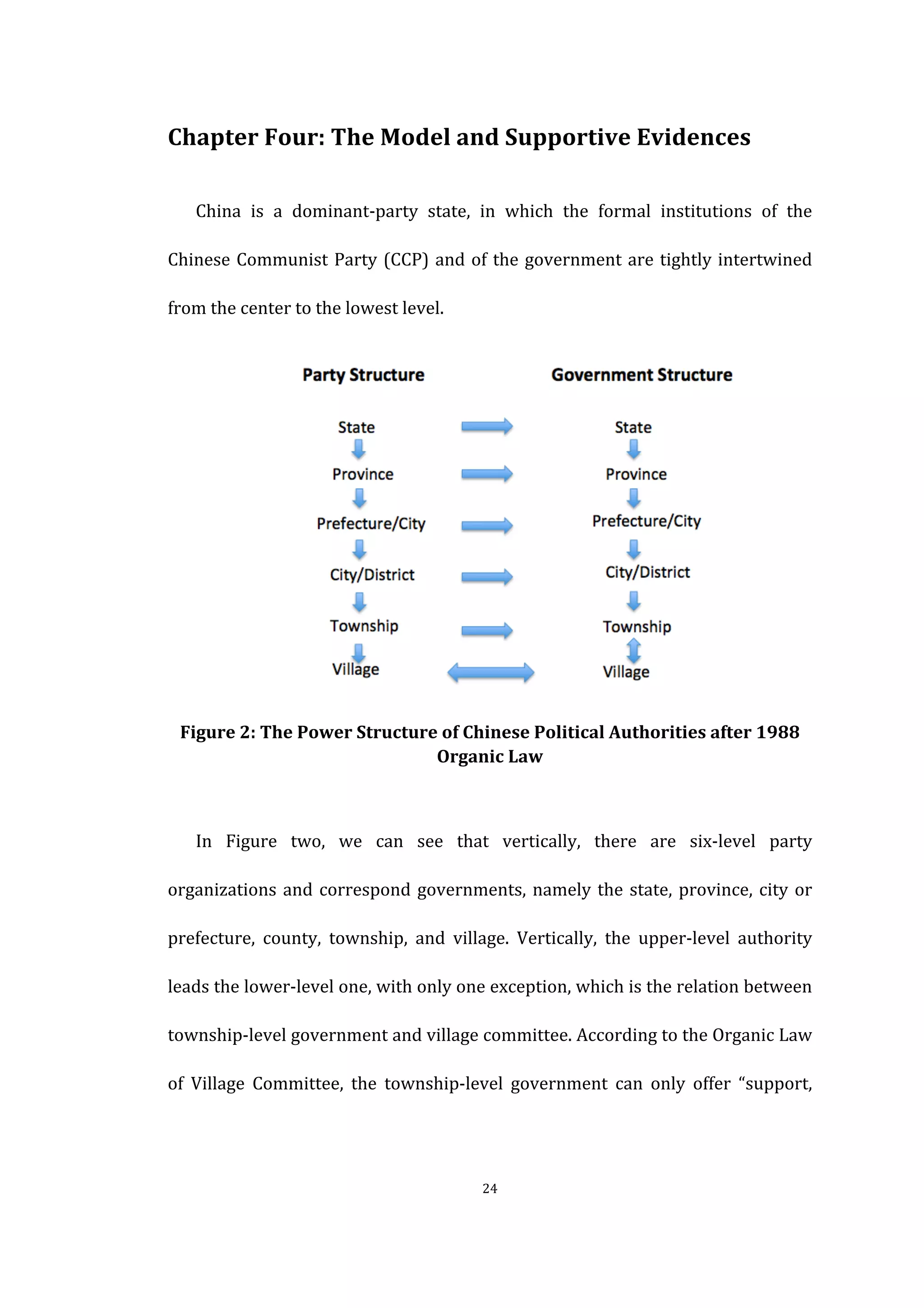
  • 19.
        12   tend  to  represent  the  villagers’  interest  in  both  popular  and  unpopular  policies.     The   scholars   above   have   contributed   valuable   knowledge   to   this   certain   research  field,  but  several  arguments  need  to  be  further  discussed  and  improved.   First,   though   Chinese   central   leaders   still   mainly   focus   on   maximizing   the   strategic  effects  of  local  elections,  i.e.  to  maintain  local  stability  and  prompt  the   enforcement   of   state   policies,   the   election,   as   a   democratic   setting,   will   spontaneously   create   some   institutional   effects.   Given   that   village   elections   become  more  competitive  and  widespread  with  time  passing,  these  institutional   effects  will  further  stand  out.  Thus  when  discussing  political  outcomes  of  such   elections,  we  should  not  simply  neglect  the  institutional  effects.  Second,  previous   research  works  mainly  focus  on  the  accountability  issue  of  village  chief,  while  the   role   party   secretary   plays   in   local   affairs   is   largely   ignored.   Actually,   party   branch   still   possesses   paralleled   de   jure   and   de   facto   power   in   local   decision-­‐making   process,   and   nominally,   party   secretary   is   still   the   boss   and   “first   hand”   (“Yibashou”   in   Chinese)   in   village.   (Oi   &   Rozelle   2000,   Alpermann   2001)   Consequently,   we   should   take   party   secretary’s   preference,   and   most   importantly   the   interactions   between   village   chief   and   party   secretary,   into   consideration.   Finally,   we   must   avoid   the   generalization   problem   during   the   research.  As  the  Organic  Law  of  Village  Committee  only  provides  an  outline  of   village  elections,  different  provinces  can  formulate  different  electoral  rules  based   on  their  own  reality.  Thus,  the  concrete  interactions  between  party  secretary  and  
  • 20.
        13   village   chief   may   be   largely   influenced   by   peculiar   formal   and   informal   institutions.     In   terms   of   the   power-­‐sharing   puzzle   between   village   chief   and   party   secretary,   though   some   scholars   have   mentioned   this   problem,   few   conduct   deeper  research.  Guo  and  Bernstein  (2004)  argued  that  the  conflict  could  arise   because  the  foundation  of  their  legitimacy  and  authority  differs,  and  a  possible   solution  is  to  merge  these  two  institutions  by  asking  party  secretary  to  run  for   the  post  of  village  chief.  Besides,  He  (2003)  argued  that  the  relation  between  the   self-­‐governing   village   and   the   upper-­‐level   government   may   also   be   in   trouble.   While   the   party   secretary   in   villages   serves   as   the   agent   of   upper-­‐level   party   branch,   the   elected   village   committee   is   not   necessarily   obedient   to   the   upper-­‐level  authorities.  Li  (2002)  further  explained  the  two-­‐committee  conflict   within  the  context  of  the  relation  between  the  party  and  villagers.  He  argued  that   the   functions   of   these   two   committees   are   overlapped   in   terms   of   the   village   governance,   resulting   in   a   paradox   that   emphasizing   the   party   leadership   will   paralyze   the   self-­‐governance,   while   highlighting   the   self-­‐governance   will   deteriorate  the  party  leadership.   Regarding   “Qingxian  Model”,  only  a  few  scholars,  all  of  whom  are  Chinese,   focused  on  its  function  and  implication.  Among  these  research  works,  there  do   have   some   valuable   pieces,   such   as   Peng   and   Shangguan   (2008)’s   paper   “the   political   participation   after   local   election:   an   example   of   the   villagers  
  • 21.
        14   representative  assembly  in  ‘Qingxian  Model’”,  Wang  (2009)’s  paper  “improving   the   village   self-­‐autonomy:  the  analysis  of  ‘Qingxian  Model’”,  Liu  et  al.  (2010)’s   paper  “from  grassroots  democracy  to  the  rule  of  law:  a  survey  of  Qing  County’s   villager   self-­‐autonomy”,   and   Lian   et   al.   (2009)’s   paper   “get   rid   of   the   two-­‐dimension  dilemma  in  the  authority  delineation  of  party  branch  and  village   committee:  a  reconsideration  of  ‘Qingxian  Model’”.  However,  the  basic  argument   of   these   papers   is   similar.   They   all   first   describe   causes   and   functions   of   “Qingxian   Model”   in   detail   and   then   basically   affirm   the   positive   influence   of   “Qingxian  Model”  on  enhancing  the  party’s  leadership,  overcoming  the  existing   conflict   and   protecting   villagers’   rights.   However,   few   of   these   studies   have   mentioned   the   institutional   problem   inside   the   “Qingxian   Model”   and   the   potential  harm  it  can  exert  on  Chinese  local  democracy.                    
  • 22.
        15   Chapter  Three:  Background  of  Chinese  Village  Elections   Local  leaders  in  China’s  administrative  structure  have  always  played  a  crucial   role  in  enforcing  state  policies  and  fulfilling  the  well-­‐being  of  local  villagers  due   to  the  large  geographic  scope  and  the  decentralization  nature  inherited  since  as   early   as   the   Mao   era.   (Cai   &   Treisman,   2006)   Up   to   2009,   there   have   been   691,510   administrative   villages   in   China,   which   widely   distributed   across   the   Chinese  territory.  Even  though  the  village  is  not  an  official  level  of  government,   leaders   at   this   level   still   serve   as   key   political   and   economic   actors   in   determining  the  fate  of  China’s  villagers.   During  the  collectivization  era,  the  production  team  (shengchan  dadui)  was   the  only  legal  organization  in  local  areas.  Basically,  all  villagers  and  households   in  a  certain  area  must  be  enrolled  in  a  local  production  team.  Though  the  size  of   production   teams   varied   depending   on   the   local   population,   their   main   responsibilities   were   the   same,   consisting   of   organizing   team   members   to   conduct  collective  economic  activities,  allocating  local  goods  and  compensations,   and   conducting   political   and   ideological   educations.   (Oi,   1989)   In   such   an   organization  simultaneously  possessing  the  economic  and  political  function,  the   power  delineation  was  clear.  The  production  team  leader,  who  is  almost  always  a   party  member,  served  a  dualistic  role.  Towards  the  general  team  members,  the   team  leader  strictly  controls  the  over-­‐all  power,  most  importantly  the  allocation  
  • 23.
        16   power   of   public   resources.   However,   as   the   agent   of   upper-­‐level   communal   officials,   the   team   leader   has   to   follow   their   command   and   finish   the   task   mandated  by  them.  In  this  sense,  it  is  a  perfect  vertical  power  structure,  in  which   the  team  leader  is  the  gatekeeper  of  resources  and  opportunities  for  the  team   and  its  members,  but  also  the  executor  and  enforcer  of  mandated  policies  from   above.   Although   local   governments   had   already   emerged   before   popular   elections,  they  could  seldom  exert  any  leverage  to  the  existing  power  structure   as  team  leaders,  who  are  also  party  cadres,  still  strictly  held  the  general  power,   and   government   leaders   in   this   system   served   only   as   the   executor   under   the   control  of  production  team.  Though  there  were  elections  of  local  party  leaders,   due  to  the  “intra-­‐party  democracy”  rule  of  CCP,  villagers  had  no  influence  at  all  as   the   candidates   were   pre-­‐selected   by   the   upper-­‐level   party   committee   and   the   election   was   only   open   to   party   members.   In   this   sense,   we   can   see   that   this   vertical  power  structure  is  adaptable  to  the  collective  economy  pattern  as  it  can   maximize  party  cadres’  allocation  and  distribution  power  of  public  resources.   However,  since  Deng  Xiaoping  initiated  the  decollectivization  reform  in  1978,   the  social  and  economic  changes  have  largely  influenced  the  CCP  governance  in   rural   areas.   First,   after   initiating   the   decollectivization   reform,   most   original   production   teams   became   village   small   groups   (xiaozu),   a   subordinate   organization  in  villages  retaining  little  economic  power.  Instead,  the  family  per  se   became   the   unit   of   production   and   accounting,   taking   care   of   its   resources  
  • 24.
        17   allocation,   such   as   the   grain,   fertilizer,   and   harvest   alone.   Unlike   the   circumstances   during   collectivization   era   when   rural   households   mainly   depended  on  the  sharing  of  public  goods,  villagers  basically  controlled  their  own   fates   after   the   reform,   making   them   cherish   more   on   private   surplus   and   simultaneously   became   more   resistant   to   unpopular   policies   mandated   from   above  as  these  policies  would  deprive  certain  part  of  their  private  goods.  This   transformation   therefore   made   unpopular   policies   harder   to   enforce   in   local   areas.  Since  local  cadres  are  the  agents  of  central  government,  villagers  would   naturally  express  their  anger  to  these  cadres,  which  deteriorated  the  cadre-­‐mass   relations.     Besides,  local  party  secretaries  themselves  also  became  less  prestigious  since   the  decollectivization  reform.  Age  and  corruption  were  two  main  problems.  First,   the  aging  problem  of  local  cadres  began  to  perplex  CCP  senior  leaders  as  early  as   in  1970s.  (Li  &  O’Brien,  1995)  As  there  was  no  genuine  limit  on  party  cadres’   tenure,   most   of   them,   who   assumed   the   position   since   the   foundation   of   new   China,  never  stepped  down.  This  problem  became  severer  after  the  reform  was   initiated  as  these  old  “local  emperors”  who  were  armed  with  the  Mao  doctrines   can  hardly  understand  and  keep  up  with  the  new  development.  As  of  2001,  there   were  1,357,000  party  branches  in  rural  China  with  a  total  party  membership  of   29.5   million,   but   among   these   local   branches,   as   many   as   356,000   were   experienced   rectifications   from   1994   to   2000   due   to   their   weakness.   (Guo   &  
  • 25.
        18   Bernstein,   2004)   Besides,   the   corruptive   problem   also   became  furious  in  local   areas  after  decollectivization.  Since  CCP  largely  decentralized  decisive  power  to   local   cadres   to   decide   local   affairs,   party   secretaries   then   possessed   the   final   discretion  on  the  surplus  of  public  goods  as  long  as  they  submitted  the  required   amount   of   money   and   goods   to   higher-­‐level   authorities.   In   this   situation,   the   high-­‐speed  economic  development  in  local  areas  would  create  great  incentives   for   these   cadres   to   seek   illegal   rents   without   effective   monitor   from   above,   resulting  in  the  large  agency  costs  of  central  government.     Based   on   these   realities,   CCP   senior   leaders   decided   to   introduce   popular   elections  in  rural  areas  in  1987  with  the  initiation  of  the  Organic  Law  of  Village   Committee.  The  original  purposes  of  holding  local  elections  were  on  one  hand   letting  villagers  to  decide  their  own  leaders  so  that  the  popularly  elected  cadres   could   help   enforce   unpopular   policies   from   above,   and   on   the   other   hand   transferring  the  monitoring  responsibility  on  local  cadres  to  vernacular  villagers   so   that   the   corruptive   activities   can   be   effectively   contained.   Then   with   this   political  experiment,  cadre-­‐mass  relations  were  expected  to  be  mitigated  and  the   provision   of   public   goods   was   expected   to   be   prompted.   (The   Carter   Center,   1998)   However,  as  the  1987  Organic  Law  only  provided  the  basic  principles  for  the   village   elections   without   a   specific   stipulation   on   electoral   process,   every   province   produced   its   own   electoral   rules   and   measurements   based   on   these  
  • 26.
        19   principles.  In  1998,  the  revised  version  of  the  Organic  Law  was  put  forward  with   more  detailed  stipulations  on  the  electoral  process,  but  formal  regulations  on  the   whole  electoral  process  were  still  absent  and  one  continued  to  observe  a  great   deal   of   variations   across   provinces.   (Wang,   2008)   According   to   the   record   of   Ministry   of   Civil   Affairs   (MCA),   the   first   province   to   conduct   province-­‐wide   village   elections   was   Fujian   in   1982,   and   the   last   province   to   conduct   local   elections  was  Yunnan  in  2001.  By  the  year  of  2005,  98%  of  villages  in  China  had   initiated  at  least  one  election.  (Wang,  2009)       Figure  1:  The  Procedures  of  Chinese  Village  Election      
  • 27.
        20   There  are  five  stages  of  a  whole  electoral  process  for  Chinese  village  elections   based   on   the   stipulations   of   Organic   Law,   namely   organizing   Village   Election   Committee   (VEC),   voter   registration,   candidate   nomination,   ballot   casting,   and   the  publication  of  electoral  results.   To  start  an  election,  the  village  must  first  organize  a  VEC.  The  VEC  member   should   be   nominated   and   elected   by   the   Village   Assembly   (VA),   Village   Representative   Assembly   (VRA),   and   the   Village   Team   (cunmin   xiaozu).   According  to  the  “avoidance  rule”,  a  VEC  member  should  quit  the  committee  if   she  or  her  relatives  later  becomes  the  candidate.  (Article  12)     After  the  VEC  has  been  organized,  the  committee  should  be  in  charge  of  the   next  step,  voter  registration.  According  to  the  Organic  Law,  all  villagers  whose   age  has  past  eighteen  years  possess  the  right  to  vote  and  to  be  voted,  regardless   of  their  ethnics,  races,  genders,  occupations,  family  background,  religious  belief,   education  level,  financial  status,  and  residential  length.  The  only  exception  is  that   the  people  who  have  been  deprived  of  political  rights  cannot  vote.  (Article  13)   When   the   vote   registration   is   finished,   the   VEC   should   publish   the   voter   list   twenty  days  before  the  election  day.   In   terms   of   the   candidate   nomination,   the   Organic   Law   stipulates   that   the   candidates   should   be   nominated   directly   by   registered   voters.   Besides,   the   candidate’s  number  should  exceed  the  number  of  seats.  (Article  15)  In  practice,   different   provinces   develop   their   own   nomination   ways.   Candidates   can   be  
  • 28.
        21   nominated  by  individual  voters  as  well  as  by  groups  (group  nomination).  Besides,   a  voter  can  nominate  others  or  himself  (self  nomination).     Then  on  the  election  day,  all  ballot  should  be  cast  anonymously  and  counted   publically.  Once  the  counting  process  is  finished,  the  result  must  be  published  at   once.  (Article  15)  For  those  who  are  disabled,  a  roving  box  should  be  applied.   The  election  is  valid  only  if  more  than  half  of  registered  voters  come  to  vote.  To   win  a  position,  the  candidate  must  obtain  more  than  half  of  valid  votes.  If  two   candidates   running   for   the   same   position   obtain   the   same   number   of   votes,   a   run-­‐off  election  should  be  held  to  determine  the  final  result.  (Article  15)   From  the  description  of  electoral  rules  above,  we  can  see  that  if  those  rules   are   followed   well,   the   elected   village   committee   can   be   counted   as   a   self-­‐governance   organization   in   Chinese   rural   area.   However,   as   China   is   a   party-­‐state,   in   which   Chinese   Communist   Party   (CCP)   is   the   only   incumbent   party,  the  party  branch  in  the  village  will  also  obtain  certain  discretion  over  local   affairs   in   order   to   maintain   the   CCP   control   in   rural   areas.   Though   the   CCP   demands  that  members  of  the  party  branch  should  also  be  elected  by  the  party   members   in   village,   the   positions,   in   practice,   are   mostly   assigned   by   the   upper-­‐level   party   organization,   i.e.,   the   villagers   have   no   rights   to   decide   the   party   branch   member.   Then   what   is   the   relation   between   the   assigned   party   branch  and  elected  village  committee?  At  least  in  the  Organic  Law,  there  is  no   clear  answer.  According  to  Article  3,  the  party  branch  should  take  a  leadership  
  • 29.
        22   role  in  supporting  and  protecting  villagers’  self-­‐governance,  while  in  Article  5,   the   law   stipulates   that   the   village   committee   should   support   and   organize   villagers  to  conduct  economic  activities,  and  take  the  responsibility  for  the  local   productive  service.  The  potential  power-­‐sharing  puzzle  just  lies  in  the  unclear   power  demarcation  above.   It  is  not  hard  to  perceive  the  contradiction  of  the  CCP’s  legislators.  On  one   hand,   pressed   by   the   rural   decollectivization   and   development,   the   central   government   has   to   endow   more   autonomous   rights   to   villagers   to   keep   the   stability  there,  but  on  the  other  hand,  the  800  million  populations  of  peasants  are   always  a  big  group  of  the  potential  revolts  if  the  CCP  losing  the  control,  especially   when   the   central   elites   are   instructed   by   thousand   times   that   it   was   the   dependence  on  peasants  that  led  to  the  CCP’s  victory  in  the  civil  war  against  the   former   KMT.   Thus,   this   contradiction   caused   the   unclear   power   delineation   of   party  branches  and  village  committees,  which  further  led  to  the  conflict  between   party  cadres  and  village  chiefs  in  practice.  For  party  cadres,  they  are  confused   about   the   meaning   to   have   elected   VC   as   long   as   the   party   secretary   still   possesses  the  “core  leadership”.  Elected  village  chiefs  are  also  perplexed  that  if   the  leadership  of  the  CCP  must  be  adhered  to,  why  bother  initiating  democratic   elections  in  the  first  place.  While  for  upper-­‐level  officials,  what  their  concerned   most  are  whether  the  elected  VCs  would  fully  carry  out  instructions  from  above   in  the  same  way  as  when  party  secretaries  are  in  charge.  
  • 30.
        23   In  the  following  section,  I  will  develop  a  pure  strategic  model  to  explain  how   village  elections  influence  the  interactions  between  party  secretary  and  village   chief  regarding  different  types  of  public  policies.                                  
  • 31.
        24   Chapter  Four:  The  Model  and  Supportive  Evidences   China   is   a   dominant-­‐party   state,   in   which   the   formal   institutions   of   the   Chinese  Communist  Party  (CCP)  and  of  the  government  are  tightly  intertwined   from  the  center  to  the  lowest  level.       Figure  2:  The  Power  Structure  of  Chinese  Political  Authorities  after  1988   Organic  Law     In   Figure   two,   we   can   see   that   vertically,   there   are   six-­‐level   party   organizations  and  correspond  governments,  namely  the  state,  province,  city  or   prefecture,   county,   township,   and   village.   Vertically,   the   upper-­‐level   authority   leads  the  lower-­‐level  one,  with  only  one  exception,  which  is  the  relation  between   township-­‐level  government  and  village  committee.  According  to  the  Organic  Law   of   Village   Committee,   the   township-­‐level   government   can   only   offer   “support,  
  • 32.
        25   help,   and   guidance”   to   the   village   committee’s   work,   but   cannot   intervene   the   village   committee   to   run   their   own   business.   (Article   3)   Besides,   the   village   committee   just   needs   to   “help”   township   authority   to   conduct   their   work,   without  necessity  to  be  governed  by  the  upper-­‐level  government.  In  this  sense,   unlike  relations  between  other  vertical  authorities,  the  village  committee  owns   its  own  independence.   Horizontally,  the  party  organization  leads  the  administrative  unit  in  each  of   the  first  five  levels.  The  only  exception  also  occurs  at  the  lowest  level  between   village   committee   and   local   party   branch.   Just   as   I   have   described   above,   relations   between   these   two   authorities   are   not   well   defined.   Besides,   the   selection   methods   of   members   in   these   two   authorities   are   totally   different.   Members   in   party   branch   are   mostly   assigned   by   the   upper-­‐level   party   organization,  which  means  that  the  party  branch  in  village  will  be  accountable  to   upper-­‐level  authorities.  As  for  members  in  the  village  committee,  if  we  assume   that  the  village  election  is  free  and  competitive,  they  will  be  elected  by  eligible   villagers,  and  according  to  the  Organic  Law,  if  more  than  one  fifth  of  the  voters   jointly   sign   their   names,   they   can   propose   to   dismiss   the   irresponsible   committee   members   with   a   justifiable   reason.   In   this   sense,   the   village   committee  is  accountable  to  villagers.  (Guo,  2004)   Then  what  are  the  main  tasks  for  village  officials?  In  China,  village  leaders   basically  have  three  responsibilities,  namely  the  enforcement  of  state  directives,  
  • 33.
        26   the   fulfillment   of   township   demands,   and   the   provision   of   public   goods.   Traditionally,   state   policies   include   the   birth   control,   land   expropriation,   and   state  tax  collection.  But  with  the  abolition  of  agricultural  tax  in  2006,  villagers’   burden   has   been   largely   relieved.   Regarding   the   requirements   from   township   authorities,  before  the  political  decentralization  in  1980s  when  villages  were  still   under  tightly  control,  the  township  government  had  the  financial  responsibility   to  fund  the  village  public  goods  and  services.  In  return,  villages  need  to  share  a   certain   ratio   of   their   revenue   with   township   authorities.   After   the   decentralization,   nominally   each   level   government   has   been   responsible   for   funding   and   organizing   public   goods   for   citizens   under   their   jurisdiction,   and   simultaneously   keeps   any   revenues   in   excess   of   a   preset   amount   they   are   required  to  deliver  upwards.  (Tsai,  2007)  In  reality,  villages  can  hardly  get  any   fund  from  above  and  have  to  mainly  count  on  themselves  to  generate  revenues   because  the  state  funds  allocated  to  provinces  have  been  “shared”  by  each  level   governments   and   when   they   come   to   the   lowest   level,   nothing   is   barely   left.   Simultaneously,  township  governments  lose  the  justifiable  reason  to  share  the   revenues  generated  by  village.  Instead,  they  have  to  open  some  informal  channel   to   fund   their   public   expenditures.   These   informal   institutions   include   the   establishment   of   various   levies,   fees,   and   fines,   which   are   generally   called   “extrabudgetary  funds”  as  raising  these  funds  do  not  need  explicit  authorization   from   above   as   long   as   they   are   not   violating   existing   regulations.   (Tsai,   2007)  
  • 34.
        27   However,  these  funds  are  extremely  sensitive  to  the  villagers  who  have  largely   earned   their   discretion   of   self-­‐governance.   (Li,   2002)   The   third   responsibility,   the  provision  of  public  goods  and  services  such  as  roads,  water,  electricity,  land   allocation,   and   rural   education,   is   relatively   easy   to   understand.   As   village   leaders,  to  enhance  the  local  economic  and  social  development  is  always  their   priority.   As   I   described   in   Chapter   Three,   before   initiating   village   elections,   party   secretary   possessed   greater   discretion   on   local   affairs,   and   village   chief   only   served  as  the  executor  to  enforce  party  cadres’  demands.  Besides,  as  both  party   secretary  and  village  chief  were  appointed  by  upper-­‐level  authorities,  they  must   simultaneously  follow  mandates  from  above.  In  this  institutional  setting,  there   will   be   no   obvious   conflict   between   both   village   leaders   and   they   will   jointly   enforce   popular   and   unpopular   policies   mandated   from   above   without   any   divergence.  Sometimes  they  may  use  coercions  to  deal  with  the  potential  popular   resistance  on  certain  unpopular  policy  to  protect  their  principals’  interests.       Figure  3:  The  Power  Structure  between  Township  and  Village  Authorities   before  1988  Organic  Law  
  • 35.
        28     Though   this   governance   type   can   effectively   prompt   the   delivery   of   public   policies,  it  may  also  instigate  villagers’  dissatisfactions,  and  the  accumulation  of   anger  may  finally  result  in  the  instability  of  local  areas.  Besides,  as  upper-­‐level   principals   can   hardly   exert   effective   monitor   on   local   cadres   and   villagers   possess   no   right   to   do   so,   village   leaders   then   have   strong   incentives   to   participate  in  illegal  rent-­‐seeking  activities,  which  will  sabotage  the  provision  of   public  goods  and  generate  great  agency  lost  for  upper-­‐level  authorities.   After   1988   Organic   Law,   the   local   governance   pattern   has   been   changed   greatly   since   village   chief   and   party   secretary   are   accountable   to   different   principals.   Then,   when   facing   the   tasks   above,   will   they   have   conflict   policy   preferences?   If   so,   in   what   kind   of   specific   public   policy   will   they   fight   each   other?   4.1  The  Formal  Model   I  will  develop  two  separate  models  to  formulate  interactions  between  party   branch   and   village   committee   when   dealing   with   two   types   of   public   policies,   consistent  policies  and  contentious  policies.  Basically,  consistent  policies  mainly   focus   on   the   provision   of   certain   public   goods,   such   as   the   construction   of   modern  roads,  the  advanced  irrigation  system,  the  establishment  of  rural  schools,   and   the   allocation   of   public   lands.   As   villagers   will   generally   benefit   from   this   type  of  policies,  the  enforcement  of  such  policies  will  be  acceptable  and  welcome.  
  • 36.
        29   However,  contentious  policies,  such  as  the  birth  control,  the  land  expropriation,   and   the   illegal   levy   of   revenue   from   the   township   government,   are   relatively   difficult  to  execute  in  rural  areas  they  jeopardize  villagers’  interests.     In  both  models,  there  are  two  players,  the  village  chief  (VC),  who  represents   the   village   committee,   and   the   party   secretary   (PS)   representing   local   party   branch.   Regarding   both   types   of   public   policies,   both   players   can   choose   to   accept  (A)  and  enforce  them  in  village,  or  reject  (R)  and  appeal  to  a  higher-­‐level   office  to  protect  the  villagers’  interests.  For  both  players,  I  assume  that:     (A).   They   both   possess   paralleled   discretion   over   the   decision-­‐making   process  of  certain  policies;   (B).   Institutional   effect   outweighs   strategic   effect,   meaning   that   their   preferences  are  determined  by  legal  provisions  and  institutional  settings  rather   than  the  expectations  from  upper-­‐level  authorities;   (C).  Both  players  are  rational  players,  caring  only  about  their  own  interests;   (D).   As   both   players   have   the   same   discretion,   when   they   choose   different   actions,  they  will  both  have  the  same  chance  to  win  out.   In  terms  of  the  payoff,  “a”  denotes  the  benefits  for  both  players  if  the  outcome   is  consistent  with  their  preferences;  “w”  denotes  the  punishment  for  the  party   secretary   if   her   choice   is   inconsistent   with   her   principal,   i.e.,   the   upper-­‐level   authorities;  “x”  denotes  the  cost  for  village  chief  if  her  action  is  inconsistent  with   villagers’  interest;  and  “t”  denotes  the  transaction  cost  in  the  circumstance  when  
  • 37.
        30   player  choose  different  actions.  To  better  understand  it,  we  can  assume  it  to  be   the   extra   punishment   on   both   players   for   the   delay   of   the   initiation   of   public   policies   resulting   from   conflict   preferences   between   the   village   chief   and   the   party   secretary.   Besides,   we   further   assume   that   compared   with   benefits   and   punishments,  the  extra  transaction  cost  “t”  is  relatively  small.  Below  are  the  two   models  respectively.   4.1.1.  Model  1:  Pure  Strategic  Game  on  Consistent  Policies   The  concrete  payoff  for  both  players  regarding  different  actions  is  shown  in   Figure  4.  As  this  type  of  policies  is  mainly  related  to  the  provision  and  allocation   of  certain  public  goods,  villagers  will  generally  gain  benefits.  In  this  sense,  both   village  chief  and  party  secretary  will  tend  to  enforce  such  policies.     Figure  4:  Pure  Strategic  Game  on  Consistent  Public  Policies    
  • 38.
        31   In   this   figure,   when   both   players   choose   to   accept,   policies   will   surely   be   enforced  and  both  players  will  gain  the  total  benefit  “a”.  If  one  player  chooses  to   accept  while  the  other  chooses  to  reject,  certain  policy  will  have  half  chance  to  be   enforced   and   half   chance   to   be   tabled.   Regardless   of   the   result,   as   players   in   these  two  situations  have  different  choices,  transaction  cost  “t”  will  be  added  to   both  players.  Besides,  the  player  who  chooses  to  reject  the  policies  will  assume   an   additional   cost   (“x”   for   village   chief   and   “w”   for   party   secretary)   as   their   actions  are  controvert  with  their  principals’  preferences.  If  both  players  choose   to   reject,   policies   will   surely   be   tabled.   In   this   situation,   no   profits   will   be   distributed  on  either  side.  Besides,  they  all  have  to  suffer  from  the  punishment.   By  solving  this  game,  we  can  easily  figure  out  that  the  only  Nash  Equilibrium   is  the  situation  in  which  both  players  choose  to  accept  and  enforce  the  public   policies.   This   result   is   quite   intuitive.   For   the   party   secretary,   she   will   always   prefer  to  follow  upper-­‐level  mandates  regardless  of  concrete  policy  types.  In  this   particular  situation,  the  provision  of  public  goods  and  services  will  surely  help   maintain  the  stability  in  rural  areas,  which  for  CCP  is  the  highest  priority.  For  the   village  chief,  although  she  also  chooses  to  accept  the  policies,  the  motivation  is   not  originated  from  upper-­‐level  authorities’  demand,  but  from  villagers’  needs.   In  sum,  there  will  be  no  conflict  between  the  village  chief  and  the  party  secretary   when  consistent  policies  are  mandated  from  above.  
  • 39.
        32   4.1.2.  Model  2:  Pure  Strategic  Game  on  Contentious  State  Policies   In  this  model,  this  type  of  public  policies  must  fulfill  two  requirements.  First,   there   are   divergent   preferences   between   state   villagers   and   upper-­‐level   governments.  Enforcing  such  policies  in  villages  will  surely  jeopardize  villagers’   interest.   Second,   elected   village   chiefs   must   possess   certain   discretion   in   the   implementation  process  of  such  policies.  With  these  qualifications,  the  one-­‐child   policy,  land  expropriation  policy,  and  the  illegal  revenue  levy  from  upper-­‐level   governments  can  perfectly  fit  into  this  type.   The  one-­‐child  policy,  initiated  in  1979,  regulates  that  each  family  could  only   have   one   child   in   order   to   control   the   birth   fertility.   However,   this   policy   is   strongly   controversial   to   Chinese   traditional   thought,   which   is   still   popular   nowadays   in   most   Chinese   rural   areas.   In   this   sense,   the   tension   between   the   central  authorities’  demand  of  shrinking  the  fertility  and  villagers’  will  to  have   more  children  is  still  existing,  even  though  there  are  some  exemptions  permitted   by  the  state.  For  example  in  some  area,  if  the  first  child  is  a  girl,  the  family  can   have  one  more  child,  and  if  the  couple  are  all  single  child  of  their  parents,  they   can  have  at  most  two  children.  Under  the  pressure  of  this  tension,  village  leaders,   who  possess  certain  discretion  over  the  enforcement  of  birth  control,  can  choose   either  to  fulfill  the  mandate  from  above,  or  to  be  accountable  to  the  villagers  by   helping  them  petition  for  more  ratios.   The   land   expropriation   policy   is   also   under   great   debate   in   current   China.  
  • 40.
        33   According   to   the   Organic   Law   of   China’s   Land   (China   Legal   Publishing   House,   2011),   the   upper-­‐level   government   can   expropriate   certain   amount   of   land   in   rural   areas   to   satisfy   modern   use,   including   the   public   use   such   as   the   construction  of  national  or  provincial  highways,  and  the  private  use  such  as  the   establishment   of   township   enterprises.   These   activities   will   result   in   the   permanent  loss  of  farmland  to  villagers.  (Cai  2003)  Although  strict  limitations   are  imposed  on  this  behavior  by  legal  provisions,  they  are  occasionally  violated   by  the  upper-­‐level  governments,  which  exacerbates  villagers’  hostility.  Similar  to   the  one-­‐child  policy,  the  village  chief  still  possesses  certain  discretion  to  choose   whether  to  follow  the  command  above  or  delay  the  expropriation  by  lobbying   upper-­‐level  government.   In   terms   of   “extrabudgetary   funds”   that   the   township   leaders   collect   from   villages,  just  as  I  described  above,  are  also  extremely  sensitive  to  villagers  once   they   figure   out   the   truth.   As   villagers   can   hardly   gain   any   regular   funds   from   above,  they  will  cherish  any  coin  they  earn  by  their  own  hands.  In  this  sense,   village  leaders  are  always  under  great  pressure  to  help  levy  this  illegal  money  in   villages.  Instead,  the  village  chief  can  petition  to  the  higher-­‐level  government  to   ask   for   the   abolition   of   this   informal   extraction   of   revenue,   thus   defending   villagers’  interests.  
  • 41.
        34     Figure  5:  Pure  Strategic  Game  on  Contentious  Public  Policies       The  payoff  of  both  players  is  shown  in  figure  5.  In  this  game,  the  interactions   between  village  chief  and  party  secretary  are  surely  zero-­‐sum,  meaning  that  the   profits  gained  by  one  player  will  cause  the  equal  value  loss  of  the  other.  In  this   situation,  when  both  players  choose  to  accept  and  enforce  certain  policies,  party   secretary  will  achieve  the  total  amount  of  profit  “a”,  while  village  chief  will  suffer   the  punishment  exerted  by  villagers  as  the  policy  outcome  contravenes  villagers’   preference.  Correspondingly,  when  both  players  choose  to  reject  certain  public   policies,  village  chief  will  achieve  the  total  amount  of  profits  at  the  expense  of   party  secretary’s  loss.  When  the  village  chief  chooses  to  accept  the  policies  while   the   party   secretary   rejects   them,   both   players   will   at   first   assume   the   punishment  by  their  principals  as  neither  of  them  follows  principals’  preferences.  
  • 42.
        35   Besides,  as  both  players  have  different  actions,  they  both  have  half  chance  to  win   and  half  chance  to  lose  during  their  fight,  causing  both  of  them  to  assume  extra   transaction   costs.   Finally,   when   village   chief   chooses   to   reject   and   party   secretary  chooses  to  accept,  the  punishment  is  avoided  as  both  players  stay  with   their   principals’   preferences.   Since   both   players   have   the   same   chance   to   win,   they  will  only  possess  half  of  their  profit  “a”  plus  the  extra  transaction  cost.     Compared   these   two   models,   we   may   find   that   when   state   and   villagers’   preferences  change,  the  payoff  for  both  players  are  totally  different.  In  this  model,   the   situation   that   both   players   choose   to   accept   the   policies   is   no   longer   equilibrium  as  when  public  policies  jeopardize  villagers’  interest,  accepting  them   will  be  worse  off  for  village  chief.  Instead,  the  only  Nash  Equilibrium  in  this  game   is   the   situation   in   which   village   chief   rejects   and   party   secretary   accepts   the   policy.     4.2  The  Implications  of  the  Models     By   developing   two   pure   strategic   models   of   interactions   between   villager   chief  and  party  secretary  regarding  two  different  types  of  state  policies,  we  find   two  Nash  Equilibra.  When  dealing  with  consistent  public  policies,  both  players   will   choose   to   accept.   When   dealing   with   contentious   policies,   party   secretary   chooses  to  accept  while  village  chief  chooses  to  refuse  is  the  only  stable  situation.     This   result   perfectly   answers   the   research   questions   I   put   forward   at   the  
  • 43.
        36   beginning  of  this  paper.  Since  there  exists  power-­‐sharing  puzzle  between  village   chief  and  party  secretary,  both  organizations  possess  same  discretion  over  the   decision-­‐making   process   of   the   enforcement   of   certain   public   policy.   Conflicts   between  these  two  organizations  will  emerge  only  when  state  intends  to  impose   certain  unpopular  policies  at  the  expense  of  villagers’  cost.  In  this  situation,  while   party  secretary  chooses  to  follow  the  mandate  above,  elected  village  chief  will  be   accountable  to  villagers  by  manipulating  to  delay  the  execution  of  such  policies.   This   conflict,   according   to   the   second   model,   is   stable   as   both   players   will   be   worse  off  if  defecting  to  the  other  choice.       What  can  we  learn  from  this  analysis?  What  political  outcomes  will  emerge   by  introducing  popular  elections  in  rural  areas?  First,  if  we  believe  that  formal   institutions   do   matter   once   put   into   effect,   we   should   confirm   that   with   the   expansion  and  amelioration  of  Chinese  village  elections,  village  chief  will  tend  to   be  more  accountable  to  the  general  public  for  fear  of  being  voted  out  of  office.   Regarding   party   secretaries   in   the   local   party   branch,   though   they   are   not   accountable   to   villagers,   they   still   under   the   direct   supervision   of   the   general   public,   which   means   that   villagers   have   the   potential   to   lodge   complaints   to   higher-­‐level   authorities   if   party   secretary   commits   any   malfeasance.   If   this   happens,   the   party   secretary’s   career   may   face   severe   challenge   with   the   potential  punishment  from  above.  In  this  sense,  when  dealing  with  the  consistent   public   policies,   both   party   secretary   and   village   chief   will   tend   to   accept   and  
  • 44.
        37   enforce  them  in  the  village.  At  the  same  time,  as  the  monitoring  responsibility  on   local  cadres  has  been  transferred  from  upper-­‐level  authorities  to  villagers  after   village   elections,   villagers   can   exert   more   effective   and   direct   supervision   on   local   cadres’   behavior,   thus   avoiding   potential   loss   of   profits   by   preventing   potential   embezzlement   and   corruptive   activities   from   local   cadres,   which   are   quite  normal  in  the  era  of  communal  system.  To  conclude,  by  studying  the  village   leaders’   interactions   toward   consistent   public   policies,   we   can   see   that   village   elections   can   effectively   prompt   the   provision   of   public   goods   and   services   in   villages.       In  terms  of  the  contentious  policies,  before  initiating  village  elections,  these   unpopular   were   enforced   coercively   by   upper-­‐level   government   with   no   legal   latitude   for   villagers   to   resist.   In   that   situation,   upper-­‐level   authorities   will   achieve   their   best   preference   at   the   expense   of   the   loss   of   villagers.   By   introducing   village   elections,   while   the   party   secretary’s   preference   remains   unchanged,  the  village  chief  shifts  her  accountability  to  represent  villagers  below   rather  than  simply  following  the  mandate  above.  Therefore,  the  interactions  and   the  subsequent  payoffs  of  party  secretary  and  village  chief  have  totally  changed.   Though  both  players  still  maintain  rewards  from  their  principals,  they  have  to   assume  an  extra  transaction  cost  due  to  the  policy  divergence.  Based  on  this  logic,   we  can  infer  that  initiating  village  elections  will  exacerbate  rather  than  mitigate   the  difficulty  of  the  enforcement  of  unpopular  public  policies  in  village.  
  • 45.
        38     Then,   if   we   further   compare   the   two   different   local   governance   patterns   before  and  after  initiating  village  elections,  we  may  find  the  CCP  faces  a  dilemma.   The   original   purpose   of   this   political   experiment   is   to   mitigate   the   severe   cadre-­‐mass  conflicts  and  to  exert  more  effective  monitor  on  local  cadres  in  case   of   their   corruptive   activities   and   the   subsequent   agency   lost   for   central   government.   Once   putting   village   elections   into   effect,   although   the   illegal   rent-­‐seeking   has   been   largely   mitigated,   and   cadre-­‐mass   relations   are   also   ameliorated,  some  other  problems  came  simultaneously.  The  conflicts  have  been   transferred   from   former   cadre-­‐mass   relations   to   two-­‐committee   relations   between  party  secretary  and  village  chief.  Besides,  village  elections  may  result  in   those  unpopular  policies  even  harder  to  be  enforced.     4.3  The  Supportive  Evidences  of  the  Models     Based  on  the  models  I  developed  above,  we  have  come  to  two  intermediate   conclusions.  That  is  after  initiating  the  village  elections:   (1) Regarding  consistent  public  policies,  village  chief  and  party  secretary  will   both   tend   to   be   more   willing   to   accept   and   enforce   such   policies   than   before  because  the  transfer  of  monitoring  responsibility  from  upper-­‐level   authorities  to  villagers  will  exert  more  direct  and  effective  supervision  on   villager  leaders’  behavior;   (2) Regarding  contentious  public  policies,  village  chief  and  party  secretary  will  
  • 46.
        39   tend  to  possess  different  preferences  as  they  are  accountable  to  different   principals,  which  may  result  in  the  delay  and  dysfunction  of  such  policies  in   village.   To   prove   whether   the   initiation   of   village   elections   result   in   the   transformation   of   the   execution   of   certain   local   polices,   advanced   quantitative   research  will  surely  provide  us  more  solid  evidences.  However,  data  collection,   especially   for   the   record   of   sensitive   topics,   is   always   a   severe   obstacle   for   conducting  research  in  an  authoritarian  state  such  as  China.  Even  if  researchers   have   enough   funds,   personal   ties   with   officials   in   charge   is   also   a   necessary   prerequisite.  That  may  largely  explain  why  most  of  previous  research  works  on   Chinese   village   elections   are   case   studies   instead   of   statistical   research   with   large  samples.  Unfortunately,  I  cannot  collect  enough  data  related  to  my  research   questions  above  at  the  present,  but  there  do  exist  several  previous  quantitative   studies   working   on   the   accountability   problems   of   Chinese   village   elections,   which  may  well  prove  my  models  above.     The  study  I  will  describe  in  this  paper  was  conduct  by  Shuna  Wang  and  Yang   Yao  (2006).  Their  research  mainly  focuses  on  the  impacts  of  village  elections  on   the  accountability  of  village  committee,  local  fiscal  sharing,  and  state  taxation  by   collecting  data  from  48  villages  in  eight  provinces  for  a  time  period  from  1986  to   2002.   They   found   that   village   elections   in   China   substantially   increase   local   public   expenditures,   and   reduce   administrative   costs   and   revenues   handed   to  
  • 47.
        40   upper-­‐level   authorities.   Besides,   they   found   no   significant   influence   of   village   elections   on   the   state   taxation.   Though   they   did   not   emphasize   the   different   types  of  public  polices,  the  dependent  variables  in  their  model  basically  include   all  parameters  I  discussed  above.           Table  1:  Village  Elections’  Impact  on  Local  Public  Policies     Source:  Wang,  2006.     From   the   table   above,   we   can   see   that   the   dependent   variable   “share   of   public   expenditures”,   which   represents   the   provision   of   public   goods   and   services  I  discussed  above,  is  increasing  significantly  after  the  initiation  of  village   elections.  At  the  same  time,  the  dependent  variable  “share  of  income  handed  to   township”,   which   largely   represents   the   township’s   illegal   revenue   levy   from   village  I  talked  before,  is  significantly  decreasing  after  the  elections.  Both  of  them   prove  my  models.  In  terms  of  the  dependent  variable  “share  of  administration  
  • 48.
        41   cost”,  which  refers  to  the  agency  cost  I  discussed  above,  the  decreasing  tendency   of  administrative  cost  also  proves  that  village  elections  significantly  ameliorate   the  local  governance.  As  for  the  state  taxation,   unlike   the   unpopular   policies   I   stated  above,  village  chief  has  little  discretion  on  the  execution  of  such  policies   because  the  tax  rate  has  already  been  tightly  fixed.  Besides,  since  the  agricultural   tax,   which   was   main   source   of   state   tax,   has   been   abolished   in   2006,   the   tax   burden  on  villagers  has  been  largely  relieved.  Thus,  this  variable  can  exert  little   influence   on   the   local   governance   and   interactions   between   village   chief   and   party  secretary.       Another   research   work   conducted   by   Martinez-­‐Bravo   et   al.   (2011)   also   proved   my   models.   Their   study   used   the   village-­‐level   data   from   217   villages   selected  from  25  provinces  for  the  time  period  from  1980  to  2005.  Though  this   study  did  not  directly  point  to  the  two-­‐committee  conflicts,  we  can  still  infer  this   conflict  from  their  statistical  results.  First,  by  introducing  a  survey  in  the  sample   villages,   they   found   that   village   elections   have   significantly   increased   the   unilateral  power  of  village  chief  and  simultaneously  decreased  the  discretion  of   the   party   secretary.   Then,   researchers   of   this   study   further   probed   into   the   village   chief’s   behavior   by   focusing   on   the   management   of   public   policies   in   villages.   They   categorized   public   policies   by   two   parameters,   namely   whether   certain   policy   is   popular   and   whether   village   chief   has   discretion   over   certain   policy.   Using   the   data   collected   from   these   sample   villages,   they   found   that  
  • 49.
        42   regarding  unpopular  policies  that  village  chiefs  have  decisive  power,  they  tend  to   fulfill  these  policies  based  on  villagers’  rather  than  the  upper-­‐level  authorities’   preferences,  which  prove  my  second  model  that  when  dealing  with  contentious   policies,  the  village  chief  tends  to  reject  them.  In  terms  of  the  popular  policies   that  village  chiefs  have  discretion,  they  maintained  that  village  leaders  also  tend   to  make  decisions  in  accordance  with  villagers’  preference,  which  proves  my  first   model  above  that  village  elections  help  intensify  the  monitor  on  village  leaders   and   reduce   agency   costs.   Besides,   this   study   also   introduced   a   third   placebo   group   to   test   village   chiefs’   behavior   on   policies   that   they   have   no   discretion,   whether  the  policies  are  popular  or  not,  and  they  found  that  there  is  no  obvious   change  of  policy  preferences,  proving  that  village  chiefs  can  only  exert  influence   on  policies  they  have  discretional  power.     Apart  from  the  quantitative  studies  above,  there  are  also  some  case  studies   directly   discussing   the   two-­‐committee   conflicts.   Guo   and   Bernstein   (2004)   discussed   a   case   happened   in   Da’ao   Village   of   Guangdong   Province.   The   party   secretary   in   this   village   sold   a   great   amount   of   collectively   owned   land   to   the   local  private  enterprises  and  embezzled  the  money  earned  from  the  land  sale.   Dissatisfied   by   the   party   secretary’s   corruptive   activity,   villagers,   led   by   the   village   chief,   urged   the   party   secretary   to   submit   the   account   book   for   check.   However,   the   party   secretary   adamantly   refused   villagers’   demand   in   case   his   corruption   was   exposed.   Finally,   the   village   chief   lodged   complaint   to   the  
  • 50.
        43   upper-­‐level   authorities   to   furiously   expose   the   malfeasance   of   local   party   secretary.  Pressed  by  local  villagers’  dissatisfaction,  the  upper-­‐level  party  branch   deprived  the  party  secretary’s  position  and  charged  him  for  his  embezzlement.       Another  case  study  was  conducted  by  Li  (2002)  in  Dongcun  Village  of  Hunan   Province.  In  this  case,  after  the  villagers  realized  that  the  township  government   levied   an   excessive   fee   related   to   children’s   education,   which   was   essentially   against  the  Regulation  Concerning  Peasants’  Fees  and  Labor  that  designed  by  the   State   Council,   they   lodged   a   collective   complaint   to   the   township   government   under   the   leadership   of   the   village   chief.   Without   an   acceptable   answer   from   township  leaders,  the  peaceful  complaint  soon  became  a  violent  protest.  During   the  whole  protest,  the  party  secretary  in  Dongcun  Village  remained  silent  in  his   own  home.  This  protest  soon  spread  to  another  six  villages  located  in  the  same   county  and  finally  drew  the  attention  of  provincial  leaders.  After  the  provincial   government  sent  a  special  research  team  to  the  township,  they  quickly  cancelled   the  illegal  revenue  extraction  and  dismissed  the  township  governors.                              
  • 51.
        44   Chapter  Five:  The  Case  Study,  Qingxian  Model   After  discussing  the  interactions  between  village  chief  and  party  secretary,  it   is   not   hard   to   find   that   the   power-­‐sharing   puzzle   may   cause   great   conflict   between  these  two  organizations,  especially  when  they  face  unpopular  policies   mandated   from   above.   Their   conflict   may   cause   the   delay   of   the   execution   of   certain   policies,   which   may   result   in   great   negative   effects   on   the   local   governance.  For  example,  if  villagers  are  unsatisfied  with  the  local  governance,   they   can   lodge   complaints   to   higher-­‐level   authorities,   which   may   lead   to   instability   in   local   areas.   (Li   &   O’Brien   1996,   Li   2002).   Then   here   comes   my   second  research  question  in  this  paper,  which  is  how  to  solve  the  power-­‐sharing   conflict  in  Chinese  local  areas?   In   fact,   some   institutional   designers   and   academic   scholars   have   already   perceived   this   conflict   and   were   engaged   in   some   innovations   to   solve   this   problem.   For   example,   in   Guangdong   Province,   local   CCP   secretaries   were   required  to  run  for  the  village  chief  in  order  to  merge  the  personnel  of  these  two   committees   and   retake   the   village   committee   under   CCP’s   control.   Besides,   in   Shanxi   Province,   with   the   purpose   of   improving   the   legitimacy   of   the   party   secretary  in  the  rural  area,  a  two-­‐ballot  system  was  introduced.  In  this  system,   the  upper-­‐level  party  committee  first  selects  some  candidates  eligible  to  run  for   the  party  secretary  in  a  village.  Then  the  villagers  rule  out  the  candidates  they  
  • 52.
        45   don’t  like  by  election  at  the  first  run.  After  that,  party  members  will  then  elect  the   secretary  among  the  rest  candidates  at  the  second  run.  (Li,  1999)     “Qingxian  Model”  is  another  example  to  solve  the  power-­‐sharing  problem.  In   September   2002,   leaders   in   Qing   County   of   Hebei   Province   started   to   conduct   this  new  experiment  in  selected  23  villages.  Since  the  beginning  of  2003,  the  new   institution  has  been  established  around  the  county.  Up  to  now,  all  345  villages  of   the   county   have   established   Village   Representative   Assembly   (VRA)   and   there   are  6325  representatives  in  total.     5.1  The  Basic  Content  and  Mechanism  of  “Qingxian  Model”   According  to  the  official  record,  the  standard  definition  of  “Qingxian  Model”   is  a  new  mechanism  of  self-­‐autonomy  in  a  rural  area  organized  and  led  by  the   CCP.   In   this   mechanism,   the   main   specialty   is   to   resurrect   villagers   representative   assembly   as   a   permanent   political   organization,   and   the   power   demarcation   is   that   party   branch   possesses   the   top   leadership,   villagers   representative  assembly  makes  the  decision,  while  village  committee  execute  the   concrete  policy.  (The  Official  Records  of  Qing  County’s  Villages,  2009).   In   this   model,   the   resurrection   of   VRA   is   the   main   focus,   but   actually,   the   assembly   is   not   innovative   at   all.   According   to   the   Organic   Law   of   Village   Committee,  the  villagers  assembly  (VA)  is  the  top  decision  maker,  and  for  those   large   administrative   villages   where   the   population   are   distributed   relatively  
  • 53.
        46   dispersive,   it   is   necessary   to   construct   the   VRA   to   execute   the   function   of   villagers  assembly.  The  representative,  who  is  normally  recommended  by  every   five  to  fifteen  households,  is  responsible  for  discussing  and  deciding  important   issues  related  to  village  in  regular  representative  meetings.  (Article  25)       However,  in  reality,  in  most  areas  of  Chinese  villages,  the  VA  and  VRA  have   waned  or  even  been  suspended.  In  most  areas,  the  VA  and  VRA  meetings  are  only   held  no  more  than  four  times  per  year.  (Oi  &  Rozelle,  2000)  Thus  their  functions   cannot   be   fulfilled.   This   phenomenon   is   largely   due   to   the   weak   awareness   of   political   conceptions   of   general   villagers.   Achieving   their   own   land   through   China’s  economic  reform,  what  villagers  mostly  concerned  is  their  own  economic   status.  In  terms  of  the  political  power,  they  think  it  either  belongs  to  the  VC  or   belongs  to  the  secretary,  but  not  themselves.     Leaders   in   Qing   County   perceived   the   dysfunction   of   VA   and   VRA.   After   applying   the   “Qingxian   Model”,   a   detailed   decision-­‐making   process   on   certain   issues  in  each  village  becomes  more  complicated,  at  least  nominally.  In  the  first   stage,  a  draft  resolution  is  put  forward  by  one  of  the  following  units:  the  party   branch,  the  village  committee,  1/10  of  all  villagers,  or  1/3  of  all  representatives.   After   that,   the   party   branch   would   examine   the   draft   resolution   and   have   preliminary   comments   on   it.   Then   the   joint   meeting   attended   by   all   members   from  both  party  branch  and  village  committee  would  be  held  to  set  the  agenda   for  a  subsequent  discussion.  Next  the  joint  meeting  attended  by  all  members  of  
  • 54.
        47   the  party  and  of  the  two  committees  would  scrutinize  the  draft.  Then  comes  the   most  important  part.  The  draft  would  be  discussed  and  be  voted  in  VRA  where   representatives  have  to  affix  their  own  stamps  to  assume  the  responsibility  of   decision-­‐making.  The  content  of  the  resolution  would  be  publicized  in  the  village,   and  would  be  executed  by  village  committee  who  has  the  responsibility  to  report   the  result  of  execution  to  party  branch,  the  representative  conference,  and  finally,   common  villagers.     The   “Qingxian   Model”   soon   drew   Chinese   scholars’   attention   and   positive   response  after  its  initiation.  For  example,  Xu  Fuqun  insists  that  this  model  is  a   hopeful   approach   for   the   solution   to   the   conflict   of   the   two   committees.   Cao   Guoying  concludes  that  “Qing  Model”  is  an  ideal  choice  in  the  consideration  of   limitations  in  reality.  Wen  Tiejun  Points  out  that  this  model  would  not  cost  too   much  for  reformation  and  therefore  it  is  effective.  Li  Qiang  also  thinks  that  the   model  is  both  progressive  and  conservative  and  has  taken  the  consideration  of   short  term  as  well  as  long  term  objectives.  Yu  Jianrong  himself  speaks  highly  of   this  pattern,  saying  that  the  secretary  of  Qing  County  is  so  wise  that  he  not  only   brings  out  solution  to  the  paradox  in  the  governance  of  village,  but  also  brings   out  solution  to  problems  that  have  a  decisive  effect  on  the  vitality  of  CCP.  (The   Official  Records  of  Qing  County’s  Villages,  2009)  
  • 55.
        48     5.2  The  Case  Study  in  Gengguantun  Village     In  order  to  examine  the  effectiveness  of  Qing  County  in  practice,  I  developed   a  field  study  in  Gengguantun  Village  of  Qing  County  in  July  2010,  together  with   my   three   undergraduate   classmates.   During   these   eight-­‐day   field   work,   we   audited   the   whole   process   of   VRA   meeting   as   observers,   held   a   number   of   interviews   with   the   secretary   of   the   party   branch,   Pan   Bingzhong,   as   well   as   other  relevant  officials  in  the  village,  and  had  conversations  with  representatives   of  villagers  and  party  members.  Meanwhile  we  were  also  interviewing  general   villagers   in   Gengguantun   Village   in   order   to   learn   more   about   their   opinions   concerned  about  the  practice  of  “Qing  Model”,  the  development  of  the  village,  the   conflicts  between  the  two  committees.     5.2.1.  Background  of  Gengguantun  Village     Gengguantun  Village  is  located  in  Qing  County  of  Hebei  Province.  It  is  0.5  km   far  from  the  downtown  of  Qing  County  and  close  to  No.104  National  Highway   that  provides  the  village  with  convenient  transportation.  It  is  also  not  far  from   Beijing,   the   capital   of   China,   with   only   three   hours’   driving   distance.   The   geographical   advantages   have   provided   favorable   conditions   to   the   economic   development  of  the  village.  Besides,  the  village  is  in  the  east  of  Mid-­‐Hebei  Plain   where  there  are  few  mountains  or  hills.  Climate  conditions  are  also  favorable.  In   2007,  the  gross  industrial  output  value  is  35  million  dollar,  the  yearly  average  
  • 56.
        49   net  income  of  villagers  is  2000  dollar.  It  has  become  famous  for  prosperity  and   civilization   among   nearby   areas.   In   2005,   the   village   built   the   first   large-­‐scale   straw  gasification  station  that  was  able  to  provide  enough  energy  for  cooking  for   the  whole  village.  Many  projects  in  the  village  have  also  won   various  rewards   from  upper-­‐level  authorities.     The  secretary  of  party  branch  is  Pan  Bingzhong,  who  started  to  assume  the   position  in  1994.  He  gave  others  an  impression  of  efficiency  and  resolution.  At   the   end   of   1980s   and   the   beginning   of   1990s,   the   collective   economy   of   the   village  was  close  to  collapse  because  of  a  series  of  negative  factors.  At  that  time,   Pan,  who  was  a  successful  private  entrepreneur  then  started  to  come  into  power   and   saved   the   collective   economy   through   attracting   investment   and   building   factories.   Though   Pan   had   been   emphasizing   his   selflessness   during   the   interview,   we   found   the   opposite   opinion   when   having   conversations   with   general  villagers.  According  to  their  description,  Pan  assumed  the  party  branch   position  without  giving  up  all  his  business,  but  instead  remain  to  be  the  main   shareholder   of   his   enterprises.   They   believe   many   projects   in   the   village   are   associated  with  Pan’s  business  in  a  way  after  his  came  into  power,  in  which  he   embezzled  enormous  illegal  profits.  Besides,  villagers  complained  that  Pan’s  life   is  quite  luxurious.       In   terms   of   the   two-­‐committee   conflict,   according   to   the   official   record   of   Qing   County,   the   conflict   between   the   elected   village   chief   and   the   party  
  • 57.
        50   secretary   was   widespread   across   the   whole   county   before   initiating   the   “Qingxian  Model”.  In  Gengguantun  Village,  the  conflict  was  mainly  between  the   party   secretary,   Mr.   Pan,   and   the   former   village   chief,   Mr.   Liu.   As   I   described   above,  Pan  collected  great  amount  of  money  by  selling  collectively  owned  land   and  by  embezzling  public  resources  through  his  private  enterprise.  However,  the   former   village   chief   Mr.   Liu   was   just   a   general   farmer   who   made   a   living   by   cultivating  his  own  land.  He  was  elected  because  of  his  righteous,  laborious,  and   amiable  characters.  As  Liu  preferred  to  protect  the  arable  land  from  the  modern   use,  he  was  extremely  against  Pan’s  idea  of  selling  collective  land.  According  to   the   villagers   in   Gengguantun   Village,   these   two   village   leaders   were   seldom   talking  to  each  other.  When  participating  village  meetings,  they  often  sat  far  from   each   other.   When   one   of   them   launched   a   speech,   the   other   would   express   nothing  but  indifference  and  disdain.     Liu   also   tried   to   lodge   complaint   to   the   upper-­‐level   government,   but   achieved   nothing   as   Pan’s   personal   ties,   constructed   and   intensified   through   countless  and  ceaseless  briberies,  were  much  stronger  than  his.  Finally,  Liu  had   to  quit  the  position.     After  Liu’s  resignation,  some  villagers  also  expressed  their  dissatisfactions   towards  Pan’s  malfeasance,  but  suffered  grave  consequences.  Some  villagers  told   me  during  secret  interviews  that  once  a  villager  burned  Pan’s  brand-­‐new  BMW   car   because   Pan   forcefully   removed   his   home   for   the   construction   of   new  
  • 58.
        51   apartments.  After  knowing  the  truth,  Pan  first  hired  some  members  of  criminal   syndicate  to  break  one  leg  of  this  villager,  and  then  accused  the  villager  in  the   upper-­‐level   court   for   intentionally   damaging   his   private   goods.   Finally,   the   villager  was  put  in  jail.  Soon  after  that,  Pan  bought  a  new  BMW  car  same  to  the   former  one.       5.2.2.  The  Application  of  “Qingxian  Model”  in  Gengguantun  Village     As  the  “pilot  village”  in  Qing  County,  Gengguantun  Village  started  to  apply   the   “Qingxian   Model”   as   early   as   its   initiation.   Though   in   many   official   conferences,   Zhao   Chaoying,   the   party   secretary   of   Qing   County   and   also   the   designer  of  “Qing  Model”,  has  emphasized  the  positive  effect  of  the  resurrection   of  VRA  on  the  removal  of  power-­‐sharing  conflict  between  village  chief  and  party   secretary,   realities   are   much   complicated.   We   noticed   some   phenomenon   that   both  officials  and  scholars  seldom  pay  attention  to.     First,  the  practice  of  “Qingxian  Model”  indicates  that  the  resurrection  of  VRA   can  effectively  mitigate  the  two-­‐committee  conflict,  but  it  also  leads  the  power   skewing   lopsided   to   the   party   branch.   During   our   interviews   with   common   villagers,  they  all  claim  that  there  exists  no  conflict  between  the  two  committees   and   their   heads.   The   leadership   of   the   party   branch   on   village   committee   is   strong.  The  village  chief  in  Gengguantun  Village,  Qi,  also  spoke  highly  of  Pan’s   role  and  ability  in  the  interview.  He  said,  “Without  Secretary  Pan  there  would  not  
  • 59.
        52   have  today’s  Gengguantun  Village.  It’s  just  his  personal  capability.”     However,   the   party   branch   and   the   secretary   also   become   too   powerful   accompanied   with   the   strengthening   of   party’s   leadership   as   well   as   the   eliminating   of   the   conflict.   Firstly,   the   representative   committee   can   not   implement  any  effective  oversight  of  the  party  branch.  The  15th,  July  2010  is  the   Political  Discussion  Day  for  all  villages  in  Qing  County  when  the  president  of  VRA   (it   is   Pan   actually   run   as   a   concurrent   post),   representatives,   members   of   the   party   branch,   all   officials   of   the   village   committee   participated   in   discussions.   There  were  six  sections  in  total  including  first  half  year’  report  on  work,  first  half   year’s   report   on   finance,   second   half   years’   planning,   democratic   appraisal   through  democratic  discussions,  the  speeches  made  by  the  township  official,  and   the  conclusion  of  the  discussions  made  by  the  party  secretary.  When  it  was  the   turn   of   representatives   to   comment,   some   of   them   highly   praised   the   work   of   leaders  in  the  village,  some  of  them  emphasized  that  they  could  have  democratic   rights  only  because  of  the  leadership  of  the  party  secretary.  Some  of  them  even   cited   Chairman   Mao’s   poems   to   speak   highly   of   the   leadership   of   the   party.   Obviously,  they  said  nothing  substantive  except  flattery.  After  the  discussion,  the   representatives  and  party  members  voted  for  the  policy  resolutions  and  signed   their   names.   All   decisions   won   a   unanimous   vote.   In   fact,   according   to   representatives   and   village   officials,   since   the   establishment   of   VRA,   all   resolutions  won  a  unanimous  vote.  
  • 60.
        53     Secondly,   the   VRA   and   its   representatives   not   only   fail   to   implement   any   oversight  of  the  party  branch  and  its  party  secretary,  Pan  also  makes  use  of  the   conference  as  a  way  to  strengthen  his  power  and  influence  in  pursuit  of  his  own   interests.  Here  is  an  interview  between  a  representative  and  us.     …   Interviewer:  How’s  the  frequency  of  the  meeting  of  villagers  assembly?   Representative:  It’s  too  frequent.  We  usually  have  meetings  at  night  which  last  for  1  or  2   hours.     …   Interviewer:  What  do  you  often  do  during  the  meeting?   Representative:  Villagers  can  have  discussions  with  our  representatives  to  find  out  solutions   to  some  problems.   Interviewer:  Does  the  smaller  neighboring  village  also  have  such  meetings?   Representative:   Other   villages   never   have   meetings,   if   nothing   happens.   Gengguantun   Village  is  just  a  model,  and  is  the  only  model.  Frankly  speaking,  what  you  have  just  seen  is  the   most  positive  and  brightest  side  of  the  village  and  you  can  only  see  this  side.   …     Interviewer:  Have  there  ever  been  big  problems.   Representative:  No,  and  we  can  solute  small  problems  through  negotiations.   Based  on  their  words,  when  encountering  some  tough  problems  that  party   secretary  can  hardly  solve  through  direct  demand,  people  will  seek  the  help  with   some   informal   institutions,   such   negotiations   in   clan’s   meetings   or   religious   groups,  rather  than  VA  and  VRA.  In  this  sense,  the  VRA  is  just  a  form  without  any   substance.   Moreover,  based  on  our  field  study,  the  VRA  in  Gengguantun  Village  has  not  
  • 61.
        54   become  the  channel  and  platform  for  villagers  to  participate  and  discuss  local   politics.   Villagers   are   unclear   of   the   selection   process   of   villagers’   representatives  at  all.     Interviewer:  Do  you  know  anything  about  villagers’  representative?   Villager  A:  I  am  not  one  of  them,  and  they  are  appointed  by  the  party  secretary.   Interview:  They  tell  us  they  are  elected.   Villager  A:  They  just  tell  you  the  good  things.  In  fact  it’s  just  like  your  school.  The  teacher   will  only  appoint  those  who  have  good  relation  with  him  or  her  as  class  leaders.  It’s  the  same   here.   If   you   don’t   have   good   relation   with   the   production   team,   you   are   not   allowed   to   be   a   representative.   Interviewer:  Are  there  any  benefits  of  being  representative?   Villager  A:  You  can  get  paid.   …   Interviewer:  What  kind  of  people  can  be  representatives?   Villager  A:  What  kind  of  people?  Flatterers  can!  You  can  tell  that  from  their  speeches.  They   never  tell  you  the  truth  and  in  villagers’  eyes  they  are  just  the  minion.   Interviewer:  But  they  are  quite  old,  aren’t  they?   Villager  A:  Sure.  At  their  ages,  they  can  just  get  some  money  by  flattering.  You  only  need  to   flatter,  then  you  get  paid.  Why  do  they  only  say  something  good?  If  they  say  something  bad,  they   can  get  no  money.   …   Interviewer:  Have  you  ever  voted  for  representatives?   Villager  B:  Yes,  I  have.  And  every  time  candidates  are  the  same.  They  are  those  who  have   prestige  and  whose  words  matter.   …   Interviewer:  Have  you  ever  participated  in  the  election?   Villager  C:  Yes.  
  • 62.
        55   Interviewer:  Whom  did  you  vote  for?   Villager  C:  Those  old  people.  Those  who  are  now  representatives  will  continue  to  be.  We  are   too  young  to  understand  these  affairs.   We  can  tell  that  villagers  are  not  very  keen  on  the  election,  partly  because   some  of  them  have  no  idea  on  the  political  affairs  of  the  village.  More  importantly,   many   villagers   believe   that   the   party   secretary   have   intervened   the   elections.   This  strongly  affects  the  legitimacy  of  the  elections.   Besides,  we  also  find  out  that  representatives  seldom  have  essential  contact   with   common   villagers,   who   also   seldom   call   on   representatives   when   facing   problems.  These  records  can  reflect  the  situation  very  well.   …   Interviewer:  Have  you  had  any  contacts  with  representatives?   Villager  D:  No.   Interviewer:  Who  is  in  charge  of  the  informing  if  there  are  some  events?   Villager  D:  Not  representatives.  The  village  committee  will  send  their  men  to  each  house.   …   Interviewer:  How  do  you  think  of  the  development  in  the  village?   Villager   D:   It’s   very   good.   But   we   have   no   contacts   with   the   village   committee,   and   we   cannot  understand  many  policies.  Many.   Interviewer:  If  you  are  not  satisfied,  how  can  you  deal  with  it?   Villager  D:  If  we  are  not  satisfied,  we  can  only  be  unsatisfied  at  home.  No  one  would  reflect   the  situation  to  higher  rank  and  it  is  useless  to  do  so.  In  other  villagers  there  may  be  such  actions,   but  not  here  at  Gengguantun.  We  just  follow  the  mainstream  and  do  our  own  business  quietly.   We  don’t  want  to  stir  up  trouble,  and  we  don’t  care  much  about  matters  concerned  about  a  lot  of   people  either.  
  • 63.
        56   Besides,  as  far  as  we  know,  several  years  ago,  some  unsatisfied  villagers  did   lodge  complaints  to  higher-­‐level  authorities  to  complain  about  Pan’s  malfeasance,   but  came  back  with  no  good  news.  Instead,  Pan  threatened  the  villagers  that  if   the   “troublemakers”   did   not   lodge   complaint   successfully,   he   would   make   reprisals  on  them  one  by  one.   In   conclusion,   the   resurrection   of   VRA   in   Gengguantun   Village   did   help   mitigate  the  two-­‐committee  conflict,  but  it  also  adds  more  power  to  the  party   secretary  improperly.  No  effective  oversight  from  the  VRA  of  the  party  branch   exists.   What’s   more,   the   experience   and   practice   in   Gengguantun   Village   also   suggest   that   the   establishment   of   the   VRA   does   not   provide   any   platform   or   channel   for   villagers   to   participate   in   politics,   as   it   is   originally   expected.   The   conflict  between  masses  and  cadres  continue,  while  the  harmony  in  the  village  is   still  far  away.  Then  what  goes  wrong  inside  the  “Qingxian  Model”?   5.3.  The  Analysis  of  “Qingxian  Model”   Different   from   other   solutions,   the   institutional   designers   of   Qing   County   mainly  focus  on  the  resurrection  of  the  VRA.  By  setting  the  VRA  as  the  hub  of  the   model,  the  power-­‐sharing  puzzle  between  village  chief  and  party  secretary  are   largely  solved.  According  to  the  Organic  Law  of  Village  Committee,  the  VRA  is   defined  as  the  representative  institution  of  the  VA.  While  under  the  regulations   of   Qing   County,   the   VRA   is   raised   as   a   standing   body   whose   missions   are  
  • 64.
        57   discussing,   policy-­‐making   and   supervising   through   the   meetings   held   once   a   month.  Therefore,  it  is  transformed  into  a  real  power  from  a  nominal  institution.   At   the   same   time,   the   designers   of   “Qingxian   Model”   created   a   new   position   called  the  president  of  the  VRA  and  strongly  encourage  the  party  secretary  in   village  to  run  for  this  position  in  order  to  keep  the  leadership  of  the  CCP  in  local   areas.   In   contrast,   the   village   committee   in   the   context   of   the   new   model   is   settled  just  as  the  executive  administration  of  the  VRA  and  the  VA.  Village  chief  in   this   sense   must   accept   the   legal   leadership   of   these   “democratic”   institutions,   which  means  to  accept  the  leadership  of  CCP  meanwhile.   We  can  also  perceive  the  genuine  purpose  of  the  application  of  the  “Qingxian   Model”  through  speeches  of  the  designer,  party  secretary  Zhao  of  Qing  County.   Zhao  points  out  that  the  innovative  part  of  Qing  Xian  Pattern  is  that  the  secretary   of  the  party  branch  is  recommended  to  assume  the  president  of  VRA,  who  have   the  right  to  convene  and  preside  over  the  conference.  At  the  same  time,  those   who  could  not  successfully  elected  in  the  chairperson  would  also  be  required  to   resign  the  secretary  position  or  be  exempted  by  the  party,  so  that  the  authority   of  the  secretary  of  the  party  branch  could  be  guaranteed  in  the  village.  During   the  process  of  decision-­‐making,  the  secretary  of  the  party  branch,  who  is  also  the   president  of  the  VRA  in  reality,  must  do  his  job  among  representatives  before   they   vote   on   any   resolution   that   could   direct   the   execution   of   the   village   committee.   Besides,   the   party   branch   could   also   launch   within   the   VRA   an  
  • 65.
        58   impeachment   of   the   village   chief   who   disobeys   these   resolutions.   Zhao   argues   that   it   is   in   this   way   that   the   leadership   exerted   by   the   party   over   the   village   committee   could   be   ensured,   that   the   conflict   between   the   two   committees   as   well  as  conflict  between  masses  and  cadres  could  be  eliminated  essentially,  that   villagers  could  finally  be  provided  a  channel  and  a  platform  for  the  participation   in  political  affairs.  What’s  more,  Zhao  is  also  optimistic  on  the  positive  effect  of   the   new   pattern   on   the   atmosphere   of   the   party   in   grassroots   as   well   as   the   village.  According  to  the  introductions  of  local  officials,  87%  of  the  villages  all   over   the   Qing   Xian   County   have   secretaries   of   party   branches   who   are   also   president  of  VRA  at  the  same  time.  The  representative  conference  has  become   the  tool  for  the  leadership  of  the  party  in  villages.   Concretely  speaking,  the  “Qingxian  Model”  reconstructs  the  power  structure   by   a   two-­‐level   vertical   power   system.   The   first   vertical   power   delineation   is   between   the   VRA   and   village   committee.   As   the   VRA   possesses   the   authority   endowed  by  the  law,  the  VRA  should  be  the  top  decision  maker  in  the  village.  In   this  sense,  it  is  rational  to  put  the  village  committee  under  the  control  of  the  VRA.   Thus  the  village  committee  should  be  accountable  to  the  VRA,  and  the  VRA  can   exert  its  de  jure  power  to  override  the  decision  made  by  village  committee.  The   second   vertical   power   delineation   is   between   the   party   branch   and   the   VRA.   Originally,   there   shouldn’t   be   a   vertical   system   as   their   powers   belong   to   different   domains.   The   party   branch’s   power   is   authorized   by   the   upper-­‐level  
  • 66.
        59   party   system,   while   the   VRA’s   power   is   authorized   directly   by   the   villagers.   However,  this  model  encourages  the  secretary  of  the  village  party  branch  to  run   for  the  presidency  of  the  VRA;  simultaneously,  the  party  branch  is  required  to   enlarge   party   members   among   the   VRA   representatives.   By   these   two   measurements,  the  party  branch  successfully  “steals”  the  de  facto  power  of  VRA.   Thus  through  these  two-­‐level  institutional  change,  the  party  branch  of  the  CCP  in   villages  successfully  rebuilds  the  political  power  in  its  own  hands.                          
  • 67.
        60   Chapter  Six:  Conclusion   In   this   paper,   I   develop   a   pure   strategic   model   to   explain   the   interactions   between   Chinese   village   chief   and   party   secretary   after   introducing   popular   village   elections   in   1980s.   Based   on   two   different   types   of   public   policies,   consistent   policies   and   contentious   policies,   both   players   will   choose   different   actions.  When  dealing  with  consistent  policies,  both  players  will  choose  to  accept   and  enforce  them.  However,  when  discussing  contentious  policies,  while  party   secretary  will  continue  to  stay  with  the  mandate  from  above,  village  chief  will   choose  to  reject  them  and  instead  prefer  to  be  accountable  to  villagers’  interest,   which  will  lead  to  the  conflict  between  village  chief  and  party  secretary.  After   comparing  the  ex  ante  and  ex  post  payoff,  introducing  villages  elections  will  help   state  to  exert  more  direct  and  effective  monitor  on  local  cadres  by  transferring   this  responsibility  to  villagers.  At  the  same  time,  however,  village  elections  will   not   lead   to   better   enforcement   of   unpopular   policies   in   rural   areas.   Statistical   evidences  from  previous  research  works  prove  the  implications  concluded  from   the  models.   Regarding   the   two-­‐committee   conflict,   there   are   two   possible   solutions   theoretically.  The  first  solution  is  to  deprive  party  secretary’s  discretion  over  the   decision-­‐making  process  by  weakening  or  even  abolishing  the  party  branch  in   villages,   which   makes   unpopular   public   policies   rejected   directly   by   village  
  • 68.
        61   committees.  Following  this  path,  Chinese  central  leaders  may  gradually  open  the   popular  elections  to  the  upper-­‐level  governments  since  no  effective  tools  exist  in   rural  areas  to  enforce  the  unpopular  policies.  Finally,  this  path  may  lead  to  the   complete  democratization  of  Mainland  China.     However,  in  the  current  situation,  this  alternative  seems  relatively  infeasible   because  Chinese  Communist  Party  will  by  no  means  voluntarily  relinquishes  its   political  power.  In  this  case,  the  other  choice  seems  to  be  more  acceptable  by   Chinese  senior  leaders.  That  is  to  weaken  village  chief’s  discretion  and  resurrect   party   secretary’s   control   over   local   affairs.   Several   experiments   have   already   been   conducted   in   some   provinces.   In   this   paper,   I   mainly   focus   on   the   experiment  conducted  in  Hebei  Province  with  the  name  of  “Qingxian  Model”.  In   this  model,  the  party  branch  finally  recaptures  the  top  power  by  resurrecting  the   villagers  representative  assembly  (VRA)  as  a  permanent  political  organization,   and  then  requires  the  secretary  of  party  branch  to  run  for  the  president  of  VRA.   At  the  same  time,  CCP  largely  enlarges  its  membership  among  representatives  of   VRA  to  assure  the  majority  advantage.  Through  this  arrangement,  party  branch   controlled  the  VRA  and  then  further  direct  the  village  committee  legally.   In  terms  of  the  application  of  “Qingxian  Model”,  while  some  scholars  praise  it   as   a   good   innovation   to   reconstruct   the   power   structure   and   solve   the   power-­‐sharing  problem  between  the  party  branch  and  village  committee,  I  argue   that  it  is  rather  a  reverse  of  China’s  democratization.  In  fact,  the  original  purpose  
  • 69.
        62   of  the  self-­‐autonomy  reform  in  rural  China  is  to  slightly  relax  the  control  of  the   CCP  at  the  local  level  and  let  villagers  decide  their  own  business.  But  it  still  left  a   conservative  “tail”  in  the  Organic  Law  of  Village  Committee  by  alleging  that  the   CCP  still  possesses  the  macro-­‐level  leadership  in  a  village,  which  obscured  the   power  delineation  and  led  to  the  conflict  between  the  secretary  and  the  VC.  In   this   sense,   the   “Qingxian   Model”   essentially   contradicts   Chinese   political   democratization  in  the  long  run.   What’s  worse,  the  disadvantages  of  “Qingxian  Model”  have  already  emerged   in  villages  of  Qing  County.  After  a  field  work  in  2010  in  Qing  County,  I  found  that   the  application  of  “Qingxian  Model”  potentially  cultivates  the  corruptive  spoil  for   secretaries  in  local  level  as  they  regain  the  discretion  of  the  resources  allocation.   Besides,  as  the  party  branch  firmly  control  the  VRA,  its  resurrection  soon  lose   the  meaning  but  just  serve  as  the  tool  for  the  secretary  to  acquire  the  legitimacy.   During  my  interview  of  some  general  villages,  they  told  me  that  representatives   were  already  pre-­‐selected  by  party  branch  and  voting  was  no  more  than  just  a   form.  They  had  neither  the  ability,  nor  the  motivation  to  contain  party  secretarys.   In   this   sense,   “Qingxian   Model”   and   other   similar   innovations   may   exert   long-­‐term  harm  to  China’s  political  reform  and  development  in  the  long  run.        
  • 70.
        63   References   Alpermann,  B.  (2001).  The  post-­‐election  administration  of  Chinese  villages.   The  China  Journal,  46,  45-­‐67.     Besley,   T.   &   Burgess,   R.   (2002).   The   political   economy   of   government   responsiveness:   Theory   and   evidence   from   India.   The   Quarterly   Journal   of   Economic,  117(4),  1415-­‐1451.     Brandt,  L.  &  Turner,  M.  A.  (2007).  The  usefulness  of  imperfect  elections:  The   case  of  village  elections  in  rural  China.  Economics  and  Politics,  19  (3),  453-­‐480.     Cai,  H.  &  Treisman,  D.  (2006).  Did  government  centralization  cause  China’s   economic  miracle?  World  Politics,  58,  505-­‐535.     Chan,   S.   (1998).   Research   Notes   on   Villagers’   Committee   Election:   Chinese   Style  Democracy.  Journal  of  Contemporary  China,  7  (19),  507-­‐521.     China  Legal  Publishing  House  (Ed).  (2011).  The  organic  law  of  China’s  land   (newest  ed.).  Beijing,  BJ:  China  Legal  Publishing  House.     Chinese  People’s  Publishing  House  (Ed).  (2012).  The  constitution  of  Chinese   Communist  Party.  Beijing,  BJ:  Chinese  People’s  Publishing  House.     Epstein,  A.  (1997).  Village  elections  in  China:  Experimenting  with  democracy,   in   Joint   Economic   Committee,   Congress   of   the   United   States   (Ed.),   China’s   economic  future:  Challenges  to  US  policy,  Armonk:  M.  E.  Sharp.     Foster   A.   D.   &   Rosenzweig   M.   R.   (2001).   Democratization,   decentralization   and  the  distribution  of  local  public  goods  in  a  poor  rural  economy.  Working  Paper   01-­‐056.  Philadelphia:  Penn  Institute  for  Economic  Research.     Guo,   X.   (2001).   Land   expropriation   and   rural   conflicts   in   China.  The   China   Quarterly,  166,  422-­‐439.     Guo,   Z.   &   Bernstein,   T.   P.   (2004).   The   impact   of   elections   on   the   village   structure  of  power:  The  relations  between  the  village  committees  and  the  party   branches.  Journal  of  Contemporary  China,  13  (39),  257-­‐275.     He,  X.  (2003).  The  New  China’s  Soil  (Xin  Xiangtu  Zhongguo).  Guilin,  Guangxi:   Guangxi  Normal  University  Press.  
  • 71.
        64     Kelliher,  D.  R.  (1997).  The  Chinese  Debate  over  Village  Self-­‐Government.  The   China  Journal,  37,  64-­‐86.     Kennedy,  J.  J.  &  Rozelle,  S.  &  Shi,  Y.  (2004).  Elected  leaders  and  collective  land:   Farmers’   evaluation   of   village   leaders’   performance   in   rural   China.   Journal   of   Chinese  Political  Science,  9  (1),  1-­‐22.     Li,  J.  (2002).  The  Binary  Paradox:  An  Essential  Challenge  Faced  by  Chinese   Villages’  Self-­‐Governance.  Journal  of  Henan  Normal  University,  29  (6),  55-­‐67.     Li,   L.   (1999).   The   two-­‐ballot   system   of   Shanxi:   Subjecting   village   party   secretaries  to  a  popular  vote.  China  Journal,  42,  103-­‐118.     Li,  L.  (2002).  The  Politics  of  Introducing  Direct  Township  Elections  in  China.   The  China  Quarterly,  171,  704-­‐723.     Li,   L.   (2002).   Elections   and   Popular   Resistance   in   Rural   China.   China   Information,  16,  89-­‐107.     Li,   L.   (2003).   The   Empowering   Effect   of   Village   Elections   in   China.   Asian   Survey,  43  (4),  648-­‐662.     Li,  L.  &  O’Brien,  K.J.  (1995).The  Politics  of  Lodging  Complaints  in  Rural  China.   The  China  Quarterly,  143,  756-­‐783.     Li,   L.   &   O’Brien,   K.   J.   (1996).   Villagers   and   Popular   Resistance   in   Contemporary  China.  Modern  China,  22  (1),  28-­‐61.     Li,   L.   &   O’Brien,   K.   J.   (2006).   Rightful   Resistance   in   Rural   China.   NY:   Cambridge  University  Press.     Lian,  R.  &  Guo,  J.  &  Xu,  Y.  (2009).  Get  rid  of  the  two-­‐dimension  dilemma  in   the   authority   delineation   of   party   branch   and   village   committee:   a   reconsideration  of  “Qingxian  Model”.  Horizon  of  Theory  (Lilun  Shiye),  8,  23-­‐26.     Liu,  Y.  &  Li,  H.  &  Ran,  S.  (2010).  From  grassroots  democracy  to  the  rule  of  law:   A  survey  of  Qing  County’s  villager  self-­‐autonomy.  The  Modern  Enterprise  Culture   (Xiandai  Qiye  Wenhua),  5,  104-­‐106.     Louie,   K.   (1998).   Village   Self-­‐Governance   and   Democracy   in   China:   An   Evaluation.  Democratization,  8  (4),  134-­‐154.  
  • 72.
        65     Mansion,   M.   (1994).   Survey   research   in   the   study   of   contemporary   China:   Learning  from  local  samples.  China  Quarterly,  139,  741-­‐765.     Manion,   M.   (1996).   The   Electoral   Connection   in   the   Chinese   Countryside.   American  Political  Science  Review,  90  (4),  736-­‐748.     Martinez-­‐Bravo,   M.   &   Qian,   N.   &   Miquel,   G.   P.   &   Yao,   Y.   (2011).   Do   local   elections  in  non-­‐democracies  increase  accountability?  Evidence  from  rural  China.   Working  papers  of  NBER  program.  No.  16948.     Mu,  R.  &  Zhang,  X.  (2011).  The  role  of  elected  and  appointed  village  leaders  in   the   allocation   of   public   resources:   Evidence   from   a   low-­‐income   region   in   China.   IFPRI  discussion  paper,  no.  01601.     O’Brien,  K.  J.  (1994).  Implementing  political  reform  in  China’s  villages.  The   Australian  Journal  of  Chinese  Affairs,  32,  33-­‐59.     O’Brien,  K.  J.  &  Li,  L.  (1999).  The  Struggle  over  Village  Elections,  in  Goldman,   M  &  Macfarquhar,  R  (Ed.),  The  Paradox  of  China’s  Post-­‐Mao  Reforms.  Cambridge,   MA:  Harvard  University  Press.     O’Brien,   K.   J.   &   Li,   L.   (2000).   Accommodating   “democracy”   in   a   one-­‐party   state:  Introducing  village  elections  in  China.  The  China  Quarterly,  162,  465-­‐489.     Oi,   J.   (1989).   State   and   peasant   in   contemporary   China:   The   political   economy  of  village  government.  Berkeley:  University  of  Carolina  Press.     Oi,   J.   C.   &   Rozelle,   S.   (2000).   Elections   and   power:   The   locus   of   decision-­‐making  in  Chinese  villages.  The  China  Quarterly,  162,  513-­‐539.     Olken,  B.  (2010).  Direct  democracy  and  local  public  goods:  Evidence  from  a   field   experiment   in   Indonesia.   American   Political   Science   Review,   104(2),   243-­‐267.     Party  Committee  of  Qing  County  &  Government  of  Qing  County.  (Ed.).  (2009).   The   official   records   of   Qing   County’s   Villages.   Qing   County,   Hebei:   Qingxian   Publishing  House.     Pei,  C.  (1995).  Creeping  Democratization  in  China.  Journal  of  Democracy,  6   (4),  65-­‐79.    
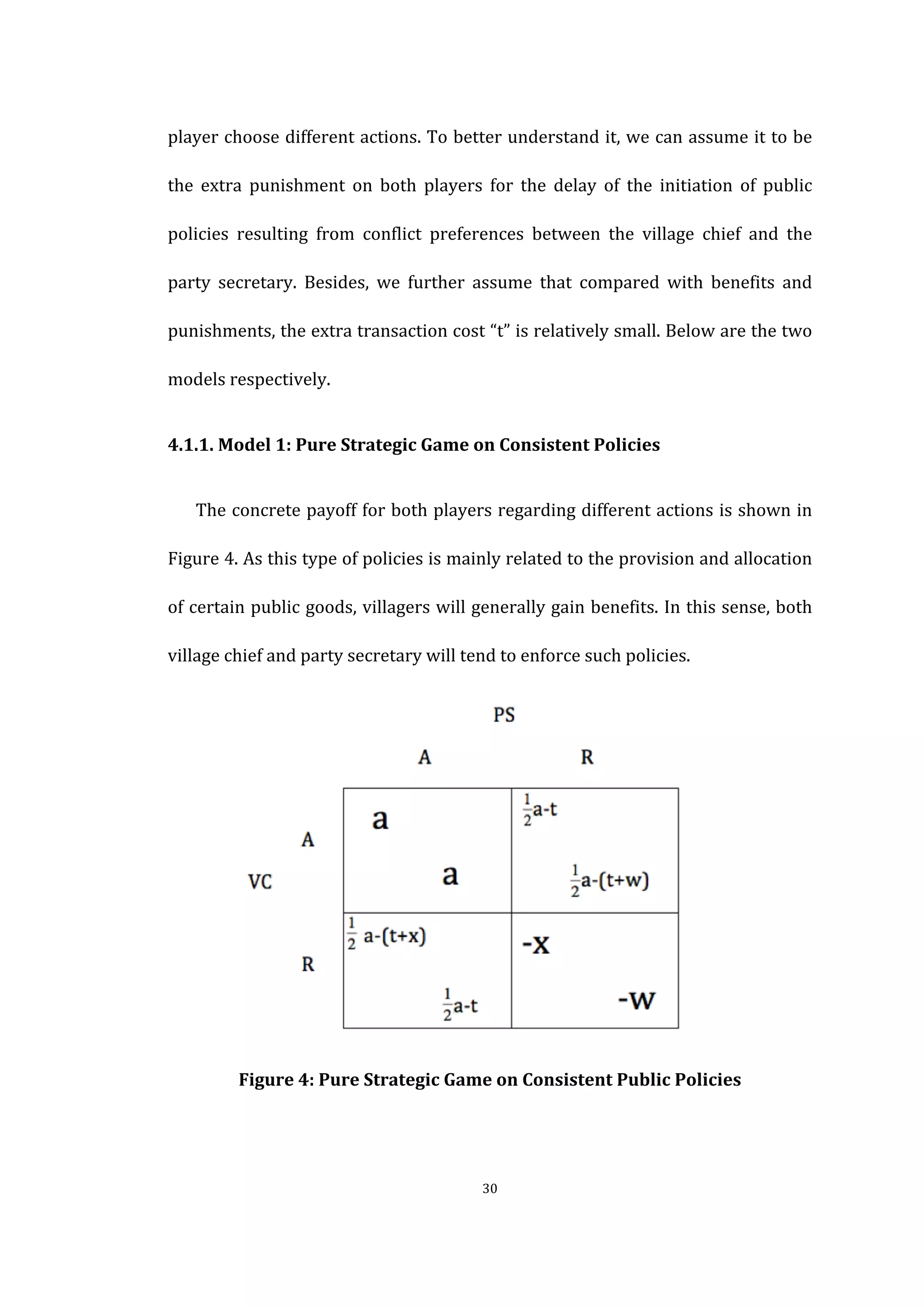
  • 73.
        66   Peng,   R.   &   Shangguan,   Z.   (2008).   The   political   participation   after   local   election:   an   example   of   the   villagers   representative   assembly   in   “Qingxian   Model”.  Cross  the  Century  (Kua  Shi  Ji),  12,  18-­‐20.     Shi,  T.  (1999).  Economic  development  and  village  elections  in  rural  China.   Journal  of  Contemporary  China,  22,  425-­‐442.     Shi,  T.  (1999).  Village  Committee  Elections  in  China:  Institutionalist  Tactics   for  Democracy.  World  Politics,  51  (3),  385-­‐412.     The  Carter  Center  (Ed.).  (1998).  Report  on  the  Evaluation  of  The  Pilot  Project   in   Nine   Counties   among   Three   Provinces.   Online   Source:   http://www.cartercenter.org/543.html.     Tsai,  L.  L.  (2002).  Cadres,  temple  and  lineage  institutions,  and  governance  in   rural  China.  The  China  Journal,  48,  1-­‐27.     Tsai,   L.   L.   (2007).   Accountability   Without   Democracy:   Solidary   Groups   and   Public  Goods  Provision  in  Rural  China.  NY:  Cambridge  University  Press.     Wang,   C.   (2009).   Improving   the   village   self-­‐autonomy:   the   analysis   of   “Qingxian  Model”.  Southeast  Academia  (Dongnan  Xueshu),  4,  15-­‐16.     Wang,   S.   (2008).   The   Role   of   Local   Elections   in   Authoritarian   Regimes:   The   Case  of  China’s  Village  Elections.  Ph.D.  Dissertation.  Yale  University.     Wang,   S.   &   Yao,   Y.   (2007).   Grassroots   Democracy   and   Local   Govenance:   Evidence  from  Rural  China.  World  Development,  35  (10),  1635-­‐1649.     Wang,   X.   (2009).   Democracy   with   Chinese   Characteristics:   A   New   Look   at   Village  Elections  in  China.  China  Elections  and  Governance  Review,  1,  7-­‐16.     Wang,  Z.  (1998).  Village  Committees:  The  Basis  for  China’s  Democratization.   In  Vermeer,  E.  B.  &  Pieke,  F.  N.  &  Chong,  W.  L.  (Eds).  Cooperative  and  Collective  in   China’s  Rural  Development  Between  State  and  Private  Interests.  Armonk,  NY:  M.E.   Sharpe.     Zhongguofangzheng  Press  (Ed).  (2004).The  regulations  of  Chinese  Communist   Party’s  Organization  Work  in  Rural  Area.  Beijing,  BJ:  Zhongguofangzheng  Press.