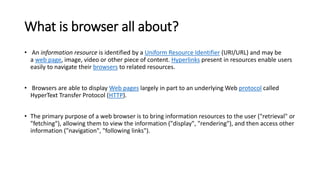
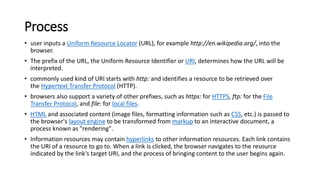
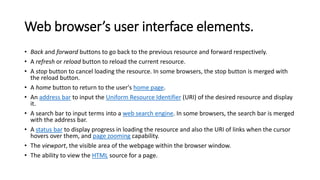
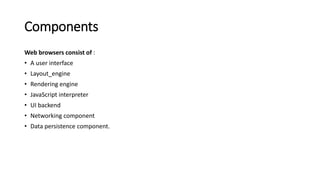
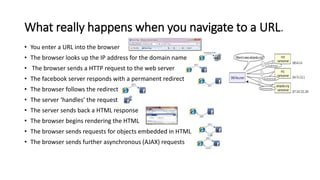
A browser allows users to view and interact with resources on the World Wide Web. It displays HTML pages and other web content by making HTTP requests and rendering the responses. Key components of a browser include a user interface, layout engine, rendering engine, JavaScript interpreter, and networking components. When a user enters a URL, the browser looks up the IP address and sends HTTP requests to retrieve and display the requested content, including linked resources. Common browser features include back/forward buttons, an address bar, and the ability to view page source. Browsers support privacy/security functions and web standards.
![The functions return a table of values,
including:
• status-line - A string representing the status, such as "HTTP/1.1 200 OK". In case of an error, a
description will be provided in this line.
• status: The HTTP status value; for example, "200". If an error occurs during a request, then this
value is going to be nil.
• header - An associative array representing the header. Keys are all lowercase, and standard
headers, such as 'date', 'content-length', etc. will typically be present.
• rawheader - A numbered array of the headers, exactly as the server sent them. While
header['content-type'] might be 'text/html', rawheader[3] might be 'Content-type: text/html'.
• cookies - A numbered array of the cookies the server sent. Each cookie is a table with the
following keys: name, value, path, domain, and expires.
• body - The full body, as returned by the server.](https://image.slidesharecdn.com/browser-170623044059/85/Browser-18-320.jpg)
![Load balancing
• Load balancing improves the distribution of workloads across multiple computing resources, such as
computers, a computer cluster, network links,
• Load balancing aims to optimize resource use, maximize throughput, minimize response time, and avoid
overload of any single resource.
• Using multiple components with load balancing instead of a single component may increase reliability and
availability through redundancy.
• Load balancing usually involves dedicated software or hardware, such as a multilayer switch or a Domain
Name System server process. central processing units, or disk drives.
• User requests to the Wikimedia Elasticsearch server cluster are routed via load balancing.
• Elasticsearch can be used to search all kinds of documents. It provides scalable search, has near real-time
search, and supports multitenancy. "Elasticsearch is distributed, which means that indices can be divided
into shards and each shard can have zero or more replicas. Each node hosts one or more shards, and acts
as a coordinator to delegate operations to the correct shard(s). Rebalancing and routing are done
automatically [...]".
• Elasticsearch uses Lucene and tries to make all its features available through the JSON and Java API. It
supports facetting and percolating, which can be useful for notifying if new documents match for
registered queries.
• Another feature is called "gateway" and handles the long-term persistence of the index; for example, an
index can be recovered from the gateway in the event of a server crash. Elasticsearch supports real-
time GET requests, which makes it suitable as a NoSQLdatastore, but it lacks distributed transactions.](https://image.slidesharecdn.com/browser-170623044059/85/Browser-24-320.jpg)