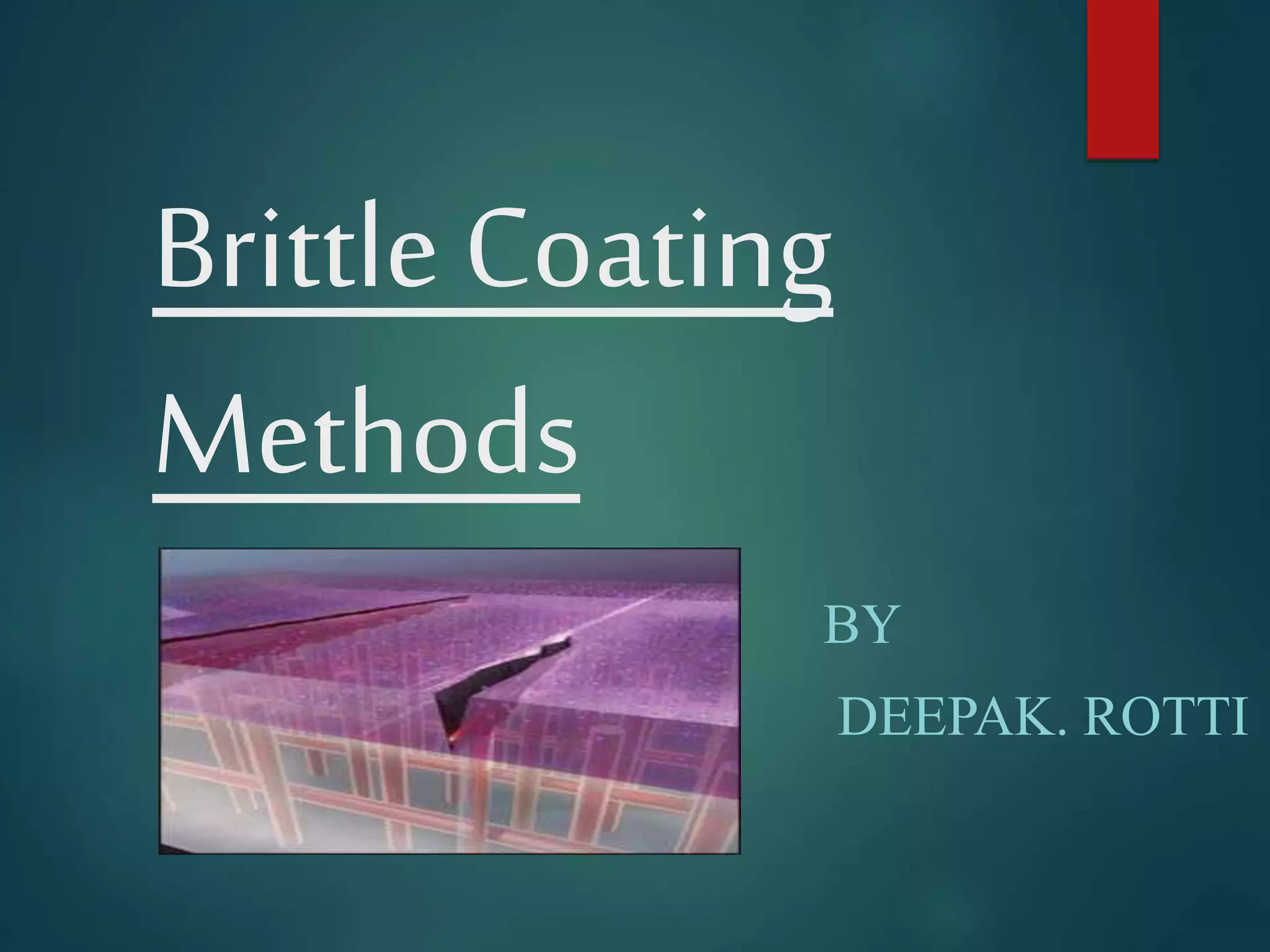
Brittle Coating
Methods
BY
DEEPAK. ROTTI
Introduction:
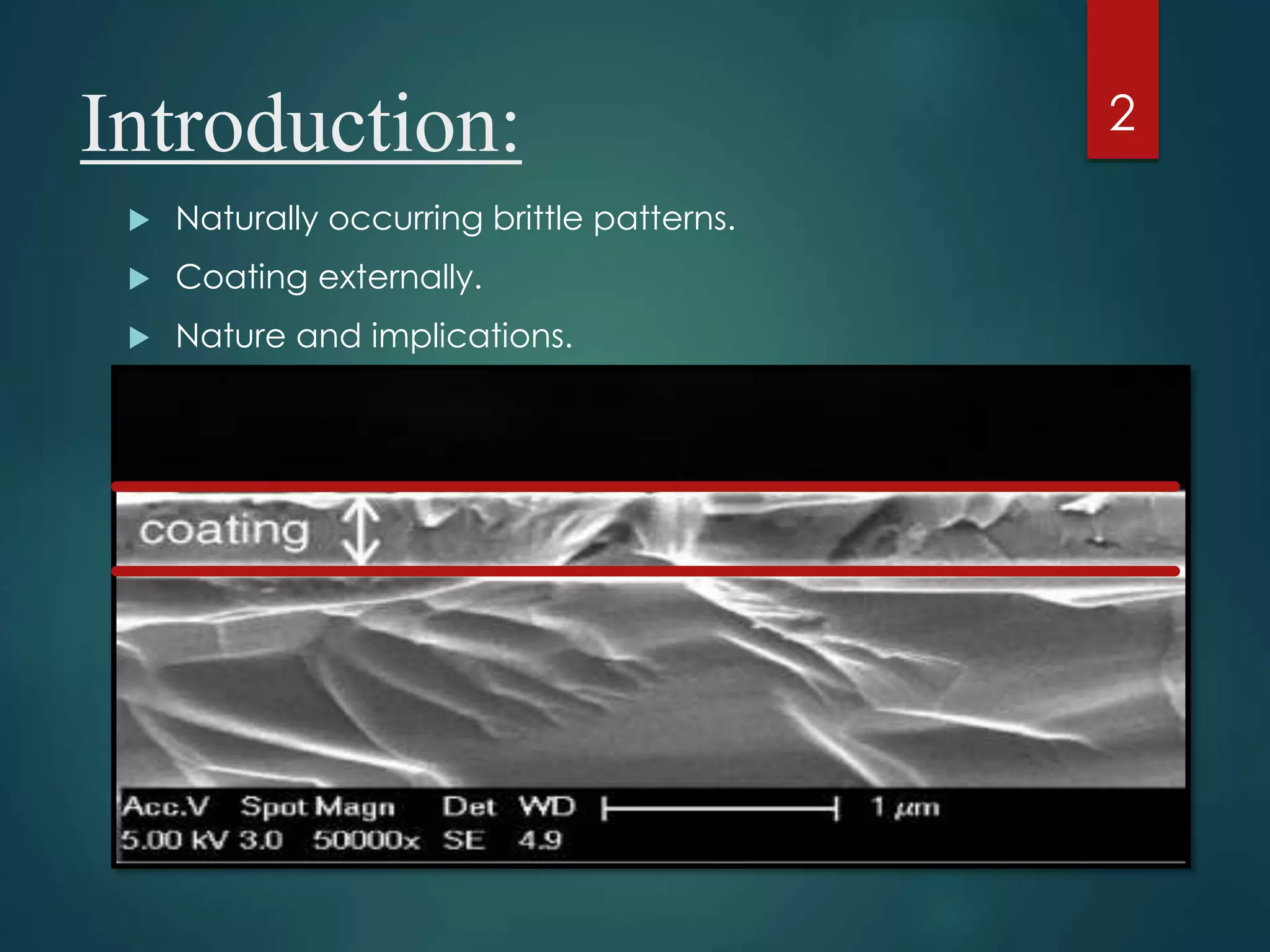
 Naturally occurring brittle patterns.
 Coating externally.
 Nature and implications.
 Advantages of brittle coating method are:
 It provides nearly the whole field data for both magnitude
and direction of principal stresses.
 It does not require a model and be applied to prototype of
the required component.
 The data obtained can be converted to stresses in a simple
fashion and complex mathematical analysis is not required.
2
Types of brittle coatings:
 Resign based coating (stress coat): 1/3rd zinc resin ate + 2/3rd.
carbon + di-butylphthalate.
 Thickness 0.1-0.15mm ; sensitivity 0.003-0.003m ; temp 600c.
 Ceramic based coating (all temp): Finely ground ceramic
particles suspended in a solvent + drying + heated up to 5400c.
 Thickness 0.1-0.15mm ; sensitivity 0.002-0.002m ; temp
3700c.
 Tens.Lac Brittle Lacquer: high sensitivity, non-flammable,
odorless, and of low toxicity brittle lacquer.
 Thickness 0.075mm ; sensitivity 500u cm/cm ; temp 1000c.
3
Steps followed for brittle
coating:
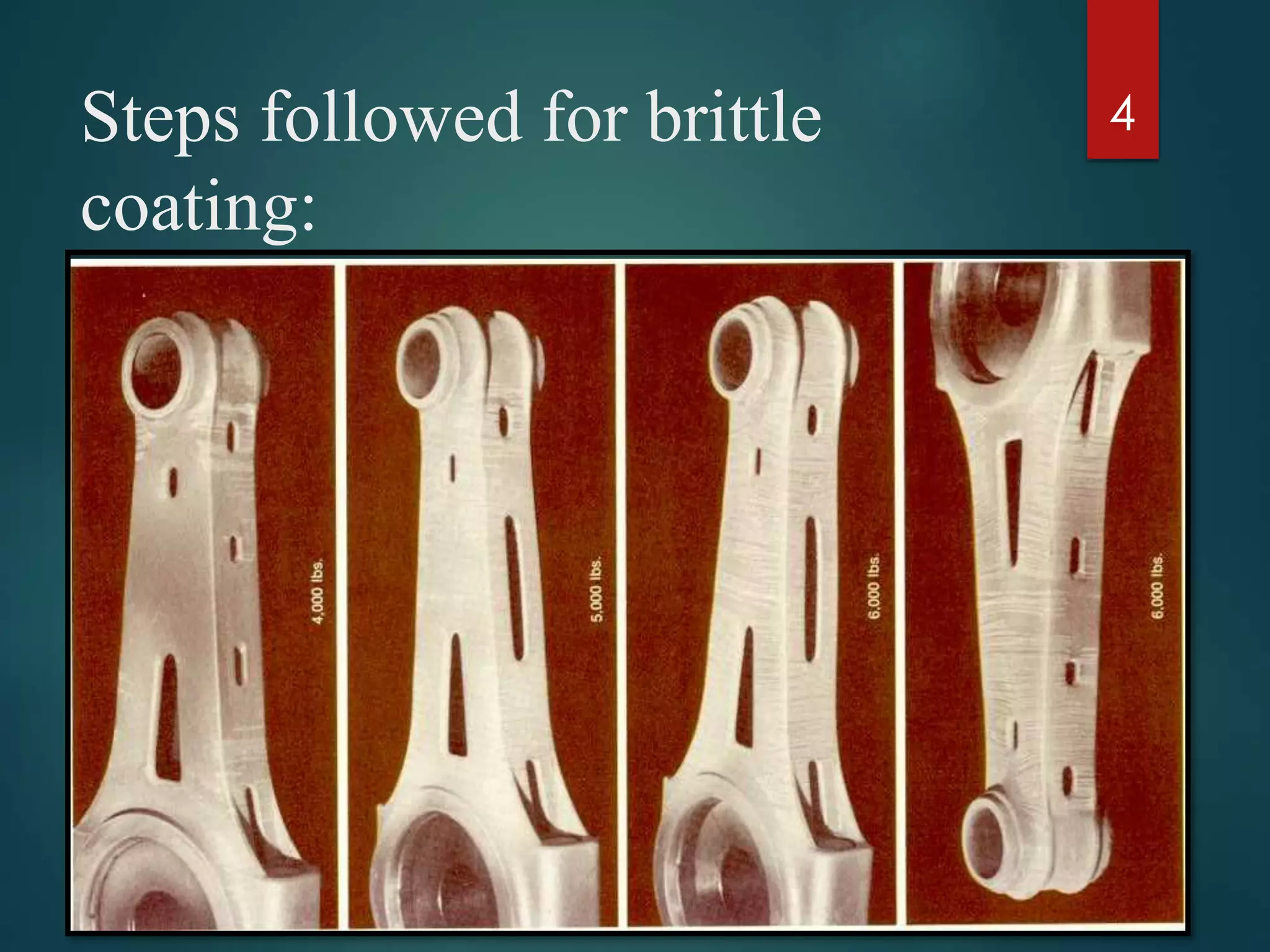
 Select the type of coating material.
 Clean the surface of the specimen under consideration.
 Provide an undercoat to provide better reflective characters.
 Application of base coat and allowed to dry for 24 hours.
 Testing of specimen.
 Detection and Analysis of crack patterns.
4
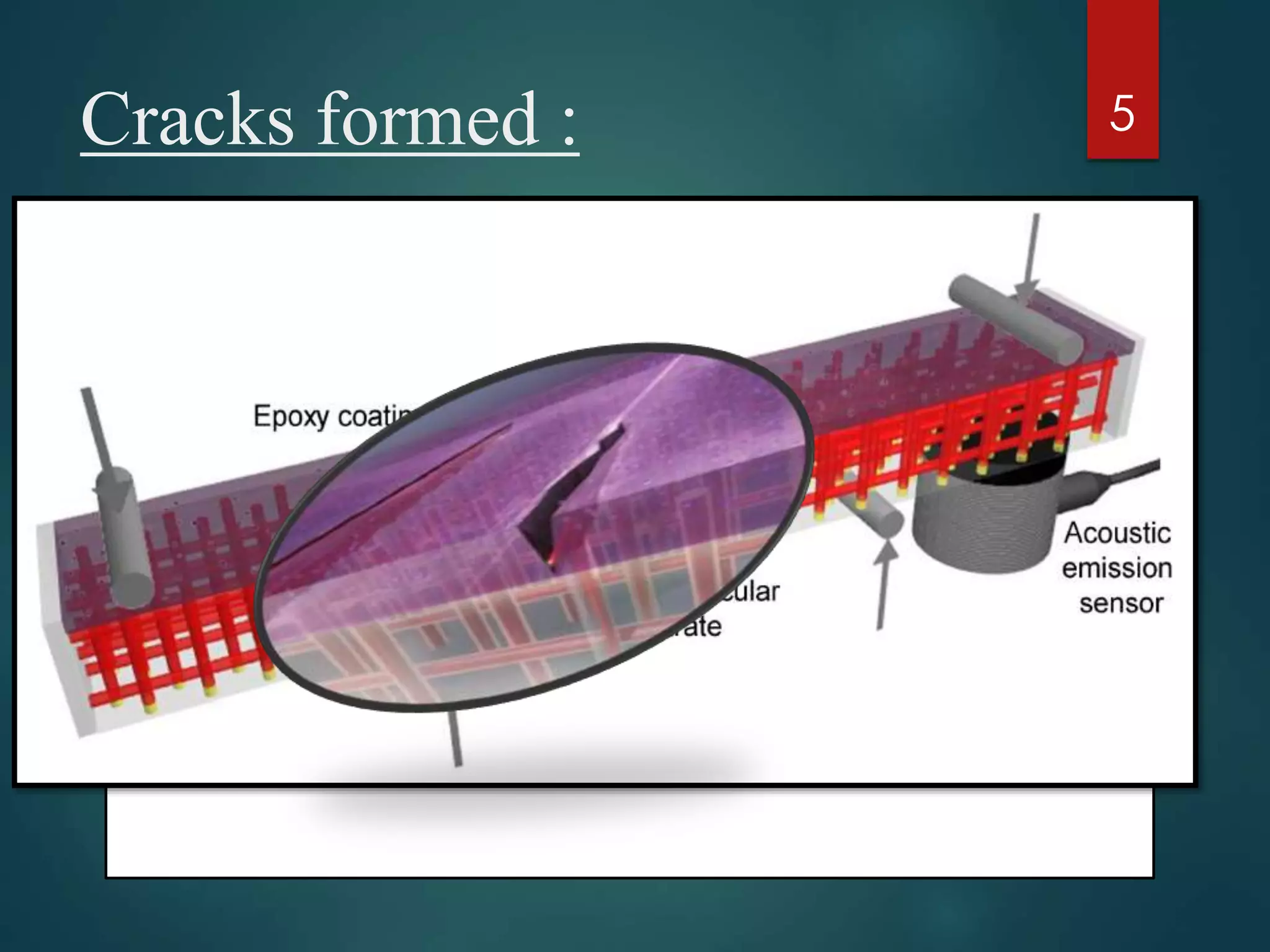
Cracks formed : 5
6. References:
 Experimental stress analysis by ‘James dally and
William riley’.
 Fracture modes in brittle coatings with large
interlayer modulus mismatch by Sataporn
Wuttiphan.
 Principle of stress coat in brittle coating by ‘Herzl
Chai and Brian Lawn’.
6
“
”
Thank
you........xyz
7
 esa
8

Brittle coating methods

  • 1.
  • 2.
    Introduction:  Naturally occurringbrittle patterns.  Coating externally.  Nature and implications.  Advantages of brittle coating method are:  It provides nearly the whole field data for both magnitude and direction of principal stresses.  It does not require a model and be applied to prototype of the required component.  The data obtained can be converted to stresses in a simple fashion and complex mathematical analysis is not required. 2
  • 3.
    Types of brittlecoatings:  Resign based coating (stress coat): 1/3rd zinc resin ate + 2/3rd. carbon + di-butylphthalate.  Thickness 0.1-0.15mm ; sensitivity 0.003-0.003m ; temp 600c.  Ceramic based coating (all temp): Finely ground ceramic particles suspended in a solvent + drying + heated up to 5400c.  Thickness 0.1-0.15mm ; sensitivity 0.002-0.002m ; temp 3700c.  Tens.Lac Brittle Lacquer: high sensitivity, non-flammable, odorless, and of low toxicity brittle lacquer.  Thickness 0.075mm ; sensitivity 500u cm/cm ; temp 1000c. 3
  • 4.
    Steps followed forbrittle coating:  Select the type of coating material.  Clean the surface of the specimen under consideration.  Provide an undercoat to provide better reflective characters.  Application of base coat and allowed to dry for 24 hours.  Testing of specimen.  Detection and Analysis of crack patterns. 4
  • 5.
  • 6.
    6. References:  Experimentalstress analysis by ‘James dally and William riley’.  Fracture modes in brittle coatings with large interlayer modulus mismatch by Sataporn Wuttiphan.  Principle of stress coat in brittle coating by ‘Herzl Chai and Brian Lawn’. 6
  • 7.
  • 8.