Bridging the gap: Virtual Worlds as a Platform for Knowledge Transfer Third International Conference on Communities and Technologies Michigan State University
A few words about my background M.Sc. in Management Information (Tilburg University, The Netherlands) and Technology & Human Affairs (Washington University in Saint Louis) 12 years of experience as a management consultant Currently work for YNNO, a small consultancy firm for new ways of working in The Netherlands Clients: insurance companies, Dutch government, healthcare industry Areas of expertise: collaborative technologies, virtual teamwork, knowledge management, digital working, office design Since August 2006 also Ph.D. candidate at Nyenrode Business Universiteit Status: finishing initial theory development, in preparation stage for empirical study
The subject of my research The managerial relevance of virtual worlds How can enterprises mimic certain aspects of virtual worlds, to make new ways of working possible?
Virtual worlds I use the boundaries set by Richard Bartle (2004): underlying, automated rules user represented by a single avatar interaction in real-time multi-user persistent. So this includes both gaming and non-gaming virtual worlds.
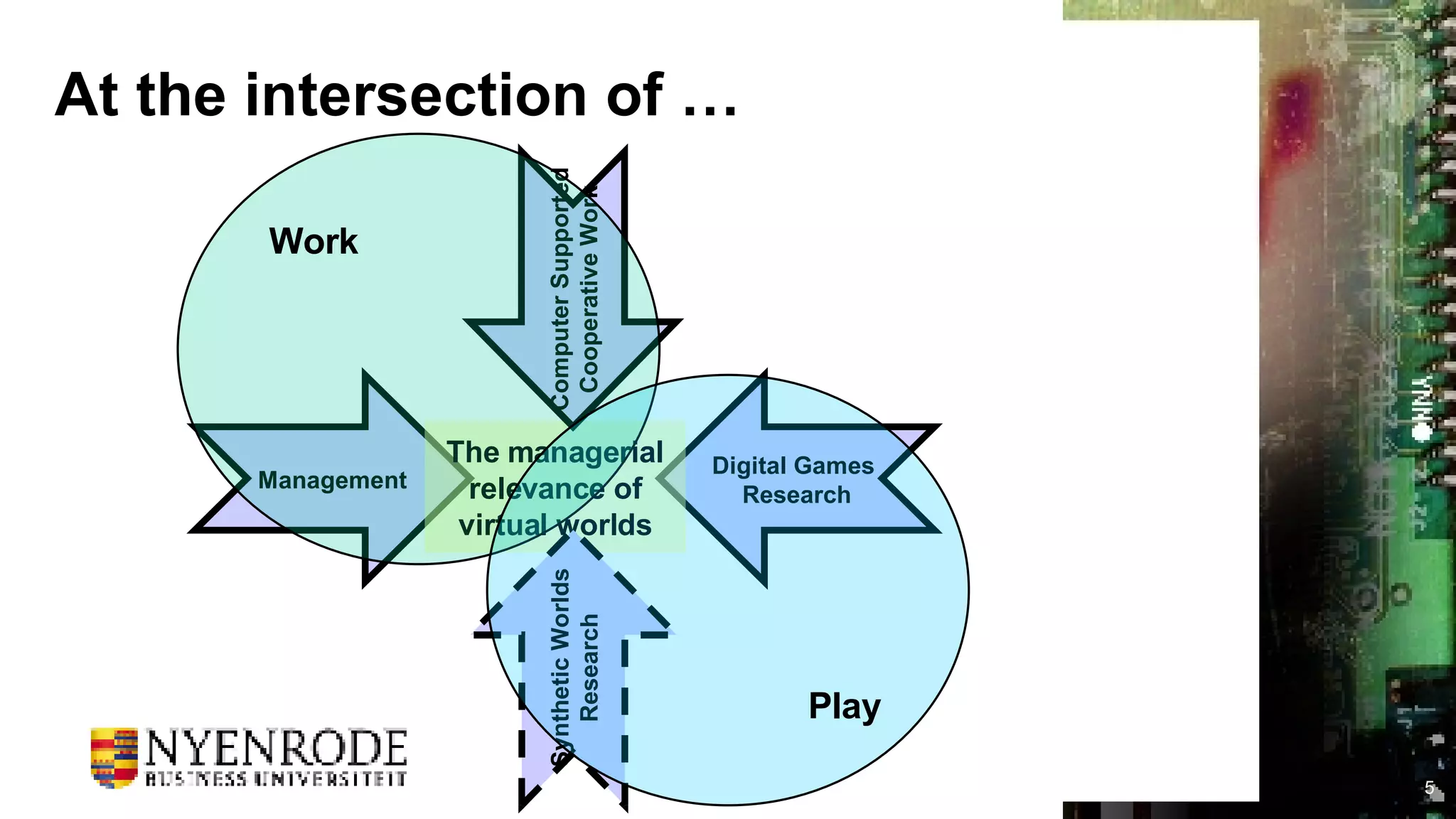
At the intersection of … Digital Games  Research Management The managerial relevance of virtual worlds Computer Supported Cooperative Work Synthetic Worlds Research Work Play
Starting point: knowledge transfer Effective knowledge transfer leads to sustained competitive advantage (Prusak, 2001; Thomas & Allen, 2006)  by making companies more agile  and by fostering creative problem solving (Soo, et al., 2002) The major challenges lie in the area of tacit knowledge Larry Prusak: “…don’t capture, but connect…” Knowledge is embedded in a community (Dixon, 2000; Wenger & Snyder, 2000; McDermott, 1999)
Conditions for knowledge transfer Communication is key (Davenport & Prusak, 2000) It requires the full spectrum of communication It is best served by spontaneous meetings of the mind Trust is necessary (Matson & Prusak, 2006) Traditional view: this requires face-to-face contact (Davenport & Prusak, 2000; Dixon, 2000) However: face-to-face contact is often expensive and time-consuming
Problems of computer supported cooperative work (CSCW) Communicating ambiguous information takes more time (Daft & Lengel, 1986; Walther, 1996) Supporting informal interactions is difficult (Dourish & Bly, 1992; Kraut, et al., 1990) In general: supporting the social aspects of work is difficult Ackerman (2000): “the social-technical gap” showing promise: use of instant messaging in the workplace Thus: CSCW falls short in supporting knowledge transfer because it fails to support “the talk around the task” (Brown, et al., 2005)
A fundamental problem of approach? “ [T]elecommunications research seems to work under the implicit assumption that there is a natural and perfect state - being there - and that our state is in some sense broken when we are not physically proximate. The goal then is to attempt to restore us, as best as possible, to the state of being there. [This orients] us towards the construction of crutch-like telecommunication tools (…)” Jim Hollan & Scott Stornetta (1992)
A new starting point There are practices taking place in virtual worlds that may foreshadow new ways of working in enterprises Apparently communicating and collaborating without “being there” is not an issue in virtual worlds The divide: CSCW is connected to work, while virtual worlds inhabit the realm of play
 
The key difference: motivation Virtual worlds are intrinsically motivating Computer supported cooperative work is extrinsically motivating: the outcome of the activity supplies the motivation (completing a work-related task)
Illustration of extrinsic motivation “ You have to be extremely focused on results [when you work in a virtual team]. People that are focused on the process will most likely have big problems. That’s because the satisfaction you get from the process is very low.” “ The first thing you notice about virtual meetings is that they are much more businesslike, more to the point than regular meetings. Whereas in regular meetings people exchange some small talk and talk about personal things, this is lost in virtual meetings.”
Hypothesis A higher level of intrinsic motivation when using computer-mediated communication always equals a better support for the social aspects of work patterns (specifically: informal communication and trust)
Motivation in virtual worlds These five elements cause intrinsic motivation in virtual worlds: competence autonomy relatedness fantasy curiosity
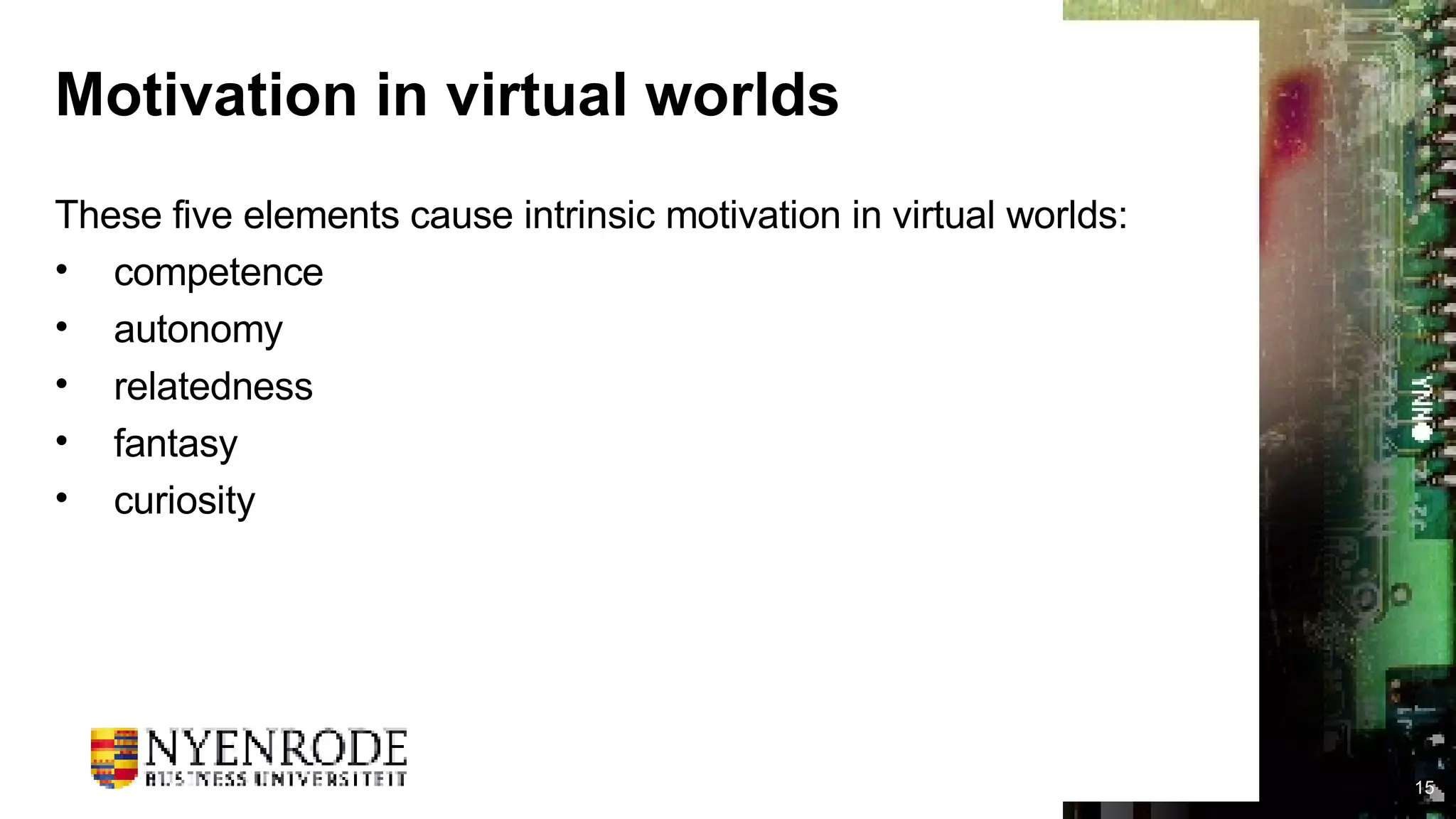
Competence Creating a balance between skills and challenges (Lepper & Malone, 1987) Condition for a flow experience (Csikszentmihalyi, 1990): rules that require the learning of skills A feeling of effectiveness (Ryan, et al., 2006)
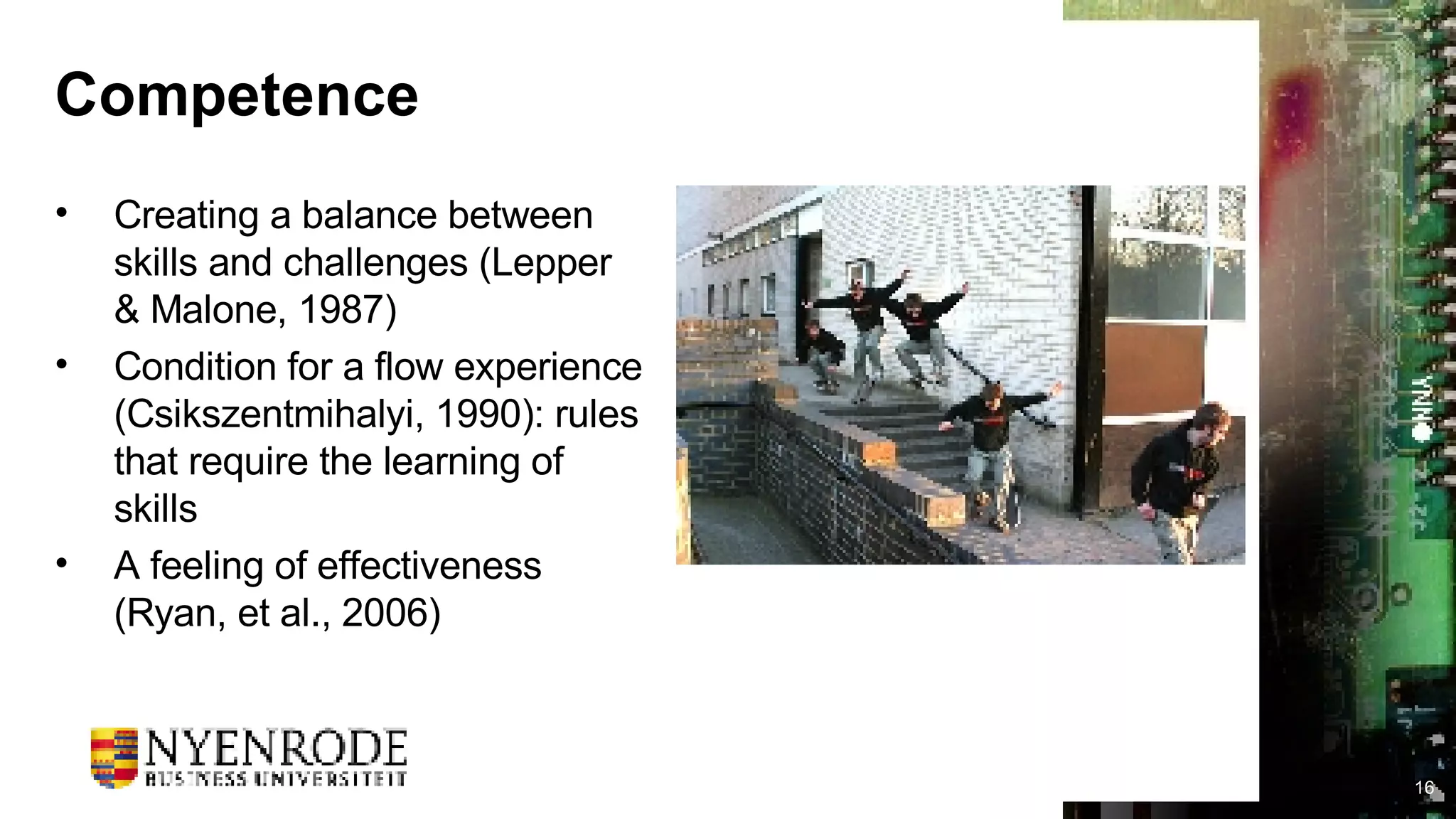
Autonomy Providing a sense of control to the user (Lepper & Malone, 1987) Condition for a flow experience (Csikszentmihalyi, 1990): the possibility to exercise control A sense of volition (Ryan, et al., 2006) The first person imperative: participating as an agent (Laurel, 1993) Immediate feedback (Steinkuehler, 2004)
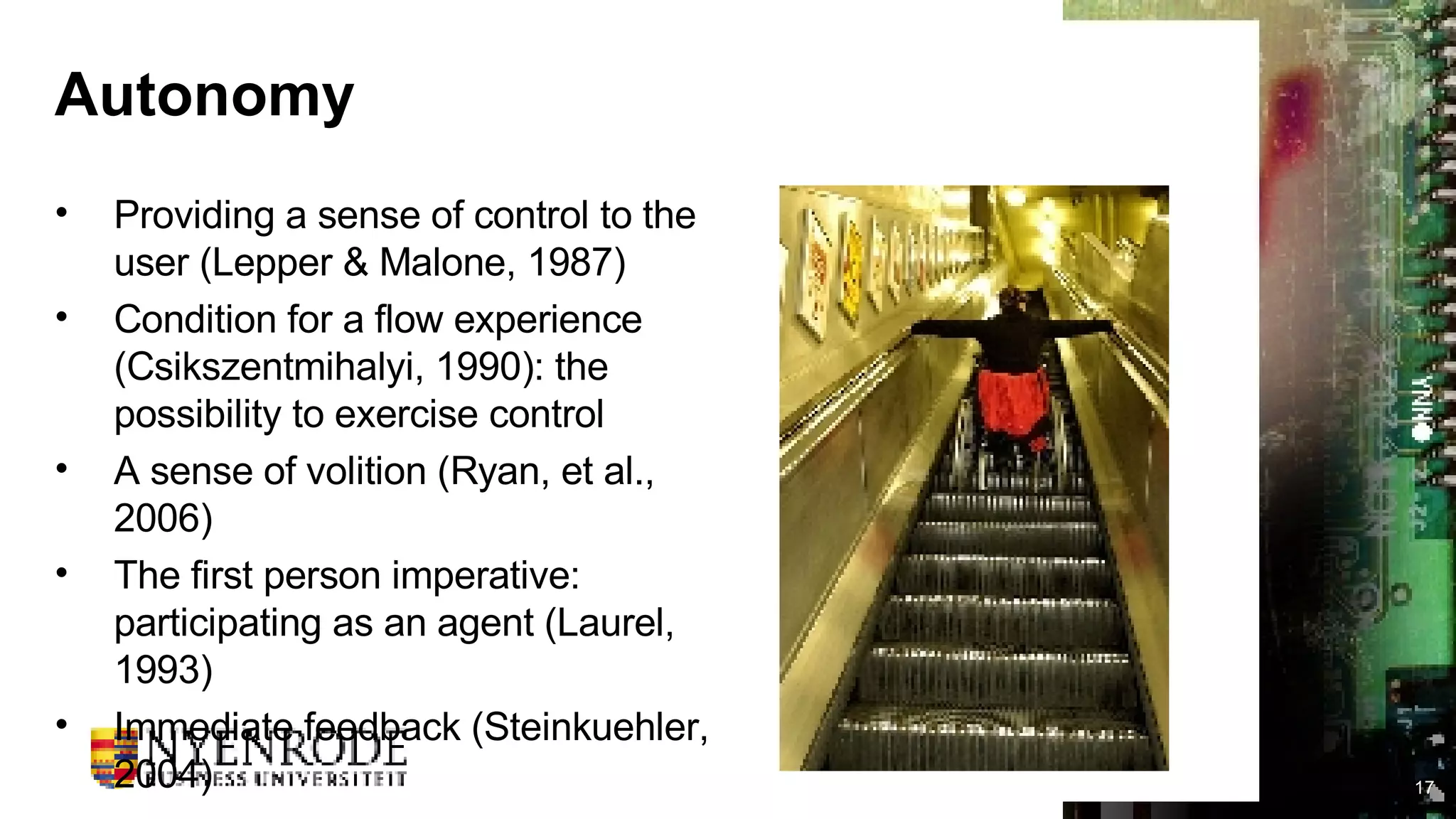
Relatedness The feeling of belonging and being connected with others (Ryan, et al., 2006) A new type of  third places : places for neither work nor home where informal social interactions can take place (Steinkuehler, 2005) Opportunity for  social action : the ability to do things together with others (Brown & Bell, 2004; Ducheneaut, et al., 2007) A space that makes it possible to “bump into” people and strike up opportunistic conversations (Evard, et al., 2001)
Fantasy Creating fantasy situations (Lepper & Malone, 1987) “ making the activity as distinct as possible from the so-called ‘paramount reality’ of everyday existence” is conducive to flow (Csikszentmihalyi, 1990)
Curiosity Stimulating the sensory and cognitive curiosity of users (Lepper & Malone, 1987) Curiosity is socially stimulated (Steinkuehler, 2004)
Also playing a role… Extrinsic motivation that has been internalized: External regulation: satisfy an external demand or reward (Ryan & Deci, 2000);  conditioning mechanisms in place to make players accept tedium (Yee, 2006) Introjected regulation: avoid guilt or attain ego enhancements (Ryan & Deci, 2000); virtual worlds offer motivators such as competition, collaboration and recognition (Bonk & Dennen, 2005)
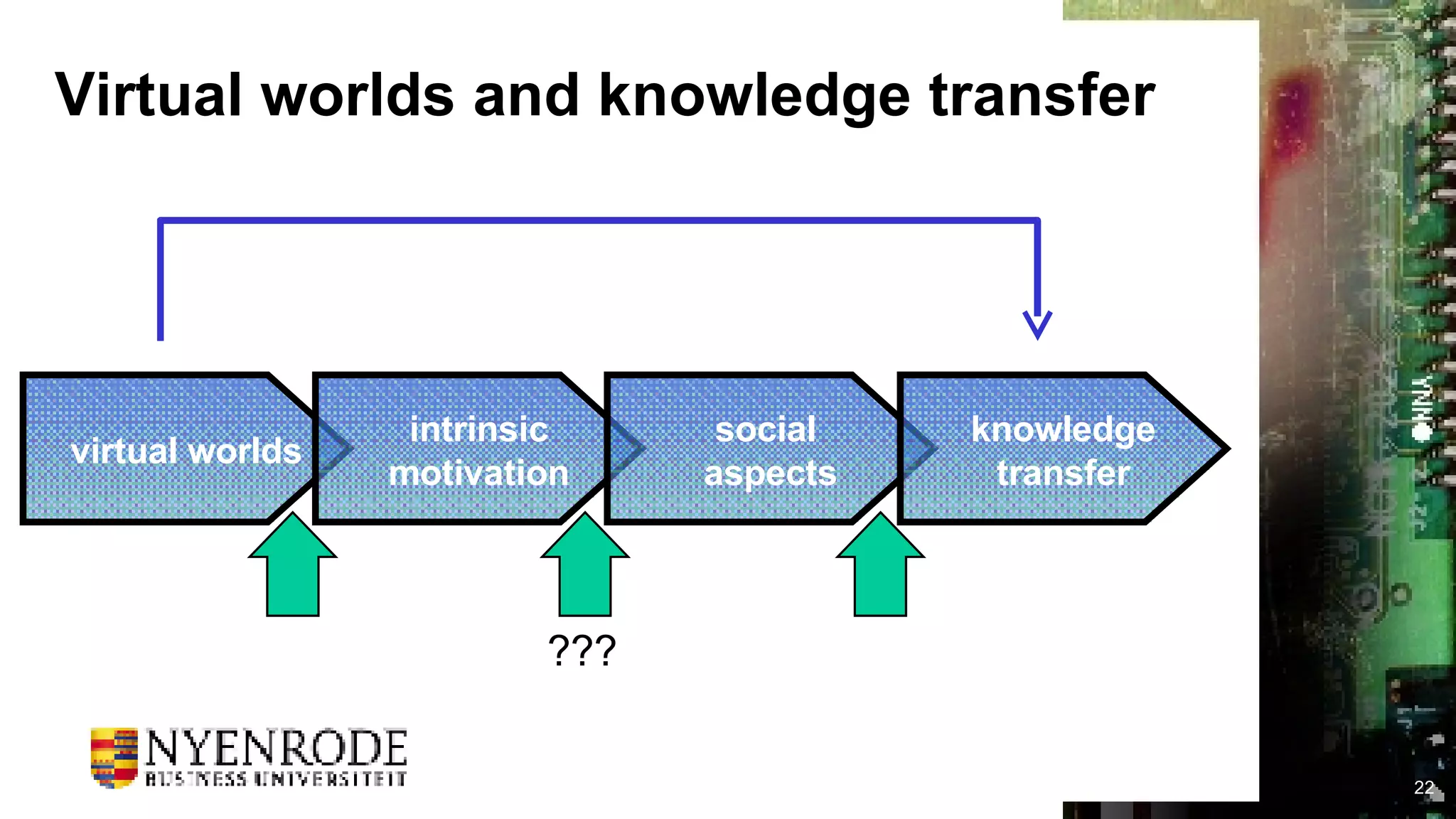
Virtual worlds and knowledge transfer virtual worlds intrinsic motivation social  aspects knowledge transfer ???
What’s next? Currently undertaking an exploratory field study in World of Warcraft This fall: initiate an empirical investigation involving managers / knowledge workers from several European enterprises
Questions?
Additional sources Ducheneaut, N., R.J. Moore & E. Nickell, „Virtual “Third Places”: A Case Study of Sociability in Massively Multiplayer Games”,  Computer Supported Cooperative Work  (2007), 16: 129-166. Soo, C, T. Devinney, D. Midgley, A. Deering, “Knowledge Management: Philosophy, Processes, and Pitfalls”,  California Management Review , vol. 44, no. 4 (Summer 2002). Dixon, N.M.,  Common Knowledge: How Companies Thrive by Sharing What They Know , Harvard Business School Press, Boston, 2000. Wenger, E.C, & W.M. Snyder, “Communities of Practice: The Organizational Frontier”,  Harvard Business Review , January-February 2000  McDermott, R., “Why Information Technology Inspired But Cannot Deliver Knowledge Management”,  California Management Review , vol. 41, no. 4 (Summer 1999).

Bridging The Gap, Communities And Technologies, 28 June 2007

  • 1.
    Bridging the gap:Virtual Worlds as a Platform for Knowledge Transfer Third International Conference on Communities and Technologies Michigan State University
  • 2.
    A few wordsabout my background M.Sc. in Management Information (Tilburg University, The Netherlands) and Technology & Human Affairs (Washington University in Saint Louis) 12 years of experience as a management consultant Currently work for YNNO, a small consultancy firm for new ways of working in The Netherlands Clients: insurance companies, Dutch government, healthcare industry Areas of expertise: collaborative technologies, virtual teamwork, knowledge management, digital working, office design Since August 2006 also Ph.D. candidate at Nyenrode Business Universiteit Status: finishing initial theory development, in preparation stage for empirical study
  • 3.
    The subject ofmy research The managerial relevance of virtual worlds How can enterprises mimic certain aspects of virtual worlds, to make new ways of working possible?
  • 4.
    Virtual worlds Iuse the boundaries set by Richard Bartle (2004): underlying, automated rules user represented by a single avatar interaction in real-time multi-user persistent. So this includes both gaming and non-gaming virtual worlds.
  • 5.
    At the intersectionof … Digital Games Research Management The managerial relevance of virtual worlds Computer Supported Cooperative Work Synthetic Worlds Research Work Play
  • 6.
    Starting point: knowledgetransfer Effective knowledge transfer leads to sustained competitive advantage (Prusak, 2001; Thomas & Allen, 2006) by making companies more agile and by fostering creative problem solving (Soo, et al., 2002) The major challenges lie in the area of tacit knowledge Larry Prusak: “…don’t capture, but connect…” Knowledge is embedded in a community (Dixon, 2000; Wenger & Snyder, 2000; McDermott, 1999)
  • 7.
    Conditions for knowledgetransfer Communication is key (Davenport & Prusak, 2000) It requires the full spectrum of communication It is best served by spontaneous meetings of the mind Trust is necessary (Matson & Prusak, 2006) Traditional view: this requires face-to-face contact (Davenport & Prusak, 2000; Dixon, 2000) However: face-to-face contact is often expensive and time-consuming
  • 8.
    Problems of computersupported cooperative work (CSCW) Communicating ambiguous information takes more time (Daft & Lengel, 1986; Walther, 1996) Supporting informal interactions is difficult (Dourish & Bly, 1992; Kraut, et al., 1990) In general: supporting the social aspects of work is difficult Ackerman (2000): “the social-technical gap” showing promise: use of instant messaging in the workplace Thus: CSCW falls short in supporting knowledge transfer because it fails to support “the talk around the task” (Brown, et al., 2005)
  • 9.
    A fundamental problemof approach? “ [T]elecommunications research seems to work under the implicit assumption that there is a natural and perfect state - being there - and that our state is in some sense broken when we are not physically proximate. The goal then is to attempt to restore us, as best as possible, to the state of being there. [This orients] us towards the construction of crutch-like telecommunication tools (…)” Jim Hollan & Scott Stornetta (1992)
  • 10.
    A new startingpoint There are practices taking place in virtual worlds that may foreshadow new ways of working in enterprises Apparently communicating and collaborating without “being there” is not an issue in virtual worlds The divide: CSCW is connected to work, while virtual worlds inhabit the realm of play
  • 11.
  • 12.
    The key difference:motivation Virtual worlds are intrinsically motivating Computer supported cooperative work is extrinsically motivating: the outcome of the activity supplies the motivation (completing a work-related task)
  • 13.
    Illustration of extrinsicmotivation “ You have to be extremely focused on results [when you work in a virtual team]. People that are focused on the process will most likely have big problems. That’s because the satisfaction you get from the process is very low.” “ The first thing you notice about virtual meetings is that they are much more businesslike, more to the point than regular meetings. Whereas in regular meetings people exchange some small talk and talk about personal things, this is lost in virtual meetings.”
  • 14.
    Hypothesis A higherlevel of intrinsic motivation when using computer-mediated communication always equals a better support for the social aspects of work patterns (specifically: informal communication and trust)
  • 15.
    Motivation in virtualworlds These five elements cause intrinsic motivation in virtual worlds: competence autonomy relatedness fantasy curiosity
  • 16.
    Competence Creating abalance between skills and challenges (Lepper & Malone, 1987) Condition for a flow experience (Csikszentmihalyi, 1990): rules that require the learning of skills A feeling of effectiveness (Ryan, et al., 2006)
  • 17.
    Autonomy Providing asense of control to the user (Lepper & Malone, 1987) Condition for a flow experience (Csikszentmihalyi, 1990): the possibility to exercise control A sense of volition (Ryan, et al., 2006) The first person imperative: participating as an agent (Laurel, 1993) Immediate feedback (Steinkuehler, 2004)
  • 18.
    Relatedness The feelingof belonging and being connected with others (Ryan, et al., 2006) A new type of third places : places for neither work nor home where informal social interactions can take place (Steinkuehler, 2005) Opportunity for social action : the ability to do things together with others (Brown & Bell, 2004; Ducheneaut, et al., 2007) A space that makes it possible to “bump into” people and strike up opportunistic conversations (Evard, et al., 2001)
  • 19.
    Fantasy Creating fantasysituations (Lepper & Malone, 1987) “ making the activity as distinct as possible from the so-called ‘paramount reality’ of everyday existence” is conducive to flow (Csikszentmihalyi, 1990)
  • 20.
    Curiosity Stimulating thesensory and cognitive curiosity of users (Lepper & Malone, 1987) Curiosity is socially stimulated (Steinkuehler, 2004)
  • 21.
    Also playing arole… Extrinsic motivation that has been internalized: External regulation: satisfy an external demand or reward (Ryan & Deci, 2000); conditioning mechanisms in place to make players accept tedium (Yee, 2006) Introjected regulation: avoid guilt or attain ego enhancements (Ryan & Deci, 2000); virtual worlds offer motivators such as competition, collaboration and recognition (Bonk & Dennen, 2005)
  • 22.
    Virtual worlds andknowledge transfer virtual worlds intrinsic motivation social aspects knowledge transfer ???
  • 23.
    What’s next? Currentlyundertaking an exploratory field study in World of Warcraft This fall: initiate an empirical investigation involving managers / knowledge workers from several European enterprises
  • 24.
  • 25.
    Additional sources Ducheneaut,N., R.J. Moore & E. Nickell, „Virtual “Third Places”: A Case Study of Sociability in Massively Multiplayer Games”, Computer Supported Cooperative Work (2007), 16: 129-166. Soo, C, T. Devinney, D. Midgley, A. Deering, “Knowledge Management: Philosophy, Processes, and Pitfalls”, California Management Review , vol. 44, no. 4 (Summer 2002). Dixon, N.M., Common Knowledge: How Companies Thrive by Sharing What They Know , Harvard Business School Press, Boston, 2000. Wenger, E.C, & W.M. Snyder, “Communities of Practice: The Organizational Frontier”, Harvard Business Review , January-February 2000 McDermott, R., “Why Information Technology Inspired But Cannot Deliver Knowledge Management”, California Management Review , vol. 41, no. 4 (Summer 1999).