Design Pattern
Bridge Pattern
A Structural design pattern


                              Copyright © Astha
The Problem
Suppose a task has been given of writing a program that will draw rectangles
with either of two drawing programs. It also have been told that when
instantiate a rectangle, it will know whether it should use drawing program 1
(DP1) or drawing program 2 (DP2).

The rectangles are defined as two pairs of points, as represented in the
following figure. The differences between the drawing programs are
summarized
in Table below.
                                                     X2, Y2


           X1, Y1
                                                 Copyright © Astha
The Problem
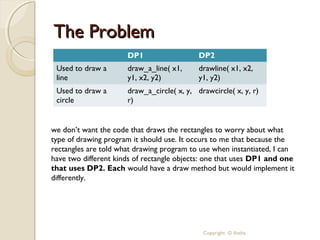
                      DP1                   DP2
 Used to draw a       draw_a_line( x1,      drawline( x1, x2,
 line                 y1, x2, y2)           y1, y2)
 Used to draw a       draw_a_circle( x, y, drawcircle( x, y, r)
 circle               r)


we don’t want the code that draws the rectangles to worry about what
type of drawing program it should use. It occurs to me that because the
rectangles are told what drawing program to use when instantiated, I can
have two different kinds of rectangle objects: one that uses DP1 and one
that uses DP2. Each would have a draw method but would implement it
differently.


                                             Copyright © Astha
The Problem


              Copyright © Astha
The Problem
A straightforward approach: implementing two shapes and two
drawing programs.


                                       Copyright © Astha
The Problem
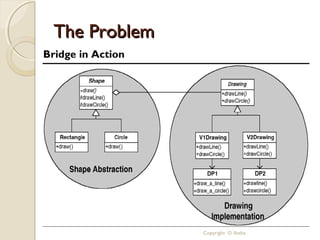
Bridge in Action


                   Copyright © Astha
Intent
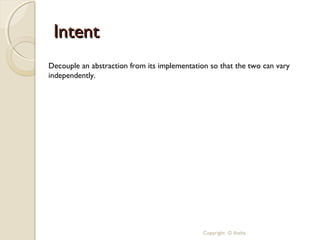
Decouple an abstraction from its implementation so that the two can vary
independently.


                                              Copyright © Astha
Applicability
Use the Bridge pattern when
 you want to avoid a permanent binding between an abstraction and its
implementation. This might be the
case, for example, when the implementation must be selected or switched at
run-time.
 both the abstractions and their implementations should be extensible by
subclassing. In this case, the Bridge
pattern lets you combine the different abstractions and implementations and
extend them independently.
 changes in the implementation of an abstraction should have no impact on
clients; that is, their code should
not have to be recompiled.


                                               Copyright © Astha
Structure


            Copyright © Astha
Participants
• Abstraction (Window)
    o defines the abstraction's interface.
    o maintains a reference to an object of type Implementor.
• RefinedAbstraction (IconWindow)
    o Extends the interface defined by Abstraction.
• Implementor (WindowImp)
    o defines the interface for implementation classes. This interface doesn't
    have to correspond exactly to Abstraction's interface; in fact the two
    interfaces can be quite different. Typically the Implementor interface
    provides only primitive operations, and Abstraction defines higher-level
    operations based on these primitives.
• ConcreteImplementor (XWindowImp, PMWindowImp)
    o implements the Implementor interface and defines its concrete
    implementation.


                                                Copyright © Astha
Collaborations
• Abstraction forwards client requests to its Implementor object.


                                               Copyright © Astha
Consequences
   Decoupling interface and implementation. An implementation is not bound
    permanently to an interface. The implementation of an abstraction can be
    configured at run-time. It's even possible for an object to change its
    implementation at run-time.
   Improved extensibility. You can extend the Abstraction and Implementor
    hierarchies independently.
   Hiding implementation details from clients. You can shield clients from
    implementation details, like the sharing of Implementor objects and the
    accompanying reference count mechanism (if any).


                                                Copyright © Astha
Implementation
1. Only one Implementor. In situations where there's only one implementation,
   creating an abstract Implementor class isn't necessary. This is a degenerate
   case of the Bridge pattern; there's a one-to-one relationship between
   Abstraction and Implementor. Nevertheless, this separation is still useful
   when a change in the implementation of a class must not affect its existing
   clients—that is, they shouldn't have to be recompiled, just relinked.
2. Creating the right Implementor object. How, when, and where do you decide
   which Implementor class to instantiate when there's more than one?


                                                 Copyright © Astha
Assignment
A document viewer has been made for an enterprise solution (desktop
application), which supports viewing of some specific types of documents. The
supporting types are HTML, Microsoft Word and Microsoft Excel.

Underneath, the document viewer uses an abstract interface of the document
which contains methods to show the document in the viewer.

Now the enterprise application is going to have a web solution where there
would be another document viewer (different in several aspects from the
existing one) with the same functionalities as it is now in the desktop version.

Use the Bridge pattern to solve the problem in such a way that new document
types can be easily incorporated into the system and new type of document
viewer can also be incorporated.


                                                 Copyright © Astha

Bridge pattern

  • 1.
    Design Pattern Bridge Pattern AStructural design pattern Copyright © Astha
  • 2.
    The Problem Suppose atask has been given of writing a program that will draw rectangles with either of two drawing programs. It also have been told that when instantiate a rectangle, it will know whether it should use drawing program 1 (DP1) or drawing program 2 (DP2). The rectangles are defined as two pairs of points, as represented in the following figure. The differences between the drawing programs are summarized in Table below. X2, Y2 X1, Y1 Copyright © Astha
  • 3.
    The Problem DP1 DP2 Used to draw a draw_a_line( x1, drawline( x1, x2, line y1, x2, y2) y1, y2) Used to draw a draw_a_circle( x, y, drawcircle( x, y, r) circle r) we don’t want the code that draws the rectangles to worry about what type of drawing program it should use. It occurs to me that because the rectangles are told what drawing program to use when instantiated, I can have two different kinds of rectangle objects: one that uses DP1 and one that uses DP2. Each would have a draw method but would implement it differently. Copyright © Astha
  • 4.
    The Problem Copyright © Astha
  • 5.
    The Problem A straightforwardapproach: implementing two shapes and two drawing programs. Copyright © Astha
  • 6.
    The Problem Bridge inAction Copyright © Astha
  • 7.
    Intent Decouple an abstractionfrom its implementation so that the two can vary independently. Copyright © Astha
  • 8.
    Applicability Use the Bridgepattern when  you want to avoid a permanent binding between an abstraction and its implementation. This might be the case, for example, when the implementation must be selected or switched at run-time.  both the abstractions and their implementations should be extensible by subclassing. In this case, the Bridge pattern lets you combine the different abstractions and implementations and extend them independently.  changes in the implementation of an abstraction should have no impact on clients; that is, their code should not have to be recompiled. Copyright © Astha
  • 9.
    Structure Copyright © Astha
  • 10.
    Participants • Abstraction (Window) o defines the abstraction's interface. o maintains a reference to an object of type Implementor. • RefinedAbstraction (IconWindow) o Extends the interface defined by Abstraction. • Implementor (WindowImp) o defines the interface for implementation classes. This interface doesn't have to correspond exactly to Abstraction's interface; in fact the two interfaces can be quite different. Typically the Implementor interface provides only primitive operations, and Abstraction defines higher-level operations based on these primitives. • ConcreteImplementor (XWindowImp, PMWindowImp) o implements the Implementor interface and defines its concrete implementation. Copyright © Astha
  • 11.
    Collaborations • Abstraction forwardsclient requests to its Implementor object. Copyright © Astha
  • 12.
    Consequences  Decoupling interface and implementation. An implementation is not bound permanently to an interface. The implementation of an abstraction can be configured at run-time. It's even possible for an object to change its implementation at run-time.  Improved extensibility. You can extend the Abstraction and Implementor hierarchies independently.  Hiding implementation details from clients. You can shield clients from implementation details, like the sharing of Implementor objects and the accompanying reference count mechanism (if any). Copyright © Astha
  • 13.
    Implementation 1. Only oneImplementor. In situations where there's only one implementation, creating an abstract Implementor class isn't necessary. This is a degenerate case of the Bridge pattern; there's a one-to-one relationship between Abstraction and Implementor. Nevertheless, this separation is still useful when a change in the implementation of a class must not affect its existing clients—that is, they shouldn't have to be recompiled, just relinked. 2. Creating the right Implementor object. How, when, and where do you decide which Implementor class to instantiate when there's more than one? Copyright © Astha
  • 14.
    Assignment A document viewerhas been made for an enterprise solution (desktop application), which supports viewing of some specific types of documents. The supporting types are HTML, Microsoft Word and Microsoft Excel. Underneath, the document viewer uses an abstract interface of the document which contains methods to show the document in the viewer. Now the enterprise application is going to have a web solution where there would be another document viewer (different in several aspects from the existing one) with the same functionalities as it is now in the desktop version. Use the Bridge pattern to solve the problem in such a way that new document types can be easily incorporated into the system and new type of document viewer can also be incorporated. Copyright © Astha