Facade PatternMelbourne Patterns GroupPresented by Alberto Borda
Any fool can write code that a computer can understand. Good programmers write code that humans can understand.-Martin Fowler
Structural PatternsAdapterBridgeCompositeDecoratorFacadeFlyweightProxy
IntentEncapsulation hides the details of the implementation of an object.Object-Oriented Analysis and Design, Booch
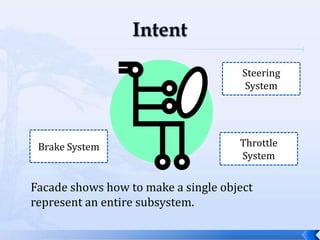
IntentSteering SystemBrake SystemThrottle SystemFacade shows how to make a single object represent an entire subsystem.
IntentProvide a unified interface to a set of interfaces in a subsystem. Facade defines a higher-level interface that makes the subsystem easier to use.Design Patterns: Elements of Reusable Object-Oriented Software, Gamma et al
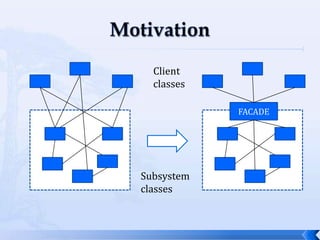
MotivationClientclassesFACADESubsystemclasses
ApplicabilityProvide a simple interface to a subsystem. There are many dependencies between clients and the implementation classes of an abstraction.Layer your subsystems.
ParticipantsFacadeDelegate requests to appropriate subsystem objects.Subsystem classesImplement subsystem functionality.Handle work assigned by the facade.
ConsequencesShields clients from subsystem components. Promotes weak coupling between the subsystems and its clients.It’s does not prevent applications from using subsystem classes if they need to.
ImplementationReducing client-subsystem coupling.Public versus private subsystem classes.
 Facade DemoExample on IronPython
Remote Facade DemoExample on C# with WCF
Questions & Answers
BibliographyDesign Patterns: Elements of Reusable Object-Oriented Software, Gamma et alObject-Oriented Analysis and Design with Applications, 2nd edition, Grady Booch

Facade Pattern

Editor's Notes

  • #4 Structural patterns are concerned with how classes and objects are composed to form larger structures.Structural object patterns describe ways to compose objects to realize new functionality. The added flexibility of object composition comes from the ability to change the composition at run-time, which is impossible with static class composition
  • #6 Facade shows how to make a single object represent an entire subsystem. A facade is a representative for a set of objects. The facade carries out its responsibilities by forwarding messages to the objects it represents.
  • #8 Structuring a system into subsystems helps reduce complexity. A common design goal is to minimize the communication and dependencies between subsystems. One way to achieve this goal is to introduce a facade object that provides a single, simplified interface to the more general facilities of a subsystem.
  • #9 Use the facade pattern when:1.- Simple default view of the subsystem that is good enough for most clients.Only clients needing more customizability will need to look beyond the facade.2.- Introduce a facade to decouple the subsystem from clients and other subsystems, thereby promoting subsystem independence and portability.3.- Use a facade to define an entry point to each subsystem level.
  • #11 The Facade pattern offers the following benefits:1.- Reduce the number of objects that clients deal with and make the subsystem easier to use.2.- Weak coupling lets you vary the components of the subsystem without affecting its clients. Facades help layer a system and the dependencies between objects. They can eliminate complex or circular dependencies. This can be an important consequence when the client and the subsystem are implemented independently. In large software systems reducing compilation dependencies with facades can limit the recompilation needed for a small change in an important subsystem3.-