.
BRICKS
Manufacturing of bricks
Operations involved
1. Preparation of clay
2. Moulding
3. Drying
4. burning
Burning of bricks
 In the process of burning, the dried bricks
are burned either in clamps (small scale)
or kilns (large scale) up to certain degree
temperature. In this stage, the bricks will
gain hardness and strength so it is
important stage in manufacturing of
bricks.
.
 The temperature required for burning is
about 1100oC. If they burnt beyond this
limit they will be brittle and easy to break.
If they burnt under this limit, they will not
gain full strength and there is a chance to
absorb moisture from the atmosphere.
 Hence burning should be done properly
to meet the requirements of good brick.
Burning of brick
1. Clamp burning
2. Kiln burning
-intermittent kiln
-continuous kiln
Clamp burning
.
Clamp burning
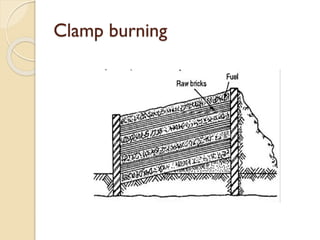
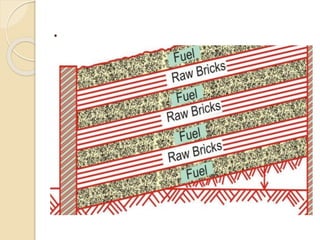
 Trapezoidal shape
 End raised at 15º from ground level
 Brick wall in mud at short end
 Alternate layers of raw bricks and fuels
 Fuels- grass, cow dung, wood
 Air circulation spaces are provided
 Total height of clamp 3 – 4 m
.
 Plastered with mud on sides and top, filled
with earth to prevent the escape of heat
 Burning period = 1to 2 months
 Cooling period =1 to 2 months
 Burning bricks are taken from the clamp
Advantages
 Tough and strong bricks
 burning and cooling are gradual
 Cheap and economical
 No skilled labour and supervision
required
 Saving of clamps fuel
Disadvantages
 Bricks are not of required shape
 It is very slow process
 It is not possible to regulate fire in a
clamp
 Quality of brick is not uniform
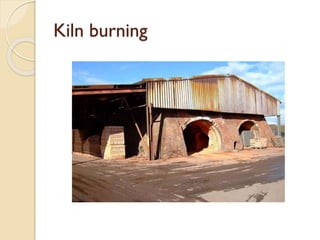
Kiln burning
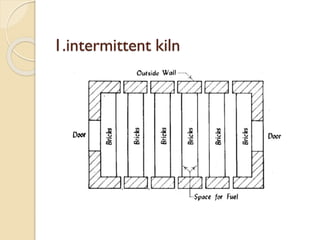
1.intermittent kiln
.
 A kiln is a large oven to burn bricks
 2-3 brick row
 Trolleys used for movement of bricks
 Loading of kiln with raw bricks
 Each door is built up with dry bricks and
are covered with mud or clay
 Fire period = 48 to 60 hours
 Cool period = 12 days
 Bricks are then taken out
Advantages of kiln burning
 Bricks are evenly burnt
 Performance of this kiln is better
 Suitable for burning of structural clay tiles,
terra cotta etc..
2. Continuous kiln
 Bull’s trench kiln
 Hoffman’s kiln
 Tunnel kiln
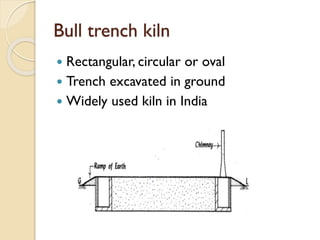
Bull trench kiln
 Rectangular, circular or oval
 Trench excavated in ground
 Widely used kiln in India
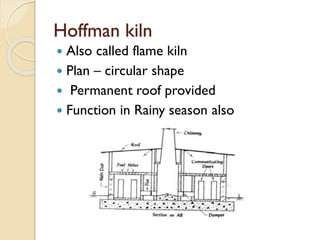
Hoffman kiln
 Also called flame kiln
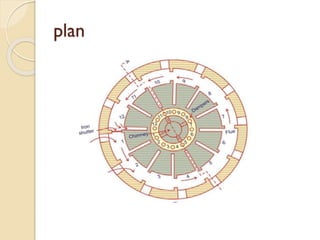
 Plan – circular shape
 Permanent roof provided
 Function in Rainy season also
plan
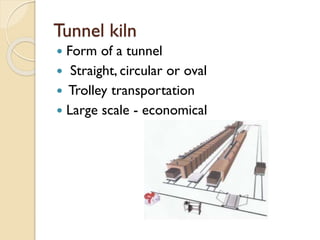
Tunnel kiln
 Form of a tunnel
 Straight, circular or oval
 Trolley transportation
 Large scale - economical
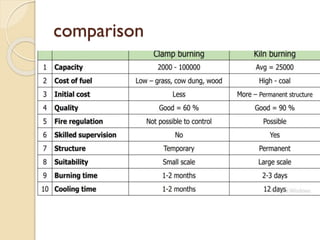
comparison
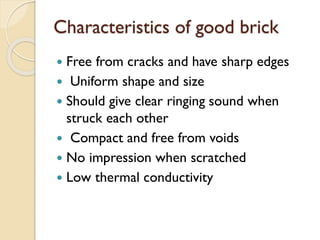
Characteristics of good brick
 Free from cracks and have sharp edges
 Uniform shape and size
 Should give clear ringing sound when
struck each other
 Compact and free from voids
 No impression when scratched
 Low thermal conductivity
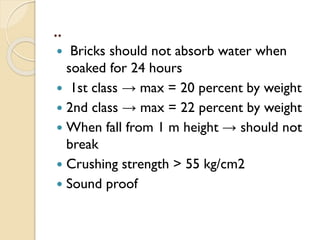
..
 Bricks should not absorb water when
soaked for 24 hours
 1st class → max = 20 percent by weight
 2nd class → max = 22 percent by weight
 When fall from 1 m height → should not
break
 Crushing strength > 55 kg/cm2
 Sound proof
.
IS specifications of bricks
 Unburnt bricks
 burnt bricks
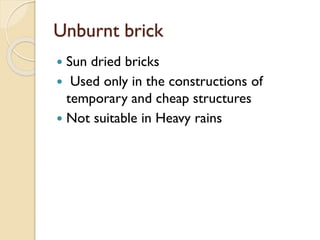
Unburnt brick
 Sun dried bricks
 Used only in the constructions of
temporary and cheap structures
 Not suitable in Heavy rains
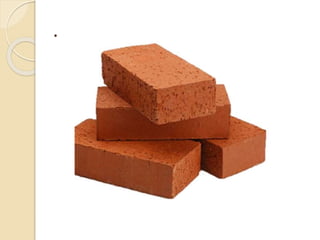
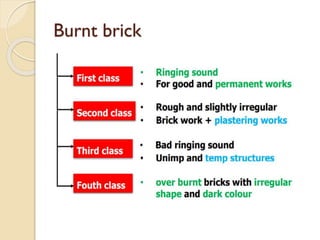
Burnt brick

brick 2.pdf

  • 1.
  • 2.
    Manufacturing of bricks Operationsinvolved 1. Preparation of clay 2. Moulding 3. Drying 4. burning
  • 3.
    Burning of bricks In the process of burning, the dried bricks are burned either in clamps (small scale) or kilns (large scale) up to certain degree temperature. In this stage, the bricks will gain hardness and strength so it is important stage in manufacturing of bricks.
  • 4.
    .  The temperaturerequired for burning is about 1100oC. If they burnt beyond this limit they will be brittle and easy to break. If they burnt under this limit, they will not gain full strength and there is a chance to absorb moisture from the atmosphere.  Hence burning should be done properly to meet the requirements of good brick.
  • 5.
    Burning of brick 1.Clamp burning 2. Kiln burning -intermittent kiln -continuous kiln
  • 6.
  • 7.
  • 8.
    Clamp burning  Trapezoidalshape  End raised at 15º from ground level  Brick wall in mud at short end  Alternate layers of raw bricks and fuels  Fuels- grass, cow dung, wood  Air circulation spaces are provided  Total height of clamp 3 – 4 m
  • 9.
    .  Plastered withmud on sides and top, filled with earth to prevent the escape of heat  Burning period = 1to 2 months  Cooling period =1 to 2 months  Burning bricks are taken from the clamp
  • 10.
    Advantages  Tough andstrong bricks  burning and cooling are gradual  Cheap and economical  No skilled labour and supervision required  Saving of clamps fuel
  • 11.
    Disadvantages  Bricks arenot of required shape  It is very slow process  It is not possible to regulate fire in a clamp  Quality of brick is not uniform
  • 12.
  • 13.
  • 14.
    .  A kilnis a large oven to burn bricks  2-3 brick row  Trolleys used for movement of bricks  Loading of kiln with raw bricks  Each door is built up with dry bricks and are covered with mud or clay  Fire period = 48 to 60 hours  Cool period = 12 days  Bricks are then taken out
  • 15.
    Advantages of kilnburning  Bricks are evenly burnt  Performance of this kiln is better  Suitable for burning of structural clay tiles, terra cotta etc..
  • 16.
    2. Continuous kiln Bull’s trench kiln  Hoffman’s kiln  Tunnel kiln
  • 17.
    Bull trench kiln Rectangular, circular or oval  Trench excavated in ground  Widely used kiln in India
  • 18.
    Hoffman kiln  Alsocalled flame kiln  Plan – circular shape  Permanent roof provided  Function in Rainy season also
  • 19.
  • 20.
    Tunnel kiln  Formof a tunnel  Straight, circular or oval  Trolley transportation  Large scale - economical
  • 21.
  • 22.
    Characteristics of goodbrick  Free from cracks and have sharp edges  Uniform shape and size  Should give clear ringing sound when struck each other  Compact and free from voids  No impression when scratched  Low thermal conductivity
  • 23.
    ..  Bricks shouldnot absorb water when soaked for 24 hours  1st class → max = 20 percent by weight  2nd class → max = 22 percent by weight  When fall from 1 m height → should not break  Crushing strength > 55 kg/cm2  Sound proof
  • 24.
  • 25.
    IS specifications ofbricks  Unburnt bricks  burnt bricks
  • 26.
    Unburnt brick  Sundried bricks  Used only in the constructions of temporary and cheap structures  Not suitable in Heavy rains
  • 27.