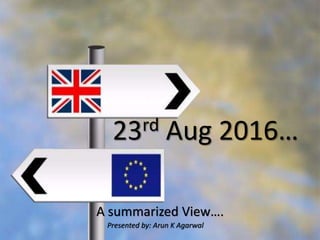
23rd Aug 2016…
Presented by: Arun K Agarwal
A summarized View….
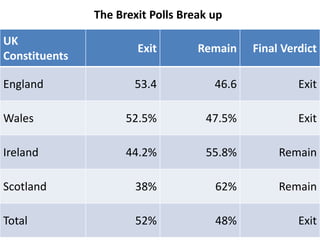
UK
Constituents
Exit Remain Final Verdict
England 53.4 46.6 Exit
Wales 52.5% 47.5% Exit
Ireland 44.2% 55.8% Remain
Scotland 38% 62% Remain
Total 52% 48% Exit
The Brexit Polls Break up
Implications and Consequences
Britain, Europe, India and the World
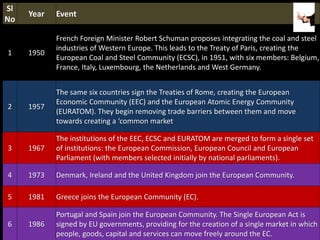
Sl
No
Year Event
1 1950
French Foreign Minister Robert Schuman proposes integrating the coal and steel
industries of Western Europe. This leads to the Treaty of Paris, creating the
European Coal and Steel Community (ECSC), in 1951, with six members: Belgium,
France, Italy, Luxembourg, the Netherlands and West Germany.
2 1957
The same six countries sign the Treaties of Rome, creating the European
Economic Community (EEC) and the European Atomic Energy Community
(EURATOM). They begin removing trade barriers between them and move
towards creating a ‘common market
3 1967
The institutions of the EEC, ECSC and EURATOM are merged to form a single set
of institutions: the European Commission, European Council and European
Parliament (with members selected initially by national parliaments).
4 1973 Denmark, Ireland and the United Kingdom join the European Community.
5 1981 Greece joins the European Community (EC).
6 1986
Portugal and Spain join the European Community. The Single European Act is
signed by EU governments, providing for the creation of a single market in which
people, goods, capital and services can move freely around the EC.
Sl
No
Year Event
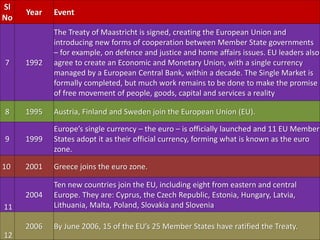
7 1992
The Treaty of Maastricht is signed, creating the European Union and
introducing new forms of cooperation between Member State governments
– for example, on defence and justice and home affairs issues. EU leaders also
agree to create an Economic and Monetary Union, with a single currency
managed by a European Central Bank, within a decade. The Single Market is
formally completed, but much work remains to be done to make the promise
of free movement of people, goods, capital and services a reality
8 1995 Austria, Finland and Sweden join the European Union (EU).
9 1999
Europe’s single currency – the euro – is officially launched and 11 EU Member
States adopt it as their official currency, forming what is known as the euro
zone.
10 2001 Greece joins the euro zone.
11
2004
Ten new countries join the EU, including eight from eastern and central
Europe. They are: Cyprus, the Czech Republic, Estonia, Hungary, Latvia,
Lithuania, Malta, Poland, Slovakia and Slovenia
12
2006 By June 2006, 15 of the EU’s 25 Member States have ratified the Treaty.
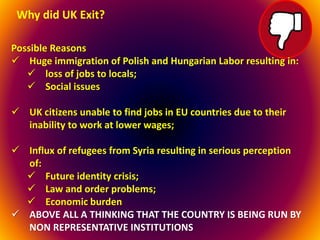
Why did UK Exit?
Possible Reasons
 Huge immigration of Polish and Hungarian Labor resulting in:
 loss of jobs to locals;
 Social issues
 UK citizens unable to find jobs in EU countries due to their
inability to work at lower wages;
 Influx of refugees from Syria resulting in serious perception
of:
 Future identity crisis;
 Law and order problems;
 Economic burden
 ABOVE ALL A THINKING THAT THE COUNTRY IS BEING RUN BY
NON REPRESENTATIVE INSTITUTIONS
Why did UK Exit?
UK was always a reluctant member of EU:
 Retained its currency;
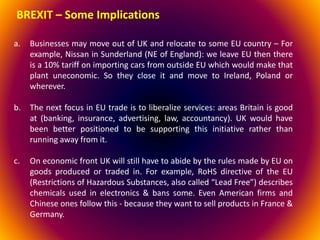
a. Businesses may move out of UK and relocate to some EU country – For
example, Nissan in Sunderland (NE of England): we leave EU then there
is a 10% tariff on importing cars from outside EU which would make that
plant uneconomic. So they close it and move to Ireland, Poland or
wherever.
b. The next focus in EU trade is to liberalize services: areas Britain is good
at (banking, insurance, advertising, law, accountancy). UK would have
been better positioned to be supporting this initiative rather than
running away from it.
c. On economic front UK will still have to abide by the rules made by EU on
goods produced or traded in. For example, RoHS directive of the EU
(Restrictions of Hazardous Substances, also called “Lead Free”) describes
chemicals used in electronics & bans some. Even American firms and
Chinese ones follow this - because they want to sell products in France &
Germany.
BREXIT – Some Implications
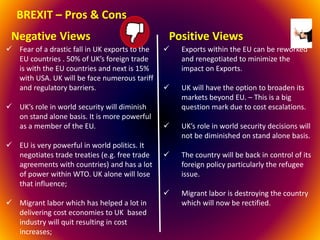
BREXIT – Pros & Cons
Negative Views Positive Views
 Exports within the EU can be reworked
and renegotiated to minimize the
impact on Exports.
 UK will have the option to broaden its
markets beyond EU. – This is a big
question mark due to cost escalations.
 UK’s role in world security decisions will
not be diminished on stand alone basis.
 The country will be back in control of its
foreign policy particularly the refugee
issue.
 Migrant labor is destroying the country
which will now be rectified.
 Fear of a drastic fall in UK exports to the
EU countries . 50% of UK’s foreign trade
is with the EU countries and next is 15%
with USA. UK will be face numerous tariff
and regulatory barriers.
 UK’s role in world security will diminish
on stand alone basis. It is more powerful
as a member of the EU.
 EU is very powerful in world politics. It
negotiates trade treaties (e.g. free trade
agreements with countries) and has a lot
of power within WTO. UK alone will lose
that influence;
 Migrant labor which has helped a lot in
delivering cost economies to UK based
industry will quit resulting in cost
increases;
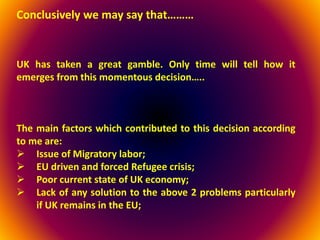
Conclusively we may say that………
UK has taken a great gamble. Only time will tell how it
emerges from this momentous decision…..
The main factors which contributed to this decision according
to me are:
 Issue of Migratory labor;
 EU driven and forced Refugee crisis;
 Poor current state of UK economy;
 Lack of any solution to the above 2 problems particularly
if UK remains in the EU;
Forum Open to Discussions…..

Brexit

  • 1.
    23rd Aug 2016… Presentedby: Arun K Agarwal A summarized View….
  • 2.
    UK Constituents Exit Remain FinalVerdict England 53.4 46.6 Exit Wales 52.5% 47.5% Exit Ireland 44.2% 55.8% Remain Scotland 38% 62% Remain Total 52% 48% Exit The Brexit Polls Break up
  • 3.
    Implications and Consequences Britain,Europe, India and the World
  • 4.
    Sl No Year Event 1 1950 FrenchForeign Minister Robert Schuman proposes integrating the coal and steel industries of Western Europe. This leads to the Treaty of Paris, creating the European Coal and Steel Community (ECSC), in 1951, with six members: Belgium, France, Italy, Luxembourg, the Netherlands and West Germany. 2 1957 The same six countries sign the Treaties of Rome, creating the European Economic Community (EEC) and the European Atomic Energy Community (EURATOM). They begin removing trade barriers between them and move towards creating a ‘common market 3 1967 The institutions of the EEC, ECSC and EURATOM are merged to form a single set of institutions: the European Commission, European Council and European Parliament (with members selected initially by national parliaments). 4 1973 Denmark, Ireland and the United Kingdom join the European Community. 5 1981 Greece joins the European Community (EC). 6 1986 Portugal and Spain join the European Community. The Single European Act is signed by EU governments, providing for the creation of a single market in which people, goods, capital and services can move freely around the EC.
  • 5.
    Sl No Year Event 7 1992 TheTreaty of Maastricht is signed, creating the European Union and introducing new forms of cooperation between Member State governments – for example, on defence and justice and home affairs issues. EU leaders also agree to create an Economic and Monetary Union, with a single currency managed by a European Central Bank, within a decade. The Single Market is formally completed, but much work remains to be done to make the promise of free movement of people, goods, capital and services a reality 8 1995 Austria, Finland and Sweden join the European Union (EU). 9 1999 Europe’s single currency – the euro – is officially launched and 11 EU Member States adopt it as their official currency, forming what is known as the euro zone. 10 2001 Greece joins the euro zone. 11 2004 Ten new countries join the EU, including eight from eastern and central Europe. They are: Cyprus, the Czech Republic, Estonia, Hungary, Latvia, Lithuania, Malta, Poland, Slovakia and Slovenia 12 2006 By June 2006, 15 of the EU’s 25 Member States have ratified the Treaty.
  • 6.
    Why did UKExit? Possible Reasons  Huge immigration of Polish and Hungarian Labor resulting in:  loss of jobs to locals;  Social issues  UK citizens unable to find jobs in EU countries due to their inability to work at lower wages;  Influx of refugees from Syria resulting in serious perception of:  Future identity crisis;  Law and order problems;  Economic burden  ABOVE ALL A THINKING THAT THE COUNTRY IS BEING RUN BY NON REPRESENTATIVE INSTITUTIONS
  • 7.
    Why did UKExit? UK was always a reluctant member of EU:  Retained its currency;
  • 8.
    a. Businesses maymove out of UK and relocate to some EU country – For example, Nissan in Sunderland (NE of England): we leave EU then there is a 10% tariff on importing cars from outside EU which would make that plant uneconomic. So they close it and move to Ireland, Poland or wherever. b. The next focus in EU trade is to liberalize services: areas Britain is good at (banking, insurance, advertising, law, accountancy). UK would have been better positioned to be supporting this initiative rather than running away from it. c. On economic front UK will still have to abide by the rules made by EU on goods produced or traded in. For example, RoHS directive of the EU (Restrictions of Hazardous Substances, also called “Lead Free”) describes chemicals used in electronics & bans some. Even American firms and Chinese ones follow this - because they want to sell products in France & Germany. BREXIT – Some Implications
  • 9.
    BREXIT – Pros& Cons Negative Views Positive Views  Exports within the EU can be reworked and renegotiated to minimize the impact on Exports.  UK will have the option to broaden its markets beyond EU. – This is a big question mark due to cost escalations.  UK’s role in world security decisions will not be diminished on stand alone basis.  The country will be back in control of its foreign policy particularly the refugee issue.  Migrant labor is destroying the country which will now be rectified.  Fear of a drastic fall in UK exports to the EU countries . 50% of UK’s foreign trade is with the EU countries and next is 15% with USA. UK will be face numerous tariff and regulatory barriers.  UK’s role in world security will diminish on stand alone basis. It is more powerful as a member of the EU.  EU is very powerful in world politics. It negotiates trade treaties (e.g. free trade agreements with countries) and has a lot of power within WTO. UK alone will lose that influence;  Migrant labor which has helped a lot in delivering cost economies to UK based industry will quit resulting in cost increases;
  • 10.
    Conclusively we maysay that……… UK has taken a great gamble. Only time will tell how it emerges from this momentous decision….. The main factors which contributed to this decision according to me are:  Issue of Migratory labor;  EU driven and forced Refugee crisis;  Poor current state of UK economy;  Lack of any solution to the above 2 problems particularly if UK remains in the EU;
  • 12.
    Forum Open toDiscussions…..