BREXIT
Presented by: Idris Saify
EUROPEAN UNION
 The EU is a political and economic union of member states which
are located primarily in Europe
 It is a single market with no barriers to trade between members
and a common external tariff against imports from outside.
 There is free movement of goods, persons, services and capital –
the so-called Four Freedoms.
 The EU has approximately 500 million consumers and had 28
member states at the start of 2014, of which 18 use the common
currency unit, the euro.
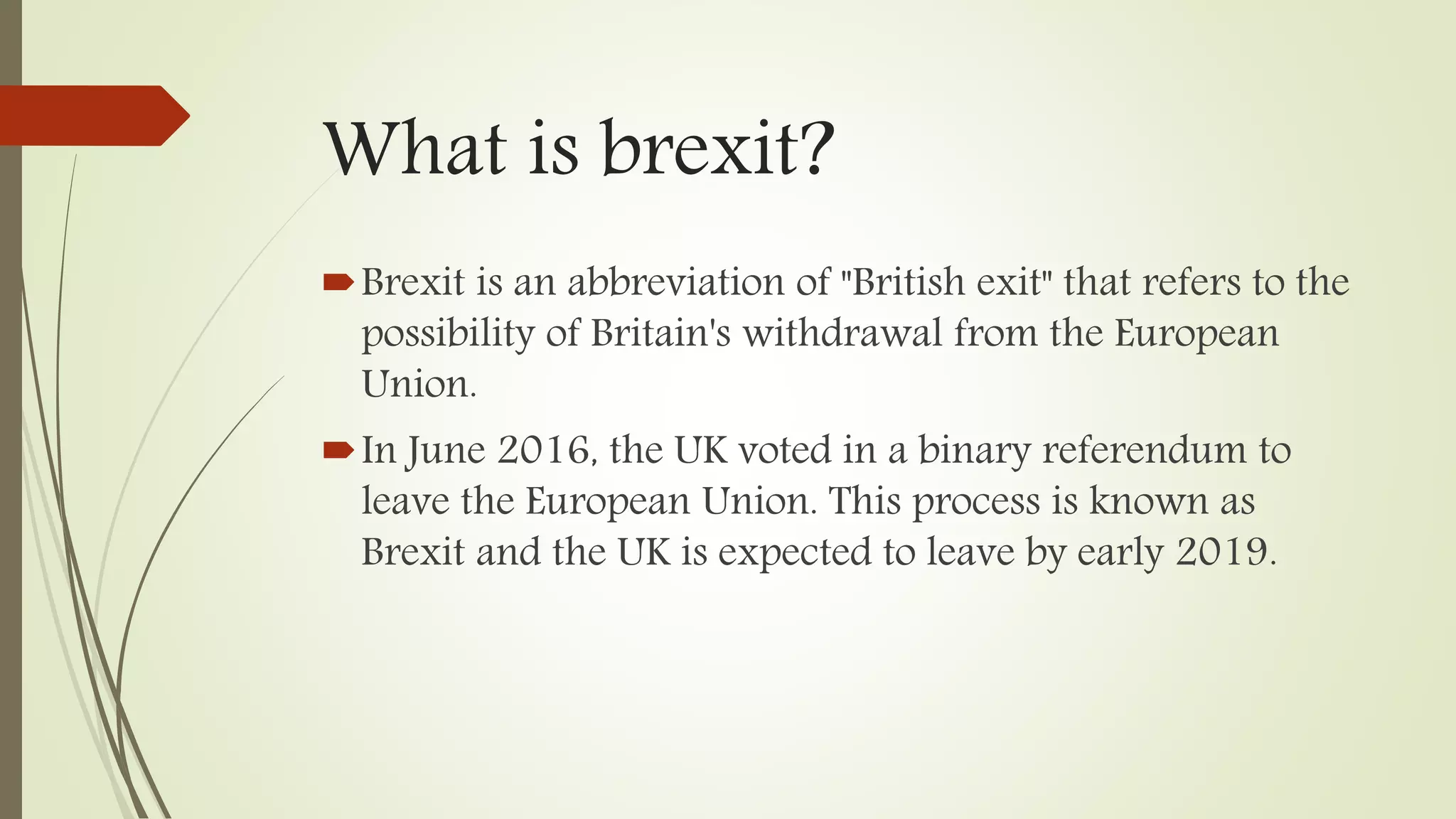
What is brexit?
Brexit is an abbreviation of "British exit" that refers to the
possibility of Britain's withdrawal from the European
Union.
In June 2016, the UK voted in a binary referendum to
leave the European Union. This process is known as
Brexit and the UK is expected to leave by early 2019.
Why?
 Possible Reasons:
 Huge immigration of Polish and Hungarian Labor resulting in:
loss of jobs to locals;
Social issues
 UK citizens unable to find jobs in EU countries due to their inability to work at lower
wages;
 Influx of refugees from Syria resulting in serious perception of:
 Future identity crisis;
 Law and order problems;
 Economic burden
 ABOVE ALL A THINKING THAT THE COUNTRY IS BEING RUN BY NON
REPRESENTATIVE INSTITUTIONS
ECONOMIC IMPACT
 One in every ten UK jobs are linked to the trade with the EU. Therefore Brexit
might affect there jobs directly or indirectly.
 61% of UK small business exports go to the EU. Being able to trade freely with EU
countries, with no tariffs or barriers, helps small businesses in the UK grow and
create jobs. This might be affected.
 Impact of Brexit could lead into lower GDP of 2.2% in 2030 or hopefully lead
into higher GDP of 1.6%.
 Leaving the EU could lead into lower trade between the EU and UK generating
complications.
 Leaving the EU could also affect Foreign Direct Investment, immigration and
economic regulation in UK.
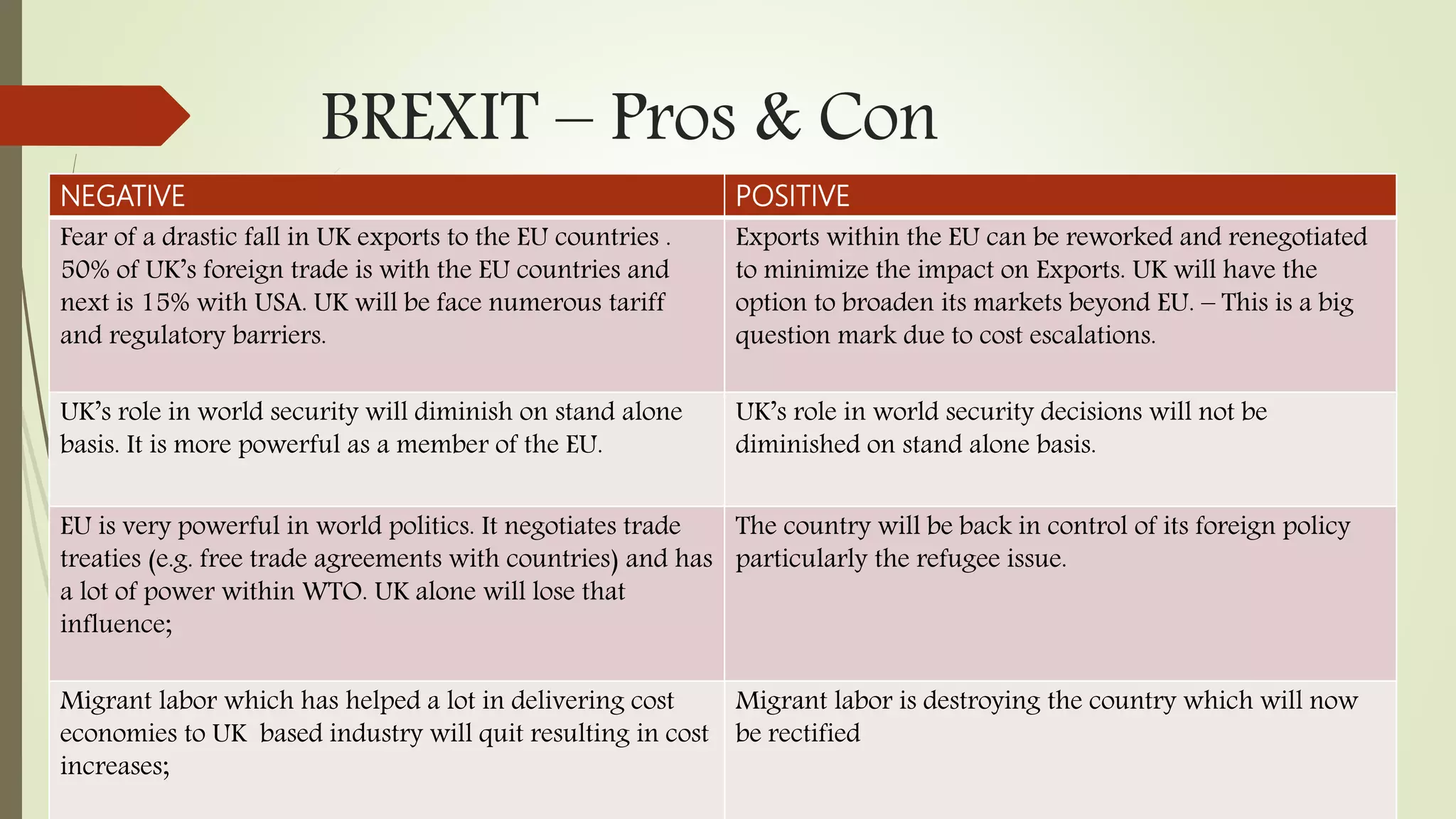
BREXIT – Pros & Con
NEGATIVE POSITIVE
Fear of a drastic fall in UK exports to the EU countries .
50% of UK’s foreign trade is with the EU countries and
next is 15% with USA. UK will be face numerous tariff
and regulatory barriers.
Exports within the EU can be reworked and renegotiated
to minimize the impact on Exports. UK will have the
option to broaden its markets beyond EU. – This is a big
question mark due to cost escalations.
UK’s role in world security will diminish on stand alone
basis. It is more powerful as a member of the EU.
UK’s role in world security decisions will not be
diminished on stand alone basis.
EU is very powerful in world politics. It negotiates trade
treaties (e.g. free trade agreements with countries) and has
a lot of power within WTO. UK alone will lose that
influence;
The country will be back in control of its foreign policy
particularly the refugee issue.
Migrant labor which has helped a lot in delivering cost
economies to UK based industry will quit resulting in cost
increases;
Migrant labor is destroying the country which will now
be rectified
TRADE IMPACT
 Trading freely with the EU allows UK businesses to grow. Being able to trade freely
with the EU helps UK businesses grow and create jobs . Therefore, leaving EU might
put all this at risk.
 4 out of 5 Small Business back the EU. Four out of five UK small businesses say access
to EU markets is important to their future growth, in case of UK leaving EU, these
small business might suffer losses.
 70% of major business expect damage if UK leave the EU. A new survey shows 70%
of FTSE 350 firms, some of the UK’s largest companies, think they’ll be hit if UK
leaves the EU.
 TTIP (Transatlantic Trade and Investment Partnership) deal between US and EU will
not benefit UK if they leave EU.
 CETA (The Comprehensive Economic and Trade Agreement) between Canada and
EU will also not benefit UK if Brexit happens.
IMPACT ON INDIA
This will make dollar stronger, and pound weaker, thus
lead to inflation
 Negative impact on the Indian firms in uk (Tata)
Scope for increased investment in India firms by foreign
nations
BREXIT may increase the export of fisheries product to
UK
CONCLUSION
 On the whole the UK’s politics tend to be to the right of most EU countries and its
economics is more free-market oriented.
 It is argued that the formulation of polices and laws in the EU is more interventionist,
centralised and socialist than many free-market economists think is beneficial to the EU’s
long term economic performance
 The US wants the UK to stay a full member of the EU to champion liberal, free-market
values in Europe
 But many in the UK feel that the UK cannot change the direction of the EU and so are
primarily concerned with reducing the EU’s political, legal and economic power over the
UK.
 The British Chambers of Commerce in 2013 found that 57% of business wanted to
remain in the EU while transferring specific powers regarding health and safety law, and
employment law, back to Westminster
 Plus 58% of firms feel that withdrawing from EU membership would harm UK business
interests.
 The outcome of the next election and renegotiation is very important to the UK’s
economic and political future

Brexit

  • 1.
  • 2.
    EUROPEAN UNION  TheEU is a political and economic union of member states which are located primarily in Europe  It is a single market with no barriers to trade between members and a common external tariff against imports from outside.  There is free movement of goods, persons, services and capital – the so-called Four Freedoms.  The EU has approximately 500 million consumers and had 28 member states at the start of 2014, of which 18 use the common currency unit, the euro.
  • 3.
    What is brexit? Brexitis an abbreviation of "British exit" that refers to the possibility of Britain's withdrawal from the European Union. In June 2016, the UK voted in a binary referendum to leave the European Union. This process is known as Brexit and the UK is expected to leave by early 2019.
  • 4.
    Why?  Possible Reasons: Huge immigration of Polish and Hungarian Labor resulting in: loss of jobs to locals; Social issues  UK citizens unable to find jobs in EU countries due to their inability to work at lower wages;  Influx of refugees from Syria resulting in serious perception of:  Future identity crisis;  Law and order problems;  Economic burden  ABOVE ALL A THINKING THAT THE COUNTRY IS BEING RUN BY NON REPRESENTATIVE INSTITUTIONS
  • 5.
    ECONOMIC IMPACT  Onein every ten UK jobs are linked to the trade with the EU. Therefore Brexit might affect there jobs directly or indirectly.  61% of UK small business exports go to the EU. Being able to trade freely with EU countries, with no tariffs or barriers, helps small businesses in the UK grow and create jobs. This might be affected.  Impact of Brexit could lead into lower GDP of 2.2% in 2030 or hopefully lead into higher GDP of 1.6%.  Leaving the EU could lead into lower trade between the EU and UK generating complications.  Leaving the EU could also affect Foreign Direct Investment, immigration and economic regulation in UK.
  • 6.
    BREXIT – Pros& Con NEGATIVE POSITIVE Fear of a drastic fall in UK exports to the EU countries . 50% of UK’s foreign trade is with the EU countries and next is 15% with USA. UK will be face numerous tariff and regulatory barriers. Exports within the EU can be reworked and renegotiated to minimize the impact on Exports. UK will have the option to broaden its markets beyond EU. – This is a big question mark due to cost escalations. UK’s role in world security will diminish on stand alone basis. It is more powerful as a member of the EU. UK’s role in world security decisions will not be diminished on stand alone basis. EU is very powerful in world politics. It negotiates trade treaties (e.g. free trade agreements with countries) and has a lot of power within WTO. UK alone will lose that influence; The country will be back in control of its foreign policy particularly the refugee issue. Migrant labor which has helped a lot in delivering cost economies to UK based industry will quit resulting in cost increases; Migrant labor is destroying the country which will now be rectified
  • 7.
    TRADE IMPACT  Tradingfreely with the EU allows UK businesses to grow. Being able to trade freely with the EU helps UK businesses grow and create jobs . Therefore, leaving EU might put all this at risk.  4 out of 5 Small Business back the EU. Four out of five UK small businesses say access to EU markets is important to their future growth, in case of UK leaving EU, these small business might suffer losses.  70% of major business expect damage if UK leave the EU. A new survey shows 70% of FTSE 350 firms, some of the UK’s largest companies, think they’ll be hit if UK leaves the EU.  TTIP (Transatlantic Trade and Investment Partnership) deal between US and EU will not benefit UK if they leave EU.  CETA (The Comprehensive Economic and Trade Agreement) between Canada and EU will also not benefit UK if Brexit happens.
  • 8.
    IMPACT ON INDIA Thiswill make dollar stronger, and pound weaker, thus lead to inflation  Negative impact on the Indian firms in uk (Tata) Scope for increased investment in India firms by foreign nations BREXIT may increase the export of fisheries product to UK
  • 9.
    CONCLUSION  On thewhole the UK’s politics tend to be to the right of most EU countries and its economics is more free-market oriented.  It is argued that the formulation of polices and laws in the EU is more interventionist, centralised and socialist than many free-market economists think is beneficial to the EU’s long term economic performance  The US wants the UK to stay a full member of the EU to champion liberal, free-market values in Europe  But many in the UK feel that the UK cannot change the direction of the EU and so are primarily concerned with reducing the EU’s political, legal and economic power over the UK.  The British Chambers of Commerce in 2013 found that 57% of business wanted to remain in the EU while transferring specific powers regarding health and safety law, and employment law, back to Westminster  Plus 58% of firms feel that withdrawing from EU membership would harm UK business interests.  The outcome of the next election and renegotiation is very important to the UK’s economic and political future

Editor's Notes

  • #8 TTIP 2012 (19:20) investment agreement CETA canada remove 98% trade tarrifes to EU 2014(2020) FTA