Presentation
On
BREXIT
Presented By: Subject
Md Sazzad Hossain Marketing Management
Jahir Uddin MKTG-4201)
Md Israfil Palash Subject Teacher
Dr. Mohammad Masrurul Mowla
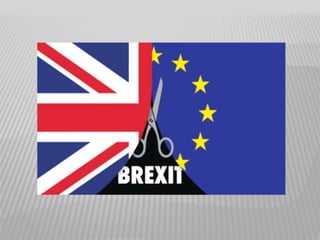
WHAT IS BREXIT?
THE UNITED KINGDOM (UK) INTENDS TO WITHDRAW
FROM THE EUROPEAN UNION (EU), A PROCESS
COMMONLY KNOWN AS BREXIT, AS A RESULT OF JUNE
2016 REFERENDUM IN WHICH 52% VOTED TO LEAVE EU.
THE TERM “BREXIT” IS SHORT FORM OF THE WORDS
“BRITISH” AND “EXIT”.
What is European Union?
The European Union is a political-economic
union of 28 member states that are located
primarily in Europe
Reasons for BREXIT
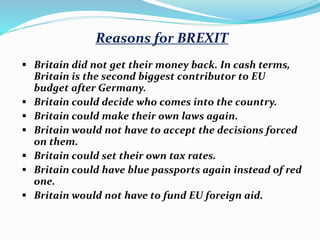
 Britain did not get their money back. In cash terms,
Britain is the second biggest contributor to EU
budget after Germany.
 Britain could decide who comes into the country.
 Britain could make their own laws again.
 Britain would not have to accept the decisions forced
on them.
 Britain could set their own tax rates.
 Britain could have blue passports again instead of red
one.
 Britain would not have to fund EU foreign aid.
1975 REFERENDUM
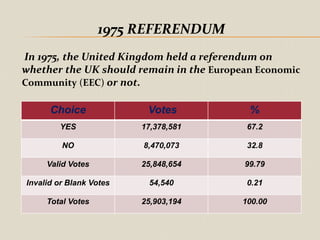
In 1975, the United Kingdom held a referendum on
whether the UK should remain in the European Economic
Community (EEC) or not.
Choice Votes %
YES 17,378,581 67.2
NO 8,470,073 32.8
Valid Votes 25,848,654 99.79
Invalid or Blank Votes 54,540 0.21
Total Votes 25,903,194 100.00
2016 REFERENDUM
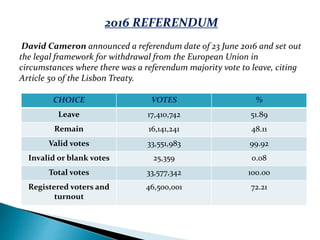
David Cameron announced a referendum date of 23 June 2016 and set out
the legal framework for withdrawal from the European Union in
circumstances where there was a referendum majority vote to leave, citing
Article 50 of the Lisbon Treaty.
CHOICE VOTES %
Leave 17,410,742 51.89
Remain 16,141,241 48.11
Valid votes 33,551,983 99.92
Invalid or blank votes 25,359 0.08
Total votes 33,577,342 100.00
Registered voters and
turnout
46,500,001 72.21
Global Impact
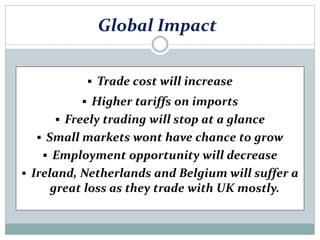
 Trade cost will increase
 Higher tariffs on imports
 Freely trading will stop at a glance
 Small markets wont have chance to grow
 Employment opportunity will decrease
 Ireland, Netherlands and Belgium will suffer a
great loss as they trade with UK mostly.
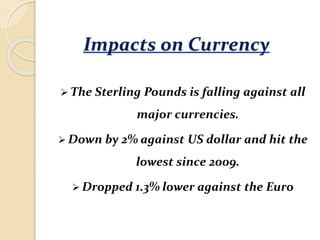
Impacts on Currency
 The Sterling Pounds is falling against all
major currencies.
 Down by 2% against US dollar and hit the
lowest since 2009.
 Dropped 1.3% lower against the Euro
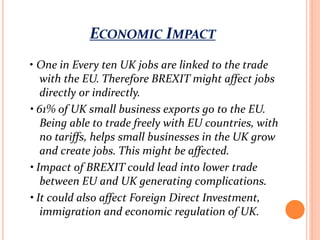
ECONOMIC IMPACT
• One in Every ten UK jobs are linked to the trade
with the EU. Therefore BREXIT might affect jobs
directly or indirectly.
• 61% of UK small business exports go to the EU.
Being able to trade freely with EU countries, with
no tariffs, helps small businesses in the UK grow
and create jobs. This might be affected.
• Impact of BREXIT could lead into lower trade
between EU and UK generating complications.
• It could also affect Foreign Direct Investment,
immigration and economic regulation of UK.
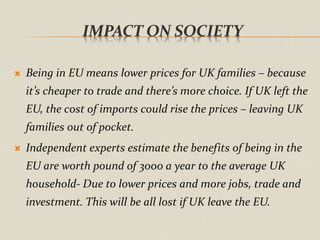
IMPACT ON SOCIETY
 Being in EU means lower prices for UK families – because
it’s cheaper to trade and there’s more choice. If UK left the
EU, the cost of imports could rise the prices – leaving UK
families out of pocket.
 Independent experts estimate the benefits of being in the
EU are worth pound of 3000 a year to the average UK
household- Due to lower prices and more jobs, trade and
investment. This will be all lost if UK leave the EU.
 From our discussion on BREXIT and its impacts
on Global terms will lead us to the conclusion
that as every coin have two sides, same as
BREXIT will give advantages to UK somewhat
but as its impacts may also damage or lower the
economy of United Kingdom and other
countries as well who currently trading with
them being in European Union member.
Presentation on Brexit

Presentation on Brexit

  • 1.
    Presentation On BREXIT Presented By: Subject MdSazzad Hossain Marketing Management Jahir Uddin MKTG-4201) Md Israfil Palash Subject Teacher Dr. Mohammad Masrurul Mowla
  • 3.
    WHAT IS BREXIT? THEUNITED KINGDOM (UK) INTENDS TO WITHDRAW FROM THE EUROPEAN UNION (EU), A PROCESS COMMONLY KNOWN AS BREXIT, AS A RESULT OF JUNE 2016 REFERENDUM IN WHICH 52% VOTED TO LEAVE EU. THE TERM “BREXIT” IS SHORT FORM OF THE WORDS “BRITISH” AND “EXIT”. What is European Union? The European Union is a political-economic union of 28 member states that are located primarily in Europe
  • 4.
    Reasons for BREXIT Britain did not get their money back. In cash terms, Britain is the second biggest contributor to EU budget after Germany.  Britain could decide who comes into the country.  Britain could make their own laws again.  Britain would not have to accept the decisions forced on them.  Britain could set their own tax rates.  Britain could have blue passports again instead of red one.  Britain would not have to fund EU foreign aid.
  • 5.
    1975 REFERENDUM In 1975,the United Kingdom held a referendum on whether the UK should remain in the European Economic Community (EEC) or not. Choice Votes % YES 17,378,581 67.2 NO 8,470,073 32.8 Valid Votes 25,848,654 99.79 Invalid or Blank Votes 54,540 0.21 Total Votes 25,903,194 100.00
  • 6.
    2016 REFERENDUM David Cameronannounced a referendum date of 23 June 2016 and set out the legal framework for withdrawal from the European Union in circumstances where there was a referendum majority vote to leave, citing Article 50 of the Lisbon Treaty. CHOICE VOTES % Leave 17,410,742 51.89 Remain 16,141,241 48.11 Valid votes 33,551,983 99.92 Invalid or blank votes 25,359 0.08 Total votes 33,577,342 100.00 Registered voters and turnout 46,500,001 72.21
  • 7.
    Global Impact  Tradecost will increase  Higher tariffs on imports  Freely trading will stop at a glance  Small markets wont have chance to grow  Employment opportunity will decrease  Ireland, Netherlands and Belgium will suffer a great loss as they trade with UK mostly.
  • 8.
    Impacts on Currency The Sterling Pounds is falling against all major currencies.  Down by 2% against US dollar and hit the lowest since 2009.  Dropped 1.3% lower against the Euro
  • 9.
    ECONOMIC IMPACT • Onein Every ten UK jobs are linked to the trade with the EU. Therefore BREXIT might affect jobs directly or indirectly. • 61% of UK small business exports go to the EU. Being able to trade freely with EU countries, with no tariffs, helps small businesses in the UK grow and create jobs. This might be affected. • Impact of BREXIT could lead into lower trade between EU and UK generating complications. • It could also affect Foreign Direct Investment, immigration and economic regulation of UK.
  • 10.
    IMPACT ON SOCIETY Being in EU means lower prices for UK families – because it’s cheaper to trade and there’s more choice. If UK left the EU, the cost of imports could rise the prices – leaving UK families out of pocket.  Independent experts estimate the benefits of being in the EU are worth pound of 3000 a year to the average UK household- Due to lower prices and more jobs, trade and investment. This will be all lost if UK leave the EU.
  • 11.
     From ourdiscussion on BREXIT and its impacts on Global terms will lead us to the conclusion that as every coin have two sides, same as BREXIT will give advantages to UK somewhat but as its impacts may also damage or lower the economy of United Kingdom and other countries as well who currently trading with them being in European Union member.