Tariffs
Quotas
Exchange controls
European Union (EU)
• Customs union that is moving in the
direction of an economic union by:
– Adopting a common currency
– Removing trade restrictions
– Permitting free flow of goods and workers
throughout the member nations
• Goal is to remove all barriers to free
trade among its members
North American Free Trade
Agreement (NAFTA)
• Accord removing trade barriers among
Canada, Mexico, and the United States
• Particularly important to U.S.
marketers because Canada and Mexico
are two of its largest trading partners
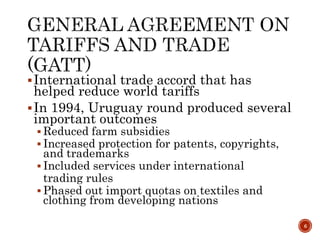
International trade accord that has
helped reduce world tariffs
In 1994, Uruguay round produced several
important outcomes
 Reduced farm subsidies
 Increased protection for patents, copyrights,
and trademarks
 Included services under international
trading rules
 Phased out import quotas on textiles and
clothing from developing nations
6
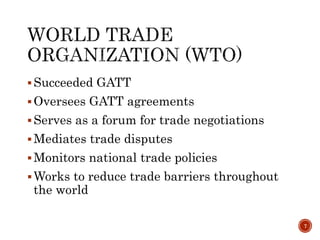
Succeeded GATT
Oversees GATT agreements
Serves as a forum for trade negotiations
Mediates trade disputes
Monitors national trade policies
Works to reduce trade barriers throughout
the world
7
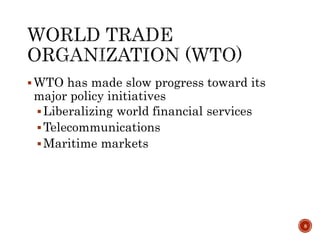
WTO has made slow progress toward its
major policy initiatives
Liberalizing world financial services
Telecommunications
Maritime markets
8
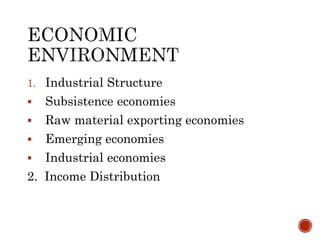
1. Industrial Structure
 Subsistence economies
 Raw material exporting economies
 Emerging economies
 Industrial economies
2. Income Distribution
FACTORS:-
 Government bureaucracy
Political stability
Monetary regulations
The impact of culture on marketing strategy
The impact of marketing strategy on
cultures
Marketing objectives and policies
 what volume of foreign sales it wants
How many countries it wants to market
Decide on the type of countries to enter
1. EXPORTING
2. JOINT VENTURING
 LICENSING
 CONTRACT MANUFACTRING
 MANAGEMENT MANUFACTURING
 JOINT OWNERSHIP
3. DIRECT INVESTMENT
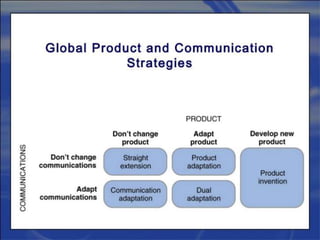
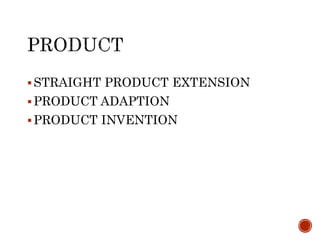
STRAIGHT PRODUCT EXTENSION
PRODUCT ADAPTION
PRODUCT INVENTION
COMMUNICATION ADAPTION
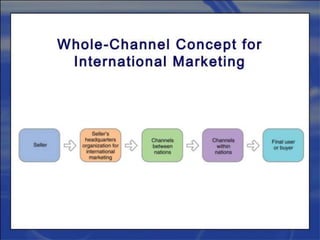
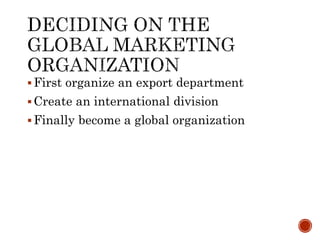
First organize an export department
Create an international division
Finally become a global organization
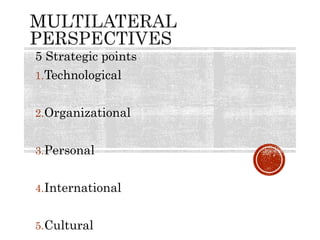
5 Strategic points
1.Technological
2.Organizational
3.Personal
4.International
5.Cultural
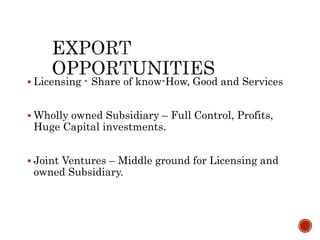
 Licensing - Share of know-How, Good and Services
 Wholly owned Subsidiary – Full Control, Profits,
Huge Capital investments.
 Joint Ventures – Middle ground for Licensing and
owned Subsidiary.
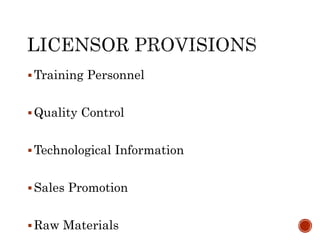
Training Personnel
Quality Control
Technological Information
Sales Promotion
Raw Materials
Economic Information
1.Foreign Markets
2.Data on Competition
3.Review Of Marketing
4.Manufacturing Considerations
 Product Line Extension - Adding Flavors, form,
colors, package size.
 Geographical Development
It is universally accepted that a firm cannot
secure its profits without continual expansion of
its activities.
Entry In Market
1.Licensing
2.Joint Venture
3.Subsidiary
Capital Allocation
Man Power
Managerial Skills
Product Adaptation Program
The biggest challenge confronting the whole
world today is to use the advances in
research and technology to solve man’s
economic and social problems in order to
narrow the gap between rich and poor.

Global marketing