BREASTFEEDING
Guided by – Dr.Ramesh Pawar sir Presented by- Dr.Minal Holani
Community Medicine dept MPHN 2nd Semester
GMCH Akola GMCH Akola
• Breastfeeding is the process of feeding a mother's breast milk to her
infant, either directly from the breast or by expressing (pumping
out) the milk from the breast .
• Breastmilk is safe, clean and contains antibodies which help protect
against many common childhood illnesses.
• The NFHS-5, National data revealed that 63.7% breastfed
exclusively during 0-6 months,45.9 % received timely
complementary feeds at 6-8 months and only 11.1% received
adequate diet during 6-23 months..
Initiation of breastfeeding within one hour of birth has increased from 9.5% in
NFHS-1(1992-93) to 41.8 % in NFHS – 5 (2015-16)
HORMONAL CONTROL OF MILK PRODUCTION
Works before or during the feed to make
milk flow
• Prolactin is necessary for the secretion of milk by the cells of the alveoli.
• The prolactin level is highest about 30 minutes after the beginning of the
feed.
• Oxytocin makes the myoepithelial cells around the alveoli contract.
• The oxytocin reflex is also sometimes called the “letdown reflex” or the
“milk ejection reflex”.
• Milk production is controlled in the breast by a substance called the
feedback inhibitor of lactation, or FIL (a polypeptide), which is present in
breast milk.
Breast-milk composition
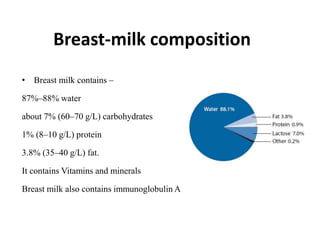
• Breast milk contains –
87%–88% water
about 7% (60–70 g/L) carbohydrates
1% (8–10 g/L) protein
3.8% (35–40 g/L) fat.
It contains Vitamins and minerals
Breast milk also contains immunoglobulin A
• Signs of good positioning
Baby’s head and body are in line.
Baby is held close to body.
Baby’s whole body is supported with your arm along their back.
Baby approaches breast nose to nipple, so that they come to breast from
underneath the nipple.
• Signs of a good latch
A comfortable experience with no pain.
More areola is visible above baby’s mouth than below.
Baby’s mouth is wide open.
Their lower lip is turned out.
Their chin is touching – or nearly touching – your breast.
• Signs of a poor latch
More of the areola is visible below the baby’s lower
lip than upper lip .
The baby’s mouth is not wide open.
The baby’s lower lip points forward or is turned
Inwards.
The baby’s chin is away from the breast.
• Signs of effective suckling
 Baby takes slow deep suckles, sometimes pausing.
 May be able to see or hear baby swallowing after one or two suckles.
 Suckling is comfortable and pain free .
 Baby finishes the feed, releases the breast and looks contented and relaxed.
 Breast is softer after the feed.
• Signs of Ineffective Suckling
 Baby suckle quickly all the time without swallowing.
 Cheeks may be drawn in as baby suckles.
 Nipple may stay stretched out as baby stops suckling.
 Baby may pull away from breast out of frustation and refuse to feed.
 Breast may become engorged.
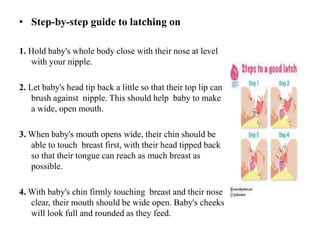
• Step-by-step guide to latching on
1. Hold baby's whole body close with their nose at level
with your nipple.
2. Let baby's head tip back a little so that their top lip can
brush against nipple. This should help baby to make
a wide, open mouth.
3. When baby's mouth opens wide, their chin should be
able to touch breast first, with their head tipped back
so that their tongue can reach as much breast as
possible.
4. With baby's chin firmly touching breast and their nose
clear, their mouth should be wide open. Baby's cheeks
will look full and rounded as they feed.
• CONTRAINDICATIONS TO BREASTFEEDING-
MOTHERS SHOULD NOT BREAST FEED OR SHOULD NOT FEED EBM:
 Infant is diagnosed with classic galactosemia, a rare genetic metabolic
disorder
 Mother has HIV
 Mother is infected with human T-cell lymphotropic virus type I or type
II (HTLV – 1/2)
 Mother is using an illicit drug, such as opioids, PCP (phencyclidine) or cocaine.
 Mother has suspected or confirmed Ebola virus disease
MOTHERS SHOULD TEMPORARILY NOT BREASTFEED OR SHOULD
NOT FEED EBM:
 Mother is infected with untreated brucellosis
 Mother has an active Herpes simplex virus infection with lesions present
on the breast
 Mother has mpox virus infection
MOTHERS SHOULD TEMPORARILY NOT BREASTFEED BUT CAN
FEED EBM:
 Mother has untreated, active tuberculosis
 Mother has active varicella (chicken pox) infection
BFHI- 10 STEPS TO BREASTFEEDING
• 1a. Comply fully with the International Code of Marketing of Breast-milk
Substitutes and relevant World Health Assembly resolutions.
• 1b. Have a written infant feeding policy that is routinely communicated to
staff and parents.
• 1c. Establish ongoing monitoring and data-management systems.
• 2. Ensure that staff have sufficient knowledge, competence and skills to
support breastfeeding.
• 3. Discuss the importance and management of breastfeeding with pregnant
women and their families.
• 4. Facilitate immediate and uninterrupted skin-to-skin contact and support
mothers to initiate breastfeeding as soon as possible after birth.
• 5. Support mothers to initiate and maintain breastfeeding and manage
common difficulties.
• 6. Do not provide breastfed newborns any food or fluids other than breast
milk, unless medically indicated.
• 7. Enable mothers and their infants to remain together and to practise
rooming-in 24 hours a day.
• 8. Support mothers to recognize and respond to their infants’cues for
feeding.
• 9. Counsel mothers on the use and risks of feeding bottles, teats and
pacifiers.
• 10. Coordinate discharge so that parents and their infants have timely
access to ongoing support and care.
• BREASTFEEDING IN DIFFICULT SITUATIONS
1) Low Birth Weight : Recommended fluid intake is 60ml/kg/day
and feed volume 15-20 ml (8 feeds in 24 hrs)
Preferable options for feeding are-
Expressed breast milk
Donor breast milk
Infant formula
2) Malnutrition:
For infants less than 6 months –
Continued breastfeeding
Supplementary suckling technique
Cup feeding
3) HIV :
Replacement feeding (heat treated breast milk/ formula milk/animal milk)
or
Exclusive breastfeeding for 6 months
BREAST CONDITIONS AND FEEDING DIFFICULTIES –
1)Full Breasts-
Breasts are heavy ,mother feels uncomfortable.
Occurs from 3-5 days after delivery
Management- Good attachment
Breastfed frequently
2)Breast Engorgement-
Breasts are swollen and oedematous
Breasts are painful
Skin is shiny and red
Management- Good attachment
Express milk be hand or pump
Apply warm compresses
Warm showers before expressing
Cold compresses after feeding or expressing
3) Blocked duct:
Tender, localised lump in one breast
Redness over lump
Management- Gentle Massage during feeding
Warm compresses
Feed frequently from affected breast
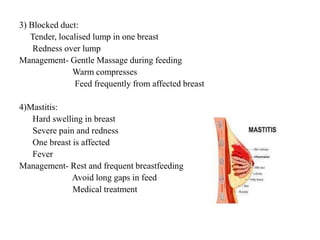
4)Mastitis:
Hard swelling in breast
Severe pain and redness
One breast is affected
Fever
Management- Rest and frequent breastfeeding
Avoid long gaps in feed
Medical treatment
5) Breast abscess-
Painful swelling in breast
Discoloration of skin
Secondary to mastitis
Management: Needs to be drained
Medical treatment
Feeding Expressed breastmilk
6)Sore or Fissured Nipple-
Severe nipple pain
Visible fissure at tip
Nipple may look squashed from side to side
Management: Improve Baby position
Good attachment
Apply hind milk after feeds
Do not wash with water repeatedly
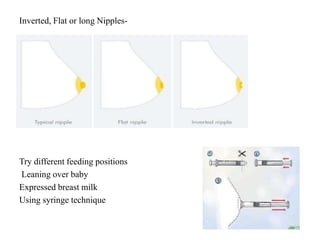
Inverted, Flat or long Nipples-
Try different feeding positions
Leaning over baby
Expressed breast milk
Using syringe technique
BREASTFEEDING.pptx
BREASTFEEDING.pptx

BREASTFEEDING.pptx

  • 1.
    BREASTFEEDING Guided by –Dr.Ramesh Pawar sir Presented by- Dr.Minal Holani Community Medicine dept MPHN 2nd Semester GMCH Akola GMCH Akola
  • 2.
    • Breastfeeding isthe process of feeding a mother's breast milk to her infant, either directly from the breast or by expressing (pumping out) the milk from the breast . • Breastmilk is safe, clean and contains antibodies which help protect against many common childhood illnesses. • The NFHS-5, National data revealed that 63.7% breastfed exclusively during 0-6 months,45.9 % received timely complementary feeds at 6-8 months and only 11.1% received adequate diet during 6-23 months..
  • 3.
    Initiation of breastfeedingwithin one hour of birth has increased from 9.5% in NFHS-1(1992-93) to 41.8 % in NFHS – 5 (2015-16)
  • 5.
    HORMONAL CONTROL OFMILK PRODUCTION Works before or during the feed to make milk flow
  • 6.
    • Prolactin isnecessary for the secretion of milk by the cells of the alveoli. • The prolactin level is highest about 30 minutes after the beginning of the feed. • Oxytocin makes the myoepithelial cells around the alveoli contract. • The oxytocin reflex is also sometimes called the “letdown reflex” or the “milk ejection reflex”. • Milk production is controlled in the breast by a substance called the feedback inhibitor of lactation, or FIL (a polypeptide), which is present in breast milk.
  • 7.
    Breast-milk composition • Breastmilk contains – 87%–88% water about 7% (60–70 g/L) carbohydrates 1% (8–10 g/L) protein 3.8% (35–40 g/L) fat. It contains Vitamins and minerals Breast milk also contains immunoglobulin A
  • 10.
    • Signs ofgood positioning Baby’s head and body are in line. Baby is held close to body. Baby’s whole body is supported with your arm along their back. Baby approaches breast nose to nipple, so that they come to breast from underneath the nipple.
  • 11.
    • Signs ofa good latch A comfortable experience with no pain. More areola is visible above baby’s mouth than below. Baby’s mouth is wide open. Their lower lip is turned out. Their chin is touching – or nearly touching – your breast. • Signs of a poor latch More of the areola is visible below the baby’s lower lip than upper lip . The baby’s mouth is not wide open. The baby’s lower lip points forward or is turned Inwards. The baby’s chin is away from the breast.
  • 12.
    • Signs ofeffective suckling  Baby takes slow deep suckles, sometimes pausing.  May be able to see or hear baby swallowing after one or two suckles.  Suckling is comfortable and pain free .  Baby finishes the feed, releases the breast and looks contented and relaxed.  Breast is softer after the feed.
  • 13.
    • Signs ofIneffective Suckling  Baby suckle quickly all the time without swallowing.  Cheeks may be drawn in as baby suckles.  Nipple may stay stretched out as baby stops suckling.  Baby may pull away from breast out of frustation and refuse to feed.  Breast may become engorged.
  • 14.
    • Step-by-step guideto latching on 1. Hold baby's whole body close with their nose at level with your nipple. 2. Let baby's head tip back a little so that their top lip can brush against nipple. This should help baby to make a wide, open mouth. 3. When baby's mouth opens wide, their chin should be able to touch breast first, with their head tipped back so that their tongue can reach as much breast as possible. 4. With baby's chin firmly touching breast and their nose clear, their mouth should be wide open. Baby's cheeks will look full and rounded as they feed.
  • 16.
    • CONTRAINDICATIONS TOBREASTFEEDING- MOTHERS SHOULD NOT BREAST FEED OR SHOULD NOT FEED EBM:  Infant is diagnosed with classic galactosemia, a rare genetic metabolic disorder  Mother has HIV  Mother is infected with human T-cell lymphotropic virus type I or type II (HTLV – 1/2)  Mother is using an illicit drug, such as opioids, PCP (phencyclidine) or cocaine.  Mother has suspected or confirmed Ebola virus disease
  • 17.
    MOTHERS SHOULD TEMPORARILYNOT BREASTFEED OR SHOULD NOT FEED EBM:  Mother is infected with untreated brucellosis  Mother has an active Herpes simplex virus infection with lesions present on the breast  Mother has mpox virus infection MOTHERS SHOULD TEMPORARILY NOT BREASTFEED BUT CAN FEED EBM:  Mother has untreated, active tuberculosis  Mother has active varicella (chicken pox) infection
  • 18.
    BFHI- 10 STEPSTO BREASTFEEDING • 1a. Comply fully with the International Code of Marketing of Breast-milk Substitutes and relevant World Health Assembly resolutions. • 1b. Have a written infant feeding policy that is routinely communicated to staff and parents. • 1c. Establish ongoing monitoring and data-management systems. • 2. Ensure that staff have sufficient knowledge, competence and skills to support breastfeeding. • 3. Discuss the importance and management of breastfeeding with pregnant women and their families. • 4. Facilitate immediate and uninterrupted skin-to-skin contact and support mothers to initiate breastfeeding as soon as possible after birth.
  • 19.
    • 5. Supportmothers to initiate and maintain breastfeeding and manage common difficulties. • 6. Do not provide breastfed newborns any food or fluids other than breast milk, unless medically indicated. • 7. Enable mothers and their infants to remain together and to practise rooming-in 24 hours a day. • 8. Support mothers to recognize and respond to their infants’cues for feeding. • 9. Counsel mothers on the use and risks of feeding bottles, teats and pacifiers. • 10. Coordinate discharge so that parents and their infants have timely access to ongoing support and care.
  • 21.
    • BREASTFEEDING INDIFFICULT SITUATIONS 1) Low Birth Weight : Recommended fluid intake is 60ml/kg/day and feed volume 15-20 ml (8 feeds in 24 hrs) Preferable options for feeding are- Expressed breast milk Donor breast milk Infant formula
  • 22.
    2) Malnutrition: For infantsless than 6 months – Continued breastfeeding Supplementary suckling technique Cup feeding 3) HIV : Replacement feeding (heat treated breast milk/ formula milk/animal milk) or Exclusive breastfeeding for 6 months
  • 23.
    BREAST CONDITIONS ANDFEEDING DIFFICULTIES – 1)Full Breasts- Breasts are heavy ,mother feels uncomfortable. Occurs from 3-5 days after delivery Management- Good attachment Breastfed frequently 2)Breast Engorgement- Breasts are swollen and oedematous Breasts are painful Skin is shiny and red Management- Good attachment Express milk be hand or pump Apply warm compresses Warm showers before expressing Cold compresses after feeding or expressing
  • 24.
    3) Blocked duct: Tender,localised lump in one breast Redness over lump Management- Gentle Massage during feeding Warm compresses Feed frequently from affected breast 4)Mastitis: Hard swelling in breast Severe pain and redness One breast is affected Fever Management- Rest and frequent breastfeeding Avoid long gaps in feed Medical treatment
  • 25.
    5) Breast abscess- Painfulswelling in breast Discoloration of skin Secondary to mastitis Management: Needs to be drained Medical treatment Feeding Expressed breastmilk 6)Sore or Fissured Nipple- Severe nipple pain Visible fissure at tip Nipple may look squashed from side to side Management: Improve Baby position Good attachment Apply hind milk after feeds Do not wash with water repeatedly
  • 26.
    Inverted, Flat orlong Nipples- Try different feeding positions Leaning over baby Expressed breast milk Using syringe technique