

Full-term and pre-term
newborn
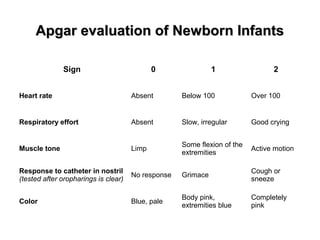
Apgar evaluation of Newborn InfantsApgar evaluation of Newborn Infants
Sign 0 1 2
Heart rate Absent Below 100 Over 100
Respiratory effort Absent Slow, irregular Good crying
Muscle tone Limp
Some flexion of the
extremities
Active motion
Response to catheter in nostril
(tested after oropharings is clear)
No response Grimace
Cough or
sneeze
Color Blue, pale
Body pink,
extremities blue
Completely
pink
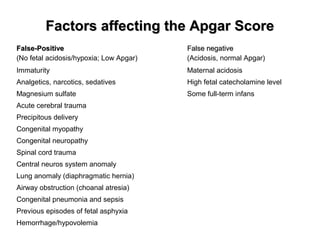
Factors affecting the Apgar ScoreFactors affecting the Apgar Score
False-PositiveFalse-Positive
(No fetal acidosis/hypoxia; Low Apgar)
False negativeFalse negative
(Acidosis, normal Apgar)
Immaturity Maternal acidosis
Analgetics, narcotics, sedatives High fetal catecholamine level
Magnesium sulfate Some full-term infans
Acute cerebral trauma
Precipitous delivery
Congenital myopathy
Congenital neuropathy
Spinal cord trauma
Central neuros system anomaly
Lung anomaly (diaphragmatic hernia)
Airway obstruction (choanal atresia)
Congenital pneumonia and sepsis
Previous episodes of fetal asphyxia
Hemorrhage/hypovolemia
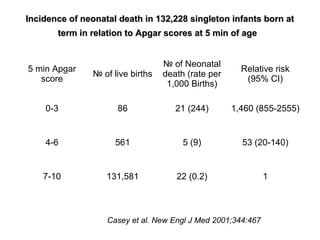
Incidence of neonatal death in 132,228 singleton infants born atIncidence of neonatal death in 132,228 singleton infants born at
term in relation to Apgar scores at 5 min of ageterm in relation to Apgar scores at 5 min of age
5 min Apgar
score
№ of live births
№ of Neonatal
death (rate per
1,000 Births)
Relative risk
(95% CI)
0-3 86 21 (244) 1,460 (855-2555)
4-6 561 5 (9) 53 (20-140)
7-10 131,581 22 (0.2) 1
Casey et al. New Engl J Med 2001;344:467
Sponsored
Medical Lecture Notes – All Subjects
USMLE Exam (America) – Practice
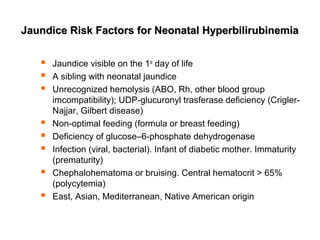
Jaundice Risk Factors for Neonatal HyperbilirubinemiaJaundice Risk Factors for Neonatal Hyperbilirubinemia
 Jaundice visible on the 1st
day of life
 A sibling with neonatal jaundice
 Unrecognized hemolysis (ABO, Rh, other blood group
imcompatibility); UDP-glucuronyl trasferase deficiency (Crigler-
Najjar, Gilbert disease)
 Non-optimal feeding (formula or breast feeding)
 Deficiency of glucose–6-phosphate dehydrogenase
 Infection (viral, bacterial). Infant of diabetic mother. Immaturity
(prematurity)
 Chephalohematoma or bruising. Central hematocrit > 65%
(polycytemia)
 East, Asian, Mediterranean, Native American origin
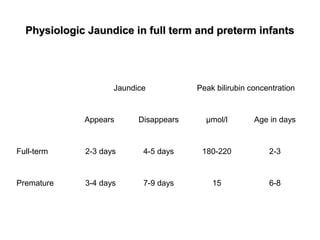
Physiologic Jaundice in full term and preterm infantsPhysiologic Jaundice in full term and preterm infants
Jaundice Peak bilirubin concentration
Appears Disappears µmol/l Age in days
Full-term 2-3 days 4-5 days 180-220 2-3
Premature 3-4 days 7-9 days 15 6-8
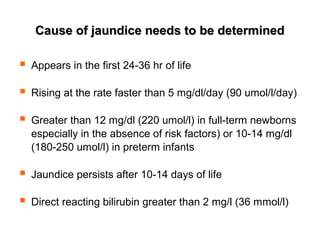
Cause of jaundice needs to be determinedCause of jaundice needs to be determined
 Appears in the first 24-36 hr of life
 Rising at the rate faster than 5 mg/dl/day (90 umol/l/day)
 Greater than 12 mg/dl (220 umol/l) in full-term newborns
especially in the absence of risk factors) or 10-14 mg/dl
(180-250 umol/l) in preterm infants
 Jaundice persists after 10-14 days of life
 Direct reacting bilirubin greater than 2 mg/l (36 mmol/l)
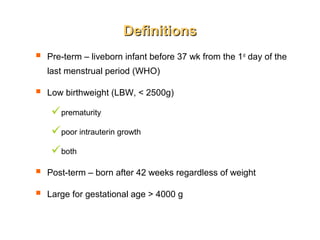
DefinitionsDefinitions
 Pre-term – liveborn infant before 37 wk from the 1st
day of the
last menstrual period (WHO)
 Low birthweight (LBW, < 2500g)
prematurity
poor intrauterin growth
both
 Post-term – born after 42 weeks regardless of weight
 Large for gestational age > 4000 g
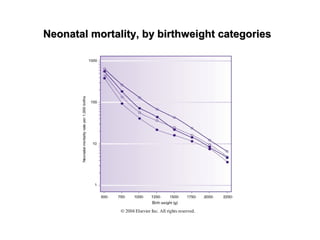
Neonatal mortality, by birthweight categoriesNeonatal mortality, by birthweight categories
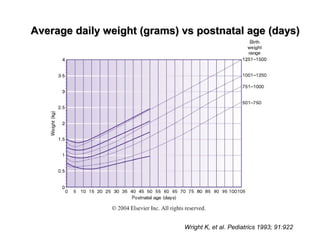
Average daily weight (grams) vs postnatal age (days)Average daily weight (grams) vs postnatal age (days)
Wright K, et al. Pediatrics 1993; 91:922

Full term & Pre term Newborn

  • 1.
  • 2.
    Apgar evaluation ofNewborn InfantsApgar evaluation of Newborn Infants Sign 0 1 2 Heart rate Absent Below 100 Over 100 Respiratory effort Absent Slow, irregular Good crying Muscle tone Limp Some flexion of the extremities Active motion Response to catheter in nostril (tested after oropharings is clear) No response Grimace Cough or sneeze Color Blue, pale Body pink, extremities blue Completely pink
  • 3.
    Factors affecting theApgar ScoreFactors affecting the Apgar Score False-PositiveFalse-Positive (No fetal acidosis/hypoxia; Low Apgar) False negativeFalse negative (Acidosis, normal Apgar) Immaturity Maternal acidosis Analgetics, narcotics, sedatives High fetal catecholamine level Magnesium sulfate Some full-term infans Acute cerebral trauma Precipitous delivery Congenital myopathy Congenital neuropathy Spinal cord trauma Central neuros system anomaly Lung anomaly (diaphragmatic hernia) Airway obstruction (choanal atresia) Congenital pneumonia and sepsis Previous episodes of fetal asphyxia Hemorrhage/hypovolemia
  • 4.
    Incidence of neonataldeath in 132,228 singleton infants born atIncidence of neonatal death in 132,228 singleton infants born at term in relation to Apgar scores at 5 min of ageterm in relation to Apgar scores at 5 min of age 5 min Apgar score № of live births № of Neonatal death (rate per 1,000 Births) Relative risk (95% CI) 0-3 86 21 (244) 1,460 (855-2555) 4-6 561 5 (9) 53 (20-140) 7-10 131,581 22 (0.2) 1 Casey et al. New Engl J Med 2001;344:467
  • 5.
    Sponsored Medical Lecture Notes– All Subjects USMLE Exam (America) – Practice
  • 6.
    Jaundice Risk Factorsfor Neonatal HyperbilirubinemiaJaundice Risk Factors for Neonatal Hyperbilirubinemia  Jaundice visible on the 1st day of life  A sibling with neonatal jaundice  Unrecognized hemolysis (ABO, Rh, other blood group imcompatibility); UDP-glucuronyl trasferase deficiency (Crigler- Najjar, Gilbert disease)  Non-optimal feeding (formula or breast feeding)  Deficiency of glucose–6-phosphate dehydrogenase  Infection (viral, bacterial). Infant of diabetic mother. Immaturity (prematurity)  Chephalohematoma or bruising. Central hematocrit > 65% (polycytemia)  East, Asian, Mediterranean, Native American origin
  • 7.
    Physiologic Jaundice infull term and preterm infantsPhysiologic Jaundice in full term and preterm infants Jaundice Peak bilirubin concentration Appears Disappears µmol/l Age in days Full-term 2-3 days 4-5 days 180-220 2-3 Premature 3-4 days 7-9 days 15 6-8
  • 8.
    Cause of jaundiceneeds to be determinedCause of jaundice needs to be determined  Appears in the first 24-36 hr of life  Rising at the rate faster than 5 mg/dl/day (90 umol/l/day)  Greater than 12 mg/dl (220 umol/l) in full-term newborns especially in the absence of risk factors) or 10-14 mg/dl (180-250 umol/l) in preterm infants  Jaundice persists after 10-14 days of life  Direct reacting bilirubin greater than 2 mg/l (36 mmol/l)
  • 9.
    DefinitionsDefinitions  Pre-term –liveborn infant before 37 wk from the 1st day of the last menstrual period (WHO)  Low birthweight (LBW, < 2500g) prematurity poor intrauterin growth both  Post-term – born after 42 weeks regardless of weight  Large for gestational age > 4000 g
  • 10.
    Neonatal mortality, bybirthweight categoriesNeonatal mortality, by birthweight categories
  • 11.
    Average daily weight(grams) vs postnatal age (days)Average daily weight (grams) vs postnatal age (days) Wright K, et al. Pediatrics 1993; 91:922