APPAREL INTERNSHIP JURY
BRANDIX APPAREL INDIA UNIT-1
VISAKHAPATNAM


Internship Mentor: Mr. Sumit Kumar Sharma
Industry Mentor: Mr. Vijaya Kumar Kodukula
Project Mentor: Mr. Murali Krishna Maddi


By:
Balla Bala Bhargava Tejaswani
MNS Pravallika
COMPANY PROFILE
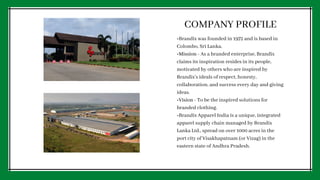
•Brandix was founded in 1972 and is based in
Colombo, Sri Lanka.
•Mission - As a branded enterprise, Brandix
claims its inspiration resides in its people,
motivated by others who are inspired by
Brandix’s ideals of respect, honesty,
collaboration, and success every day and giving
ideas.
•Vision - To be the inspired solutions for
branded clothing.
•Brandix Apparel India is a unique, integrated
apparel supply chain managed by Brandix
Lanka Ltd., spread on over 1000 acres in the
port city of Visakhapatnam (or Vizag) in the
eastern state of Andhra Pradesh.
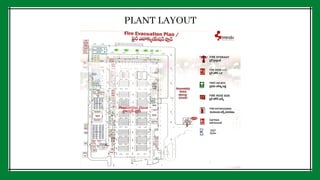
PLANT LAYOUT
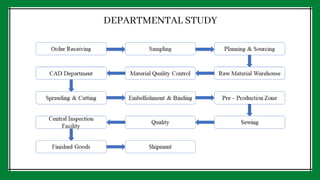
DEPARTMENTAL STUDY
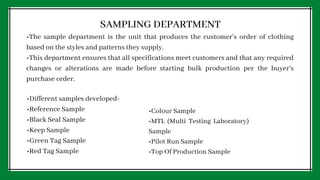
SAMPLING DEPARTMENT
•The sample department is the unit that produces the customer's order of clothing
based on the styles and patterns they supply.
•This department ensures that all specifications meet customers and that any required
changes or alterations are made before starting bulk production per the buyer's
purchase order.
•Different samples developed-
•Reference Sample
•Black Seal Sample
•Keep Sample
•Green Tag Sample
•Red Tag Sample
•Colour Sample
•MTL (Multi Testing Laboratory)
Sample
•Pilot Run Sample
•Top Of Production Sample
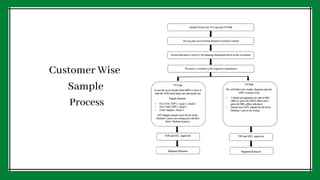
Customer Wise
Sample
Process
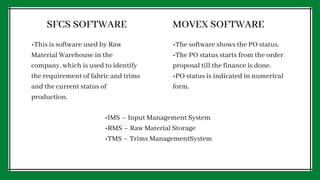
SFCS SOFTWARE MOVEX SOFTWARE
•This is software used by Raw
Material Warehouse in the
company, which is used to identify
the requirement of fabric and trims
and the current status of
production.
•The software shows the PO status.
•The PO status starts from the order
proposal till the finance is done.
•PO status is indicated in numerical
form.
•IMS – Input Management System
•RMS – Raw Material Storage
•TMS – Trims ManagementSystem
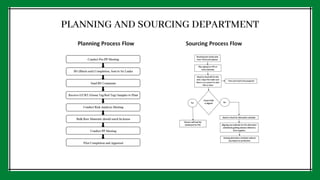
PLANNING AND SOURCING DEPARTMENT
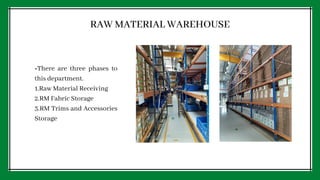
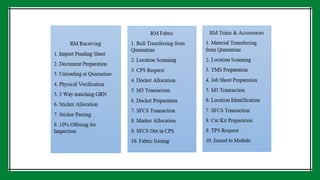
RAW MATERIAL WAREHOUSE
•There are three phases to
this department.
1.Raw Material Receiving
2.RM Fabric Storage
3.RM Trims and Accessories
Storage
Water spider is a term that refers to the specific person whose main role is to take
care of the tasks that are issued such as supplying materials to the workstation.
Water spiders classification for each section:
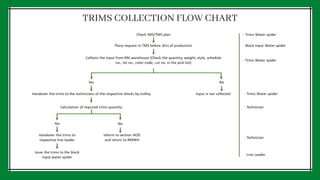
Trims water spider-1
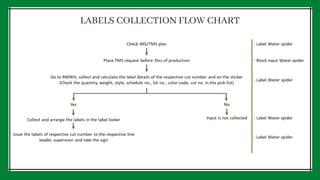
Label water spider-1
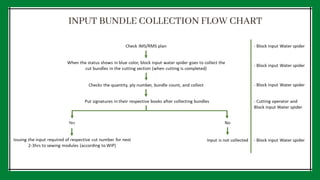
Block input water spider- 4 (for blocks A, B, C, D)
1.WATER SPIDER
TRIMS COLLECTION FLOW CHART
LABELS COLLECTION FLOW CHART
INPUT BUNDLE COLLECTION FLOW CHART
Checking IMS/TMS/RMS of the modules.
Put input request for TMS and get necessary input based on the module requirement.
Collect the cut bundles from the cutting section, counting the bundles and put signature
in the cutting operators book.
According to the WIP in the sewing module, input quantity is arranged in the input area.
[Trims are issued and arranged in total quantity, cut bundles are arranged for next 2-
3hrs]
Lace relaxation is done.
Elastic is arranged (provided in bins).
Issuing the input to the operators.
Cleaning the input area of sewing module.
Placing the trims in the return trims area (when the style is closed)
INPUT WATER SPIDER JOB ROLE
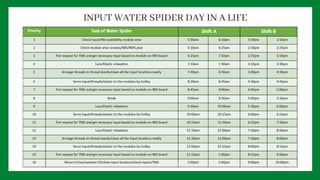
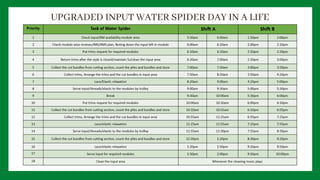
INPUT WATER SPIDER DAY IN A LIFE
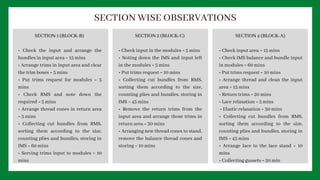
SECTION 1 (BLOCK-B)
• Check the input and arrange the
bundles in input area = 15 mins
• Arrange trims in input area and clear
the trim boxes = 5 mins
• Put trims request for modules = 5
mins
• Check RMS and note down the
required = 5 mins 
• Arrange thread cones in return area
= 5 mins
• Collecting cut bundles from RMS,
sorting them according to the size,
counting plies and bundles, storing in
IMS = 60 mins
• Serving trims input to modules = 10
mins
SECTION 2 (BLOCK-C)


• Check input in the modules = 5 mins
• Noting down the IMS and input left
in the modules = 5 mins
• Put trims request = 10 mins
• Collecting cut bundles from RMS,
sorting them according to the size,
counting plies and bundles, storing in
IMS = 45 mins
• Remove the return trims from the
input area and arrange those trims in
return area = 30 mins
• Arranging new thread cones to stand,
remove the balance thread cones and
storing = 10 mins
SECTION 4 (BLOCK-A)


• Check input area = 15 mins
• Check IMS balance and bundle input
in modules = 60 mins
• Put trims request = 10 mins
• Arrange thread and clean the input
area = 15 mins
• Return trims = 20 mins
• Lace relaxation = 5 mins
• Elastic relaxation = 30 mins
• Collecting cut bundles from RMS,
sorting them according to the size,
counting plies and bundles, storing in
IMS = 45 mins
• Arrange lace to the lace stand = 10
mins
• Collecting gussets = 20 min
SECTION WISE OBSERVATIONS
UPGRADED INPUT WATER SPIDER DAY IN A LIFE
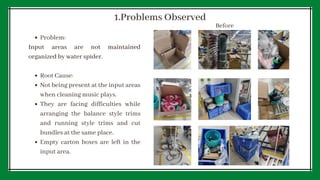
Problem:
Root Cause:
Not being present at the input areas
when cleaning music plays.
They are facing difficulties while
arranging the balance style trims
and running style trims and cut
bundles at the same place.
Empty carton boxes are left in the
input area.
Input areas are not maintained
organized by water spider.
1.Problems Observed
Before
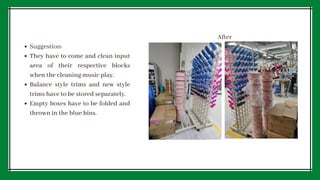
Suggestion:
They have to come and clean input
area of their respective blocks
when the cleaning music play.
Balance style trims and new style
trims have to be stored separately.
Empty boxes have to be folded and
thrown in the blue bins.
After
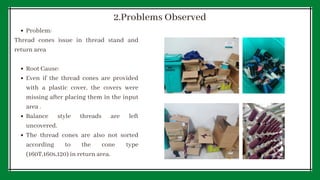
Problem:
Root Cause:
Even if the thread cones are provided
with a plastic cover, the covers were
missing after placing them in the input
area .
Balance style threads are left
uncovered.
The thread cones are also not sorted
according to the cone type
(160T,160s,120) in return area.
Thread cones issue in thread stand and
return area
2.Problems Observed
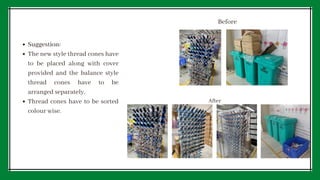
Suggestion:
The new style thread cones have
to be placed along with cover
provided and the balance style
thread cones have to be
arranged separately.
Thread cones have to be sorted
colour wise.
Before
After
2. TRIMS RECONCILIATION
Trims reconciliation is a process that is used to do the analysis of trims
consumption.
What percentage of trims are used for one style, what percentage of trims is
left after production, what is the percentage of trims wastage is calculated.
Trims reconciliation helps to understand the required quantity and arrange it
in the sewing module.
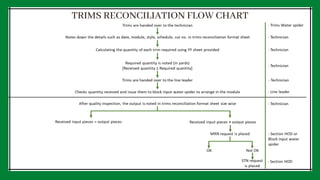
TRIMS RECONCILIATION FLOW CHART
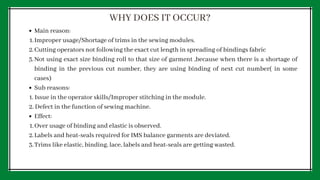
Main reason:
Improper usage/Shortage of trims in the sewing modules.
Cutting operators not following the exact cut length in spreading of bindings fabric
Not using exact size binding roll to that size of garment ,because when there is a shortage of
binding in the previous cut number, they are using binding of next cut number( in some
cases)
Sub reasons:
Effect:
Over usage of binding and elastic is observed.
Labels and heat-seals required for IMS balance garments are deviated.
Trims like elastic, binding, lace, labels and heat-seals are getting wasted.
1.
2.
3.
1. Issue in the operator skills/Improper stitching in the module.
2. Defect in the function of sewing machine.
1.
2.
3.
WHY DOES IT OCCUR?
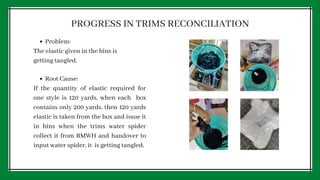
Problem:
The elastic given in the bins is
getting tangled.
Root Cause:
If the quantity of elastic required for
one style is 120 yards, when each box
contains only 200 yards, then 120 yards
elastic is taken from the box and issue it
in bins when the trims water spider
collect it from RMWH and handover to
input water spider, it is getting tangled.
PROGRESS IN TRIMS RECONCILIATION
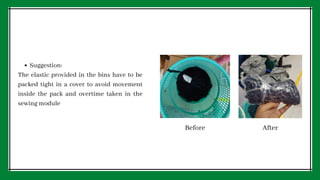
Suggestion:
The elastic provided in the bins have to be
packed tight in a cover to avoid movement
inside the pack and overtime taken in the
sewing module
Before After
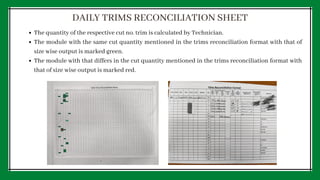
DAILY TRIMS RECONCILIATION SHEET
The quantity of the respective cut no. trim is calculated by Technician.
The module with the same cut quantity mentioned in the trims reconciliation format with that of
size wise output is marked green.
The module with that differs in the cut quantity mentioned in the trims reconciliation format with
that of size wise output is marked red.
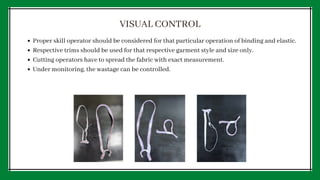
Proper skill operator should be considered for that particular operation of binding and elastic.
Respective trims should be used for that respective garment style and size only.
Cutting operators have to spread the fabric with exact measurement.
Under monitoring, the wastage can be controlled.
VISUAL CONTROL
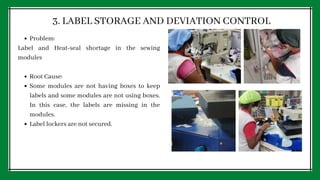
Problem:
Root Cause:
Some modules are not having boxes to keep
labels and some modules are not using boxes.
In this case, the labels are missing in the
modules.
Label lockers are not secured.
Label and Heat-seal shortage in the sewing
modules
3. LABEL STORAGE AND DEVIATION CONTROL
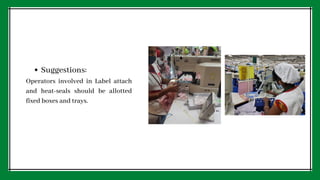
Suggestions:
Operators involved in Label attach
and heat-seals should be allotted
fixed boxes and trays.
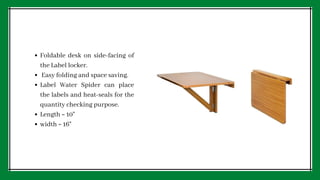
Foldable desk on side-facing of
the Label locker.
Easy folding and space saving.
Label Water Spider can place
the labels and heat-seals for the
quantity checking purpose.
Length = 10
width = 16
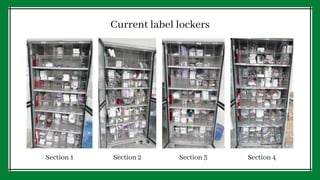
Current label lockers
Section 1 Section 4
Section 3
Section 2
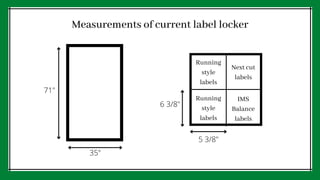
Measurements of current label locker
71
35
6 3/8
5 3/8
Running
style
labels
Running
style
labels
Next cut
labels
IMS
Balance
labels
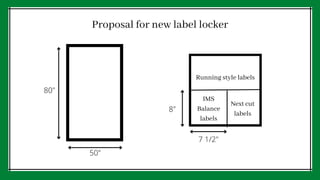
Proposal for new label locker
80
50
8
7 1/2
Running style labels
IMS
Balance
labels
Next cut
labels
THANK YOU!

brandix ppt.pdf

  • 1.
    APPAREL INTERNSHIP JURY BRANDIXAPPAREL INDIA UNIT-1 VISAKHAPATNAM Internship Mentor: Mr. Sumit Kumar Sharma Industry Mentor: Mr. Vijaya Kumar Kodukula Project Mentor: Mr. Murali Krishna Maddi By: Balla Bala Bhargava Tejaswani MNS Pravallika
  • 2.
    COMPANY PROFILE •Brandix wasfounded in 1972 and is based in Colombo, Sri Lanka. •Mission - As a branded enterprise, Brandix claims its inspiration resides in its people, motivated by others who are inspired by Brandix’s ideals of respect, honesty, collaboration, and success every day and giving ideas. •Vision - To be the inspired solutions for branded clothing. •Brandix Apparel India is a unique, integrated apparel supply chain managed by Brandix Lanka Ltd., spread on over 1000 acres in the port city of Visakhapatnam (or Vizag) in the eastern state of Andhra Pradesh.
  • 3.
  • 4.
  • 5.
    SAMPLING DEPARTMENT •The sampledepartment is the unit that produces the customer's order of clothing based on the styles and patterns they supply. •This department ensures that all specifications meet customers and that any required changes or alterations are made before starting bulk production per the buyer's purchase order. •Different samples developed- •Reference Sample •Black Seal Sample •Keep Sample •Green Tag Sample •Red Tag Sample •Colour Sample •MTL (Multi Testing Laboratory) Sample •Pilot Run Sample •Top Of Production Sample
  • 6.
  • 7.
    SFCS SOFTWARE MOVEXSOFTWARE •This is software used by Raw Material Warehouse in the company, which is used to identify the requirement of fabric and trims and the current status of production. •The software shows the PO status. •The PO status starts from the order proposal till the finance is done. •PO status is indicated in numerical form. •IMS – Input Management System •RMS – Raw Material Storage •TMS – Trims ManagementSystem
  • 8.
  • 9.
    RAW MATERIAL WAREHOUSE •Thereare three phases to this department. 1.Raw Material Receiving 2.RM Fabric Storage 3.RM Trims and Accessories Storage
  • 23.
    Water spider isa term that refers to the specific person whose main role is to take care of the tasks that are issued such as supplying materials to the workstation. Water spiders classification for each section: Trims water spider-1 Label water spider-1 Block input water spider- 4 (for blocks A, B, C, D) 1.WATER SPIDER
  • 24.
  • 25.
  • 26.
  • 27.
    Checking IMS/TMS/RMS ofthe modules. Put input request for TMS and get necessary input based on the module requirement. Collect the cut bundles from the cutting section, counting the bundles and put signature in the cutting operators book. According to the WIP in the sewing module, input quantity is arranged in the input area. [Trims are issued and arranged in total quantity, cut bundles are arranged for next 2- 3hrs] Lace relaxation is done. Elastic is arranged (provided in bins). Issuing the input to the operators. Cleaning the input area of sewing module. Placing the trims in the return trims area (when the style is closed) INPUT WATER SPIDER JOB ROLE
  • 28.
    INPUT WATER SPIDERDAY IN A LIFE
  • 29.
    SECTION 1 (BLOCK-B) •Check the input and arrange the bundles in input area = 15 mins • Arrange trims in input area and clear the trim boxes = 5 mins • Put trims request for modules = 5 mins • Check RMS and note down the required = 5 mins • Arrange thread cones in return area = 5 mins • Collecting cut bundles from RMS, sorting them according to the size, counting plies and bundles, storing in IMS = 60 mins • Serving trims input to modules = 10 mins SECTION 2 (BLOCK-C) • Check input in the modules = 5 mins • Noting down the IMS and input left in the modules = 5 mins • Put trims request = 10 mins • Collecting cut bundles from RMS, sorting them according to the size, counting plies and bundles, storing in IMS = 45 mins • Remove the return trims from the input area and arrange those trims in return area = 30 mins • Arranging new thread cones to stand, remove the balance thread cones and storing = 10 mins SECTION 4 (BLOCK-A) • Check input area = 15 mins • Check IMS balance and bundle input in modules = 60 mins • Put trims request = 10 mins • Arrange thread and clean the input area = 15 mins • Return trims = 20 mins • Lace relaxation = 5 mins • Elastic relaxation = 30 mins • Collecting cut bundles from RMS, sorting them according to the size, counting plies and bundles, storing in IMS = 45 mins • Arrange lace to the lace stand = 10 mins • Collecting gussets = 20 min SECTION WISE OBSERVATIONS
  • 30.
    UPGRADED INPUT WATERSPIDER DAY IN A LIFE
  • 31.
    Problem: Root Cause: Not beingpresent at the input areas when cleaning music plays. They are facing difficulties while arranging the balance style trims and running style trims and cut bundles at the same place. Empty carton boxes are left in the input area. Input areas are not maintained organized by water spider. 1.Problems Observed Before
  • 32.
    Suggestion: They have tocome and clean input area of their respective blocks when the cleaning music play. Balance style trims and new style trims have to be stored separately. Empty boxes have to be folded and thrown in the blue bins. After
  • 33.
    Problem: Root Cause: Even ifthe thread cones are provided with a plastic cover, the covers were missing after placing them in the input area . Balance style threads are left uncovered. The thread cones are also not sorted according to the cone type (160T,160s,120) in return area. Thread cones issue in thread stand and return area 2.Problems Observed
  • 34.
    Suggestion: The new stylethread cones have to be placed along with cover provided and the balance style thread cones have to be arranged separately. Thread cones have to be sorted colour wise. Before After
  • 35.
    2. TRIMS RECONCILIATION Trimsreconciliation is a process that is used to do the analysis of trims consumption. What percentage of trims are used for one style, what percentage of trims is left after production, what is the percentage of trims wastage is calculated. Trims reconciliation helps to understand the required quantity and arrange it in the sewing module.
  • 36.
  • 37.
    Main reason: Improper usage/Shortageof trims in the sewing modules. Cutting operators not following the exact cut length in spreading of bindings fabric Not using exact size binding roll to that size of garment ,because when there is a shortage of binding in the previous cut number, they are using binding of next cut number( in some cases) Sub reasons: Effect: Over usage of binding and elastic is observed. Labels and heat-seals required for IMS balance garments are deviated. Trims like elastic, binding, lace, labels and heat-seals are getting wasted. 1. 2. 3. 1. Issue in the operator skills/Improper stitching in the module. 2. Defect in the function of sewing machine. 1. 2. 3. WHY DOES IT OCCUR?
  • 38.
    Problem: The elastic givenin the bins is getting tangled. Root Cause: If the quantity of elastic required for one style is 120 yards, when each box contains only 200 yards, then 120 yards elastic is taken from the box and issue it in bins when the trims water spider collect it from RMWH and handover to input water spider, it is getting tangled. PROGRESS IN TRIMS RECONCILIATION
  • 39.
    Suggestion: The elastic providedin the bins have to be packed tight in a cover to avoid movement inside the pack and overtime taken in the sewing module Before After
  • 40.
    DAILY TRIMS RECONCILIATIONSHEET The quantity of the respective cut no. trim is calculated by Technician. The module with the same cut quantity mentioned in the trims reconciliation format with that of size wise output is marked green. The module with that differs in the cut quantity mentioned in the trims reconciliation format with that of size wise output is marked red.
  • 41.
    Proper skill operatorshould be considered for that particular operation of binding and elastic. Respective trims should be used for that respective garment style and size only. Cutting operators have to spread the fabric with exact measurement. Under monitoring, the wastage can be controlled. VISUAL CONTROL
  • 42.
    Problem: Root Cause: Some modulesare not having boxes to keep labels and some modules are not using boxes. In this case, the labels are missing in the modules. Label lockers are not secured. Label and Heat-seal shortage in the sewing modules 3. LABEL STORAGE AND DEVIATION CONTROL
  • 43.
    Suggestions: Operators involved inLabel attach and heat-seals should be allotted fixed boxes and trays.
  • 44.
    Foldable desk onside-facing of the Label locker. Easy folding and space saving. Label Water Spider can place the labels and heat-seals for the quantity checking purpose. Length = 10 width = 16
  • 45.
    Current label lockers Section1 Section 4 Section 3 Section 2
  • 46.
    Measurements of currentlabel locker 71 35 6 3/8 5 3/8 Running style labels Running style labels Next cut labels IMS Balance labels
  • 47.
    Proposal for newlabel locker 80 50 8 7 1/2 Running style labels IMS Balance labels Next cut labels
  • 48.