0 | P a g e 
Final Report 
Managing People for High Performance 
Submitted to: 
Sir.Nabeel Arif 
Submitted by: 
ShahidNadeem (RMBA Fall 12-025) 
Hassan Salman (RMBA Fall 12-022) 
Muhammad Saleem (RMBA Fall 12-023) 
 
ShanzaMehmood (RMBA Fall 12-037) 
Muhammad Azeem (EXMBA Fall 10-026) 
Date of submission: 
29th May, 2014 
Institute of Business & Management 
University of Engineering & Technology 
Lahore
Table of Contents 
Dedication....................................................................................................................................... 3 
Acknowledgement ......................................................................................................................... 4 
Executive Summary ........................................................................................................................ 5 
Organizational Structure ............................................................................................................. 7 
Organogram – Hosiery ................................................................................................................... 8 
Project Background ........................................................................................................................ 9 
Decision Making ......................................................................................................................... 9 
Suggestions / Strategies for Improvement ................................................................................. 10 
Decentralized Structure............................................................................................................ 10 
ERP Training .............................................................................................................................. 11 
Job Rotation and Effective Planning in Task Design................................................................ 11 
Performance Management ...................................................................................................... 11 
Justice & Equity ............................................................................................................................ 12 
Grievance Redressal System .................................................................................................... 12 
Performance Management System ............................................................................................. 13 
Strategy Map for Interloop .......................................................................................................... 16 
Competencies ............................................................................................................................... 18 
Balance Scorecard ........................................................................................................................ 19 
Comparison of Stated Versus Achieved Score of Objectives .................................................. 21 
Actual Performance .................................................................................................................. 22 
Targets....................................................................................................................................... 22 
Graphical Presentation of Balance Scorecard Scores ................................................................. 23 
Financial Perspective ................................................................................................................ 23 
Comments ................................................................................................................................. 24 
Customer Perspective............................................................................................................... 25 
Comments ................................................................................................................................. 26 
1 | P a g e
Internal Perspective ..................................................................................................................... 27 
Comments ................................................................................................................................. 28 
Learning & Growth Perspective ................................................................................................... 29 
Comments ................................................................................................................................. 30 
Conclusion..................................................................................................................................... 31 
2 | P a g e
3 | P a g e 
THIS REPORT IS 
DEDICATED TO OUR 
RESPECTED 
TEACHERS AND 
BELOVED GRAND 
PARENTS. 
Dedication
4 | P a g e 
Acknowledgement
5 | P a g e 
Executive Summary 
This report is analysis of Interloop, one of the world’s largest socks manufacturer with an annual 
company turnover exceeding $200 million, to identify its elements of high performance work 
system. Organizational structure, Information system, Task design, Reward system, People 
(selection, training and development), Justice and equity are few aspects critically analyzed in 
this regard. 
The effects of these defined elements on productivity and efficiency, Contribution to cost, 
product quality, customer satisfaction, employee turnover, learning organizations on Interloop 
are also investigated. Our team has recommended few solutions / strategies to these identified 
key issues which arehampering growth of Interloop. We are very optimistic that Interloop will 
overcome these hurdles if they apply these strategies in true sense. 
Moreover, we have critically analyzed Performance Management System of Interloopand tried to 
present our understanding of this system.
6 | P a g e 
Company Introduction 
Interloop started out in 1992 with just 10 knitting machines, now has 2300 machines and a 
workforce of more than 13500. Interloop Limited has transformed itself into South Asia’s largest 
Socks Manufacturer and Exporter offering the highest quality socks at a level of service 
unknown in our industry. It is located in Pakistan's Industrial hub Faisalabad and Lahore. 
Interloop is an integral part of this business community, continuously striving to revolutionize 
business practices in this region. 
Interloop is a complete vertical unit offering a wide range of price points and needle counts and 
is on the cutting edge in terms of the latest technology for each production process. They believe 
their success is due to a highly focused concentration on quality and speedy turnaround, a 
combination which increases its customers' edge in a highly competitive marketplace. In 
pursuance of its goal to achieve and maintain good quality, Interloop set up a High-Tech 
Spinning Unit that will ensure finest quality yarn made from the best available natural cotton. 
This project has enhanced the value of money for our customers by offering even more 
competitive rates to its clients. 
Hard work and utmost commitment from its employees and management, strict Quality Control 
Measures, timely Shipments and reliable Service Standards have been paramount towards 
Interloop's phenomenal growth. It is one of the very few firms in Pakistan with an impressive 
Social Responsibility Portfolio, realizing that a commitment to sustainability in all areas of 
commercial activity endorse the long term interests of a business.
7 | P a g e 
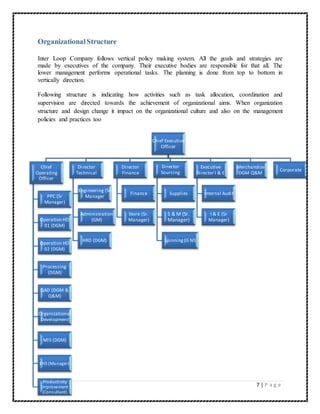
Organizational Structure 
Inter Loop Company follows vertical policy making system. All the goals and strategies are 
made by executives of the company. Their executive bodies are responsible for that all. The 
lower management performs operational tasks. The planning is done from top to bottom in 
vertically direction. 
Following structure is indicating how activities such as task allocation, coordination and 
supervision are directed towards the achievement of organizational aims. When organization 
structure and design change it impact on the organizational culture and also on the management 
policies and practices too 
Chief Executive 
Officer 
Chief 
Operating 
Officer 
PPC (Sr 
Manager) 
Operation HD 
01 (DGM) 
Operation HD 
02 (DGM) 
Processing 
(DGM) 
QAD (DGM & 
Q&M) 
Organizational 
Development 
MIS (DGM) 
EHS (Manager) 
Productivity 
improvement 
(Consultant) 
Director 
Technical 
Engineering (Sr 
Manager 
Administration 
(GM) 
HRD (DGM) 
Director 
Finance 
Finance 
Store (Sr. 
Manager) 
Director 
Sourcing 
Supplies 
S & M (Sr. 
Manager) 
Spinning (G M) 
Executive 
Director I & E 
Internal Audit 
I & E (Sr 
Manager) 
Merchandize 
DGM Q&M 
Corporate
8 | P a g e 
Organogram – Hosiery
Project Background 
We have identified issues in the system of Interloop mentioned in the last report submitted. Now 
we are suggesting Interloop few strategies for removing and improving its system which are as 
follows: 
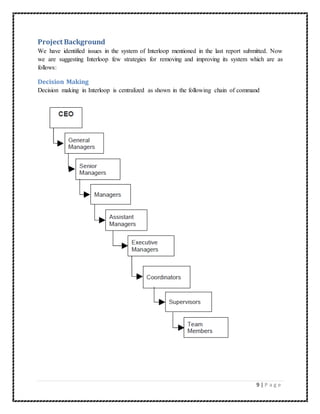
Decision Making 
Decision making in Interloop is centralized as shown in the following chain of command 
9 | P a g e
10 | P a g e 
Suggestions / Strategies for Improvement 
Decentralized Structure 
Interloop should use the model of TQM (from downward to upward) by decentralization and delegate the 
power to the front level employees for making decisions to avoid any wastage and increase the efficiency. 
Because any organization cannot grow unless the management delegate powers. 
For example, an inspection executive receiving and inspecting raw material cotton bags in huge quantities 
should have authority, after consultation with immediate supervisor, to accept or reject particular type of 
product. The same procedure should be used for finished goods delivery to avoid any kind of delay. 
Recommended decentralized chain of command is as follows: 
Team 
Members 
Supervisors 
Coordinators 
Executive 
Manager 
Assistant 
Manager 
Managers 
Senior 
Managers 
General 
Managers 
CEO
ERP Training 
Interloop must schedule ERP training sessions for selected employees recommended by department heads 
with regular interval for optimal utilization of ERP. Once implemented thoroughly, Interloop can save 
huge amount of cost which can used in other development projects. 
11 | P a g e 
ERP user manuals should be available in every relevant department for references purpose. 
Job Rotation and Effective Planning in Task Design 
The management reliance on particular employee for completing any task can be minimized by 
rotating employees on different areas of departments. Every personnel of department should 
know responsibilities of every employee to avoid any delay. This will help them in following 
ways: 
o Decision.It will improve tactical-level decisions throughout the Interloop. It will also 
remove many small decisions from senior management, which therefore has more time to 
develop strategic direction. 
o Speed. Since there are fewer layers of bureaucracy in a decentralized structure, 
Interloopwould be able to make decisions more quickly, which is useful in a highly 
competitive environment. 
o Turnover. Employees who are given more authority tend to stay with aInterloop longer, 
so employee turnover declines. 
o Training. Giving some authority to local managers is an excellent way to observe their 
decision-making ability, which can be used to determine advancement to higher 
positions. 
o Wide span of control. There is less need for middle managers, since many employees can 
report to fewer managers. This reduces overhead costs. 
Task assignment and planning should be done in sucha way that no employee gets 
overburden for achieving targets. 
Performance Management 
Interloop should implement well acquired Performance Management System (analyzed later) to 
avoid any kind of biasness like recency effect, personal biases has been seen in Interloop. 
Interloop must developa system of evaluation which involves employee himself/herself for feedback and 
ultimately it will enhance their motivation level.
12 | P a g e 
Justice & Equity 
Grievance Redressal System 
We are suggesting Interloop a Grievance Redressal System to resolve differences in peaceful, 
orderly and expeditious manner. 
It enables the parties to investigate and discuss the problem through 
(i) Open-door policy 
(ii) Step ladder type 
(iii) Grievance handling committee 
Steps in Handling Grievances 
Interloop should follow the points mentioned below: 
1. Receive and define the nature of dissatisfaction. 
(a) Manner and attitude when complaint is received 
(b) Acknowledging grievance – it will create a conducive work environment with instances 
of grievance reduced. 
(c) Assessment must be made that the complaint is presented fairly. 
(d) Statement and issues must not be pre-judged. 
(e) Proper time and attention is given. 
2. Get the facts 
(a) Facts are separated from impressions and opinions. 
(b) Consult the policies. 
(c) Consult the records. 
3. Analyze the cause of grievance and decide alternative course of actions should be though to 
manage it. 
4. Execution and review 
The manager should execute the decision quickly, ignoring the fact, that it may or may not hurt 
the employees concerned. 
5. Follow-up 
After implementing the decision, a follow-up must be there to ensure that the grievance has been 
resolved completely and adequately.
13 | P a g e 
Performance Management System
14 | P a g e 
Setting of Personal Objective / Personal Performance Plan 
Goals are determined for each personnel of departments at the start of year till 30th January. The 
following factors are considered while setting goals for individuals: 
 Look at your business and departmental goals 
 Identify where you could deliver results to support your business and department 
 Create SMART objectives and development of actions 
 Use the success factors as a reference in creating development of actions 
 Discuss and agree your personal objectives and development of actions for the 
year with your manager 
 Ensure your agreed objectives and development of actions are recorded on your 
P&D Dialogue paper 
Performance Dialogue I 
This supervisor / head dialogue is for reviewing the objectives to assess progress and adjust if 
necessary, based on changing business needs or priorities.Coaching the individuals if required. 
The period of dialogue is from 1st to 10th of April every year. 
Mid Year Performance Management Review Meeting 
The period of midyear performance management review is from 20thto 30th of June every year 
which consists of following points: 
 Internal audit of performance 
 Hold frequent informal feedback, discussion with your manager throughout the 
performance year 
 Hold a more formal dialogue with your manager in the middle of the year 
 Review your progress on objectives and development of actions 
 Discuss long term development plans 
Performance Dialogue II 
This performance dialogue longs from 15th to 30th of September every year to discuss following 
matters: 
 Review progress and accomplishments 
 Evaluate performance against the objectives agreed upon
15 | P a g e 
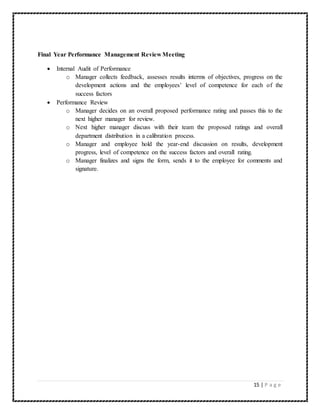
Final Year Performance Management Review Meeting 
 Internal Audit of Performance 
o Manager collects feedback, assesses results interms of objectives, progress on the 
development actions and the employees’ level of competence for each of the 
success factors 
 Performance Review 
o Manager decides on an overall proposed performance rating and passes this to the 
next higher manager for review. 
o Next higher manager discuss with their team the proposed ratings and overall 
department distribution in a calibration process. 
o Manager and employee hold the year-end discussion on results, development 
progress, level of competence on the success factors and overall rating. 
o Manager finalizes and signs the form, sends it to the employee for comments and 
signature.
16 | P a g e 
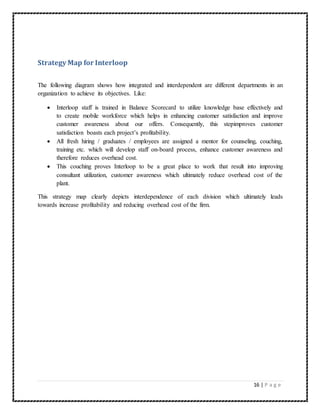
Strategy Map for Interloop 
The following diagram shows how integrated and interdependent are different departments in an 
organization to achieve its objectives. Like: 
 Interloop staff is trained in Balance Scorecard to utilize knowledge base effectively and 
to create mobile workforce which helps in enhancing customer satisfaction and improve 
customer awareness about our offers. Consequently, this stepimproves customer 
satisfaction boasts each project’s profitability. 
 All fresh hiring / graduates / employees are assigned a mentor for counseling, couching, 
training etc. which will develop staff on-board process, enhance customer awareness and 
therefore reduces overhead cost. 
 This couching proves Interloop to be a great place to work that result into improving 
consultant utilization, customer awareness which ultimately reduce overhead cost of the 
plant. 
This strategy map clearly depicts interdependence of each division which ultimately leads 
towards increase profitability and reducing overhead cost of the firm.
17 | P a g e 
Financial 
Customer 
Internal 
Learning & Growth 
Increase Project Profitability Reduce Overhead Cost 
Improve Customer Satisfaction Improve Customer Awareness 
Better Use of Knowledge Base Improve Staff on-board process Improve Consultant Utilization 
Create a mobile workforce Automate Invoice Processing 
All Staff Trained in Balance Scorecard All Graduates have a Mentor A great place to work
18 | P a g e 
Competencies 
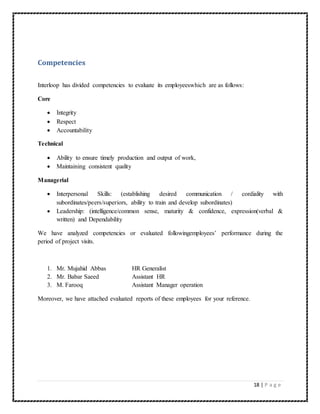
Interloop has divided competencies to evaluate its employeeswhich are as follows: 
Core 
 Integrity 
 Respect 
 Accountability 
Technical 
 Ability to ensure timely production and output of work, 
 Maintaining consistent quality 
Managerial 
 Interpersonal Skills: (establishing desired communication / cordiality with 
subordinates/peers/superiors, ability to train and develop subordinates) 
 Leadership: (intelligence/common sense, maturity & confidence, expression(verbal & 
written) and Dependability 
We have analyzed competencies or evaluated followingemployees’ performance during the 
period of project visits. 
1. Mr. Mujahid Abbas HR Generalist 
2. Mr. Babar Saeed Assistant HR 
3. M. Farooq Assistant Manager operation 
Moreover, we have attached evaluated reports of these employees for your reference.
19 | P a g e 
Balance Scorecard 
Interloop is working on the following objectives to alignbusiness activities to its vision and 
strategy, improve internal and external communications, and monitor overall performance 
against strategic goals. 
It provides a framework that not only provides performance measurements, but helps Interlooop 
planners identify what should be done and measured. Moreover, it enables executives to truly 
execute their strategies. 
Financial Perspective 
 Increase Project Profitability 
o Projetcs greater than 250 million 
o Operating Profit 
o % Operating Profit 
 Reduce Overhead Cost 
o % overhead to revenue 
o Sales people trained in software 
Internal Perspective 
 Better use of knowledge base 
o Number of items in database 
o Number of hits to database 
o Total Number of Industry template 
 Improve staff on-board process 
o % staff through company induction 
o Cost to crecruit per head 
 Improve consultant utilization 
o % consultant utilization 
o No. of new projects found 
 Create a mobile workforce 
o Sales staff issues with iPads 
 Automate invoice processing 
o Days taken to issue an incoice 
o Number of bad debts issued
20 | P a g e 
Customer Perspective 
 Improve Customer Satisfaction 
o % Satisfaction Surveys complete 
o Satisfaction Survey score 
o Consultant days on customer site 
 Improve Customer Awareness 
o Position 1 in Google search 
o Number of customer meetings 
Learning & Growth Perspective 
 All staff trained on Balance Scorecard 
o Number of courses booked 
o Number of courses attended 
o Total number of staff trained 
 All graduates have a mentor 
o % graduates with a mentor 
o Number of consultants mentoring 
 A great place to work 
o Employee staisfaction score 
o Number of CVs received
21 | P a g e 
Comparison of Stated Versus Achieved Score of Objectives 
The Annex-I is explanation of objectives in more detail and comparison of stated versus 
achieved targets in terms of scores. 
 According to the Annex-I, Interloop has successfully exceeded the target in enhancing 
project profitability and performed reasonably well in Financial Perspective. 
 Interloop has surpassed the targets in improving its customer awareness and performed 
very well in enhancing customer satisfaction as shown by figures in Annex-I. 
 Moreover, the information in Annex-I reveals effectiveness of internal perspective of 
Interloop managed to meet some targets but needs a lot of improvements in this area 
particularly delegation. 
 Furthermore, Interloop has excelled in learning and growth perspective except number of 
consultants appointed for mentoring and number of CVs received which needs 
improvement as per data menioned in Annex-I.
22 | P a g e 
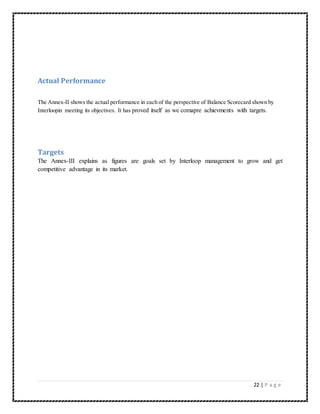
Actual Performance 
The Annex-II shows the actual performance in each of the perspective of Balance Scorecard shown by 
Interloopin meeting its objectives. It has proved itself as we comapre achievments with targets. 
Targets 
The Annex-III explains as figures are goals set by Interloop management to grow and get 
competitive advantage in its market.
Graphical Presentation of Balance Scorecard Scores 
We have analyzed each of the perspective separately and shown in graphically to understand it 
thoroughly. 
23 | P a g e 
Financial Perspective 
Objective: Increase Project Profitability 
Month 
Actual 
Target 
%Achieved 
April 
0 
1 
0% 
May 
1 
1 
100% 
June 
1 
1 
100% 
July 
2 
2 
100% 
August 
2 
2 
100% 
September 
2 
October 
3 
November 
3 
December 
3 
January 
4 
February 
4 
March 
4 
4.5 
4 
3.5 
3 
2.5 
2 
1.5 
1 
0.5 
0 
Actual 
Target
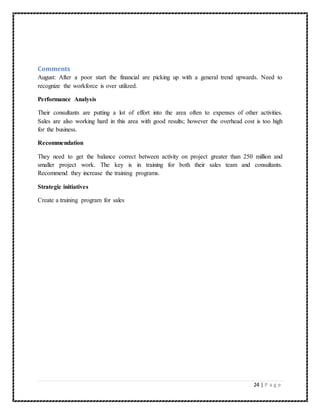
Comments 
August: After a poor start the financial are picking up with a general trend upwards. Need to 
recognize the workforce is over utilized. 
24 | P a g e 
Performance Analysis 
Their consultants are putting a lot of effort into the area often to expenses of other activities. 
Sales are also working hard in this area with good results; however the overhead cost is too high 
for the business. 
Recommendation 
They need to get the balance correct between activity on project greater than 250 million and 
smaller project work. The key is in training for both their sales team and consultants. 
Recommend they increase the training programs. 
Strategic initiatives 
Create a training program for sales
25 | P a g e 
Customer Perspective 
Objective: Improve Customer Satisfaction 
Month Actual Target %Achieved 
April 85% 90% 94% 
May 87% 90% 97% 
June 90% 90% 100% 
July 92% 90% 102% 
August 88% 90% 98% 
September 90% 
October 90% 
November 90% 
December 90% 
January 90% 
February 90% 
March 90% 
0.94 
0.92 
0.9 
0.88 
0.86 
0.84 
0.82 
0.8 
Actual 
Target
26 | P a g e 
Performance Analysis 
Customer satisfaction has been good and on the rise until this month. The sharp dip may indicate 
that they have a problem with one or two customers however, it should be noted that they are 
still well within target parameters. 
Recommendation 
Suggest they ask their account managers to work more closely with customers and spend more 
time on customer site. 
Strategic Initiatives 
Account managers to spend more time on customer site 
Comments 
August: General trend is upwards however they are seeing a sharp decline this month. May be 
connected to over- utilization.
27 | P a g e 
Internal Perspective 
Objectives 
 Better use of knowledge base 
 Improve staff on board process 
 Improve consultant utilization 
 Create a mobile work force 
 Automate invoice processing 
Metrics 
 Number of items in database 
 Number of hits to database 
 Total number of industry templates 
Objective: Better use of knowledge base 
Month Actual Target %Achieved 
April 22 27 81% 
May 23 28 82% 
June 23 29 79% 
July 24 30 80% 
August 24 31 77% 
September 32 
October 33 
November 34 
December 35 
January 36 
February 37 
March 38
28 | P a g e 
40 
35 
30 
25 
20 
15 
10 
5 
0 
Comments 
Actual 
Target 
August: Generally below target, they are not recruiting fast enough and existing staff have too 
many roles
29 | P a g e 
Learning & Growth Perspective 
Objectives: 
 All staff trained in balanced scorecard 
 All graduates have a mentor 
 A great place to work 
Metrics 
 Number of courses booked 
 Number of courses attended 
 Total number of staff trained 
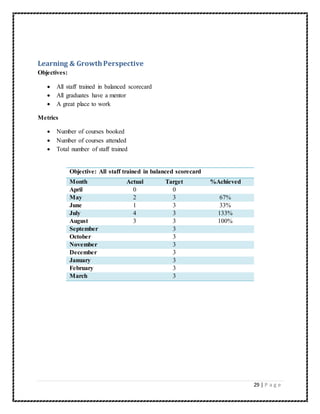
Objective: All staff trained in balanced scorecard 
Month Actual Target %Achieved 
April 0 0 
May 2 3 67% 
June 1 3 33% 
July 4 3 133% 
August 3 3 100% 
September 3 
October 3 
November 3 
December 3 
January 3 
February 3 
March 3
4.5 
4 
3.5 
3 
2.5 
2 
1.5 
1 
0.5 
Comments 
August: After a good recovery in July they are seeing another decline in august. Focused 
attention must be placed on training programs. 
30 | P a g e 
0 
Actual 
Target
31 | P a g e 
Conclusion 
Interloop has founded highly structured automated system which can only be beneficial in the long run if 
they follow it sincerely and improve it continually. We have identified some weaknesses and suggested 
improvements in the above explanation. Training to its employees regarding this automated system is the 
key to its growth. 
We have examined Performance Management System, Strategy Map, performance in terms of Balance 
Scorecard actual versus target objectives in the form of statistics and graphically too. Interloop has 
performed very effectively in Financial, Learning & growth perspectives of Balance scorecard while they 
have performed average in Customer perspective and need improvement in Internal Perspective.

Interloop Final Project.(Shahid Nadeem IB&M Uet)

  • 1.
    0 | Pa g e Final Report Managing People for High Performance Submitted to: Sir.Nabeel Arif Submitted by: ShahidNadeem (RMBA Fall 12-025) Hassan Salman (RMBA Fall 12-022) Muhammad Saleem (RMBA Fall 12-023) ShanzaMehmood (RMBA Fall 12-037) Muhammad Azeem (EXMBA Fall 10-026) Date of submission: 29th May, 2014 Institute of Business & Management University of Engineering & Technology Lahore
  • 2.
    Table of Contents Dedication....................................................................................................................................... 3 Acknowledgement ......................................................................................................................... 4 Executive Summary ........................................................................................................................ 5 Organizational Structure ............................................................................................................. 7 Organogram – Hosiery ................................................................................................................... 8 Project Background ........................................................................................................................ 9 Decision Making ......................................................................................................................... 9 Suggestions / Strategies for Improvement ................................................................................. 10 Decentralized Structure............................................................................................................ 10 ERP Training .............................................................................................................................. 11 Job Rotation and Effective Planning in Task Design................................................................ 11 Performance Management ...................................................................................................... 11 Justice & Equity ............................................................................................................................ 12 Grievance Redressal System .................................................................................................... 12 Performance Management System ............................................................................................. 13 Strategy Map for Interloop .......................................................................................................... 16 Competencies ............................................................................................................................... 18 Balance Scorecard ........................................................................................................................ 19 Comparison of Stated Versus Achieved Score of Objectives .................................................. 21 Actual Performance .................................................................................................................. 22 Targets....................................................................................................................................... 22 Graphical Presentation of Balance Scorecard Scores ................................................................. 23 Financial Perspective ................................................................................................................ 23 Comments ................................................................................................................................. 24 Customer Perspective............................................................................................................... 25 Comments ................................................................................................................................. 26 1 | P a g e
  • 3.
    Internal Perspective .....................................................................................................................27 Comments ................................................................................................................................. 28 Learning & Growth Perspective ................................................................................................... 29 Comments ................................................................................................................................. 30 Conclusion..................................................................................................................................... 31 2 | P a g e
  • 4.
    3 | Pa g e THIS REPORT IS DEDICATED TO OUR RESPECTED TEACHERS AND BELOVED GRAND PARENTS. Dedication
  • 5.
    4 | Pa g e Acknowledgement
  • 6.
    5 | Pa g e Executive Summary This report is analysis of Interloop, one of the world’s largest socks manufacturer with an annual company turnover exceeding $200 million, to identify its elements of high performance work system. Organizational structure, Information system, Task design, Reward system, People (selection, training and development), Justice and equity are few aspects critically analyzed in this regard. The effects of these defined elements on productivity and efficiency, Contribution to cost, product quality, customer satisfaction, employee turnover, learning organizations on Interloop are also investigated. Our team has recommended few solutions / strategies to these identified key issues which arehampering growth of Interloop. We are very optimistic that Interloop will overcome these hurdles if they apply these strategies in true sense. Moreover, we have critically analyzed Performance Management System of Interloopand tried to present our understanding of this system.
  • 7.
    6 | Pa g e Company Introduction Interloop started out in 1992 with just 10 knitting machines, now has 2300 machines and a workforce of more than 13500. Interloop Limited has transformed itself into South Asia’s largest Socks Manufacturer and Exporter offering the highest quality socks at a level of service unknown in our industry. It is located in Pakistan's Industrial hub Faisalabad and Lahore. Interloop is an integral part of this business community, continuously striving to revolutionize business practices in this region. Interloop is a complete vertical unit offering a wide range of price points and needle counts and is on the cutting edge in terms of the latest technology for each production process. They believe their success is due to a highly focused concentration on quality and speedy turnaround, a combination which increases its customers' edge in a highly competitive marketplace. In pursuance of its goal to achieve and maintain good quality, Interloop set up a High-Tech Spinning Unit that will ensure finest quality yarn made from the best available natural cotton. This project has enhanced the value of money for our customers by offering even more competitive rates to its clients. Hard work and utmost commitment from its employees and management, strict Quality Control Measures, timely Shipments and reliable Service Standards have been paramount towards Interloop's phenomenal growth. It is one of the very few firms in Pakistan with an impressive Social Responsibility Portfolio, realizing that a commitment to sustainability in all areas of commercial activity endorse the long term interests of a business.
  • 8.
    7 | Pa g e Organizational Structure Inter Loop Company follows vertical policy making system. All the goals and strategies are made by executives of the company. Their executive bodies are responsible for that all. The lower management performs operational tasks. The planning is done from top to bottom in vertically direction. Following structure is indicating how activities such as task allocation, coordination and supervision are directed towards the achievement of organizational aims. When organization structure and design change it impact on the organizational culture and also on the management policies and practices too Chief Executive Officer Chief Operating Officer PPC (Sr Manager) Operation HD 01 (DGM) Operation HD 02 (DGM) Processing (DGM) QAD (DGM & Q&M) Organizational Development MIS (DGM) EHS (Manager) Productivity improvement (Consultant) Director Technical Engineering (Sr Manager Administration (GM) HRD (DGM) Director Finance Finance Store (Sr. Manager) Director Sourcing Supplies S & M (Sr. Manager) Spinning (G M) Executive Director I & E Internal Audit I & E (Sr Manager) Merchandize DGM Q&M Corporate
  • 9.
    8 | Pa g e Organogram – Hosiery
  • 10.
    Project Background Wehave identified issues in the system of Interloop mentioned in the last report submitted. Now we are suggesting Interloop few strategies for removing and improving its system which are as follows: Decision Making Decision making in Interloop is centralized as shown in the following chain of command 9 | P a g e
  • 11.
    10 | Pa g e Suggestions / Strategies for Improvement Decentralized Structure Interloop should use the model of TQM (from downward to upward) by decentralization and delegate the power to the front level employees for making decisions to avoid any wastage and increase the efficiency. Because any organization cannot grow unless the management delegate powers. For example, an inspection executive receiving and inspecting raw material cotton bags in huge quantities should have authority, after consultation with immediate supervisor, to accept or reject particular type of product. The same procedure should be used for finished goods delivery to avoid any kind of delay. Recommended decentralized chain of command is as follows: Team Members Supervisors Coordinators Executive Manager Assistant Manager Managers Senior Managers General Managers CEO
  • 12.
    ERP Training Interloopmust schedule ERP training sessions for selected employees recommended by department heads with regular interval for optimal utilization of ERP. Once implemented thoroughly, Interloop can save huge amount of cost which can used in other development projects. 11 | P a g e ERP user manuals should be available in every relevant department for references purpose. Job Rotation and Effective Planning in Task Design The management reliance on particular employee for completing any task can be minimized by rotating employees on different areas of departments. Every personnel of department should know responsibilities of every employee to avoid any delay. This will help them in following ways: o Decision.It will improve tactical-level decisions throughout the Interloop. It will also remove many small decisions from senior management, which therefore has more time to develop strategic direction. o Speed. Since there are fewer layers of bureaucracy in a decentralized structure, Interloopwould be able to make decisions more quickly, which is useful in a highly competitive environment. o Turnover. Employees who are given more authority tend to stay with aInterloop longer, so employee turnover declines. o Training. Giving some authority to local managers is an excellent way to observe their decision-making ability, which can be used to determine advancement to higher positions. o Wide span of control. There is less need for middle managers, since many employees can report to fewer managers. This reduces overhead costs. Task assignment and planning should be done in sucha way that no employee gets overburden for achieving targets. Performance Management Interloop should implement well acquired Performance Management System (analyzed later) to avoid any kind of biasness like recency effect, personal biases has been seen in Interloop. Interloop must developa system of evaluation which involves employee himself/herself for feedback and ultimately it will enhance their motivation level.
  • 13.
    12 | Pa g e Justice & Equity Grievance Redressal System We are suggesting Interloop a Grievance Redressal System to resolve differences in peaceful, orderly and expeditious manner. It enables the parties to investigate and discuss the problem through (i) Open-door policy (ii) Step ladder type (iii) Grievance handling committee Steps in Handling Grievances Interloop should follow the points mentioned below: 1. Receive and define the nature of dissatisfaction. (a) Manner and attitude when complaint is received (b) Acknowledging grievance – it will create a conducive work environment with instances of grievance reduced. (c) Assessment must be made that the complaint is presented fairly. (d) Statement and issues must not be pre-judged. (e) Proper time and attention is given. 2. Get the facts (a) Facts are separated from impressions and opinions. (b) Consult the policies. (c) Consult the records. 3. Analyze the cause of grievance and decide alternative course of actions should be though to manage it. 4. Execution and review The manager should execute the decision quickly, ignoring the fact, that it may or may not hurt the employees concerned. 5. Follow-up After implementing the decision, a follow-up must be there to ensure that the grievance has been resolved completely and adequately.
  • 14.
    13 | Pa g e Performance Management System
  • 15.
    14 | Pa g e Setting of Personal Objective / Personal Performance Plan Goals are determined for each personnel of departments at the start of year till 30th January. The following factors are considered while setting goals for individuals:  Look at your business and departmental goals  Identify where you could deliver results to support your business and department  Create SMART objectives and development of actions  Use the success factors as a reference in creating development of actions  Discuss and agree your personal objectives and development of actions for the year with your manager  Ensure your agreed objectives and development of actions are recorded on your P&D Dialogue paper Performance Dialogue I This supervisor / head dialogue is for reviewing the objectives to assess progress and adjust if necessary, based on changing business needs or priorities.Coaching the individuals if required. The period of dialogue is from 1st to 10th of April every year. Mid Year Performance Management Review Meeting The period of midyear performance management review is from 20thto 30th of June every year which consists of following points:  Internal audit of performance  Hold frequent informal feedback, discussion with your manager throughout the performance year  Hold a more formal dialogue with your manager in the middle of the year  Review your progress on objectives and development of actions  Discuss long term development plans Performance Dialogue II This performance dialogue longs from 15th to 30th of September every year to discuss following matters:  Review progress and accomplishments  Evaluate performance against the objectives agreed upon
  • 16.
    15 | Pa g e Final Year Performance Management Review Meeting  Internal Audit of Performance o Manager collects feedback, assesses results interms of objectives, progress on the development actions and the employees’ level of competence for each of the success factors  Performance Review o Manager decides on an overall proposed performance rating and passes this to the next higher manager for review. o Next higher manager discuss with their team the proposed ratings and overall department distribution in a calibration process. o Manager and employee hold the year-end discussion on results, development progress, level of competence on the success factors and overall rating. o Manager finalizes and signs the form, sends it to the employee for comments and signature.
  • 17.
    16 | Pa g e Strategy Map for Interloop The following diagram shows how integrated and interdependent are different departments in an organization to achieve its objectives. Like:  Interloop staff is trained in Balance Scorecard to utilize knowledge base effectively and to create mobile workforce which helps in enhancing customer satisfaction and improve customer awareness about our offers. Consequently, this stepimproves customer satisfaction boasts each project’s profitability.  All fresh hiring / graduates / employees are assigned a mentor for counseling, couching, training etc. which will develop staff on-board process, enhance customer awareness and therefore reduces overhead cost.  This couching proves Interloop to be a great place to work that result into improving consultant utilization, customer awareness which ultimately reduce overhead cost of the plant. This strategy map clearly depicts interdependence of each division which ultimately leads towards increase profitability and reducing overhead cost of the firm.
  • 18.
    17 | Pa g e Financial Customer Internal Learning & Growth Increase Project Profitability Reduce Overhead Cost Improve Customer Satisfaction Improve Customer Awareness Better Use of Knowledge Base Improve Staff on-board process Improve Consultant Utilization Create a mobile workforce Automate Invoice Processing All Staff Trained in Balance Scorecard All Graduates have a Mentor A great place to work
  • 19.
    18 | Pa g e Competencies Interloop has divided competencies to evaluate its employeeswhich are as follows: Core  Integrity  Respect  Accountability Technical  Ability to ensure timely production and output of work,  Maintaining consistent quality Managerial  Interpersonal Skills: (establishing desired communication / cordiality with subordinates/peers/superiors, ability to train and develop subordinates)  Leadership: (intelligence/common sense, maturity & confidence, expression(verbal & written) and Dependability We have analyzed competencies or evaluated followingemployees’ performance during the period of project visits. 1. Mr. Mujahid Abbas HR Generalist 2. Mr. Babar Saeed Assistant HR 3. M. Farooq Assistant Manager operation Moreover, we have attached evaluated reports of these employees for your reference.
  • 20.
    19 | Pa g e Balance Scorecard Interloop is working on the following objectives to alignbusiness activities to its vision and strategy, improve internal and external communications, and monitor overall performance against strategic goals. It provides a framework that not only provides performance measurements, but helps Interlooop planners identify what should be done and measured. Moreover, it enables executives to truly execute their strategies. Financial Perspective  Increase Project Profitability o Projetcs greater than 250 million o Operating Profit o % Operating Profit  Reduce Overhead Cost o % overhead to revenue o Sales people trained in software Internal Perspective  Better use of knowledge base o Number of items in database o Number of hits to database o Total Number of Industry template  Improve staff on-board process o % staff through company induction o Cost to crecruit per head  Improve consultant utilization o % consultant utilization o No. of new projects found  Create a mobile workforce o Sales staff issues with iPads  Automate invoice processing o Days taken to issue an incoice o Number of bad debts issued
  • 21.
    20 | Pa g e Customer Perspective  Improve Customer Satisfaction o % Satisfaction Surveys complete o Satisfaction Survey score o Consultant days on customer site  Improve Customer Awareness o Position 1 in Google search o Number of customer meetings Learning & Growth Perspective  All staff trained on Balance Scorecard o Number of courses booked o Number of courses attended o Total number of staff trained  All graduates have a mentor o % graduates with a mentor o Number of consultants mentoring  A great place to work o Employee staisfaction score o Number of CVs received
  • 22.
    21 | Pa g e Comparison of Stated Versus Achieved Score of Objectives The Annex-I is explanation of objectives in more detail and comparison of stated versus achieved targets in terms of scores.  According to the Annex-I, Interloop has successfully exceeded the target in enhancing project profitability and performed reasonably well in Financial Perspective.  Interloop has surpassed the targets in improving its customer awareness and performed very well in enhancing customer satisfaction as shown by figures in Annex-I.  Moreover, the information in Annex-I reveals effectiveness of internal perspective of Interloop managed to meet some targets but needs a lot of improvements in this area particularly delegation.  Furthermore, Interloop has excelled in learning and growth perspective except number of consultants appointed for mentoring and number of CVs received which needs improvement as per data menioned in Annex-I.
  • 23.
    22 | Pa g e Actual Performance The Annex-II shows the actual performance in each of the perspective of Balance Scorecard shown by Interloopin meeting its objectives. It has proved itself as we comapre achievments with targets. Targets The Annex-III explains as figures are goals set by Interloop management to grow and get competitive advantage in its market.
  • 24.
    Graphical Presentation ofBalance Scorecard Scores We have analyzed each of the perspective separately and shown in graphically to understand it thoroughly. 23 | P a g e Financial Perspective Objective: Increase Project Profitability Month Actual Target %Achieved April 0 1 0% May 1 1 100% June 1 1 100% July 2 2 100% August 2 2 100% September 2 October 3 November 3 December 3 January 4 February 4 March 4 4.5 4 3.5 3 2.5 2 1.5 1 0.5 0 Actual Target
  • 25.
    Comments August: Aftera poor start the financial are picking up with a general trend upwards. Need to recognize the workforce is over utilized. 24 | P a g e Performance Analysis Their consultants are putting a lot of effort into the area often to expenses of other activities. Sales are also working hard in this area with good results; however the overhead cost is too high for the business. Recommendation They need to get the balance correct between activity on project greater than 250 million and smaller project work. The key is in training for both their sales team and consultants. Recommend they increase the training programs. Strategic initiatives Create a training program for sales
  • 26.
    25 | Pa g e Customer Perspective Objective: Improve Customer Satisfaction Month Actual Target %Achieved April 85% 90% 94% May 87% 90% 97% June 90% 90% 100% July 92% 90% 102% August 88% 90% 98% September 90% October 90% November 90% December 90% January 90% February 90% March 90% 0.94 0.92 0.9 0.88 0.86 0.84 0.82 0.8 Actual Target
  • 27.
    26 | Pa g e Performance Analysis Customer satisfaction has been good and on the rise until this month. The sharp dip may indicate that they have a problem with one or two customers however, it should be noted that they are still well within target parameters. Recommendation Suggest they ask their account managers to work more closely with customers and spend more time on customer site. Strategic Initiatives Account managers to spend more time on customer site Comments August: General trend is upwards however they are seeing a sharp decline this month. May be connected to over- utilization.
  • 28.
    27 | Pa g e Internal Perspective Objectives  Better use of knowledge base  Improve staff on board process  Improve consultant utilization  Create a mobile work force  Automate invoice processing Metrics  Number of items in database  Number of hits to database  Total number of industry templates Objective: Better use of knowledge base Month Actual Target %Achieved April 22 27 81% May 23 28 82% June 23 29 79% July 24 30 80% August 24 31 77% September 32 October 33 November 34 December 35 January 36 February 37 March 38
  • 29.
    28 | Pa g e 40 35 30 25 20 15 10 5 0 Comments Actual Target August: Generally below target, they are not recruiting fast enough and existing staff have too many roles
  • 30.
    29 | Pa g e Learning & Growth Perspective Objectives:  All staff trained in balanced scorecard  All graduates have a mentor  A great place to work Metrics  Number of courses booked  Number of courses attended  Total number of staff trained Objective: All staff trained in balanced scorecard Month Actual Target %Achieved April 0 0 May 2 3 67% June 1 3 33% July 4 3 133% August 3 3 100% September 3 October 3 November 3 December 3 January 3 February 3 March 3
  • 31.
    4.5 4 3.5 3 2.5 2 1.5 1 0.5 Comments August: After a good recovery in July they are seeing another decline in august. Focused attention must be placed on training programs. 30 | P a g e 0 Actual Target
  • 32.
    31 | Pa g e Conclusion Interloop has founded highly structured automated system which can only be beneficial in the long run if they follow it sincerely and improve it continually. We have identified some weaknesses and suggested improvements in the above explanation. Training to its employees regarding this automated system is the key to its growth. We have examined Performance Management System, Strategy Map, performance in terms of Balance Scorecard actual versus target objectives in the form of statistics and graphically too. Interloop has performed very effectively in Financial, Learning & growth perspectives of Balance scorecard while they have performed average in Customer perspective and need improvement in Internal Perspective.