




1 
The Effect of Product Category on Consumer 
Brand Relationships 
Dr. Marc Fetscherin, Rollins College, USA 
Dr. Michele Boulanger, Rollins College, USA 
Dr. Cid Gonçalves Filho, FUMEC University, Brazil 
Dr. Gustavo Souki, UNA/DataConsumer, Brazil 
Article accepted in 
Journal of Product and Brand Management, Vol. 23, No. 1. (2014 forthcoming)
Agenda 
• Introduction 
• Literature Review 
• Theoretical Framework and Hypotheses 
• Methodology and Results 
• Conclusion and Limitation 
2
Introduction 
• Among the consumer brand relationship facets studied, brand love is one 
of the most recent and least researched 
• Despite the effect of product category in the branding literature, little is 
known whether brand love is universally applicable to any product 
category or if it’s product category specific 
• The purpose of this study is to address this by comparing four different 
product categories (soft drinks, mobile phones, shoes and cars) and 
conducted a survey with 800 respondents 
3
Agenda 
• Introduction 
• Literature Review 
• Theoretical Framework and Hypotheses 
• Methodology and Results 
• Conclusion and Limitation 
4
Consumer Brand Relationships 
• Consumer brand relationship research is multi-disciplinary, complex, 
dynamic and “many unresolved issues and conundrums remain” 
(Fournier, 2009, p. 5) 
• Brands as relationship partners (Keh et al., 2007) with many different 
relationship constructs (Fournier, 1998) 
• Various types and intensities of emotions and relationships consumers 
have with brands brand loyalty (Jacoby and Chestnut, 1978) 
– brand trust (Chaudhuri and Holbrook, 2001), 
– brand passion (Bauer et al., 2007), 
– brand attachment (Park et al., 2010; Thomson, MacInnis and Park, 2005) 
– brand romance (Patwardhan and Balasubramanian, 2011), 
– brand fidelity (Hess, et al., 2011) 
– brand love (Ahuvia, 2005; Albert et al., 2008a; Batra et al., 2012) 
5
Brand Love 
• Fournier (1998) identify love as one key dimension 
• Empirical evidence for feelings of love toward products or brands (Albert 
et al., 2008; Ahuiva, 2005; Carroll & Ahuvia, 2006; Thomson et al., 2005; 
Swaminathan et al., 2007; Batra et al., 2012) 
• Current brand love studies assess the conceptualization or dimensionality 
of brand love: 
– Thomson et al. (2005) 3 dimensions 
– Heinrich et al. (2006) 3 dimensions 
– Carroll and Ahuvia (2006) 5 dimensions 
– Batra et al. (2008) 7 dimensions 
– Albert et al. (2008) found 6 first order and 2 second order dimensions 
– Batra et al., (2012) 7 dimensions 
• However, little is known whether the construct of brand love is 
universally applicable to any product category or if it’s product category 
specific 
6
Importance of Product Category 
• The role of the product category has been studied in the branding literature 
for decades. It has an effect on 
– brand extension (Broniarczyk & Alba, 1994), 
– number of (un)acceptable brands in a product category (Newman & Dolich, 1979), 
– brand personality (Aaker, 1997) 
– consumer product variety seeking behavior (Van Trijp, et al. 1996) 
• Schema and categorization theory (Sujan, 1985) indicates product category 
characteristics influence the brand-level effects consumers. Chaudhuri and 
Holbrook (2001, p. 83) argue, these “theories suggest that product-category 
cognitions are likely to precede thoughts and feelings about brands within 
the product category”. 
• Contradictory results: 
– Kressmann et al., (2006) show product category involvement leads to higher 
perceived brand relationship quality 
– Valta (2013, p. 101) finds empirical evidence that “product category involvement 
does not significantly impact brand relationship quality” 
7
Brand Love and Product Category 
• Albert et al. (2008a, p. 1074) “indicate that consumers may treat product 
categories differently in terms of their ability to generate love feelings” and 
suggest that “a formal study of this phenomenon should help practitioners 
develop specific marketing programs toward consumer segments open to 
love relationship” 
• Current brand love studies either focus on 
– One product category (e.g., Hayes et al., 2006; Swaminathan et al., 2007) or 
– Multiple product categories (Caroll & Ahuiva, 2006; Albert et al. 2008a; Bergkvist & 
Bech-Larsen, 2010) without specifically analyzing product category differences 
• This led to the motivation of this study to shed some light whether brand 
love is product category specific 
• This paper contributes to the nascent consumer brand relationships theory 
by investigating the effect of the product category onto consumer’s brand 
love relationships 
8
Agenda 
• Introduction 
• Literature Review 
• Theoretical Framework and Hypotheses 
• Methodology and Results 
• Conclusion and Limitation 
9
10 
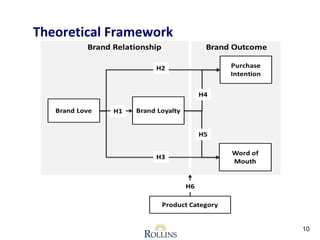
Theoretical Framework
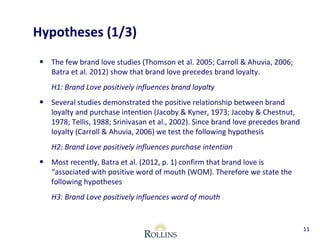
Hypotheses (1/3) 
• The few brand love studies (Thomson et al. 2005; Carroll & Ahuvia, 2006; 
Batra et al. 2012) show that brand love precedes brand loyalty. 
H1: Brand Love positively influences brand loyalty 
• Several studies demonstrated the positive relationship between brand 
loyalty and purchase intention (Jacoby & Kyner, 1973; Jacoby & Chestnut, 
1978; Tellis, 1988; Srinivasan et al., 2002). Since brand love precedes brand 
loyalty (Carroll & Ahuvia, 2006) we test the following hypothesis 
H2: Brand Love positively influences purchase intention 
• Most recently, Batra et al. (2012, p. 1) confirm that brand love is 
“associated with positive word of mouth (WOM). Therefore we state the 
following hypotheses 
H3: Brand Love positively influences word of mouth 
11
Hypotheses (2/3) 
• Many have explored the positive relationship between brand loyalty and 
purchase intention (Jacoby & Kyner, 1973; Jacoby & Chestnut, 1978; Tellis, 
1988; Srinivasan et al., 2002). We test the following: 
H4: Brand loyalty positively influences purchase intention 
• Dick and Basu (1994) or Frank (1997) found that brand loyalty can add to 
positive word-of-mouth. The positive and direct relationship between 
brand loyalty and (positive) word-of-mouth finds further support by 
Reichheld (2006) and Walsh and Beatty (2007). We state: 
H5: Brand loyalty positively influences word-of-mouth 
12
• Albert et al. (2008a, p. 1074) “indicate that consumers may treat product 
categories differently in terms of their ability to generate love feelings” this 
has not yet been assessed empirically 
• Limited and contradictory cross-product category research on consumer-brand- 
relationship and specifically no cross-category study about brand 
love. Reluctant do develop specific hypotheses concerning what cross-category 
difference exist. We therefore state: 
H6: Product Category influences the relationships between consumers and 
their brands 
13 
Hypotheses (3/3)
Agenda 
• Introduction 
• Literature Review 
• Theoretical Framework and Hypotheses 
• Methodology and Results 
• Conclusion and Limitation 
14
Sample and Data Collection 
• Product category 
– Caroll and Ahuiva (2006): soft drinks, cereals, mobile phones 
– Albert et al. (2008a): shoes, cars, lingerie, watches, and perfumes 
– Bergkvist and Bech-Larsen (2010): clothes brand, soft drink, toothpaste… 
– We selected soft drinks, mobile phones, shoes, and cars 
• Respondents 
– 200 respondents per product category* 
– Translation back-translation method by two independent translators to establish 
translation equivalence (Douglas and Craig, 2007) 
– Local trained field workers conducted pre-test with 20 respondents 
– Randomly selected consumers at a shopping mall in a major city in Brazil. The mall is 
known for the highest flux of consumers in terms of genre, age and social class 
distribution. Survey conducted from Monday - Sunday between 10am and 10pm in 
order to obtain variance of profile respondents 
15 
* Above min. 17 observations per cell by Cohen (1998), 20 by Hair et al. (1998), or same as the suggested min. sample of 100 by 
Spector (1992)
16 
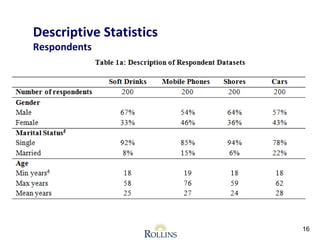
Descriptive Statistics 
Respondents
17 
Descriptive Statistics 
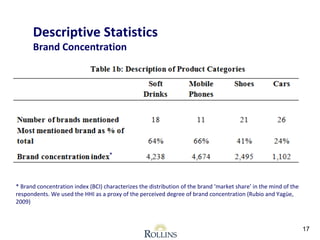
Brand Concentration 
* 
* Brand concentration index (BCI) characterizes the distribution of the brand ‘market share’ in the mind of the 
respondents. We used the HHI as a proxy of the perceived degree of brand concentration (Rubio and Yagüe, 
2009)
Validity and Reliability 
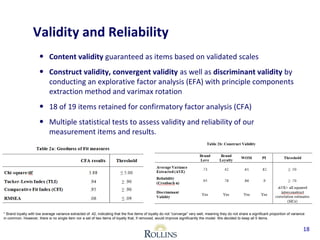
• Content validity guaranteed as items based on validated scales 
• Construct validity, convergent validity as well as discriminant validity by 
conducting an explorative factor analysis (EFA) with principle components 
extraction method and varimax rotation 
• 18 of 19 items retained for confirmatory factor analysis (CFA) 
• Multiple statistical tests to assess validity and reliability of our 
measurement items and results. 
* Brand loyalty with low average variance extracted of .42, indicating that the five items of loyalty do not “converge” very well, meaning they do not share a significant proportion of variance 
in common. However, there is no single item nor a set of two items of loyalty that, if removed, would improve significantly the model. We decided to keep all 5 items. 
18
19 
Hypotheses Testing 
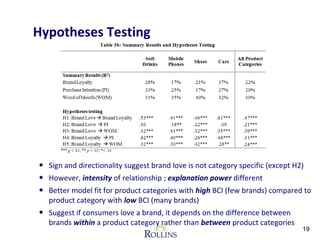
• Sign and directionality suggest brand love is not category specific (except H2) 
• However, intensity of relationship ; explanation power different 
• Better model fit for product categories with high BCI (few brands) compared to 
product category with low BCI (many brands) 
• Suggest if consumers love a brand, it depends on the difference between 
brands within a product category rather than between product categories
Agenda 
• Introduction 
• Literature Review 
• Theoretical Framework and Hypotheses 
• Methodology and Results 
• Conclusion and Limitation 
20
Conclusion and Limitation 
• Advance the research about consumer brand relationship 
• Assess if product category is relevant for the relationship between 
consumers and their favorite brands 
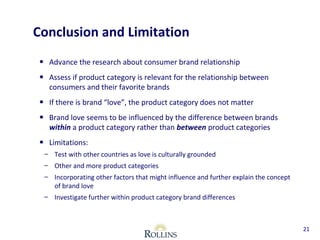
• If there is brand “love”, the product category does not matter 
• Brand love seems to be influenced by the difference between brands 
within a product category rather than between product categories 
• Limitations: 
– Test with other countries as love is culturally grounded 
– Other and more product categories 
– Incorporating other factors that might influence and further explain the concept 
of brand love 
– Investigate further within product category brand differences 
21
Aaker, J. (1997). Dimensions of brand personality. Journal of Marketing Research, 34(3), 347-356. 
Ahuvia, A. (2005). Beyond the extended self: loved objects and consumers identity narratives. Journal of Consumer Research, 32(June), 
171-184. 
Albert, N., Merunka, D., & Valette-Florence, P. (2008a). When consumers love their brand: exploring the concept and its dimensions. Journal 
of Business Research, 61, 1062-1075. 
Albert, N., Merunka, D., & Valette-Florence, P. (2008b). The feeling of love toward a brand: concept and measurement. Advances in 
Consumer Research, 36, 300-307. 
Anderson, J., & Gerbing, D. (1988). Structural Equation Modeling in Practice: A Review and Recommended Two-Step Approach. 
Psychological Bulletin, 103(2), 411-423. 
Ashworth, L., Dacin, P., & Thomson, M. (2009). Why on earth do consumers have relationship with marketers?. In: MacInnis D, W. Park W, 
J. Priester J. editors. Handbook of Brand Relationships. Armonk, New York:M.E. Sharpe, 2009 pp. 82-106. 
Batra, R., Ahuvia, A., & Bagozzi, R. (2008). Brand love: its nature and consequences. Working paper; University of Michigan-Dearborn, Ann- 
Arbor. 
Batra, R., Ahuvia, A., & Bagozzi, R. (2012). Brand Love. Journal of Marketing (in print). 
Bauer, H., Heinrich, D., & Martin., I. (2007). How to create high emotional consumer-brand relationships? The causalities of brand passion. 
In: proceedings of the Australian and New Zeland Academy. 
Berry, L. (2000). Cultivating service brand equity. Journal of Academy of Marketing Science, 28(1), 128-137. 
Bloemer, J.,& Kasper, H. (1995). The complex relationship between consumer satisfaction and brand loyalty. Journal of Economic 
Psychology, 16(2): 311-329. 
Broniarczyk, S., & Alba, J. (1994). The Importance of the Brand in Brand Extension. Journal of Marketing Research, 31(2), 214-228. 
Bergkvist, L., & Bech-Larsen, T. (2010). Two studies of consequences and antecedents of brand love. Journal of Brand Management, 17(7), 
504-518. 
Busacca, B., & Castaldo, S. (2003). Brand knowledge, brand trust and consumer response: a conceptual framework. In: 2nd workshop 
“Trust within and between organizations special session “Trust in marketing”. Amsterdam. 
Carroll, B.A., & Ahuvia, A. (2001). Some antecedents and outcomes of brand love. Marketing Letters, 17(2), 79-89. 
Chaudhuri, A., & Holbrook, M.B. (2001). The Chain of effects from brand trust and brand affect to brand performance: the role of brand 
loyalty. Journal of Marketing, 65(2), 81-93. 
Churchill, G. (1979). A Paradigm for developing better measures of marketing constructs. Journal of Marketing Research, 16(February), 64- 
73. 
22 
References
Dick. A.S., & Basu, K. (1994). Consumer loyalty: toward an integrated conceptual framework. Journal of the Academy of Marketing Science, 
22(Spring), 99–113. 
Douglas, S. P. & Craig, C. S. (2007). Collaborative and Iterative Translation: An Alternative Approach to Back Translation. Journal of 
International Marketing, 15(1), 30-43. 
Eagly, A., Chaiken, S. (1993). The psychology of attitudes. Harcourt Brace Jovanovich, Forth Worth, 1993. 
Fournier, S. (1997). Consumers and their brands: developing relationship theory in consumer research. Journal of Consumer Research, 
24(4), 343-372. 
Fournier, S., & Yao, J.L. (1997). Reviving brand loyalty: a reconceptualization within the framework of consumer-brand relationships. 
International Journal of Research in Marketing, 14(5), 451-72. 
Frank, M. (1997). The realities of web-based electronic commerce. Strategy and Leadership, 3(May), 30–32. 
Garbarino, E., & Johnson, M.S. (1999). The roles of satisfaction, trust, and commitment in consumer relationships. Journal of Marketing, 
63(2), 70-87. 
Hendrick, C. & Hendrick, S. (1986). A theory and method of love. Journal of Personality and Social Psychology, 50(2), 392-402. 
Jacoby, J. & Kyner, D. (1973). Brand loyalty vs. repeat purchasing behavior. Journal of Marketing Research, 10(1), 1-9. 
Jacoby, J., & Chestnut, R. (1978). Brand loyalty measurement and management. New York: Wiley. 
Juster , F.T. (1966). Consumer buying intention and purchase probability. National Bureau of Economic Research, Columbia University 
Press. 
Keh, H.T., Pang, J. & Peng, S. (2007). Understanding and measuring brand love. In proceedings of the Advertising and Consumer 
Psychology conference, New Frontiers in Branding: Attitudes, Attachments, and Relationships. Santa Monica, CA. 
Keller, K. (1993). Conceptualizing, measuring, and managing consumer-based brand equity. Journal of Marketing, 57, 1–22. 
Kumar, A., Lee, H-J., & Kim, Y.K. (2009). Indian consumers' purchase intention toward a United States versus local brand. Journal of 
Business Research, 62(5), 521-527. 
Malhotra, N.K., Agarwal, K., & Peterson, M. (1996). Methodological issues in cross-cultural marketing A state-of-the-art review. International 
Marketing Review, 13(5), 7-43. 
Maxham, J .G. & Netemeyer, R.G. (2002). A longitudinal study of complaining consumers' evaluations of multiple service failures and 
recovery efforts. Journal of Marketing, 66(4), 57-71. 
Miniard, P.W., Obermiller, C., & Page, T.J. (1983). A further assessment of measurement influence on the intention-behavior relationship. 
Journal of Marketing Research, 20(2), 206-213. 
23 
References
Newman, L.H., & Dolich, I. (1979). Examination of Ego-Involvement as a Modifier of Attitude Change Caused From Product Testing. 
Advances in Consumer Research, 6, 180-183. 
Quester, P.G., & Lim, A.L. (2003). Production involvement/brand loyalty: Is there a link?. Journal of Product & Brand Management, 12(1), 22- 
38. 
Park, C., MacInnis, D., Priester, J., Eisengerich, A., & Iacabucci, D. (2010). Brand Attachment and Brand Attitude Strength: Conceptual and 
Empirical Differentiation of Two Critical Brand Equity Drivers. Journal of Marketing, 74, 1–17. 
Reichheld, F. (2006). The ultimate question: driving good profits and true growth, Boston, MA: Harvard Business School Press. 
Sekaran, U. (1983). Methodological and theoretical issues in cross-cultural research. Journal of International Business Studies, 14(2), 61-73. 
Singh, J. (1990). Voice, exit, and negative word-of-mouth behaviors: an investigation across three service categories. Journal of the 
Academy of Marketing Science, 18(1), 1-15. 
Srinivasan, S. , Anderson, R., & Ponnavolu, K. (2002). Consumer loyalty in E-commerce: an exploration of its antecedents and 
consequences. Journal of Retailing, 27, 279-295. 
Sujan, M. (1985). Effects on Evaluation Strategies Mediating Consumer Judgement. Journal of Consumer Research, 12(June), 31-46. 
Swaminathan, V., Page, K.L. & Gürhan Canli, Z. (2007). "My" brand or "your" brand: the effects of brand relationship ‐ dimensions and self-construal 
on brand evaluations. Journal of Consumer Research, 34(2), 248-259. 
Tellis, G.J. (1988). Advertising exposure, loyalty and brand purchase: a two stage model of choice. Journal of Marketing Research, 25, 134- 
144. 
Thomson, M., MacInnis, D.J., & Park, C.W. (2005). The ties that bind: measuring the strength of consumers emotional attachment to brands. 
Journal of Consumer Psychology, 15, 77-91. 
VanTrijp, H., Hoyer, W.D., & Inman, J. (1996). Why Switch? Product Category: Level Explanations for True Variety-Seeking Behavior. 
Journal of Marketing Research, 33(3), 281-292. 
Wangenheim, F., & Bayon, T. (2004). Satisfaction, loyalty and word of mouth within the consumer base of a utility provider: differences 
between stayers, switchers and referral switchers. Journal of Consumer Behaviour, 3(3), 211-220. 
Walsh, G., & Beatty, S. E. (2007). Customer-based corporate reputation of a service firm. Journal of the Academy of Marketing Science, 
35(1) 
24 
References

Brand Love

  • 1.
    1 The Effectof Product Category on Consumer Brand Relationships Dr. Marc Fetscherin, Rollins College, USA Dr. Michele Boulanger, Rollins College, USA Dr. Cid Gonçalves Filho, FUMEC University, Brazil Dr. Gustavo Souki, UNA/DataConsumer, Brazil Article accepted in Journal of Product and Brand Management, Vol. 23, No. 1. (2014 forthcoming)
  • 2.
    Agenda • Introduction • Literature Review • Theoretical Framework and Hypotheses • Methodology and Results • Conclusion and Limitation 2
  • 3.
    Introduction • Amongthe consumer brand relationship facets studied, brand love is one of the most recent and least researched • Despite the effect of product category in the branding literature, little is known whether brand love is universally applicable to any product category or if it’s product category specific • The purpose of this study is to address this by comparing four different product categories (soft drinks, mobile phones, shoes and cars) and conducted a survey with 800 respondents 3
  • 4.
    Agenda • Introduction • Literature Review • Theoretical Framework and Hypotheses • Methodology and Results • Conclusion and Limitation 4
  • 5.
    Consumer Brand Relationships • Consumer brand relationship research is multi-disciplinary, complex, dynamic and “many unresolved issues and conundrums remain” (Fournier, 2009, p. 5) • Brands as relationship partners (Keh et al., 2007) with many different relationship constructs (Fournier, 1998) • Various types and intensities of emotions and relationships consumers have with brands brand loyalty (Jacoby and Chestnut, 1978) – brand trust (Chaudhuri and Holbrook, 2001), – brand passion (Bauer et al., 2007), – brand attachment (Park et al., 2010; Thomson, MacInnis and Park, 2005) – brand romance (Patwardhan and Balasubramanian, 2011), – brand fidelity (Hess, et al., 2011) – brand love (Ahuvia, 2005; Albert et al., 2008a; Batra et al., 2012) 5
  • 6.
    Brand Love •Fournier (1998) identify love as one key dimension • Empirical evidence for feelings of love toward products or brands (Albert et al., 2008; Ahuiva, 2005; Carroll & Ahuvia, 2006; Thomson et al., 2005; Swaminathan et al., 2007; Batra et al., 2012) • Current brand love studies assess the conceptualization or dimensionality of brand love: – Thomson et al. (2005) 3 dimensions – Heinrich et al. (2006) 3 dimensions – Carroll and Ahuvia (2006) 5 dimensions – Batra et al. (2008) 7 dimensions – Albert et al. (2008) found 6 first order and 2 second order dimensions – Batra et al., (2012) 7 dimensions • However, little is known whether the construct of brand love is universally applicable to any product category or if it’s product category specific 6
  • 7.
    Importance of ProductCategory • The role of the product category has been studied in the branding literature for decades. It has an effect on – brand extension (Broniarczyk & Alba, 1994), – number of (un)acceptable brands in a product category (Newman & Dolich, 1979), – brand personality (Aaker, 1997) – consumer product variety seeking behavior (Van Trijp, et al. 1996) • Schema and categorization theory (Sujan, 1985) indicates product category characteristics influence the brand-level effects consumers. Chaudhuri and Holbrook (2001, p. 83) argue, these “theories suggest that product-category cognitions are likely to precede thoughts and feelings about brands within the product category”. • Contradictory results: – Kressmann et al., (2006) show product category involvement leads to higher perceived brand relationship quality – Valta (2013, p. 101) finds empirical evidence that “product category involvement does not significantly impact brand relationship quality” 7
  • 8.
    Brand Love andProduct Category • Albert et al. (2008a, p. 1074) “indicate that consumers may treat product categories differently in terms of their ability to generate love feelings” and suggest that “a formal study of this phenomenon should help practitioners develop specific marketing programs toward consumer segments open to love relationship” • Current brand love studies either focus on – One product category (e.g., Hayes et al., 2006; Swaminathan et al., 2007) or – Multiple product categories (Caroll & Ahuiva, 2006; Albert et al. 2008a; Bergkvist & Bech-Larsen, 2010) without specifically analyzing product category differences • This led to the motivation of this study to shed some light whether brand love is product category specific • This paper contributes to the nascent consumer brand relationships theory by investigating the effect of the product category onto consumer’s brand love relationships 8
  • 9.
    Agenda • Introduction • Literature Review • Theoretical Framework and Hypotheses • Methodology and Results • Conclusion and Limitation 9
  • 10.
  • 11.
    Hypotheses (1/3) •The few brand love studies (Thomson et al. 2005; Carroll & Ahuvia, 2006; Batra et al. 2012) show that brand love precedes brand loyalty. H1: Brand Love positively influences brand loyalty • Several studies demonstrated the positive relationship between brand loyalty and purchase intention (Jacoby & Kyner, 1973; Jacoby & Chestnut, 1978; Tellis, 1988; Srinivasan et al., 2002). Since brand love precedes brand loyalty (Carroll & Ahuvia, 2006) we test the following hypothesis H2: Brand Love positively influences purchase intention • Most recently, Batra et al. (2012, p. 1) confirm that brand love is “associated with positive word of mouth (WOM). Therefore we state the following hypotheses H3: Brand Love positively influences word of mouth 11
  • 12.
    Hypotheses (2/3) •Many have explored the positive relationship between brand loyalty and purchase intention (Jacoby & Kyner, 1973; Jacoby & Chestnut, 1978; Tellis, 1988; Srinivasan et al., 2002). We test the following: H4: Brand loyalty positively influences purchase intention • Dick and Basu (1994) or Frank (1997) found that brand loyalty can add to positive word-of-mouth. The positive and direct relationship between brand loyalty and (positive) word-of-mouth finds further support by Reichheld (2006) and Walsh and Beatty (2007). We state: H5: Brand loyalty positively influences word-of-mouth 12
  • 13.
    • Albert etal. (2008a, p. 1074) “indicate that consumers may treat product categories differently in terms of their ability to generate love feelings” this has not yet been assessed empirically • Limited and contradictory cross-product category research on consumer-brand- relationship and specifically no cross-category study about brand love. Reluctant do develop specific hypotheses concerning what cross-category difference exist. We therefore state: H6: Product Category influences the relationships between consumers and their brands 13 Hypotheses (3/3)
  • 14.
    Agenda • Introduction • Literature Review • Theoretical Framework and Hypotheses • Methodology and Results • Conclusion and Limitation 14
  • 15.
    Sample and DataCollection • Product category – Caroll and Ahuiva (2006): soft drinks, cereals, mobile phones – Albert et al. (2008a): shoes, cars, lingerie, watches, and perfumes – Bergkvist and Bech-Larsen (2010): clothes brand, soft drink, toothpaste… – We selected soft drinks, mobile phones, shoes, and cars • Respondents – 200 respondents per product category* – Translation back-translation method by two independent translators to establish translation equivalence (Douglas and Craig, 2007) – Local trained field workers conducted pre-test with 20 respondents – Randomly selected consumers at a shopping mall in a major city in Brazil. The mall is known for the highest flux of consumers in terms of genre, age and social class distribution. Survey conducted from Monday - Sunday between 10am and 10pm in order to obtain variance of profile respondents 15 * Above min. 17 observations per cell by Cohen (1998), 20 by Hair et al. (1998), or same as the suggested min. sample of 100 by Spector (1992)
  • 16.
  • 17.
    17 Descriptive Statistics Brand Concentration * * Brand concentration index (BCI) characterizes the distribution of the brand ‘market share’ in the mind of the respondents. We used the HHI as a proxy of the perceived degree of brand concentration (Rubio and Yagüe, 2009)
  • 18.
    Validity and Reliability • Content validity guaranteed as items based on validated scales • Construct validity, convergent validity as well as discriminant validity by conducting an explorative factor analysis (EFA) with principle components extraction method and varimax rotation • 18 of 19 items retained for confirmatory factor analysis (CFA) • Multiple statistical tests to assess validity and reliability of our measurement items and results. * Brand loyalty with low average variance extracted of .42, indicating that the five items of loyalty do not “converge” very well, meaning they do not share a significant proportion of variance in common. However, there is no single item nor a set of two items of loyalty that, if removed, would improve significantly the model. We decided to keep all 5 items. 18
  • 19.
    19 Hypotheses Testing • Sign and directionality suggest brand love is not category specific (except H2) • However, intensity of relationship ; explanation power different • Better model fit for product categories with high BCI (few brands) compared to product category with low BCI (many brands) • Suggest if consumers love a brand, it depends on the difference between brands within a product category rather than between product categories
  • 20.
    Agenda • Introduction • Literature Review • Theoretical Framework and Hypotheses • Methodology and Results • Conclusion and Limitation 20
  • 21.
    Conclusion and Limitation • Advance the research about consumer brand relationship • Assess if product category is relevant for the relationship between consumers and their favorite brands • If there is brand “love”, the product category does not matter • Brand love seems to be influenced by the difference between brands within a product category rather than between product categories • Limitations: – Test with other countries as love is culturally grounded – Other and more product categories – Incorporating other factors that might influence and further explain the concept of brand love – Investigate further within product category brand differences 21
  • 22.
    Aaker, J. (1997).Dimensions of brand personality. Journal of Marketing Research, 34(3), 347-356. Ahuvia, A. (2005). Beyond the extended self: loved objects and consumers identity narratives. Journal of Consumer Research, 32(June), 171-184. Albert, N., Merunka, D., & Valette-Florence, P. (2008a). When consumers love their brand: exploring the concept and its dimensions. Journal of Business Research, 61, 1062-1075. Albert, N., Merunka, D., & Valette-Florence, P. (2008b). The feeling of love toward a brand: concept and measurement. Advances in Consumer Research, 36, 300-307. Anderson, J., & Gerbing, D. (1988). Structural Equation Modeling in Practice: A Review and Recommended Two-Step Approach. Psychological Bulletin, 103(2), 411-423. Ashworth, L., Dacin, P., & Thomson, M. (2009). Why on earth do consumers have relationship with marketers?. In: MacInnis D, W. Park W, J. Priester J. editors. Handbook of Brand Relationships. Armonk, New York:M.E. Sharpe, 2009 pp. 82-106. Batra, R., Ahuvia, A., & Bagozzi, R. (2008). Brand love: its nature and consequences. Working paper; University of Michigan-Dearborn, Ann- Arbor. Batra, R., Ahuvia, A., & Bagozzi, R. (2012). Brand Love. Journal of Marketing (in print). Bauer, H., Heinrich, D., & Martin., I. (2007). How to create high emotional consumer-brand relationships? The causalities of brand passion. In: proceedings of the Australian and New Zeland Academy. Berry, L. (2000). Cultivating service brand equity. Journal of Academy of Marketing Science, 28(1), 128-137. Bloemer, J.,& Kasper, H. (1995). The complex relationship between consumer satisfaction and brand loyalty. Journal of Economic Psychology, 16(2): 311-329. Broniarczyk, S., & Alba, J. (1994). The Importance of the Brand in Brand Extension. Journal of Marketing Research, 31(2), 214-228. Bergkvist, L., & Bech-Larsen, T. (2010). Two studies of consequences and antecedents of brand love. Journal of Brand Management, 17(7), 504-518. Busacca, B., & Castaldo, S. (2003). Brand knowledge, brand trust and consumer response: a conceptual framework. In: 2nd workshop “Trust within and between organizations special session “Trust in marketing”. Amsterdam. Carroll, B.A., & Ahuvia, A. (2001). Some antecedents and outcomes of brand love. Marketing Letters, 17(2), 79-89. Chaudhuri, A., & Holbrook, M.B. (2001). The Chain of effects from brand trust and brand affect to brand performance: the role of brand loyalty. Journal of Marketing, 65(2), 81-93. Churchill, G. (1979). A Paradigm for developing better measures of marketing constructs. Journal of Marketing Research, 16(February), 64- 73. 22 References
  • 23.
    Dick. A.S., &Basu, K. (1994). Consumer loyalty: toward an integrated conceptual framework. Journal of the Academy of Marketing Science, 22(Spring), 99–113. Douglas, S. P. & Craig, C. S. (2007). Collaborative and Iterative Translation: An Alternative Approach to Back Translation. Journal of International Marketing, 15(1), 30-43. Eagly, A., Chaiken, S. (1993). The psychology of attitudes. Harcourt Brace Jovanovich, Forth Worth, 1993. Fournier, S. (1997). Consumers and their brands: developing relationship theory in consumer research. Journal of Consumer Research, 24(4), 343-372. Fournier, S., & Yao, J.L. (1997). Reviving brand loyalty: a reconceptualization within the framework of consumer-brand relationships. International Journal of Research in Marketing, 14(5), 451-72. Frank, M. (1997). The realities of web-based electronic commerce. Strategy and Leadership, 3(May), 30–32. Garbarino, E., & Johnson, M.S. (1999). The roles of satisfaction, trust, and commitment in consumer relationships. Journal of Marketing, 63(2), 70-87. Hendrick, C. & Hendrick, S. (1986). A theory and method of love. Journal of Personality and Social Psychology, 50(2), 392-402. Jacoby, J. & Kyner, D. (1973). Brand loyalty vs. repeat purchasing behavior. Journal of Marketing Research, 10(1), 1-9. Jacoby, J., & Chestnut, R. (1978). Brand loyalty measurement and management. New York: Wiley. Juster , F.T. (1966). Consumer buying intention and purchase probability. National Bureau of Economic Research, Columbia University Press. Keh, H.T., Pang, J. & Peng, S. (2007). Understanding and measuring brand love. In proceedings of the Advertising and Consumer Psychology conference, New Frontiers in Branding: Attitudes, Attachments, and Relationships. Santa Monica, CA. Keller, K. (1993). Conceptualizing, measuring, and managing consumer-based brand equity. Journal of Marketing, 57, 1–22. Kumar, A., Lee, H-J., & Kim, Y.K. (2009). Indian consumers' purchase intention toward a United States versus local brand. Journal of Business Research, 62(5), 521-527. Malhotra, N.K., Agarwal, K., & Peterson, M. (1996). Methodological issues in cross-cultural marketing A state-of-the-art review. International Marketing Review, 13(5), 7-43. Maxham, J .G. & Netemeyer, R.G. (2002). A longitudinal study of complaining consumers' evaluations of multiple service failures and recovery efforts. Journal of Marketing, 66(4), 57-71. Miniard, P.W., Obermiller, C., & Page, T.J. (1983). A further assessment of measurement influence on the intention-behavior relationship. Journal of Marketing Research, 20(2), 206-213. 23 References
  • 24.
    Newman, L.H., &Dolich, I. (1979). Examination of Ego-Involvement as a Modifier of Attitude Change Caused From Product Testing. Advances in Consumer Research, 6, 180-183. Quester, P.G., & Lim, A.L. (2003). Production involvement/brand loyalty: Is there a link?. Journal of Product & Brand Management, 12(1), 22- 38. Park, C., MacInnis, D., Priester, J., Eisengerich, A., & Iacabucci, D. (2010). Brand Attachment and Brand Attitude Strength: Conceptual and Empirical Differentiation of Two Critical Brand Equity Drivers. Journal of Marketing, 74, 1–17. Reichheld, F. (2006). The ultimate question: driving good profits and true growth, Boston, MA: Harvard Business School Press. Sekaran, U. (1983). Methodological and theoretical issues in cross-cultural research. Journal of International Business Studies, 14(2), 61-73. Singh, J. (1990). Voice, exit, and negative word-of-mouth behaviors: an investigation across three service categories. Journal of the Academy of Marketing Science, 18(1), 1-15. Srinivasan, S. , Anderson, R., & Ponnavolu, K. (2002). Consumer loyalty in E-commerce: an exploration of its antecedents and consequences. Journal of Retailing, 27, 279-295. Sujan, M. (1985). Effects on Evaluation Strategies Mediating Consumer Judgement. Journal of Consumer Research, 12(June), 31-46. Swaminathan, V., Page, K.L. & Gürhan Canli, Z. (2007). "My" brand or "your" brand: the effects of brand relationship ‐ dimensions and self-construal on brand evaluations. Journal of Consumer Research, 34(2), 248-259. Tellis, G.J. (1988). Advertising exposure, loyalty and brand purchase: a two stage model of choice. Journal of Marketing Research, 25, 134- 144. Thomson, M., MacInnis, D.J., & Park, C.W. (2005). The ties that bind: measuring the strength of consumers emotional attachment to brands. Journal of Consumer Psychology, 15, 77-91. VanTrijp, H., Hoyer, W.D., & Inman, J. (1996). Why Switch? Product Category: Level Explanations for True Variety-Seeking Behavior. Journal of Marketing Research, 33(3), 281-292. Wangenheim, F., & Bayon, T. (2004). Satisfaction, loyalty and word of mouth within the consumer base of a utility provider: differences between stayers, switchers and referral switchers. Journal of Consumer Behaviour, 3(3), 211-220. Walsh, G., & Beatty, S. E. (2007). Customer-based corporate reputation of a service firm. Journal of the Academy of Marketing Science, 35(1) 24 References

Editor's Notes

  • #8 Brand Relationship and product category. (1) One product category: consumer electronics (Swaminathan et al., 2007), sunglasses (Hayes et al., 2006) (2) multiple product categories (Ji, 2002; Smit et al. 2007; Mai L-we & Conti, 2008; Breivik & Thorbjørnsen, 2008). References of footnotes provided upon request to authors.
  • #9 Brand Relationship and product category. (1) One product category: consumer electronics (Swaminathan et al., 2007), sunglasses (Hayes et al., 2006) (2) multiple product categories (Ji, 2002; Smit et al. 2007; Mai L-we & Conti, 2008; Breivik & Thorbjørnsen, 2008). References of footnotes provided upon request to authors.
  • #12 Brand Relationship and product category. (1) One product category: consumer electronics (Swaminathan et al., 2007), sunglasses (Hayes et al., 2006) (2) multiple product categories (Ji, 2002; Smit et al. 2007; Mai L-we & Conti, 2008; Breivik & Thorbjørnsen, 2008). References of footnotes provided upon request to authors.
  • #13 Brand Relationship and product category. (1) One product category: consumer electronics (Swaminathan et al., 2007), sunglasses (Hayes et al., 2006) (2) multiple product categories (Ji, 2002; Smit et al. 2007; Mai L-we & Conti, 2008; Breivik & Thorbjørnsen, 2008). References of footnotes provided upon request to authors.
  • #14 Brand Relationship and product category. (1) One product category: consumer electronics (Swaminathan et al., 2007), sunglasses (Hayes et al., 2006) (2) multiple product categories (Ji, 2002; Smit et al. 2007; Mai L-we & Conti, 2008; Breivik & Thorbjørnsen, 2008). References of footnotes provided upon request to authors.
  • #16 Brand Relationship and product category. (1) One product category: consumer electronics (Swaminathan et al., 2007), sunglasses (Hayes et al., 2006) (2) multiple product categories (Ji, 2002; Smit et al. 2007; Mai L-we & Conti, 2008; Breivik & Thorbjørnsen, 2008). References of footnotes provided upon request to authors.
  • #19 Brand Relationship and product category. (1) One product category: consumer electronics (Swaminathan et al., 2007), sunglasses (Hayes et al., 2006) (2) multiple product categories (Ji, 2002; Smit et al. 2007; Mai L-we & Conti, 2008; Breivik & Thorbjørnsen, 2008). References of footnotes provided upon request to authors.
  • #22 Brand Relationship and product category. (1) One product category: consumer electronics (Swaminathan et al., 2007), sunglasses (Hayes et al., 2006) (2) multiple product categories (Ji, 2002; Smit et al. 2007; Mai L-we & Conti, 2008; Breivik & Thorbjørnsen, 2008). References of footnotes provided upon request to authors.