Low Price Guarantee:
Creating Brand Trust in Retailing through Mass
Communication
Euler Alves Brandão – Presenter
Cid Gonçalves Filho
Reynaldo Maia Muniz
Stetik Group
September 2013
INTRODUCTION
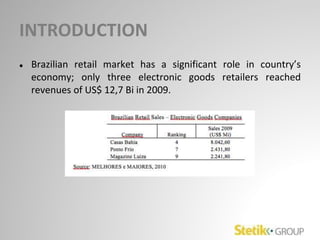
● Brazilian retail market has a significant role in country’s
economy; only three electronic goods retailers reached
revenues of US$ 12,7 Bi in 2009.
INTRODUCTION
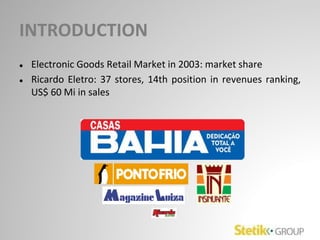
● Electronic Goods Retail Market in 2003: market share
● Ricardo Eletro: 37 stores, 14th position in revenues ranking,
US$ 60 Mi in sales
INTRODUCTION
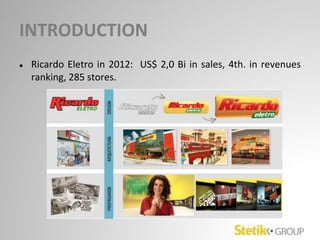
● Ricardo Eletro in 2012: US$ 2,0 Bi in sales, 4th. in revenues
ranking, 285 stores.
INTRODUCTION
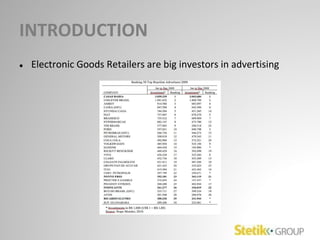
● Electronic Goods Retailers are big investors in advertising
IMAGE STUDIES PERSPECTIVE
● Image in this paper has the sense of “the idea a person has
about something, that is a mind projection concerning
objects, people, situations, etc.; it is, therefore, a subjective
representation about something” (SALLES, 2004);
● Perception is understood as “the set of psychological
processes by which people recognize, organize, synthesize and
provide meaning (the brain) to the sensations received from
environmental stimuli (the sensory organs)” (STERNBERG,
2000).
IMAGE STUDIES PERSPECTIVE
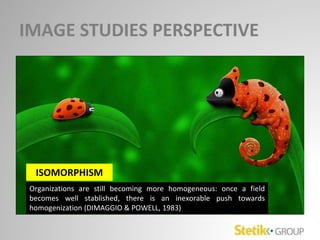
ISOMORPHISM
Organizations are still becoming more homogeneous: once a field
becomes well stablished, there is an inexorable push towards
homogenization (DIMAGGIO & POWELL, 1983)
IMAGE STUDIES PERSPECTIVE
● Image do not necessarily reflects a “truth”: they are based on
a subjective perception of reality and can be originated from
false assumptions;
● Image is dealt in marketing under different perspectives,
including:
● Store image
● Brand/Product image
● Corporate/Marketing image
IMAGE STUDIES PERSPECTIVE
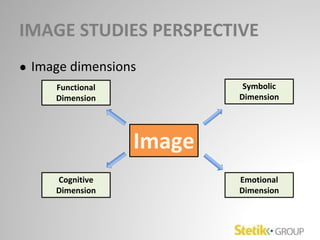
● Image dimensions
Image
Functional
Dimension
Emotional
Dimension
Cognitive
Dimension
Symbolic
Dimension
HYPOTHETICAL RESEARCH MODEL
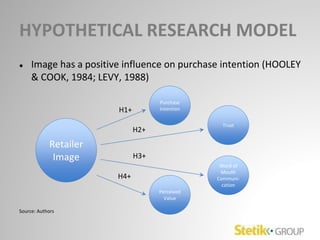
● Image has a positive influence on purchase intention (HOOLEY
& COOK, 1984; LEVY, 1988)
Source: Authors
Retailer
Image
Purchase
Intention
Trust
Word of
Mouth
Communi-
cation
Perceived
Value
H1+
H4+
H2+
H3+
METHODOLOGY
● PHASE 1 – Exploratory (qualitative)
● 48 detailed interviews
● All Social/Economic classes (ABCD)
● Results: outlined image dimensions, generating basis to create an
image scale along with the review of previous studies
● PHASE 2 – Survey (quantitative)
● 490 interviews
● Results: image scale
DATA ANALYSIS
DATA ANALYSIS
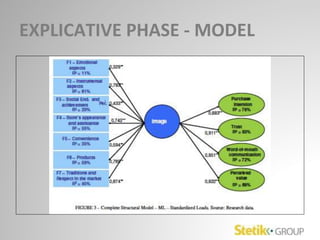
EXPLICATIVE PHASE - MODEL
CONCLUSIONS
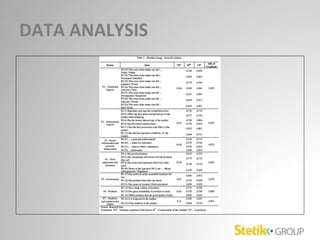
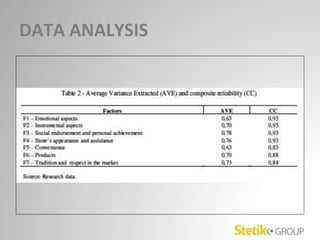
● “Instrumental Aspects” (price and negotiation) have a bigger impact on
retailer’s image – public is relatively objective in the choice;
● Consumers need retailer’s endorsement assuring quality and availability
of products;
● “Store appearance and assistance” relevance shows how image and
expectations of the interaction with salespeople and retailer’s experience
affects the purchase decision;
● Strong impacts of the image in behavioral intentions, specially in Purchase
Intentions and Word-of-Mouth: these are high rates, leading to believe
the scale elaborated has a reasonable nomologic validity, and its
managerial use can be recommended.
CONCLUSIONS
● The results of this work lead us to believe that, when choosing electronics
retailers, the consumer makes an internal search in his/her memory,
tracking back the Image he/she has of them, which was created by
previous experiences, word-of-mouth and mass communication,
among other elements. Eminently instrumental in his/her analysis, the
consumer establishes an objective criterion of choice, but uses subjective
perceptions from the retailers to decide, which in a way, makes an
interesting contrast.
● In what concerns the theory, it is believed that the development of an
image scale for the retail industry would be a relevant contribution, and
accordingly, this study can generate a base for future studies and its
validation in a broader sense. On the other hand, the image model’s test
involving behavioral intentions in the retail contributes towards the
understanding of the explanation of consumer’s behavior in this field.
THANK YOU!
euler@stetikgroup.com.br

Low Price Guarantee: Creating Brand Trust in Retailing thought Mass Communication

  • 1.
    Low Price Guarantee: CreatingBrand Trust in Retailing through Mass Communication Euler Alves Brandão – Presenter Cid Gonçalves Filho Reynaldo Maia Muniz Stetik Group September 2013
  • 2.
    INTRODUCTION ● Brazilian retailmarket has a significant role in country’s economy; only three electronic goods retailers reached revenues of US$ 12,7 Bi in 2009.
  • 3.
    INTRODUCTION ● Electronic GoodsRetail Market in 2003: market share ● Ricardo Eletro: 37 stores, 14th position in revenues ranking, US$ 60 Mi in sales
  • 4.
    INTRODUCTION ● Ricardo Eletroin 2012: US$ 2,0 Bi in sales, 4th. in revenues ranking, 285 stores.
  • 5.
    INTRODUCTION ● Electronic GoodsRetailers are big investors in advertising
  • 6.
    IMAGE STUDIES PERSPECTIVE ●Image in this paper has the sense of “the idea a person has about something, that is a mind projection concerning objects, people, situations, etc.; it is, therefore, a subjective representation about something” (SALLES, 2004); ● Perception is understood as “the set of psychological processes by which people recognize, organize, synthesize and provide meaning (the brain) to the sensations received from environmental stimuli (the sensory organs)” (STERNBERG, 2000).
  • 7.
    IMAGE STUDIES PERSPECTIVE ISOMORPHISM Organizationsare still becoming more homogeneous: once a field becomes well stablished, there is an inexorable push towards homogenization (DIMAGGIO & POWELL, 1983)
  • 8.
    IMAGE STUDIES PERSPECTIVE ●Image do not necessarily reflects a “truth”: they are based on a subjective perception of reality and can be originated from false assumptions; ● Image is dealt in marketing under different perspectives, including: ● Store image ● Brand/Product image ● Corporate/Marketing image
  • 9.
    IMAGE STUDIES PERSPECTIVE ●Image dimensions Image Functional Dimension Emotional Dimension Cognitive Dimension Symbolic Dimension
  • 10.
    HYPOTHETICAL RESEARCH MODEL ●Image has a positive influence on purchase intention (HOOLEY & COOK, 1984; LEVY, 1988) Source: Authors Retailer Image Purchase Intention Trust Word of Mouth Communi- cation Perceived Value H1+ H4+ H2+ H3+
  • 11.
    METHODOLOGY ● PHASE 1– Exploratory (qualitative) ● 48 detailed interviews ● All Social/Economic classes (ABCD) ● Results: outlined image dimensions, generating basis to create an image scale along with the review of previous studies ● PHASE 2 – Survey (quantitative) ● 490 interviews ● Results: image scale
  • 12.
  • 13.
  • 14.
  • 15.
    CONCLUSIONS ● “Instrumental Aspects”(price and negotiation) have a bigger impact on retailer’s image – public is relatively objective in the choice; ● Consumers need retailer’s endorsement assuring quality and availability of products; ● “Store appearance and assistance” relevance shows how image and expectations of the interaction with salespeople and retailer’s experience affects the purchase decision; ● Strong impacts of the image in behavioral intentions, specially in Purchase Intentions and Word-of-Mouth: these are high rates, leading to believe the scale elaborated has a reasonable nomologic validity, and its managerial use can be recommended.
  • 16.
    CONCLUSIONS ● The resultsof this work lead us to believe that, when choosing electronics retailers, the consumer makes an internal search in his/her memory, tracking back the Image he/she has of them, which was created by previous experiences, word-of-mouth and mass communication, among other elements. Eminently instrumental in his/her analysis, the consumer establishes an objective criterion of choice, but uses subjective perceptions from the retailers to decide, which in a way, makes an interesting contrast. ● In what concerns the theory, it is believed that the development of an image scale for the retail industry would be a relevant contribution, and accordingly, this study can generate a base for future studies and its validation in a broader sense. On the other hand, the image model’s test involving behavioral intentions in the retail contributes towards the understanding of the explanation of consumer’s behavior in this field.
  • 17.