The Business Case for Brand
Relationships
3rd International Consumer
Brand Relationship Conference
Ed Lebar
September 28, 2013
Rollins College
Winter Park, Fla.
Presentation Content
● Overview of the BlackBar Brand Relationships Model
● Demonstration of how and which brand relationships
influence consumer franchise power
● Contribution of Consumer Brand Relationships to brand
pricing power (perceptions of worth)
● Explanation of how branded business valuation multiples
are significantly impacted by Consumer Brand
Relationship Equity, customer franchise power and
operating profit
● Exploration of how consumer brand communication and
Consumer Brand Relationships work together to build
consumer franchise
Brand Perceptions
Brand Relationship is
defined by the combination
of a specific brand image
with a specific attitude of
the brand;
Brand Perceptions
Brand
Experiences
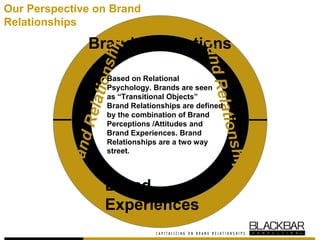
Based on Relational
Psychology. Brands are seen
as “Transitional Objects”
Brand Relationships are defined
by the combination of Brand
Perceptions /Attitudes and
Brand Experiences. Brand
Relationships are a two way
street.
Our Perspective on Brand
Relationships
Five Universal Relationships
● Reinforcement
● Identification
● Role Model
● Self-Differentiation
● Playful
Reinforcement
Your brand of choice
makes you
look and feel good
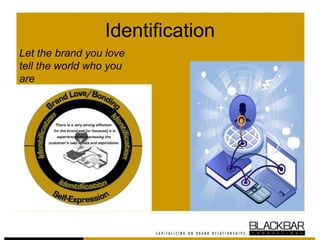
Identification
Let the brand you love
tell the world who you
are
Role Model
Be empowered by
brands
that lead the way
Self-Differentiation
Let a brand with a
difference
make a difference to you
Playful
Fun brands that
are
just to enjoy
Brand Perceptions
Brand Perceptions
Brand
Experiences
CustomerCustomer
Acquisitio
n
Growt
h
Maintenanc
e
Retentio
n
Brand Relationships Influence
the Size and Composition
of a Brands’ Customer
Franchise
Acquisition of New Users is
Influenced by Brand
Relationships
4 of the Universal Brand Relationships
contribute significantly to trial consideration
among non-users
Entertaining
/Playful
Identification
Reinforcement
Self-
Differentiating
0.54*
0.48*
0.38*
0.22*
Acquisitio
ns
Customer
Brand Relationships Build the
Customer Franchise
* Standardized regression
coefficients
Reinforcement
Role Model
0.24*
0.10*
Maintenanc
e
IdentificationCustomer
0.16*
Brand Relationships Build the
Customer Franchise
Influence of Brand Relationships
on Franchise Maintenance
A different combination of relationships are significant
influencers of brand preference among users
* Standardized regression
coefficients
Brand Perceptions
Brand Perceptions
Brand
Experiences
$Pricing
Power
Brand Relationships Contribute to
Pricing Power
Brand Relationships Contribute to
Consumer Pricing Power ( perceptions of
Worth)
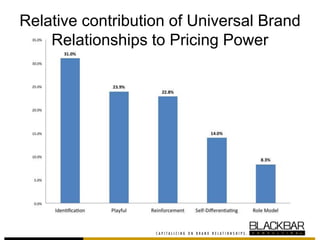
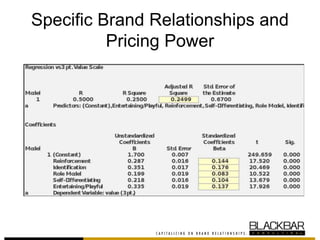
● The Five Universal Brand Relationships account for
almost 25 % of consumer price evaluations ( willingness
to pay/perceptions of worth)
● Identification has the most influence on pricing power;
the implication is that brands that inspire a strong
emotional bond (“ I love the brand/it loves me”) and
facilitates self expression are worth paying more for
● Self Differentiating and Roll Model have significantly
less impact of pricing power. Brand Relationships built
around differentiation do little to assist a brand’s power
to price.
Relative contribution of Universal Brand
Relationships to Pricing Power
Brand Perceptions
Brand Perceptions
Brand
Experiences
Customer
$Financial &
Market
Returns
Brand Relationships influence
brands’ Market value directly,
and also indirectly via
their influence on
Customer
Franchise.
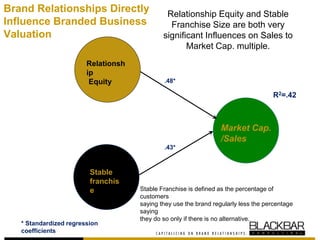
Relationship Equity and Stable
Franchise Size are both very
significant Influences on Sales to
Market Cap. multiple.
R2=.42
Market Cap.
/Sales
.48*
.43*
Stable Franchise is defined as the percentage of
customers
saying they use the brand regularly less the percentage
saying
they do so only if there is no alternative.
Brand Relationships Directly
Influence Branded Business
Valuation
Relationsh
ip
Equity
Stable
franchis
e
* Standardized regression
coefficients
Relationsh
ip
Equity
Operatin
g
Profit
Stable
franchis
e
R2=.86
Market
Cap.
.14*
.89*
.32*
-
.22
The negative correlation between Relationship Equity
and Operating Profit reflects the fact that there is a trade-
off
between investment in the brand and the quarterly or
yearly
earnings statement. Nothing comes without a cost.
Actual Market Cap. is a function of
Relationship Equity, Operating Profit
and Stable Franchise Size
Brand Relationships Directly
Influence Branded Business
Valuation
* Standardized regression
coefficients
Assessing Individual Company Brands:
Relative Contribution of Relationship Equity,
Operating Profit & Franchise to Market
Capitalization
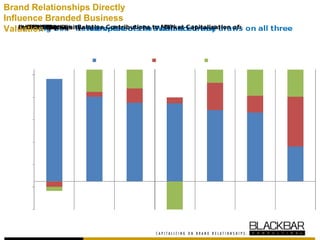
When we apply this regression to 2012 financial data for the 30
‘mono” brands in our data, the relative contributions of each of
the three factors average out as follows:
● Relationship Equity 40%
● Operating Profit 47%
● Stable Franchise Size 13%
● However, as shown in the following examples the relative
contributions on the three factors to the individual brands’
market capitalization vary significantly from the above
averages
Brand Relationships Directly
Influence Branded Business
Valuation
Brand Relationships Directly
Influence Branded Business
Valuation
Brand Perceptions
Brand Perceptions
Brand
Experiences
Customer
$Financial &
Market
Returns
Marketing investment in Brand
Relationships shape their
strength and pattern.
Marketing
Investment
s
Non-purchase
Behaviors/
Word of
Mouth
Specific Brand Relationships
Encourage personal and
electronic word of mouth
CONSUMER COMMUNICATION
ABOUT BRANDS
What’s this got to do with the business case
?....
Work with the right relationships and empower
your marketing strategy
Summary ( non-users)
● Identification prompts the most positive
communication about the brand – whether or
not people use it.
● People can use brand communication as a form of
self expression; that doesn’t mean they necessarily
love the brand – or love it enough to use it.
If Identification is the Relationship with the most power; It is likely to
prompt positive communication about the brand and discourage
negatives communication
Summary ( users)
● Reinforcement generates the most negative and
least positive comment about the brand
● The brand’s satisfactory performance will not bond consumers
with the brand unless it also provides active support for self
esteem – they are independent.
Users’ generate more positive comments among all
relationships
But Users brand relationships discriminate little between
among
positives and also little among negatives type of
communication
Net Take Away
Consumer Brand Relationship
Positively Impact
1. Acquisition
2. Retention
3 Pricing power/willingness to pay more
4. Valuation multiples
5.Consumer brand communication
Statistical Appendix
Top reinforcement brands are
Pantene,
L’Oreal, J&J, Amazon and Google.
While
both components of the relationship
are
important, hair care brands do it more
by enhancing self-esteem.
<< Reinforcement
>>
Brands most identified with are Amazon,
Google and WalMart. Apple and J&J
are well-loved brands, but are not
experienced as a means of self-
expression to the extent of the former.
Facebook is a means of self-expression
– but not as well loved.
.
<< Identification
>>
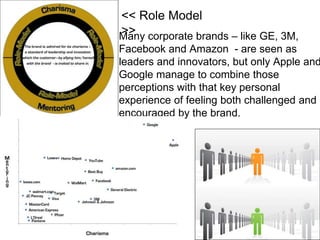
Many corporate brands – like GE, 3M,
Facebook and Amazon - are seen as
leaders and innovators, but only Apple and
Google manage to combine those
perceptions with that key personal
experience of feeling both challenged and
encouraged by the brand.
<< Role Model
>>
J&J and WalMart epitomize the customer
experience of feeling at the center of
attention, but their product offering is not
differentiated from competitors’. The
uniqueness of Amazon - and the way its
offering feels customized - makes the
customer feel different.
<< Self-
Differentiation>>
Brands from several very different
categories are seen as relaxed and stylish
but the most successful casual dining
brands – together with YouTube and
Amazon – are the ones which just seem t
give pleasure, without requiring anything i
return.
<<
Playful>>
The Market Valuation Model:
Produces an Excellent Fit
Predicting Market Capitalization
Predicted vs. Actual market cap
Relative Contribution of Relationship Equity,
Operating Profit and Stable Franchise -
calculation of percentages for Individual Brands
In order to apply the regression equation to actual data – where operating profit is measured in $m’s ,
franchise in terms of % of consumers, and Relational Equity in terms of a constructed scale measure
– it is necessary to use non-standardized coefficients.
The three components of MarCap are:
MarCap= (c1 x RE) +(c2 x OP) + (c3 x StabFran)
1 2 3
The relevant percentages are calculated for each brand as::
1/MarCap,
2/Marcap
3/Marcap
Specific Brand Relationships and
Pricing Power
Consumer Brand Communication &
Relationship Equity
There is relatively little difference in Relationship Equity between those communicating
negatively and those not communicating at all about the brand. For brands used,
Relationship Equity is actually higher among the former - No news is not necessarily good
news.
Constructing and Measuring
Brand Relationships
Our Definition of Brand Relationships
● Based on the concepts of Relational Psychology, in
which relationships -- with other people and things --
form an integral part of the individual’s personality.
● Relational Psychology recognizes how inanimate
relationship partners -- so-called “Transitional
Objects” -- may be invested with the same type of
characteristics (personality, motivations, imagined
behaviours, etc.) as animate ones.
● The Brand is a “Transitional Object”, represented in
the individual’s psyche simultaneously as both the
object and source of emotions, feelings and
behaviors. The relationship with the brand reflects
both sides of these inner exchanges.
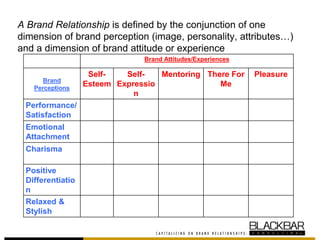
A Brand Relationship is defined by the conjunction of one
dimension of brand perception (image, personality, attributes…)
and a dimension of brand attitude or experience
Brand Attitudes/Experiences
Brand
Perceptions
Self-
Esteem
Self-
Expressio
n
Mentoring There For
Me
Pleasure
Performance/
Satisfaction
Emotional
Attachment
Charisma
Positive
Differentiatio
n
Relaxed &
Stylish
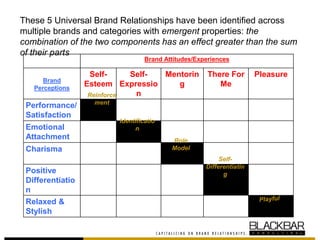
These 5 Universal Brand Relationships have been identified across
multiple brands and categories with emergent properties: the
combination of the two components has an effect greater than the sum
of their parts
Brand Attitudes/Experiences
Brand
Perceptions
Self-
Esteem
Self-
Expressio
n
Mentorin
g
There For
Me
Pleasure
Performance/
Satisfaction
Emotional
Attachment
Charisma
Positive
Differentiatio
n
Relaxed &
Stylish
Reinforce
ment
Identificatio
n
Role
Model
Self-
Differentiatin
g
Brand Perception Factors
Relaxed and Stylish
Fun
Cool
Easy
Friendly
Stylish
Different
Positive
Differentiation
Distinctive
Unique
Charisma
Dynamic
Excitingly
Innovative
Leader
Progressive
Functionality
Performs well
Gives Satisfaction
Emotional Values
Love it
Fits my life
COPYRIGHT 2012 BRANDYIELD CONSULTING LLC
Brand Attitude/Experience Factors
● Mentoring
Challenges Me To Think
Differently
Teaches Me
Inspires Me
Shares My Values
● There For Me
Appreciates My Business
Is Recommended By People I
Care About
Responds To My Needs
Has My Interests At Heart
● Pleasure
Brings Back Good Memories
Provides A Little Treat For Me
Excites Me
● Self-Expression
Simplifies My Life
Helps Me To Express Myself
Frees Me To Be Myself
● Self-Esteem
Makes Me Look Good To
Others
Makes Me Feel Good About
Myself
COPYRIGHT 2012 BRANDYIELD CONSULTING LLC
Consumer Brand Communication:
● Little communication (bottom left)
● Little communication – but what there is, positive (top left)
● A lot of communication, generally positive (top right)

The business case for Consumer Brand Relationships

  • 1.
    The Business Casefor Brand Relationships 3rd International Consumer Brand Relationship Conference Ed Lebar September 28, 2013 Rollins College Winter Park, Fla.
  • 2.
    Presentation Content ● Overviewof the BlackBar Brand Relationships Model ● Demonstration of how and which brand relationships influence consumer franchise power ● Contribution of Consumer Brand Relationships to brand pricing power (perceptions of worth) ● Explanation of how branded business valuation multiples are significantly impacted by Consumer Brand Relationship Equity, customer franchise power and operating profit ● Exploration of how consumer brand communication and Consumer Brand Relationships work together to build consumer franchise
  • 3.
    Brand Perceptions Brand Relationshipis defined by the combination of a specific brand image with a specific attitude of the brand; Brand Perceptions Brand Experiences Based on Relational Psychology. Brands are seen as “Transitional Objects” Brand Relationships are defined by the combination of Brand Perceptions /Attitudes and Brand Experiences. Brand Relationships are a two way street. Our Perspective on Brand Relationships
  • 4.
    Five Universal Relationships ●Reinforcement ● Identification ● Role Model ● Self-Differentiation ● Playful
  • 5.
    Reinforcement Your brand ofchoice makes you look and feel good
  • 6.
    Identification Let the brandyou love tell the world who you are
  • 7.
    Role Model Be empoweredby brands that lead the way
  • 8.
    Self-Differentiation Let a brandwith a difference make a difference to you
  • 9.
  • 10.
    Brand Perceptions Brand Perceptions Brand Experiences CustomerCustomer Acquisitio n Growt h Maintenanc e Retentio n BrandRelationships Influence the Size and Composition of a Brands’ Customer Franchise
  • 11.
    Acquisition of NewUsers is Influenced by Brand Relationships 4 of the Universal Brand Relationships contribute significantly to trial consideration among non-users Entertaining /Playful Identification Reinforcement Self- Differentiating 0.54* 0.48* 0.38* 0.22* Acquisitio ns Customer Brand Relationships Build the Customer Franchise * Standardized regression coefficients
  • 12.
    Reinforcement Role Model 0.24* 0.10* Maintenanc e IdentificationCustomer 0.16* Brand RelationshipsBuild the Customer Franchise Influence of Brand Relationships on Franchise Maintenance A different combination of relationships are significant influencers of brand preference among users * Standardized regression coefficients
  • 13.
  • 14.
    Brand Relationships Contributeto Consumer Pricing Power ( perceptions of Worth) ● The Five Universal Brand Relationships account for almost 25 % of consumer price evaluations ( willingness to pay/perceptions of worth) ● Identification has the most influence on pricing power; the implication is that brands that inspire a strong emotional bond (“ I love the brand/it loves me”) and facilitates self expression are worth paying more for ● Self Differentiating and Roll Model have significantly less impact of pricing power. Brand Relationships built around differentiation do little to assist a brand’s power to price.
  • 15.
    Relative contribution ofUniversal Brand Relationships to Pricing Power
  • 16.
    Brand Perceptions Brand Perceptions Brand Experiences Customer $Financial& Market Returns Brand Relationships influence brands’ Market value directly, and also indirectly via their influence on Customer Franchise.
  • 17.
    Relationship Equity andStable Franchise Size are both very significant Influences on Sales to Market Cap. multiple. R2=.42 Market Cap. /Sales .48* .43* Stable Franchise is defined as the percentage of customers saying they use the brand regularly less the percentage saying they do so only if there is no alternative. Brand Relationships Directly Influence Branded Business Valuation Relationsh ip Equity Stable franchis e * Standardized regression coefficients
  • 18.
    Relationsh ip Equity Operatin g Profit Stable franchis e R2=.86 Market Cap. .14* .89* .32* - .22 The negative correlationbetween Relationship Equity and Operating Profit reflects the fact that there is a trade- off between investment in the brand and the quarterly or yearly earnings statement. Nothing comes without a cost. Actual Market Cap. is a function of Relationship Equity, Operating Profit and Stable Franchise Size Brand Relationships Directly Influence Branded Business Valuation * Standardized regression coefficients
  • 19.
    Assessing Individual CompanyBrands: Relative Contribution of Relationship Equity, Operating Profit & Franchise to Market Capitalization When we apply this regression to 2012 financial data for the 30 ‘mono” brands in our data, the relative contributions of each of the three factors average out as follows: ● Relationship Equity 40% ● Operating Profit 47% ● Stable Franchise Size 13% ● However, as shown in the following examples the relative contributions on the three factors to the individual brands’ market capitalization vary significantly from the above averages
  • 20.
    Brand Relationships Directly InfluenceBranded Business Valuation
  • 21.
    Brand Relationships Directly InfluenceBranded Business Valuation
  • 22.
    Brand Perceptions Brand Perceptions Brand Experiences Customer $Financial& Market Returns Marketing investment in Brand Relationships shape their strength and pattern. Marketing Investment s Non-purchase Behaviors/ Word of Mouth Specific Brand Relationships Encourage personal and electronic word of mouth
  • 23.
    CONSUMER COMMUNICATION ABOUT BRANDS What’sthis got to do with the business case ?.... Work with the right relationships and empower your marketing strategy
  • 24.
    Summary ( non-users) ●Identification prompts the most positive communication about the brand – whether or not people use it. ● People can use brand communication as a form of self expression; that doesn’t mean they necessarily love the brand – or love it enough to use it.
  • 25.
    If Identification isthe Relationship with the most power; It is likely to prompt positive communication about the brand and discourage negatives communication
  • 26.
    Summary ( users) ●Reinforcement generates the most negative and least positive comment about the brand ● The brand’s satisfactory performance will not bond consumers with the brand unless it also provides active support for self esteem – they are independent.
  • 27.
    Users’ generate morepositive comments among all relationships But Users brand relationships discriminate little between among positives and also little among negatives type of communication
  • 28.
    Net Take Away ConsumerBrand Relationship Positively Impact 1. Acquisition 2. Retention 3 Pricing power/willingness to pay more 4. Valuation multiples 5.Consumer brand communication
  • 29.
  • 30.
    Top reinforcement brandsare Pantene, L’Oreal, J&J, Amazon and Google. While both components of the relationship are important, hair care brands do it more by enhancing self-esteem. << Reinforcement >>
  • 31.
    Brands most identifiedwith are Amazon, Google and WalMart. Apple and J&J are well-loved brands, but are not experienced as a means of self- expression to the extent of the former. Facebook is a means of self-expression – but not as well loved. . << Identification >>
  • 32.
    Many corporate brands– like GE, 3M, Facebook and Amazon - are seen as leaders and innovators, but only Apple and Google manage to combine those perceptions with that key personal experience of feeling both challenged and encouraged by the brand. << Role Model >>
  • 33.
    J&J and WalMartepitomize the customer experience of feeling at the center of attention, but their product offering is not differentiated from competitors’. The uniqueness of Amazon - and the way its offering feels customized - makes the customer feel different. << Self- Differentiation>>
  • 34.
    Brands from severalvery different categories are seen as relaxed and stylish but the most successful casual dining brands – together with YouTube and Amazon – are the ones which just seem t give pleasure, without requiring anything i return. << Playful>>
  • 35.
    The Market ValuationModel: Produces an Excellent Fit Predicting Market Capitalization Predicted vs. Actual market cap
  • 36.
    Relative Contribution ofRelationship Equity, Operating Profit and Stable Franchise - calculation of percentages for Individual Brands In order to apply the regression equation to actual data – where operating profit is measured in $m’s , franchise in terms of % of consumers, and Relational Equity in terms of a constructed scale measure – it is necessary to use non-standardized coefficients. The three components of MarCap are: MarCap= (c1 x RE) +(c2 x OP) + (c3 x StabFran) 1 2 3 The relevant percentages are calculated for each brand as:: 1/MarCap, 2/Marcap 3/Marcap
  • 37.
  • 38.
    Consumer Brand Communication& Relationship Equity There is relatively little difference in Relationship Equity between those communicating negatively and those not communicating at all about the brand. For brands used, Relationship Equity is actually higher among the former - No news is not necessarily good news.
  • 39.
  • 40.
    Our Definition ofBrand Relationships ● Based on the concepts of Relational Psychology, in which relationships -- with other people and things -- form an integral part of the individual’s personality. ● Relational Psychology recognizes how inanimate relationship partners -- so-called “Transitional Objects” -- may be invested with the same type of characteristics (personality, motivations, imagined behaviours, etc.) as animate ones. ● The Brand is a “Transitional Object”, represented in the individual’s psyche simultaneously as both the object and source of emotions, feelings and behaviors. The relationship with the brand reflects both sides of these inner exchanges.
  • 41.
    A Brand Relationshipis defined by the conjunction of one dimension of brand perception (image, personality, attributes…) and a dimension of brand attitude or experience Brand Attitudes/Experiences Brand Perceptions Self- Esteem Self- Expressio n Mentoring There For Me Pleasure Performance/ Satisfaction Emotional Attachment Charisma Positive Differentiatio n Relaxed & Stylish
  • 42.
    These 5 UniversalBrand Relationships have been identified across multiple brands and categories with emergent properties: the combination of the two components has an effect greater than the sum of their parts Brand Attitudes/Experiences Brand Perceptions Self- Esteem Self- Expressio n Mentorin g There For Me Pleasure Performance/ Satisfaction Emotional Attachment Charisma Positive Differentiatio n Relaxed & Stylish Reinforce ment Identificatio n Role Model Self- Differentiatin g
  • 43.
    Brand Perception Factors Relaxedand Stylish Fun Cool Easy Friendly Stylish Different Positive Differentiation Distinctive Unique Charisma Dynamic Excitingly Innovative Leader Progressive Functionality Performs well Gives Satisfaction Emotional Values Love it Fits my life COPYRIGHT 2012 BRANDYIELD CONSULTING LLC
  • 44.
    Brand Attitude/Experience Factors ●Mentoring Challenges Me To Think Differently Teaches Me Inspires Me Shares My Values ● There For Me Appreciates My Business Is Recommended By People I Care About Responds To My Needs Has My Interests At Heart ● Pleasure Brings Back Good Memories Provides A Little Treat For Me Excites Me ● Self-Expression Simplifies My Life Helps Me To Express Myself Frees Me To Be Myself ● Self-Esteem Makes Me Look Good To Others Makes Me Feel Good About Myself COPYRIGHT 2012 BRANDYIELD CONSULTING LLC
  • 45.
    Consumer Brand Communication: ●Little communication (bottom left) ● Little communication – but what there is, positive (top left) ● A lot of communication, generally positive (top right)