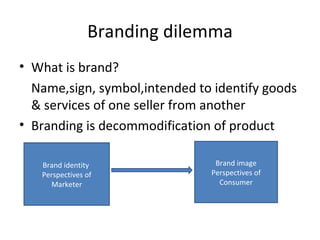
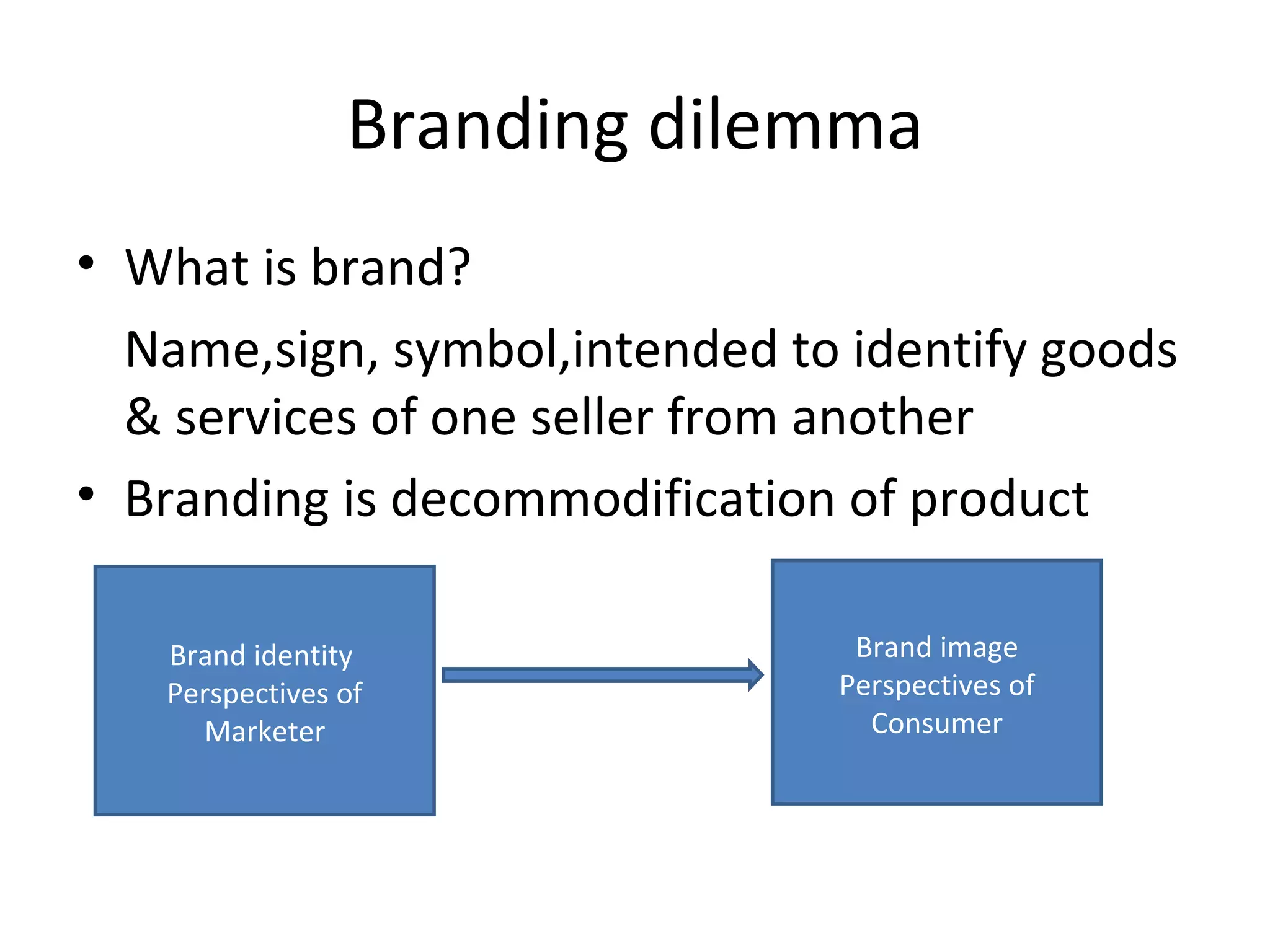
Branding dilemma What is brand?  Name,sign, symbol,intended to identify goods & services of one seller from another Branding is decommodification of product Brand identity  Perspectives of Marketer Brand image Perspectives of Consumer
Brand name “ A rose by any other name would not smell as sweet” Brand name provides an identity which differentiates Key marketing concept of positioning, imagery are centered around brand name
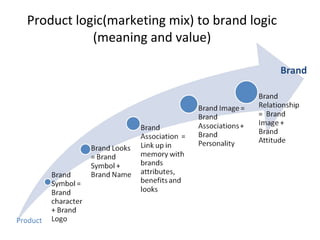
Product logic(marketing mix) to brand logic  (meaning and value) Product Brand
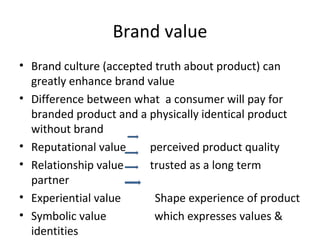
Brand value Brand culture (accepted truth about product) can greatly enhance brand value Difference between what  a consumer will pay for branded product and a physically identical product without brand Reputational value  perceived product quality Relationship value  trusted as a long term partner Experiential value  Shape experience of product Symbolic value  which expresses values & identities
BRAND ARCHITECTURE Handling of a large product portfolio Brand-product relationship Six models in the brand-product relationship The product brand; The line brand; The range brand; The umbrella brand; The source brand and; The endorsing brand
The Product Brand Strategy It involves the assignment of a particular name to one, and only one, product as well  as one exclusive positioning. The result of this strategy is that each new product receives its own brand name that belongs only to it For example, Procter & Gamble-detergent market by brands ariel, vizir,dash and soap market by camay ,zest etc.
The Line Brand Strategy This strategy involves the exploitation of successful concept by extending it but by staying very close to the product For example, L’Oreal hair line products The Range Brand Strategy It bestow a single brand name and promote through a single promise a range of products belonging to the same area of competence For example, in food sector it is heinz, green giant etc.
Umbrella Brand Strategy The same brand supports several products in different markets.  Each of them has its own advertising tool and its own communications  The main advantage of umbrella strategy is the capitalisation on one single name and economies of scale on an international level For example, TATA, Palmolive etc.
Source Brand Strategy  This is identical to umbrella brand strategy except for the point that they are no longer called by one generic name  Two tier brand structure Sub-branding For example, AMUL Masti Dahi  Endorsing Brand Strategy It gives approval to  a wide variety of products grouped under product brands, line brands or range brands The brand endorsement can be indicated in a graphic manner by placing the emblem or in a nominal way  For example, Johnson products with duck
Brand Equity Financial—Goodwill,  over a period of time What is to be measured Clear understanding of concept  Consumer way of determining the brand What are the measures  Critical, Continuous, Creative You can manage what is under your control How to measure
Brand Equity Brand doesn’t exist in isolation it has to be understood in relation to category Differential account of brand reflecting in behavior The brand image consumer feels, thinks and experiences(the cognitive and affective mixes )
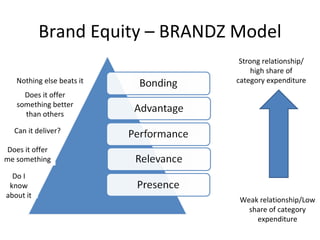
Brand Equity – BRANDZ Model Nothing else beats it Does it offer something better than others Can it deliver? Does it offer me something Do I know about it Strong relationship/ high share of category expenditure Weak relationship/Low share of category expenditure
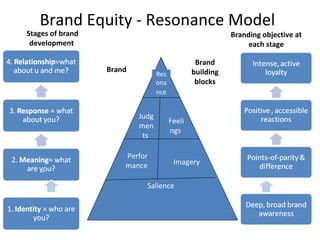
Brand Equity - Resonance Model Salience  Performance  Imagery  Resonance   Judgments  Feelings  Brand  Brand building blocks Stages of brand development  Branding objective at each stage
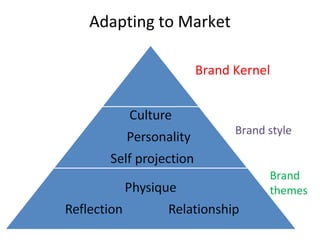
Adapting to Market Brand style Brand Kernel Brand themes

Brand

  • 1.
    Branding dilemma Whatis brand? Name,sign, symbol,intended to identify goods & services of one seller from another Branding is decommodification of product Brand identity Perspectives of Marketer Brand image Perspectives of Consumer
  • 2.
    Brand name “A rose by any other name would not smell as sweet” Brand name provides an identity which differentiates Key marketing concept of positioning, imagery are centered around brand name
  • 3.
    Product logic(marketing mix)to brand logic (meaning and value) Product Brand
  • 4.
    Brand value Brandculture (accepted truth about product) can greatly enhance brand value Difference between what a consumer will pay for branded product and a physically identical product without brand Reputational value perceived product quality Relationship value trusted as a long term partner Experiential value Shape experience of product Symbolic value which expresses values & identities
  • 5.
    BRAND ARCHITECTURE Handlingof a large product portfolio Brand-product relationship Six models in the brand-product relationship The product brand; The line brand; The range brand; The umbrella brand; The source brand and; The endorsing brand
  • 6.
    The Product BrandStrategy It involves the assignment of a particular name to one, and only one, product as well as one exclusive positioning. The result of this strategy is that each new product receives its own brand name that belongs only to it For example, Procter & Gamble-detergent market by brands ariel, vizir,dash and soap market by camay ,zest etc.
  • 7.
    The Line BrandStrategy This strategy involves the exploitation of successful concept by extending it but by staying very close to the product For example, L’Oreal hair line products The Range Brand Strategy It bestow a single brand name and promote through a single promise a range of products belonging to the same area of competence For example, in food sector it is heinz, green giant etc.
  • 8.
    Umbrella Brand StrategyThe same brand supports several products in different markets. Each of them has its own advertising tool and its own communications The main advantage of umbrella strategy is the capitalisation on one single name and economies of scale on an international level For example, TATA, Palmolive etc.
  • 9.
    Source Brand Strategy This is identical to umbrella brand strategy except for the point that they are no longer called by one generic name Two tier brand structure Sub-branding For example, AMUL Masti Dahi Endorsing Brand Strategy It gives approval to a wide variety of products grouped under product brands, line brands or range brands The brand endorsement can be indicated in a graphic manner by placing the emblem or in a nominal way For example, Johnson products with duck
  • 10.
    Brand Equity Financial—Goodwill, over a period of time What is to be measured Clear understanding of concept Consumer way of determining the brand What are the measures Critical, Continuous, Creative You can manage what is under your control How to measure
  • 11.
    Brand Equity Branddoesn’t exist in isolation it has to be understood in relation to category Differential account of brand reflecting in behavior The brand image consumer feels, thinks and experiences(the cognitive and affective mixes )
  • 12.
    Brand Equity –BRANDZ Model Nothing else beats it Does it offer something better than others Can it deliver? Does it offer me something Do I know about it Strong relationship/ high share of category expenditure Weak relationship/Low share of category expenditure
  • 13.
    Brand Equity -Resonance Model Salience Performance Imagery Resonance Judgments Feelings Brand Brand building blocks Stages of brand development Branding objective at each stage
  • 14.
    Adapting to MarketBrand style Brand Kernel Brand themes